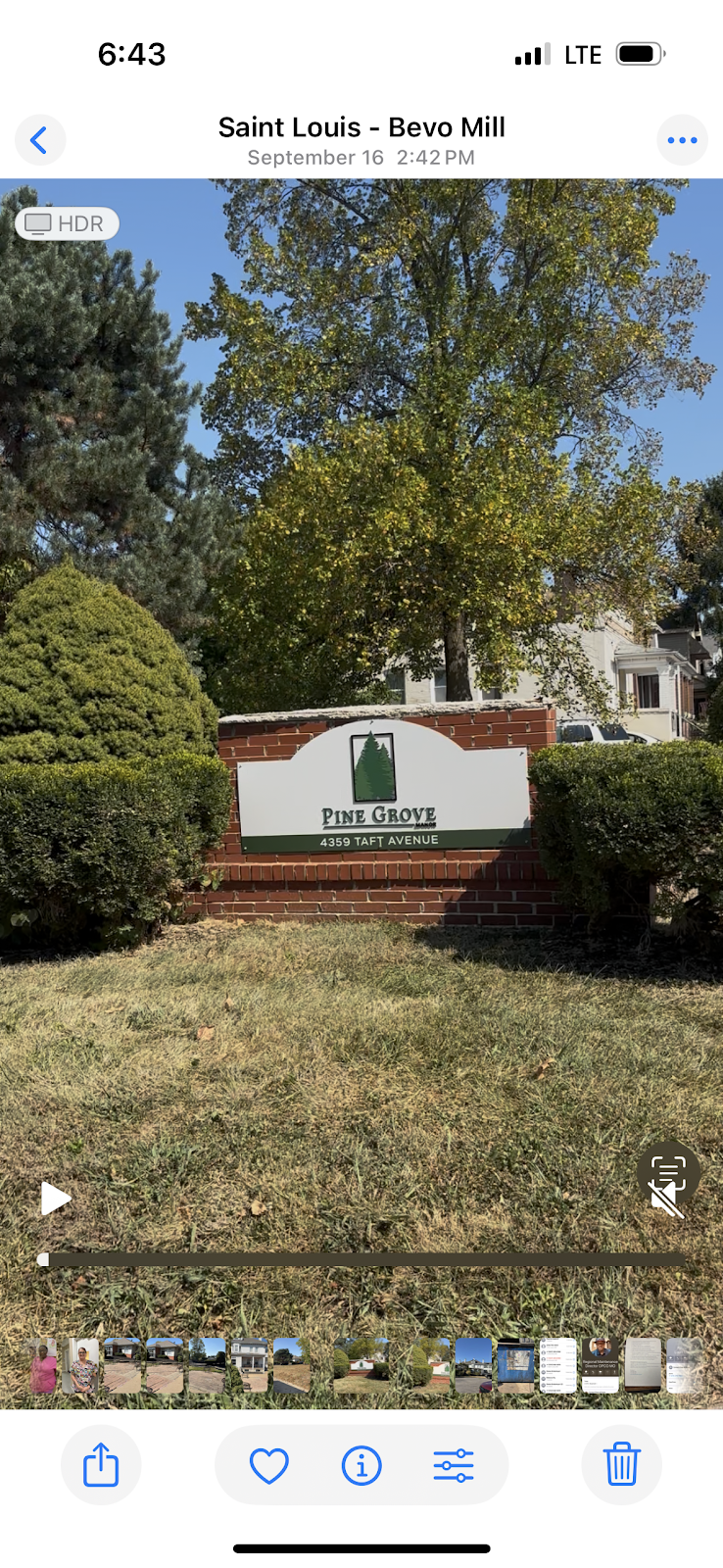
PINE GROVE MANOR

4359 TAFT AVENUE, SAINT LOUIS, MO 63116 (314) 752-2022
For profit - Corporation 77 Beds OPCO SKILLED MANAGEMENT Data: November 2025 1 Immediate Jeopardy citation
Trust Grade
21/100
#441 of 479 in MO
Last Inspection: April 2024

Within standard 12-15 month inspection cycle. Federal law requires annual inspections.

Overview

Pine Grove Manor has received a Trust Grade of F, which indicates significant concerns about its care quality and overall environment. It ranks #441 out of 479 facilities in Missouri, placing it in the bottom half of all nursing homes in the state, and #12 out of 13 in St. Louis City County, meaning there is only one local facility that performs worse. The facility is worsening, with the number of reported issues rising from 2 in 2023 to 6 in 2024. Staffing is a relative strength, with a turnover rate of 0%, which is well below the Missouri average of 57%, but the overall staffing rating is only 1 out of 5 stars. There are concerning incidents, such as a resident being verbally abused by staff and dangerous hot water temperatures in resident bathrooms, which posed a scalding risk. While there are some positives, like low staff turnover, the numerous serious issues and poor trust grade raise significant red flags for families considering this facility.

Trust Score
F
21/100
In Missouri
#441/479
Bottom 8%
Safety Record
High Risk
Review needed
Inspections
Getting Worse
2 → 6 violations
Staff Stability
○ Average
Turnover data not reported for this facility.
Penalties
⚠ Watch
$22,155 in fines. Higher than 86% of Missouri facilities, suggesting repeated compliance issues.
Skilled Nurses
⚠ Watch
Each resident gets only 14 minutes of Registered Nurse (RN) attention daily — below average for Missouri. Fewer RN minutes means fewer trained eyes watching for problems.
Violations
⚠ Watch
21 deficiencies on record. Higher than average. Multiple issues found across inspections.
★☆☆☆☆
1.0
Overall Rating
★☆☆☆☆
1.0
Staff Levels
★★★☆☆
3.0
Care Quality
★★☆☆☆
2.0
Inspection Score
Stable
2023: 2 issues
2024: 6 issues

The Good

  • Full Sprinkler Coverage · Fire safety systems throughout facility
  • No fines on record

Facility shows strength in fire safety.

The Bad

1-Star Overall Rating

Below Missouri average (2.5)

Significant quality concerns identified by CMS

Federal Fines: $22,155

Below median ($33,413)

Minor penalties assessed

Chain: OPCO SKILLED MANAGEMENT

Part of a multi-facility chain

Ask about local staffing decisions and management

The Ugly 21 deficiencies on record

1 life-threatening 1 actual harm
Apr 2024 6 deficiencies 1 IJ (1 affecting multiple)
CRITICAL (K)

Immediate Jeopardy (IJ) - the most serious Medicare violation

Accident Prevention (Tag F0689)

Someone could have died · This affected multiple residents

**NOTE- TERMS IN BRACKETS HAVE BEEN EDITED TO PROTECT CONFIDENTIALITY** Based on observation, interview and record review, the facility failed to maintain an environment free of accident hazards by no...

Read full inspector narrative →
**NOTE- TERMS IN BRACKETS HAVE BEEN EDITED TO PROTECT CONFIDENTIALITY** Based on observation, interview and record review, the facility failed to maintain an environment free of accident hazards by not maintaining safe water temperatures in resident rooms on the North and South halls between 105 degrees Fahrenheit (F) and 120 F for 16 (Residents #49, #14, #12, #15, #54, #34, #8, #3, #27, #5, #43, #258, #18, #11, #52, and #40) of 31 sampled residents. The hot water temperatures in these resident room bathrooms ranged from 141 to 153 degrees F. The census was 55. The administrator was notified on 3/28/24 at 7:00 P.M., of an immediate jeopardy (IJ), which began on 3/28/24. The IJ was removed on 3/29/24 as confirmed by surveyor verification. Review of the facility's Safety of Water Temperatures Policy, dated December 2009, showed: -Policy Statement: Tap water in the facility shall be kept within a temperature range to prevent scalding of residents; -Policy Interpretation and Implementation; -Water heaters that service resident rooms, bathrooms, common areas, and tub/shower areas shall be set to temperatures of no more that 105-120 degrees Fahrenheit, or the maximum allowable temperature per state regulation; -Maintenance staff is responsible for checking thermostats and temperature controls in the facility and recording these checks in a maintenance log; -Maintenance shall conduct periodic tap water temperature checks and record the water temperatures in a safety log; -If at any time water temperatures feel excessive to the touch, staff will report this finding to the immediate supervisor; -Direct-care staff shall be informed of risk factors for scalding/burns that are more common in the elderly, such as: -decreased skin thickness; -decreased skin sensitivity; -peripheral neuropathy; -reduced reaction time; -decreased cognition; -decreased mobility; -decreased communication; -The length of exposure to warm or hot water, the amount of skin exposed, and the resident's current condition affect whether or not exposure to certain temperatures will cause scalding or burns. Therefore, ongoing resident observation and assessment during prolong exposure to warm or hot water will help to determine the safety of the situation. 1. Observation on 3/28/24 between 8:30 A.M., and 2:00 P.M., of the hot water heater in the mechanical room, behind the oxygen room, showed: -Information on the water heater read, Temperature setting: -Low = 100 degrees F; -Triangle shape = 120 degrees F; -A = 130 degrees F; -B - 140 degrees F; -C = 150 degrees F; -D = 160 degrees F; -Hot = 170 degrees F; -Very hot = 180 degrees F; -Time to produce 2nd and 3rd degree burns on adult skin; -A = More than 30 seconds; -B = Less than 5 seconds; -C = 1 and 1/2 seconds; -D = 1/2 second; -Very Hot = Instantaneous. -The temperature gauge set on very hot. Observation on 3/28/24 between 10:30 A.M., and 2:00 P.M., of the hot water heater in the mechanical room, behind the linen room, showed the temperature gauge set between hot (170 degrees F) and very hot (180 degrees F). During an interview on 3/28/24 at 2:00 P.M., the Maintenance Director said the residents had been complaining of the water being too cold and he would go in and turn the water heaters up a notch each time someone complained about the temperatures. The hot water heater behind the oxygen room served the south hall rooms and the hot water heater behind the linen room served the north hall rooms. These were the only water heaters in the west building. During an interview on 3/28/24 at 2:20 P.M., the Corporate Regional Nurse acknowledged the gauge behind the oxygen room was set at very hot. It should not have been set that high. During an interview on 3/28/24 at 2:25 P.M., the Administrator acknowledged the water heater behind the linen room was set between hot and very hot. The Maintenance Director should not be turning up the temperature on the water heaters without checking the actual temperature of the water in the rooms. 2. Review of Resident #49's quarterly Minimum Data Set, (MDS), a federally mandated assessment instrument completed by facility staff, dated 3/19/24, showed: -Moderately impaired cognition; -Diagnoses included dementia and Alzheimer's disease; -Walk 10 feet: Independent; -Walk 50 feet with two turns: Independent; -Walk 150 feet: Independent. Review of Resident #14's quarterly MDS, dated [DATE], showed: -Cognitively intact; -Diagnoses included: Cerebral infarction (stroke) with residual deficits; -Used a wheelchair/scooter; -Able to wheel 50 feet with two turns: Independent; -Wheel 150 feet: Independent. Observation of Resident #49 and Resident #14's shared bathroom on 3/28/24 at 10:50 A.M., showed the water temperature at the sink measured 142.7 degrees F, using a digital thermometer. 3. Review of Resident #12's quarterly MDS, dated [DATE], showed: -Severe cognitive impairment; -Diagnoses included dementia; -Used a wheelchair/scooter; -Able to wheel 50 feet with two turns: Dependent; -Wheel 150 feet: Dependent. Review of Resident #15's quarterly MDS, dated [DATE], showed: -Moderately impaired cognition; -Diagnoses included dementia; -Used a wheelchair/scooter; -Able to wheel 50 feet with two turns: Independent; -Wheel 150 feet: Independent. Observation of Resident #12 and Resident #15's shared bathroom on 3/28/24 at 11:01 A.M., showed the water temperature at the sink measured 144.6 degrees F, using a digital thermometer. 4. Review of Resident #54's admission MDS, dated [DATE], showed: -Moderately impaired cognition; -Diagnoses included seizures; -Walk 10 feet: Supervision; -Walk 50 feet with two turns: Supervision; -Walk 150 feet: Supervision. Review of Resident #34's quarterly MDS, dated [DATE], showed: -Cognitively intact; -Diagnoses included vascular dementia; -Walk 10 feet: Independent; -Walk 50 feet with two turns: Independent; -Walk 150 feet: Independent. Observation and interview of Resident #54 and Resident #34's shared bathroom on 3/28/24 at 11:42 A.M., showed the water temperature at the sink measured 145 degrees F, using a digital thermometer. Resident #54 said sometimes the water is too hot. 5. Review of Resident #8's quarterly MDS, dated [DATE], showed: -Cognitively intact; -Diagnoses included stroke and overactive bladder; -Used a wheelchair/scooter; -Able to wheel 50 feet with two turns: independent; -Wheel 150 feet: independent. Review of the resident #3's quarterly MDS, dated [DATE], showed: -Cognitively intact; -Diagnoses included: vascular dementia, bipolar and schizophrenia; -Walk 10 feet: Independent; -Walk 50 feet with two turns: Independent; -Walk 150 feet: Independent. Observation of Resident #8 and Resident #3's shared bathroom on 3/28/24 at 12:54 P.M., showed the water temperature at the sink measured 145.2 degrees F, using a digital thermometer. 6. Review of Resident #27's quarterly MDS, dated [DATE], showed: -Moderately cognitively impaired; -Diagnoses included: Dementia, paranoid schizophrenia (a pattern of behavior where a person feels distrustful and suspicious of other people and acts accordingly) and major depressive disorder; -Walk 10 feet: Independent; -Walk 50 feet with two turns: Independent; -Walk 150 feet: Independent. Review of Resident #5's quarterly MDS, dated [DATE], showed: -Diagnoses included bowel disease and schizophrenia; -Walk 10 feet: Independent; -Walk 50 feet with two turns: Independent; -Walk 150 feet: Independent. Observation of Resident #27 and Resident #5's shared bathroom on 3/28/24 at 1:00 P.M., showed the water temperature at the sink measured 147.2 degrees F, using a digital thermometer. 7. Review of Resident #43's quarterly MDS, dated [DATE], showed: -Cognitively intact; -Diagnoses included mild cognitive impairment; -Used a wheelchair/scooter; -Able to wheel 50 feet with two turns: Dependent; -Wheel 150 feet: Dependent. Review of Resident #258's quarterly MDS, dated [DATE], showed: -Moderate cognitively impaired; -Diagnoses included: Dementia, paranoid schizophrenia and major depressive disorder; -Walk 10 feet: Independent; -Walk 50 feet with two turns: Independent; -Walk 150 feet: Independent. Observation of Resident #43 and Resident #258's shared bathroom on 3/28/24 at 1:03 P.M., showed the water temperature at the sink measured 141.2 degrees F, using a digital thermometer. 8. Review of Resident #18's annual MDS, dated [DATE], showed: -Cognitively intact; -Diagnoses included heart disease; -Used a wheelchair/scooter; -Able to wheel 50 feet with two turns: Independent; -Wheel 150 feet: Independent. Review of Resident #11's quarterly MDS, dated [DATE], showed; -Cognitively impaired; -Diagnoses included dementia and stoke; -Used a wheelchair/scooter; -Able to wheel 50 feet with two turns: Dependent; -Wheel 150 feet: Dependent. Observation on of Resident #18 and Residents #11's shared bathroom on 3/28/24 at 1:30 P.M., showed the water temperature at the sink measured at 152.4 degrees F, with a digital thermometer 9. Review of Resident #52's quarterly MDS, dated [DATE], showed: -Cognitively intact; -Diagnoses included viral hepatitis and fractures; -Used a wheelchair/scooter; -Able to wheel 50 feet with two turns: Independent; -Wheel 150 feet: Independent. Review of Resident #40's quarterly MDS, dated [DATE], showed: -Cognitively intact; -Diagnoses included depression and neurogenic bladder; -Used a wheelchair/scooter; -Able to wheel 50 feet with two turns: Independent; -Wheel 150 feet: Independent. Observation of Resident #52 and Resident #40's shared bathroom on 3/28/24 at 1:30 P.M., showed the water temperature at the sink measured 153 degrees F, using a digital thermometer. 10. During an observation and interview on 3/28/24 at 2:00 P.M., Certified Nursing Aide (CNA) A said there were two residents who wandered and could wander into the bathroom and turn the water on. CNA A said the water temperature was not that hot. CNA A and the surveyor entered room [ROOM NUMBER] and checked the water. CNA A turned the water on and within a few seconds, said the water was hot. The water temperature was checked by the surveyor using a digital thermometer. The temperature read at 141 degrees F and was confirmed by CNA A. CNA A said they use the bathroom to provide care to residents, such as bed baths and incontinence care. CNA A said normally if the water was hot, he/she would mix in cold water. CNA A said he/she could not say if a confused resident would know to turn the cold water on to mix with the hot water. During an interview on 3/28/24 at 2:00 P.M., the Maintenance Director said he did not know the water temperatures were so high in the resident rooms on the North and South halls. He took water temperatures monthly with a laser thermometer in resident rooms. He did not know laser thermometers could be unreliable for taking water temperatures. He did not have a different type of thermometer. During an observation and interview on 3/28/24 at 2:05 P.M., the Director of Nursing (DON) said there are 13 residents who wander and could turn the water on in the bathroom, and two of the 13 residents go into the bathroom and play in the water. A water temperature above 110 would be considered hot. The residents have thinner skin and would be at risk for getting burnt. The DON and surveyor went to room [ROOM NUMBER] and the water temperature at the sink measured 139.5 (F). During an interview on 3/28/24 at 2:20 P.M., the Corporate Regional Nurse said she knew the temperatures should not be over 120 degrees F. She did not know the Maintenance Director was using a laser thermometer. He should not have been using this type of thermometer to take water temperatures. She did not know the water temperatures were so high. During interviews on 3/28/24 at 2:10 P.M. and 2:25 P.M., the Administrator said Maintenance staff was responsible for taking water temperatures monthly and keeping documentation of them. The water temperature should be between 105 and 120 degrees F. Note: At the time of the survey, the violation was determined to be at the immediate jeopardy level K. Based on observation, interview and record review completed during the onsite visit, it was determined the facility had implemented corrective actions to remove the IJ violation at the time. A final revisit will be conducted to determine if the facility is in substantial compliance with participation requirements. At the time of the exit, the deficiency was lowered to the E level. This statement does not denote the facility has complied with state law (section 198.026.1 RSMO) requiring that prompt remedial action to be taken to address Class I violation(s).
CONCERN (D)

Potential for Harm - no one hurt, but risky conditions existed

Deficiency F0698 (Tag F0698)

Could have caused harm · This affected 1 resident

Based on interview and record review, the facility failed to complete pre (before) and post (after) dialysis (procedure to remove waste products and excess fluid from the blood when the kidneys are no...

Read full inspector narrative →
Based on interview and record review, the facility failed to complete pre (before) and post (after) dialysis (procedure to remove waste products and excess fluid from the blood when the kidneys are not working properly) assessments and failed to have an accurate care plan for one of one resident reviewed for dialysis services (Resident #34). The census was 55. Review of the facility's Care of a Resident with End-Stage Renal Disease (ESRD) Policy, date revised September 2010, showed: -Residents with ESRD will be cared for according to currently recognized standards of care; -Staff caring for residents with ESRD, including residents receiving dialysis care outside the facility, shall be trained in the care and special needs of these residents; -Education and training of staff includes, specifically: -The type of assessment data that is to be gathered about the resident's condition on a daily or per shift basis; -Signs and symptoms of worsening condition and/or complications of ESRD; -How to recognize and intervene in medical emergencies such as hemorrhages and septic infections; -Timing and administration of medications, particularly those before and after dialysis. Review of Resident #34's quarterly Minimum Data Set (MDS), a federally mandated assessment instrument completed by facility staff, dated 3/3/24, showed: -Cognitively intact; -Diagnoses included: ESRD; -Received dialysis while a resident. Review of the care plan in use at the time of survey, showed: -Focus: I receive hemodialysis (HD, process for removal of waste and excess water from the blood due to kidney failure) at outside facility on Monday and Fridays. I had a right arm fistula (connection or passageway between an artery and a vein, surgically created for dialysis treatments) revision (using a piece of vein to patch or replace a narrow segment of the fistula) in 1/24. It is no longer in my wrist; it is mid arm. Edited 3/27/24; -Interventions: -Complete dialysis communication sheet on dialysis days; -Monitor and report signs of localized infection right wrist (localized swelling, redness, pain or tenderness, heat at the infected area, purulent (pus) drainage, loss of function, turbid/bloody/malodorous dialysate (the material that passes through the membrane in dialysis); -Monitor and report signs of systemic infection (fever, lassitude (fatigue) or malaise (lack of health often indicative of or accompanying the onset of an illness), change in mental status, anorexia, nausea, headache, lymph node tenderness/enlargement). -The care plan did not show the current dialysis site location. Review of the physician order sheet, in use at the time of survey, showed the following current orders: -On Mondays and Fridays, document on dialysis communication sheet and send with the resident; -A full set of vital signs (blood pressure (b/p), pulse (p), respirations (r) and temperature (T)) on Mondays and Fridays, must be charted or given to nurse no later than 9 A.M.; -Upon return, complete open dialysis communication form, return to facility post-dialysis information, once a day on Monday and Friday. Review of dialysis communication forms dated 2/5/24 through 4/1/24, showed: -On 2/5/24, the dialysis center information and the return to facility post dialysis information was blank; -On 2/28/24, the dialysis center information and the return to facility post dialysis information was blank; -On 3/1/24, the pre-dialysis information, dialysis center information, and the return to facility post dialysis information was blank; -On 3/8/24, the return to facility post dialysis information was blank; -On 3/11/24, the return to facility post dialysis information was blank; -On 3/25/24, the dialysis center information, the b/p and p were blank and the return to facility post dialysis information was blank. General condition of resident: Dialysis center did not send back vital signs; Post facility return vital signs noted to be posted on the prior page (under dialysis center information). Review of the progress notes, dated 2/1/24 through 4/1/24, showed: -On 3/25/24 at 3:59 P.M., the resident returned from dialysis and refused his/her b/p to be taken; -There was no documentation for 2/5, 2/28, 3/1, 3/8 or 3/11/24, showing the resident refused his/her assessment or the facility contacted the dialysis center to obtain their assessment. Review of the vital signs tab, showed: -On 2/5/24, only the post assessment b/p was documented; -On 2/28/24, only the post assessment b/p was documented; -On 3/1/24, pre-assessment: T and b/p was documented, post assessment only the b/p was documented; -On 3/8/24, only the T was documented for pre and post assessment; -On 3/11/24, no vital signs were documented; -On 3/25/24, only the b/p was documented for pre and post assessment. During an interview and observation on 4/2/24 at 9:30 A.M., the resident said his/her dialysis access site was on the right side of his/her upper chest, as he/she pulled his/her shirt up to show the catheter was on the right side of his/her upper chest. The resident said he/she went to an outside facility for dialysis on Mondays and Fridays. During an interview on 4/2/24 at 12:30 P.M. Registered Nurse (RN) B said residents who receive dialysis services should have pre and post dialysis assessments completed. The assessment was documented on the dialysis communication form. The pre-assessment included checking the graft site (location where the resident received dialysis), bruit (a rumbling sound that you can hear) and thrill (a rumbling sensation that you can feel) and the resident's vital signs. The resident should take the dialysis communication form with them to dialysis and give the form back to the nurse when they return from dialysis. When the resident returns from dialysis, the nurse should complete the post dialysis assessment. The assessment included checking the graft site, bruit, and thrill, observe for any bleeding and obtain vital signs. Sometimes when the resident went out for dialysis, he/she would forget to take the communication form with him/her or forget to give the form to dialysis center, and sometimes the dialysis center did not send the form back. Sometimes when the resident returned to the facility, he/she would refuse to have his/her vital signs checked. If the resident refused the assessment, it should be documented on the dialysis communication form and in the medical record. If there was a blank on the dialysis communication form, that would mean the nurse did not do it. During an interview on 4/2/24 at 12:45 P.M. and on 4/3/24 at 9:10 A.M., the Director of Nursing (DON) said residents who receive dialysis services should have a pre and post dialysis assessment completed by the nurse. The pre-dialysis assessment included what medications were given to the resident before going to dialysis and location of the shunt (surgically placed fistula) site and vital signs. The post dialysis assessment included vital signs, how many liters of fluid was taken off by dialysis, check for bruit and thrill, if any bleeding was observed and the general condition of the resident. The assessments were documented on the dialysis communication form. Sometimes when the resident returned from dialysis, he/she would refuse to have an assessment completed. If the resident refused, the DON expected for the nurse to reapproach the resident later. If there was a blank on the dialysis communication form, the DON could check the progress notes and check under the vital signs tab to check for the information. If the dialysis center did not return the form, the facility calls the dialysis center and requests the information and asks for the dialysis center to send the information over. Sometimes the dialysis center sends the information right over and sometimes they say they will send it and they don't. The DON checked the residents medical record and said: -On 2/5/24, the dialysis center did not complete their portion of the form and no post assessment was completed and no post dialysis vitals were documented; - On 2/28/24, the dialysis center did not complete their portion of the form and there was no post assessment completed; -On 3/1/24, the dialysis center did not complete their portion of the form and there was no post assessment completed. Only the post assessment b/p documented under vital signs; -On 3/8/24, the dialysis center did not send the form back. The post assessment was documented on the wrong page of the form. It was documented under the dialysis center portion of the form; -On 3/11/24, the nurse documented the post assessment under the dialysis center; -On 3/25/24, the nurse documented the post assessment under the dialysis center; -The DON would expect for the dialysis communication forms to be completed and she would expect for staff to follow the facility's policies and procedures. During an interview on 4/3/24 at 10:45 A.M., the Administrator said he would expect for staff to follow the facility's policies and procedures.
CONCERN (E)

Potential for Harm - no one hurt, but risky conditions existed

Deficiency F0679 (Tag F0679)

Could have caused harm · This affected multiple residents

**NOTE- TERMS IN BRACKETS HAVE BEEN EDITED TO PROTECT CONFIDENTIALITY** Based on observation, interview and record review, the facility failed to provide meaningful activities or one on one activities...

Read full inspector narrative →
**NOTE- TERMS IN BRACKETS HAVE BEEN EDITED TO PROTECT CONFIDENTIALITY** Based on observation, interview and record review, the facility failed to provide meaningful activities or one on one activities for residents dependent on staff for their needs, for four (Residents #27, #5, #28, and #33) of 31 sampled residents. The census was 55. 1. Review of the facility's March and April 2024 activity's calendar, included: -3/28/24: 8:30 A.M., Coffee talk time; 11:30 A.M., Movie Lunch; 2:00 P.M., Resident Council and 5:00 P.M., cards; -3/29/24: 8:30 A.M., Coffee talk time; 10:30 A.M., one on ones; 12:00 P.M., 70s/80s musical lunch; 2:00 P.M., Easter Party; 5:00 P.M., cards; -3/30/24: 8:30 A.M., Coffee talk time; 1:00 P.M., coloring club; 5:00 P.M., cards; -3/31/24: 8:30 A.M., Coffee talk time; 1:00 P.M., book club; 5:00 P.M., cards; -4/1/24: 8:30 A.M., Coffee talk time; 12:00 P.M., 50s/60s musical lunch; 2:00 P.M., Resident council; 5:00 P.M., cards; -4/2/24: 8:30 A.M., Coffee talk time; 11:30 A.M., movie lunch; 2:00 P.M., bible study; 5:00 P.M., cards; -4/3/24: 8:30 A.M., Coffee talk time; 10:30 A.M., one on ones; 12:00 P.M., pop musical lunch; 2:00 P.M., bingo; 5:00 P.M., cards. 2. Observation and interview during the Resident Group meeting on 4/1/24 at 10:15 A.M., showed five residents, who the facility identified as alert and oriented, attended the meeting. When asked about the facility's activity program, Resident #10 said activities are pretty much bingo. Resident #8 agreed and said the activities program should give us something to look forward to. Resident #45 said the activity program is not good, there is a Preacher who visits, sometimes a violin player, and a pastor comes here on Sundays. Resident #10 said he/she volunteers to lead the activities, and he/she also does the weekend activities. He/She said during activities, the residents play Monopoly, cards or bingo, otherwise, some residents read and some watch television. The activities are all done on their own. There was no regular activities program. 3. Review of Resident #27's Preference for Customary Routine and Activities, dated 12/5/23, showed: -Resident to have books, newspapers and magazines to read-Somewhat important; -Listening to music-Not important at all; -No additional activity preferences. Review of the resident's care plan, dated 12/12/2022, edited on 1/1/2024, showed: -Problem: Activities, resident is not at ease in joining other residents in activities. He/She prefers to watch television like the news, he/she likes snacks from the vending machine; -Goal: Resident will express satisfaction with activity involvement; -Approach: Likes listening to music, encourage to express his/her preferences with activities. Review of the resident's Minimum Data Set (MDS), a federally mandated assessment instrument completed by facility staff, dated 3/11/24, showed:: -Cognitively moderately impaired; -Independent with activities of daily living (ADLs); -Diagnoses included: Schizophrenia (disorder that affects a person's ability to think, feel, and behave clearly), heart disease, stroke and cancer. During an interview on 4/3/24 at 9:00 A.M., the resident said if you like bingo, the activities program is okay. He/She wants to go outside, do something outside, walk around the block, anything. He/She couldn't recall the last time he/she did something outside, other than sit on the porch. He/She didn't know they had Bible study. He/She used to go church regularly, and would enjoy Bible study. During an interview on 4/3/24 at 9:10 A.M., the Activities Director (AD) said the resident enjoys movies and has never talked about doing anything else. 4. Review of Resident #5's Preference for Customary Routine and Activities, dated 7/12/23, showed: -Resident to have books, newspapers and magazines to read-Somewhat important; -Listening to music-Very important; -Be around animals and pets-Very important; -Keep up with the news-Very important; -Do things with groups of people-Not important at all; -Do favorite activities-Very important; -Go outside when good weather-Very important; -Participate in religious practices-Somewhat important. Review of the resident's activity's note, dated 11/20/23 at 12:28 P.M., showed talked with resident. Resident talked with me (Activity Director) about his/her tattoos. -No further activity notes. Review of the resident's quarterly MDS, dated [DATE], showed: -Cognitively intact; -No behaviors; -Independent with mobility; -Diagnoses included: Diabetes, anxiety, depression and schizophrenia. Review of the resident's care plan, in use during the time of the investigation, last updated on 1/18/24, showed no information regarding activities. During interviews on 3/28/24 at 1:03 P.M. and 4/2/24 at 8:00 A.M., the resident said he/she did not participate in activities because the facility did not offer many choices. They played bingo and card games on Monday, Wednesday and Friday. If the facility offered more activities, he/she would participate. During an interview on 4/3/24 at 9:10 A.M., the AD said the resident did not enjoy activities. He/She did not like playing games. The resident preferred snacks and people watching. Talking to other residents was considered his/her activities. 5. Review of Resident #28's Preferences for Customary Routine and Activities, dated 7/5/23, showed: -Do favorite activities-Very important; -Go outside when good weather-Somewhat important. Review of the resident's activity's progress note, dated 10/31/23 at 9:00 A.M., showed the resident joined the Halloween party yesterday and got punch to drink and collected candy from staff for trick or treating. Seemed to enjoy the party; -No further activity's notes. Review of the resident's quarterly MDS, dated [DATE], showed: -Cognitively intact; -No behaviors; -Independent with mobility; -Diagnoses included schizophrenia. Review of the resident's care plan, updated 1/15/24, showed no information regarding activities. During an interview on 3/28/24 at 11:53 A.M., the resident said the facility did not have many activities. All they had was bingo, and he/she was not interested in bingo. If the facility offered more activities, he/she would participate. During an interview on 4/3/24 at 9:10 A.M., the AD said the resident did not enjoy activities and preferred to stay in his/her room. The resident participated in parties when they had them and liked snacks and beverages. 6. Review of Resident #33's activity notes, showed: -On 6/13/23 at 3:14 P.M., spoke with resident in smoking area regarding upcoming birthday. Asked if he/she was excited and he/she responded yes. He/She was glad his/her birthday being soon was remembered; -On 10/31/23 at 9:03 A.M., the resident joined the Halloween party yesterday and got to drink punch and collected candy from staff for trick or treating. Seemed to enjoy party; -No further activity notes. Review of the resident's Preference for Customary Routine and Activities, dated 11/27/23, showed: -Do favorite activities-Very important; -Go outside when good weather-Very important. Review of the resident's quarterly MDS, dated [DATE], showed: -Cognitively intact; -No behaviors; -Independent with mobility; -Diagnoses included cancer and schizophrenia. Review of the resident's care plan, revised 3/7/24, showed: -Problem: The resident does go outside to smoke, interact with staff, attend activities that are passive, he/she enjoys popcorn, holiday celebrations and the monthly birthday parties; -Goal: Resident will report participation in a satisfying activity program; -Approach: Inform resident of upcoming activities by providing activity calendar, verbal reminders. Involve resident with those who have shared interests and praise involvement. During an interview on 3/28/24 at 9:50 A.M., the resident said the facility did not offer any activities except for bingo. If they provided more activities, he/she would participate. During an interview on 4/3/24 at 9:10 A.M., the AD said the resident did not like activities. He/She preferred watching television and would participate in parties when they had them. 7. During an interview on 4/3/24 at 9:10 A.M., the AD said she was the only one doing activities for the entire facility. She does have a volunteer come in to play the violin and someone for Bible study. Her work hours are from 7:00 A.M. to 3:00 P.M., Monday through Friday. Most activities are self-governed and Resident #10 will call bingo and is her biggest help. On weekends, she leaves board games and cards for the residents. Some residents receive one on one activities, but she does not have a list of residents who receive one on ones. She documents activity notes on her clipboard and on the activity calendar. During an interview on 4/3/24 at 12:57 P.M., the Administrator said the AD does not have much formal training. They had her set up to take a course, but wanted to see if she liked the position first. Resident Activities should be specific to resident preferences and should be documented in the progress notes. Activities should also be available on the weekends and the facility should provide the activities.
CONCERN (E)

Potential for Harm - no one hurt, but risky conditions existed

Deficiency F0680 (Tag F0680)

Could have caused harm · This affected multiple residents

Based on interview and record review, the facility failed to ensure the activity program was directed by a qualified professional. The census was 55. Review of the facility's undated Job Description f...

Read full inspector narrative →
Based on interview and record review, the facility failed to ensure the activity program was directed by a qualified professional. The census was 55. Review of the facility's undated Job Description for Activity Director, showed: -Qualifications; -A minimum of a high school diploma; -Completed a state approved activities director course; -One year experience in a resident activities program in a health care setting; -If an applicant has not met the last two of the above requirements, a consultant may be provided aimed at assisting the individual at achieving the requirements. During an interview on 4/3/24 at 9:10 A.M., the Activity Director said she was the only one doing activities for the facility. She had not been trained on how to run an activity program. She was enrolled in the course, but had not started the program yet. She had been employed at the facility for about two years. She started out as the receptionist and transferred to the activity program about a year ago. During an interview on 4/3/24 at 10:11 A.M., the Administrator said the Activity Director did not have any formal training. She had the book and was enrolled in the class back in September 2023, but she did not start the classes because they wanted to see if she would remain consistent with the activity program. The activities program should be ran by a qualified professional.
CONCERN (E)

Potential for Harm - no one hurt, but risky conditions existed

Food Safety (Tag F0812)

Could have caused harm · This affected multiple residents

Based on observation, interview and record review, the facility failed to ensure the ice machine in the main kitchen had an air gap between the drain pipe to prevent back siphonage. This had the poten...

Read full inspector narrative →
Based on observation, interview and record review, the facility failed to ensure the ice machine in the main kitchen had an air gap between the drain pipe to prevent back siphonage. This had the potential to affect all residents who consumed drinks with ice. The census was 55. Review of the facility Air Gap Policy for Ice Machine Draining Pipe, undated, showed: -Objective: To ensure the sanitary operation of the ice machine by preventing the backflow of drain water into the ice machine through the establishment of an effective air gap; -Policy Statement: -All ice machines must have an air gap between the drain pipe of the ice machine and the floor drain or any other drainage system it connects to. This air gap is critical to prevent the possibility of contaminated water flowing back into the ice machine; -Definition: -An air gap is defined as a physical separation between the end of the drainage pipe and the overflow level of the receiving vessel (floor drain, sink, or other drainage systems). This gap must be open to the atmosphere to ensure no back siphonage occurs; -Requirements: -Air Gap Size: The air gap between the ice machine's drain pipe and the receiving drainage system must be at least twice the diameter of the drain pipe but not less than 1 inch, ensuring compliance with most health and safety regulations; -Location and Accessibility: The air gap must be located where it is easily visible for inspection and verification of the physical gap. It must not be obstructed by any equipment or materials that could compromise its effectiveness; -Maintenance: Regular inspections must be conducted to ensure that the air gap remains unobstructed and functional. Any adjustments or repairs required to maintain the specified air gap must be performed promptly; -Compliance: Failure to maintain the required air gap may result in the contamination of the ice machine and potential health risks to consumers. Such violations must be addressed immediately to ensure continued compliance with health and safety standards; -Implementation: -All staff responsible for the installation, maintenance, and inspection of ice machines must be trained on the importance of the air gap and how to verify its presence and adequacy. Observations on 3/28/24 and 4/3/24 between 9:00 A.M. and 4:00 P.M., of the ice machine located in the main kitchen, showed a gray plastic tube extended from the back of the ice machine, into a white polyvinyl (PVC, a type of plastic used for pipes that carry water and for many other products) drain pipe. The area where the gray ice machine tubing was inserted into the PVC drain pipe was covered with dirt and debris. The PVC pipe was connected to the floor drain without an air gap observed. During an interview on 4/3/24 at 11:19 A.M., the Dietary Manager said he was aware ice machines should have an air gap. He was not aware the ice machine did not one. During an interview on 4/3/24 at 1:05 P.M., the Administrator said he expected an air gap to be present at the ice machine.
CONCERN (E)

Potential for Harm - no one hurt, but risky conditions existed

Infection Control (Tag F0880)

Could have caused harm · This affected multiple residents

**NOTE- TERMS IN BRACKETS HAVE BEEN EDITED TO PROTECT CONFIDENTIALITY** Based on observation, interview and record review, the facility failed to follow acceptable standards of practice for infection ...

Read full inspector narrative →
**NOTE- TERMS IN BRACKETS HAVE BEEN EDITED TO PROTECT CONFIDENTIALITY** Based on observation, interview and record review, the facility failed to follow acceptable standards of practice for infection control when staff failed to provide perineal care (peri care, cleansing the surface area between the thighs, extending from the pubic bone to the tail bone) per their policy for two residents (Resident #28 and #35) and when staff failed to perform hand hygiene and/or change both gloves during care for two residents. (Resident #258 and #46). The sample was 31. The census was 55. Review of the facility's Perineal Care policy, undated, showed: -Purpose: The purpose of this procedure is to provide cleanliness and comfort to the residents to prevent infections and skin irritation, and to observe the resident's skin condition; -Steps in the procedure: -For a female resident: wet the washcloth and apply soap or cleansing agent; wash perineal area, wiping from front to back. Separate labia and wash area downward from front to back, folding washcloth to clean area for each side of the labia. After task is completed, place soiled wash cloth and clothes in empty trash bag. Sanitize hands, then apply new gloves. Continue to wash the perineum moving inside outward to include thighs, alternating from side to side, using downward stokes. Rinse perineum thoroughly in the same direction, using fresh water and clean wash cloth. Turn resident on the side. Rinse wash cloth and apply soap or skin cleansing agent. Wash the rectal area thoroughly, wiping from the base of the labia towards and extending over the buttocks, folding wash cloth to clean rectal area. Rinse thoroughly using the same technique and dry area thoroughly. Remove gloves and sanitize hands. Review of the facility's wound care policy, date revised October 2010, showed: -Steps in procedure: -Use disposable cloth to establish clean field on resident's overbed table. Place all items to be used during procedure on clean field. Arrange supplies so they can be easily reached. -Wash and dry hands thoroughly; -Put on exam gloves. Loosen tape and remove dressing; -Pull glove over dressing and discard into appropriate receptacle. Wash and dry your hands thoroughly; -Put on gloves; -Dress the wound. Review of the facility's Handwashing/Hand Hygiene policy, date revised August 2019, showed: -Policy statement: This facility considers hand hygiene the primary means to prevent the spread of infections; - All personnel shall be trained and regularly in-serviced on the importance of hand hygiene in preventing the transmission of healthcare-associated infections; -All personnel shall follow the handwashing/hand hygiene procedures to help prevent the spread of infections to other personnel, residents, and visitors; -Use an alcohol-based hand rub containing at least 62% alcohol; or, alternatively, soap (antimicrobial or non-antimicrobial) and water for the following situations: -Before and after direct contact with residents; -Before handling clean or soiled dressings, gauze pads, etc.; -Before moving from a contaminated body site to a clean body site during resident care; -After handling used dressings, contaminated equipment, etc.; -After removing gloves; -The use of gloves does not replace hand washing/hand hygiene. 1 Review of Resident #28's quarterly Minimum Data Set (MDS), a federally mandated assessment instrument completed by the facility staff, dated 1/4/24, showed: -Cognitively intact; -Occasionally incontinent of bowel and bladder; -Toilet hygiene: partial/moderate assistance, helper does less than half the effort; -Diagnoses included: high blood pressure and bowel disease. Review of the care plan in use at the time of survey, showed: -Focus: Resident had occasional urinary incontinence and was frequently incontinent of bowel; -Interventions: Provide incontinence care after each incontinent episode. Observation on 4/1/24 at 9:23 A.M., showed the resident walked into the bathroom and used the bathroom. The resident stood up. Certified Medication Technician (CMT) E performed hand hygiene and put gloves on. CMT E used a wipe to wipe the resident from front to back, three times using the same wipe and without turning the wipe. Then, CMT E used a new wipe and wiped the resident, from the buttocks down towards the peri area. CMT E obtained a new wipe and wiped the resident from the peri area up to the buttocks. During an interview on 4/2/24 at 9:05 A.M., CMT E said the resident preferred to stand up during perineal or personal care. When providing perineal care to the resident on 4/1/24, he/she wiped the resident's anal area improperly by wiping from top to bottom while the resident was in standing position. He/She did not provide the resident's personal care regularly due to his/her primary task was to administer medications. During perineal care, he/she used one wipe for each side of the groin, each labia fold, anal area, and each side of buttocks. Gloves should be changed before and after providing care and if soiled. When gloves are changed, both gloves should be changed. 2. Review of Resident #35's quarterly MDS, dated [DATE], showed: -Should a brief interview for mental status be conducted? No; -Made decisions regarding tasks of daily life: Severely impaired, never/rarely made decisions; -Always incontinent of urine and bowel; -Toilet hygiene: dependent-helper does all the effort. Resident does none of the effort to complete the activity; -Upper extremity: impairment on one side; -Diagnoses included: Stroke, hemiplegia (paralysis of one side of the body) or hemiparesis (muscle weakness or partial paralysis on one side of the body) Review of the care plan in use at the time of survey, showed: -Focus: Resident had urinary and bowel incontinence. Resident was unable to conceptualize the need to use the bathroom related to having a stroke with residual effects; -Interventions: Provide incontinence care after each incontinent episode. Observation on 4/1/24 at 7:40 A.M., showed the resident lay in bed. Certified Nurse Aide (CNA) D, performed hand hygiene, put gloves on, pulled the resident's brief down, and provided peri care, wiping from front to back without separating the labia. CNA D removed his/her gloves, performed hand hygiene, put gloves on and completed the rest of the resident's care. During an interview on 4/2/24 at 10:29 A.M., CMT F said he/she would provide the residents' perineal care while in bed. He/She would wipe the resident's perineal area from front to back. Hand hygiene was done before and after glove changes. Gloves are changed when you go from dirty to clean. 3. During an interview on 4/2/24 at 11:15 A.M., CNA H said when peri care was performed, hand hygiene should be done prior to the start of care. He/She would cleanse the skin folds and change his/her gloves, then wipe the peri area from the front to back, using a clean wipe for each swipe. For female residents, he/she would separate the labia and wipe from front to back. Then, he/she would wash the resident's back side. During an interview on 4/2/24 at 12:45 P.M., the Director of Nursing (DON) said staff should perform hand hygiene before and after care and if their hands become soiled. When staff perform peri care they should wipe from front to back, using one wipe for each swipe. Staff should separate the labia when providing care. 4. Review of Resident #258's annual MDS dated [DATE], showed: -Moderately impaired cognition; -Diagnoses included: dementia, anxiety, and schizophrenia (disorder that affects a person's ability to think, feel, and behave clearly); -Had surgical wound; -Received surgical wound care. Review of the physician order sheet, in use at the time of survey, showed: -An order for: Clean area to right scapular (shoulder) area with wound cleanser, pat dry, apply abdomen (ABD) pad (highly absorbent dressing) and secure with hypafix (dressing) daily and as needed until healed, once a day; -An order for: cleanse surgical wound to right abdomen with normal saline (NS, mixture of sodium chloride and water), apply ABD pad to wound every day and as needed. Review of the care plan, in use at the time of survey, showed: -Focus: Resident had a surgical wound to his/her right upper extremity (RUE). 3/22/24, returned from hospital with antibiotic (ABT) for abscess (enclosed area of pus) right upper back; -Intervention: Dressing changes as ordered. Observation on 4/1/24 at 2:10 P.M., showed Registered Nurse (RN) B, performed hand hygiene and put gloves on and removed the dressing on the right side of the resident's abdomen. RN B removed one glove and applied a new glove, no hand hygiene was done prior to applying a new glove. Then he/she cleaned the wound and removed one glove and put a new glove on, without completing hand hygiene prior to applying a new glove. RN B applied the new dressing. RN B removed both gloves and performed hand hygiene and applied new gloves. He/She removed the dressing from the right scapula area. RN B removed one glove and put a new glove on. RN B did not complete hand hygiene prior to applying the new glove and then cleaned the wound with wound cleanser. Then, he/she changed both gloves. CNA C entered the room and performed hand hygiene and put on gloves and held the ABD pad into place while RN B taped the dressing into place. 5. Review of Resident #46's significant change MDS, dated [DATE], showed; -Moderately impaired cognition; -Diagnoses included: Parkinson's disease (central nervous system disorder that affects movement), arthritis, high blood pressure and heart failure; -Application of dressing to feet. Observation and interview on 4/1/24 at 1:49 P.M., showed RN B said the resident had an ingrown toe nail, as he/she prepared treatment supplies for the resident. With clean gloves on both hands, RN B assisted another resident, who wandered in the resident's room, out of the room. RN B held the other resident's hand with his/her gloved left hand, while holding the treatment supplies (wound cleanser bottle, dressings, and tape) with his/her right hand against his/her chest. RN B returned to the treatment cart, placed the supplies on top of the cart and changed only his/her left glove using the gloved right hand. He/She then entered the resident's room to provide treatment to his/her left foot. He/She removed the resident's pressure relief boot to right foot and assessed and touched the heel with scabbed wounds. He/She then obtained and wet a dressing and cleansed the left great toe and applied dry dressing. RN B did not change gloves and/or perform hand hygiene during the procedure. 6. During an interview on 4/2/24 at 11:15 A.M., CNA H said when gloves are changed, both gloves should be changed. During an interview on 4/2/24 at 11:20 A.M., RN B said, hand hygiene should be performed before and after providing care for the residents or if soiled. Staff should change both gloves when they change their gloves. During an interview on 4/2/24 at 12:45 P.M., the DON said staff should change both gloves when they change their gloves. By not changing both gloves, there was a possible risk for cross contamination or infection. The DON expected staff to follow the facility's policies and procedures. During an interview on 4/3/24 at 10:45 A.M., the Administrator said he expected staff to follow the facility's policies and procedures.
Nov 2023 1 deficiency
CONCERN (D) 📢 Someone Reported This

A family member, employee, or ombudsman was alarmed enough to file a formal complaint

Potential for Harm - no one hurt, but risky conditions existed

Accident Prevention (Tag F0689)

Could have caused harm · This affected 1 resident

**NOTE- TERMS IN BRACKETS HAVE BEEN EDITED TO PROTECT CONFIDENTIALITY** Based on observation, interview and record review, the facility failed to ensure interventions to prevent falls were utilized as...

Read full inspector narrative →
**NOTE- TERMS IN BRACKETS HAVE BEEN EDITED TO PROTECT CONFIDENTIALITY** Based on observation, interview and record review, the facility failed to ensure interventions to prevent falls were utilized as care planned, the interventions were reevaluated for effectiveness and additional appropriate interventions to prevent falls were addressed for two of three sampled residents (Resident #2 and #3). The census was 62. Review of the facility's Fall Protocol, undated, showed the following: -Purpose: To identify and intervene to decrease the risks and injuries related to resident falls and other injuries: -Responsibilities: The charge nurse is responsible for the initial completion of the Fall Risk Assessment upon admission. The charge nurse is responsible for obtaining the therapy screening when needed for a Fall Risk Assessment score of 10 or greater and when a resident has a fall or is noted to have a change of condition that puts the resident at risk for a fall. The Fall Investigation Team (Interdisciplinary Team) is responsible for reviewing all falls and incidents on a weekly basis for identification and to determine further intervention to decrease risks related to fall and other incidents. The Director of Nursing (DON) has overall responsibility to ensure that the protocol is followed. 1. Review of Resident #3's annual Minimum Data Set (MDS), a federally mandated assessment instrument completed by facility staff, dated 8/30/23, showed the following: -Severe cognitive impairment; -Delusion behaviors; -Supervision with ambulation; -Diagnoses of high blood pressure, anxiety disorder, depression and psychotic disorder (severe mental disorder that causes abnormal thinking and perceptions); -No falls noted. Review of the resident's care plan, updated 10/6/23, showed the following: -Problem: Resident's fall assessment indicated that he/she is a fall risk due to unsteady gait, psychotropic medications. He/She is very impulsive and will walk off without his/her walker; -Goal: The resident will remain free from injury; -Approach: Given a different walker, avoid use of restraints, encourage resident to assume a standing position slowly. Review of the resident's progress notes, showed the following: -10/25/23 at 4:30 P.M., staff went to answer the resident's call light and noted the resident on the floor next to his/her bed. The resident said to staff that he/she rolled off the bed; -10/27/23 at 1:56 P.M., the resident self-propelling in his/her wheelchair after lunch. The staff noted the resident to be laying in hallway on his/her back in front of his/her wheelchair. The resident was unable to articulate to this nurse about the incident. The resident denies pain relating to the fall. The resident was assisted back into his/her wheelchair and into his/her room per his/her request. The resident's physician and the Assistant Director of Nursing (ADON) were made aware; -11/26/23 at 5:30 P.M., called to room at 5:00 P.M. by Certified Nurse Aide (CNA) reporting the resident was on the floor between the beds in his/her room. Upon entering the room, the resident was observed sitting upright between the beds. The resident's manual walker was next to his/her roommate's bed. The CNA said he/she had just assisted resident to bed, then heard a loud noise as he/she left the room and noticed the resident was on the floor when he/she went back in the room. The resident said he/she had sat up and got his/her walker, slid off the bed on to the floor as he/she was standing up. The resident denied hitting his/her head. The resident was very nervous and shaking. The resident was assisted back to bed. Review of the resident's medical record, showed no documentation of new interventions regarding these incidents/falls. Observation on 11/29/23 at 9:50 A.M., showed the resident lay in his/her bed with his/her walker on the side of the bed. During an interview at the time, the resident said staff told him/her to ask for help when needed. The resident's room was at the back end of the hall. During an interview on 11/29/23 at 9:51 A.M., CNA A said the resident will get up on his/her own, come and eat and go back to his/her room. CNA A said the Charge Nurse gave him/her report at the beginning of the shift but did not report any falls. CNA A said he/she usually works on the first floor. CNA A said as the resident's CNA, he/she should know about the resident's falls. CNA A did not know about any new interventions. He/She should get this information from the Charge Nurse. Observation on 11/29/23 at 9:55 A.M., showed no resident care cart visible on the second floor. Observation on 11/29/23 at 10:45 A.M. of the staff care cart on the first floor, showed documentation of a resident list, dated October 2023. The resident's name was not on this list. The cart contained a resident care list clipped to a board, incontinence briefs and towels. During observation and interview on 11/29/23 at 10:49 A.M. with the DON, of the staff care cart on the first floor, the DON said she put the November resident care list on the cart on 11/1/23. The DON said she did not check the cart daily to ensure it remains there. During an interview on 12/1/23 at 11:24 A.M., the DON said the resident is on hospice so he/she was not evaluated for physical therapy. 2. Review of Resident #3's admission MDS, dated [DATE], showed the following: -Severe cognitive impairment; -Behaviors of delusions and hallucinations; -Mobility device of a wheelchair -Dependent with activities of daily living; -Diagnoses of non traumatic brain dysfunction, high blood pressure, Alzheimer's Disease, dementia and depression; -No falls noted. Review of the resident's care plan, dated 10/12/23, showed the following: -Problem: The resident has a history of falls prior to admission per resident's family regarding passing out. The resident has poor safety awareness, rejects care, wanders, weakness, incontinence, adult failure to thrive and daily antidepressants; -Goal: Resident will remain free from injury; -Approach: Bed against the wall, bolster mattress and one floor mat. Review of the resident's progress notes, showed the following: -10/21/23 at 9:44 A.M., the resident in the room next door came to the nurse's desk and said that the resident was laying on his/her floor in his/her room yelling help. The nurse went into his/her room and found the resident laying on his/her back in the middle of the room next to his/her wheelchair with his/her head towards the window and his/her feet towards the the door. The resident had on non-slip socks. The resident cannot state what happened except he/she fell and denies any pain. The resident became agitated when staff tried to get him/her off the floor. The resident was put into bed and all parties were notified. Awaiting for a call back from the resident's physician; -11/9/23 at 10:35 A.M., the resident was found laying on the floor in his/her room on his/her right side at 10:00 A.M. The resident was laying on floor mat beside his/her bed with his/her wheelchair behind him/her. The resident was unable to state what happened due to continued poor cognition. It appears the resident was attempting self transfer to his/her bed. The resident remains alert with some confusion. The resident had no signs or symptoms of pain or distress noted at this time. There were no latent injuries noted at this time. There was no bruising, lacerations or displacement noted at this time; -11/24/23 at 7:16 A.M., at 5:45 A.M., this nurse was called to room by the Certified Medication Technician (CMT) and said the resident was on the floor. Upon entering the room, the resident was observed laying on his/her blue safety mat next to his/her bed on his/her left side. The resident was awake and alert to him/her self only. The resident said he/she didn't have any pain, but would like to get up from the floor; -11/29/23 at 12:00 A.M., the resident was on the floor with both nurses tending to him/her when the nurse came in for the shift. They were applying pressure and ice to stop the bleeding from the open area on the right side of the resident's head. The staff said the CNAs were doing rounds, standing at the doorway when the resident jumped up and tried to walk to the door but it was too far and his/her legs gave out and he/she hit his/her head on the concrete floor. This nurse went and called 911 for an ambulance. The nurse contacted the DON after the resident had left for the hospital. A message was left for the resident's family member and the resident's doctor. Review of the resident's medical record, showed no documentation regarding new interventions for these falls/incidents. Observation on 11/29/23 at 10:35 A.M., showed the resident lay in bed with a mat on the floor. The bed was up against the wall and at regular height. During an interview on 11/29/23 at 10:37 A.M., CNA B said he/she has only been with the facility for a couple of weeks. CNA B is still learning about the residents. CNA B said he/she got report this morning that the resident had a fall last night and got a laceration to his/her head. CNA B did not know of any new interventions for the resident at this time regarding any of the resident's falls. CNA B said he/she would find out about interventions from the DON. CNA B said he/she could check the electronic health system or check at the nurse's station. During an interview on 11/29/23 at 10:40 A.M., Nurse C said CNA staff could find out new interventions regarding resident care from their staff care cart on either floor. During an interview on 12/6/23 at 1:48 P.M., the Physical Therapy (PT) Director said he/she will be advised about resident falls from either the DON, ADON or the Charge Nurse. The PT Director said after a resident falls, it will depend on the resident if therapy services are initiated. The PT Director said Resident #2 was previously on Speech Therapy and was not compliant so the resident was discharged . The PT Director believed Resident #2 would not be compliant with physical therapy. The PT Director said a resident on hospice will only get therapy if the hospice company approves. The PT Director said he/she was familiar with Resident #3 being on hospice and the hospice company would not approve the therapy. 3. During an interview on 12/1/23 at 11:24 A.M., the DON said neither resident was evaluated for physical therapy. The DON said Resident #2 has short term memory and would not retain the information. The DON said she made the decision to change Resident #2's walker because the previous walker was a pick up and walk type walker. Resident #2's current walker has rollers on the front legs for easier use. At 12:31 P.M., the DON said she is responsible for the care plans and new interventions regarding resident falls. The DON said she did not know what else to do for either resident. The fall assessment form is completed in the point of care charting. This will determine the level of resident fall risk. This is how the information would be communicated to the staff. 4. During an interview on 11/29/23 at 12:53 P.M., the Administrator said he expected the falls to be tracked and new interventions in place to assist with supervision of the residents. The Administrator expected the DON to develop new interventions, put them on the nursing report for the Charge Nurses and the Charge Nurse would communicate the interventions to the CNA staff.
Oct 2023 1 deficiency 1 Harm
SERIOUS (G) 📢 Someone Reported This

A family member, employee, or ombudsman was alarmed enough to file a formal complaint

Actual Harm - a resident was hurt due to facility failures

Free from Abuse/Neglect (Tag F0600)

A resident was harmed · This affected 1 resident

Based observation, interview and record review, the facility failed to ensure one resident was free from verbal abuse and intimidation (Resident #3). On 9/25/23 at 4:48 A.M., Certified Nurse Aide (CNA...

Read full inspector narrative →
Based observation, interview and record review, the facility failed to ensure one resident was free from verbal abuse and intimidation (Resident #3). On 9/25/23 at 4:48 A.M., Certified Nurse Aide (CNA) A went into the resident's room and cursed at the resident to lay in his/her bed, calling the resident derogatory names and verbally threatening physical harm to the resident. The census was 65. The administrator was notified on 10/26/23, of the past non-compliance. The facility provided training and in-services for all staff regarding the facility's abuse prevention and resident rights policies. Review of the facility's Abuse Policy, revised 9/1/18, showed: -Purpose: The facility maintains a no tolerance policy on any form of abuse towards our residents. The resident has the right to be free from verbal, sexual, physical, and mental abuse, corporal punishment, and involuntary seclusion. Residents must not be subjected to abuse by anyone, including but not limited to, facility staff, other residents, consultants or volunteers, staff of other agencies serving the resident, family members or legal guardians, visitors and friends, or other individuals; -Definitions: -Abuse means the willful infliction of injury, unreasonable confinement, intimidation or punishment with resulting physical harm, pain or mental anguish. This also includes the deprivation by an individual, including a caretaker, of goods or services that are necessary to attain or maintain physical, mental and psychosocial well-being. This presumes that instances of abuse of all residents, even those in a coma, cause physical harm, or pain or mental anguish; -Verbal Abuse is defined as the use of oral, written or gestured language that willfully includes disparaging and derogatory terms to residents or their families, or within their hearing distance, regardless of their age, ability to comprehend, or disability. Examples of verbal abuse include, but are not limited to: threats of harm and saying things to frighten a resident; -Mental Abuse includes, but is not limited to, humiliation, harassment, threats of punishment or deprivation. Review of Resident #3's annual Minimum Data Set (MDS), a federally mandated assessment instrument completed by facility staff, dated 9/25/23, showed: -Cognitively impaired; -Diagnoses included non-traumatic brain dysfunction (Injuries to the brain that are not caused by an external physical force to the head, can be caused by illness, oxygen deprivation, metabolic disorders, etc.), dementia, anxiety disorder, psychotic disorder (a loss of contact with reality) and schizophrenia (a serious mental illness that affects how a person thinks, feels, and behaves). Review of the facility's self-report, dated 9/27/23, showed: -Incident Dated 9/25/2023, at 4:48 A.M. -Incident Discovered on 9/27/2023; -Administrator and the Director of Nursing (DON) started to investigate a complaint on an employee, CNA A on the morning of 9/27/2023. During the investigation on 9/27/2023, it was discovered CNA A went into the resident's room and started cursing at the resident to lay in his/her bed, calling him/her retarded, and verbally threatening the resident to not come back out of his/her room. No actual violence was detected; however many verbal insults and cursing were picked up on the audio system of the cameras. Investigation concluded with the termination of CNA A's employment for verbal abuse. Effective immediately. Review of the facility's Verbal Abuse Investigation, dated 9/27/23, showed; -On 9/27/23, the Administrator and DON watched the video camera on the East 2 hall, date/time stamped 9/25/23, at 4:48 A.M. The resident was seen walking in the hallway by his/her room by him/herself, when staff member, CNA A came up the hallway towards the resident. CNA A had a hurried march from the end of the hallway toward the resident, and was overheard on the audio verbally threatening the resident. CNA A called the resident retarded, and stated, I told you not to come out of that room again, you better get your ass in that room. CNA A said, I told you not to open that goddamn door again, and he/she would break the resident in the god damn head. As CNA A continued to curse at the resident, the resident backed into his/her room with CNA A following closely behind the resident into his/her room; -The resident had a full body assessment, completed by the DON on 9/27/23, and he/she was found to be free from lacerations, hematomas, abrasions, burns, swelling and bruises. The resident was alert and oriented to self, did not recall any incident. When asked if anyone hurt him/her, he/she said No. When asked if anyone said mean things to him/her, he/she said, No. When asked if anyone cursed at him/her, he/she said, No. When asked if he/she felt safe, he/she said, Yes.; -Six additional residents were interviewed and no residents witnessed abuse by CNA A. During an interview on 10/12/23 at 10:10 A.M., and at 2:59 P.M., the Administrator said he received a complaint about a staff person. Resident #2 said CNA A was acting peculiar with his/her waistband at the nurse's station and he/she reported it. While checking the validity of the statement, the audio only picked up, What are you doing? CNA A said his/her waistband was messed up. Resident #2 exited the hallway, and then CNA A walked down the hall, yelling, scolding the resident for being in the hallway. CNA A was contacted following the viewing of the tape, on the 27th, he/she was told they have evidence on camera of the verbal abuse, and he/she said, Oh! It was shocking to him/her it was caught on camera. When asked about his/her pants, he/she said his/her drawstring was messed up. CNA A did not deny the allegation; it was a very short exchange. He said he did not get a statement because the CNA had not returned to the facility and was immediately terminated. Observation of a copy of the facility camera footage, showed the resident slowly exited his/her room, his/her back to the camera as he/she peered down the hallway towards CNA A. CNA A, who wore blue scrubs, was at the opposite end of the hallway and walked towards the resident. The resident then entered the hallway, and stood facing CNA A, who continued walking towards the resident. CNA A walked in a fast pace towards the resident. CNA A was visibly taller in stature and build than the resident. The resident turned and walked back into his/her room. CNA A continued his/her quick pace towards the resident's room. CNA A entered the resident's room and said, Now get your ass in this room or I will break your goddamn head! Both the resident and CNA A were inside the room, out of the camera's view. CNA A's voice became louder. He/She said I'm tired of you going out of the goddamn door, don't come out there no more. You're fucking retarded. CNA A continued to speak loudly, in an aggressive tone, but the comments were unintelligible. He/She then exited the resident's room, closed the resident's room door and continued back down the hallway. During an interview on 10/12/23 at 3:00 P.M., the DON said when reviewing the camera/audio footage, the body language of CNA A was intimidating, the verbiage and his/her tone, calling the resident derogatory, awful names was shocking. Staff had the ability to walk away, the resident had always been a timid person and was not hard to redirect. CNA A used a very violent tone towards the resident. During an interview on 10/13/23 at 10:20 A.M., CNA A said he/she accidentally spoke to a resident in a way he/she should not have. He/She spoke to the resident in a verbally aggressive manner, but it was not on purpose. CNA A confirmed he/she had on blue scrub pants the morning of the incident. Prior to his/her interaction with the resident, he/she had been startled by a different resident while sitting in the nurse's station. He/She was surprised when the other resident walked up on CNA A because he/she thought everyone was in bed. CNA A said he/she got upset because the other resident lied on everyone. CNA A was worried the resident would tell a lie about him/her. He/She was taken off guard, and when he/she saw Resident #3, he/she spoke to the resident in a way he/she should not have. It was not intentional. The resident was childlike, and was sometimes easy to redirect. The resident mainly came out of his/her room to look for food. During an interview on 10/12/23 at 2:59 p.m., the Administrator said he expected staff to follow their Abuse Policy. When he overheard CNA A verbally abuse the resident, he/she was immediately terminated. MO00225071
Jun 2022 6 deficiencies
CONCERN (E)

Potential for Harm - no one hurt, but risky conditions existed

Safe Environment (Tag F0584)

Could have caused harm · This affected multiple residents

**NOTE- TERMS IN BRACKETS HAVE BEEN EDITED TO PROTECT CONFIDENTIALITY** Based on observation, interview and record review, the facility failed to provide residents with a clean, comfortable and homeli...

Read full inspector narrative →
**NOTE- TERMS IN BRACKETS HAVE BEEN EDITED TO PROTECT CONFIDENTIALITY** Based on observation, interview and record review, the facility failed to provide residents with a clean, comfortable and homelike environment by not ensuring common areas, such as dining rooms and restrooms, were clean and free of hazards. The facility also failed to provide a homelike environment to one resident by not providing a functional dresser to keep the resident's clothes in private, clean and in proper order. The census was 59. Review of the facility's Cleaning and Disinfection of Environmental Surfaces policy, dated August 2019, showed: -Environmental surfaces will be cleaned and disinfected according to current Centers for Disease Control and Prevention (CDC) recommendation for disinfection of healthcare facilities; -Non-critical items are those that come in contact with intact skin but not mucous membranes: -Non-critical environmental surfaces include bed rails, some food utensils, bedside tables, furniture and floors; -Most non-critical items can be decontaminated where they are used (as opposed to being transported to a central processing location); -Non-critical surfaces will be disinfected with an Environmental Protection Agency (EPA) registered intermediate or low-level hospital disinfectant according to the label's safety precautions and use directions; -Housekeeping surfaces (e.g., floors, tabletops) will be cleaned on a regular basis, when spills occur, and when these surfaces are visibly soiled; -Environmental surfaces will be disinfected (or cleaned) on a regular basis (e.g., daily, three times per week) and when surfaces are visibly soiled; -Walls, blinds, and window curtains in resident areas will be cleaned when these surfaces are visibly contaminated or soiled; -Disinfecting (or detergent) solutions will be prepared as needed and replaced with fresh solution frequently (e.g., floor mopping solution will be replaced every three resident rooms, or changed no less often than at 60 minute intervals); -Mop heads and cleaning cloths will be decontaminated regularly; -Horizontal surfaces will be wet dusted regularly (e.g., daily, three times per week) using clean cloths moistened with an EPA registered hospital disinfectant (or detergent). The disinfectant (or detergent) will be prepared as recommended by the manufacturer. 1. Observation of the main dining room on 6/7/22 at 9:38 A.M., 6/7/22 at 5:23 P.M. and 6/8/22 at 6:14 A.M., showed four windows in the dining area. Dirt and debris lay in the windowsills with a large build-up of dirt and spider webs in the corners. In the third windowsill, a drink cup lay on its side and in the first windowsill, a medication cup lay on its side. At the entrance, closest to the nurses station, six 1x1 foot floor tiles missing from the floor. The floor was cracked in places with a buildup of dirt and debris in the corners around the parameter of the dining room. On 6/9/22 at 7:24 A.M., the drink cup from the third windowsill was gone. All other environmental concerns remained. During an interview on 6/10/22 at 9:35 A.M., the administrator said the dining room floor needed stripped and cleaned. The facility has had issues with maintenance staff. The staff they hired did not return. The facility hired a company to do the floor cleaning. She expected floor, corners and edges to be cleaned. 2. Observation of the carpet on the 100 hall North and South on 6/7/22 at 9:38 A.M., 6/7/22 at 5:23 P.M., 6/8/22 at 6:14 A.M. and 6/9/22 at 7:24 A.M., showed: -In the hall, near the entrance to the main dining room, closest to the nurse's station, the carpet matted, with a darkened discoloration and felt sticky to the feet; -The carpet that ran down the hall, the length of the dining room and down past rooms 114-123, creased in the center in a curvy and wavy elevated section, where the carpet pulled away from the floor and rolled onto itself; -The hall near the second entrance to the main dining room, the carpet was matted with a darkened discoloration and sticky; -The hall near the third entrance to the main dining room had a buildup of thick debris along the transition strip, the carpet was sticky and matted; -The carpet at the fire doors, at the entrance to 100 South hall, has wrinkled and was uneven; -The carpet down the 100 South hall was matted and discolored in places. An odor of urine remained during all observations, near room [ROOM NUMBER]. Observation on 6/7/22 at 1:50 A.M., showed a staff person propelled a Hoyer lift (mechanical lift) down the 100 North hall by the dining room. The carpet rolled and lifted as the lift rolled over the wrinkles. During an interview on 6/10/22 at 9:35 A.M., the administrator said COVID-19 delayed carpet care. The goal was to replace the carpet. The carpet was last cleaned last year. There have been recent spills on the carpet. During an interview on 6/9/22 at 8:55 A.M., the housekeeping manager said the carpet has been like that for a while. It is dangerous and has been reported. Staff are aware. It has been like this for a year. During an interview on 6/9/22 at 9:17 A.M., the maintenance director said he is over four buildings. There is currently no maintenance staff employed at the facility. The facility cannot keep maintenance staff, so the carpet has not been reported. Carpet is a life safety issue. He did not know about the carpets condition. It should have been reported. 3. Observation on 6/6/22 at 7:06 A.M., showed the restroom in Hall 200 East, across room [ROOM NUMBER], very dirty, toilet not flushed, with dried feces all over the toilet seat and on the floor. The restroom's sliding door was half-way opened. A strong odor observed from the hallway. On 6/7/22 at 11:28 A.M., and 6/8/22 at 7:24 A.M., the restroom across room [ROOM NUMBER] remained in the same condition. The door was closed but unlocked. A hand-written sign up the door stated, Do not use till further notice. During an interview on 6/8/22 at 7:30 A.M., Certified Nurse Assistant (CNA) V said the housekeeping staff comes to Hall 200 East daily around 11:00 A.M. The housekeeper cleans all the resident rooms and commons areas, including the restrooms. During an interview on 6/8/22 at 8:23 A.M., the housekeeping manager said the housekeepers are responsible for cleaning all common areas and resident rooms. The housekeeping manager said she was aware of the common restroom across room [ROOM NUMBER] being out of order, but not aware of the current condition, dirty with feces all over seat and floor. The maintenance staff had been notified a week ago. The restroom required some parts to be fixed, and maintenance staff was awaiting for the parts to arrive. The housekeeping manager agreed that confused residents may not be able to read the signs on the door and could continue to use the restroom despite of if being out of order. She added the nursing staff should be responsible to constantly monitor the residents to prevent them from using the restroom. The restroom may need to be temporary locked while out of order. During an interview on 6/8/22 at 8:38 A.M., Certified Medical Technician (CMT) X, and CNA V said they clean their areas in the facility as much as possible, without relying on the housekeepers, if not necessary. CMT X said the nursing staff are also responsible for maintaining the residents' areas clean and homelike. CMT X and CNA V said they were aware that the common resident restroom across room [ROOM NUMBER] was out of order but was not aware that it was being used and was not cleaned. CMT X said in a situation as such, the nursing staff should clean the area right away then notify the housekeeping staff to deep clean and disinfect. They both agreed the restroom should be kept clean and residents should be prevented from using it while it is out of order. During an interview on 6/8/22 at 10:19 A.M., the maintenance director said the common restroom by room [ROOM NUMBER] has been out of order for a week. The floor needed to be totally removed to replace a new pipe. He has now temporarily locked the restroom door. During an interview an observation on 6/8/22 at 10:38 A.M., CMT X said the maintenance staff locked the dirty restroom. Observation showed the restroom door screwed shut. During an interview on 6/9/22 at 9:06 A.M., the resident in room [ROOM NUMBER] said he/she uses the restroom across his/her room whenever he/she needed to. 4. Observation on 6/7/22 at 5:16 P.M. and 6/9/22 at 8:55 A.M. of Resident #29's room, showed: -One three drawer night stand. The third drawer missing the front. The second drawer missing the knobs to open the door; -Another three drawer night stand. The top drawer missing knobs. A shoestring used in place of the knobs to open the drawer. During an interview on 6/10/22 at 7:41 A.M., the resident said the drawers were broken for a while. He/she would like to have them repaired. During an interview on 6/9/22 at 8:55 A.M., the housekeeping supervisor said she was familiar with the missing knobs and front of the resident's night stand. She reported the issue to maintenance a while ago. The missing front of the drawer and knobs was not considered homelike. 5. During an interview on 6/10/22 at 9:31 A.M., the administrator and the Director of Nursing (DON) said they were not aware of the condition of the restroom in Hall 200 East, across room [ROOM NUMBER]. The administrator said the maintenance reported this week, during the survey, that the restroom was locked due to being out of order, but was not notified of the area being uncleaned with feces all over the toilet and floor. The facility was awaiting for the parts needed to fix the restroom. At 9:45 A.M., during the interview, the administrator asked a staff person to have the restroom opened and cleaned immediately. The administrator expected all staff to keep the area clean and functional at all times. The administrator added that residents' furniture will be kept in-order and functional. On 6/10/22 at 11:30 A.M., the administrator said the restroom in Hall 200 East, across room [ROOM NUMBER], was deep-cleaned and will remained temporarily locked until it is fixed.
CONCERN (E)

Potential for Harm - no one hurt, but risky conditions existed

Deficiency F0678 (Tag F0678)

Could have caused harm · This affected multiple residents

**NOTE- TERMS IN BRACKETS HAVE BEEN EDITED TO PROTECT CONFIDENTIALITY** Based on interview and record review, the facility failed to ensure all facility staff received training in cardiopulmonary resu...

Read full inspector narrative →
**NOTE- TERMS IN BRACKETS HAVE BEEN EDITED TO PROTECT CONFIDENTIALITY** Based on interview and record review, the facility failed to ensure all facility staff received training in cardiopulmonary resuscitation (CPR) for healthcare providers, resulting in some staff responsible for providing CPR not receiving the correct CPR training. The census was 59. Review of the documentation provided by the facility staff assignment sheets for the dates of [DATE] through [DATE], showed the facility identified staff CPR certified and responsible to provide CPR in the event of an emergency for each shift. Review of the documentation of CPR certification, provided by the facility for the staff identified on the staff assignment sheets, showed: -The Minimum Data Set (MDS) coordinator's CPR certification for CPR and automated external defibrillator (AED, portable device used to correct irregular heart rates): -The certification was not specified for healthcare providers; -The training site, showed the CPR and AED training course designed specifically for lay people; -Certified Nursing Assistant (CNA) G's CPR certification for CPR and AED: -The certification was not specified for healthcare providers; -The training site, showed the CPR and AED training course designed specifically for lay people; -CNA E's CPR certification for CPR and AED: -The certification was not specified for healthcare providers; -The training site, showed the CPR and AED training course designed specifically for lay people; -Registered Nurse (RN) A's CPR certification for CPR and AED: -The certification was not specified for healthcare providers; -The training site, showed the CPR and AED training course designed specifically for lay people; -Licensed Practical Nurse (LPN) J's CPR certification for CPR and AED: -The certification was not specified for healthcare providers; -The training site, showed the CPR and AED training course designed specifically for lay people; -CNA Q's CPR certification for CPR and AED: -The certification was not specified for healthcare providers; -The training site, showed the CPR and AED training course designed specifically for lay people; CNA C's CPR certification for babysitters training: -The certification was not specified for healthcare providers; -CNA S's CPR certification for standard CPR and AED: -The certification was not specified for healthcare providers; -The company website, showed the course is an online only certification course; -CNA R's CPR certification for standard CPR and AED: -The certification was not specified for healthcare providers; -The company website, showed the course is an online only certification course; -CNA L's CPR certification for standard CPR and AED: -The certification was not specified for healthcare providers; -The company website, showed the course is an online only certification course; -CNA M's CPR certification for standard CPR and AED: -The certification was not specified for healthcare providers; -The company website, showed the course is an online only certification course; -CNA N's CPR certification for standard CPR and AED: -The certification was not specified for healthcare providers; -The company website, showed the course is an online only certification course; -Certified Medication Technician (CMT) K's CPR certification for standard CPR and AED: -The certification was not specified for healthcare providers; -The company website, showed the course is an online only certification course; -CNA H's CPR certification for standard CPR and AED: -The certification was not specified for healthcare providers; -The company website, showed the course is an online only certification course; -CNA N's CPR certification for standard CPR and AED: -The certification was not specified for healthcare providers; -The company website, showed the course is an online only certification course; -CMT F's CPR certification for standard CPR and AED: -The certification was not specified for healthcare providers; -The company website, showed the course is an online only certification course. Further review of the documentation provided by the facility staff assignment sheets for the dates of [DATE] through [DATE], showed: -On [DATE], no staff with the correct CPR training responsible for providing CPR on the 7:00 A.M. thorough 7:00 P.M. shift; -On [DATE], no staff with the correct CPR training responsible for providing CPR on the 7:00 P.M. thorough 7:00 A.M. shift; -On [DATE], no staff with the correct CPR training responsible for providing CPR on the 7:00 P.M. thorough 7:00 A.M. shift; -On [DATE], no staff with the correct CPR training responsible for providing CPR on the 7:00 P.M. thorough 7:00 A.M. shift. During an interview on [DATE] at 7:27 A.M., the Director of Nursing said she is responsible for ensuring staff are properly trained. The facility identified issues with the CPR certifications not qualifying. Because of this, she is in the process of becoming trained to be a qualified CPR trainer and will then be able to train the staff with a qualifying CPR certification.
CONCERN (E)

Potential for Harm - no one hurt, but risky conditions existed

Deficiency F0804 (Tag F0804)

Could have caused harm · This affected multiple residents

Based on observation, interview and record review, the facility failed to ensure each reside receives food prepared to provide proper nutritive value and texture for two residents (Residents #111 and ...

Read full inspector narrative →
Based on observation, interview and record review, the facility failed to ensure each reside receives food prepared to provide proper nutritive value and texture for two residents (Residents #111 and #38). The facility identified three residents who received pureed diets. The census was 59. The sample was 15. Review of the facility's Pureed Food Guidelines, dated 2019, showed the following for casseroles: -1 cup cooked; -half slice bread; -Broth or water; -Place bread, then food to be pureed, in blender or food processor. Begin with half cup liquid, puree, then continue to alternate adding half cup liquid and pureeing until product is correct consistency; -The consistency of the pureed food should not be thinner than pudding or thicker than mashed potatoes. 1. Review of the facility's dinner menu for Tuesday 6/7/22, showed: -Chicken pasta bake; -Sweet peas and carrots; -Biscuit with margarine -Chilled melon slices. Observation of the dinner meal service on 6/7/22 at 5:37 P.M., showed staff served residents in the main dining room. Observation of a pureed dinner plate, showed the food appeared chunky and thick, with large dime sized chunks of food and did not appear completely pureed. The Director of Nursing (DON) was informed of the texture of the food and said it was not properly pureed and needed to be blended more. Observation in the kitchen on 6/7/22 at 5:44 P.M., showed: -Cook AA blended new puree food diet for one resident. He/she said he/she added a spoonful of chicken pasta bake, two or three pieces of bread and 8 ounces of hot water; -He/she did not follow the recipe. Further observation showed staff added 12 ounces of pasta bake and three pieces of garlic bread and blended. They added a 1.25 cups of hot water and blended more until the food was at a proper puree consistency. During an interview at 6:05 P.M., the dietary manager said staff normally follow the recipe but today they did not. 2. Review of Resident #111's quarterly Minimum Data Set (MDS, a federally mandated assessment instrument completed by facility staff), dated 5/6/22, showed: -Severe cognitive impairment; -Limited assistance of one person required for eating; -Diagnoses included traumatic brain dysfunction, dementia and hemiplegia or hemiparesis (paralysis or weakness on one side or one part of the body); -Swallowing disorder: Coughing or choking during meals or when swallowing medications. Review of the resident's care plan, in use at the time of the survey, showed a problem start date of 7/27/19 for nutritional status: -At risk for alteration in nutrition/hydration related to requiring mechanically altered diet with thicken liquids. No straws. The resident is dependent on staff with eating, can feed self with built up utensils and divided plate with set up and supervision. When the resident is being assisted with eating, he/she will want staff to keep feeding him/her despite having a mouth full of food; -Goal: Maintain adequate nutrition status and remain free of signs and symptoms of dehydration and pneumonia; -Approaches included: Puree diet, honey thick liquids. Assistance with eating. Encourage to eat slowly, chew and swallow food completely before taking another bite and not to drink longer than 3 seconds in length. Monitor for increased signs of coughing, choking and shortness of breath and report to nurse. Serve meals as ordered. Review of the resident's electronic physician order sheet (ePOS), showed an order dated 6/6/22, for puree diet and honey thick liquids with no straws. Review of a list of residents who receive puree diets, showed the resident listed. Observation of meal service on 6/7/22 at 5:37 P.M., showed a staff person served a plate of pureed pasta bake to the resident. Certified Nursing Assistant (CNA) Z began to take a spoonful of the food and placed it in the resident's mouth. The food appeared chunky and thick, with large dime sized chunks of food and did not appear completely pureed. The DON was informed of the texture of the food and said it was not properly pureed and needed to be blended more. Review of the resident's meal ticket, showed puree diet. 3. Review of Resident #38's significant change MDS, showed: -Cognitively impaired; -Assistance of two staff for transfers, bed mobility and dressing; -Assistance of one staff for eating and personal hygiene; -Swallowing disorder: Coughing or choking during meals or when swallowing medications; -Diagnoses included heart failure, elevated blood pressure, kidney failure and diabetes. Review of the resident's ePOS, dated 4/22/22, showed a diet order for a mechanical soft diet (a texture-modified diet that restricts foods that are difficult to chew or swallow, foods can be pureed, finely chopped, blended, or ground to make them smaller, softer, and easier to chew) and controlled carbohydrates (CCHO, controlled amounts of carbohydrates per meal). Review of the resident's care plan, updated 5/13/22, showed: -Concern: Nutritional Status, requires a mechanically altered diet, over ideal body weight and at risk for alterations in nutrition; -Interventions: Mechanical soft diet, weights as ordered: notify DON, physician, and family of significant weight changes. Review of the resident's nutrition note, dated 6/1/2022 at 6:56 A.M., showed: Diet is mechanical soft/CCHO. Resident now with upgraded diet, previously on comfort foods. Resident remains at risk for weight fluctuation with fluid shifts, impaired healing and poor nutrition. Observation and interview on 6/8/22 at 12:45 A.M., showed the resident inside his/her room, seated on his/her bed. The resident's meal was on the bedside table and positioned over his/her lap. The resident's meal ticket was on the tray and showed mechanical soft. On the plate was an unaltered hamburger on a bun, and a cold noodle salad, which contained large pieces of spiral noodles and broccoli florets. The resident said his/her lunch was too difficult to eat and the hamburger and noodle salad remained uneaten. 9. During an interview on 6/8/22 at 10:38 A.M., Certified Medication Technician (CMT) X and CNA V said staff knew a resident's diet order by the meal ticket served on the tray. If the meal served did not match the ticket, they would notify dietary or take the tray back to the kitchen to have the tray replaced with the correct diet. Both staff said they were trained on how to identify food texture. 10. During an interview on 6/10/22 at 9:50 A.M., the administrator said it would not be appropriate to serve a regular diet meal to a resident on a mechanical soft diet; the food should be chopped up. She expected meal textures to be followed. Staff should be able to recognize the appropriate texture from the meal ticket. Staff are trained on diet orders. If a resident is not served the ordered diet texture, it would be a potential choking hazard.
CONCERN (E)

Potential for Harm - no one hurt, but risky conditions existed

Deficiency F0909 (Tag F0909)

Could have caused harm · This affected multiple residents

**NOTE- TERMS IN BRACKETS HAVE BEEN EDITED TO PROTECT CONFIDENTIALITY** Based on observation, interview and record review, the facility failed to conduct regular inspection of all bed frames, mattress...

Read full inspector narrative →
**NOTE- TERMS IN BRACKETS HAVE BEEN EDITED TO PROTECT CONFIDENTIALITY** Based on observation, interview and record review, the facility failed to conduct regular inspection of all bed frames, mattresses and bed rails, as part of a regular maintenance program to identify areas of possible entrapment for four of 15 sampled residents (Residents #57, #111, #42 and #13). The census was 59. Review of the facility's Proper Use of Assist Rails policy, dated December 2016, showed: -Purpose: The purse of these guidelines are to ensure the safe use of assist rails as resident mobility aides and to prohibit the use of side rails as restraints; -Assist rails are only permissible if they assist with mobility and transfer of residents; -An assessment will be made to determine the resident's symptoms, risk of entrapment and reason for using assist rails. When used for mobility or transfer, an assessment will include a review of the resident's: -Bed mobility; -Ability to change positions, transfer to and from bed or chair, and to sit and toilet; -Risk of entrapment from the use of assist rails; -That the bed's dimensions are appropriate for the resident's size and weight; -Documentation will indicate if less restrictive approaches are not successful, prior to considering the use of assist rails; -The risk and benefits of assist rails will be considered for each resident; -When assist rails usage is appropriate, the facility will assess the space between the mattresses and assist rails to reduce the risk for entrapment (the amount of space may vary, depending on the type of bed and mattress being used); -Facility staff, in conjunction with the attending physician, will assess and document the resident's risk for injury due to neurological disorders or other medical conditions. 1. Review of Resident #57's quarterly Minimum Data Set (MDS, a federally mandated assessment instrument completed by facility staff), dated 5/28/22, showed: -Severe cognitive impairment; -Extensive assistance required for bed mobility; -Total dependence required for transfers; -Functional limitation in range of motion to both lower extremities. Review of the resident's medical record, showed: -Diagnoses included Alzheimer's disease and history of falling; -A care plan for admission date of 2/23/21, showed: -History of falling related to unsteady gate, poor safety awareness, pain and psychotropic medication use; -Goal: Remain free from serious injury; -Approaches included bolster mattress (mattress with elevated edges) to help prevent falls from bed, bed against the wall, lowest position with a floor mat, keep call light in reach; -The use of assist rails not included in the care plan; -The electronic physician order sheet, showed no order for assist rails. A side rail assessment, dated 6/7/21, showed: -Half rails times two for positioning; -No assessment for risk of entrapment. Observation on 6/6/22 at 6:57 A.M., showed the resident in bed on his/her back. A fall mat on the right side of the bed on the floor. The right side of the bed against the wall. A quarter assist rail on the right side of the bed. 2. Review of Resident #111's quarterly MDS, dated [DATE], showed: -The resident refused to complete the cognitive assessment; -Extensive assistance for bed mobility; -Total dependence to transfer. Review of the resident's medical record, showed: -Diagnoses included dementia and hemiplegia (paralysis or weakness on one side of the body); -A care plan for the admission of 12/24/12, showed: -At risk for falls related to history of falls, poor safety awareness and daily use of antipsychotic medications; -Goal: Remain free from serious injury; -Approaches included keep bed in lowest position with breaks locked, mat to side of bed; -The use of assist rails not included in the care plan; -The electronic physician order sheet, showed no order for assist rails. During an interview on 6/8/22 at 10:22 A.M., the Director of Nursing (DON) said there was no assist rail assessment completed for the resident. 3. Review of Resident #42's medical record, showed; -admitted on [DATE]; -Diagnoses included arthritis, muscle weakness, acquired absence of right leg above the knee and acquired absence of left leg below the knee. Review of the resident's side rail assessment, dated 6/7/21, showed: -One assist rail for bed mobility; -No assessment for the risk of entrapment. Review of the resident's quarterly MDS, dated [DATE], showed; -Cognitively intact; -Independent with bed mobility and transfers; -Functional limitation in range of motion to both lower extremities. Review of the resident's care plan, updated 5/19/22, showed: -Problem: The resident requested a one half side rail on the right side of the bed for independent bed mobility; -Goal: The request will be honored; -Intervention: Ensure one half side rail up while in bed per request. Review of the resident's active orders, as of 6/7/22, showed no orders for the use of assist rails. Observation on 6/6/22 at 7:05 A.M., 6/7/22 at 5:03 P.M., and 6/8/22 at 8:27 A.M., showed the resident lay in bed on his/her back. One half sized assist rail raised on the right side of the bed. 4. Review of Resident #13's electronic medical record (EMR), showed: -admitted on [DATE]; -Diagnoses included mild cognitive impairment, scoliosis (where the spine twists and curves to the side), depression, high blood pressure and history of falling; -Total dependence or two persons physical assist with bed mobility, transfers and toilet use. Review of the resident's assist rail assessment, dated 6/8/22, showed: -Assist rails per request to assist for mobility; -Bed mobility - assist with turning side to side; -Types of rails to be used - top half, two sides; -Risks and benefits were explained to resident. Review of the resident's active orders, as of 6/7/22, showed no orders for the use of assist rails. During an interview and observation on 6/6/22 at 11:52 A.M., the resident lay in bed on his/her back. Two half-sized assist rails raised on both sides of the bed. The resident said he/she needs the assist rails to turn side to side especially during care. The resident said he/she requires maximum assist with personal hygiene but is able to turn by his/herself, as long as the assist rails were raised up. 5. During an interview on 6/8/22 at 10:23 A.M., the maintenance director said he did not complete measurements on side rails. The side rails are already premeasured on the bed. He was not aware the measurements were required as part of a regular maintenance program. On 6/9/22 at 9:17 A.M., the maintenance director said he is over four buildings. There is currently no maintenance staff employed at the facility. 6. During an interview on 6/10/22 at 9:31 A.M., the administrator and DON said they would expect maintenance to conduct regular inspections of all bed frames, mattresses and assist rails as part of a regular maintenance program to identify areas of possible entrapment. The inspections have not been done.
CONCERN (F)

Potential for Harm - no one hurt, but risky conditions existed

Food Safety (Tag F0812)

Could have caused harm · This affected most or all residents

Based on observation and interview, the facility failed to maintain food under sanitary conditions when staff failed to label and date opened/stored food, to ensure dishes were air dried, kitchen equi...

Read full inspector narrative →
Based on observation and interview, the facility failed to maintain food under sanitary conditions when staff failed to label and date opened/stored food, to ensure dishes were air dried, kitchen equipment remained clean and floors were free of dust, grease and grime. In addition, staff failed to routinely test the chemical dishwasher prior to use. These deficient practices had the potential to affect all residents who consumed food from the facility kitchen. The census was 59. Review of the Food Storage Policy, procedure guidelines, undated, showed: Food stored in freezers and refrigerators are covered, labeled and dated, especially foods taken from their original containers and leftovers. Review of the Infection Control/Sanitation/Mechanical Dishwasher policy, undated, showed: -To ensure effective dishwashing, all equipment must be functioning at optimum levels and correct operating procedures followed; -To ensure dish machine is working correctly, the temperatures and/or sanitizing concentration will need to be checked and recorded prior to doing dishes after each meal service. A test strip is used to determine the sanitizing concentration. Chlorine based sanitizers must be at 50 - 100 parts per million (ppm); -Dishes must air dry before putting away. 1. Observation of the kitchen on 6/6/22 at 6:56 A.M., showed: -The entire perimeter of the kitchen floor, with a build up of a black substance, which appeared to be an accumulation of grease and dirt; -Inside the small refrigerator, both bottom crispers, filled with approximately 1 inch of a yellowish liquid, the front of the bottom right crisper, broken, with missing pieces of plastic; -Inside the freezer next to the small refrigerator: -A bag of diced chicken, the bag opened, and undated; -A package of egg rolls, in an opened package, undated; -The larger two door refrigerator, the right door handle missing, with a blue strip of tape over the missing handle, covered in dirt and debris; -Inside the larger refrigerator, 15 cups of juice, covered and undated; -Inside the second large two door refrigerator: -A package of ham, opened and undated; -A package of sliced turkey, opened and undated; -A plastic container containing sliced apples in juice, undated; -A package of sliced cheese, opened and undated; -On the prep table were numerous clear plastic cups, with visible droplets of water on the interior of the glasses; -A large amount of black build of dirt and grease on the floor next to the stove; -Inside the dry storage, a large bag of noodles, opened and undated; -Inside the deep freeze: -A package of pork chops, opened and undated; -A package of hash browns, opened and undated; -A package of biscuits, opened and undated; -A bag of sausage patties, opened and undated; -The fronts of the refrigerators, freezers, dishwashing sink and stove, covered in smears and were sticky to the touch. Further observation on 6/7/22 at 11:45 A.M., showed: -The entire perimeter of the kitchen floor, with a black build-up of grease and dirt; -A bag of diced chicken, opened and undated inside the small refrigerator; -A package of sliced ham, opened and undated inside the two door refrigerator, next to the hand washing sink; -The fronts of the refrigerators and freezers, dishwashing sink and stove were covered in smears and sticky to the touch; Further observation of the kitchen on 6/10/22 at 7:39 A.M. showed: -Numerous plastic cups, stacked wet; -Large and small pans stacked wet; -A tray of cups containing juice and a tray containing cups of milk were covered but undated inside the small refrigerator; -Inside the small freezer beside the small refrigerator, beef patties, inside a plastic bag, opened, and undated; -A door handle to the refrigerator was broken and covered with blue tape, which was covered in crumbs/debris; -A package of shredded cheese, wrapped, and undated was inside the double door refrigerator, next to the dishwasher; -Inside the floor freezer a package of sausage, opened and undated; -Inside the double door refrigerator an undated, opened package of sliced ham; -The fronts of the refrigerators and freezers, dishwashing sink and stove were covered in smears and sticky to the touch. 2. Observation on 6/6/22 at 7:18 A.M., showed Dietary Aide CC, with gloved hands remove the plastic glasses stacked on a tray on top of the prep table and set them upright in a row. The were glasses visibly wet with water droplets on the interior of the glasses. He/she then walked over to the refrigerator, opened the refrigerator with the broken handle, touched the sticky tape covering the area of the broken handle, picked up a pitcher with his/her thumb inside the spout of the pitcher, and poured the juice into the wet glasses. 3. During an interview on 6/10/22 at 7:34 A.M., the dietary manager (DM) said staff deep clean the kitchen twice a month. He said packaged food, once opened, should be placed in a zip locked bag, then dated and labeled. The cups and pans should not be stacked wet because it could cause bacteria, and they should be open to air to dry properly. He said staff are expected to check the dishwasher chemical sanitizer twice a day and document the results. 4. Observation and interview on 6/8/22 at 8:20 A.M., the DM said the dishwasher is a chemical sanitized dishwasher and he tests the dishwasher every morning and before dinner. He then removed a chemical test strip from a plastic container zip locked onto a plastic tubing behind the dish washing sink. The DM then dipped the chemical test strip into the reservoir inside the dishwasher. He checked the chemical strip against the plastic container's colored diagram which indicated the results in ppm. The test strip indicated zero ppm. The dietary manager said he used the wrong test strips. The test strips over by the sink are for the chemicals used for the sink and sanitizers for cleaning the tables. He obtained a new package of test strips. He then submerged the new test strip into the dishwasher reservoir. The test strip registered against the color coded parts per million diagram on the container, showed 20 ppm. He did not know the required ppm for the chemical sanitizer. The DM reviewed the dishwasher temperature/sanitizer log book, which was blank. He said staff had not been documenting in the test log. He expected dietary staff to document the results of the chemical test strips each time the dishwashing machine is checked. 5. During an interview on 6/10/22 at 10:00 A.M., the administrator said she expected staff to clean under equipment and the perimeters of the kitchen floors. Staff are to wipe down the stoves and refrigerators. She said staff cannot wipe/sanitize a piece of tape and was not aware a handle was broken. Pots and pans should be allowed to air dry, prior to use, because mold and/or bacteria could grow in those conditions. Food be stored with a label and date. She expected staff to check the dishwasher chemicals and document the results on the log sheet.
MINOR (C)

Minor Issue - procedural, no safety impact

Deficiency F0570 (Tag F0570)

Minor procedural issue · This affected most or all residents

Based on interview and record review, the facility failed to maintain a sufficient surety bond (one and one-half times the average monthly balance) to ensure protection of resident funds. The facility...

Read full inspector narrative →
Based on interview and record review, the facility failed to maintain a sufficient surety bond (one and one-half times the average monthly balance) to ensure protection of resident funds. The facility held funds for 41 residents. The census was 59. Review of the facility's Resident's Rights and Handling Resident Funds and Property Policy and Procedure, dated August 2008, showed: -With written authorization of a resident, the facility can hold and manage a resident's personal fund, limited to Veteran's pension, Social Security income, and personal spending money from Department of Mental Health and Medicaid residents; -The facility is bonded for 1.5 times the average monthly balance of personal funds, including petty cash, rounded to the nearest $2000. Review of the facility's personal funds account for the last twelve consecutive months from May 2021 through April 2022, showed an average monthly balance of $68,000, which would require a bond of $102,000. Review of the Department of Health and Senior Services approved bond list, showed the facility had an approved bond for $100,000. During an interview on 6/10/21 at 9:31 A.M., the administrator said the bond was not sufficient. She would expect the bond to be increased for sufficient coverage.
Sept 2019 7 deficiencies
CONCERN (D)

Potential for Harm - no one hurt, but risky conditions existed

Deficiency F0658 (Tag F0658)

Could have caused harm · This affected 1 resident

**NOTE- TERMS IN BRACKETS HAVE BEEN EDITED TO PROTECT CONFIDENTIALITY** Based on observation, interview and record review, the facility failed to ensure staff followed their verbal policy of not pre-p...

Read full inspector narrative →
**NOTE- TERMS IN BRACKETS HAVE BEEN EDITED TO PROTECT CONFIDENTIALITY** Based on observation, interview and record review, the facility failed to ensure staff followed their verbal policy of not pre-pouring medications, thereby creating a safety concern for two residents (Residents #43 and #34). The facility also failed to obtain orders for one resident to self administer medications and failed to instruct the resident on the proper administration of those medications (Resident #40). The sample size was 16. The facility census was 62. Review of the facility's Administering Medications Policy, dated 2001 and last revised 12/2012, showed the following: -Policy statement: Medications shall be administered in a safe and timely manner, and as prescribed; -Interpretation and Implementation: -Only persons licensed or permitted by this state to prepare, administer and document the administration of medications may do so; -The Director of Nursing Services will supervise and direct all nursing personnel who administer medications and/or have related functions; -Medications must be administered in accordance with the orders, including any required time frame; -If a dosage is believed to be inappropriate or excessive for a resident, or a medication has been identified as having potential adverse consequences for the resident or is suspected of being associated with adverse consequences, the person administering the medication shall contact the resident's Attending Physician or the facility's Medical Director to discuss the concerns; -Medications must be administered within the one hour of their prescribed time unless otherwise specified; -The individual administering the medications must verify the resident's identity before giving the resident his/her medications by checking the identification band, checking the photograph attached to the medical record and if necessary verify the resident's identification with other facility personnel; -The individual administering the medication must check the label THREE times to verify the right resident, right medication, right dosage, right time and right route of administration before giving the medication; -The following information must be checked/verified for each resident prior to administering medications: Allergies and vital signs if necessary; -The expiration/beyond use date on the medication label must be checked prior to administering ; -Each nurse's station will have a current Physician's Desk Reference (PDR) and/or other medication reference, as well as a copy of the surveyor guidance for unnecessary drugs available. 1. Review of Resident #43's quarterly Minimum Data Set (MDS), a federally mandated assessment instrument completed by facility staff, dated 7/17/19, showed the following: -No cognitive impairment; -Diagnoses included dementia and depression. Observation on 9/4/19 at 4:32 P.M., showed Certified Medication Technician (CMT) F removed an unlabeled cup of medications from the top drawer of the medication cart, approached the resident seated in the common room, handed him/her the cup of medications and a cup of water. The resident consumed the medications, and CMT F returned to the medication cart. During an interview on 9/4/19 at 4:33 P.M., CMT F said the resident had been in the bathroom and had just returned. That was why the medications were already in the cup. CMT F said he/she administered Gabapentin (used to treat seizures and nerve pain), Tylenol (treats mild pain and fever) and an eye pill. Review of the physician's order sheet (POS), dated 8/5/19 through 9/5/19, showed the following: -An order, dated 2/25/18, to administer Tylenol 325 milligrams (mg) one tablet three times a day at 7:00 A.M.-11:00 A.M., 11:00 A.M.-4:00 P.M. and 4:00 P.M.-8:00 P.M.; -An order, dated 2/25/18, to administer Gabapentin 600 mg three times a day at 7:00 A.M.-11:00 A.M., 11:00 A.M.-4:00 P.M. and 4:00 P.M.-8:00 P.M.; -An order, dated 2/25/18, to administer Preser-Vision (vitamin to treat cataracts) one tablet twice a day at 7:00 A.M.-11:00 A.M. and 4:00 P.M.-8:00 P.M. Review of the medication administration record (MAR), dated 8/27/19 through 9/9/19, showed all three medications recorded as administered; however, it did not provide a specific time of administration. 2. Review of Resident #34's quarterly MDS, dated [DATE], showed the following: -No cognitive impairment; -Diagnoses included paranoid schizophrenia (a range of problems with thinking, behavior or emotions and usually involves delusions, hallucinations or disorganized speech), anxiety and diabetes. Observation and interview on 9/4/19 at 4:36 P.M., showed CMT F removed an unlabeled cup of medications from the top drawer of the medication cart. He/she said the resident had been in the bathroom when he/she poured the medications. He/she had to hold the medications back. He/she displayed three pills in the medication cup and said the pills were Gabapentin, a stool softener and a vitamin. Review of the POS, dated 8/5 through 9/5/19, showed the following: -An order, dated 4/9/19, to administer Gabapentin 400 mg one capsule three times a day at 7:00 A.M.-11:00 A.M., 11:00 A.M.-4:00 P.M. and 4:00 P.M.-8:00 P.M.; -An order, dated 4/9/19, to administer colace (stool softener) 100 mg one tablet twice a day at 7:00 A.M.-11:00 A.M. and 4:00 P.M.-8:00 P.M.; -An order, dated 4/9/19, to administer Calcium 500 mg one tablet twice a day at 7:00 A.M.-11:00 A.M. and 4:00 P.M.-8:00 P.M. Review of the MAR, dated 8/27/19 through 9/9/19, showed all three medications recorded as administered; however it did not provide a specific time of administration. During an interview on 9/9/19 at 9:15 A.M., the administrator and Director of Nursing (DON) said pre-pouring medications was a hot topic and a safety issue, and the staff know better. They both said pre-pouring medications was never okay, and if a resident was in the bathroom, then the person passing medications should wait for them to exit the bathroom. 3. Review of Resident #40's quarterly MDS, dated [DATE], showed the following: -No cognitive impairment; -Diagnoses included chronic lung disease, pneumonia and candida (fungal infection caused by yeast). Review of the POS, dated 8/5/19 through 9/5/19, showed the following: -An order, dated 1/6/19, to administer Flonase (allergy relief) one spray each nostril once a day for sinus congestion; -An order, dated 1/16/19, to administer Symbicort (steroid and brochodilator (dilates bronchioles of the lungs) inhaler used to treat chronic lung disease) one puff (inhalation) twice a day. Observation on 9/5/19 at 9:14 A.M., showed the resident seated in a wheelchair next to the medication cart and CMT E handed him/her the bottle of Flonase. He/she squirted one spray in each nostril and then repeated the process with a second spray. CMT E then handed him/her the Symbicort inhaler, and he/she took one puff of the medication without taking an initial cleansing breath. He/she handed the inhaler back to the CMT and rolled away. Review of the Symbicort packaging label, showed to rinse mouth after use. Review of the care plan, dated 7/24/19 and last updated 8/9/19, showed no documentation he/she administered his/her own nasal spray and inhaler. Further review of the POS, dated 8/5/19 through 9/5/19, showed he/she did not have an order for self administration of the Flonase or Symbicort. During an interview on 9/9/19 at 9:15 A.M., the DON said if a resident administered his/her own medication there should be a physician's order to do so, and it should be entered on the care plan. At the very least, the CMT should have verbally guided the resident during the administration of the medication and teach him/her the correct way to administer both the nasal spray and the inhaler. The CMT should have instructed the resident to rinse his/her mouth after the inhaler, as one should with any steroid.
CONCERN (E)

Potential for Harm - no one hurt, but risky conditions existed

Accident Prevention (Tag F0689)

Could have caused harm · This affected multiple residents

**NOTE- TERMS IN BRACKETS HAVE BEEN EDITED TO PROTECT CONFIDENTIALITY** Based on observation, interview and record review, the facility failed to ensure appropriate and safe transfer techniques were u...

Read full inspector narrative →
**NOTE- TERMS IN BRACKETS HAVE BEEN EDITED TO PROTECT CONFIDENTIALITY** Based on observation, interview and record review, the facility failed to ensure appropriate and safe transfer techniques were used in the care of three residents (Residents #48, #9 and #49) during three of four transfers observed. The facility also failed to prevent resident access to razors and chemicals in two shower rooms and a resident's unlocked room (Resident #54) . This had the potential to affect all residents who were able to move freely around the facility. The census was 62. 1. Review of Resident #48's annual Minimum Data Set (MDS), a federally mandated assessment instrument completed by facility staff, dated 8/2/19, showed the following: -Severe cognitive impairment; -Unable to ambulate; -Required limited assistance to complete dependence on staff for all mobility and personal hygiene; -Diagnoses included hemiplegia (paralysis on one side of the body), traumatic brain injury and dementia. Review of the resident's care plan, dated 8/2/19, showed the following: -Problem: At risk for falls related to past history of falls. Poor safety awareness related to dementia and daily use of psychotropic medications. Required a Hoyer lift (full mechanical lift) for all transfers; -Approach: Required a Hoyer lift for all transfers. Observation on 9/5/19 at 8:05 A.M., showed Certified Nurse Aide (CNA) A entered the resident's room where he/she lay in bed. He/she cleaned the resident up and rolled the Hoyer sling under him/her. CNA G entered the room with the Hoyer lift and pushed it toward CNA A. CNA A rolled the Hoyer lift under the bed and connected the loops of the sling to the mechanical lift. CNA A operated the lift, and CNA G moved the wheelchair to the middle of the room. CNA A did not spread the legs of the lift under the bed and did not spread the legs of the lift when he/she pulled the lift away from the bed. With the legs of the lift closed, CNA A pushed the lift approximately 4 feet to the wheelchair. CNA A then opened the legs of the lift around the wheelchair and lowered the resident to the chair while CNA G guided the resident's body. During an interview on 9/5/19 at 8:20 A.M., CNA A said they did not open the legs under the bed because there was not room to do so. 2. Review of Resident #9's quarterly MDS, dated [DATE], showed the following: -Severe cognitive impairment; -Unable to ambulate; -Required extensive assistance to complete dependence on staff for all mobility and personal hygiene; -Diagnoses included absence of left leg below knee and dementia. Review of the resident's care plan, dated 9/5/19, showed the following: -Problems: At risk for falls related to impaired vision. Poor safety awareness related to dementia. Required a Hoyer lift for all transfers; -Approach: Required a Hoyer lift for all transfers. Observation on 9/9/19 at 7:40 A.M., showed CNA A and CNA D entered the resident's room and put gloves on. CNA A approached the resident and told him/her they were going to get him/her up. CNA A rolled the resident onto his/her side and put the Hoyer sling under him/her. CNA D pushed the Hoyer lift under the bed with the legs closed, and CNA A hooked the pad to the Hoyer lift. CNA A kept the legs of the Hoyer lift closed as he/she moved the resident from the bed and opened the legs of the hoyer lift as he/she approached the wheelchair. CNA D held onto the back of the resident as they lowered him/her into the wheelchair. During an interview on 9/9/19 at 7:50 A.M., CNA A said they kept the legs of the Hoyer lift closed under the bed because there was no room to open them. 3. Review of Resident #49's quarterly MDS, dated [DATE], showed the following: -Severe cognitive impairment; -Unable to ambulate; -Required extensive assistance to complete dependence on staff for all mobility and personal hygiene; -Diagnoses included Alzheimer's disease. Observation on 9/4/19 at 10:50 A.M., showed CNA A and CNA B entered the resident's room where he/she lay in bed. They rolled him/her back and forth in the bed and placed a Hoyer sling under him/her. CNA A rolled the Hoyer lift under the bed and both CNAs connected the loops of the sling to the mechanical lift. CNA A operated the lift and CNA B guided the resident's legs. CNA A did not spread the legs of the lift under the bed or when he/she pulled the lift away from the bed. With the legs of the lift closed, CNA A pushed the lift approximately 5 feet to the wheelchair. CNA A then opened the legs of the lift around the wheelchair and lowered the resident to the chair while CNA B guided the resident's body. During an interview on 9/4/19 at approximately 10:55 A.M., CNAs A and B said the only acceptable time to open the legs of the lift is to fit them around the chair. During an interview on 9/9/19 at 9:15 A.M., the Director of Nursing (DON) said staff should open the legs of the Hoyer lift when under the bed while lifting the resident, close the legs when pushing the lift to the chair and then re-open the legs to lower the resident in to the chair. She said when the legs of the lift were spread open, it provided stability to the lift. When asked if stability was needed when rolling the lift to the wheelchair, she said the lift was too hard to push when the lift legs were opened. She said the facility policy should be changed to support the spread of the Hoyer legs under the bed and around the chair, however, each case varies based on the ability to turn the lift. Review of the facility's undated Transfer Techniques Policy, showed the following: -Transfers are defined as a way to move a resident from one position to another in a safe manner. Transfers allow residents to be as independent as possible when moving from one surface to another safely, such as bed to chair, chair to toilet, etc. The ability to transfer is very important for non-ambulatory residents because it is a weight-bearing activity, which is a positive effect on muscle strengthening; -Mechanical lift transfers: a. Put the Hoyer sling behind the resident's back while resident is lying in bed, roll the resident from side to side to get sling positioned properly; b. Pull the leg loops forward and under the thigh. Cross the loops; c. Roll the base as far under the bed as possible so that the bars are over the resident; d. Attach both sides of sling in the correct color to Hoyer hooks and raise the resident slowly. Raise the resident until buttocks are just above the mattress. Move the resident away from bed and move resident into position over chair/wheelchair to be seated in; e. Lower resident into chair/wheelchair slowly and remove sling straps from Hoyer hooks. Review of the Hoyer lift manufacturer's operational manual, showed the following: -The legs MUST be in the opened/locked position before lifting the resident; -The legs of the lift must be in the maximum open position and the shifter handle locked in place for optimum stability and safety; -If it is necessary to close the legs of the lift under a bed, close the legs of the lift only as long as it takes to position the lift over the resident and lift the resident off the surface of the bed. When the legs of the lift are no longer under the bed, return the legs of the lift to the maximum open position. During a follow up interview on 9/9/19 at 11:40 A.M., the DON said she reviewed the manufacturer's guidelines and realized the legs of the lift needed to be spread at all times to provide stability. She said she also spoke to the physical therapist who said that the legs of the lift should be spread at all times to provide stability during transfers. 4. Observations of the first floor East Hall shower room, showed the following: -The door to the shower room did not have a lock; -On 9/4/19 at 10:42 A.M. and on 9/5/19 at 9:10 A.M., the door to the shower room was open. The shower room contained a plastic three drawer container. The top drawer contained five disposable razors; -On 9/6/19 at 5:45 A.M. and on 9/9/19 at 7:00 A.M. the door to the shower room was open. The top drawer of the plastic container held six disposable razors. During an interview on 9/9/19 at 9:30 A.M., the DON said disposable razors were stored in the supply room behind the first floor nurses' station. The supply room was locked for safety reasons. Disposable razors should not be left out in an accessible area where any resident had access to them. 5. Observations of Resident #54's room on 9/4/19 at 10:49 A.M., 9/5/19 at 11:35 A.M., 9/6/19 at 11:23 A.M. and 9/9/19 at 7:10 A.M., showed a 32 ounce bottle of hydrogen peroxide and a 10 ounce bottle of nail polish remover on the resident's bedside table. During an interview on 9/6/19 at 11:23 A.M., the resident said he/she purchased the hydrogen peroxide to put on an area of his/her forehead. Insurance would not pay for the removal of the area. He/she read in a pamphlet that a physician would use a peroxide solution to remove the area, so the resident bought the hydrogen peroxide to try to see if he/she could remove the area himself/herself. He/she also painted his/her own nails and used the polish remover. He/she did this in his/her room without staff present. During an interview on 9/9/19 at 9:30 A.M., the DON said she was not aware the resident had the hydrogen peroxide and polish remover in his/her possession. A resident would need to be assessed to determine if they were safe to have these items at bedside. The resident would need an order to self administer the hydrogen peroxide. The administrator said these items should not be left out in resident rooms due to the potential of other residents drinking them. 6. Observations of the second floor shower room on 9/4/19 at 11:00 A.M., 9/5/19 at 12:14 P.M. and 9/9/19 at 6:56 A.M., showed the door open and a prescription bottle of selenium sulfide 2.5% (anti-fungal medication) which stated For external use only on the ledge of the shower stall. During an interview on 9/9/19 at 9:30 A.M., the DON said for safety reasons, all medications should be stored in a locked treatment cart. Staff should not leave medications unattended.
CONCERN (E)

Potential for Harm - no one hurt, but risky conditions existed

Deficiency F0804 (Tag F0804)

Could have caused harm · This affected multiple residents

Based on observation, interview and record review, the facility failed to serve food that was palatable when staff failed to follow recipes for the preparation of therapeutic pureed diets. The facilit...

Read full inspector narrative →
Based on observation, interview and record review, the facility failed to serve food that was palatable when staff failed to follow recipes for the preparation of therapeutic pureed diets. The facility identified five residents who received pureed diets. The census was 62. 1. Observation on 9/4/19 at 4:35 P.M. of the pureed dinner preparation, showed [NAME] H placed six breaded pork patties into the blender bowl. [NAME] H then added approximately a half cup of barbecue sauce and one cup of water. [NAME] H then blended the mixture. [NAME] H then added approximately two more ounces of water and blended the mixture. He/she did not measure the water and guessed it was approximately two ounces. [NAME] H then placed the mixture into a metal pan. The pork had a thick consistency. Review of the Pureed Meats Recipe, provided by the facility, showed the following: -For five servings: -15 ounces of meat; -1 ¼ cups of broth; -2 ½ slices of bread; -Place entrée in blender and grind; -Add bread. Grind; -Add four ounces or ½ cup of liquid. Blend. Continue alternating adding ½ cup liquid until consistency is smooth between pudding and mashed potato consistency; -Transfer to serving pan, cover with foil; -Use only the amount of liquid necessary to puree the product. Do not increase or decrease the amount of meat or bread. 2. Further observation of the pureed dinner preparation, on 9/4/19 at 5:02 P.M., showed [NAME] H added hot water to powdered chicken bouillon and placed it in the blender bowl with cooked corn. [NAME] H added 5 pieces of bread and an unmeasured amount of broth and blended. [NAME] H then added an additional unmeasured amount of broth and continued to blend the mixture. [NAME] H then added 6 more pieces of bread and an unmeasured amount of broth to the bowl and continued to blend. He/she then placed the corn into a metal pan. The corn had a lumpy texture and tasted like bread. Review of the Pureed Vegetables Recipe, provided by the facility, showed the following: -For five servings: -3 ¾ cups vegetables/cooked and drained; -2 ½ bread slices; -1/2 cup vegetable juice; -1/2 cup melted butter or margarine; -Place vegetables in food processor. Blend; -Add bread. Blend; -Add small amounts of juice, and blend. Alternate adding juice and blending until consistency is smooth; -Add butter or margarine, and blend; -Transfer to serving pan and cover with foil; -Use only the mount of liquid necessary to puree the product. Do not increase the amount of vegetables or bread. 3. Further observation of the pureed dinner preparation on 9/4/19 at 5:15 P.M., showed [NAME] H poured a premeasured pan of beans into the blender bowl. He/she said it had juice in it so liquid wouldn't be added, but he/she may need to add thickener. [NAME] H blended the beans. [NAME] H then added three large scoops of thickener and blended. [NAME] H then poured the mixture into a metal pan. The beans had a very smooth texture. Review of the Pureed Side Dishes recipe, provided by the facility, showed the following: -For five servings: -2 ½ cups side dish/prepared (potatoes, rice, dumplings, noodles or baked beans); -1 cup broth or milk; -Place side dish in food processor. Blend; -If necessary, add small amount of broth or milk and blend. Alternate added broth or milk and blending until consistency is smooth; -Transfer to serving pan and cover with foil; -Use only the amount of liquid necessary to puree the product. Do not increase or decrease the amount of side dish. 4. During an interview on 9/9/19 at 7:45 A.M. the dietary manager (DM) said she expected staff to follow the recipes to ensure the nutritive value of the food was preserved. Staff should also taste the pureed foods to ensure the taste was good and consistency was correct. 5. Observation of the pureed breakfast meal on 9/6/19 at 8:20 A.M., showed, [NAME] I scooped the pureed hot cereal into the bowl. The mixture appeared very watery and thin. [NAME] I verified this was the hot cereal served to residents on pureed diets. The hot cereal tasted very watery without much other flavor. The mixture slid off of a spoon. During an interview on 9/6/19 at 8:30 A.M., the DM agreed the texture of the hot cereal was the wrong consistency to be served to residents on pureed diets. The hot cereal was too thin. The consistency should be like pudding or baby food. She expected staff to ensure tastes and textures were correct before serving to residents.
CONCERN (F)

Potential for Harm - no one hurt, but risky conditions existed

Food Safety (Tag F0812)

Could have caused harm · This affected most or all residents

Based on observation and interview, the facility failed to serve food under sanitary conditions by not ensuring at least a one inch air gap for the ice machine drain and not ensuring dishes and equipm...

Read full inspector narrative →
Based on observation and interview, the facility failed to serve food under sanitary conditions by not ensuring at least a one inch air gap for the ice machine drain and not ensuring dishes and equipment were clean and stored in a manner to protect them from dust and debris. The facility failed to ensure the dishwasher equipment and the floor underneath the dishwasher were clean. In addition, the facility failed to date thawed meat. This had the potential to affect all residents who consumed food from the facility kitchen. The census was 62. Observations of the kitchen on 9/4/19 at 10:20 A.M. and 5:00 P.M., 9/5/19 at 10:11 A.M., 9/6/19 at 6:05 A.M. and 9/9/19 at 7:30 A.M., showed the following: -The ice machine drain spout with a slimy substance on the exterior, with less than an inch gap between the drain pipe and the pipe into which it drained; -A heavy black carbon build-up on the exterior of the stove top range, three large pots, 12 baking sheets and on the interior and exterior of a large skillet; -The standup mixer remained uncovered when not in use; -Two large, uncovered, plastic bins in a walk way, which contained plastic soup bowls, half hardly placed inside, with the surfaces right side up, three stacks of saucers right side up, 13 stacks of clear plastic dessert bowls right side up, and five stacks of dinner plates right side up; -A fan in the window of the dry storage room, which blew out to the kitchen where food was prepared, with visible fragments of dust on the exterior and a ½ inch layer of dust at the base; -The dishwasher accelerator pump under the dishwasher, with a large area of rust on top, and the floor underneath with food particles and dirt; -In the reach in refrigerator, six plastic bags of thawing raw chicken, two bags of thawing bacon and plastic wrapped pork loins, thawing in containers. None of the packages of meat were dated to show how long the meat had been in the refrigerator. During an interview on 9/9/19 at 7:45 A.M., the dietary manager (DM) did not know the air gap for the ice machine was not at an appropriate distance from the drain to the pipe into which it drained. She agreed the build up on the cookware was unsanitary. The stove top was cleaned weekly, but it currently was not in good condition. The standup mixer should be covered when not in use to protect from dust. There should not be any dirt or dust on the fan blades or vents. She agreed the dishware should be inverted to protect from dust and other contaminants. The dishwasher equipment needed to be painted, and the floor around it should be cleaned daily. They have a policy posted on the refrigerator door that any thawed meats must be used within two days, but she did not know the bags of meat should be dated to ensure it was safe to use.
MINOR (B)

Minor Issue - procedural, no safety impact

Safe Environment (Tag F0584)

Minor procedural issue · This affected multiple residents

Based on observation and interview, facility staff failed to provide a homelike environment by not removing serving trays from dining tables for residents on the second floor during meals. The census ...

Read full inspector narrative →
Based on observation and interview, facility staff failed to provide a homelike environment by not removing serving trays from dining tables for residents on the second floor during meals. The census was 62. Observations on 9/4/19 at 12:45 P.M. and 5:26 P.M., 9/5/19 at 7:58 A.M. and 9/6/19 at 8:17 A.M., showed facility staff served the breakfast, lunch and dinner meals on trays to six residents in the second floor dining room and three residents in the solarium. During an interview on 9/5/19 at 7:58 A.M., Resident #41 said he/she has lived in the facility for almost 12 years. Staff have always served him/her meals on a tray; that is how it has always been. He/she did not eat meals on a tray when he/she used to live at home. During an interview on 9/9/19 at 9:24 A.M., the administrator said it was not homelike to have to eat meals on serving trays. She expected staff to remove trays when serving residents meals. She was not aware staff were doing this.
MINOR (B)

Minor Issue - procedural, no safety impact

Transfer Notice (Tag F0623)

Minor procedural issue · This affected multiple residents

Based on interview and record review, the facility failed to provide written transfer/discharge notices to residents or their legal representative for four sampled residents who were transferred to th...

Read full inspector narrative →
Based on interview and record review, the facility failed to provide written transfer/discharge notices to residents or their legal representative for four sampled residents who were transferred to the hospital for medical reasons (Residents #64, #57, #56 and #48). The census was 62. 1. Review of Resident #64's Minimum Data Set (MDS), a federally mandated assessment instrument completed by facility staff, admission and discharge assessments, showed the following; -admission date of 10/3/18; -Discharge to hospital 1/19/19; -readmission to facility 1/30/19; -Discharge to hospital 7/11/19; -readmission to facility 7/16/19; -No documentation the resident and/or their representative received written notice of the resident's transfers. 2. Review of Resident #57's MDS admission and discharge assessments showed the following: -admission date of 6/18/19; -Discharge to hospital 6/23/19; -readmission to facility 6/26/19; -Discharge to hospital 7/11/19; -readmission to facility 7/25/19; -No documentation the resident and/or their representative received written notice of the resident's transfers. 3. Review of Resident #56's MDS admission and discharge assessments showed the following: -admission to facility 10/31/18; -Discharge to hospital 4/7/19; -readmission to facility 4/13/119; -No documentation the resident and/or their representative received written notice of the resident's transfer. 4. Review of Resident #48's admission and discharge assessments showed the following: -admission to facility 1/12/19; -Discharge to hospital 7/22/19; -readmission to facility 7/27/19; -No documentation the resident and/or their representative received written notice of the resident's transfer. 5. During an interview on 9/9/19 at 9:15 A.M., the administrator verified the transfer/discharge notice letters were not sent when residents were transferred to the hospital. The administrator said she was aware of the regulation, but thought the facility covered the regulation with completion of the transfer form and the bed hold policy notification. She was not aware a separate transfer/discharge letter, with the required elements, should also be sent when the resident was transferred to the hospital.
MINOR (B)

Minor Issue - procedural, no safety impact

Staffing Information (Tag F0732)

Minor procedural issue · This affected multiple residents

Based on observation and interview, the facility failed to ensure the posted daily nurse staffing information contained the required information, by not including the number of actual total hours work...

Read full inspector narrative →
Based on observation and interview, the facility failed to ensure the posted daily nurse staffing information contained the required information, by not including the number of actual total hours worked for each category of licensed and non-licensed nursing staff who were directly responsible for resident care, during three of four days of observations. In addition, the facility failed to maintain 18 months of the daily nurse staffing information as required. The census was 62. Observations on 9/4/19 at 2:00 P.M., 9/5/19 at 7:20 A.M. and on 9/6/19 at 11:00 A.M., showed the facility's nurse staffing information, posted on the wall behind the nurses' station, included the number of licensed and non-licensed nursing staff for each shift, but it did not contain the actual total hours worked for each type of nursing staff. During an interview on 9/6/19 at 11:30 A.M., the Director of Nursing said they did not keep hard copies of nurse staffing information. They posted the information on an erase board and changed it daily, but they did not keep documentation. She was not aware the facility needed to keep documentation for 18 months of posted nurse staffing information. During an interview on 9/6/19 at 11:40 A.M., the administrator said the nurse staffing information posted on the wall behind the nurses' station did not include the hours worked. She did not know this was a requirement. They did not keep hard copies of the posted nurse staffing information. She thought keeping the daily assignment sheets was enough.
Understanding Severity Codes (click to expand)
Life-Threatening (Immediate Jeopardy)
J - Isolated K - Pattern L - Widespread
Actual Harm
G - Isolated H - Pattern I - Widespread
Potential for Harm
D - Isolated E - Pattern F - Widespread
No Harm (Minor)
A - Isolated B - Pattern C - Widespread

Questions to Ask on Your Visit

  • "What changes have you made since the serious inspection findings?"
  • "Can I speak with families of current residents?"
  • "What's your RN coverage like on weekends and overnight?"

Our Honest Assessment

Strengths
  • • Licensed and certified facility. Meets minimum state requirements.
Concerns
  • • Multiple safety concerns identified: 1 life-threatening violation(s), 1 harm violation(s), Payment denial on record. Review inspection reports carefully.
  • • 21 deficiencies on record, including 1 critical (life-threatening) violation. These warrant careful review before choosing this facility.
  • • $22,155 in fines. Higher than 94% of Missouri facilities, suggesting repeated compliance issues.
  • • Grade F (21/100). Below average facility with significant concerns.
Bottom line: Trust Score of 21/100 indicates significant concerns. Thoroughly evaluate alternatives.

About This Facility

What is Pine Grove Manor's CMS Rating?

CMS assigns PINE GROVE MANOR an overall rating of 1 out of 5 stars, which is considered much below average nationally. Within Missouri, this rating places the facility higher than 0% of the state's 100 nursing homes. A rating at this level reflects concerns identified through health inspections, staffing assessments, or quality measures that families should carefully consider.

How is Pine Grove Manor Staffed?

CMS rates PINE GROVE MANOR's staffing level at 1 out of 5 stars, which is much below average compared to other nursing homes.

What Have Inspectors Found at Pine Grove Manor?

State health inspectors documented 21 deficiencies at PINE GROVE MANOR during 2019 to 2024. These included: 1 Immediate Jeopardy (the most serious level, indicating potential for serious harm or death), 1 that caused actual resident harm, 15 with potential for harm, and 4 minor or isolated issues. Immediate Jeopardy findings are rare and represent the most serious regulatory concerns. They require immediate corrective action.

Who Owns and Operates Pine Grove Manor?

PINE GROVE MANOR is owned by a for-profit company. For-profit facilities operate as businesses with obligations to shareholders or private owners. The facility is operated by OPCO SKILLED MANAGEMENT, a chain that manages multiple nursing homes. With 77 certified beds and approximately 51 residents (about 66% occupancy), it is a smaller facility located in SAINT LOUIS, Missouri.

How Does Pine Grove Manor Compare to Other Missouri Nursing Homes?

Compared to the 100 nursing homes in Missouri, PINE GROVE MANOR's overall rating (1 stars) is below the state average of 2.5 and health inspection rating (2 stars) is below the national benchmark.

What Should Families Ask When Visiting Pine Grove Manor?

Based on this facility's data, families visiting should ask: "What changes have been made since the serious inspection findings, and how are you preventing similar issues?" "Can you walk me through typical staffing levels on day, evening, and night shifts?" "Can I visit during a mealtime to observe dining assistance and food quality?" "How do you handle medical emergencies, and what is your hospital transfer rate?" These questions are particularly relevant given the facility's Immediate Jeopardy citations and the below-average staffing rating.

Is Pine Grove Manor Safe?

Based on CMS inspection data, PINE GROVE MANOR has documented safety concerns. Inspectors have issued 1 Immediate Jeopardy citation (the most serious violation level indicating risk of serious injury or death). The facility has a 1-star overall rating and ranks #100 of 100 nursing homes in Missouri. Families considering this facility should ask detailed questions about what corrective actions have been taken since these incidents.

Do Nurses at Pine Grove Manor Stick Around?

PINE GROVE MANOR has not reported staff turnover data to CMS. Staff turnover matters because consistent caregivers learn residents' individual needs, medications, and preferences. When staff frequently change, this institutional knowledge is lost. Families should ask the facility directly about their staff retention rates and average employee tenure.

Was Pine Grove Manor Ever Fined?

PINE GROVE MANOR has been fined $22,155 across 1 penalty action. This is below the Missouri average of $33,300. While any fine indicates a compliance issue, fines under $50,000 are relatively common and typically reflect isolated problems that were subsequently corrected. Families should ask what specific issues led to these fines and confirm they've been resolved.

Is Pine Grove Manor on Any Federal Watch List?

PINE GROVE MANOR is not on any federal watch list. The most significant is the Special Focus Facility (SFF) program, which identifies the bottom 1% of nursing homes nationally based on persistent, serious quality problems. Not being on this list means the facility has avoided the pattern of deficiencies that triggers enhanced federal oversight. This is a positive indicator, though families should still review the facility's inspection history directly.