SAPPHIRE NURSING AND REHAB AT GOSHEN

46 HARRIMAN DRIVE, GOSHEN, NY 10924 (845) 360-1200
For profit - Individual 24 Beds SAPPHIRE CARE GROUP Data: November 2025
Trust Grade
85/100
#94 of 594 in NY
Last Inspection: April 2025

Within standard 12-15 month inspection cycle. Federal law requires annual inspections.

Overview

Sapphire Nursing and Rehab at Goshen has a Trust Grade of B+, indicating they are above average in care quality, making them a recommended choice. They rank #94 out of 594 facilities in New York, placing them in the top half of the state, and are the best option among 10 facilities in Orange County. However, the facility's trend is worsening, with the number of issues increasing from 2 in 2024 to 3 in 2025. Staffing is a concern, rated at 2 out of 5 stars, with residents expressing dissatisfaction about insufficient staff to meet their needs. On a positive note, they have no fines on record, which shows good compliance, and while RN coverage is average, it is reassuring that there have been no critical or serious violations reported. Specific incidents include a lack of sufficient nursing staff across care units and failure to properly cool food, which could pose health risks. Overall, while there are strengths in compliance and quality measures, staffing concerns and recent trends should be carefully considered by families.

Trust Score
B+
85/100
In New York
#94/594
Top 15%
Safety Record
Low Risk
No red flags
Inspections
Getting Worse
2 → 3 violations
Staff Stability
○ Average
31% turnover. Near New York's 48% average. Typical for the industry.
Penalties
✓ Good
No fines on record. Clean compliance history, better than most New York facilities.
Skilled Nurses
○ Average
Each resident gets 37 minutes of Registered Nurse (RN) attention daily — about average for New York. RNs are the most trained staff who monitor for health changes.
Violations
⚠ Watch
17 deficiencies on record. Higher than average. Multiple issues found across inspections.
★★★★★
5.0
Overall Rating
★★☆☆☆
2.0
Staff Levels
★★★★★
5.0
Care Quality
★★★★☆
4.0
Inspection Score
Stable
2024: 2 issues
2025: 3 issues

The Good

  • 5-Star Quality Measures · Strong clinical quality outcomes
  • Full Sprinkler Coverage · Fire safety systems throughout facility
  • No fines on record
  • Staff turnover below average (31%)

    17 points below New York average of 48%

Facility shows strength in quality measures, fire safety.

The Bad

Staff Turnover: 31%

15pts below New York avg (46%)

Typical for the industry

Chain: SAPPHIRE CARE GROUP

Part of a multi-facility chain

Ask about local staffing decisions and management

The Ugly 17 deficiencies on record

Apr 2025 3 deficiencies
CONCERN (D)

Potential for Harm - no one hurt, but risky conditions existed

Deficiency F0657 (Tag F0657)

Could have caused harm · This affected 1 resident

**NOTE- TERMS IN BRACKETS HAVE BEEN EDITED TO PROTECT CONFIDENTIALITY** Based on record review and interviews conducted during the recertification survey from 4/10-[DATE], the facility did not ensure ...

Read full inspector narrative →
**NOTE- TERMS IN BRACKETS HAVE BEEN EDITED TO PROTECT CONFIDENTIALITY** Based on record review and interviews conducted during the recertification survey from 4/10-[DATE], the facility did not ensure that the comprehensive care plan was reviewed and revised by the interdisciplinary team after a change in condition and conversion to comfort care for 1 of 1 residents investigated for death . Specifically, Resident #113 was admitted to the facility for short term rehabilitation, had a decline in condition during their stay, elected comfort care, and expired at the facility, and the Comprehensive Care Plan did not reflect these changes. Findings include: Resident #113 was admitted to the facility for short term rehabilitation with diagnoses that included fracture of pubis, bacteremia, and pain. The admission Minimum Data Set, dated [DATE] documented the resident had intact cognition; was dependent on staff for all activities of daily living except eating; and received physical and occupational therapy. The Facility Policy titled Comfort Care/Palliative Care, last reviewed [DATE], documented that Nursing will initiate and maintain a comprehensive care plan to ensure accurate and current information of resident wishes are being reflected. The Facility Policy titled Comprehensive Care Planning, last reviewed [DATE], documented the facility will develop and implement a comprehensive person-centered care plan for each resident and updates to the care plan will be completed as needed, with changes in treatment, needs, and condition. Social Services note dated [DATE] documented Resident #113 was admitted to the facility for short term rehabilitation with the intention of returning home where he lived with his wife after completing rehabilitation. The Medical Orders for Life-Sustaining Treatment form dated [DATE] documented Resident #113's advance directives were Do Not Resuscitate, Do Not Intubate, Do Not Hospitalize unless pain or severe symptoms are not controlled, no feeding tube, and to determine use of antibiotics when infection occurs. Nursing progress notes dated [DATE]-[DATE] documented changes in Resident #113's condition including jumbled words, changes in urinary pattern, hematuria, and oxygen use. Resident #113's Respiratory Care Plan, last updated on [DATE], did not reflect the use of oxygen as an intervention. Nursing progress notes dated [DATE] documented a change in Resident #113's condition including not eating, temperature increase, and a change in their breathing pattern. Nursing progress note dated [DATE] documented a further decline in Resident #113's condition. The Registered Nurse notified the family and physician of the resident's condition, orders were received to hold all medications and provide comfort measures. The family visited and requested last rites for resident. Physician Order dated [DATE] documented Comfort Care. There was no documented evidence of a care plan for Comfort Care for Resident #113. Resident #113's Psychosocial Care Plan and Discharge Care Plan, both last updated on [DATE], did not reflect any changes to goals for discharge or new interventions for psychosocial support despite resident change in status. Physician Orders dated [DATE] and [DATE] documented Morphine Sulfate Concentrate 20 MG/ML 0.25 ml By Mouth Every 4 hours as needed. Resident #113's Pain Care Plan, last updated on [DATE], and Respiratory Care Plan last updated [DATE], did not reflect the addition of morphine for pain management or shortness of breath. Nursing progress note dated [DATE] documented Resident #113 with agonal breathing, Physician and family notified resident actively dying. Nursing progress Note dated [DATE] documented Resident #113 pronounced dead at 12:15 AM, Physician and family notified. During an interview on [DATE] at 2:04 PM, Licensed Practical Nurse Unit Manager #2 stated Resident #113 was admitted for short term rehabilitation, had a change in condition during their stay, and then passed away at the facility. Resident #113 did not want to be hospitalized . Stated they can update care plans but cannot initiate them. New orders or a change in condition would warrant an update to the care plan and new orders did transfer over to Resident #113's care plan, but they did not revise the care plan any further when Resident #113 was declining and converted to Comfort Care. During an interview on [DATE] at 03:06 PM the Director of Social Work and Social Worker #1, stated they would typically have a meeting to discuss a change in resident's condition and update the care plan as applicable. They only had an interdisciplinary care plan meeting for Resident #113 prior to their decline. They did not make any changes or updates to the care plan when Resident #113 was declining or when they elected comfort care. During an interview on [DATE] at 10:01 AM and follow up interview on [DATE] at 2:55 PM, the Director of Nursing stated that care plans were initiated shortly after admission. Care plans would be updated when new orders came in or if there was a change in a resident's status. They stated the new orders came over to a general care plan for Resident #113, and some areas on the Care Plan were updated, but the care plan was not updated to reflect Resident #113's overall decline or comfort care. 10 NYCRR 415.11(c)(2)(i-iii)
CONCERN (D)

Potential for Harm - no one hurt, but risky conditions existed

Food Safety (Tag F0812)

Could have caused harm · This affected 1 resident

Based on observation, interview, and record review, conducted during the recertification survey from 4/10/2025 to 4/16/2025, the facility did not ensure proper storage, preparation, distribution, and ...

Read full inspector narrative →
Based on observation, interview, and record review, conducted during the recertification survey from 4/10/2025 to 4/16/2025, the facility did not ensure proper storage, preparation, distribution, and service of food in accordance with professional standards for food safety. Specifically, 1) the kitchen had damaged tile and linoleum flooring and 2) staff did not wear a hairnet in order to prevent hair from contacting food. The findings include: A facility policy dated 3/1/2022 and titled Preventive Maintenance and Inspections documented Preventive Maintenance is the care and servicing by personnel for the purpose of maintaining fixtures, equipment and facilities in a satisfactory operating condition by providing for systematic inspection, detection and correction of incipient failures either before they occur or before they develop into major defects. A schedule is developed to delineate all inspections that are to be completed on a regular basis. Inspections verify that all equipment and furnishing are in working order, esthetically pleasant, clean and free from safety hazards. Kitchen will be inspected and documented weekly. A facility policy dated 11/14/2024 and titled Foodborne Handling and Preparation to Reduce Foodborne Illnesses documented it is the policy of this facility to ensure that all foods are handled and prepared in a manner that is sanitary and reduces the risk of foodborne illnesses. Food service staff will present themselves in a manner appropriate for the kitchen, with clean clothing, hair covered, facial hair covered and fingernails trimmed. Food Service Director/Designee will monitor sanitation procedures regularly and adjust tasks as needed. During the initial tour of the kitchen on 04/10/2025 at 9:20 AM, with the Food Service Director, observation of the area around the dishwashing machine and pot washing sink revealed damaged tile flooring which formed an uneven and wobbly surface. Observation of the paper products storage room revealed damaged linoleum flooring which formed an uneven surface. The Food Service Director was interviewed during the observation and stated they were aware of the broken tiles and cracked linoleum but had not reported it to the Maintenance Department. During a follow up visit to the kitchen and observation of tray line on 04/10/2025 at 11:33 AM, dietary service aide # 10 entered the kitchen without a hairnet and passed the tray line towards the beverage area. When interviewed during the observation, dietary service aide #10 stated they knew they were supposed to wear a hairnet but did not wear one. During an interview on 4/10/2025 at 11:42 AM the Director of Food Service stated they were responsible for making sure staff wore hair covering when entering the kitchen area. They further stated that they had instructed all the dietary service staff to wear a hairnet when entering the kitchen. During an interview with Director of Maintenance/Housekeeping on 04/16/25 at 12:26 PM, they stated they inspected the kitchen equipment but had not checked the kitchen floor in the last 6 months. They stated that they were not aware of broken tiles or cracked linoleum in the kitchen. 10NYCRR 415.14(h)
CONCERN (D)

Potential for Harm - no one hurt, but risky conditions existed

Infection Control (Tag F0880)

Could have caused harm · This affected 1 resident

Based on record review, and interviews during a Recertification Survey (4/10/2025 - 4/16/2025), the facility did not maintain an infection prevention and control program designed to prevent the develo...

Read full inspector narrative →
Based on record review, and interviews during a Recertification Survey (4/10/2025 - 4/16/2025), the facility did not maintain an infection prevention and control program designed to prevent the development and transmission of communicable diseases and infection. Specifically, the facility did not ensure an infection surveillance plan based on facility assessment was implemented for identifying, tracking, and monitoring infections, communicable diseases, and outbreaks. The findings include: A facility policy titled Infection Prevention and Control Program dated 12/01/2017 and last reviewed on 3/21/24 documented the elements of the Infection Prevention and Control Program consists of coordination/oversight, surveillance, data analysis, outbreak management, enhanced barrier precautions, prevention of infection, identifying, recording and correcting infection control and prevention incidents, and conducting and annual review of the Infection Prevention and Control Program. Surveillance tools are used for recognizing the occurrence of infections, recording their number and frequency, detecting outbreaks and epidemics and detecting unusual pathogens with infection control implications. The infection control reports for March 2025 and April 2025 documented residents on antibiotic therapy for respiratory infection, urinary tract infection, pressure ulcer, bacteremia, and local infection of the skin. The infection reports had no documentation that could be reviewed for infection onset dates, signs and symptoms, laboratory tests/results, isolation, and outbreak potential. During an interview on 04/10/25 at 10:51 AM with the Assistant Director of Nursing Infection Preventionist, they stated they were responsible for tracking infections. They further stated the list of infections for March 2025 and April 2025 was a report of residents that were placed on antibiotic therapy. They stated they did not have line list documentation for infection onset date, signs and symptoms, laboratory tests/results, radiology tests/results, precautions and isolation. During an interview with Director of Nursing on 04/15/25 at 1:48 PM, they stated the Assistant Director of Nursing Infection Control Preventionist was responsible for surveillance of infections. They stated a surveillance report should include date of onset of symptoms, signs and symptoms, laboratory tests and results, isolation and outbreak potential. They stated the Infection Control Preventionist would revise the line list. 10 NYCRR 415.19 (b) (4)
Dec 2024 2 deficiencies
CONCERN (D) 📢 Someone Reported This

A family member, employee, or ombudsman was alarmed enough to file a formal complaint

Potential for Harm - no one hurt, but risky conditions existed

Incontinence Care (Tag F0690)

Could have caused harm · This affected 1 resident

**NOTE- TERMS IN BRACKETS HAVE BEEN EDITED TO PROTECT CONFIDENTIALITY** Based on record review and interviews during an abbreviated survey (NY00362632) the facility did not ensure that a resident who ...

Read full inspector narrative →
**NOTE- TERMS IN BRACKETS HAVE BEEN EDITED TO PROTECT CONFIDENTIALITY** Based on record review and interviews during an abbreviated survey (NY00362632) the facility did not ensure that a resident who entered the facility with an indwelling catheter was assessed for removal of the catheter as soon as possible unless the resident's clinical condition demonstrated that catheterization was necessary for 2(Resident #1,#2) out of 3 residents reviewed for indwelling catheters. Specifically, (1) Resident #1 was admitted to the facility on [DATE] with a Foley catheter in place, and they were never assessed or trialed for the Foley catheter removal, as per the facility policy. (2) Resident #2 was admitted to the facility on [DATE] with a Foley catheter in place, and they were never assessed or trialed for the Foley catheter removal, as per the facility policy. The findings are: The facility Catheter Care, Urinary policy dated 2/1/2017 and last revised 11/1/2019 documented the purpose of this procedure is to prevent urinary catheter-associated complications, including urinary tract infections. Catheter Evaluation included review and document the clinical indications for catheter use, nursing and the interdisciplinary team should assess and document the ongoing need for a catheter that is in place, use a standardized tool for documenting clinical indications for catheter use and remove the catheter as soon as it is no longer needed. 1)Resident #1 was admitted with diagnoses including but not limited to Sepsis, Malignant Neoplasm of the Prostate and Bacteremia. A Comprehensive Minimum Data Set (a tool that measures health assessment) dated 10/24/2024 documented the resident had moderate cognitive impairment. The resident had impairment to the upper extremities on both sides and required a walker or a wheelchair for locomotion. The resident required moderate assistance with eating, maxima assistance with bed mobility and was dependent for toileting and transfers. The resident had an indwelling catheter and was always incontinent of bowel. Review of a urinary incontinence care plan dated 10/23/2024 documented Resident #1 had a potential for urinary incontinence secondary to their foley catheter. Interventions listed included encourage oral fluids, encourage/support resident to use call bell to notify staff of need to void, monitor for signs and symptoms of urinary tract infection and monitor output as needed. Review of a Foley catheter care plan dated 10/23/2024 documented Resident #1 had altered elimination pattern related to the Foley catheter. The goal was the catheter would be patent and draining every shift. Interventions listed included attempt to remove catheter when appropriate, catheter care every shift, change Foley every 30 days and as needed, ensure urinary drainage bag is covered and monitor for and document signs and symptoms of urinary tract infection. There was no documented evidence of Resident #1's clinical indication for continued catheter use or any assessments by the interdisciplinary team documenting the ongoing need for the Foley catheter in place. There was no evidence of Resident #1 having a voiding trial to evaluate if their Foley catheter could be removed. 2) Resident #2 was admitted with diagnoses including but not limited to Malignant Neoplasm of Bladder, Hyperkalemia and Hypotension. A Comprehensive Minimum Data Set (an assessment tool that measures health status) dated 11/20/2024 documented the resident had moderate cognitive impairment. The resident was dependent for all cares. The resident had an indwelling catheter and was always incontinent of bowel. Review of a urinary incontinence care plan dated 11/14/2024 documented on 11/21/2024 Resident #2 had a Foley. Interventions listed included monitor output as indicated. There was no documented evidence of Resident #2's clinical indication for continued catheter use or any documentation or assessments by the interdisciplinary team regarding the ongoing need for the Foley catheter in place. There was no evidence of Resident #2 having a voiding trial to evaluate if their Foley catheter could be removed. During an interview on 12/5/2024 at 1:48 PM the Director of Nursing stated if a resident comes to the facility with a Foley catheter, and they do not have a Urology consult in place, the physician will review the chart and decide on whether to remove the foley catheter or not. During an interview on 12/6/2024 at 2:14 PM, the Attending Physician #1 stated Resident #1 presented with a history of prostate cancer, sepsis and urinary tract infection and they were on intravenous antibiotics. Attending Physician #1 stated if a resident is admitted to the facility with a catheter, then it is protocol to wait 2 or 3 days to determine if it can be removed. During an interview on 12/6/2024 at 5:00 PM Licensed Practical Nurse #2-unit 2 manager stated generally if a Foley catheter is not for long-term use, then the residents are usually started on Flomax and a voiding trial to try and remove the foley catheter. Licensed Practical Nurse #2-unit 2 manager stated depending on what is happening with the resident, the physician decides when the foley catheter is removed. During the void trials if the resident has not voided in 8 hours or has pain, or distention then the physician is informed, and the Foley catheter may be re-inserted. There was no documented evidence that a voiding trial was initiated for Resident #1. Resident #1 was discharged to the hospital on [DATE] with foley catheter in place. 10NYCRR 415.12(d)(2)
CONCERN (D) 📢 Someone Reported This

A family member, employee, or ombudsman was alarmed enough to file a formal complaint

Potential for Harm - no one hurt, but risky conditions existed

Deficiency F0711 (Tag F0711)

Could have caused harm · This affected 1 resident

**NOTE- TERMS IN BRACKETS HAVE BEEN EDITED TO PROTECT CONFIDENTIALITY** Based on record review and interviews during an abbreviated survey (NY00362632) the facility did not ensure the physician review...

Read full inspector narrative →
**NOTE- TERMS IN BRACKETS HAVE BEEN EDITED TO PROTECT CONFIDENTIALITY** Based on record review and interviews during an abbreviated survey (NY00362632) the facility did not ensure the physician reviewed the resident's total program of care, including treatments at each visit and a decision about the continued appropriateness of the resident's current medical regimen for 1 out of 3 residents (Resident #1, #2) reviewed for Foley catheter use. Specifically, (1) Resident #1 was admitted to the facility with a Foley catheter on 10/18/2024. Attending Physician #1 did not address Resident #1's Foley catheter when they completed their history and physical. The history and physical documented Resident #1 had stress incontinence and the catheter section documented not applicable. Resident #1 was discharged back to the hospital on [DATE] with the foley catheter still in place. (2) Resident #2 was admitted to the facility with a Foley catheter on 11/16/2024. Attending Physician #1 did not address Resident #2's Foley catheter when they completed their history and physical. The history and physical documented Resident #2 had stress incontinence and the catheter section documented not applicable. Resident #2 still had a foley catheter in place during the onsite visit. The findings are: The facility Physician's Visit policy dated 2/1/2016 and last revised 1/2020 documented the attending physician must make visits in accordance with applicable state and federal regulations. The attending physician must perform relevant tasks at the time of each visit, including a review of the resident's total program of care and appropriate documentation. 1)Resident #1 was admitted with diagnoses including but not limited to Sepsis, Malignant Neoplasm of the Prostate and Bacteremia. A Comprehensive Minimum Data Set (a tool that measures health assessment) dated 10/24/2024 documented the resident had moderate cognitive impairment. The resident had impairment to the upper extremities on both sides and required a walker or a wheelchair for locomotion. The resident required moderate assistance with eating, maximal assistance with bed mobility and was dependent for toileting and transfers. The resident had an indwelling catheter and was always incontinent of bowel. Review of Attending Physician #1's history and physical documentation dated 10/18/2024 revealed Resident #1's Foley catheter use was not documented or addressed for appropriateness of continued use. Resident #1 was documented to have stress incontinence and the catheter status stated not applicable. 2) Resident #2 admitted to the facility admitted to the facility 11/15/2024 with diagnoses including but not limited to Malignant Neoplasm of Bladder, Hyperkalemia and Hypotension. A Comprehensive Minimum Data Set (an assessment tool that measures health status) dated 11/20/2024 documented the resident had moderate cognitive impairment. The resident was dependent for all cares. The resident had a indwelling catheter and was always incontinent of bowel. Review of Attending Physician #1's history and physical documentation dated 11/16/2024 revealed Resident #2's Foley catheter use was not documented or addressed for appropriateness of continued use. Resident #2 was documented to have stress incontinence and the catheter status stated not applicable. During an interview on 12/5/2024 at 1:48 PM the Director of Nursing stated foley catheters orders for discontinuation are determined by the physician. When the physician comes they review the resident's chart, they complete the history and physical and they also complete monthly assessments including addressing the Foley catheter and document. During an interview on 12/6/2024 at 2:14 PM Attending Physician #1 stated they have been servicing the facility for about a year now. Attending Physician #1 stated the history and physical documentation dated 10/18/2024, regarding Resident #1 having stress incontinence and the catheter being not applicable was a documentation error reflected from the hospital documentation. The provider could not provide a reason why the residents were not offered a void and trial or a discontinuation of foley catheters. 10NYCRR 415.15(b)(2)(iii)
Feb 2023 4 deficiencies
CONCERN (D)

Potential for Harm - no one hurt, but risky conditions existed

Safe Environment (Tag F0584)

Could have caused harm · This affected 1 resident

**NOTE- TERMS IN BRACKETS HAVE BEEN EDITED TO PROTECT CONFIDENTIALITY** Based on observation, interview, and record review conducted during Recertification Survey between 1/31/2023 -2/7/2023, the faci...

Read full inspector narrative →
**NOTE- TERMS IN BRACKETS HAVE BEEN EDITED TO PROTECT CONFIDENTIALITY** Based on observation, interview, and record review conducted during Recertification Survey between 1/31/2023 -2/7/2023, the facility did not ensure they provided a safe, clean, comfortable, and homelike environment. Specifically, on 3 of 3 units there were window curtains hanging off the tracks, peeling chipped wall paint, damaged sheet rock, and dirty/stained bed mattress were observed. The findings are: The facility Policy and Procedure titled Preventive Maintenance and Inspections documented routine inspections to promote safety throughout the facility and aid in keeping fixtures and equipment in good working order and operating in accordance with manufacturer's guidelines. The policy further documented Interior inspection of windows, screens, walls, doors and door frames, paint/wall coverings, and flooring would be conducted and documented monthly. During observation tours of units 1, 2, and 3 on 1/31/23, 2/1/23, 2/2/23, and 2/6/23 the following were observed: - window curtains hanging off the tracks in rooms 115, 118 and 137. - peeling chipped wall paint in rooms [ROOM NUMBER] and in the unit 3 dining room. - damaged sheet rock in room [ROOM NUMBER]. - a dirty bed mattress with dark brown stains in room [ROOM NUMBER]. During an interview on 2/6/23 at 3:30 PM, Resident #88 stated the damaged sheet rock in their room had been in this condition for some time and nothing had been done to repair it. During an interview on 2/7/23 at 1:17 PM, the Director of Maintenance (DOM) stated a sample of the rooms were toured by maintenance staff daily. The maintenance department was made aware of issues when input in the facility work order system (Tels). The DOM stated they were aware of the curtains hanging off the track and damaged walls in multiple resident rooms and were in the process of addressing the issue. The DOM stated they were not aware of the damaged wall in the unit 3 dining room. During an interview on 2/7/23 at 1:46 PM, the Registered Nurse Unit Manager (RNUM#1) stated nursing staff would report maintenance issues using Tels. Sometimes nursing would inform the unit supervisor of the concern, and the supervisor would put the work order in Tels. The RNUM #1 stated chipped wall paint and hanging curtains were issues that should have been reported by staff to the maintenance department. RNUM #1 was unaware of the condition of Resident #75 mattress. During an interview on 2/07/23 at 1:56 PM, Certified Nursing Assistant (CNA #3) stated they were told to go to the front desk and ask to speak with maintenance to report a concern. CNA #3 stated they were not aware of Tels system process. During an interview on 2/07/23 at 2:29 PM, CNA #2 stated they were not certain if the stains on the mattress of Resident #75 were urine stains, as the resident is always incontinent. CNA #2 stated they did not report the condition of the mattress to anyone because the mattress did not have any rips or a bad deep dip. CNA #2 stated Resident #75 needed a new mattress. CNA #2 stated concerns were reported to the nurse and the nurse was responsible for putting in a work order to maintenance. 415.5(h)(2)
CONCERN (D)

Potential for Harm - no one hurt, but risky conditions existed

Quality of Care (Tag F0684)

Could have caused harm · This affected 1 resident

**NOTE- TERMS IN BRACKETS HAVE BEEN EDITED TO PROTECT CONFIDENTIALITY** Based on observation, record review and interview conducted during 1/31/23-2/7/23 Recertification Survey the facility did not en...

Read full inspector narrative →
**NOTE- TERMS IN BRACKETS HAVE BEEN EDITED TO PROTECT CONFIDENTIALITY** Based on observation, record review and interview conducted during 1/31/23-2/7/23 Recertification Survey the facility did not ensure that residents received treatment and care in accordance with professional standards of practice and/or the comprehensive person centered care plan for 1 of 5 residents (#24) reviewed for pressure ulcers and 1 of 1 resident (Resident #65) reviewed for skin conditions. Specifically, 1) bilateral heel protectors were not applied for Resident #24 who was assessed as high risk for pressure ulcers and had bilateral heel pressure ulcers and 2) the facility did not provide routine wound assessments and or skin checks for Resident #65 assessed with right heel bogginess upon admission. The findings are: 1. Resident #24 was admitted with diagnoses including Peripheral Vascular Disease, Renal Insufficiency and Stage 3 Left Heel pressure ulcer (PU). The 8/15/22 admission Minimum Data Set (MDS, a resident assessment and screening tool) documented the resident had a Brief Interview Mental Status (BIMS) score of 14 which indicated cognition was intact. The resident required extensive assistance of 1 person for bed mobility and toileting; extensive assistance of 2 persons for transfer; and had (1) stage 3 PU that was present upon admission. The 8/30/22 Left Heel DTI (Deep Tissue Injury) Care Plan documented a pressure ulcer of the left heel, unstageable with an onset date of 8/8/22. Left heel stage 3 with an onset date of 12/20/22. The interventions indicated heel protectors for pressure relief, left heel protector/boot to be worn at all times for pressure relief, remove for care and skin check. The 12/23/22 Quarterly MDS documented the resident had a Brief Interview Mental Status (BIMS) score of 8 which indicated moderate cognitive impairment. The resident was totally dependent x 2 staff assistance for for bed mobility, transfer and toileting; and had (2) stage 3 PU's. The 1/9/23 Right Heel Pressure Ulcer Care Plan documented a pressure ulcer of the right heel, stage 3 with an onset date of 11/2/22. The interventions indicated right heel protect/boot to be worn at all times for pressure relief, remove during care and skin check. The 1/9/23-2/7/3 Certified Nurse Assistant Accountability sheets documented bilateral heel boots to be worn at all times. There was no documented evidence that bilateral heel boots were applied on 1/11-1/13/23, 1/16/23, 1/18/23, 1/20-1/22/23, 1/24/23-1/30/23, 2/1/23, 2/3/23 and 2/7/23. During an observation on 1/31/23 at 12:38 PM Resident #24 was in their geri chair with bandages to both feet. There were no heel protectors/ offloading devices observed. During an observation on 2/2/23 at 10:28 AM Resident #24 was in bed with both legs bent up toward the chest. Both feet were wrapped with a dressing. There were no heel protectors/ offloading devices observed. During an observation on 2/3/23 at 2:38 PM Resident #24 was in their geri chair and both feet were resting on the geri chair footrest. There were no heel protectors/off loading devices observed. During an interview on 2/07/23 at 1:30 PM with the Registered Nurse Unit Manager (RNUM #1), RNUM #1 stated they had not seen the bilateral heel booties on the resident until yesterday when the resident was being seen by rehab. RNUM #1 stated rehab usually notified nursing if a resident needed heel booties. RNUM #1 stated if the heel booties were scheduled to be put on in the morning the CNA would put them on. RNUM #1 stated if the resident was supposed to be wear heel booties for 24 hours, then the CNA would take the booties off for care or hygiene and then put them back on. During an interview on 2/07/23 at 2:38 PM with Certified Nurse Assistant (CNA #2), CNA #2 stated they had never seen heel booties on the resident or been informed to use them. CNA #2 stated they were unaware that they were supposed to document in the CNA accountability for the bilateral heel booties. During an interview on 2/07/23 at 3:21 PM with the Wound Nurse Practitioner (WNP), The WNP stated the positioning device or heel booties were to be used to relieve pressure and help with the wound healing process. 2. The facility Policy and Procedure titled Pressure Injury Assessment and Protocol dated 10/2018 documented resident's skin is viewed and evaluated/inspected regularly by the direct care giver/certified nurse's aide and any changes in condition or unusual findings will be reported to the nurse immediately. Resident #65 was admitted to the facility on [DATE] and with diagnoses which included Diabetes Mellitus Type 2, Peripheral Vascular Disease, Dementia, and diabetic ulcers on the left heel and left malleolus (ankle). The 12/16/2022 Nurse's admission note documented right heel boggy. The 12/16/2022 Braden Assessment documented 14 (moderate risk) for breakdown. Th 12/19/2022 Risk for Impaired Skin Integrity Care Plan documented interventions included cleanse skin with AM and PM care, report changes to the nurse, heel boots right and left worn in and out of bed, offload heels, pressure relief mattress, skin checks weekly and sign TAR by nurse. The 12/23/2022 admission Minimum Data Set documented the resident had a BIMS score of 3 which indicated severe cognitive impairment and required extensive assistance with bed mobility. Resident is at risk for developing pressure ulcers., Infection of the foot, Surgical Wound. No Pressure Ulcer or Vascular Ulcers. Interventions Pressure reducing device in chair, pressure reducing device in bed, nutrition or hydration intervention, surgical wound care, application of non surgical dressing, application of ointments/medications other than to feet. The 1/25/2023 Physician's order documented skin prep to bilateral heels. The 1/25/2023 through 2/5/2023 Treatment Administration Records (TAR) documented skin prep to the resident's bilateral heels as ordered. There was no documented evidence in the TAR that weekly skin checks were conducted from 12/2022-2/2023. There was no documented evidence in the wound care nurse consult notes that a right heel assessment was conducted 12/27/2022, 1/3/2023, 1/10/2023, and 1/24/2023. On 2/6/23 at 3:20 PM, a wound care observation was conducted. When the resident's right sock was removed by the Licensed Practical Nurse (LPN #2), brown drainage was noted covering the heel area of the sock. The heel of the right foot was discolored, dark and had drainage. During interview on 2/6/2023 at 3:20 PM with LPN #2 they stated this was the first time they saw any issues with the resident's right foot. LPN # 2 stated they had been providing treatments to the resident's left foot and never noted any issues with the resident's right foot. During an interview on 02/07/23 at 11:20 AM with the Wound Nurse Practitioner (WNP), they stated they had been following the resident's left foot wounds and did not recall ever seeing the resident's right foot. The WNP stated they would have checked the right foot when they first started seeing the resident, but were not aware of the resident's boggy right heel. During an interview on 02/07/23 at 12:14 PM, CNA #2 stated when the resident was transferred to the unit approximately 2 weeks ago, the resident had treatments on both feet. CNA #2 stated they were the regular aide responsible for the resident's care on the day shift, but had not removed the resident's socks on that day. CNA #2 stated they had not noted anything on the right foot prior. 483.25 (b)(1)
CONCERN (D)

Potential for Harm - no one hurt, but risky conditions existed

Accident Prevention (Tag F0689)

Could have caused harm · This affected 1 resident

**NOTE- TERMS IN BRACKETS HAVE BEEN EDITED TO PROTECT CONFIDENTIALITY** Based on observation, record review, and interview during the recertification survey from 1/31/23 through 02/7/23, the facility ...

Read full inspector narrative →
**NOTE- TERMS IN BRACKETS HAVE BEEN EDITED TO PROTECT CONFIDENTIALITY** Based on observation, record review, and interview during the recertification survey from 1/31/23 through 02/7/23, the facility failed to ensure residents remained free of accident hazards, for 1 of 3 resident reviewed for accidents. Specifically, Resident #60 was not provided liquids in the prescribed consistency, and was not provided supervision during meals as planned. Findings include: Resident # 60 had diagnoses including Cerebral Vascular Event with a Hemiplegia (one side of body paralyzed), Dysphagia (difficulty swallowing) and history of pneumonia. Review of the Quarterly Minimum Data Set (MDS) dated [DATE] documented a Brief Interview Mental Status (BIMS) Score of 15 indicating his/her cognition was intact. The resident required supervision for eating; complained of difficulty or pain with swallowing; and required a mechanically modified diet. Review of the physician orders dated January 2023 documented nectar thickened liquids. Review of the Activities of Daily Living (ADL) Care Plan, revised 1/10/23, documented to escort the resident in and out of the Dining Room for meals, position appropriately at the table, provide items within reach, and provide continued help. Review of the Nutrition Care Plan, revised 1/25/23, documented aspiration and choking precautions were in place. Review of the Speech Therapy Evaluation dated 1/11/23 documented resident (#60) was referred to Speech Therapy for Dysphagia and swallowing treatment 2-5 times per week. Review of Discharge Summary for Speech Therapy dated 2/1/2023 documented recommendations for ground solids and nectar thick liquid per hospital swallow evaluation. During an observation on 01/31/23 at 12:26 PM in the main dining room, Resident #60's meal ticket documented a modified diet, built up utensils, nectar thickened tea, 2 packets of thickener and to provide 2 mugs. The tea was thickened at the table by the recreation aide (RA) using 1 teaspoon of thickener per cup, from the Active Food Thickener container. During an interview on 01/31/23 at 12:57 PM, with the Recreation Aide (RA) regarding thickened liquids, the RA stated I put the thickener in and keep checking it until it is the correct consistency. During an Observation on 02/02/23 at 12:18 PM, the Resident's meal tray had two 8 ounce (oz.) cups for tea and an additional 4 oz. bottle of thickened water. CNA #4 took 1 scoop of thickener into each of the residents' 2 cups for tea from the Active Food Thickener container. The meal tray ticket documented to use 2 packets of thickener. No packets were used. The packets where unavailable in the main dining room. During an interview on 2/2/2023 at 1:00 PM, Certified Nurse Assistant #4 (CNA #4) stated he/she knew how to measure the thickener. CNA #4 stated it says on the container 1 scoop is for nectar thick. CNA #4 stated they had education regarding thickening liquids from nursing. Review of the instructions on the Active Food Thickener container documented to use 1 tablespoon plus ½ teaspoon or use 1 large scoop and a ½ a small scoop of thickener to make nectar thick liquids. During an interview on 02/02/23 at 4:00 PM, the Registered Dietician (RD) stated the big scoop was 1 tablespoon, and the small scoop was 1 teaspoon. The RD stated at lunch she/he noted the tea was not the correct consistency and could have been a little thicker. The RD stated she/he thought the proper amount of thickener was added. During a telephone interview on 02/03/23 at 03:40 PM, the Speech Therapist (ST) stated Resident #60 was at risk for aspiration pneumonia. When he/she evaluated the resident it was determined the resident would aspirate thin liquids and he/she recommended the continuation of nectar thick liquids. During a meal observation on 2/4/2023 at 5:15PM, Resident #60 was eating alone in his room with no staff present. During an interview on 2/6/2023 at 3:15 PM with LPN #3 stated she was aware Resident #60 required supervision at meals and assumed staff was present since the roommate required assistance. 415.12
CONCERN (E)

Potential for Harm - no one hurt, but risky conditions existed

Deficiency F0725 (Tag F0725)

Could have caused harm · This affected multiple residents

Based on interview, and review of facility records during the Recertification Survey beginning on 1/31/2023 and ending on 2/7/2023, the facility did not ensure sufficient nursing staff to provide nurs...

Read full inspector narrative →
Based on interview, and review of facility records during the Recertification Survey beginning on 1/31/2023 and ending on 2/7/2023, the facility did not ensure sufficient nursing staff to provide nursing services to attain or maintain the highest practicable physical, mental, and psychosocial well-being of the resident population in accordance with resident needs. Specifically, three of three resident care units reviewed for sufficient staff did not consistently meet the facility staffing minimum. In addition, during a Resident Council meeting, residents verbalized staffing was inadequate. Findings include: The facility Staffing Policy and Procedure, revised 3/5/2020, documented for the facility to provide adequate staffing on each shift to ensure that our resident's needs and services are met. During a Resident Council meeting on 2/3/23 at 10:03 AM members expressed concerns about the lack of staff available to provide care to the residents. Resident Council members stated they felt that things had changed drastically since the onset of Covid-19. Staff were constantly being removed to help on other units. Members stated the more regular nurses were being sent to other units and agency nurses were floated to the unit and often did not know the residents' plan of care. In addition, the Resident Council stated they did not have enough CNAs and the recreation aides were pulled to be CNAs on the units. During an interview on 2/7/23 at 4:00 PM, the staffing coordinator (SC) stated she started working as the SC in May 2021 and was directed to staff the units according to the PAR levels unless the unit census dropped below 30 residents. The minimum staffing requirements were confirmed as: - Day shift -Unit P1 - 3 CNAs and 1 nurse; Unit P2 - 3 CNAs and 2 nurses; and Unit P3 - 3 CNAs and 1 nurse. - Evening shift - Unit P1 - 3 CNAs and 1 nurse; Unit P2 - 3 CNAs and 2 nurses; Unit P3 - 3 CNAs and 1 nurse. - Night shift - Unit P1 - 2 CNAs and 1 nurse; Unit P2 - 2 CNAs and 1 nurse; Unit P3 - 2 CNAs and 1 nurse. Review of the census and daily nursing staffing sheets for October, November and December 2022 confirmed staffing was below the PAR levels on the following days: - On 10/2/22, Unit P1 had 40 residents and 1 CNA and 1 Temporary Nursing Assistant (TNA) on day shift. - On 10/23/22, Unit P3 had 40 residents and 2 CNAs on day shift. - On 10/30/22, Unit P3 had 40 residents and 2 CNAs on day shift. - On 11/12/22, Unit P2 had 40 residents, 2 CNAs on the evening shift. - On 12/3/22, Unit P1 had 40 residents and 1 CNA on night shift; Unit P3 had 39 residents and 2 CNAs and 1 LPN on the day shift. - On 12/4/22 , Unit P1 had 40 residents, 2 CNAs, 1 LPN on the day shift, and 1 CNA on the night shift; Unit P3 had 39 residents and 2 CNAs and 1 LPN on the day shift. - On 12/10/22, Unit P3 had 39 residents, 1.5 CNAs, and 1 LPN on the evening shift. - On 12/11/22, Unit P1 had 39 residents, 2 CNAs and 1 LPN on day shift; Unit P2 had 36 residents and 1 CNA on day shift and 1 LPN on evenings, - On 12/17/22, Unit P1 had 38 residents with 2 CNAs and 1 LPN on evening shift, and Unit P3 had 39 residents and 1 CNA on night shift. - On 12/18/22, Unit P1 had 38 residents with 2 CNAs and 1 LPN on day shift, 2 CNAs and 1 LPN on evenings, and 1 CNA on nights; Unit P2 had 32 residents with 2 CNAs on evening shift; and Unit P3 had 2 CNAs and 1 LPN on day shift, and 2 CNAs and 1 LPN on evening shift. - On 12/24/22, Unit P1 had 38 residents with 2 CNAs and 1 LPN on day shift, and 2 CNAs on evening shift; Unit P2 had 31 residents with 2 CNAs on day shift, and 2 CNAs on evening shift. Unit P3 had 40 residents with 2 CNAs and 1 LPN on day shift. - On 12/25/22, Unit P1 had 38 residents with 2 CNAs and 1 LPN on day shift, 2 CNAs and 1 LPN on evening shift, and 1 CNA on night shift. Unit P3 had 31 residents with 2 CNAs and 1 LPN on evening shift and 1 CNA on night shift. - On 12/31/22, Unit P1 had 40 residents with 1 LPN on evening shift and 1 CNA on night shift; Unit P3 had 1 CNA on night shift. During an interview on 02/07/23 at 4:15 PM, Registered Nurse (RN #2) stated when they had 1 nurse and 2 CNAs per unit it was not sufficient staffing. RN #2 stated they had about 18 residents who needed Hoyer lift transfers and when short staffed, had to start putting people to bed around 4 PM. During an interview on 02/07/23 at 4:18 PM, LPN #2 stated they were responsible for 40 residents and usually had 2 CNAs on the unit. When there was not sufficient staffing it caused increased wait times. LPN #2 stated there was not much difference between weekdays and weekends. LPN #2 stated they were often asked to stay for the night shift. During an interview on 02/07/23 at 4:32 PM, LPN #3 stated they had 38 residents, with 2 CNAs and 1 LPN at times. LPN #3 stated it became more stressful when CNAs were dealing with residents with behaviors. LPN #3 stated the impact of having less staff made it difficult to do their job. LPN #3 stated they did the best they could with residents' preferences for going to sleep but at times would have to put the residents to bed early. During an interview on 2/07/23 at 4:41 PM, CNA #5 stated there was not enough staff to manage resident care. CNA #5 stated when a resident needed assistance of 2 staff it could be difficult to complete assignments. CNA #5 stated sometimes they had to put residents to bed early as a result. Residents at times could be waiting 20 minutes after ringing the call bell when the 2 CNAs were busy helping one resident that needed a 2 person assist. CNA #5 stated that they often had to stay an extra shift and management was aware that there was a need for more staffing. During an interview on 02/07/23 at 4:47 PM, the Assistant Director of Nursing (ADON)stated they felt there was not enough staff in the building to manage resident care, as staff often reported that they needed help and had difficulty completing their assignments. The ADON stated they usually had a difficult time staffing facility. The ADON stated that due to staff feeling overworked there was burnout which resulted in call outs. The ADON stated they felt resident needs were not completely being met. During an interview on 02/07/23 at 4:49 PM, the Administrator stated they were aware of staffing concerns and the staff call outs can at times affect resident care. The Administrator stated the Resident Council President had brought staffing concerns to his attention. During an interview on 02/07/23 at 4:54 PM, the Director of Nursing (DON) stated some days were better than others with staffing and they could be short staffed at times. The DON stated they were aware they had not been meeting their staffing minimums. 415.13(a)(1)(i-iii)
Dec 2019 8 deficiencies
CONCERN (D)

Potential for Harm - no one hurt, but risky conditions existed

Comprehensive Care Plan (Tag F0656)

Could have caused harm · This affected 1 resident

Based on observation, interview and record review during the recent recertification survey, it could not be ensured that the facility implemented care plan intervention for positioning devices. Specif...

Read full inspector narrative →
Based on observation, interview and record review during the recent recertification survey, it could not be ensured that the facility implemented care plan intervention for positioning devices. Specifically, Resident #75 required wheelchair positioning devices in order to sit upright in the chair. This was evident for one resident reviewed for positioning. The findings are: Resident #75 was admitted to the facility with diagnoses including Atherosclerotic Heart Disease, Dementia with Behaviors, Hypertension, Urinary Tract Infection and Psychotic Disorder. The admission Minimum Data Set (MDS; a tool to assess a resident's care needs) dated 3/5/19 indicated the resident was severely impaired for cognition. The assessment indicated that the resident required extensive assistance of one person for all Activities of Daily Living (ADLs) including bed mobility, transfers, locomotion, toilet use and personal hygiene. Review of the ADL care plan initiated on 6/26/19 included an intervention to provide assistive devices for independence in mobility and for positioning and support. The intervention was dated 8/7/19. The 10/29/19 significant change assessment indicated that the resident required extensive assistance of two people for most ADLs and required total assistance of one person for eating. The assessment indicated that the resident was receiving Occupational Therapy 155 minutes over 6 days. No end date was identified. Review of the Rehabilitation Communication Form dated 9/25/19 showed an order to discontinue Resident #75's high back wheelchair, water gel cushion and overlay. The Resident is to utilize a standard hemi height wheelchair with a wedge seat cushion, lateral support with a head rest and an elevated calf/foot board. The form also recommended that the round blue foam headrest can be removed if Resident #75 is actively holding her head in a neutral position. A travel pillow is given as well to help keep her head/neck in a neutral position while sleeping in the wheelchair. The following observations were made of the resident: 1. On 12/3/19 at 10:30AM, Resident #75 was observed to be leaning to the right and sleeping in the wheelchair with the leg rests down during an activity. A rectangular board covered in black vinyl was in place on the right side of the wheel chair. Resident #75's head was resting on the board. 2. On 12/3/19 at 12:30PM, Resident #75 was observed to be positioned in the same manner as she was at 10:30AM. A family member placed a pillow in the chair, on the right side for positioning prior to assisting with lunch. 3. On 12/04/19 at 12:38 PM, Resident #75 was observed to be leaning to the right with her head resting on the board without a pillow in place while in the dining room waiting for lunch. The leg rests were also down. 4. On 12/9/19 at 11:15AM, Resident #75 was observed to be in the common area with a U shaped neck pillow around her neck as well as blue bolsters on either side for head and neck support. The foot rests were observed to be up. Review of the December 2019 Certified Nurse Aide (CNA) Accountability Record for Resident #75 was reviewed and did not include instructions to apply positioning devices for Resident #75. In an interview with the RN unit manager on 12/10/19 9:40AM she explained that the CNAs are responsible for applying the positioning devices. When asked how the Occupational Therapy (OT) recommendations are communicated to the CNA, she stated that the information is added to the CNA Accountability Record. She was unaware that the instructions were not transcribed onto the CNA Accountability Record. The CNA who was caring for the resident was interviewed on 12/10/19 at 10:35AM regarding the positioning devices, she stated that she knows the bolsters are supposed to be applied along with the gel cushion. She stated there is another positioning device that seems to be missing (the resident was still in bed). She stated she knows to apply the positioning devices. She could not say why the devices had not been in place during the initial observations. 415.11(c)(1)
CONCERN (D)

Potential for Harm - no one hurt, but risky conditions existed

Deficiency F0657 (Tag F0657)

Could have caused harm · This affected 1 resident

**NOTE- TERMS IN BRACKETS HAVE BEEN EDITED TO PROTECT CONFIDENTIALITY** Based on record review and interview during the recent recertification survey, it could not be ensured that the facility reviewe...

Read full inspector narrative →
**NOTE- TERMS IN BRACKETS HAVE BEEN EDITED TO PROTECT CONFIDENTIALITY** Based on record review and interview during the recent recertification survey, it could not be ensured that the facility reviewed, revised and updated a nutrition care plan to address the declining nutritional status for Resident #82. This was evident for 1 of 4 residents reviewed for nutrition. The findings are: Resident #82 was admitted to the facility on [DATE]. The annual Minimum Data Set (MDS; a tool to assess care needs of a resident) dated [DATE] included the following diagnoses Coronary Artery Disease, Hypertension, Peripheral Vascular Disease, Hypothyroidism, Dementia, Anxiety, Depression and Dysphagia. Review of the resident's weights showed that in [DATE], Resident #82 weighed 186.8lbs and no significant weight loss or gain was identified in the previous 1-6 months. The [DATE] quarterly assessment was reviewed and indicated the resident's weight was 166 lbs at the time of the assessment. A significant weight loss was identified; however the resident was not on a physician prescribed weight loss program. The following was the resident's weight history from [DATE] through [DATE] showing a 56.8 lbs weight loss: January - 186.8 lbs February - 185.5 lbs March - 180.0 lbs [DATE].8 lbs May - no weight June - 158.0 lbs July - 160 lbs Sept - 150 lbs Oct - 142.2 lbs Nov. - 141.8 lbs Dec - 130 lbs Review of the Nutrition care plan initiated on [DATE] indicated that Resident #82 has selective erratic eating patterns, leaving 25% or more at most meals. A [DATE] care plan update included a Liquid Protein Supplement. The last update to the care plan was dated [DATE] and indicated the resident's diet was downgraded to puree consistency. It further noted that Resident #82 should alternate solids and liquids while being provided close supervision for meals. There were no interventions in the care plan that addressed the resident's 56.8lbs weight loss since [DATE]. In an interview with the consulting Registered Dietitian on [DATE] at 1:35PM she stated she had only been at the facility for 3 days and was focusing on the new admissions. She reviewed the medical record and could not find any notes from the previous dietitian regarding the resident's declining nutritional status. In an interview with the Director of Nursing (DON) regarding nutrition documentation she was unable to find any documentation in the EMR (electronic medical record). She stated it should be in the chart. She checked the chart and found the last documentation in the chart was dated [DATE]. In an interview with the RN unit manager on [DATE] at 2:20PM she stated that the resident recently lost 11 lbs between November and December. She stated that the Nurse Practitioner ordered a 3-day calorie count at that time (after the December weight had been taken). When asked about a dietitian addressing the weight loss, she stated there was no dietitian. She stated there was someone floating but not here all the time. The Nutrition care plan had not been reviewed, revised and updated with new interventions to address the resident's 56.8 lb weight loss since January and abnormal lab values since July. The resident expired on [DATE]. 415.11(c)(2)(i-iii)
CONCERN (D)

Potential for Harm - no one hurt, but risky conditions existed

Quality of Care (Tag F0684)

Could have caused harm · This affected 1 resident

Based on observations, interviews and record review conducted during the Recertification Survey it cannot be ensured that the facility provided care and services to address the resident's skin and wou...

Read full inspector narrative →
Based on observations, interviews and record review conducted during the Recertification Survey it cannot be ensured that the facility provided care and services to address the resident's skin and wound care needs in accordance with professional standards of practice 1 of 5 residents (Resident #55) reviewed for pressure ulcers. Specifically, physician's orders/treatments were not put in place for the care/treatment of left lower extremity deep tissue injuries. The findings are: Resident #55 was re-admitted to the facility with diagnoses including Peripheral Vascular Disease, Cerebrovascular Accident, and Non-Alzheimer Dementia. The 10/29/19 Significant Change Minimum Data Set (MDS; an assessment tool) revealed the resident had severe cognitive impairment, a stage 2 pressure ulcer and 2 unstageable pressure ulcers which were present on admission. The 12/2/19 nursing progress note revealed that Resident #55 had a left lower extremity Deep Tissue Injury (DTI) of the medial aspect measuring 4.5cm x1.5cm with intact skin and a left lower extremity (LLE) DTI of the distal aspect measuring 0.5cmx2.7cm with intact skin. The note went on to document that the Nurse Practitioner on the unit was aware and had assessed the resident. The 12/5/19 Pressure Ulcer Care Plan was updated to include the LLE proximal aspect brown eschar, LLE DTI medial aspect intact skin, and LLE DTI distal aspect intact skin. Interventions included treatment per physician/nurse practitioner order. A wound observation was conducted on 12/10/19 at 9:05AM confirming that Resident #55 had wounds to the left lower leg. Duoderm was applied to the wounds at the time of the observation. The 12/10/19 Physician's Orders included to cleanse the left medial leg with normal saline, pat dry, apply duoderm dressing on leg every 72 hours and to cleanse the lateral leg DTI with normal saline, pat dry, cover with duoderm every 72 hours. An interview was conducted on 12/10/19 at 10:25AM with the Nurse Manager. She stated the Assistant Director of Nursing (ADON) had reported to her on the previous day (12/9/19) that Resident #55 had new wounds of the lower leg. She further stated that she was not aware that the physician's orders were not in place for the treatment of the LLE wounds. An interview was conducted on 12/10/19 at 10:40AM with the ADON. She stated that on 12/2/19 she had noted that Resident #55 had new LLE wounds and had brought the Nurse Practitioner (NP) to the resident's room on 12/2/19 to observe the wounds. She further stated that the NP was supposed to put treatment orders in place and that she was not aware that the orders were not put in place. An interview was conducted on 12/10/19 at 11:11AM with the Director of Nursing (DON). She stated that last week she was informed that the resident had new wounds of the lower leg. She stated she did not know until 12/10/19 that the treatment orders had not been put in place. 415.12
CONCERN (D)

Potential for Harm - no one hurt, but risky conditions existed

Deficiency F0692 (Tag F0692)

Could have caused harm · This affected 1 resident

**NOTE- TERMS IN BRACKETS HAVE BEEN EDITED TO PROTECT CONFIDENTIALITY** Based on record review, observation and interview during the recent recertification survey, the facility did not ensure that acc...

Read full inspector narrative →
**NOTE- TERMS IN BRACKETS HAVE BEEN EDITED TO PROTECT CONFIDENTIALITY** Based on record review, observation and interview during the recent recertification survey, the facility did not ensure that acceptable parameters of nutritional status were maintained for Resident #82. This was evident for 1 of 4 residents reviewed for nutrition. The findings are: Resident #82 was admitted to the facility on [DATE]. The annual Minimum Data Set (MDS; a tool to assess care needs of a resident) dated 3/6/19 included the following diagnoses Coronary Artery Disease, Hypertension, Peripheral Vascular Disease, Hypothyroidism, Dementia, Anxiety, Depression and Dysphagia. Review of the resident's weights showed that in January 2019, Resident #82 weighed 186.8lbs and no significant weight loss or gain was identified in the previous 1-6 months. The 5/21/19 quarterly assessment was reviewed and indicated the resident's weight was 166 lbs at the time of the assessment. A significant weight loss was identified; however, the resident was not on a physician prescribed weight loss program. The following was the resident's weight history from January 2019 through December 2019 showing a 56.8 lbs weight loss: January - 186.8 lbs February - 185.5 lbs March - 180.0 lbs April 170.8 lbs May - no weight June - 158.0 lbs July - 160 lbs Sept - 150 lbs Oct - 142.2 lbs Nov. - 141.8 lbs Dec - 130 lbs Review of the Nutrition care plan initiated on 4/27/18 indicated that Resident #82 has selective erratic eating patterns, leaving 25% or more at most meals. A 6/28/18 care plan update included a Liquid Protein Supplement. The last update to the care plan was dated 2/20/19 and indicated the resident's diet was downgraded to puree consistency. It further noted that Resident #82 should alternate solids and liquids while being provided close supervision for meals. There were no interventions in the care plan that addressed the resident's 56.8lbs weight loss since January 2019. A Progress Note dated 11/25/19 indicated Appetite poor @ breakfast, good @ lunch. Must remind resident to swallow and not hold food in her mouth. At 10:30AM on 12/3/19 the resident was observed in an activity asleep in her wheelchair with food debris on her face. Prior to lunch the food had been cleaned off. During the lunch observation, before the resident had eaten, she was observed tilted over in her chair with what looked like pureed food coming out of her mouth. A 12/5/19 note indicated - Asked to see patient who was not eating much today. Confused and anxious. The current MD orders were reviewed which showed an order for Comfort care dated 5/31/19. Additional orders included Do Not Resuscitate, Do Not Intubate and Do Not Hospitalize. The diet order was Heart Healthy, thin liquids and puree. Supplements identified were Liquid Protein Supplement 30ml daily initiated on 6/28/18 (documented on the care plan). Review of Progress Notes in the Electronic Medical Record (EMR) since May 2019 (when the EMR was instituted) revealed no evidence of any dietary progress notes written on this resident to address her weight loss and the low albumin and total protein levels. There was no evidence of a Nutrition Assessment done for this resident since January 2019. In an interview with the consulting Registered Dietitian on 12/06/19 at 1:35PM she stated that she reviewed Resident #9's medical record and could not find any notes from the previous dietitian regarding the resident's weight loss. In an interview with the Director of Nursing (DON) on 12/6/19 regarding nutrition documentation she shared that she was unable to find any documentation in the EMR. She stated it should be in the chart. She checked the chart and confirmed that the last documentation in the chart was dated July 2018. In an interview with the RN unit manager on 12/06/19 at 2:20PM she stated that the resident recently lost 11 lbs between November and December. She stated that the Nurse Practitioner ordered a 3-day calorie count at that time. When asked about a dietitian addressing the weight loss, she stated there was no dietitian. She stated there was someone floating but not here all the time. Review of the resident's food intake since 12/1/19 indicated that the resident ate mostly 25% at meals. Her fluid intake at meals ranged between 120ml and 350ml at meals. There was no evidence that there was any dietary intervention to address the resident's 56.8 lb weight loss since January. The resident expired on 12/6/19. 415.12(i)(1)
CONCERN (D)

Potential for Harm - no one hurt, but risky conditions existed

Medication Errors (Tag F0758)

Could have caused harm · This affected 1 resident

Based on observations, interviews, and record review conducted during the Recertification Survey, it could not be ensured that the facility reviewed each resident's drug regime to certify that they ar...

Read full inspector narrative →
Based on observations, interviews, and record review conducted during the Recertification Survey, it could not be ensured that the facility reviewed each resident's drug regime to certify that they are free of unnecessary medications for 1 of 5 residents (Resident #9) reviewed for unnecessary medications. Specifically, a lack of documentation to indicate the continued use of an antipsychotic medication. The findings are: Resident #9 was admitted to the facility with diagnoses including Diabetes Mellitus, Anxiety and Depression. The 3/2/19 admission Minimum Data Set (MDS; an assessment tool) revealed that Resident #9 had severe cognitive impairment and displayed no maladaptive behaviors. The 9/2/19 Quarterly MDS revealed that Resident #9 had a Brief Interview of Mental Status (BIMS) score of 9 indicating moderate cognitive impairment and displayed no maladaptive behaviors. Further review of the 9/2/19 MDS showed that Resident #9 had diagnoses including but not limited to Non-Alzheimer Dementia and received 7 days of antipsychotic medication. At the time of the facility survey care plans were not provided despite several surveyor requests. Review of Resident #9's Electronic Medical Record (EMR) showed Physician's Orders for stat (immediate and one-time dose) psychotropic medications as follows: 4/9/19 Haldol 1mg by mouth stat, 4/10/19 Haldol 2mg/ml 10ml STAT, 4/14/19 Haldol 2mg/ml 1 gram by mouth STAT, 4/18/19 Haldol 2mg/ml, 1 ml STAT and 4/27/19 Haldol 2mg/ml, 0.5ml STAT. Review of Resident #9's EMR showed Physician's Orders for psychotropic medications as follows: 4/10/19 Haldol 2mg/ml 1ml daily at 12PM, 4/16/19 Risperdal 0.5mg twice a day (discontinued on 4/26/19) and 8/27/19 Haldol 2mg/ml, 1.5ml daily for Unspecified time. The 4/9/19 Psychiatry Consult revealed the resident had a diagnosis of unspecified psychosis not due to a substance or known physiological conditions. The resident eloped the prior day (4/8/19) and this (4/9/19) evening she became combative, scratching at the nurse. The 5/13/19 Psychiatry Consult noted that Resident #9 still has incidences when she attempts to elope. The 7/1/19 Psychiatry Consult states that she is doing well behaviorally, with a history of delusional and disorganized thinking with attempts to leave the facility stating that she heard children, meds helpful continue Haldol. On the 8/5/19 Psychiatry Consult, it was noted that Resident #9 was alert to person and immediate location but is disorganized, continues to talk about having to to go home to children and raise them or hearing children nearby, meds helpful continue Haldol, Psych history unspecified psychosis since admission to facility earlier this year. The 9/9/2019 Psychiatry Consult states that she is still delusional , meds helpful, continue Haldol. On 10/7/19 the Psychiatry Consult showed that Resident #9 was wheeling self around and appears more confused than last visit, meds helpful, may benefit from medication to address dementia, start Exelon 1.5mg daily, then in 1 week increase to 1.5mg twice daily and continue Haldol. On 11/4/19 The Psychiatry Note read that her thoughts are delusional at times, alert, oriented to person, place and time, meds helpful, symptoms managed with current regime continue medications. An interview was conducted on 12/6/19 at 2:57PM with the Registered Nurse Manager (RN). She stated that the resident did not have behavior issues. She went on to explain that the Haldol had been started after the resident had eloped from the facility. She further stated that non-pharmacalogical interventions had not been implemented prior to the start of the Haldol. An interview was conducted on 12/9/19 at 11:10AM with the Director of Nursing (DON) who stated that the resident did not have a psych history and only exhibited behaviors towards her daughter after having been admitted to the facility. She further stated that due to her wish to go home, the resident had become agitated in the past. There was no documented evidence that the facility had attempted non-pharmacological interventions to treat the resident's maladaptive behaviors prior to the initiation of the antipsychotic medication. The resident was treated with an antipsychotic medication, Haldol, without clear clinical justification for its initial and ongoing use. 415.12(l)(2)(ii)
CONCERN (D)

Potential for Harm - no one hurt, but risky conditions existed

Infection Control (Tag F0880)

Could have caused harm · This affected 1 resident

Based on observation and interview conducted during a recertification survey, the facility did not ensure that staff followed proper hand hygiene during wound care treatment for 1 of 5 residents (#55)...

Read full inspector narrative →
Based on observation and interview conducted during a recertification survey, the facility did not ensure that staff followed proper hand hygiene during wound care treatment for 1 of 5 residents (#55) reviewed for pressure ulcers. The findings are: Resident #55 was admitted with diagnoses including Peripheral Vascular Disease, Cerebral Vascular Accident and Non-Alzheimer's Dementia. The 12/10/19 Physician's Orders documented: cleanse the coccyx wound with ns (normal saline), pat dry, apply calcium alginate on the surface of the wound, then pack undermining from 7 o'clock to 5'oclock with gauze moistened with ns, cover with carboflex, then reinforce with Duoderm daily. A dressing observation was conducted on 12/10/19 at 9:05 AM and the following was observed: The Director of Nursing (DON) washed her hands, donned a pair of gloves and measured the sacral wound, removed the dirty gloves, without washing or sanitizing her hands donned another pair of gloves, cleansed the wound, removed the dirty gloves, proceeded to go through the residents drawer to obtain wound care supplies, without washing or sanitizing her hands donned another pair of gloves, packed the wound, removed the dirty gloves, donned clean gloves and applied the dressing. The Director of Nursing (DON) was interviewed on 12/10/19 at 12:10 PM, and stated by the time she realized she had not washed/sanitized her hands, it was too late. She further stated she was very nervous. 415.19(b)(4)
CONCERN (E)

Potential for Harm - no one hurt, but risky conditions existed

Food Safety (Tag F0812)

Could have caused harm · This affected multiple residents

Based on observation, interview and record review the facility did not ensure that proper cooling procedures were implemented for food that was cooked and cooled to be used at a later date. Specifical...

Read full inspector narrative →
Based on observation, interview and record review the facility did not ensure that proper cooling procedures were implemented for food that was cooked and cooled to be used at a later date. Specifically, temperature logs used to document cooling temperatures to ensure that food is cooled according to acceptable timeframes were not being completed. The findings are: Initial tour of the kitchen was conducted on 12/03/19 at 10:38 AM. A cooked whole roast beef was observed in the walk-in refrigerator. It had not been cut into smaller pieces for proper cooling. Ground and pureed turkey were also observed in the walk-in refrigerator. The Food Service Director (FSD) stated the turkey had been cooked ahead of time, taken off the bone and used for the ground and puree diets. When asked about proper cooling procedures he verbalized the cooling procedure with the required timeframes and looked for cooling logs but could not find any. The FSD stated there were no cooling logs to make sure food was cooled according to acceptable procedures. He stated there was no way of knowing if the roast beef was cooled properly so he would throw it out. The turkey would be reheated to 165 degrees (a temperature that is high enough to destroy any potential bacterial contamination). Potentially hazardous foods requiring refrigeration must be cooled by an adequate method so that every part of the product is reduced from 120 degrees Fahrenheit to 70 degrees Fahrenheit within two hours, and from 70 degrees Fahrenheit to 45 degrees Fahrenheit or below within four additional hours. Bacteria that cause food poisoning grow at temperatures between 45 degrees Fahrenheit and 120 degrees Fahrenheit. The cooling requirement limits the length of time that potentially hazardous food is in the temperature range at which harmful bacteria can grow. Foods particularly important to meet the cooling requirement include soups, sauces, gravies, stews, rice, chili, whole turkeys, turkey breasts and whole roast beef. Food temperatures should be measured with a stem thermometer. https://www.health.ny.gov/environmental/indoors/food_safety/coolheat.htm 415.14(h)
MINOR (B)

Minor Issue - procedural, no safety impact

Transfer Notice (Tag F0623)

Minor procedural issue · This affected multiple residents

**NOTE- TERMS IN BRACKETS HAVE BEEN EDITED TO PROTECT CONFIDENTIALITY** 2) Resident #9 was transferred to the hospital on 8/21/19. The 8/21/19 nursing progress note indicated the following: transferre...

Read full inspector narrative →
**NOTE- TERMS IN BRACKETS HAVE BEEN EDITED TO PROTECT CONFIDENTIALITY** 2) Resident #9 was transferred to the hospital on 8/21/19. The 8/21/19 nursing progress note indicated the following: transferred to the hospital due to increased confusion, moist cough and a chest x ray which indicated infiltrates of the right lung. Family aware. Resident #9 returned to the facility on 8/26/19 with diagnoses including pneumonia. There was no documented evidence in the resident's medical record that the family and/or the state ombudsman's office were notified of either of the hospitalizations in writing. An interview was conducted on 12/6/19 at 4:38 PM with the Registered Nurse (RN #1). She stated when a resident was transferred to the hospital the nursing staff call the resident's family to make them aware. She stated she did not notify the Ombudsman when a resident was transferred to the hospital. She further stated she did not send written notification to the family. An interview was conducted on 12/6/19 at 4:42 PM with the Social Worker (SW). She stated that when a resident was discharged to the hospital, the nursing supervisor notified the family and the Ombudsman. An interview was conducted on 12/9/19 at 11:49 AM with the Director of Nursing (DON). She stated nursing notified the family via telephone when a resident was transferred to the hospital. She further stated the nursing staff did not notify the ombudsman when a resident was transferred to the hospital. 415.3(h)(1)(iii)(a-e) Based on record review and interview during the most recent recertification survey, the facility did not ensure that written notification was sent to the families (or resident representative) and the ombudsman with information regarding transfers from the facility to the hospital. This was evident for 2 of 2 residents reviewed for hospitalization (Residents # 93, #9). The findings are: 1) Resident #93 was transferred to the hospital on [DATE]. The 12/3/19 Nurse Practitioner progress note indicated the following: Severe hypoglycemia despite multiple glucagon injections. Unable to insert Intravenous access. Will send to emergency room for further management of hypoglycemia. Discussed resident's condition with family. Resident #93 did not return to the facility.
Understanding Severity Codes (click to expand)
Life-Threatening (Immediate Jeopardy)
J - Isolated K - Pattern L - Widespread
Actual Harm
G - Isolated H - Pattern I - Widespread
Potential for Harm
D - Isolated E - Pattern F - Widespread
No Harm (Minor)
A - Isolated B - Pattern C - Widespread

Questions to Ask on Your Visit

  • "Can I speak with families of current residents?"
  • "What's your RN coverage like on weekends and overnight?"

Our Honest Assessment

Strengths
  • • Grade B+ (85/100). Above average facility, better than most options in New York.
  • • No major safety red flags. No abuse findings, life-threatening violations, or SFF status.
  • • No fines on record. Clean compliance history, better than most New York facilities.
  • • 31% turnover. Below New York's 48% average. Good staff retention means consistent care.
Concerns
  • • 17 deficiencies on record. Higher than average. Multiple issues found across inspections.
Bottom line: Generally positive indicators. Standard due diligence and a personal visit recommended.

About This Facility

What is Sapphire Nursing And Rehab At Goshen's CMS Rating?

CMS assigns SAPPHIRE NURSING AND REHAB AT GOSHEN an overall rating of 5 out of 5 stars, which is considered much above average nationally. Within New York, this rating places the facility higher than 99% of the state's 100 nursing homes. This rating reflects solid performance across the metrics CMS uses to evaluate nursing home quality.
How is Sapphire Nursing And Rehab At Goshen Staffed?

CMS rates SAPPHIRE NURSING AND REHAB AT GOSHEN's staffing level at 2 out of 5 stars, which is below average compared to other nursing homes. Staff turnover is 31%, compared to the New York average of 46%. This relatively stable workforce can support continuity of care.

What Have Inspectors Found at Sapphire Nursing And Rehab At Goshen?

State health inspectors documented 17 deficiencies at SAPPHIRE NURSING AND REHAB AT GOSHEN during 2019 to 2025. These included: 16 with potential for harm and 1 minor or isolated issues.

Who Owns and Operates Sapphire Nursing And Rehab At Goshen?

SAPPHIRE NURSING AND REHAB AT GOSHEN is owned by a for-profit company. For-profit facilities operate as businesses with obligations to shareholders or private owners. The facility is operated by SAPPHIRE CARE GROUP, a chain that manages multiple nursing homes. With 24 certified beds and approximately 115 residents (about 479% occupancy), it is a smaller facility located in GOSHEN, New York.
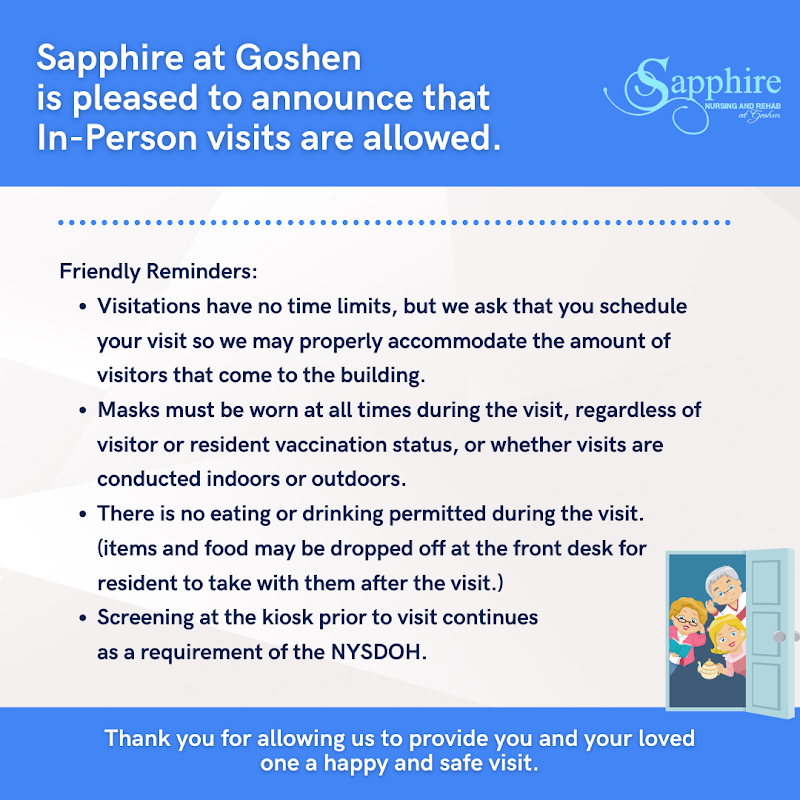
How Does Sapphire Nursing And Rehab At Goshen Compare to Other New York Nursing Homes?

Compared to the 100 nursing homes in New York, SAPPHIRE NURSING AND REHAB AT GOSHEN's overall rating (5 stars) is above the state average of 3.1, staff turnover (31%) is significantly lower than the state average of 46%, and health inspection rating (4 stars) is above the national benchmark.

What Should Families Ask When Visiting Sapphire Nursing And Rehab At Goshen?

Based on this facility's data, families visiting should ask: "Can you walk me through typical staffing levels on day, evening, and night shifts?" "Can I visit during a mealtime to observe dining assistance and food quality?" "How do you handle medical emergencies, and what is your hospital transfer rate?" "Can I speak with family members of current residents about their experience?" These questions are particularly relevant given the below-average staffing rating.

Is Sapphire Nursing And Rehab At Goshen Safe?

Based on CMS inspection data, SAPPHIRE NURSING AND REHAB AT GOSHEN has a clean safety record: no substantiated abuse findings (meaning no confirmed cases of resident harm), no Immediate Jeopardy citations (the most serious violation level indicating risk of serious injury or death), and is not on the Special Focus Facility watch list (a federal program monitoring the lowest-performing 1% of nursing homes). The facility has a 5-star overall rating and ranks #1 of 100 nursing homes in New York. While no facility is perfect, families should still ask about staff-to-resident ratios and recent inspection results during their visit.

Do Nurses at Sapphire Nursing And Rehab At Goshen Stick Around?

SAPPHIRE NURSING AND REHAB AT GOSHEN has a staff turnover rate of 31%, which is about average for New York nursing homes (state average: 46%). Moderate turnover is common in nursing homes, but families should still ask about staff tenure and how the facility maintains care continuity when employees leave.

Was Sapphire Nursing And Rehab At Goshen Ever Fined?

SAPPHIRE NURSING AND REHAB AT GOSHEN has no federal fines on record. CMS issues fines when nursing homes fail to meet care standards or don't correct problems found during inspections. The absence of fines suggests the facility has either maintained compliance or corrected any issues before penalties were assessed. This is a positive indicator, though families should still review recent inspection reports for the full picture.

Is Sapphire Nursing And Rehab At Goshen on Any Federal Watch List?

SAPPHIRE NURSING AND REHAB AT GOSHEN is not on any federal watch list. The most significant is the Special Focus Facility (SFF) program, which identifies the bottom 1% of nursing homes nationally based on persistent, serious quality problems. Not being on this list means the facility has avoided the pattern of deficiencies that triggers enhanced federal oversight. This is a positive indicator, though families should still review the facility's inspection history directly.