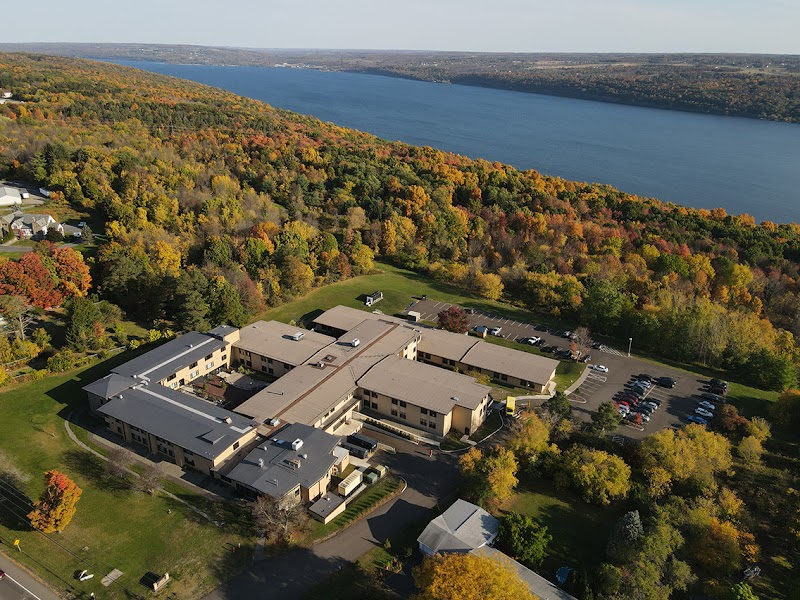
CAYUGA NURSING AND REHABILITATION CENTER

1229 TRUMANSBURG ROAD, ITHACA, NY 14850 (607) 273-8072
For profit - Limited Liability company 160 Beds Independent Data: November 2025 1 Immediate Jeopardy citation
Trust Grade
33/100
#384 of 594 in NY
Last Inspection: January 2025

Within standard 12-15 month inspection cycle. Federal law requires annual inspections.

Overview

Cayuga Nursing and Rehabilitation Center has received a Trust Grade of F, which indicates significant concerns about the quality of care provided. Ranking #384 out of 594 in New York places them in the bottom half of facilities, while being #2 out of 5 in Tompkins County means only one local option is rated higher. Although the facility has shown some improvement, reducing issues from 14 in 2023 to 10 in 2025, there are still serious concerns present. Staffing is rated average with a 3/5 score, but the turnover rate is 41%, which is consistent with the state average. However, the facility has accumulated fines of $41,616, which is higher than 86% of New York facilities, indicating ongoing compliance issues. There are notable weaknesses, such as a critical incident where a resident received the wrong diet, resulting in a hospital visit, and another concerning finding where a resident was administered expired medication. Additionally, the environment has been reported to be unclean and damaged in multiple areas, impacting residents' comfort and safety. Overall, while there are some strengths in staffing, the facility's serious deficiencies and history of compliance problems warrant careful consideration.

Trust Score
F
33/100
In New York
#384/594
Bottom 36%
Safety Record
High Risk
Review needed
Inspections
Getting Better
14 → 10 violations
Staff Stability
○ Average
41% turnover. Near New York's 48% average. Typical for the industry.
Penalties
✓ Good
$41,616 in fines. Lower than most New York facilities. Relatively clean record.
Skilled Nurses
⚠ Watch
Each resident gets only 14 minutes of Registered Nurse (RN) attention daily — below average for New York. Fewer RN minutes means fewer trained eyes watching for problems.
Violations
⚠ Watch
31 deficiencies on record. Higher than average. Multiple issues found across inspections.
★★☆☆☆
2.0
Overall Rating
★★★☆☆
3.0
Staff Levels
★★☆☆☆
2.0
Care Quality
★★☆☆☆
2.0
Inspection Score
Stable
2023: 14 issues
2025: 10 issues

The Good

  • Full Sprinkler Coverage · Fire safety systems throughout facility
  • No fines on record
  • Staff turnover below average (41%)

    7 points below New York average of 48%

Facility shows strength in fire safety.

The Bad

2-Star Overall Rating

Below New York average (3.1)

Below average - review inspection findings carefully

Staff Turnover: 41%

Near New York avg (46%)

Typical for the industry

Federal Fines: $41,616

Above median ($33,413)

Moderate penalties - review what triggered them

The Ugly 31 deficiencies on record

1 life-threatening
Jan 2025 10 deficiencies 1 IJ
CRITICAL (J)

Immediate Jeopardy (IJ) - the most serious Medicare violation

Accident Prevention (Tag F0689)

Someone could have died · This affected 1 resident

**NOTE- TERMS IN BRACKETS HAVE BEEN EDITED TO PROTECT CONFIDENTIALITY** Based on record review and interviews during the recertification and abbreviated (NY00341003) surveys conducted 1/16/2025-1/24/2...

Read full inspector narrative →
**NOTE- TERMS IN BRACKETS HAVE BEEN EDITED TO PROTECT CONFIDENTIALITY** Based on record review and interviews during the recertification and abbreviated (NY00341003) surveys conducted 1/16/2025-1/24/2025, the facility failed to ensure the residents' environment remained free of accident hazards for one (1) of three (3) residents (Resident #171) reviewed. Specifically, Resident #171 had a physician order for a regular dysphagia (difficulty swallowing) pureed texture diet and was served and fed ground vegetables, began to cough, and was sent to the hospital. Additionally, staff education was not initiated timely after the incident. This resulted in Immediate Jeopardy past non-compliance to Resident #171 and placed all residents on modified consistency diets at risk for serious injury, serious harm, serious impairment, or death. Findings include: The facility policy, Dysphagia, dated 3/2022 documented the Speech Language Pathologist would identify and convey swallowing recommendations to nursing and dietary staff so the recommendations could reflect on the resident's meal ticket. The care plan, orders, and care card were to be updated. The facility policy Activities of Daily Living Services revised/reviewed 1/19/2024, documented assistance with eating and drinking was provided to residents and included monitoring dietary restrictions. Regular training sessions were conducted to update staff on best practices and address identified areas for improvement. The 2019 [NAME] Diet and Nutrition Care Manual documented vegetables on a pureed diet should be soft, well-cooked, and pureed using appropriate recipes, and free from chunks, lumps, and/or seeds. All pureed foods were the consistency of moist mashed potatoes or puddings. Resident #171 had diagnoses including dementia and oropharyngeal dysphagia (difficulty swallowing). The 3/30/2024 quarterly Minimum Data Set assessment documented the resident had severely impaired cognition, had functional limitation in both arms and legs, was dependent for eating, did not have a swallowing disorder , and received a mechanically altered diet. The 1/29/2022 physician order documented regular pureed diet. The 11/29/2023 Speech Language Pathologist #35 evaluation and plan of treatment documented the resident had swallowing dysfunction and was referred for dysphagia services due to worsening signs/symptoms of dysphagia. The resident was on a pureed diet and aspiration (inhaling food/fluid into the lungs) precautions. The 4/4/2024 Registered Dietitian #34 quarterly nutritional assessment documented the resident had an abnormal weight loss, received a pureed diet with honey thickened liquids, a change in feeding ability was noted, and a mechanically altered diet was required. The Comprehensive Care Plan initiated 7/12/2023 and revised 4/25/2024 documented the resident had nutritional problems related to dysphagia and a mechanically altered diet, with a goal to tolerate consistency served with no episodes of aspiration. Interventions included monitor for signs and symptoms of dysphagia including pocketing, choking, coughing, drooling, holding food in mouth, several attempts at swallowing, and appearing concerned during meals; provide and serve regular pureed diet with honey thick liquids. The resident required assistance with activities of daily living. Interventions included extensive assistance of 1 with feeding, pureed solids with honey thick fluids. The 5/1/2024 facility Investigation Summary initiated by the Director of Nursing at 6:00 PM, documented Licensed Practical Nurse #10 reported Resident #171 was fed the wrong consistency diet at 5:30 PM in the 2nd floor dining room. The physician was notified, and the resident was sent to the emergency department. The investigation summary included the following witness statements: - 5/1/2024 Certified Nurse Aide #3 documented they were feeding the resident, noticed the resident was not swallowing, was trying to cough, and nodded their head when asked if they were choking. They sat the resident upright and began to take food out of their mouth. Another certified nurse aide (unidentified) told Certified Nurse Aide #3 the resident had the wrong consistency food, and the nurse was called. The statement did not include what food the certified nurse aide was feeding the resident. - 5/1/2024 Certified Nurse Aide #9 documented they entered the dining room, staff were already with the resident, they looked at the resident's meal tray, noticed it was the wrong consistency, took the tray to Dietary Aide #4 and explained that it was the wrong consistency. - 5/1/2024 Licensed Practical Nurse #10 documented they were called to the unit dining room for a coughing resident. Resident #171 had coughed up some food with a large amount of phlegm. Staff were unable to get the resident's blood oxygen saturation above 87%, the on-call provider was called, and the resident was sent to the emergency room. - 5/1/2024 Dietary Aide #4 was interviewed by the Director of Nursing and stated they did not remember the incident but believed the certified nurse aide must have served the wrong food. - 5/2/2024 Dietary Aide #13 documented they helped Dietary Aide #4 load the food cart to be taken to the 2nd floor unit for supper. Dietary Aide #13 told Dietary Aide #4 what each food item was, what scoop to use, and the tops of the pans were labeled with what each food item was. - on 5/2/2024 the Administrator reviewed video surveillance of the 2nd floor dining room. At 5:12 PM Certified Nurse Aide #3 brought Resident #171 their meal tray and began assisting the resident with feeding. Within minutes the resident began to show signs of choking. Multiple certified nurse aides and a nurse stepped in to confirm the resident's airway was clear and no longer choking. There was no Heimlich Maneuver performed and the resident was able to cough up the food consumed. The video review did not include observations of the resident's food being plated by dietary staff. - 5/3/2024 the Director of Nursing documented significant information related to the incident included Resident#171's meal ticket for 5/1/2024 was accurate, and the meal tray was accurate except for Brussels sprouts that were chopped, mechanical soft and not pureed. - The investigation summary submitted to the New York State Department of Health on 5/7/2024 at 1:16 PM by the Director of Nursing documented the dietary server (unidentified) filled the tray, the certified nurse aide (unidentified) passed out the tray and fed the resident. The dietary and certified nurse aide were suspended for 3 days. All nursing, social work, therapy, and recreation staff were educated and quizzed on safe dining. Certified Nurse Aide #3's educational record documented: - on 10/12/2023 they completed a Food Safety and Diets quiz. The quiz documented they were to never give any resident food or beverage unless they knew the resident's diet order and to report any concerns involving resident's safety and wellbeing. - on 10/19/2023, they completed the skill of feeding a resident which included tray placement/removal, diet types/consistencies, and reading meal ticket/documentation. The 5/2/2024 hospital discharge summary for Resident #171 documented the resident was admitted with breathing issues due to aspiration of Brussels sprouts. The discharge diagnoses were acute hypoxic respiratory failure secondary to acute acquired pneumonia (infection in the lungs) versus aspiration pneumonitis (pneumonia caused by inhaling food or fluid into the lungs). A 5/3/2024 at 4:17 PM Director of Nursing progress note documented the Interdisciplinary Team met to discuss the choking incident, an investigation was underway, dietary and nursing staff involved were to be re-educated, and leadership staff would spend time in the dining room at meals to monitor that meal tickets were being accurately filled. The 5/3/2024-5/14/2024 dietary consistency in-service documented dietary staff were educated on types and examples of appropriate diet consistencies and what foods to avoid for that type of consistency. A 5/14/2024 at 1:17 PM Director of Nursing progress note documented dining safety education went out to employees in departments who helped serve meals and helped residents with eating and was to be completed by 5/23/2024. The 5/7/2024 Dining Safety for Clinical Staff education documented mealtimes could be hectic, which made it even more essential the facility reduced the risk of incidents by making sure the residents received the diet they were supposed to have. The post-test included a question about meal ticket checks. The sign-in sheets documented staff education began on 5/7/2024. During an interview on 1/17/2025 at 2:56 PM, Certified Nurse Aide #3 stated meal trays with plates, meal tickets, and utensils, were brought to the unit on a cart by dietary staff. Food was placed in the unit kitchenette and served by dietary workers. Unit staff put drinks on the trays, the tray was then placed on the kitchenette counter, the dietary server plated the food items and put the plate back on the meal tray on the counter. The meal tray was then delivered by unit staff to the resident. The dietary server was responsible for ensuring the correct consistency food was plated, and unit staff were responsible for checking the meal ticket against the food items before serving to ensure they were correct. The aide stated they did not check the meal ticket, and the food served before feeding Resident #171 their supper on 5/1/2024 and they fed the resident the wrong consistency Brussels sprouts. They stated the unit had a lot going on in the dining room during that meal. They were feeding the resident their food, the resident looked like they were trying to cough something up, was not making vocal noises, and the aide summoned the nurse right away. The resident went to the hospital and returned a few days later on aspiration precautions and comfort measures. During a telephone interview on 1/21/2025 at 1:09 PM, Dietary Aide #4 stated the unit staff gave the dietary server the resident's meal ticket, the server read the ticket, plated the food, and returned the plate to the meal tray and placed it on the counter for delivery to the resident. If there was a discrepancy, unit staff were to bring the food back to the server for correction. Each meal ticket listed the resident's food consistency. Dietary Aide #4 denied plating the wrong food for Resident #171 on 5/1/2024 and stated unit staff must have delivered the resident the wrong meal tray. They stated there should have been multiple steps to ensure the resident did not receive the wrong consistency food. During an interview on 1/21/2025 at 2:00 PM, Licensed Practical Nurse #10 stated unit staff checked the resident's meal ticket prior to putting drinks on the tray, placed the tray on the kitchenette counter, the dietary server plated the food after reading the meal ticket, and the tray was taken to the resident by unit staff. Every staff member who touched the tray, including whoever was feeding the resident, should check the meal ticket and the food to ensure they were correct to prevent the resident from getting the wrong consistency and choking or aspirating the food. On 5/1/2024, Resident #171 received regular Brussels sprouts and should have received pureed. The nurse believed all other foods on the tray were the correct consistency. The resident choked on the Brussels sprouts and cleared their airway by themself. The resident was taken to their room, the on-call provider was called, and the resident was sent to the hospital. They stated the resident's care plan was not followed, and all unit staff were reeducated on diet consistencies and food safety. During an interview on 1/21/2025 at 3:25 PM, Certified Nurse Aide #9 stated during meal service, any unit staff touching a resident's meal tray was to verify the meal ticket matched what was on the tray, including the dietary server. During a meal service observation and interview on 1/22/2025 at 12:07 PM, Dietary Aide #12 stated each pan of food on the steam table was covered with cellophane that was labeled with the date it was cooked and its consistency such as mechanical soft or pureed. Pureed was like pudding consistency and mechanical soft had chunks. They stated they learned the different consistencies when they were trained. During an interview on 1/22/2025 at 2:54 PM, the Director of Nursing stated nursing staff was trained on meal service and consistencies during orientation and yearly. Any staff member touching a meal tray was to verify the meal ticket matched the served food before the resident received the tray. Resident #171 received the wrong consistency food on 5/1/2024, they went to the hospital and was diagnosed with aspiration pneumonia. All nursing staff received post incident education regarding meal ticket verification with the served meal. On 1/23/2025 at 11:21 AM, the Director of Nursing stated 2nd floor unit staff received informal education regarding checking meal tickets and was unsure when the Registered Nurse Educator started the formal education for all nursing staff. During an interview on 1/22/2025 at 2:55 PM, Dietary Manager #26 stated food consistency education was done for dietary staff after the incident on 5/1/2024. Staff education on consistencies and training to check meal tickets versus consistency was provided upon hire and yearly. During an interview on 1/23/2025 at 11:15 AM, Registered Nurse Educator #14 stated nursing staff education on checking meal tickets versus served food and drinks did not begin until 5/7/2024 because they had to generate the education in the education computer system. That was where most of the education was done for staff, including the post test. Those staff members without computer access were provided with education in person. The staff who were directly involved in the incident were educated immediately post incident, but the educator was unsure if they had it documented anywhere. During an interview on 1/23/2025 at 11:22 AM, the Administrator stated the facility knew the cause of the incident the day it occurred. The facility was given, by regulation, 5 days to complete their investigation, and post incident education was provided at the completion of the facility investigation. The video of the incident was not saved, but a detailed summary, to include what was viewed on the video, was provided in the investigation and the summary. During an interview on 1/23/2025 at 3:14 PM, Medical Director #7 stated they expected staff to follow orders which included diet orders. Eating the wrong consistency could cause some residents to cough or choke on the food. 10NYCRR 415.4(b)(1)(i)____________________________________________________________________________ Immediate Jeopardy past non-compliance was identified, and the Administrator notified on 1/23/2025 at 11:30 AM. The facility provided verification the following corrective actions were completed: - On 5/2/2024 Certified Nurse Aide #3 was reeducated on following resident care plans regarding appropriate diet and consistency as ordered. - On 5/3/2024-5/14/2024 all dietary staff were educated on diet consistencies. - On 5/7/2024-5/11/2024 all nursing staff were educated on diet consistencies. - On 1/23/2025 staff education rosters were reviewed, and no discrepancies were identified. - During mealtime observations on 1/22/2025 and 1/23/2025, diet consistencies matched resident requirements.
CONCERN (D)

Potential for Harm - no one hurt, but risky conditions existed

Deficiency F0565 (Tag F0565)

Could have caused harm · This affected 1 resident

Based on interviews and record review during the recertification survey conducted 1/16/2025-1/24/2025, the facility did not ensure that views, grievances, or recommendations voiced by residents during...

Read full inspector narrative →
Based on interviews and record review during the recertification survey conducted 1/16/2025-1/24/2025, the facility did not ensure that views, grievances, or recommendations voiced by residents during Resident Council group meetings were considered or acted upon and responded to with a rationale for 10 of 10 anonymous residents present at the resident group meeting. Specifically, 10 of 10 anonymous residents present at the resident group meeting stated they did not receive responses to topics or concerns addressed in prior meetings. Additionally, there was no documented evidence residents' voiced concerns were investigated, and rationales or responses were provided to the residents. Findings include: The facility policy, Resident Council, revised 3/18/2024, documented the resident council would provide a platform for residents to voice their concerns, provide feedback, and actively participate in decision-making processes that would directly impact their living conditions and experiences within the facility. The resident council would serve as a liaison between residents and facility administration addressing concerns or complaints regarding facility operations, policies, and resident experiences. The council appointed liaison would assist with documentation, relaying concerns to facility managers, ensuring facility follow through and would report back to the council as requested. The facility policy Resident Rights, revised 3/18/2024, documented the facility would establish a formal process for residents to file complaints or grievances. Residents would be provided with information on the procedure for addressing complaints and would have access to a designated individual or department to seek resolution. During a resident group meeting on 1/17/2025 at 9:54 AM, 10 anonymous residents stated the facility did not follow up, address, or resolve their concerns. They stated they did not receive any feedback from the facility about concerns regarding staff not responding timely to call lights, communication with unit staff, noise levels on the units during shift change and at night, and one resident stopped attending because they felt like it was useless. Resident Council meeting minutes documented: - on 8/2/2024, old business noted, calls bells were not being answered timely, residents were not receiving their meds because they were unavailable, noise levels at night were awful especially during 3:00 PM to 11:00 PM and 11:00 PM to 7:00 AM shifts. New concerns were raised about staff playing music while performing care and passing meal trays. - on 9/6/2024, old business noted, call bells not being answered timely, medications not available, Unit 2 staff were still noisy on 3:00 PM to 11:00 PM and 11:00 PM to 7:00 AM shifts, agency nurses forgot to give medications, and staff played music when performing care and passing meal trays. New concerns were raised about staff using offensive language. - on 10/21/2024, old business noted, call bells not being answered timely, medications were still not in the facility, Unit 2 staff was still noisy, staff played music when performing care and passing meal trays, and staff were still using offensive language. New concerns were raised about residents taking food from other trays, and cell phones being used by aides in resident rooms. The residents felt like they were attending resident council meetings and complaining but nothing was being done about it. - on 11/1/2024, old business noted, call bells not being answered timely, medications were given late, residents and staff were loud, staff were still using offensive language, and music was played on staff cellphones. New concerns were raised about cellphone usage at the nursing station, residents were getting up late for breakfast, items were stolen from resident rooms, and residents were not being assisted to bed timely. - on 12/6/2024, old business noted, residents not woken up for breakfast, items were stolen from resident rooms, personal cellphone usage at the nursing station, and not being assisted to be timely. New concerns were raised about loud staff, staff swearing and using inappropriate language, staff were not being truthful, staff were taking too many breaks at once, music was played on staff cellphones, staff were wearing ear buds while providing care, and residents were assisted to bed too early/late. The residents wanted to see compliance with their concerns and not just on paper. Resident Council staff responses documented: - in 8/2024, the Food Service department noted nursing was responsible for checking all items on resident trays and they would monitor dietary staff to ensure they did not have their phones out during meal service, and they believed it was a Director of Nursing issue. There were no other documented staff responses related to resident's voiced concerns. - in 9/2024, the Nursing Department noted they would start monthly staff meetings and include break education, education to staff on passing medications in the dining room and using basins for hygiene and hiring and training new staff to allow for timely care. The dietary department noted residents would need to notify nursing if they had a missing item on their tray and nursing should check all trays prior to the tray going to the resident. - in 10/2024, the Food Service department noted residents who took food off trays should be reported to the nursing staff who oversaw the meal service. Once meals were delivered to residents it was nursing staff who supervised meal consumption. There were no other documented staff responses to the resident's voiced concerns. - in 11/2024, there were no documented staff responses to the resident's voiced concerns. - in 12/2024, the nursing department noted all issues were addressed in staff meetings. During an interview on 1/24/2025 at 8:41 AM Recreation Leader #37 stated they ran resident council meetings until December 2024. During the Resident Council meetings, they went around the table and asked the residents what their issues were so they could let other departments know. They documented the specific issues and delivered them to each department. A response sheet was filled out and returned with the plans to fix the problems. In the next resident council meeting they would go over old business and how it was addressed before they moved on to new concerns. They were unsure why the old business and new business had a lot of the same concerns with no resolutions. They were not the one who typed up the minutes or held onto the staff response sheets. Residents expressed their concerns were not addressed and they were not seeing changes. They stated it was important to address resident council concerns because the facility was the residents' home, and it was their job to make sure residents were taken care. During an interview on 1/24/2025 at 11:30 AM, Activities Director #36 stated they started at the facility in the middle of November, and they reviewed the old Resident Council minutes. The minutes seemed to be all over the place with no structure. They noticed reoccurring issues that were not resolved. They constructed a new agenda since they took over Resident Council and they thought the resident's concerns were now being addressed. The resident's wanted to see things done and not just on paper. Activities Director #36 stated they reviewed the minutes in their monthly Quality Assurance and Performance Improvement meetings. They thought since bring the issues to the meeting, there was more of a response from other departments. During an interview on 1/24/2025 at 12:01 PM, the Administrator stated they were not involved with Resident Council, but they reviewed the monthly minutes. They tried to follow up with the residents' concerns within a week or by the next meeting. Facility response sheets were kept with the minutes and were brought back to the Resident Council meetings to address concerns. They saw repeated concerns on the monthly minutes, but they had a new Activities Director who made corrections to the resident council. They thought outcomes were being communicated back to the residents. They did not think there was a clear depiction of what the follow up was because it was not documented appropriately so it looked like they were not addressing the resident's concerns. 10NYCRR 415.5(c)(6)
CONCERN (D)

Potential for Harm - no one hurt, but risky conditions existed

Investigate Abuse (Tag F0610)

Could have caused harm · This affected 1 resident

**NOTE- TERMS IN BRACKETS HAVE BEEN EDITED TO PROTECT CONFIDENTIALITY** Based on record review and interviews during the recertification and abbreviated (NY00354013) surveys conducted 1/20/2025-1/24/2...

Read full inspector narrative →
**NOTE- TERMS IN BRACKETS HAVE BEEN EDITED TO PROTECT CONFIDENTIALITY** Based on record review and interviews during the recertification and abbreviated (NY00354013) surveys conducted 1/20/2025-1/24/2025, the facility did not ensure all alleged violations involving abuse, neglect, or mistreatment were thoroughly investigated for 1 of 1 resident (Resident #371) reviewed. Specifically, Resident #371 was care planned for 2-person assistance with a mechanical lift for transfers and Certified Nurse Aide #29 transferred the resident alone resulting in the resident nearly falling. The resident was not assessed by a qualified professional following notification of the care plan violation and was subsequently found with skin tears to both legs. Findings included: The facility policy, Resident Incident/Accident Documentation within Electronic Medical Record revised 7/25/2024, documented all incidents that involved resident care would be investigated and documented on the Incident Documentation Tool and enabled the facility to evaluate care given to residents, to assist in the prevention of incidents, and evaluate the intervention given in the event of an incident. An incident was an occurrence not consistent with the routine operation of the facility or routine care of a resident. Reports were completed by licensed practical nurses and registered nurses. The nursing supervisor or designee would immediately notify the Administrator or designee of statements that physical abuse, mistreatment, or neglect has occurred, if a physical condition, like a bruise, was inconsistent with the history or course of treatment of the resident, or there was an observation of an act or condition of abuse, mistreatment, or neglect. Resident #371 had diagnoses including atrial fibrillation (an abnormal heart rhythm), long term use of anticoagulants (blood thinners), and progressive neuropathy (sensory and motor nerve damage). The 8/7/2025 Minimum Data Set assessment documented the resident was cognitively intact but had periods of altered consciousness, had no behavioral symptoms, and required moderate assistance to dependence for most activities of daily living. The 7/31/2024 Comprehensive Care Plan documented the resident had an activities of daily living self-care performance deficit related to musculoskeletal impairment. Interventions included the resident was non-ambulatory, was dependent for transfers with two-person assistance and a mechanical lift, required moderate assistance of two people for lying to sitting at the edge of the bed, and required moderate assistance for rolling left to right. Staff statements completed on 9/7/2024 documented: -Licensed Practical Nurse #30 stated Certified Nurse Aide #29 approached them and stated they were leaving at the end of tray pass as they had attempted to transfer a resident to get them up for dinner, the resident was combative, and the resident was almost dropped to the floor. They attempted to gain help by turning on the call light and then pulling the call light from the wall to trigger the emergency light, but no one came to assist them. The Manager on Duty was notified and Licensed Practical Nurse #30 was asked to obtain statements from the other staff on the floor. Licensed Practical Nurse #30 determined the resident was a mechanical lift with assistance of 2, not a one-person transfer. - Certified Nurse Aide #33 noticed Resident #371 was not up for the dinner meal. Certified Nurse Aide #29 offered to go get the resident for the meal. Certified Nurse Aide #33 stated they thought the resident was a one-person transfer. Certified Nurse Aide #29 declined assistance to get the resident up. Certified Nurse Aide #29 was upset no one came to assist them and stated the resident pulled Certified Nurse Aide #29 down and the resident was almost on the floor. - Certified Nurse Aide #28 stated they were going to go get Resident #371 up for dinner and went to look at the list (for transfer status) and saw Certified Nurse Aide #29 at the desk then go down the hall. They asked Certified Nurse Aide #29 if they needed assistance and was told they did not. Approximately 5 to 10 minutes later, Certified Nurse Aide #29 went into the dining room asking where everyone was, they were calling for help because Resident #371 was sitting on the aide's leg. There was no documented evidence the resident was assessed by a qualified professional following the reported care plan violation with the transfer. The 9/8/2024 at 3:50 PM Licensed Practical Nurse #27 Incident note for a skin impairment documented. A bruise on the right shin and three skin tears on the left shin were found on 9/8/2024 at 10:20 AM while the resident was lying in bed. The origin of the skin tears and bruise were unknown. The skin tears required butterfly bandages and were left open to air. The provider and the resident's family were notified. The 9/8/2024 at 11:21 AM Investigation report prepared by Licensed Practical Nurse #39 documented: - on 9/8/2024 the resident was found in bed with four skin tears measuring 5.0 by 0.7 centimeters, 1.0 by 1.0 centimeters, 0.5 by 0.5 centimeters, and 1.0 by 0.6 centimeters on the left lower extremity, and a bruise measuring 5.0 by 1.5 centimeters on the right leg. - The resident was unable to give a description of what happened and was alert and orientated only to person. - The were no predisposing environmental or situational factors. The resident had impaired memory, impaired vision, poor safety awareness, and had a current acute condition. The 9/8/2024 investigation summary documented: - It was undetermined when the skin tears and bruise occurred, and they were discovered during morning care. - Licensed Practical Nurse #27 and Licensed Practical Nurse #28 were interviewed. They reported the skin tears and bruising were not present on 9/7/2024 in the morning and were present on 9/8/2024, during morning care. Licensed Practical Nurse #27 noted the skin tears were not present when they saw the resident's legs for a treatment on 9/7/2024 at 4:00 PM (before the inappropriate transfer occurred). - The resident was combative at times, they had poor intake of food and water, they were a mechanical lift transfer but there was one known incident of an attempt of a one person transfer 9/7/2024 in the evening with no noted skin tears. The undated Investigation Conclusion signed by the Director of Nursing documented the care plan violation was the first incident and documented Certified Nurse Aide #29 was suspended for three days and was re-educated on checking the [NAME] for each resident and making sure to follow it. There were planned and scheduled October in-services for bed mobility, safe transfers, and mechanical lift training. They were unable to determine the cause of the skin tears. The resident was noted to be combative with care and that could have been the cause of the skin tear. The resident had a history of skin tears, poor intake, and was observed wheeling their wheelchair into multiple pieces of furniture throughout their stay. There was no documented evidence the facility addressed the lack of assessment by a qualified professional on 9/7/2024 for possible injury following the transfer by one staff. During a telephone interview on 1/21/2025 at 1:57 PM, Certified Nurse Aide #29 stated they were serving dinner trays in the dining room when they noticed Resident #371 was not in the dining room. They offered to go get the resident and was informed by Certified Nurse Aide #33 the resident was a one-person transfer. They woke Resident #371 up, got them turned to the side of the bed with the wheelchair next to the bed, and attempted to stand the resident with a gait belt. Resident #371 started to be combative, was not bearing weight, and almost slid off the bed due to being mid-transfer. Certified Nurse Aide #29 stated they had to put their leg in-between the resident's legs and scoot the resident back onto the bed. When the aide went to the nursing station, they were informed the resident was a mechanical lift, not a one-person assist. One of the nurses, they were unsure whom went to assist with getting the resident up. The nurse did a full body check and there were no injuries. During an interview on 1/22/2025 at 4:39 PM, Licensed Practical Nurse #30 stated they were not assigned to Resident #371's floor, but they were the Supervisor on duty. They were called down to the unit due to Resident #371 being transferred incorrectly and a skin tear on the resident's leg. They believed the registered nurse did the assessment on the resident as licensed practical nurses were not allowed to do the skin check in that situation. During an interview on 1/23/2025 at 9:33 AM, Registered Nurse #39 stated if a resident was improperly transferred while they were on duty they should be notified. They stated on 9/7/2024, they were not notified of Resident #371 being transferred incorrectly. If it had been reported to them, they would have assessed the resident, documented, and then reported the incident. During an interview on 1/24/2025 at 9:29 AM, the Director of Nursing stated there were two kinds of investigations, one required notification of the Director of Nursing immediately and the other required nursing staff to fill out a risk assessment. The risk assessment was for falls, a bruise, a skin tear, or a resident to resident incident. If a resident or staff had an injury related to an improper transfer, they were usually notified immediately. If a resident was injured due to a care plan violation, they obtained statements from the staff or obtained a verbal statement. Those verbal interviews were summarized on the witness statement section of the incident report. For injuries of unknown origin, they did a 72-hour look back at the resident's care and obtained statements from staff who worked. They expected a full assessment on the resident after the improper transfer. There was no accident and incident report entered for the improper transfer on 9/7/2024 and they were not aware it had occurred until they started the investigation on the injury of unknown origin on 9/8/2024. There was no documentation the registered nurse on duty was notified and they should have been. They stated they were able to rule out abuse and neglect without having a documented assessment or a note about the transfer incident as the resident had a history of being combative and self-inflicted injuries from kicking items. The resident also did not appear fearful when spoken to about the incidents. 10NYCRR 415.4(b)(3)
CONCERN (D)

Potential for Harm - no one hurt, but risky conditions existed

Deficiency F0635 (Tag F0635)

Could have caused harm · This affected 1 resident

Based on record review and interviews during the recertification survey conducted 1/16/2025-1/24/2025, the facility did not ensure at the time of admission residents had physician orders for immediate...

Read full inspector narrative →
Based on record review and interviews during the recertification survey conducted 1/16/2025-1/24/2025, the facility did not ensure at the time of admission residents had physician orders for immediate care consistent with the resident's physical status for 1 of 1 resident (Resident #473) reviewed. Specifically, Resident #473's hospital discharge orders and hospital discharge summary had conflicting diet consistency information that was not clarified on admission to the facility. Findings include: The facility policy, Physician Visits & Medical Orders, revised 1/19/2024, documented the attending physician would prescribe the medical regimen of care for the residents they admitted . Before or on admission of a resident, the physician would submit information pertaining to the admitting diagnosis(es), current medical findings, the diet prescribed, medication treatment orders, and the resident's functional status. Medical orders would be written by physicians to meet the needs of the resident. Members of the interdisciplinary team would provide care, services and treatment according to the most recent medical orders and according to laws, regulations and standards of practice. The facility policy, admission of Resident to Care Facility, revised 1/19/2024, documented the facility would ensure each resident received necessary care and services upon admission. Resident #473 had diagnoses including mild cognitive impairment, hypertension (high blood pressure), and weakness. The Minimum Data Set assessment was not yet completed. The 1/21/2025 hospital discharge summary documented the hospital stay was complicated by new thin liquid dysphagia (difficulty swallowing), for which the resident was given a thickened liquid diet. The resident never had trouble with thin liquids or swallowing at baseline per family. The speech language pathologist evaluation during admission showed evidence of dysphagia with thin liquids. The discharge summary documented diet as below, can be re-evaluated by speech language pathologist. The nursing home transfer documented a regular diet. The 1/21/2025 physician order entered by the Director of Nursing at 11:13 AM documented a regular diet, regular texture, regular thin consistency. The order was signed by Nurse Practitioner #23 on 1/21/2025. During a lunch observation on 1/22/2025 at 12:41 PM, Resident #473 had a mug containing a thin brown liquid and a cup containing a thin, clear amber colored liquid. The resident was actively drinking the amber colored liquid. The resident's visitor questioned the liquids as the resident had thickened liquids the day before. A speech language pathologist arrived and removed the thin fluids and said they were going to check with the other speech language pathologist to see if they did an evaluation on 1/21/2025. The 1/22/2025 at 12:52 PM Physician #7 order documented the resident was to receive a regular diet, regular texture, with nectar consistency liquids. The 1/22/2025 at 2:24 PM Speech Language Pathologist #16 progress note documented a skilled dysphagia evaluation was medically indicated due to discrepancy between diet recommendation on the hospital discharge paperwork and report from the resident's family. Thin liquids were not trialed due to patient preference for nectar. They recommended regular solids, nectar liquids, and skilled dysphagia treatment 3-5 times a week for 4 weeks using restorative and compensatory techniques. During an interview on 1/23/2025 at 1:36 PM, Licensed Practical Nurse Manager #15 stated when admitting a resident, the Director of Admissions brought them a hard copy of the hospital orders. They entered those orders into the electronic medical record. The Director of Nursing and another Nurse Manager checked the orders for accuracy. That was their triple check system. If information in the discharge paperwork was inconsistent, it should be clarified. They were not working the day Resident #473 was admitted so they had not reviewed their orders. The resident was admitted on thin liquids and should have been on nectar thick. The correct consistency was important because the resident could have choked or aspirated which could lead to complications. During an interview on 1/24/2025 at 9:10 AM, the Director of Admissions stated when a resident was admitted they received the discharge summary and orders the day of admission, reviewed them, and uploaded them to the documents tab in the electronic medical record. If the hospital orders and discharge summary had conflicting information, they would clarify. Additionally, they created a portable document format (PDF) file with all preadmission information they had obtained and sent it to the on-call provider, the Director of Nursing and the appropriate Nurse Manager. The on-call provider, once they received the portable document format, printed it, signed it, and returned it and those became the admission orders. On 1/17/2025 a hospital physician, entered a diet change of nectar thick liquids as a message rather than an order. As a result, it did not flow into the orders. Therefore the 1/16/2025 order for a regular diet was the only active hospital diet order the resident had. They became aware of that issue after the resident was already admitted and the question regarding the appropriate liquid consistency was raised. The resident's admission paperwork did not give them an inclination there was a swallowing issue and when they saw the regular diet, it did not cue them to look for dysphagia. They did not think their facility caught the issue but should have as that was why there was a triple check system. During an interview on 1/24/2025 at 10:03 AM, Speech Language Pathologist #16 stated they reviewed Resident #473's records and saw a regular diet but did not see the resident had thin liquid dysphagia. On 1/21/2025, they were told the resident's family wanted the resident to have nectar thick liquids, so they did an evaluation that day. During an interview on 1/24/2025 at 11:21 AM, the Director of Nursing stated they often put the admissions orders in and if not, they performed one of the checks. When they put the orders in the electronic medical record, they looked at the discharge orders but only looked at the discharge summary if there were new medications. Any order that needed clarification was not activated. They entered Resident #473's admission orders but did not review their discharge summary because there was nothing in the orders that made them question anything. They had since reviewed the discharge summary and saw the resident had thin liquid dysphagia while at the hospital. If they had reviewed the discharge summary on admission and saw that, they would have asked speech to evaluate the resident and held the diet order pending that evaluation to make sure they could swallow safely. During an interview on 1/24/2025 at 11:44 AM, Nurse Practitioner #23 stated when there was a new admission, they looked over the discharge orders and discharge summary to make sure everything was appropriate. Once nursing entered the orders, they reviewed and signed off. If there was conflicting information, they would ask the nursing staff to ask for clarification from the discharging facility. They were involved in Resident #473's admission and would have reviewed their orders and summary. They did not know if there was conflicting information about their diet and did not recall asking nursing to clarify their diet. During a follow up interview on 1/24/2025 at 2:49 PM, Nurse Practitioner #23 accessed the resident's medical record and reviewed the discharge instructions and summary. They stated they saw the diet was regular but in the discharge summary, saw documentation on evidence of dysphagia and had to be reevaluated by speech. They stated the information was certainly conflicting and orders should have been clarified to ensure they were given the appropriate fluids to reduce the risk of aspirating. 10 NYCRR 415.11
CONCERN (D)

Potential for Harm - no one hurt, but risky conditions existed

PASARR Coordination (Tag F0644)

Could have caused harm · This affected 1 resident

Based on record review and interviews during the recertification survey conducted 1/16/2025-1/24/2025, the facility did not ensure that residents with newly evident or possible serious mental disorder...

Read full inspector narrative →
Based on record review and interviews during the recertification survey conducted 1/16/2025-1/24/2025, the facility did not ensure that residents with newly evident or possible serious mental disorders, intellectual disabilities, or related conditions were referred for a Level II Preadmission Screening and Resident Review (a federal requirement to help ensure that individuals who have a mental disorder or intellectual disabilities were not inappropriately placed in nursing homes for long term care; a Level II Preadmission Screening and Resident Review identifies the specialized services required by the resident) for 1 of 2 residents (Resident #66) reviewed. Specifically, Resident #66 had a significant mental illness and a change in behavior that required medication intervention and there was no documentation a new Screen Level I was completed, or a Level II referral was initiated. Findings include: The New York State Department of Health Instruction Manual for Department of Health-695 (2/2009) documented if a Residential Health Care Facility resident was newly diagnosed with a mental illness, a new SCREEN and Level II referral must be completed within 14 calendar days. If a Residential Health Care Facility resident, who was previously identified as having mental illness was identified as having experienced a significant change in physical and/or mental condition, a new SCREEN and Level II Evaluation must be completed within 14 calendar days. During an interview on 1/23/2025 at 11:16 AM, the Administrator stated they did not have a facility policy regarding Preadmission Screening and Resident Review. Resident #66 had diagnoses including schizophrenia, hallucinations, and delusional disorder. The 12/26/2024 Minimum Data Set assessment documented the resident was cognitively intact, had a diagnosis of schizophrenia and hallucinations, and was receiving an antipsychotic medication routinely and as needed. The comprehensive care plan initiated on 5/1/2024, and revised 8/7/2024, documented the resident had a psychosocial well-being problem related to the diagnosis of schizophrenia in the resident's teen years that required inpatient mental health services; they continued to have psychosis and delusions, was accusatory toward staff, and refused basic care and prescribed medications; they were verbally and physically violent towards staff and would throw objects including food, fluids, and feces; they had made accusations of rape within the facility, did not trust staff or their family, and continued to confabulate incidents of abuse. Interventions included monitor/document resident feelings and response to internal and external problems, initiate referrals as needed or increase social relationships, allow time to answer questions and to verbalize feelings, remove to a calm safe environment when conflict arises, and paper and plastic products for safety during meals. The comprehensive care plan initiated on 10/18/2021, and revised 1/19/2025, documented the resident had potential for non-compliance related to impaired judgement with incontinence care, showers, medication, and activities of daily living. Interventions included allow time for making decisions about treatment regime to provide sense of control, encourage participation, reapproach if resistant with activities of daily living, and to praise the resident when behavior was appropriate. The 4/9/2021 Screen Form (New York State Department of Health-695 2/2009) documented the resident required skilled services, did not have a significant mental illness, and did not require a Level II evaluation. The resident's face sheet documented the resident's schizophrenia and major depressive disorder diagnosis had an onset date of 4/17/2021 and their hallucinations and delusional disorders diagnosis had an onset date of 11/8/2023. Nursing notes from 10/28/2024-11/4/2024 documented the resident had behavioral symptoms including refusal of medications, using profane language, hallucination, delusional thoughts, yelling and screaming, ripping the call light from the wall, verbally abusing staff, throwing food, and stating staff were mental patients making them watch them sexually assault and murder people. The 10/21/2024 Psychiatric Mental Health Nurse Practitioner #44 progress note documented a chief complaint of irritability and delusions. The resident was being seen after addition of Secuado (a medication used to treat schizophrenia) for management of psychosis, irritable behaviors, and mood stabilization. The resident stated they were a brain surgeon in one of their other lives. The resident was diagnoses with schizophrenia in high school and was previously institutionalized because of mental illness. The plan/recommendations were given that the resident recently recovered form COVID-19 infection which may have influenced their behaviors. The 10/30/2024 Social Worker #38 progress note documented the interdisciplinary team met for the resident's quarterly care meeting. The resident had been exhibiting more aggressive behaviors toward staff and refusing medications over the last two weeks. The resident continued to see the psychiatric nurse practitioner for medication reviews and a psychotherapist a few times. However, the resident had been refusing to see the psychotherapist the last couple of months. The resident was alert, oriented, and able to make their needs known. However, due to the resident's schizophrenia the resident often was non-compliant with care and medications. The 11/4/2024 Psychiatric Mental Health Nurse Practitioner #45 progress note documented they were asked by staff to see the resident who was non-compliant with their Secuado patch, was aggressive, yelling all night about having a baby, cursing staff, calling them [expletive], throwing food and drink at staff, and attempting to rip the call bell out of the wall. They approached the resident in the company of two staff members and the resident yelled Get out!. The resident was at the maximum dose of Risperdal (antipsychotic), but it seemed ineffective in managing the psychosis. The resident's behaviors posed an immediate risk to the resident or others. Nonpharmacological interventions and least restrictive measures had been attempted in the past with minimal improvement. During an interview on 1/23/25 at 12:15 PM Social Worker #18 (from a sister facility) stated if a resident had a significant change with mental illness it needed to be reviewed. Resident #66 did not have a Level II screen, and they had questioned that due to the resident's mental illness diagnoses. The resident was diagnosed with schizophrenia in high school with a history of inpatient stays. They now had escalation of behaviors requiring medication intervention: The resident should have had a new screen. If they did not have a new Level II screen, they would not know what specialized services the resident required and was placed in long term care appropriately. Resident #66 may need alternative services due to their long standing history of schizophrenia. During an interview 1/23/25 01:21 PM the Administrator stated the Director of Social Work was responsible for maintaining Preadmission Screening and Resident Review, referring and updating the state authority. 10NYCRR 415.11(e)
CONCERN (D)

Potential for Harm - no one hurt, but risky conditions existed

Deficiency F0660 (Tag F0660)

Could have caused harm · This affected 1 resident

Based on record review and interviews during the recertification survey conducted 1/16/2025-1/24/2025, the facility did not ensure a discharge planning process was in place addressing each resident's ...

Read full inspector narrative →
Based on record review and interviews during the recertification survey conducted 1/16/2025-1/24/2025, the facility did not ensure a discharge planning process was in place addressing each resident's discharge goals and needs and involved the resident and the resident representative for 1 of 2 residents (Resident #105) reviewed. Specifically, Resident #105 expressed the goal to be discharged back to their prior living situation and was not assisted with discharge planning or updates on the status of their discharge goal. Findings include: The facility policy Comprehensive Care Plan, revised 1/19/2024, documented to the extent practicable, the resident had the right to participate in planning for care, treatment and services shall include discharge planning to include return to the community or discharge to an appropriate level of care. The facility policy, Discharge Planning, revised 8/23/2023, documented the facility would work collaboratively with the resident to ensure a smooth transition of care; would ensure all residents who expressed a desire to return to the community were provided the opportunity and assistance by the facility to allow the resident to live in the most integrated and least restrictive setting possible; resident education would be a major focus of discharge planning activities; and would permit the resident, their legal representative or health care agent the opportunity to participate in deciding where the resident will live after discharge from the facility; and permit the resident, their legal representative or health care agent the opportunity to participate in deciding where the Resident #105 had diagnoses of metabolic encephalopathy (a chemical imbalance in the brain) and repeated falls. The 11/15/2024 Minimum Data Set admission assessment documented the resident's overall discharge goal was to be discharged to the community and an active discharge plan was already occurring for the resident to return to the community. The 12/27/2024 Minimum Data Set assessment documented the resident had moderately impaired cognition and was independent with most activities of daily living. The Comprehensive Care Plan revised 11/18/2024, documented the resident had a discharge plan to complete short term rehabilitation and return to their apartment if able. Interventions included inform the resident about referrals made to support the discharge and organize discharge meetings as needed. The 11/8/2024 at 1:42 PM former Social Worker #38 's progress note documented Resident #32 presented as alert and oriented, was able to make their own decisions and make their needs known. The resident stated their goal was to attend and participate in therapy to regain strength and independence and go back to their apartment where they lived independently. The resident had a friend who checked on them and assisted with their needs. The resident stated they were able to manage their own activities of daily living and was still driving to get their groceries. The 11/12/2024 at 9:22 AM former Social Worker #38 's progress note documented per the hospital record; the resident's friend was unsure if the resident would be able to return to their apartment. Social Worker #38 would call the friend to schedule a care meeting per the resident's wishes. The 12/27/2024 Occupational Therapy Discharge Summary documented the resident was independent for all functional skills except bathing which required set up assistance. The 12/27/2024 Physical Therapy Discharge Summary documented the resident was independent for all functional skills. There was no documented evidence an Interdisciplinary care plan meeting was held to discuss the resident's discharge potential and goals. During an interview on 1/16/2025 at 11:20 AM, Resident #105 stated they were concerned about not being able to go home. They were supposed to go home in 12/2024. They worked with Veterans Affairs for everything they needed. They had not received therapy for the last two weeks and had to postpone several appointments because of still being at the facility. They had friends that could give them a ride home and had practiced stairs in therapy. They were still paying for their apartment and their landlord lived downstairs. They did not recall attending any care plan or discharge meetings since being admitted . During an interview on 1/22/2025 at 4:43 PM, Certified Nurse Aide #20 stated Resident #32 was very independent, was steady on their feet, and alert and oriented. During an interview on1/22/2025 at 4:47 PM, Licensed Practical Nurse #21 stated Resident #32 was independent, alert and oriented, pleasant, had good safety judgement and was able to make their needs known. They were not sure why they were still in the facility. During an interview on 1/23/2025 at 12:57 PM, Licensed Practical Nurse Manager #15 stated Resident #32 was at the facility for rehabilitation and their plan was to go home. The resident was very independent, quiet, liked to stay in their room, and their cognition was good. They did not recall going to the resident's care plan meeting or any discussion about a discharge plan for them. They were not sure if the resident was still receiving therapy or why they were still at the facility. The facility's goal was to get people home as quickly as possible. During an interview on 01/23/2025 at 2:34 PM, the Occupational Director stated Resident #32 came to them due to a fall at home. The resident was no longer on therapy services and had maxed out about a month ago. They were mostly independent for activities of daily living. The Occupational Director believed the resident was on a wait list at a senior apartment complex downtown and the apartment they lived in prior was a concern due to it being a bedroom in someone else's house. Once the resident was accepted at the senior apartment complex, they would plan for home services to make sure it was set up well for them. The resident would need daily checks and a life alert due to high risk for falls. If someone had been independent for a couple weeks and not a fall risk, they would be a candidate for discharge. During an interview on 1/23/2025 at 3:05 PM, Social Worker #18 stated the Licensed Practical Nurse Director of Quality Management scheduled the discharge planning meetings and resident progress and goals were discussed. Residents should be invited to all care plan meetings without exception and there should be documentation of who attended the care plan meeting. Social work entered the discharge care plan and when they became aware that a resident was going to be cut from therapy they started working on the discharge plan. Resident #32's goal was to return to their apartment, and they did not know if the resident was on a wait list to go to a senior apartment complex. The resident was cut from therapy on 12/27/2024 and should have had things put in motion at that time to get them discharged . There was no documentation of any meetings or communication with the resident about going home. The resident slipped through the cracks. It was important for the mental health of the resident to go home and not lose their functionality while waiting to do so. During an interview on 1/23/2025 at 4:07PM, the Licensed Practical Nurse Director of Quality Management stated they or the Administrator scheduled the discharge planning meetings and let the family and resident know. They called or spoke directly to the families and told the residents directly and the conversations should be documented. They stated they were not involved with Resident #32, had no firsthand knowledge of the resident, was not involved in a discharge care plan meeting. Former Social Worker #38 had been talking with the resident. The resident was cut from therapy on 12/27/2024 which should have triggered a care plan meeting. During an interview on 1/24/2025 at 8:44 AM, the Administrator stated they knew the resident was on a waiting list for a senior apartment complex, was no longer getting therapy, and was independent/supervision for activities of daily living. They thought there was some question regarding the resident's cognitive status and safety. Lack of support in the community was a concern for a safe discharge. 10NYCRR 415.11(d)(3)
CONCERN (D)

Potential for Harm - no one hurt, but risky conditions existed

Deficiency F0698 (Tag F0698)

Could have caused harm · This affected 1 resident

Based on observations, record review, and interviews during the recertification survey conducted 1/16/2025-1/24/2025, the facility did not ensure that residents who required dialysis services (filtrat...

Read full inspector narrative →
Based on observations, record review, and interviews during the recertification survey conducted 1/16/2025-1/24/2025, the facility did not ensure that residents who required dialysis services (filtration of blood when the kidneys do not work) received such services consistent with professional standards of practice for 1 of 1 resident (Resident #65) reviewed. Specifically, Resident #65 received hemodialysis treatments at a community-based dialysis center and there was inconsistent communication and collaboration between the dialysis center and the facility. The facility policy, Care of Hemodialysis Resident, revised 3/30/2024, documented all residents receiving dialysis-hemodialysis would have interventions in place for appropriate care and treatment. The facility would complete the hemodialysis report prior to each dialysis treatment and send it to the dialysis center with the resident. The hemodialysis reports would be reviewed upon the resident's return from dialysis and confirm any new recommendations with the primary physician, if indicated. Resident #65 had diagnoses including of end stage renal disease (kidney disease), diabetes, and hypertension (high blood pressure). The 12/19/2024 Minimum Data Set assessment documented the resident had intact cognition, was independent with most activities of daily living, and received dialysis. The Comprehensive Care Plan, revised 7/22/2024, documented the resident required hemodialysis. Interventions included hemodialysis three times a week and obtain vitals and weights per recommendations. The 8/19/2024 physician orders documented: - hemodialysis every Tuesday, Thursday and Saturday. - vital signs before and after dialysis treatments. Document pre and post weight obtained at dialysis and call dialysis if not listed in the communication book. - the resident's dialysis communication book was to be filled out and sent with the resident to dialysis, reviewed upon return from dialysis, and call the dialysis provider for report if communication book was not present on return from dialysis every Tuesday, Thursday and Saturday. Resident #65's dialysis report sheets for 34 dialysis sessions had 25 sessions with incomplete documentation of vital signs and/or pre and post dialysis weights from the dialysis center staff on 10/29/2024, 10/31/2024, 11/2/2024, 11/7/2024, 11/9/2024, 11/12/2024, 11/14/2024, 11/19/2024, 11/21/2024, 11/27/2024, 11/30/2024, 12/3/2024, 12/5/2024, 12/7/2024, 12/10/2024, 12/12/2024, 12/14/2024, 12/18/2024, 12/21/2024, 12/23/2024, 12/26/2024, 12/28/2024, 12/30/2024, 1/9/2025, 1/18/2025, and 1/21/2025. The interdisciplinary progress notes did not document any communication with the dialysis center regarding any follow up that had been done regarding the 25 incomplete dialysis report sheets. During an interview on 1/16/2025 at 1:09 PM, Resident #65 stated they received dialysis three times a week for about 4 hours each time. They carried the communication book back and forth between the two facilities. During an interview on 1/21/2025 at 3:04 PM, Licensed Practical Nurse #10 stated when a resident returned from dialysis their vital signs and dressing were checked. The nurse that was assigned to the resident's hall was responsible for checking the communication sheet upon the resident's return. If the sheet was blank, they should call the dialysis center to see if there was a concern and document they did so. They stated they did not look at Resident #65's report sheet when the resident returned from dialysis that day or call dialysis to get a report. It was important to get a report from dialysis to see if the resident had a full treatment and to know if their blood pressure dropped. During an interview on 1/23/2025 at 12:13 PM, Licensed Practical Nurse Manager #15 stated Resident #65 had a communication book that went with them to dialysis. Their unit was responsible for completing the upper portion and the dialysis center was responsible for the lower section. There was no phone-to-phone report between the two facilities. They expected when a resident returned from dialysis, the nurses review the sheet to make sure the vital signs were good. If the lower section was not filled out, vital signs would be taken right then, the dialysis center was called to get report, and all communication would be documented in a progress note. That process was important so that anyone could go back and look at those sheets and know what the vital signs were and if dialysis went well. During an interview on 1/24/2025 at 11:10 AM, the Director of Nursing stated prior to going to dialysis Resident #65 received a few medications, had their vital signs taken, and the communication book was sent with them. Dialysis should fill out their section and nursing should look at the report sheet when the resident returned. It was hit and miss if dialysis completed the form. They expected to be notified if there were any issues on the form. If the form was blank or incomplete nursing should be checking the resident's vital signs and notify either them or the Unit Manager so they could see the resident and make sure they were stable. Incomplete report sheets were a normal, ongoing thing. Dialysis was good about calling them if there was an issue. If there were no issues, they might not see anything on the report sheet. If dialysis did not call and the form was blank, they assumed everything was fine. 10NYCRR 415.12(k)
CONCERN (D)

Potential for Harm - no one hurt, but risky conditions existed

Unnecessary Medications (Tag F0759)

Could have caused harm · This affected 1 resident

Based on observation, record review, and interviews during the recertification survey conducted 1/16/2025-1/24/2025, the facility did not ensure medication rates were not greater than 5 percent for 2 ...

Read full inspector narrative →
Based on observation, record review, and interviews during the recertification survey conducted 1/16/2025-1/24/2025, the facility did not ensure medication rates were not greater than 5 percent for 2 of 5 residents (Resident #27 and 110) reviewed. Specifically, Resident #27 was administered 5 medications over one hour late; their sliding scale insulin dose was given after breakfast and not before as ordered; and the insulin pen was not primed (removal of air bubbles); and Resident #110 was administered four medications via mouth and not via a gastrostomy tube as ordered and the medications were administered over one hour late. The facility's medication error rate was 37.04%. Findings include: The facility policy, Medication Administration, revised 9/2029, documented the individual administering a medication would be aware of the route, frequency, and appropriate timing of medication administration. Any errors in medication administration would be reported immediately to the attending physician, and an incident report would be sent to nursing administration. Medications would be administered only upon the orders of physicians, dentists, or podiatrists who were members of the medical staff. There was no documented evidence of a facility policy on blood glucose monitoring and insulin administration. 1) Resident #27 was had diagnoses including cerebral infarction (stroke), type 2 diabetes (the body does not use insulin effectively), depression, and hyperlipidemia (high blood fat levels). The 12/2/2024 Minimum Data Set assessment documented the resident had intact cognition and received daily insulin injections. Physician orders documented the following: - on 11/26/2024 Plavix (blood thinner) 75 milligrams once a day by mouth; duloxetine (anti-depressant) 30 milligrams delayed released capsule once a day by mouth; fenofibrate (cholesterol medication) 160 milligrams once a day by mouth; and levetiracetam (anti-seizure medication) 500 milligrams twice a day by mouth. - on 12/7/2024 Novolog (rapid-acting insulin) Injection Solution 100 units/milliliter per sliding scale subcutaneously before meals for hyperglycemia: if blood glucose level is 150 - 200 (milligrams/deciliter) = give 2 Units; 201 - 250 = give 4 Units; 251 - 300 give 6 Units; 301 - 350 = give 8 Units; 351 - 400 = give 10 Units; 401 - 450 = Notify provider if over 400. - on 12/12/2024 insulin glargine (long-acting insulin) 18 units subcutaneously every morning. The January 2025 Medication Administration Record documented the following scheduled medication administration times: - 8:00 AM clopidogrel (generic name for Plavix), duloxetine, fenofibrate, levetiracetam at 8:00 AM and 9:00PM - 9:00 AM insulin glargine at 9:00 AM - aspart insulin at 7:30 AM, 12:00 PM, and 5:00 PM before meals inject as per sliding scale. During an observation on 1/17/2025 at 9:20 AM, Licensed Practical Nurse #24 performed a finger stick blood glucose on Resident #27 with a result of 326 milligrams/deciliter. The resident stated they ate a good breakfast just after 8:00 AM (approximately 90 minutes prior to the blood glucose test). Licensed Practical Nurse #24 prepared the following medications: clopidogrel 75 milligrams, duloxetine 30 milligrams, fenofibrate 160 milligrams, levetiracetam 500 milligrams, aspart insulin 8 units, and glargine insulin 18 units. Licensed Practical Nurse #24 prepared the glargine insulin, dialed the pen to 18 units and did not prime (remove air bubbles) the pen. Once preparation was completed at 9:38 AM, they asked a coworker to get the supervisor. At 9:45 AM Registered Nurse Educator arrived and was asked to check that the 8 units of aspart insulin was drawn up correctly. Registered Nurse Educator approved the insulin dosing and Licensed Practical Nurse #24 entered the resident's room. Licensed Practical Nurse #24 proceeded to administer medications and the aspart and glargine insulins to the resident. The January 2025 medication administration record documented on 1/17/2025 Licensed Practical Nurse #24 signed for the administration of 8 units of aspart insulin for the scheduled 7:30 AM dose with a documented blood glucose of 326 milligrams/deciliter. Clopidogrel, duloxetine, fenofibrate, and levetiracetam were all signed as administered at 8:00 AM by Licensed Practical Nurse #24. The resident's weight and vitals summary documented Licensed Practical Nurse #24 entered a blood sugar of 326 on 1/17/2025 at 9:54 AM. During an interview on 1/17/2025 at 10:00 AM, Licensed Practical Nurse #24 stated the aspart insulin was due at 8:00 AM and the dose was based on the sliding scale and blood glucose results. After referring to the medication administration record, they stated the finger stick blood glucose was scheduled for 7:00 AM and the aspart at 7:30 AM because glucose checks were to be done before meals. Glucose levels should be done before meals to provide compensation for the food the resident would eat and would have enough insulin to continue throughout the day. If they checked the glucose level before they ate the result would have been different and likely lower. A lower result could have affected the amount of insulin that was needed. The next glucose check was due at 12:00 PM before lunch. If insulin doses were too close together it could cause hypoglycemia (low blood glucose). Licensed Practical Nurse #24 stated they were behind on their medication pass and the facility did not tell me what they were supposed to do. They stated insulin pens should be primed before dialing up the dose, but they did not do so with Resident #27. If the pen was not primed, the resident would get less insulin than what was prescribed which could affect their blood sugar. During an interview on 1/23/2025 at 5:06 PM, Registered Nurse Educator stated they did not question Resident #27's insulin being administered at 9:45 AM on 1/17/2025 as there were new insulins that could be given at all times of the day. If a nurse was unable to get a blood glucose reading before the resident ate it should be reported as the sliding scale insulin would not apply. It should be reported to medical who would then direct the nurse what to do. During an interview on 1/23/2025 at 1:22 PM, Licensed Practical Nurse Manager #15 stated medications could be administered as early as an hour before and as late as an hour after the scheduled time. If a nurse was running late with medication administration, they should report, and the doctor should be contacted for further instructions. Blood glucose checks were done before breakfast by the day shift. It was important they were done before breakfast because if the resident ate first, it could skew the results. If the resident already ate before the nurse was able to obtain a blood glucose, they expected the nurse to report to them and not medicate based on that blood glucose result. Insulin should not be given two hours late as it could impact subsequent blood glucose readings. Resident # 27 was an insulin dependent diabetic and on sliding scale insulin before meals. Their morning insulin and blood glucose check were due at 7:30 AM. Checking blood glucose and administering insulin at 9:45 AM was not acceptable. They should have been notified to determine how to proceed but did recall anyone reporting to them on 1/17/2025. 2) Resident #110 had a diagnoses including gastrostomy status (feeding tube) and dysphagia (difficulty swallowing). The 12/26/2024 Minimum Data Set assessment documented the resident had intact cognition, required substantial assistance with most activities of daily living, and had a feeding tube. The 1/10/2025 physician orders documented: - Eliquis 5 milligrams (a blood thinner) via percutaneous endoscopic gastrostomy tube (a feeding tube) twice a day - lacosamide oral solution 20 milliliters (an anti-seizure medication) via percutaneous endoscopic gastrostomy tube twice a day - metoprolol 25 milligrams (cardiac medication) via percutaneous endoscopic gastrostomy tube every 6 hours - famotidine 20 milligrams (an antacid) via percutaneous endoscopic gastrostomy tube twice a day The January 2025 medication administration record documented the following scheduled medication administration times: - Eliquis at 9:00 AM give via percutaneous endoscopic gastrostomy. - lacosamine at 9:00 AM via percutaneous endoscopic gastrostomy. - famotidine at 9:00 AM via percutaneous endoscopic gastrostomy. The January 2025 medication administration record documented Licensed Practical Nurse #10 signed for the following medications on 1/21/2025 at the 9:00 AM scheduled time: - Eliquis 5mg via percutaneous endoscopic gastrostomy - lacosamide 20 milliliters via percutaneous endoscopic gastrostomy. - metoprolol 25 milligrams via percutaneous endoscopic gastrostomy. - famotidine 20 milligrams via percutaneous endoscopic gastrostomy. During an observation on 1/21/2025 at 1:42 PM, Licensed Practical Nurse #10 entered Resident #110's room and told the resident they were going to try and take their pills by mouth. The resident was given a medicine cup with three whole pills, a 30 milliliter medicine cup half full of a clear liquid, and a plastic drinking cup of clear liquid. The resident took the three pills and the fluid in the medicine cup by mouth and drank clear fluid from the drinking cup. Licensed Practical Nurse #10 then exited the room. There was no documented evidence in nursing progress notes regarding late administration of medications or administering the medications by mouth and not via percutaneous endoscopic gastrostomy as ordered. During an interview on 1/21/2025 at 2:44 PM, Licensed Practical Nurse #10 stated medications could be administered as early as an hour before and as late as an hour after the scheduled time. If they were running late and it was going to be an additional two hours before they administered the medications, they should call the on-call provider to get permission to give the medications late. If someone took their medications via a tube it should be documented at the top of the medication administration record and in the body of the order itself. They stated it was not within the scope of a nurse to change the route of medication administration without a physician order. They gave Resident #110 their pills by mouth to see if they could swallow them versus having to give them via the tube. They were unsure if there was an order to give by mouth, but the Registered Nurse Educator told them to do it. Today was the first time they gave the pills like that. They spoke to the speech language pathologist earlier and thought they were going to watch the resident take their pills, so they waited to administer the medications. They just wanted to give the resident their medications, so they administered them on their own. Some of the medications were scheduled for 9:00 AM and were given outside the hour window. They did not call to get approval from the physician to give them late but should have. It was important to give medications as ordered as the resident could have choked. During an interview on 1/23/2025 at 4:55 PM, the Registered Nurse Educator stated they told Licensed Practical Nurse #10 that Resident #110 had a diet change and speech pathology needed to see the resident to see if it was safe to take their pills by mouth. Registered Nurse Educator stated Licensed Practical Nurse #10 told them they gave the pills by mouth even though the order said via tube. Licensed Practical Nurse #10 was supposed to wait for speech pathology. Licensed Practical Nurse #10 did not mention they gave the medications late or if they spoke to the speech therapist. During an interview on 1/23/2025 at 1:32 PM, Licensed Practical Nurse Manager #15 stated the route medication was given was determined by the physician and was part of the physician order. A nurse could not make that determination. If the order read to give via tube, then meds should only be given that way. Resident #110 had a percutaneous endoscopic gastrostomy tube and dysphagia. Their medications should not have been administered by mouth on 1/17/2025 as they could have choked and aspirated. They expected nurses to follow the physician order. 10NYCRR 415.12(m)(1)
CONCERN (D)

Potential for Harm - no one hurt, but risky conditions existed

Food Safety (Tag F0812)

Could have caused harm · This affected 1 resident

Based on observations, record review, and interviews during the recertification survey conducted 1/16/2025-1/24/2025, the facility did not ensure food was stored, prepared, distributed, and served in ...

Read full inspector narrative →
Based on observations, record review, and interviews during the recertification survey conducted 1/16/2025-1/24/2025, the facility did not ensure food was stored, prepared, distributed, and served in accordance with professional standards for food service safety in the main kitchen. Specifically, there were unclean areas in the kitchen; and potentially hazardous foods in the main kitchen were prepared and left out of temperature too long. Findings include: The facility policy, Cooling of Food Items, effective 8/5/2021, documented foods should be cooled 135 degrees Fahrenheit to 70 degrees Fahrenheit in 2 hours and from 70 degrees Fahrenheit to 41 degrees Fahrenheit in 4 hours (not to exceed 6 hours). If food is not cooled to 41 degrees Fahrenheit within 6 hours, reheat to 165 degrees Fahrenheit for at least 15 seconds (within 2 hours) and discard if not served immediately. Place pans in an ice bath and stir foods as they cool, then refrigerate. Place cooling items on the top shelf of the refrigerator or freezer uncovered or loosely covered in 2-inch shallow pans. The facility policy, Food Storage, last revised 7/6/2023, documented all perishable foods would be stored at proper temperatures, and refrigerated at 35-41 degrees Fahrenheit. During an observation on 1/16/25 at 10:55 AM the drain behind the oven was full and backing up with a strong, foul odor present. There was food debris under and around the equipment. During an observation on 1/16/25 at 10:59 AM a deep hotel pan of crab cake mix in the continental 2 door cooler was labeled as made 1/15. The crab cake mix was measured at 48 degrees Fahrenheit in the presence of the Director of Dietary. They stated food could be out of temperature for 2 hours and the mix was made the previous day by the night cook. They stated the drain had been a problem on and off. The Crab Cake production recipe documented once the crab cakes were portioned after mixing, chill the crab cakes for 2-3 hours. Cover product and marinate at or below 40 degrees Fahrenheit. During an interview on 1/16/25 at 11:05 AM the Facility Services Director stated they had a problem with the drain in the kitchen about 3 or 4 months ago and had the contractor come and snake it. During an interview on 1/17/25 at 2:22 PM the Director of Dietary stated cooling of food should not be done in quantity. They documented cooling temperatures of items like roasts. They prepared a lot of food the day before it was served, and they made sure it was completely chilled before service. They stated when using warm ingredients, such as the crab cake mix, it should have been put into shallow pans and chilled faster. During an interview on 1/16/25 at 2:30 PM [NAME] #43 stated they prepared the crab mix the previous evening mix using cold crab, eggs, heavy cream, and mayonnaise and breadcrumbs at room temperature. They placed it in the hotel pan and into the cooler. They stated they should have split the crab mix into shallower pans. Food could be out of temperature for 4 hours. During an interview on 1/17/25 at 2:51 PM Registered Dietitian #34 stated it was important to ensure foods were properly prepared, cooled, and stored to reduce the risk of any bacterial pathogenic growth and reduce the risk of food borne illness. 10NYCRR 415.14(h)
CONCERN (E)

Potential for Harm - no one hurt, but risky conditions existed

Quality of Care (Tag F0684)

Could have caused harm · This affected multiple residents

Based on observation, record review, and interviews during the recertification survey conducted 1/16/2025-1/24/2025, the facility did not ensure residents received treatment and care in accordance wit...

Read full inspector narrative →
Based on observation, record review, and interviews during the recertification survey conducted 1/16/2025-1/24/2025, the facility did not ensure residents received treatment and care in accordance with professional standards of practice 1 of 1 resident (Resident #49) reviewed. Specifically, Resident #49 was administered 14 doses of expired levetiracetam (seizure medication) from 1/10/2025 to 1/17/2025. Findings include: The facility policy, Medication Administration, revised 9/2019 documented the individual administering the medication should verify the medication selected for administration was the correct medications based on the medication order and the medication label. The individual administering a medication should be aware of the following information concerning each medication before administration: the route and frequency of administration, appropriate timing of medication administration, normal dosage and maximum dosage, and the expiration date had not been exceeded. Errors in administration of medications would be reported immediately to the attending physician and an incident report would be sent to nursing administration. Resident #49 had diagnoses including convulsions, dementia, and heart failure. The 12/19/2024 Minimum Data Set assessment documented the resident had severe cognitive impairment and a history of a seizure disorder. An 8/8/2023 physician order documented levetiracetam oral tablet 250 milligrams, give 1 tablet two times a day for convulsions. During the Unit 3 medication cart inspection on 1/17/2025 at 12:34 PM with Licensed Practical Nurse #31, there was a medication card (blister pack) for Resident #49 with levetiracetam 250 milligram tablets and an expiration date of 12/30/2024. The medication was dispensed on 8/21/2024 and had 14 tablets missing from the medication card. Licensed Practical Nurse #31 stated they did not realize the medication was expired and administered the levetiracetam to Resident #49 that morning. There were no additional blister packs of levetiracetam 250 milligram tablets in the medication cart. The blister pack had space for 30 tablets. The spot where the second dose of the medication was removed was initialed and dated 1/11/2025. There were 16 tablets remaining in the blister pack. The 1/2025 Medication Administration Record documented levetiracetam oral tablet 250 milligrams, give one tablet by mouth two times a day at 8:00 AM and 8:00 PM for convulsions and was administered as follows for a total of 14 doses; - on 1/10/2025 at 8:00 PM by Licensed Practical Nurse #31 - on 1/11/2025 at 8:00 AM by Registered Nurse #39; at 8:00 PM by Licensed Practical Nurse #30. - on 1/12/2025 at 8:00 AM by Registered Nurse #39; at 8:00 PM by Licensed Practical Nurse #40. - on 1/13/2025 at 8:00 AM and 8:00 PM by Registered Nurse #39. - on 1/14/2025 at 8:00 AM and 8:00 PM by Registered Nurse #39. - on 1/15/2025 at 8:00 by Licensed Practical Nurse #10; at 8:00 PM by Licensed Practical Nurse #2. - on 1/16/2025 at 8:00 by Licensed Practical Nurse #31; at 8:00 PM by Licensed Practical Nurse #30. - on 1/17/2025 at 8:00 AM by Licensed Practical Nurse #31. Nursing progress notes dated 1/10/2025-1/16/2025 did not document seizure activity for Resident #49. During an interview on 1/23/2025 at 4:27 PM, Licensed Practical Nurse #31 stated medication was delivered to the facility twice a day. The medication cards were not checked for expiration as often as they should, and they did not usually check the cards until more medication arrived. If medication was noted as expired, they should replace it. Medications should not be administered past their expiration date because they could lose their potency and were not as effective. During an interview on 1/23/2025 at 4:35 PM, Licensed Practical Nurse Unit Manager #32 stated medications were delivered to the facility twice a day and the expiration dates were checked weekly on all medication cards. If a medication was expired the nurse should have removed it from the medication cart, reordered the medication, and notified the Unit Manager. If an expired medication was given to a resident the physician should have been notified and there was no documented evidence the physician was made aware that Resident #49 was administered expired levetiracetam. They stated expired medications should not have been administered to Resident #49 because the effectiveness of the medication was not accurate, and they were unsure what the medication could do to the resident. During an interview on 1/23/2025 at 9:21 AM, the Director of Nursing stated they were unsure how often the nurses checked medication expiration dates. They were working with the nurses on not over ordering medications and they did not think the nurses were looking at expiration dates. They stated nurses should rotate the older medication cards to the front when new cards arrived at the facility. Resident #49 should not have received expired medications because the efficacy could have changed. During an interview on 1/24/2025 at 10:41 AM, Physician #7 stated they expected nurses to check expiration dates before they administered any medication. They wanted to be notified if a resident received expired medication. 10NYCRR415.12
Oct 2023 1 deficiency
CONCERN (D) 📢 Someone Reported This

A family member, employee, or ombudsman was alarmed enough to file a formal complaint

Potential for Harm - no one hurt, but risky conditions existed

Deficiency F0808 (Tag F0808)

Could have caused harm · This affected 1 resident

**NOTE- TERMS IN BRACKETS HAVE BEEN EDITED TO PROTECT CONFIDENTIALITY** Based on record review and interview during the abbreviated survey (NY00289457 and NY00288549), the facility did not ensure resi...

Read full inspector narrative →
**NOTE- TERMS IN BRACKETS HAVE BEEN EDITED TO PROTECT CONFIDENTIALITY** Based on record review and interview during the abbreviated survey (NY00289457 and NY00288549), the facility did not ensure residents were provided a therapeutic diet prescribed by a physician for 1 of 3 (Resident #1) residents reviewed. Specifically, Resident # 1 was admitted to the facility with a recommendation for an altered consistency diet due to a history of food obstruction. The resident did not have a physician ordered diet until after an episode of coughing and vomiting during a meal. The resident subsequently required hospitalization for removal of an esophageal food obstruction. Findings include: The facility policy Therapeutic Diets revised 7/6/2023 documented therapeutic diets will be ordered by the attending physician and shall be reviewed at least quarterly during the multidisciplinary care conference. Resident #1 was admitted to the facility with diagnoses including vertebral compression fracture, congestive heart failure (CHF), and esophageal obstruction. The 10/27/2021 Minimum Data Set (MDS) assessment documented the resident had moderate cognitive impairment, required extensive assistance for most activities of daily living (ADL), was edentulous (absence of teeth), and received a mechanically altered diet. The 10/18/2021 swallowing evaluation performed at the hospital prior to admission to the facility documented the resident had been treated for a food obstruction and a large bolus (ball-like mixture of food) of meat was removed from the esophagus. The resident had reduced mastication (chewing) due to edentulousness, and esophageal phase dysphagia (difficulty swallowing). An altered diet texture was needed including Level 6, soft and bite sized (soft, fork tender foods that are in small pieces), with Level 5 ground meats (minced and moist). A physician order dated 10/19/2021 documented mechanical soft diet with thin liquids. The order included a discontinued date of 10/19/2021. The physician's orders implemented on admission on [DATE] did not document a diet order. The 11/8/2021 dietetic technician #9's progress note documented the absence of a diet order. They discussed with nursing and added a diet order for no added salt (NAS), mechanical soft per resident preference with thin liquids. The comprehensive care plan (CCP), initiated 11/9/2021, documented the resident had difficulty chewing/swallowing related to poor dentition requiring a pureed diet and history of esophageal dilatation (widening of the esophagus). Interventions included puree diet, low lactose, and thin liquids. There was no documented evidence of a diet order following the dietetic technician's note or the 11/9/2021 CCP update. A 12/22/2021 nursing progress note by registered nurse (RN) #3 documented the resident vomited on a pork chop this day. The resident stated it was slimy and they could not eat it. The resident vomited several times including a small amount of undigested food and copious amounts of phlegm. The facility was unable to provide a copy of the resident's meal ticket from 12/22/2021 documenting the diet order that was in place at that time and what food was provided to the resident that date. A 12/22/2021 licensed practical nurse (LPN) #9's progress note documented the resident continued to have dysphagia since lunch with emesis (vomiting) of fluids and phlegm. The evening Supervisor was notified. A 12/22/2021 statement by RN #3 documented during the medication pass, they had entered the resident's room and observed them retching and vomiting up pieces of meat. The resident stated they tried to chew the pork chop but it was slimy and they could not chew and swallow it. Observation of the meal tray included pureed vegetables and stuffing, and a pork chop that was not mechanically ground thoroughly. A 12/23/2021 progress note by speech language pathologist (SLP) #7 documented a swallow evaluation was requested due to the events at the noon meal on 12/22/2021. The resident reportedly consumed a whole pork chop cut up into small pieces. The resident was currently ordered to receive mechanical soft solids with ground meats due to history of oropharyngeal and esophageal phase dysphagia. The resident was edentulous and did not not have dentures. Yesterday the resident had an episode of emesis of undigested pieces of pork chop. The resident's family member reported a history of lower esophageal obstruction in 10/2021 which required endoscopy with removal of a piece of pork chop to resolve. The daughter reported another episodes of suspected esophageal obstruction that occurred when the resident was living at home which resolved on its own after a couple of days. The resident had a suspected esophageal blockage with incomplete clearance of food and liquids. SLP #7 recommended to consider emergency room transfer with gastroenterology evaluation with upper endoscopy to evaluate and treat a suspected esophageal obstruction. Additionally, downgrade to pureed solids and thin liquids pending assessment and treatment. A 12/23/2021 progress note by nurse practitioner (NP) #6 documented they completed a visit for coughing and vomiting. The resident complained of not being able to keep anything down. The resident's family expressed concern of a possible food bolus as the resident had a history of them. They requested the resident be sent out for evaluation. The resident was transferred and admitted to the hospital for bolus removal. The plan included to monitor tolerance of the diet and provide a mechanical soft diet with ground meats. On 12/23/2021, the physician's order documented NAS (no added salt), pureed texture, regular/thin consistency, low lactose. The facility investigation dated 12/24/2021 documented the resident had a diet order for mechanical soft, but the pork chop they received may not have been ground properly on 12/21/2021. At the time of the incident, physician's orders in the EHR did not document any diet order. After the incident occurred, the resident had a physician order written for pureed diet with thin liquids. The hospital Discharge summary dated [DATE] documented the resident was treated for an esophageal foreign body and esophageal distal stricture. The resident was also found to have a small hiatal hernia. Due to the dental problems, the resident should be on a pureed diet, as long as the resident does not have dentures they should not advance beyond ground consistency. During an interview on 10/5/2023 at 11:00 AM, physician #1 stated admission orders should include a diet order. The registered dietitian (RD) or nursing would review the discharge paperwork from the hospital to determine the diet that was needed. The information would be entered into the medical record for a signature. A correct diet order would be important to the resident to provide care. Lack of an accurate diet order could put the resident at risk for aspiration or choking. During an interview on 10/5/2023 at 12:00 PM, LPN #5 stated they transcribed admission orders from the physician to the electronic health record (EHR). The admission Coordinator obtained discharge instructions, then the provider reviewed them. The nurses put the orders in the EHR, the provider reviewed and signed them as well as signing a paper copy and emailing. Diet orders were not always on discharge orders and sometimes were received during verbal report. If there was no diet order entered the dietary department should notice. They stated the first 2 things they usually checked admission orders for were the diet and code status. They did not remember if they entered Resident #1's admission orders. During an interview on 10/5/2023 at 10:47 AM, SLP #7 stated an SLP screen typically happened on admission if a resident had an altered diet ordered. That would be determined by hospital discharge documents or a verbal report. If there was no diet order, usually SLP or nursing would be asked to evaluate. All residents required a diet order to provide the correct texture/consistency to prevent aspiration or choking. SLP #7 had not been asked to see Resident #1 prior to the incident on 12/22/2021. They were not aware that there was not a physician diet order, or that the resident had a history of food obstruction prior to 12/22/2021. During an interview 10/18/2023 at 9:53 AM, diet technician #9 stated that while they were employed at the facility, they were provided oversight by an RD. There were gaps when the facility did not have an RD employed. A new admission required a review of primary medical history, weight, and nutritionally relevant information. This was obtained by the admission Coordinator and placed in the chart for review. A diet order must be physician ordered and there could be input from the RD or SLP. A resident should not be fed without a diet order. Dietetic technician #9 did not remember the specific resident or incident. They stated they would have notified medical, nursing, therapy, and Administration if they had noted a missing diet order. They were not able to write diet orders, just make recommendation based on evaluation. They did remember during the time of the resident's admission, orders were missed. They stated a correct diet order was important for resident safety, to prevent choking or aspiration. 10NYCRR 415.14(e)
Jun 2023 13 deficiencies
CONCERN (D)

Potential for Harm - no one hurt, but risky conditions existed

Deficiency F0553 (Tag F0553)

Could have caused harm · This affected 1 resident

Based on record review and interview during the recertification survey conducted 6/1/23-6/8/23, the facility did not ensure residents and/or resident representatives the right to participate in the de...

Read full inspector narrative →
Based on record review and interview during the recertification survey conducted 6/1/23-6/8/23, the facility did not ensure residents and/or resident representatives the right to participate in the development and implementation of the person-centered plan of care for 1 of 1 resident (Resident #45) reviewed. Specifically, Resident #45 and/or the resident's representative were not invited to attend the resident's interdisciplinary care plan meeting and were not included in the care planning process. Findings include: The facility policy Interdisciplinary Care Plan Meetings revised 7/19/18 documented the resident and/or designated representative would understand their right to attend their interdisciplinary care plan meeting and to be an active participant in their plan of care. Upon admission, the resident and/or representative was provided with a letter inviting them to the admission care plan meeting at a time and date to be specified. Individuals were encouraged to attend all care plan meetings. Invitations were sent by the social worker. Resident #45 was admitted to the facility with diagnoses including panic disorder, anxiety, and depression. The 11/7/22 admission Minimum Data Set (MDS) assessment documented the resident was cognitively intact, self-choice and family involvement in care discussions were very important, and the resident participated in the assessment. The 11/4/22 admission assessment documented the resident had a diagnosis of dementia, wore glasses, was oriented to self/time/situation, and was verbally appropriate. The comprehensive care plan (CCP) initiated 11/9/22 documented the resident was independent for meeting emotional, intellectual, physical, and social needs. Interventions included encourage ongoing family involvement, invite the resident's family to attend special events, activities, and meals, and establish and record the resident's prior level of interests by talking with the resident and family on admission and as necessary. The was no documented evidence the resident or their representative were invited to or attended the initial admission care plan meeting. The 2/23/23 at 1:35 PM psychosocial progress note by the Director of Social Services documented the interdisciplinary team met for the resident's quarterly care plan meeting. The care plans were reviewed and updated. The resident was alert, oriented and able to make needs known; was nervous/anxious daily; and spoke with their family daily. There was no documented evidence the resident or the resident's family were invited to or attended the care plan meeting. During an interview on 6/1/23 at 10:41 AM, the resident's representative stated they had never been invited to a resident care plan meeting since the resident had been admitted and they would like to attend. During an interview on 6/6/23 at 1:14 PM, the Director of Social Services stated invitations for new admission and annual care plan meetings, unless the resident requested more frequent attendance, were sent to each resident and/or their family. The Director stated they were the only staff in their department, and they usually documented the invitation in a progress note. The Director of Social Work stated the resident had told them in the past they did not want to attend a meeting and wanted their family to attend instead. They stated the facility had conducted admission and quarterly care plan meetings for the resident and there was no documentation the family attended or was invited. When re-interviewed on 6/8/23 at 10:15 AM, the Director of Social Services stated the facility had a discussion initially with the resident's family regarding long term care placement, therapy completion, and advance directives. The Director stated the facility used to send invitations to care plan meetings prior to COVID-19 and was not sure why that practice ended. Invitations were based on the MDS schedule and sent a week or two prior to the scheduled care plan meeting. The Director did not know why the invitations for this resident were not sent or why a progress note was not written. During an interview on 6/8/23 at 11:23 AM, licensed practical nurse (LPN) Unit Manager #5 stated care plan meetings were based on the MDS schedule and resident/family invitations were sent by the social services department. The LPN Manager stated the resident's family was very involved in their care and the resident was cognizant enough to attend a care plan meeting if they desired. The LPN Unit Manager was not sure if the resident or family were ever invited to the meetings. During an interview on 6/8/23 at 11:35 AM, the Administrator stated they expected that an invitation to at least the initial/annual/significant change care plan meetings was sent to the resident and/or their family. Invitations were provided by the social services department in the in-person, by telephone, or by mail. The Administrator expected the invitation to be documented in the care plan meeting notes or in a progress note. The Administrator was not aware that the family or the resident had not been invited to a meeting. 10NYCRR 415.3(e)(v)
CONCERN (D)

Potential for Harm - no one hurt, but risky conditions existed

Grievances (Tag F0585)

Could have caused harm · This affected 1 resident

Based on observation, record review, and interview during the recertification survey conducted 6/1/23-6/8/23, the facility did not ensure that prompt efforts were made to resolve grievances that resid...

Read full inspector narrative →
Based on observation, record review, and interview during the recertification survey conducted 6/1/23-6/8/23, the facility did not ensure that prompt efforts were made to resolve grievances that residents may have for 1 of 1 resident (Resident #42) reviewed. Specifically, Resident # 42 had a pair of gray pants misplaced in the laundry that were not replaced. The facility policy, Resident Complaint and Grievance Process dated 2/2012 documented as part of the facility's commitment to safe, respectful, and high-quality care, all concerns brought to the organization's attention by residents/legal representatives shall be reviewed in a timely manner. This organization shall respond to such concerns in a timely, reasonable, and consistent manner. Resident #42 was admitted with diagnoses including Parkinson's disease (a progressive neurological disorder), depression, and anxiety. The 4/5/23 quarterly Minimum Data Set (MDS) assessment documented the resident was cognitively intact and required limited assistance with most ADLs. During an interview on 6/1/23 at 11:34 AM the resident and their spouse were in the resident's room and the spouse stated the resident had been missing pants for about 3 months. The spouse described the pants as gray colored scrub pants with an elastic waist and had been bought at the recommendation of staff due to ease of putting them on and taking them off the resident. They stated the purchase price had been about $48.00. The resident's spouse stated they had notified all unit certified nurse aides (CNAs) when the pants were noticed missing. The pants were labelled by the laundry department with the resident's name when they were brought into the facility. The resident and their spouse stated neither one of them had been updated about the missing pants in at least 2 months and the pants had not been replaced. There was no documented evidence a missing item report or grievance form had been completed for the resident's missing pants. During an interview on 6/7/23 at 11:15 AM, certified nurse aide (CNA) #34 stated most resident laundry was done in the facility, unless resident families did it. Resident #42's family did not do their laundry. Resident clothing was dropped off at reception for labeling so when it went to laundry it could be returned to the right resident. The CNA stated they had a few residents who complained of missing laundry. Resident #42's spouse had reported a pair of gray scrub pants that were missing. The CNA stated they either go in person to laundry or call laundry to report missing items. They were not sure if Resident #42's pants were found. During an interview on 6/7/23 at1:16 PM, licensed practical nurse (LPN), Unit Manager # 35 stated all resident clothing went to the front desk, then to laundry for labeling with the resident's name. The LPN Unit Manager stated If a resident complained of missing clothing, they called laundry to report it, and attempted to find the item. Resident #42's spouse let them know the gray scrub pants were missing. The LPN Unit Manager stated they followed up with laundry and heard nothing more, so they assumed it was resolved. During an interview on 6/7/23 at 2:26 PM, the Director of Social Work (SW) stated they were the grievance officer for the facility. Grievance forms were available on the units and should be filled out for missing clothing. Staff should assist a resident with looking for missing items, but if not found a grievance should be filled out. A grievance form for missing items would be the only way for the facility to know to investigate. The Director of SW stated they would receive the grievance then review it with the Administrator and the Director of Nursing. Staff were told in orientation to notify SW of missing clothing. The SW was not aware resident #42 was missing clothing and did not have a grievance form on file. During an interview on 6/8/23 at 9:26 AM, Laundry Supervisor #36 stated resident clothing was turned in at reception on admission to be washed, dried, labelled, and inventoried. Any new clothing should follow the same process. If an article of clothing came through with no name, it was kept for at least 90 days while trying to find the owner. A resident should let CNAs, or the nurse know about missing items and nursing staff should notify laundry. They were aware Resident #42 was missing one sock, and a pair of gray scrub pants. The Laundry Supervisor stated they had searched everywhere and did not find the resident's items. They stated they remembered labeling the gray scrub pants themself. They kept looking for the pants and there had not been any resolution. The facility should have a way to help the resident with missing items, but they were not sure what it was. During an interview on 6/8/23 at 10:48 AM, the Administrator stated the grievance officer was the Director of SW. They stated if staff was notified of a missing item, they should look for the item and if not found they should help the resident fill out a grievance form. Staff were educated on the grievance process during orientation. The employee handbook also included the grievance process. Staff should make sure the Director of SW was aware of the grievance otherwise the concern would not be followed up on. 10NYCRR 415.3(c)(1)(i)
CONCERN (D)

Potential for Harm - no one hurt, but risky conditions existed

Comprehensive Care Plan (Tag F0656)

Could have caused harm · This affected 1 resident

**NOTE- TERMS IN BRACKETS HAVE BEEN EDITED TO PROTECT CONFIDENTIALITY** Based on observations, record review, and interviews during the recertification survey conducted 6/1/23-6/8/23 the facility did ...

Read full inspector narrative →
**NOTE- TERMS IN BRACKETS HAVE BEEN EDITED TO PROTECT CONFIDENTIALITY** Based on observations, record review, and interviews during the recertification survey conducted 6/1/23-6/8/23 the facility did not ensure the development and implementation of a comprehensive person-centered care plan for each resident that included services to attain or maintain the highest practicable well-being for 2 of 3 residents (Residents #101 and 102) reviewed. Specifically, Resident #102 received Lovenox (blood thinner) injections and did not have a care plan that included precautionary and monitoring measures for possible adverse effects; and Resident #101 did not have an individualized care plan that included the resident's customary routines, interests, preferences, and choices to enhance their well-being and to guide staff in managing the resident's dementia care. Findings include: The facility policy Baseline Care Plan revised 3/24/22 documented baseline care plans would be developed and implemented for each resident and include instructions needed to provide effective and person-centered care for the resident. Care plans should contain a list of current medications and services and treatments to be administered by the facility. The facility's April 2023 Dementia Care and Management training documented residents with dementia had a progressive brain disorder that made it more difficult for them to remember things, think clearly and communicate with others, or take care of themselves. In addition, dementia could cause mood swings and even change a person's personality and behavior. The training objectives included tips for communicating with residents with dementia, behaviors, and non-pharmacological considerations for behaviors, and a review of differences of dementia, delirium, and depression. 1)Resident #102 was admitted to the facility with diagnoses including left femur (thigh bone) fracture, and history of falls. The 4/11/23 Minimum Data Set (MDS) assessment documented the resident was cognitively intact, required extensive assistance of 2 for bed mobility and transfers, limited assistance of 1 for locomotion on the unit, did not ambulate, had a history of falls, and received daily injections. A physician order dated 4/7/23 documented Lovenox injection solution, prefilled syringe 40 milligrams (mg)/0.4 milliliters (ml), inject subcutaneously every 24 hours for DVT (deep vein thrombosis, blood clot) prevention, with an end date of 6/9/23. The 4/7/23 unsigned admission/readmission screening documented the resident had bruising on the left thigh/pelvis/groin status post left total hip replacement. The screening did not document the use of Lovenox. The comprehensive care plan (CCP) active through 6/8/23 did not include a focus of anticoagulant therapy to include monitoring for potential adverse effects related to bleeding. The 6/7/23 [NAME] (care instructions) did not include recognition of and monitoring for adverse effects of anticoagulant therapy. During an interview on 6/7/23 at 11:09 AM certified nurse aide (CNA) #34 stated resident care needs were found on the [NAME]. They stated they had never seen a [NAME] that included the need to monitor residents that were on blood thinners. CNA #34 stated at a previous employment CNAs were not allowed to cut a resident's fingernails if they were on blood thinners, but they had not been educated on any restrictions at this facility. During an interview on 6/7/23 at 11:59 AM licensed practical nurse (LPN) Unit Manager #35 stated potential risks of anticoagulant use could include impaired skin integrity such as bruising, bleeding, gastrointestinal (GI) bleeding, and abnormal laboratory values. Fall prevention was important if a resident received anticoagulants. Staff should notify the nurse for any abnormal bleeding. The LPN Unit Manager stated there should be a care plan in place for anticoagulants. Registered nurses (RNs) were responsible for initiating care plans. During an interview on 6/7/23 at 1:27 PM nurse practitioner #25 stated high risk medications included anticoagulants, antipsychotics, and antiseizures. They required extra monitoring on a day to day basis. If a resident received anticoagulants they should be monitored for bruising, bleeding of the gums, fall risk, and dark tarry stools. High risk meds should be care planned and included on the [NAME] to make staff aware of possible side effects. Resident #102 was on Lovenox and should have been monitored for adverse effects. During an interview on 6/8/23 at 9:46 AM RN Nurse Educator #48 stated high risk medications included anticoagulants. Residents receiving these medications should be monitored for possible adverse effects including bleeding. Staff should monitor for bruising, dark tarry stools, bleeding during oral care, nose bleeds, and blood in vomit, and notify the nurse if they were present. They stated the [NAME] should be resident specific and should crosswalk with the CCP. During an interview on 6/8/23 at 10:14 AM the Director of Nursing (DON) stated the admission care plans were initiated by RNs, including the DON, the night RN Supervisor, the MDS nurse, and the Nurse Educator. Care plans were resident specific. The hospital discharge summary, admission assessments, and medication orders should be reviewed to include in the CCP. Anticoagulants were considered a high risk medication and should be care planned. Staff should monitor the resident for prolonged bleeding, bruising, bleeding gums, and signs of a GI bleed. They stated this should be communicated to the CNAs by the [NAME], so they were aware. 2)Resident #101 was admitted to the facility with diagnoses including dementia, recurrent major depressive disorder with psychotic symptoms, and anxiety. The 4/3/23 Minimum Data Set (MDS) assessment documented the resident had moderately impaired cognition, it was very important for the resident to do things with groups of people, go outside when the weather was good, participate in their favorite activities, and participate in religious services and/ or practices. The resident required extensive assistance of 2 for transfers and dressing, limited assistance of 1 with locomotion on and off the unit, received an antipsychotic for 3 of 7 days, and received an antidepressant for 7 of 7 days. The March 2023 physician orders documented the resident received 20 milligrams (mg) escitalopram (Lexapro, antidepressant) once daily, 300 mg bupropion XL (Wellbutrin, antidepressant) once daily, and 2 mg aripiprazole (Abilify, antipsychotic medication) every other day at bedtime for hallucinations. The comprehensive care plan (CCP) initiated 3/10/23 did not include person-centered plans that supported the resident's dementia, depression, or activities care needs. On 4/28/23 the CCP was updated to include the resident as an elopement risk/wanderer related to impaired safety awareness. Interventions included certified nurse aides (CNAs) were to check for presence of [wander detection device] bracelet during care and report to charge nurse immediately if missing, keep picture of resident at reception desk, monitor location every 2 hours, and check wander guard bracelet functionality. There was no documented evidence of an individualized care plan with interventions that included the resident's customary routines, interests, preferences, and choices to enhance their well-being and to guide staff in managing the resident's care. On 5/1/23 the licensed clinical social worker (LCSW) #33 from an outside behavioral health services documented the resident was referred for inability to adjust to illness, increased anxiety, and cognitive difficulties. The resident's mood appeared depressed, and they had trouble concentrating. The resident was interested in utilizing therapy. Non-pharmacological interventions that could be used by the treatment team and resident included empathic listening and statements to facilitate adjustments and sense of support, encourage participation in pleasant activities, and provide positive reinforcement. A stamp on the progress note documented Nursing Review dated 5/22/23. The undated care instructions documented staff would monitor interactions between the resident and others for safety, they would intervene and separate the residents if interactions became verbal or physical. Additionally, check presence of wander guard bracelet during care and report to charge nurse immediately if missing and monitor location every 2 hours. There was no documented individualized resident centered interventions. During an observation and interview on 6/1/23 at 4:41 PM, the resident was in their room in their wheelchair, reading a book, and their television was on. During the interview the resident began to cry as they talked about the loss of their family members. The resident stated they liked to read fiction books and there were no activities, and they went to therapy. During an interview on 6/7/23 at 2:00 PM licensed practical nurse (LPN) Unit Manager #5 stated a registered nurse (RN) needed to initiate the CCP. Residents should have care plans for dementia and depression diagnoses. The CCP should be resident centered as that was how staff know what care to provide the residents. They stated Resident #101 did have a diagnoses of dementia and depression and was also followed by behavioral health services. They stated they were in charge to ensure the CCP was complete and accurate. They were unaware the resident's CCP did not included dementia or depression. They reviewed the behavioral health services recommendations but did not add the interventions to the CCP. The recommended interventions could help the resident feel more comfortable. During an interview on 6/8/23 at 8:40 AM, the Director of Recreation stated it was their job to ensure the resident's activity care plan was in place within 5 days of admission. It was important to have care plans in place, so staff knew how to care for and engage the resident. Activities were important for residents with dementia and depression as they could boost their moods. They were unaware the resident did not have an activity care plan and did not recall any of the behavioral health services recommendations being discussed during the interdisciplinary team (IDT) morning meetings. During an interview on 6/8/23 at 11:07 AM, the Director of Social Services stated they created some topic areas on the CCP but there was no discipline who was assigned to create the depression or dementia topics on the CCP. It was important for the CCP to be resident specific as it showed staff how to care for the resident. They were aware Resident #101 had diagnoses of depression and dementia and they did not know the resident was not care planned for depression or dementia. During an interview on 6/8/23 at 12:06 PM, the Director of Nursing (DON) stated a RN needed to initiate care areas on the CCP because LPNs could not. LPNs could update the CCP once it had been started. It was important for residents to be care planned for dementia and depression as it impacted how staff cared for them. It was also important for the residents to have activity care plans as activities could help with depression. They stated staff received annual dementia care training. 10NYCRR 415.11(c)(1)
CONCERN (D) 📢 Someone Reported This

A family member, employee, or ombudsman was alarmed enough to file a formal complaint

Potential for Harm - no one hurt, but risky conditions existed

ADL Care (Tag F0677)

Could have caused harm · This affected 1 resident

**NOTE- TERMS IN BRACKETS HAVE BEEN EDITED TO PROTECT CONFIDENTIALITY** Based on observation, record review, and interview during the recertification and abbreviated (NY00316633) surveys conducted 6/1...

Read full inspector narrative →
**NOTE- TERMS IN BRACKETS HAVE BEEN EDITED TO PROTECT CONFIDENTIALITY** Based on observation, record review, and interview during the recertification and abbreviated (NY00316633) surveys conducted 6/1/23-6/8/23, the facility did not ensure residents who were unable to carry out activities of daily living received the necessary services to maintain good nutrition, grooming, and personal and oral hygiene for 2 of 4 residents (Residents #6 and 50) reviewed. Specifically, Resident #6 was not assisted with toileting as planned; and Resident #50 was not assisted with getting out of bed and was not dressed. Findings include: The facility policy, Increasing Resident Independence revised 1/2021 documented direct health care providers should assist, support, and encourage the resident to maintain good standards of personal hygiene and grooming which included: bathing, teeth care (oral care), hair care, assistance with dressing (as needed), nail care, proper toileting, and elimination/reduction of body odors. The facility policy, Incontinent Care revised 11/2022 documented every incontinent resident would be washed and clothing changed as soon as possible after occurrence to prevent odors, irritation, and skin breakdown and to maintain cleanliness, comfort, and dignity. 1) Resident #6 was admitted with diagnoses including major depressive disorder, abnormalities of gait/mobility, and history of a healed fracture. The 4/29/23 Minimum Data Set (MDS) assessment documented the resident had severe cognitive impairment, required extensive assistance of 2 for toileting, was totally dependent on 2 for transfers with a mechanical lift, did not reject care, and was always incontinent of urine and bowel. The comprehensive care plan (CCP) initiated 9/27/19 and revised 10/31/22 documented the resident had frequent bladder incontinence related to impaired mobility. Interventions included disposable briefs and clean peri-area with each incontinence episode. The resident had a self-care performance deficit or limited physical mobility related to impaired mobility. Interventions included extensive assistance of 1 for toilet use, and assistance of 2 using a mechanical lift for transfers. The resident care instructions as of 6/2023 documented the resident required extensive assistance of 1 for toileting, total dependence on 2 for transfers by a mechanical lift, used white incontinence briefs, and was to be checked and changed every 2 hours. During a continuous observation on 6/1/23 from 8:17 AM-12:06 PM, Resident #6 was observed: - at 8:17 AM sitting in their wheelchair in the dining room eating breakfast; - at 9:48 AM sitting at the dining room table with 2 other residents; - at 10:14 AM eating ice cream in the dining room. - at 10:43 AM, being brought to their room by certified nursing assistant (CNA) #7. The CNA turned the resident's TV on and did not check or change the resident. - at 11:20 AM sitting in their room in front of the television. - at 12:06 PM, being transported by CNA #7 to the dining room for lunch. The resident was not checked or changed from 8:17 AM-12:06 PM. The 6/1/23 activity of daily living (ADL) documentation survey report documented the resident was toileted at 2:09 PM. During a continuous observation on 6/5/23 from 9:17 AM-1:46 PM, Resident #6 was observed: - at 9:17 AM sitting in their wheelchair in the dining room with a mechanical lift pad underneath them. - at 10:25 AM sitting at the dining room table with two other residents. - at 10:41 AM being brought to their room by registered nurse (RN) Unit Manager #13 who turned the television turned on. - at 11:54 AM, in their room in front of the television. -at 12:20 PM, being brought to the dining room by CNA #7 for lunch. -at 1:33 PM sitting at the dining room table after lunch. No staff interactions were observed. -at 1:45 PM sitting at the dining room table after lunch. No toileting, checking, or changing occurred from 9:17 AM-1:46 PM. The activity of daily living (ADL) documentation survey report did not document toileting from 6/5/23-6/8/23 from 7:00 AM to 3:00 PM. During an interview on 6/5/23 at 1:50 PM CNA #7 stated they were familiar with Resident #6. They stated they typically did morning care at 6 AM for all their assigned residents and then after lunch they put residents back to bed and changed them. CNA #7 stated that residents did not get changed every 2 hours today because there were only 2 CNAs to do care. They stated if there were 3 or 4 CNAs then residents would get checked more often. During a follow up interview on 6/6/23 at 11:04 AM CNA #7 stated Resident #6 was not checked or changed at all during the day shift on 6/5/23 because there were 2 CNAs on the unit all shift and the resident was a mechanical lift and required 2 people to use. During an interview on 6/7/23 at 12:40 PM licensed practical nurse (LPN) #10 stated Resident #6 required a mechanical lift and total care for all their activities of daily living. The resident was care planned to be checked and changed every 2 hours and this should be followed. LPN # 10 stated the resident was at risk for skin breakdown and irritation if they were not checked and changed and not provided incontinence care. During an interview on 6/7/23 at 2:01 PM with RN Unit Manager #13 stated Resident #6 required total care and used a mechanical lift. The RN Unit Manager expected staff to check and change the resident every 2 hours starting at the beginning of their shift when staffing was available. They stated there were 2 CNAs working on the unit on 6/5/23. They stated if there were 3 CNAs on the unit, they would expect the resident to be checked and changed every 2 hours. 2) Resident #50 had diagnoses including stroke with hemiplegia (paralysis), lower leg contractures, and adjustment disorder. The 5/13/23 Minimum Data Set (MDS) assessment documented the resident had severely impaired cognition, sometimes understood others or made self understood, had inattention and disorganized thinking, felt it was somewhat important to choose their own clothes, required extensive assistance of 2 with dressing, toilet use, and hygiene, had functional limitation in both legs, and was always incontinent of bowel and bladder. The [NAME] (care instructions) active 6/2023 documented the resident was scheduled for a shower on Tuesday evenings with 2 person assistance. The resident was totally dependent for dressing, toileting, and personal hygiene, required extensive assistance of 2 for bed mobility. The 5/31/23 comprehensive care plan (CCP) documented the resident had an ADL self performance deficit and limited physical ability related to stroke, weakness, and contractures. Interventions included total dependence of 1 for dressing, hygiene, and toileting; explain care prior to providing; reapproach 5-10 minutes later and reattempt; ask yes/no questions; cue and reorient; and allow choice and reapproach if refusing. During an observation on 6/5/23 at 10:47 AM, Resident #50 was lying on their back in bed wearing a hospital gown. There was a body wedge under their right shoulder. There were multiple clean shirts and pants in the resident's closet and dresser. At 12:46 PM and 2:13 PM, the resident remained lying on their back in bed wearing a hospital gown. The 6/5/23 resident ADL documentation survey report documented certified nurse aide (CNA) #21 signed at 2:18 PM the resident was dressed using extensive assistance of 1. During an observation on 6/6/23 from 8:28 AM-12:30 PM, Resident #50 was lying on their back in bed wearing a hospital gown. From 1:00 PM until 2:33 PM, the resident was lying on their back in bed wearing a hospital gown. The 6/6/23 resident ADL documentation survey report documented CNA #21 signed at 11:32 AM the resident was dressed and was totally dependent on 1. There were no progress notes documenting the resident refused to be dressed on 6/5/23 or 6/6/23. During an interview on 6/6/23 at 1:51 PM, CNA #21 stated they were assigned to Resident #50. Staff had to do everything for the resident. They stated the resident was able to voice their needs occasionally and preferred to lie on their back in bed. They stated the evening shift got the resident out of bed on occasion. The CNA stated they did not offer to get the resident out of bed on 6/5/23 or 6/6/23 and they did not know why the resident was not dressed in their own clothes. The CNA stated morning care was provided by day shift staff. During an interview on 6/6/23 at 2:49 PM, licensed practical nurse (LPN) #16 stated resident specific care was documented in the resident's care plan. Staff were to document all care refusals and the nurse was to make a progress note. Staff were to offer to dress Resident #50 daily. CNAs should inform the nurse if a resident refused care. The LPN did not know why the resident was not dressed for 2 days. During an interview on 6/8/23 at 11:06 AM, LPN Unit Manager #5 stated they expected residents to be dressed daily by 2:00 PM unless they refused. The CNA was to tell the Unit Manager of refusals, and refusals should be documented in the resident's electronic record. The resident required total care and could be resistive with care. The LPN Manager stated they expected staff to dress the resident in at least a shirt every day. The medication nurses were responsible for ensuring that each resident was dressed daily, prior to lunch. The LPN Manager did not know why the resident was not dressed on 6/5/23 and 6/6/23 as the resident had clothes in their room. During an interview on 6/8/23 at 11:54 AM, the Director of Nursing (DON) stated each resident should be dressed and out of bed before noon unless they refused. CNAs should notify the unit nurse know of any refusals and the refusal should be documented in the resident's record. 10NYCRR 415.12(a)(3)
CONCERN (D)

Potential for Harm - no one hurt, but risky conditions existed

Deficiency F0679 (Tag F0679)

Could have caused harm · This affected 1 resident

**NOTE- TERMS IN BRACKETS HAVE BEEN EDITED TO PROTECT CONFIDENTIALITY** Based on observation, record review, and interviews during the recertification survey conducted 6/1/23-6/8/23, the facility did ...

Read full inspector narrative →
**NOTE- TERMS IN BRACKETS HAVE BEEN EDITED TO PROTECT CONFIDENTIALITY** Based on observation, record review, and interviews during the recertification survey conducted 6/1/23-6/8/23, the facility did not ensure they provided residents with an ongoing program to support residents in their choice of activities, designed to meet the interests of and support the physical, mental, and psychosocial well-being of each resident for 2 of 4 residents (Residents #83 and 86) reviewed. Specifically, Residents #83 and 86 were not offered meaningful activities of their choosing as care planned. Findings include: The facility policy, Activities dated 2/7/22 documented upon admission there was a set procedure to provide continuity of car. The Activities Director gathered information from Social Services and Director of Nursing (DON), resident was greeted by staff and provided an activities calendar, an activities assessment was done within 14 days, and the resident's likes and preferences were communicated to the activity staff by the Activity Director. The facility Activities Calendar documented the following scheduled activities for June 2023: - 6/1/23- 8:00 AM Daily chronicle, 10:30 AM crossword [NAME] 1st floor dining room, 10:30 AM mobile nail cart, 2:00 PM Words in Words game 1st floor dining room, 2:00 PM sensory room, and 4:00 PM Games recreation room - 6/2/23- 8:00 AM Daily chronicle, 10:30 AM Gospel sing-along recreation room, Food committee 1st floor dining room, Chair Tai Chi 3rd floor, 2:00 PM Bingo 2nd floor, 2:00 PM origami surprise box recreation room, and 4:00 PM trivia recreation room. - 6/5/23- 8:00 AM Daily chronicle, 10:00 AM Resident council meeting recreation room, 10:30 AM ART-[NAME] 3rd floor and 2:00 PM Movies recreation room. - 6/6/23- 8:00 AM Daily chronicle, 10:30 AM Kaffeeklatch (coffee & news) recreation room, 10:30 AM Art on 2nd floor, starfish [NAME], Cooking together recreation room, 2:00 PM Balloon volleyball 3rd floor, 4:00 PM Monopoly recreation room - 6/7/23- 8:00 AM Daily chronicle, 10:30 AM Crossword [NAME] 1st floor dining room, 10:30 AM mobile nail cart, 2:00 PM workout Wednesday's 3rd floor-arms, and 4:00 PM Card Sharks recreation room. 1) Resident #83 was admitted to the facility with diagnoses including cerebral vascular disease and dementia. The 4/1/23 Minimum Data Set (MDS) assessment documented the resident had moderate cognitive impairment, had behavioral symptoms not directed toward others 1-3 of 7 days, required supervision with most activities of daily living (ADLs), felt that reading, music, pets, going outside, and doing favorite activities was very important, and doing things with groups was somewhat important. The comprehensive care plan (CCP) revised 3/27/23 documented the resident was a high risk for falls related to vascular dementia and impaired decision making. Interventions included to encourage the resident to participate in activities that promoted exercise, physical activity for strengthening, and improved mobility as tolerated. There was no individualized person-centered care plan for activities. An unsigned 3/27/23 activity assessment documented the resident graduated from an Ivy League college, used to play baseball, liked historic building preservation, loved dancing, 60s and 70s music, Indian food, pets, and nature. Activities should be modified to accommodate their cognitive deficit. The resident's CCP did not include an individualized person-centered care plan for activities based on their assessed interests and background. The resident care instructions active for 6/2023 documented the resident was independent with mobility and required limited assistance of 1 for transfers and dressing. The resident was to be monitored for location every 2 hours, participate in activities that promoted exercise, physical activity for strengthening, and help improve mobility. Resident #83 was observed: - on 6/1/23 at 11:28 AM pacing in the hallway of the 3rd floor. At 11:41 AM returning to their room and lying down in bed. - on 6/2/23 at 10:19 AM sleeping in bed. At 11:09 AM, 11:13 AM, and 11:29 AM walking up and down the unit hallway. There was no activity calendar posted on unit and no activities were taking place on the unit. At 11:56 AM the resident was lying down in their bed. - on 6/5/23 at 9:12 AM in the dining room; at 9:57 AM and 10:05 AM walking in the hallway; at 10:12 AM and 11:33 AM sitting in an orange chair by the elevator; at 12:44 PM walking to their room; and at 12:57 PM pacing in the hallway. The resident was not observed engaged in any group or individual activities. - on 6/6/23 at 9:44 AM lying in bed in their room. The resident was not observed engaged in any group or individual activities. The activity task record completed by activities leader #19 documented the resident attended the following activities: - on 6/5/23 at 11:55 AM Music therapy/program exercises (did not correspond to the scheduled activities on the June 2023 calendar). - on 6/6/23 at 9:07 AM Music therapy/program exercises (did not correspond to the scheduled activities on the June 2023 calendar). 2) Resident #86 was admitted to the facility with diagnoses including major depressive disorder and dementia. The 3/19/23 Minimum Data Set (MDS) assessment did not include the resident's cognitive status, the resident required supervision with walking in their room and the corridor. The 9/17/22 MDS documented the resident had severe cognitive impairment, did not exhibit behavioral symptoms, and felt it was somewhat important to listen to music, and very important to be around animals, keeping up with the news, doing things with groups of people, doing favorite activities, going outside, and participating in religious services or practices. The comprehensive care plan (CCP) revised 6/14/22 documented Resident #86 spent most of their time wandering and sleeping. Interventions included to provide a program of activities that was of interest and empowered the resident by encouraging/allowing choice, self-expression and responsibility, introduce the resident to other residents with similar backgrounds and interests, the resident needed bedside/in-room [ROOM NUMBER]:1 visits if unable to attend out of room activities, the resident preferred piano, socializing with staff and peers, and preferred activities included knitting, yoga, piano, pets, travel, church, and cooking. An unsigned 3/17/23 Activities-Participation Review documented the resident would wander in and out of some structured activities on the unit. The resident had confusion and had a hard time focusing for long periods of time. The resident had no perception of personal space at times and tended to upset other residents when this occurred. The resident enjoyed listening to music, 1:1 interactions with staff, some a la carts, watching TV, visiting with family and some special events. The resident care instructions as of 6/2023 documented encourage resident to participate in activities that promote exercise; invite to additional intakes, provide with activities calendar, and notify of changes. Resident #86 likes piano music, socializing with staff and peers. knitting, games, pets, travel, music, church, cooking, playing piano and likes 1:1 visits for social and sensory. Resident #86 was observed: - on 6/1/23 at 12:58 PM, 1:16 PM, and 1:28 PM in the TV room sleeping on the couch; at 2:25 PM sitting up on the couch; at 2:48 PM walking around the unit; and at 4:39 PM walking around the unit. No activities were observed being conducted on the unit during these times. - on 6/2/23 at 8:55 AM and 9:01 AM walking around the unit; at 10:27 AM sitting in orange chairs by the nursing station; at 10:55 AM attempting to socialize with a physical therapist walking by; at 11:53 AM sitting in orange chairs by the nursing station; and at 12:43 PM walking in the hall on the unit - on 6/5/23 at 9:11AM walking on the unit; at 9:30 AM spitting on their hands and touching tables in the TV room; at 10:00 AM spitting on their hands and touching chairs by the elevator; at 10:25 AM walking out of their room saying I don't know what to do to keep ourselves going; and at 10:30 AM asking staff if they could follow them and staff did not interact with Resident #86. The resident was not observed participating in activities of interest as planned. The activity task record completed by activities leader #19 documented the resident attended the following activities from 6/5/23-6/6/23: - on 6/5/23 at 8:41 AM Music therapy/program exercises (did not correspond to the scheduled activities on the June 2023 calendar). - on 6/6/23 at 9:07 AM TV/Movies and at 2:59 PM family/friend/activity/staff visits (did not correspond to the scheduled activities on the June 2023 calendar). - on 6/7/23 at 2:59 PM family/friend/activity/staff visits (did not correspond to the scheduled activities on the June 2023 calendar). During an interview on 6/6/23 at 11:32 AM activities leader #19 stated the 3rd floor was a dementia unit, it was not treated any differently than other floors, and they did not have an overall dementia program or specialized activities. They stated that recreation aide #20 usually conducted cognitive programs such as crafts and they usually passed out the Daily Chronicle at 8:00 AM. They stated if the resident was in the area when the radio was on that is what they documented. They stated they received dementia training yearly and was also a certified nurse aide (CNA). During an interview on 6/7/23 at 12:27 PM CNA # 21 stated the 3rd floor had no activities for a while since the previous activity person retired. They stated there was TV for activities and occasionally they had Bingo. They stated there were no 1:1 activities. CNA #21 stated if there was an outdoor activity, they took residents downstairs but struggled because the residents had dementia and could have behaviors, so it was hard to take them outside. They stated they tried to engage with the residents on the unit during their shift. They thought the residents could be bored if they did not have activities and a lack of activities could affect the residents' quality of life. They stated Resident #86 liked music and Resident #83 was more of an observer. During an interview on 6/7/23 at 12:47 PM, licensed practical nurse (LPN) #16 stated there were no daily activities on the unit. Sometimes the residents went to another floor for activities but there were no 1:1 activities provided on the unit. LPN # 16 stated Resident #83 could sometimes engage in activities, and usually walked about the unit, had audio books, and speech therapy worked with them to learn how to use them. Resident #86 wandered and did attend music activities. During an interview on 6/7/23 at 1:07 PM recreation leader #20, stated they had no educational background in recreation, all the units had the same activities, and they conducted activities based on the calendar on the 2nd and 3rd floor. They stated they did not provide chair tai chi for the 3rd floor on 6/2/23. During a second interview on 6/7/23 at 1:17 PM, recreation leader #19 stated the [NAME] activity did not happen on the 3rd floor because they were pulled to work as a CNA on the 2nd floor. They stated if they charted music therapy it meant the residents were sitting in the dining room listening to music. If they charted exercise, it would be physical, but many items were lumped together in the same category. Resident #83 did not do structured activities and refused 1:1 when they talked to them. The recreation leader stated staff also passed out the Daily Chronicle (an informational sheet with trivia and facts) to residents. They stated Resident #83 liked music, would attend music activities, but would not attend most structured activities. During an interview on 6/7/23 at 1:30 PM Recreation Director #18 stated the 3rd floor had residents with memory care issues. They stated they offered residents with dementia the same programs as those without. They also offered each resident activities based on their abilities. They oversaw the activities on the calendar. If an activity was on the calendar, then it should take place. They stated they were not aware that chair tai chi and [NAME] did not happen. Activity Director #18 stated if music was turned on in the dining room that would not be considered music therapy. Group activities should occur on the 3rd floor, and they wanted to be made aware if an activity did not occur. Lack of activities could affect residents' quality of life. They stated neither Resident #86 nor Resident #83 attended structured activities. During an interview on 6/8/23 at 9:10 AM occupational therapist (OT) #23 stated Resident #86 would stay up for days and sleep for days. Their significant other visited almost daily, and they enjoyed the visits. Resident #83 would mostly observe activities on the unit. The 3rd floor did not have a lot of activities. They brought in a projector screen and keyboard that played music, and the residents who did not usually verbalize would say thank you afterward. They stated they played cards and provided modified assistance to the residents. Therapy would also take the residents outside at times. The therapy department collaborated with a local college and created different type of activities they used for therapy, such as playing catch. They also included other residents that were in the vicinity to those activities to engage them as well. . 10NYCRR 415.5(f)(1)
CONCERN (D)

Potential for Harm - no one hurt, but risky conditions existed

Accident Prevention (Tag F0689)

Could have caused harm · This affected 1 resident

conducted 6/1/23-6/8/23, the facility did not ensure each resident received adequate supervision and assistance devices to prevent accidents for 1 of 3 residents (Resident #99) reviewed. Specifically,...

Read full inspector narrative →
conducted 6/1/23-6/8/23, the facility did not ensure each resident received adequate supervision and assistance devices to prevent accidents for 1 of 3 residents (Resident #99) reviewed. Specifically, Resident #99 had a history of multiple falls and did not have their locked wheelchair placed next to them while in bed as planned. Findings include: The facility policy Fall Prevention revised 3/24/22 documented findings from the resident fall risk evaluation should be incorporated to reduce the number of falls. The facility policy Baseline Care Plan revised 3/24/22 documented implementation of the baseline care plan was to increase resident safety and safeguard against adverse events. Resident #99 was admitted to the facility with diagnoses including dementia, unsteadiness, and a history of repeated falls. The 4/10/23 Minimum Data Set (MDS) assessment documented the resident had severely impaired cognition, required assistance of 1 for walking, extensive assistance of 2 for bed mobility and toilet use, limited assistance of 1 for transfers, had functional limitation of 1 leg and 1 arm, used a walker or wheelchair, had 2 falls with no injury and 2 falls with minor injury since admission, and received physical therapy (PT) and occupational therapy (OT). The 3/30/23, 5/2/23, and 5/10/23 Fall Risk Assessments documented the resident had fallen in the past, did not use ambulatory aids, had difficulty rising from a chair, could not walk unassisted, had an impaired gait, and was a high fall risk. The 4/13/23 revised comprehensive care plan (CCP) documented the resident had limited physical abilities and was a high fall risk. Interventions included walking 50 feet with standby assistance of staff following with a wheelchair, limited assistance of 1 with bed mobility, extensive assistance of 1 with toileting, staff standby assistance with transfers, non-skid socks, and place locked wheelchair next to bed when the resident was in bed. The 5/11/23 at 12:38 PM nurse practitioner (NP) #25 progress note documented the resident had falls on 4/28/23 and 5/1/23. The resident was confused, was unsteady on their feet, was unable to ask staff for assistance due to dementia, and had no safety awareness. The 5/28/23 at 2:43 PM licensed practical nurse (LPN) #16 progress note documented the resident was found lying on the floor in front of their wheelchair on the left side of their bed. The resident self-transferred. The 5/29/23 at 4:32 AM registered nurse (RN) #37 progress note documented the resident was found lying on their back next to the right side of their bed at 3:38 AM. The resident sustained 2 lacerations to the left of their eye. The 5/30/23 at 3:31 PM licensed practical nurse (LPN) #16 progress note documented the resident was found lying on their back on the floor in their room between the bed and their wheelchair. The 6/6/23 at 1:57 PM Director of Nursing (DON) progress note documented the interdisciplinary team met to discuss the resident's fall on 5/30/23. The care plan was reviewed, and the resident continued to self-transfer. The undated care instructions documented non-skid footwear/socks while in bed, while ambulating, or when mobilizing in their wheelchair, and place the locked wheelchair next to the bed when the resident was in bed. During an observation on 6/6/23 at 9:36 AM, Resident #99 was in the unit dining room sitting in their wheelchair. The resident wheeled themself out of the dining room at 9:45 AM. At 10:29 AM, certified nurse aide (CNA) #22 brought the resident to their room. At 11:09 AM, Resident #99 was lying in bed with their wheelchair in the bathroom. The resident's call bell was on the floor next to the bed. At 11:45 AM, the resident remained in bed with the wheelchair in the bathroom. During an interview on 6/6/23 at 11:47 AM, CNA #22 stated resident specific care was documented on each resident's care instructions. CNAs were to check the care instructions daily at the beginning of each shift. It was important to do so, as the resident's status may have changed. Resident #99 had frequent falls and was unsteady.The CNA stated they had put the resident to bed that morning and had left their wheelchair in the bathroom. The CNA stated the resident's wheelchair was supposed to be next to the bed when they were in bed. It was important to follow to care instructions for safety purposes. During an interview 6/6/23 at 1:46 PM, LPN #16 stated staff should check the care plan and care instructions daily to ensure there were no changes from the previous day. It was important to follow the plan for safety reasons. The resident's care instructions documented the bed was to be at knee level and the resident's wheelchair was to have the brakes locked and next to the bed when the resident was in bed. The resident had an increased risk of falling if the interventions were not implemented. The LPN was not aware the wheelchair was in the bathroom and not at bedside as planned. The LPN stated the resident had other falls recently and they would want to be made aware if the care plan was not followed. During an interview on 6/7/23 at 2:00 PM, LPN Unit Manager #5 stated the resident was at high risk for falls due to impulsiveness and impaired safety awareness. The resident had multiple falls with no major injuries and should have their wheelchair at the bedside as planned. During an interview on 6/8/23 at 9:10 AM, occupational therapist (OT) #23 stated fall risk interventions were discussed in morning report. The resident should have a locked wheelchair at the bedside when in bed as the resident was very impulsive and if the plan was not followed it could increase the risk for falling. During an interview on 6/8/23 at 12:06 PM, the DON stated they expected staff to follow resident care instructions. 10 NYCRR 415.12(h)(1)
CONCERN (D) 📢 Someone Reported This

A family member, employee, or ombudsman was alarmed enough to file a formal complaint

Potential for Harm - no one hurt, but risky conditions existed

Deficiency F0692 (Tag F0692)

Could have caused harm · This affected 1 resident

Based on observation, interview, and record review during the recertification and abbreviated (NY00316633) surveys conducted 6/1/23-6/8/23, the facility failed to ensure that residents maintained acce...

Read full inspector narrative →
Based on observation, interview, and record review during the recertification and abbreviated (NY00316633) surveys conducted 6/1/23-6/8/23, the facility failed to ensure that residents maintained acceptable parameters of nutritional status for 1 of 8 residents (Resident #101) reviewed. Specifically, Resident #101 had a significant weight loss that was not reviewed with the medical provider or reassessed by clinical nutrition staff. Findings include: The facility policy Weights-Obtaining and Monitoring revised 9/5/22, documented: - All residents would be weighed upon admission/readmission; weekly for four weeks then monthly thereafter, unless otherwise ordered by the [physician] or indicated by the registered dietitian (RD)/diet technician (diet tech). - Any residents with a noted increase/decrease of 5 pounds (lbs.) or greater from the previous documented entry would be re-weighed with a 2 person check system. - Weights would be assessed monthly by the RD/diet tech for significant change: specifically, weight increase or decrease of 5% in one month, or 7.5% over 3 months, or 10% in 6 months. - Residents with significant change in weight, including an increase or decrease, would have weekly weights implemented for four weeks for closer monitoring. Resident #101 was admitted to the facility with diagnoses including major depression, dementia, and diabetes. The 4/3/23 Minimum Data Set (MDS) assessment documented the resident had moderately impaired cognition; required extensive assistance for most activities of daily living and supervision for eating; weighed 134 pounds, had a weight loss of 5% or more in the last month or loss of 10% or more in the last 6 months, and was not on a physician prescribed weight-loss regimen. The 3/14/23 comprehensive care plan (CCP) documented the resident had a potential for nutritional deficiencies. Interventions included: invite the resident to activities that promote nutritional intake; monitor/document/report any signs or symptoms of dysphagia; monitor/record/report any signs or symptoms of malnutrition to the physician (which included significant weight loss of 3 pounds in a week, >5% in a month, >7.5% in 3 months, or >10% in 6 months); obtain and monitor labs; provide and serve diet and supplements as ordered; RD to evaluate and make diet change recommendations as needed; occupational and speech therapy as necessary; review medication changes; and weight the resident at the same time every day and record monthly. The CCP did not document any resident-specific interventions, supplements, or fortified foods, or that the resident had a history of significant weight loss prior to admission. The care instructions, active on 6/7/23, documented the resident was to be supervised with eating and weighed monthly using the wheelchair scale. The 3/10/23 RD #14 admission Nutrition Assessment documented the resident received a regular diet and was able to feed themselves with limited assistance or supervision. The resident's previous facility reported the resident had a 17 pound or 11% weight loss in the previous 6 months related to intentional portion control by the resident. The RD estimated the resident's nutrient needs to be 1600-1950 calories (25-30 calories per kilogram) and 65-80 grams of protein (1-1.2 grams per kilogram protein). The resident was consuming less than 26-50% of their meals; their baseline at the previous facility was 50% at meals and was provided with a Health Shake (oral nutritional supplement) twice a day. The resident was at risk for malnutrition and dehydration. The 2023 Weight Record documented on 3/11/23, the resident weighed 142.2 pounds. The 3/14/23 RD #14 nutrition progress note documented the admission assessment was completed and the care plan was updated. The resident's previous facility reported the resident had a 11% weight loss in 6 months due to the resident intentionally restricting portion sizes. The resident's intakes provided less than 25% of the resident's estimated needs. The resident reported an ok appetite related to the adjustment of moving facilities. The RD recommended updating the resident's preferences as needed, Health Shake twice a day, and encourage the resident's intakes with the resident eating in the dining room for all meals. The 2023 Weight record documented: - On 3/15/23, the resident weighed 145.6 pounds - On 3/29/23, the resident weighed 134.2 pounds (5.6% in 2.5 weeks, 9% loss in 2 weeks, significant) The 3/29/23 RD #14 nutrition progress note documented the resident was readmitted after a hospitalization for a fall with surgery to their left shoulder. The resident's intake following readmission continued to be less than 25% of meals and their fluid intake was low. Staff were to continue to encourage intakes. Prune juice was added for regular bowel movements and Health Shakes were increased to three times a day with fortified foods for wound healing and weight maintenance. The 3/30/23 physician #15 progress note did not document they were aware the resident had a significant weight loss. The 2023 Weight Record documented on 4/3/23, the resident was reweighed and weighed 134.2 pounds, which confirmed the 3/29/23 weight of 5.6% significant weight loss in 2.5 weeks and 9% significant weight loss in 2 weeks. The 4/6/23 RD #14 Nutrition Assessment documented the resident had a 6% weight loss in 1 month related to poor appetite. The resident's nutrition needs were reassessed to be 1500 to 1800 calories per day (25-30 calories per kilogram) and 60-70 grams of protein per day (1-1.2 grams per kilogram). The resident's significant weight loss was noted. The family reported it was the resident's baseline. Intakes since admission had been less than 25% of meals and fluid intake was inadequate. The RD recommended continuing daily prune juice, Health Shakes three times a day, and fortified foods for optimal intakes and weight maintenance. The 4/11/23 RD #14 nutrition progress note documented the resident's intakes remained inadequate and their supplement intake was less than 50% per the electronic record. The resident was at risk for malnutrition due to poor intakes and recent significant weight loss. Med Pass 2.0 (oral nutritional supplement) 4 ounces twice a day was added, and the reduced sugar Health Shake was discontinued due to refusals. The 4/11/23 physician order documented Med Pass 2.0 twice a day for risk of malnutrition. The 2023 Weight Record documented on 4/12/23, the resident weighed 132.4 pounds The 4/13/23 nurse practitioner (NP) #25 progress note documented the resident weighed 145.6 pounds. There was no documentation the resident had a significant weight loss. The 4/16/23 physician #24 progress note did not document the resident had a significant weight loss. The 2023 Weight Record documented the following: - On 4/19/23, the resident weighed 125.2 pounds (6.7% loss in 1 week, significant) - On 5/3/23, the resident weighed 121.4 pounds (14.6% loss in 2 months and 9.5% loss in 1 month, significant) The 5/5/23 physician #15 progress note documented the resident had a 10% weight loss over a month; there was no documentation the physician addressed the resident's significant weight loss. The 5/9/23 NP #25 progress note documented the resident had a significant weight loss of 17% in a month. There was no documentation the resident's significant weight loss was addressed. The 5/10/23 NP #25 progress note documented the resident was being seen after testing positive for COVID-19. The resident had no noted edema, the resident's current weight was 121.4 lbs., their weight 1 month ago was 145.6 lbs., and they had 17% weight loss at one month. There were no medical interventions recommended to address the weight loss. The 5/11/23 RD #14 progress note documented they noted a significant weight loss of 10% in 1 month related to poor appetite. The resident was tolerating their diet; they continued with inadequate intakes of 0-25% of their meals. The resident was accepting of Med Pass 2.0 twice a day; the RD increased supplementation to three times a day and added fortified foods to all meals (the RD did not document which fortified foods were being added). There was no documentation the resident's nutrient needs were re-assessed after a significant weight loss. The 5/11/23 physician order documented Med Pass 2.0 three times a day for risk of malnutrition. There was no documentation the resident's care plan was updated for the resident's significant weight loss. The 5/16/23 Physician #24 documented the resident was being seen after testing positive for COVID -19. The resident had no noted edema, the resident's current weight was 121.4 lbs., their weight 1 month ago was 145.6 lbs., and they had 17% weight loss at one month. There were no medical interventions recommended to address the weight loss. On 6/4/23, the resident weighed 120.3 pounds (15.7% loss in 3 months, significant) During an interview on 6/7/23 at 12:27 PM, certified nurse aide (CNA) #21 stated the resident ate independently after setup. They ate pretty good, and their weight had been stable. Weights were obtained at the beginning of the month. The resident was weighed on the wheelchair scale and there were no issues with the scale. A reweight list was provided by the Unit Manager and staff would then obtain the weight and the Unit Manager entered the weights in the computer. During an interview on 6/7/23 at 2:00 PM, licensed practical nurse (LPN) Unit Manager #5 stated weights were obtained by CNAs the first week of the month. The LPN then entered the weights into the computer, and if a 4 pound plus or minus difference was noted, nursing staff was to reweigh the resident. When a difference was noted, the RD asked for reweights to be completed as soon as possible. The RD communicated via email what reweights were needed. The LPN stated Resident #101 had lost weight and they were not aware of exact amount of weight as it had been gradual. Resident #101 should have had reweights taken on 4/19/23 and 5/3/23. The RD and the Unit Manager both looked at the weights. They stated they were not sure if the RD asked for a reweight for the resident. Resident #101 had been eating 50-100% of their meals, had a history of an eating disorder. The eating disorder was not on their diagnosis list, and they were unsure why. Medical should be notified of significant weight changes by the RD. They stated there were weight meetings to discuss significant weight changes, and they did not recall Resident #101 being discussed. During an interview on 6/8/23 at 10:00 AM, RD #14 stated resident weights were to be obtained the during the 1st week of the month and reweights should be completed if there was a 5 pound difference. Nursing was supposed to initiate the reweights, and at times they were missed. The RD stated they would send an electronic communication to Unit Managers on any needed reweights or missing weights. The RD monitored for the residents for significant changes in weight and a significant weight change was a 5 % change in one month, 7.5% change in 3 months, or 10% change in 6 months. The interdisciplinary team discussed weights. They stated they documented in a progress notes if there were significant changes and any weight trends and included if the resident was at risk for malnutrition. If there were any significant weight changes, they would then review nursing progress notes, therapy notes, request a consult for therapy if needed, and would add any additional interventions as recommended. The RD stated if a resident triggered for a significant change they should complete a full nutritional assessment, which included adjusting the resident's estimated daily nutritional needs. The RD stated on 3/29/23, Resident #101's intakes were documented at less than 25%, they increased their nutritional supplements to three times daily, and added a fortified cookie between meals. They stated on 4/6/23 they wrote a note the resident had a significant loss of 6% at 1 month. They continued to provide supplements as ordered. On 4/11/23, they documented the resident's intakes were low, and they started tracking the resident's acceptance to their ordered supplements. The RD stated an email was sent to NP #25 on 4/11/23 regarding the resident's weight loss. They stated the resident had a significant weight loss since 4/11/23 and they should have notified the NP about the weight loss. The resident was started on a med pass supplement twice daily, continued to receive fortified foods, and their Health Shake was discontinued due to poor acceptance. They stated a reweight was not obtained and the resident's estimated needs were not reassessed. On 5/3/23, they documented the resident had another significant weight loss and the med pass supplement was increased to 3 times daily. They stated they did not complete a reassessment of the resident's nutritional needs. During an interview on 6/8/23 at 11:11 AM, NP #25 stated they worked closely with the RD. The RD would email them weight concerns. The NP stated when reviewing the chart, the RD notes were visible to the physicians and the NP. Resident #101 had lost 20 pounds in the past 3 months. Their last visit with them was about a month ago in May. It appeared the resident's weight was trending down, but they were not made aware there had been a significant weight change. They stated they would want to be made aware of significant weight changes and there was an ongoing effort to improve communication with the RD regarding weight changes. If they were made aware they would have reviewed the resident's medications and looked at other medical issues that might have led to the resident's weight loss. 10NYCRR415.12(i)(1)
CONCERN (D)

Potential for Harm - no one hurt, but risky conditions existed

Respiratory Care (Tag F0695)

Could have caused harm · This affected 1 resident

**NOTE- TERMS IN BRACKETS HAVE BEEN EDITED TO PROTECT CONFIDENTIALITY** Based on observation, record review, and interview during the recertification survey conducted 6/1/23-6/8/23 the facility did no...

Read full inspector narrative →
**NOTE- TERMS IN BRACKETS HAVE BEEN EDITED TO PROTECT CONFIDENTIALITY** Based on observation, record review, and interview during the recertification survey conducted 6/1/23-6/8/23 the facility did not ensure residents who needed respiratory care were provided such care, consistent with professional standards of practice and the comprehensive person-centered care plan for 1 of 1 resident (Resident #75) reviewed. Specifically, Resident #75 was not administered oxygen (O2) as ordered. Findings include: The facility policy Oxygen Administration reviewed 6/28/22 documented a physician's order was required to initiate oxygen therapy, except in an emergency. Physician's orders shall include liter flow rate or O2 Protocol; administration device (i.e., nasal cannula, etc.); duration of therapy; SpO2 (oxygen saturation, percentage of oxygen in the blood) to maintain as applicable. Oxygen therapy should be administered continuously unless the need had been shown to be associated with specific situations requiring intermittent use only. Resident #75 was admitted to the facility with diagnoses including acute and chronic respiratory failure with hypoxia (insufficient O2), dependence on supplemental O2, and chronic obstructive pulmonary disease (COPD, airflow blockage). The 3/17/23 Minimum Data Set (MDS) assessment documented the resident was cognitively intact, did not reject care, did not receive daily ADL (activities of daily living) care during the 7 day look back period, and received oxygen therapy. The comprehensive care plan (CCP) initiated 10/1/21 documented the resident had emphysema (lung disease)/COPD related to smoking and used oxygen. Interventions included monitor for difficulty breathing on exertion and monitor for signs and symptoms of acute respiratory insufficiency. The intervention to provide O2 was revised on 3/30/23 to include O2 via nasal prongs/mask at 3.5 L (liters) continuously. A hospital discharge summary documented the resident was hospitalized [DATE]-[DATE] with a primary diagnosis of pneumonia with severe sepsis (system wide infection), and acute on chronic hypoxic respiratory failure. The resident presented to the emergency department (ED) due to acute dyspnea (difficulty breathing), lethargy, and in respiratory distress with low 80s oxygen saturation. The resident reported they had been having difficulty breathing that progressed to the point the resident was scared due to difficulty breathing. A physician order dated 4/10/23 documented O2 at 2 liters by NC (nasal cannula). The June 2023 [NAME] (care instructions) documented ensure resident had oxygen flowing. Resident #75 was observed: - on 6/2/23 at 9:41 AM, 11:02 AM, and 12:33 PM sitting in their wheelchair with their portable oxygen tank on the back of the wheelchair. The O2 tank was dialed to 2 liters flow rate and was empty. The resident stated staff did not always check the tank and when they asked staff, they would often reply they could not tell if the resident needed oxygen or not. The resident stated they only received one tank per day. - on 6/5/23 at 12:34 PM sitting in their wheelchair propelling in the hallway, with their portable O2 tank reading empty. At 2:43 PM the resident stated they asked for an oxygen tank the previous evening and was told the facility ran out of oxygen because they did not get enough delivered. The resident stated they were told to go to their room and use the oxygen concentrator. The resident stated certified nurse aide (CNA) #9 got them a tank a few hours later and told the resident they stole it. - on 6/6/23 at 9:24 AM sitting in their wheelchair in the hallway with the portable O2 tank empty. The 6/2023 medication administration record (MAR) documented O2 2 liters NC every shift for COPD with a start date of 6/6/23 at 3:00 PM. The MAR had an X in the day, evening, and night shifts from 6/1/23-6/5/23 and on the 6/6/23 day shift. There was no documented evidence the resident was administered O2 from 6/1/23 day shift through 6/6/23 day shift. There were no corresponding nursing progress notes documenting O2 was not administered. During an interview on 6/6/23 at 1:46 PM CNA #9 stated Resident #75 liked to roam around the unit, and they always had to check the resident's oxygen to make sure it did not run out. CNA #9 stated CNAs were responsible for changing the O2 tanks. They stated they did not receive any training on changing O2 tanks. CNA #9 stated they would ask the nurses what liter flow the tanks were supposed to be on and then just change them. They stated they usually checked the resident's tank every morning since the resident liked to roam. CNA #9 stated the resident ran out of oxygen the other night and there were no oxygen tanks on the unit, so they went to the first floor and brought one to the resident. During an interview on 6/6/23 at 2:00 PM licensed practical nurse (LPN) # 11 stated they were from the agency, and this was their first day at the facility. The LPN stated they did not receive orientation to the facility. They stated there were two residents on the unit who were on oxygen and Resident #75 was not one of them. They stated when someone was on oxygen, they measured how many liters the resident was on and made sure their O2 saturations were above 90%. The LPN stated they cared for Resident #75 and did not think the resident was on oxygen therefore they did not check the resident's oxygen tank. The LPN reviewed the resident's MAR and stated there was no oxygen order documented. During an interview on 6/6/23 at 2:16 PM registered nurse (RN) Unit Manager #13 stated physician orders did not automatically transfer to the MARS and needed to be confirmed in the EMR (electronic medical record) first. Oxygen administration required a physician order. The RN Unit Manager reviewed the resident's record and stated Resident #75 had an order for 2 liters of O2 but it was not showing on the June MAR. The order should be on the MAR. RN Unit Manager #13 stated nurses were responsible for changing portable O2 tanks and CNAs should not be changing them. The oxygen tanks should be checked in the morning and afternoon to ensure they were not empty. The RN stated they expected licensed nurses to know who received O2. They stated if the resident went without O2 they could have breathing issues and become hypoxic During an interview on 6/7/23 at 1:02 PM the Director of Nursing (DON) stated based on the facility policy CNAs and LPNs could change O2 tanks. The DON stated they were unsure if CNAs were trained on changing O2 tanks as the facility only recently hired a Nurse Educator. The DON stated typically if a portable O2 tank was full it should last approximately 8 hours. The DON stated Resident #75 required O2 at 2 liters by a nasal cannula. The resident should not go without O2 as they could have an exacerbation of their COPD and become hypoxic. The DON expected staff to know who received O2 and check the O2 tanks at the start of their shift. Oxygen required a medical order and should be on the MAR. 10NYCRR415.12(k)(6)
CONCERN (D)

Potential for Harm - no one hurt, but risky conditions existed

Food Safety (Tag F0812)

Could have caused harm · This affected 1 resident

**NOTE- TERMS IN BRACKETS HAVE BEEN EDITED TO PROTECT CONFIDENTIALITY** Based on observation, record review, and interview during the recertification survey conducted 6/1/23-6/8/23, the facility did n...

Read full inspector narrative →
**NOTE- TERMS IN BRACKETS HAVE BEEN EDITED TO PROTECT CONFIDENTIALITY** Based on observation, record review, and interview during the recertification survey conducted 6/1/23-6/8/23, the facility did not ensure food was stored and prepared in accordance with professional standards for food service safety for the main kitchen, for 2 of 3 kitchenettes (1st and 3rd floor kitchenettes), and for 2 of 2 food service employees (dietary aides #43 and 47) reviewed. Specifically, the handwashing facilities in the main kitchen and kitchenettes were inaccessible; the main kitchen and the 3rd floor kitchenette hand sinks were not equipped with paper towels; dietary aide #47 was observed performing improper hand hygiene and using gloves inappropriately; and dietary aide #43 did not perform hand hygiene before preparing and serving lunch meals. Findings include: The facility policy Hand Hygiene - CDC Guideline revised on 5/7/20, documented the facility would ensure that supplies necessary for adherence to hand hygiene were readily accessible in all areas where patient care was being delivered. Also, when washing hands with soap and water, wet hands first with water, apply an amount of product recommended by the manufacturer to hands, rub hands together vigorously for at least 20 seconds, covering all surfaces of the hands and fingers. Rinse hands with water and dry thoroughly with a disposable towel. 1) Inaccessible hand wash sinks The following observations were made: - on 6/1/23 at 10:05 AM, the hand wash sinks in the main kitchen, by the cookline, was blocked by an insulated warming cart. - on 6/2/23 at 12:19 PM, the first floor kitchenette hand wash sink was blocked by covers from the steam table. Dietary aide #30 was performing lunch service and did not have an accessible hand wash sink. - on 6/5/23 at 12:14 PM, both kitchen hand wash sinks were blocked by meal carts. - on 6/5/23 at 12:22 PM, Dietary Supervisor #46 was serving lunch in the third floor kitchenette. The hand wash sink was blocked, and the basin was covered by the lids from the steam table. - on 6/6/23 at 11:55 AM, the cookline hand wash sink in the main kitchen was blocked by a hot holding cart. During an interview on 6/6/23 at 12:48 PM, the Food Service Director stated the kitchen and kitchenette sinks should not be blocked to ensure kitchen staff had easy access to handwashing. 2) No paper towels for hand washing The following observations were made: - on 6/1/23 at 10:03 AM, in the main kitchen the hand sinks by the cook line and by the dish area had non-working paper towel dispensers. - on 6/2/23 at 11:36 AM in the main kitchen the hand wash sinks by the dish area had a non-working paper towel dispenser. - on 6/2/23 at 12:30 PM, the third floor kitchenette paper towel dispenser released an inch of towel each time. The surveyor attempted to dispense paper towels 3 times, 2 inches of paper towel was released, and the dispenser stopped working altogether. During an interview on 6/2/23 at 1:51 PM, the Food Service Director (FSD) stated they had been having a problem with the paper towel dispenser by the dish area, but they were not sure if there was a work order reporting the problem. They stated they had only spoken to maintenance regarding the issue. The following observations were made: - on 6/5/23 at 12:14 PM, the main kitchen dish area sink paper towel dispenser was not working, and no paper towels were available. - on 6/5/23 at 12:22 PM, the third floor kitchenette paper towel dispenser was not working, and no paper towels were available. - on 6/6/23 at 12:01 PM, the third floor kitchenette paper towel dispenser was not working, and no paper towels were available. During an interview on 6/6/23 at 12:37 PM, Dietary Supervisor #46 stated they would fill in when needed to serve meals out of the kitchenettes. They stated there was a sink in the kitchenette for hand washing, and they would use warm water, wash with soap for 30 seconds, scrub vigorously, and then dry with paper towels. They stated they were not aware the paper towel dispenser was not working. Paper towels were needed so staff could properly wash their hands. During an interview on 6/6/23 at 12:48 PM, the FSD stated that each kitchenette was equipped with a sink, soap, and paper towels for handwashing. They stated staff should call down to report if something was not working, or if they needed paper towels. They stated that no one had let them know the paper towel dispenser in the third floor kitchenette was not working so they could report it to maintenance. During an interview on 6/7/23 at 11:06 AM, dietary aide #43 stated the paper towel dispenser was not working properly. They stated they had not reported the malfunctioning paper towel dispenser, but they should have reported that to the FSD. During an interview on 6/7/23 at 2:01 PM, the Facilities Services Director stated that they had not received any work orders and did not have any documentation for issues with the paper towel dispensers in the kitchen or in any of the kitchenettes. 3) Improper glove use and handwashing The following observations were made: - on 6/1/23 at 10:05 AM, the hand wash sink by the cookline basin was dry and very dusty and did not appear to have been used. The sink was checked and was in working order. - on 6/2/23 at 11:36 AM the hand sink by the dish area basin was dry and did not appear to have been used. The sink was checked and was in working order. From 11:33 AM-12:10 PM four dietary staff were in the kitchen handling food and food equipment and none of the four staff used the hand wash sink by the cookline or the dish area. Staff were observed changing gloves and used the gloves to handle food products and common surfaces that other staff touched with their bare hands. During an observation on 6/2/23 at 12:30 PM, dietary aide #47 was serving lunch in the 3rd floor kitchenette. They soiled their gloves and reached for a towel, the dispenser did not work, and they changed their gloves. Dietary aide #47 used the soiled gloves they had removed to wipe up a spill on the service line. They wetted the glove in the sink and used the glove to clean the spill. Dietary aide #47 was observed continuously from 12:30 PM to 1:30 PM and did not wash their hands. During an interview on 6/2/23 at 1:51 PM, the FSD stated kitchen staff should wash their hands at the hand wash sink near the dish area, or in the bathroom. The FSD stated staff should wash their hands when they were soiled, and before and after doing the dishes. The following observations were made: - on 6/5/23 at 12:14 PM, both kitchen hand wash sinks basins were dry. - on 6/6/23 at 11:55 AM, both kitchen hand wash sinks basins were dry. - on 6/6/23 from 12:01 PM-12:14 PM, in the 3rd floor kitchenette dietary aide #43 prepared to serve the lunch meal, applied gloves, and began serving the meal. Dietary aide #43 did not perform hand hygiene prior to meal set up or serving lunch. During an interview on 6/7/23 at 11:06 AM, dietary aide #43 stated that they would wash their hands before they start serving, before they gloved up, and any time their hands were soiled. They stated they would get their hands wet, wash all the [NAME] and crannies with soap, and then dry them with paper towels. They stated they did forget to do that on 6/6/23 during lunch service and did not wash their hands prior to service. 10NYCRR 415.14(h)
CONCERN (D)

Potential for Harm - no one hurt, but risky conditions existed

Infection Control (Tag F0880)

Could have caused harm · This affected 1 resident

Based on record review and interview during the recertification survey conducted 6/1/23-6/7/23, the facility did not ensure maintenance of an infection prevention and control program designed to provi...

Read full inspector narrative →
Based on record review and interview during the recertification survey conducted 6/1/23-6/7/23, the facility did not ensure maintenance of an infection prevention and control program designed to provide a safe, sanitary, and comfortable environment and to help prevent the development and transmission of communicable diseases and infections including Legionella (a type of bacteria usually found in water causing Legionnaires' disease). Specifically, the facility Legionella Risk Assessment was not reviewed annually as required. Findings include: The facility's Legionella quarterly testing records documented the last annual Legionella risk assessment was completed on 7/2021. There was no documented evidence the Legionella risk assessment was reviewed in 2022. During an interview on 6/5/23 at 2:45 PM, the Director of Facilities stated that the Legionella risk assessment was initially completed in 2017. They stated that a Legionella risk assessment was not completed since then, because they had been told by the previous legionella testing vendor that the facility was not required to do so. 10NYCRR 415.19(a)
CONCERN (D)

Potential for Harm - no one hurt, but risky conditions existed

Deficiency F0919 (Tag F0919)

Could have caused harm · This affected 1 resident

Based on observation, record review, and interview during the recertification survey conducted 6/1/23-6/8/23, the facility did not ensure they were adequately equipped to allow residents to call for s...

Read full inspector narrative →
Based on observation, record review, and interview during the recertification survey conducted 6/1/23-6/8/23, the facility did not ensure they were adequately equipped to allow residents to call for staff assistance through a communication system which relayed the call directly to a staff member or to a centralized work area for 1 of 1 resident (Resident #15) reviewed. Specifically, Resident #15 had disabilities that prevented them from utilizing their provided call bell and the resident was not assessed for an alternate type of communication system. Findings include: The facility Call Bell Policy revised 6/30/20 documented a resident call light system will exist between the nurse's station and resident rooms, nursing must answer call bells promptly and at the discretion of a supervisor, a tap bell may replace a call light cord if there is a risk to the resident. Resident #15 was admitted with diagnoses including dementia, movement disorder, and muscle weakness. The 4/7/23 Minimum Data Set (MDS) assessment documented the resident had severely impaired cognition, required extensive assistance of 2 for bed mobility, extensive assistance of 1 for dressing, eating and personal hygiene, was totally dependent for transfers with a mechanical lift, and had no functional limitation in their range of motion in their upper or lower body. The comprehensive care plan (CCP) revised 3/15/23 documented Resident #15 had communication issues, a soft speaking voice, and self-care performance deficit related to physical limitations and disease process. Interventions included to keep call bell in reach, encourage resident to use the call bell, and avoid isolation. A 4/1/23 occupational therapy evaluation by occupational therapist (OT) #12 documented Resident #15 needed maximum assistance for rolling in bed, dressing, and feeding; and needed a mechanical lift for transfers. The resident care instructions active in 6/2023 documented safety measures were to bring the resident to common or high visibility areas for monitoring as tolerated, bring out to the unit dining room, encourage the resident to get out of bed (OOB) after shift change from days to evenings, and leave the door open when the resident was in their room. The resident was observed in their room: - on 6/1/23 at 11:00 AM, the door was closed and upon entering the resident was sitting in their wheelchair next to their bed. Their call bell was clipped to the mechanical lift pad in the chair and was at shoulder level on the right side of the wheelchair. The resident was yelling/gesturing. The resident had bilateral contracted hands and was unable to grasp or push their call bell for help. - on 6/2/23 at 9:11 AM, lying in their bed leaning to the left side towards the window with their call bell clipped to the mattress on their right side. The call bell was not accessible to the resident. - on 6/5/23 at 9:24 AM, lying in bed with their call bell attached to the mattress on the right side. The resident was positioned on their left side and was unable to reach the call bell. - on 6/6/23 at 9:32 AM, lying in bed with their call bell on the floor out of the resident's reach. - on 6/7/23 at 2:54 PM, sitting in their room alone, banging on the arms of their wheelchair. Their call bell was clipped to the side of the mattress on the left side of the resident's wheelchair and was hanging below the level of the wheelchair out of the resident's reach. During an interview on 6/6/23 at 11:56 AM certified nursing assistant (CNA) #9 stated the resident could not push their call bell because their hands were contracted. CNA #9 stated the facility had alternative touch call bells available and they thought therapy did evaluations for their use. The resident could not call for assistance due to their contracted hands. The CNA stated the CNAs tried to round on the residents every 2 hours but when staffing was short rounding did not occur. During an interview on 6/7/23 at 12:49 PM licensed practical nurse (LPN) #10 stated the resident did not push their call bell, they were not aware that the resident could not physically push the bell and that the facility had other round touch call bells available. LPN #10 stated the staff should be checking on the residents who are unable to push their bell. During an interview on 6/7/23 at 2:00 PM registered nurse (RN) Unit Manager #13 stated they thought if the resident's call bell was within reach, they should be able to push it. They stated they were unsure if the resident had been evaluated for call bell use and it was inappropriate for the resident to be sitting in their room with the door closed with their call bell on the floor. During an interview on 6/8/23 at 9:30 AM with occupational therapist (OT) # 12 stated residents were evaluated by OT upon admission for safety issues such motor function, cognition, call bell use, and their environment. This would determine what type of assistance the resident would need to call for help and if modifications needed to be put in place. Nursing could request for therapy to evaluate the resident for ding-type tap bells or touch pad bells for alternatives if the resident required them. OT #12 stated if the resident was unable to utilize their call bell, they should be checked on more frequently. The resident often verbalized signs of distress when in need and should be checked every 2 hours. 10NYCRR 415.29
CONCERN (E)

Potential for Harm - no one hurt, but risky conditions existed

Safe Environment (Tag F0584)

Could have caused harm · This affected multiple residents

**NOTE- TERMS IN BRACKETS HAVE BEEN EDITED TO PROTECT CONFIDENTIALITY** Based on observation, record review, and interview during the recertification survey conducted 6/1/23-6/8/23, the facility did n...

Read full inspector narrative →
**NOTE- TERMS IN BRACKETS HAVE BEEN EDITED TO PROTECT CONFIDENTIALITY** Based on observation, record review, and interview during the recertification survey conducted 6/1/23-6/8/23, the facility did not ensure residents had the right to a safe, clean, comfortable, and homelike environment for 2 of 3 resident units (Unit 2 including resident rooms 203, 214, 217, the second floor lounge area near the elevator, dining room, nursing station, tub room near room [ROOM NUMBER], soiled utility room across from the nursing station, the central shower room, the hallway to the ramp lounge; Unit 3 including resident room [ROOM NUMBER], and the hallway near emergency exit stairwell #2). Specifically, there were unclean and damaged floors, damaged walls, and unclean ceilings. Findings include: The following observations were made on Unit 2: - on 6/1/23 at 10:40 AM, the lounge area near the elevator had 1 stained ceiling tile. - on 6/1/23 at 10:48 AM, the dining room had two stained ceiling tiles and a 1 inch x 1 foot section of peeling wallpaper. - on 6/1/23 at 10:52 AM, the nursing station floor had a 3 inch circular divot depression in the floor, the flooring material was broken creating a potential tripping hazard. - on 6/1/23 at 11:00 AM, the tub room near room [ROOM NUMBER] had discolored hard water stains on the floor. - on 6/1/23 at 11:05 AM, resident room [ROOM NUMBER] had three circular divot depressions in the floor and the wall over the window had peeling paint. - on 6/1/23 at 11:55 AM and on 6/7/23 at 10:17 AM, resident room [ROOM NUMBER] had a 2 inch x 6 inch section of scraped wall near a window, and the cushions and the arm rests of the resident's wheelchair were unclean. - on 6/1/23 at 12:00 PM, the soiled utility room across from the nursing station had a 2 foot x 4 foot stained ceiling tile. - on 6/1/23 at 12:26 PM and on 6/2/23 at 9:37 AM, resident room [ROOM NUMBER] had an 8 inch section of scraped wall. - on 6/1/23 at 12:40 PM, the central shower room had a stained ceiling tile. - on 6/1/23 at 1:08 PM, the hallway to the ramp lounge had 5 windows with missing and damaged hardware. The windows opened fully to approximately 30 inches. The following observations were made Unit 3: - on 6/1/23 at 11:35 AM, the hallway near emergency exit stairwell #2 had four stained ceiling tiles. - on 6/1/23 at 12:00 PM, resident room [ROOM NUMBER] had four circular divot depressions in the floor, and a section of the floor was peeling. There was no documented evidence of submitted work orders for the environmental observations. During an interview on 6/7/23 at 9:30 AM, the Director of Housekeeping stated they were involved in the last monthly environmental tour of the facility. They stated they were aware of how to use the work order system and they had accessed it utilizing the computers at the resident unit nursing stations. The staff on the resident units were also aware of how to use the nursing station computer for work orders. The Director of Housekeeping stated the housekeeping supervisor usually covered the second floor. They stated four housekeepers had left the facility within the last three weeks. They stated they expected the housekeepers to check the resident units from floor to ceiling, including damaged floors, walls, and ceilings. The Director of Housekeeping stated they were not aware of the specific items identified and the maintenance department was responsible for checking the hardware on the windows. They stated that it was important to ensure that the environment was maintained within the facility as the residents were living there, and if areas were not homelike or in good repair the residents would not be happy and could be exposed to unsafe conditions. During an interview on 6/7/23 at 2:01 PM, the Director of Facilities stated they were aware of a few of the stained ceiling tiles but did not know the specific locations. They stated they did a daily walk-through of the facility which included checking random resident rooms. They also conducted annual facility inspections. The Director of Facilities stated they took notes on a pad during facility inspections, and if a serious issue was identified it should be entered into the work order system. They stated the housekeeping staff would report any issues they identified, and a housekeeping checklist was utilized by the housekeeping staff. The Director of Facilities stated that resident wheelchair washing was scheduled so that each wheelchair was washed at least once a month but could be placed on a routine schedule to be cleaned more frequently. They stated window hardware was checked annually, and any issues identified would be documented on a notepad. Window hardware was checked by housekeeping staff while in resident rooms. The Director of Facilities stated that it was important for the facility to have a clean, safe, homelike environment so that residents and staff were happy and safe. 10 NYCRR 415.29(j)(1)
CONCERN (E)

Potential for Harm - no one hurt, but risky conditions existed

Deficiency F0883 (Tag F0883)

Could have caused harm · This affected multiple residents

Based on record review and interview during the recertification survey conducted 6/1/23-6/8/23, the facility did not ensure each resident was offered influenza and/or pneumococcal immunizations and re...

Read full inspector narrative →
Based on record review and interview during the recertification survey conducted 6/1/23-6/8/23, the facility did not ensure each resident was offered influenza and/or pneumococcal immunizations and received education regarding the benefits and potential side effects of the immunizations for 3 of 5 residents (Residents #79, 102, and 416) and 6 of 11 staff (licensed practical nurse [LPN]#10, recreation aide #20, nurse practitioner [NP] #25, resident helper #26, certified nurse aide [CNA] #28, and dietary aide #30) reviewed. Specifically, there was no documented evidence Residents #79 and #146 were offered, declined, or educated on the pneumococcal immunization; no documented evidence Resident #102 was offered, declined, or educated on the influenza and pneumococcal immunization; and no documented evidence LPN #10, recreation aide #20, NP #25, resident helper #26, CNA #28, and dietary aide #30 were offered or educated on the influenza immunization. Findings include: The facility policy Pneumococcal Polysaccharide Vaccination revised 3/2016 documented the facility would provide vaccination against pneumococcal disease to prevent the spread of this type of infection. The vaccine would be offered to the resident population. All persons, upon admission, would be reviewed for receiving the pneumococcal vaccine. Each resident would be offered the recommended immunization unless contraindicated or already immunized. Documentation in the resident's medical record would include whether the resident did or did not receive the vaccine. The facility policy Influenza Vaccine revised 3/2019 documented all residents and employees who had no contraindications to the vaccine would be offered the influenza vaccine between October 1st and March 31st of each year. Education on benefits and side effects would be provided. Those receiving the vaccine would have documentation entered in their record. A resident's refusal would be documented on the Informed Consent for Influenza Vaccine and placed in the resident's record. An employee refusal would be documented on the Employee Informed Consent for Influenza Vaccine. The Infection Preventionist (IP) would maintain surveillance data. If the vaccine was administered from an outside agency, documentation would be provided to the facility. On 6/5/23 at 3:15 PM, the facility staff and resident immunization matrix for influenza and pneumonia vaccines documented LPN #10, recreation aide #20, NP #25, resident helper #26, CNA#28, and dietary aide #30, did not have a record of influenza vaccination being received or a declination of the vaccine including benefits and potential side effects of the vaccine. Residents #79 and 416 did not have a record for the pneumonia vaccine being received or a declination of the vaccine including benefits and potential side effects of the vaccine. Resident #102 did not have a record for either the influenza or pneumonia vaccine being received or a declination of the vaccine including benefits and potential side effects of the vaccine. During an interview on 6/7/23 at 12:57 PM, agency LPN #10 stated they refused the flu vaccine offered by their primary physician on 10/12/22 and had a copy of their declination on their mobile phone. The LPN stated no one at the facility asked about the flu immunization or a declination. During an interview on 6/7/23 at 1:08 PM, resident helper #26 stated they received the flu vaccine from an outside source and the facility did not inquire about their flu vaccines status. Resident helper #26 stated their flu vaccine documentation was at home. During an interview on 6/7/23 at 1:17 PM, activities leader #20 stated they started working at the facility in 3/2023 and was not offered the flu vaccine. The leader did not receive the vaccine from an outside source. Activities leader #20 stated the registered nurse (RN) Infection Preventionist (IP) asked about their immunization status on 6/6/23 and told them they would not receive the flu vaccine as it was too late in the season. During an interview on 6/7/23 at 2:23 PM, NP #25 stated they declined the flu vaccine and signed a declination. The NP stated they were unsure if the facility's Human Resource department had the declination on file. During an interview on 6/7/23 at 2:38 PM, the Director of Nursing (DON) provided the surveyor with a copy of agency LPN #27 flu declination that was provided by the nursing agency on this date. The DON stated the facility had no other declinations or vaccination records for the employees in question. During an interview on 6/8/23 at 9:41 AM, CNA #28 stated they were offered the flu vaccine by the facility and refused. The CNA could not remember if they were required to sign a declination. During an interview on 6/8/23 at 10:22 AM, the RN IP #29 stated they were responsible for tracking all resident and staff vaccinations, obtaining a refusal declination if needed, and educating staff during the flu season. Refusals were tracked via a declination form. The RN IP stated they offered and reminded staff needing either the vaccine or declination when they passed them in the facility hallways. The forms were on hand at the times the facility offered a formal vaccine clinic. The RN IP was aware the documents were a state requirement. New orientee's were provided the form with their orientation packet. If a staff member received the flu vaccine, a specific sticker was placed on their identification badge. The RN IP stated they came in on off-shift hours to vaccinate the staff working those hours. Agency staff personnel records were obtained from each agency. Staff who received the vaccine from an outside source were to submit the documents to the RN IP as proof. Residents receiving the vaccines had the administration date entered into their medical records. If a resident declined a vaccine, a declination form was obtained and entered into the resident's record. Unit Managers were to assist in obtaining the vaccination record or declination forms from families or outside physician offices for residents in the facility. They stated they did not know why declination forms were available. During an interview on 6/8/23 at 11:48 AM, the Director of Nursing (DON) stated employee and resident vaccinations were offered and tracked by the RN IP. If a staff member or resident refused, the RN IP was to obtain a signed declination, educate them on mask wear during flu season, and re-offer the vaccine later. The admissions department was to obtain the resident's immunization record upon admission. 10NYCRR 415.19 (a)(1-3)
Jul 2021 7 deficiencies
CONCERN (D)

Potential for Harm - no one hurt, but risky conditions existed

Deficiency F0558 (Tag F0558)

Could have caused harm · This affected 1 resident

**NOTE- TERMS IN BRACKETS HAVE BEEN EDITED TO PROTECT CONFIDENTIALITY** Based on observation, record review, and interview during the recertification survey conducted from 7/27/21-7/30/21 the facility...

Read full inspector narrative →
**NOTE- TERMS IN BRACKETS HAVE BEEN EDITED TO PROTECT CONFIDENTIALITY** Based on observation, record review, and interview during the recertification survey conducted from 7/27/21-7/30/21 the facility did not ensure the right to reside and receive services with reasonable accommodation of resident needs and preferences for 1 of 3 residents (Resident #72) reviewed. Specifically, Resident #72 was observed on multiple occasions with their call bell out of reach. Findings include: The facility Call Bell policy revised 6/30/20 documents a resident call system will exist between the nurse's station and resident rooms, toilet, and bathing facilities at all times at the facility. Place and secure the call signal within easy reach of the resident. Resident #72 was admitted to the facility with diagnoses including dementia and muscle weakness. The 5/8/21 Minimum Data Set (MDS) assessment documented the resident had moderately impaired cognition, required extensive assistance of 2 for bed mobility and did not have functional limitation of upper extremities. The [NAME] report (care instructions) active on 7/27/21 documented to make sure call light was within reach and encourage the resident to use it for assistance as needed. The resident needed prompt response to all requests for assistance. The resident was observed with the call bell out of reach: - on 7/27/21 at 10:12 AM, the resident was lying supine in bed. The call bell was clipped to the left side of the top of the mattress above the resident's head and was dangling to the side of the bed below the enabler bar. - On 7/28/21 at 8:55 AM, the resident was lying in bed with the head of bed elevated at 45 degrees. The resident's breakfast tray was on a table in front of the resident. The call bell was clipped to the top of the mattress on the left side, above the resident's head. The end of the call bell was dangling over the side of the bed and was not within the resident's reach. - On 7/29/21 at 9:32 AM, the resident was lying supine in bed. The call bell was pinned to the left side of the mattress above the resident's head. The resident did not respond when asked if they could reach the call bell. During an interview with certified nurse aide (CNA) #17 on 7/29/21 at 10:01 AM, the CNA stated Resident #72 was able to use their call bell independently but did not use it very often. The CNA who puts the resident to bed should make sure the call bell was in a spot the resident could reach. Sometimes the cord would slip through the pin and would need to be adjusted. CNA #17 stated the call bell should always be within reach of the resident. During an interview with CNA #20 on 7/29/21 at 1:37 PM, the CNA stated all call lights should be placed in reach of residents. The CNA stated they would usually clip the resident's call bell to the top of the blanket so it could be easily reached. The CNA stated Resident #72 could use the call bell but usually did not. The resident should have a call bell in reach and if it was out of place the CNA stated they would notice it and readjust it. During an interview with licensed practical nurse (LPN) #16 on 7/29/21 at 2:04 PM, the LPN stated Resident #72 could use their call bell. The call bell should always be within easy reach of all residents. It was everyone's responsibility to make sure the call bell was accessible. During an interview with LPN Unit Manager #23 on 7/29/21 at 3:51 PM, the LPN stated a resident's call bell should be in reach so the resident could call for assistance. All call bells should be placed within reach and checked on during rounds. 10NYCRR 415.5(e)(1)
CONCERN (D)

Potential for Harm - no one hurt, but risky conditions existed

Safe Environment (Tag F0584)

Could have caused harm · This affected 1 resident

Based on observations, record review and interview during the recertification survey conducted 7/27/21-7/30/21 the facility did not ensure residents right to a safe, clean, comfortable, and homelike e...

Read full inspector narrative →
Based on observations, record review and interview during the recertification survey conducted 7/27/21-7/30/21 the facility did not ensure residents right to a safe, clean, comfortable, and homelike environment, allowing the resident to use their personal belongings to the extent possible for 1 of 1 (Resident #62) reviewed. Specifically, Resident #62's room was stark and devoid of any personal belongings. Findings include: The facility Resident admission Agreement revised 3/2021 documents the resident has the right to retain, securely store and use personal clothing and possessions as space permits, unless to do so would infringe upon rights of other residents. Resident #62 was admitted to the facility with diagnoses including dementia and epilepsy (seizure disorder). The 12/26/20 admission Minimum Data Set (MDS) documented the resident had severe cognitive impairment, had adequate vision, required extensive assistance with most activities of daily living (ADLs) and considered it very important to take care of personal belongings. The resident Belongings Inventory dated 10/11/20 documented the resident had one pair of pants, a long sleeved shirt, and a sweater. There was no documentation of any additional personal belongings. The comprehensive care plan (CCP), initiated 12/18/20, documented the resident was independent for meeting emotional, intellectual, physical, and social needs. The resident's preferred activities were reading romance novels and listening to country and western music. The resident was observed to reside in a private room with no personal belongings such as pictures, personal wall hangings, or personal effects; the dressers, side table and bathroom counter were completely devoid of any items: -on 7/27/21 at 10:33 AM and 3:56 PM. There was one piece of art hanging on the wall and was a facility provided print which was present in all resident rooms; -on 7/28/21 at 8:52 AM; and -on 7/29/21 at 9:29 AM and 1:32 PM. During a telephone interview with the resident's family member on 7/27/21 at 11:00 AM, the family member stated they had not been to the facility since the resident was admitted due to COVID-19 and multiple outside responsibilities. During an interview with certified nurse aide (CNA) #17 on 7/29/21 at 10:01 AM, the CNA stated Resident #62's room was not personal and needed to be. The CNA did not know who was responsible to bring personal items to the resident as the CNA did not think anyone was really involved with resident. The CNA stated staff were not allowed to hang things on the walls because the rooms were newly remodeled. During an interview with CNA #20 on 7/29/21 at 1:37 PM, the CNA stated Resident #62's room was very plain. The CNA stated the family could bring things to hang and maintenance could help, but they were not allowed to hang anything up because the rooms were new. The CNA stated they would like to see the rooms more personalized as it helped the residents. During an interview with licensed practical nurse (LPN) #16 on 7/29/21 at 2:04 PM, the LPN stated the resident's room was very plain and the resident did not stay in there much. The resident had been at the facility for a while and the LPN had not seen many visitors who could bring personal effects in. Social work would be able to help with decorations, but the owner did not want any holes in the walls because everything was new. The LPN stated residents should be able to have items hung on the walls since it was their home. During an interview with social worker (SW) #22 on 7/29/21 at 3:28 PM, the SW stated all personal items for residents go through the front desk. The SW stated that recreation and social work have tried to put things in resident rooms to make them homelike. If the resident did not have any personal items social work or activities would go out and purchase them. The SW stated the resident's family member was planning on coming in. The SW stated having a stark, bare room could have a negative impact on a resident's mood and adjustment. During an interview with LPN Unit Manager #23 on 7/29/21 at 3:51 PM, the LPN stated the family and activities would be responsible for room decorations. Resident #62's room was kind of bare. The LPN stated they had not seen the resident's family. The LPN stated staff were not allowed to hang things on the walls since the rooms were remodeled. During an interview with the Director of Nursing (DON) on 7/29/21 at 4:14 PM, the DON stated resident rooms should be homelike and a bare room could cause problems for the resident such as depression. Social work and recreation would be involved in assisting the resident with decorations. Only certain things could be hung on the walls to avoid damage. 10NYCRR 415.5(h)(1)
CONCERN (D)

Potential for Harm - no one hurt, but risky conditions existed

Investigate Abuse (Tag F0610)

Could have caused harm · This affected 1 resident

**NOTE- TERMS IN BRACKETS HAVE BEEN EDITED TO PROTECT CONFIDENTIALITY** Based on observation, interview and record review during the recertification and abbreviated surveys (NY00275631) conducted 7/27...

Read full inspector narrative →
**NOTE- TERMS IN BRACKETS HAVE BEEN EDITED TO PROTECT CONFIDENTIALITY** Based on observation, interview and record review during the recertification and abbreviated surveys (NY00275631) conducted 7/27/21-7/30/21 the facility did not ensure that all alleged violations involving abuse, neglect, exploitation, or mistreatment were thoroughly investigated to prevent further potential abuse and were reported to the New York State Department of Health (NYS DOH) for 2 of 3 (Residents #50 and 65) reviewed. Specifically, Residents #50 and 65 were observed by staff engaging in a sexual interaction, the incident was not investigated, reported timely and a plan was not implemented to prevent further incidents. Residents #50 and 65 were observed the following day engaged in a sexual interaction. Findings include: The facility policy Resident Incident/Accident Documentation dated 3/2021 documents all incidents involving resident care will be investigated and documented on the Incident Documentation Tool. Examples of incidents include abuse (sexual) and falls. Incident reports may be completed by a registered nurse (RN) or licensed practical nurse (LPN). The nursing supervisor/designee will immediately notify the Administrator/designee of a visual or aural observation of an act or condition of abuse, mistreatment, or neglect. The facility policy Recognizing and Reporting Elder Abuse/Neglect dated 12/5/16 documents abuse may be resident-to-resident which includes nonconsensual sexual contact of any type with a resident. Any suspicion of abuse to any resident must be reported immediately to the nursing supervisor. Alleged acts of abuse are reported by the supervisor to the Director of Nursing (DON) and Administrator. Resident #50 had diagnoses including Parkinson's disease (a neurological disorder) and dementia. The 4/26/21 Minimum Data Set (MDS) assessment documented the resident had moderate cognitive impairment and required extensive assistance with transfers and ambulation. Resident #50's comprehensive care plan (CCP) initiated 7/22/20 documented the resident had the potential to be a victim of abuse due to cognitive communication deficit, dementia, and Parkinson's disease. The resident had a female friend who was very attentive and had been found in Resident #50's room inappropriately touching Resident #50. Interventions included advocate for resident's needs regarding privacy and safety; allow resident to sit across the table from female resident during meals, no physical touch. Monitor and report any concerns the resident had regarding interactions with staff or residents to nursing and social worker. Resident #65 had diagnoses including chronic obstructive pulmonary disease (COPD) and dementia. The 2/6/21 annual MDS documented the resident had moderate cognitive impairment, was non-ambulatory and required extensive assistance of one for bed mobility and transfers. Resident #65's CCP initiated 3/27/17 documented the resident's cognition appeared to have some memory issues, the resident was able to understand and be understood. Interventions included monitor/document/report as needed any changes in cognitive function, specifically changes in decision making ability, memory, recall and general awareness, difficulty expressing self and understanding others, level of consciousness and mental status. Resident #65's CCP did not include inappropriate interactions with other resident's prior to 5/11/21. A 5/3/21 facility incident report documented on 5/3/21 at 1:48 PM, Resident #65 was found in Resident #50's room at Resident #50's bedside, manually massaging Resident #50's private parts. Resident #65 was removed from Resident #50's room and brought to the dining room. A witness statement by CNA #15 documented that on 5/2/21 at 10:45 PM Resident #65 was observed in Resident #50's room with their gown opened, breasts exposed, their brief was undone, and Resident #50's hands were on Resident #65's private parts. The CNA asked Resident #65 if everything was okay. Resident #65 responded they were playing. Resident #65 came out of the room [ROOM NUMBER] minutes later. The incident on 5/3/21 was reported to NYS DOH on 5/4/21 at 12:37 PM. The report documented medical record review showed no prior indicators of this type of behavior. There was no documented evidence the event occurring on 5/2/21 was investigated and reported to NYS DOH as required. Nursing progress notes for Resident #50 and 65 dated 5/2/21 and 5/3/21 did not include documentation of the witnessed event on 5/2/21 at 10:45 PM. There was no documentation Resident's #50 and 65 were assessed. A psychosocial progress note for Resident #50 documented a late entry on 5/3/21 at 7:45 AM. The social worker was informed that Resident #50 was friendly with Resident #65 and enjoyed sitting in the dining room holding Resident #65's hand. Resident #65 was found in Resident #50's room (no time specified) with their hands on Resident #50's genitals. Resident #50 was in bed and appeared to be sleeping, per Unit Manager. Resident #65 was taken out of the room. The social worker spoke with Resident #50 about feeling safe. The resident stated they felt safe. A BIMS (Brief Interview for Mental Status) was completed, and the resident received a 9/15 indicating moderate cognitive impairment. The family was informed, and Resident #65 was being monitored. There was no corresponding psychosocial documentation for Resident #65 referencing the incident between Resident #50 and 65 on 5/2/21. The following observations were made: -on 7/27/21 at 11:34 AM Resident #50 was sitting in a wheelchair by the nursing station; -on 7/27/21 at 11:40 AM Resident #65 was sitting in the dining room with other residents; -on 7/28/21 at 9:00 AM Residents #50 and 65 were sitting in the dining room. Resident #50 was napping, and Resident #65 was reading. Resident #65 started singing to Resident #50. During an interview with the Director of Nursing (DON) on 7/28/21 at 2:17 PM the witness statement by CNA #15 noting a scenario and date different from the 5/3/21 incident was reviewed. The DON stated CNA #15 must have written the wrong date on the witness statement. The DON stated they would look through their records to see if the documentation could be clarified. At 2:37 PM The DON stated after going through all their records, the witness statement by CNA #15 was added to the incident report (NY00275631). There was no report made to NYSDOH for the 5/2/21 incident. When unit manager LPN #13 was re-educating staff on their unit about the 5/3/21 incident (abuse, keeping Residents #50 and 65 separated) a few days later, CNA #15 had stated they observed Residents #50 and 65 inappropriately touching each other during the evening of 5/2/21. LPN #13 told CNA #15 they needed to fill out a witness statement and CNA #15 was verbally re-educated on abuse reporting. CNA #15 had stated that LPN #14 on the evening 5/2/21, had told CNA #15 the residents were both consenting adults and the incident did not need to be reported. During an interview 7/29/21 at 9:49 AM CNA #12 stated LPN #13 re-educated all staff on the unit about resident-to-resident sexual abuse, nonconsenting residents and keeping Residents #50 and 65 separated, a few days after the 5/3/21 incident. Residents #50 and 65 were not supposed to touch each other and they were to be redirected when they got too close. They tried to keep Resident #65 occupied with activities and did not get them up so early. They heard about the 5/2/21 incident during morning report on 5/3/21. During an interview 7/29/21 at 1:53 PM LPN #14 stated they were the charge nurse on the evening of 5/2/21. CNA #15 had come to LPN #14 to report Residents #50 and 65 had been inappropriately touching one another in Resident #50's room. LPN #14 decided to remove Resident #65 from Resident #50's room and take Resident #65 back to their room. Resident #65 was cleaned up and stayed in their room the rest of the night. They thought the incident was passed on during shift report. LPN #14 did not report the incident to a registered nurse (RN) supervisor so there was no RN assessment of the residents. LPN #14 was not sure if there was an RN supervisor on that shift as a lot of times there was no RN in the building on the off-shifts. LPN #14 figured the powers-that-be could deal with the incident in the morning. When LPN #14 returned to work a few days later, they had re-education on abuse, resident-to-resident, and keeping Residents #50 and 65 separated. LPN #14 was relieved they had decided to separate Residents #50 and 65 the evening of 5/2/21. LPN #14 did not feel Resident #50's and 65's cognition levels were high enough to be able to have consensual sex. The 5/2/21 incident should have been reported. During an interview 7/30/21 at 9:29 AM with the RN Infection Preventionist (IP)/Educator, the RN stated there was always an RN supervisor available by phone. It was usually the DON, assistant director of nursing (ADON) or themselves. LPN #14 should have called a supervisor when the incident happened on 5/2/21 so that Residents #50 and 65 could have been assessed. They did not hear about the 5/2/21 incident until a few days later. Both CNA #15 and LPN #14 had abuse training in 2020. During an interview with the Administrator on 7/30/21 at 9:48 AM the Administrator stated there was always a manager on duty. It was usually the DON, ADON, IP or themselves. Staff know they can call a manager. The Administrator showed the managers on duty for July on their computer calendar but could not locate that information for 5/2/21. The Administrator stated the 5/2/21 incident between Residents #50 and 65 should have been called to a manager for assessment and reported to NYS DOH. 10 NYCRR 483.12 (c)
CONCERN (D)

Potential for Harm - no one hurt, but risky conditions existed

Deficiency F0804 (Tag F0804)

Could have caused harm · This affected 1 resident

Based on observation, interview and record review during the recertification survey conducted from 7/27/21-7/30/21 the facility did not ensure each resident receives and facility provides food and dri...

Read full inspector narrative →
Based on observation, interview and record review during the recertification survey conducted from 7/27/21-7/30/21 the facility did not ensure each resident receives and facility provides food and drink that is palatable, attractive, and at a safe and appetizing temperature for 2 of 3 meals (third floor unit dinner and first floor unit lunch) reviewed. Specifically, meal temperatures were not maintained at acceptable parameters during the 2 meals. Findings include: The undated facility policy Food Temperatures documented temperatures should be taken prior to meal service to ensure hot foods stay above 135 F (Fahrenheit) and cold foods stay below 41 F during the holding and plating process, and until food leaves the service area. Foods should be transported as quickly as possible to maintain temperatures for delivery and service. Food preparation and service areas will follow these methods: hold foods at or below 41 F for cold foods and at or above 165 F for hot foods to keep food out of temperature danger zone. During an interview with Resident #299 on 7/27/21 at 11:01 AM the resident stated hot food was cold and scrambled eggs were cold. The resident stated there were wilted foods and some of the dairy foods smelled off as if spoiled. During an interview with Resident #34 on 7/27/21 at 12:21 PM the resident stated they preferred to eat their meals in their room. The food was not good and was often cold. The resident stated staff frequently warmed up the resident's food because it had become cold. The resident stated food was important because they were a diabetic. At 5:13 PM the resident stated the food was brought to the floor then reheated before they received it because the resident had complained about the food temperatures and quality in the past. During an observation on 7/27/21 at 6:10 PM, the dinner food tray was delivered to Resident #34. A replacement tray was ordered for the resident and the original tray was used for testing. At 6:12 PM the tossed salad was measured at 55 F, the spinach was measured at 115 F, and orange juice was measured at 55 F. The tossed salad was not cold or palatable, and the spinach was not warm or palatable. The orange juice was not served within acceptable temperature parameters. During an observation on 7/28/21 at 12:35 PM, both rolling carts of resident room lunch trays were brought to the first floor unit. A lunch test tray was delivered to resident #299 at 12:41 PM. A replacement tray was ordered for the resident and the original tray was used for testing. At 12:43 PM, the beef was measured at 127 F, the macaroni salad was measured at 55 F, the potato tots were measured at 89 F, the apple juice was measured at 63 F, the apple sauce was measured at 59 F, the tossed salad was measured at 55 F, and the prune juice was measured at 61 F. The macaroni salad and tossed salad were not cold or palatable, and the potato tots were not warm or palatable. The beef, the apple juice, the apple sauce, and the prune juice were not served within acceptable temperature parameters. During an interview on 7/28/21 at 1:11 PM, the Food Service Director stated that hot foods served to residents should be 135 F or above and cold foods should be served at 45 F or lower. The Food Service Director stated the tossed salad and macaroni salad temperature of 55 F was not palatable. The potato tots at 89 F and the spinach at 115 F were not palatable. The Director stated after the tossed salad was prepared it was placed in a main kitchen refrigerator, then kept in a cooler within the kitchenette prior to serving. The orange juice, apple juice, prune juice and apple sauce should have been lower than 55 F and all should have been kept in the kitchenette cooler prior to serving. 10NYCRR 415.14(d)(1)(2)
CONCERN (D)

Potential for Harm - no one hurt, but risky conditions existed

Food Safety (Tag F0812)

Could have caused harm · This affected 1 resident

Based on observation, interview, and record review during the recertification survey conducted from 7/27/21 to 7/30/21, the facility did not ensure food was prepared and stored in accordance with prof...

Read full inspector narrative →
Based on observation, interview, and record review during the recertification survey conducted from 7/27/21 to 7/30/21, the facility did not ensure food was prepared and stored in accordance with professional standards for food service safety for three isolated food items (slices of pork, crab salad, and pureed peaches). Specifically, the pork slices, crab salad and pureed peaches were not discarded three days after being prepared. Findings include: The undated facility policy Use of Leftovers documented a leftover is any food that was prepared for service but not served. Leftovers can be used within three days (the day of preparation counts as day 1). The cook/designee will check the refrigerators by 12 PM to ensure all food items greater than 3 days are discarded. During an observation on 7/27/21 at 10:02 AM, a metal bin with 4 slices of pork with a prepared date of 7/22/2021 was stored in a main kitchen cooler. During an interview on 7/27/21 at 10:02 AM, the Food Service Director verified the pork with the prepared date of 7/22/2021 and stated the facility policy was to pull and discard prepared food after three days. The full-time day cook was running the kitchen on 7/26/2021, as the Food Service Director was doing other kitchen tasks that day. During an observation on 7/27/21 at 10:24 AM, a metal bin of crab salad and a container of pureed peaches both with prepared dates of 7/23/2021, were stored in the dessert preparation cooler. During an interview on 7/27/21 at 10:24 AM, the Food Service Director stated they had not looked in the dessert preparation cooler and did not know the peaches or crab salad were there. During an interview on 7/28/21 at 1:30 PM, cook #6 stated they were aware of the facility policy to discard food in coolers three days after being prepared. The cook stated food service worker #7 was responsible for the task of checking for expired food on 7/26/2021. If the cook was running the entire kitchen/kitchenettes, someone else would be tasked to check refrigerators. During an interview on 7/29/21 at 10:43 AM, food service worker #7 stated all kitchen staff were responsible for checking expired food in the facility kitchen coolers and was aware of the facility policy for discarding prepared food. Food service worker #7 stated they were tasked to check the main kitchen coolers on 7/26/2021, and did not identify the crab salad, pureed peaches or pork were past their date. 10NYCRR 415.14(h)
CONCERN (D)

Potential for Harm - no one hurt, but risky conditions existed

Deficiency F0849 (Tag F0849)

Could have caused harm · This affected 1 resident

**NOTE- TERMS IN BRACKETS HAVE BEEN EDITED TO PROTECT CONFIDENTIALITY** Based on record review and interviews conducted during the recertification and abbreviated survey (NY00271957) conducted from [D...

Read full inspector narrative →
**NOTE- TERMS IN BRACKETS HAVE BEEN EDITED TO PROTECT CONFIDENTIALITY** Based on record review and interviews conducted during the recertification and abbreviated survey (NY00271957) conducted from [DATE]-[DATE], the facility did not notify hospice of a resident's passing as required for 1 of 3 (Resident #99) residents reviewed. Specifically, Resident #99 expired and the facility did not notify hospice of the resident's death. Findings include: The [DATE] facility Agreement for Hospice Care for Skilled Nursing Facility Residents documented the facility will immediately notify the Hospice Provider if there is a significant change in a hospice patient's physical, mental, social, or emotional status, or if clinical complications appear that suggest a need to alter the hospice provider plan of care, or if the hospice resident dies. Resident #99 had diagnoses including Alzheimer's dementia and pulmonary embolism (blood clot in the lung). The [DATE] Minimum Data Set (MDS) assessment documented the resident had severe cognitive impairment and required extensive assistance of two staff for most activities of daily living (ADLs). The [DATE] physician progress note documented the resident was nonresponsive that morning. The vital signs were stable, the resident had no fever and was breathing without difficulty, but nonetheless nonresponsive. The resident was presumed septic and was sent to the emergency room for evaluation. The [DATE] emergency room progress note documented the resident had encephalopathy (alteration in brain function) and a sodium level of 169 milliequivalents per liter (mEq/L) (normal 135-145 mEq/L) likely due to dehydration. The resident had poor oral intake, difficulty swallowing and advanced dementia with limited verbal response. The family decided to move to comfort measures for the resident. The [DATE] nurse practitioner (NP) progress note documented the resident was seen for readmission to the facility, had advanced dementia and the family decided to forego aggressive treatment. The resident was on comfort measures only and a hospice referral was made. The [DATE] hospice registered nurse (RN) #8's admission note documented the facility was educated on what to do at the time of death and the facility was aware of the need to notify hospice of the resident's passing. The [DATE] at 6:20 AM RN Supervisor progress note documented the RN supervisor was called to assess the resident and the resident was pronounced deceased at 6:20 AM. The medical provider was notified. There was no documentation hospice was notified of the resident's death. The [DATE] hospice RN #8 progress note documented they were called by the resident's family member who notified hospice of the resident's death. The facility had not notified hospice. When interviewed on [DATE] at 9:52 AM, hospice RN #9 stated hospice RN #8 was not available to interview. RN #9 stated the facility should notify hospice of a resident's passing and it was not typically common for the family to notify hospice. When interviewed on [DATE] at 10:49 AM, licensed practical nurse unit manager (LPN) #4 stated they were not employed at the facility when Resident #99 passed, but in general if there was any kind of change in status or if the resident passed away hospice had to be notified. The LPN stated hospice should be notified at the same time the family and the physician were notified. When interviewed on [DATE] at 2:04 PM, the Director of Nursing (DON) stated the facility was required to contact hospice if a hospice resident passed away. 483.70(o)(1-4)
CONCERN (D)

Potential for Harm - no one hurt, but risky conditions existed

Infection Control (Tag F0880)

Could have caused harm · This affected 1 resident

Based on observation, record review and interview during the recertification and abbreviated survey (NY00271957) conducted 7/27-7/30/21, the facility did not establish and maintain an infection preven...

Read full inspector narrative →
Based on observation, record review and interview during the recertification and abbreviated survey (NY00271957) conducted 7/27-7/30/21, the facility did not establish and maintain an infection prevention and control program to ensure the health and safety of residents and to prevent the transmission of COVID-19 for 1 of 1 resident (Resident #302) and 1 licensed practical nurse (LPN) #1 reviewed. Specifically, LPN #1 was observed at a distance closer than 6 feet with their surgical mask not covering their nose and mouth during a treatment administration with Resident #302. Additionally, LPN #1 was observed on multiple occasions in the hall and at the nursing desk with incorrect mask use. Findings include: The New York State Department of Health (NYSDOH) Revised Health Advisory entitled COVID-19 Cases in Nursing Homes and Adult Care Facilities, dated 3/13/20 and updated 7/10/20, documented all healthcare personnel (HCP) and other facility staff shall wear a facemask while within 6 feet of residents. Extended wear of facemasks is allowed; facemasks should be changed when soiled or wet and when healthcare personnel (HCP) go on breaks. The 3/29/21 Centers for Disease Control and Prevention (CDC) guidance, titled Interim Infection Prevention and Control Recommendations to Prevent SARS-CoV-2 (COVID-19) Spread in Nursing Homes, directs nursing homes to implement source control measures. Per such guidance, source control means the use of well-fitting masks, facemasks, or respirators to cover a person's mouth and nose to prevent spread of respiratory secretions when they are breathing, talking, sneezing, or coughing. In addition to providing source control, these devices also offer varying levels of protection against exposure to infectious droplets and particles produced by infected people. Because of the potential for asymptomatic and pre-symptomatic transmission, source control measures are recommended for everyone in a healthcare facility, even if they do not have symptoms of COVID-19. The 5/24/21 COVID-19 Transmission-Based Precautions facility policy required all staff to wear personal protective equipment (PPE; face mask) while in the facility. Resident #302 had diagnoses including dementia, a history of methicillin resistant Staphylococcus Aureus (MRSA-antibiotic resistant bacteria) infection in the blood, osteomyelitis (bone infection), clostridium difficile (c-diff, a resistant bacteria) diarrhea and Stage II (partial-thickness skin loss) pressure ulcers. The 7/19/21 Minimum Data Set (MDS) assessment documented the resident was mildly cognitively impaired, required extensive assist of two staff for activities of daily living (ADLs), had one Stage II and one unstageable pressure ulcer and one deep tissue injury (DTI) pressure ulcer present on admission. The 7/13/21 physician orders documented Stage II bottom-wash with soap and water, pat dry, apply Calazime (barrier cream) every day and evening shift; right heel DTI-cleanse with soap and water, pat dry, apply skin prep. The 7/27/21 physician order documented to cleanse DTI left foot/ankle with soap and water, pat dry, apply skin prep. The 7/27/21 comprehensive care plan (CCP) included the following care areas: -diagnosis of MRSA; interventions included contact isolation-wear gowns and masks when changing contaminated items, mask/face shield to be worn if there is risk of splashes, open wounds should be kept covered instead of open to air, private room, resident care equipment to be cleaned and disinfected according to protocol. -diagnosis of C-diff; contact isolation-wear gowns and masks when changing linens. Disinfect all equipment before it leaves the room, hand washing after toileting and before and after meals. On 7/29/21 at 9:49 AM, a treatment to Resident #302's coccyx and heels was observed with LPN #1 and certified nurse aide (CNA) #2. The resident was in a private room. A yellow caddy hung from the door that contained PPE including disposable gowns and gloves. LPN #1 and CNA #2 donned gowns, gloves, and surgical masks. The resident was rolled on to their right side. LPN #1's surgical mask hung loosely from their face exposing their nose and upper lip. The LPN and CNA cleaned the resident's buttocks and applied Calazime cream to the resident. LPN #1 applied skin prep to both ankles. LPN #1's surgical mask remained below their nose and upper lip during the entire treatment. When interviewed on 7/29/21 at 10:00 AM, LPN #1 stated all staff received infection control training that included hand washing and making sure the correct PPE was worn. The LPN stated masks were worn all the time and were supposed to be squeezed at the nose to keep it in place. The LPN stated it was important to keep their mask over their nose for infection control, so they were not coughing and breathing on someone. They stated their mask was not in the correct position during the treatment and it should have covered their nose and mouth. On 7/29/21, LPN #1 was observed with their mask below their nose and upper lip at the following times: -at 12:47 PM at the medication cart; -at 12:57 PM walking back towards the medication cart; -at 1:13 PM sitting at the desk on the computer; and -at 3:41 PM sitting at the desk on the computer. There were no residents present. During an observation on 7/29/21 at 3:57 PM, LPN #1 was at their medication cart talking to the Assistant Director of Nursing (ADON) at a distance closer than 6 feet. The ADON, LPN #1 and the surveyor walked towards the medication room. LPN #1's mask was observed sitting below their nose and upper lip and the LPN laughed and stated Yes, it slips down. The ADON instructed LPN #1 to change to a blue surgical mask and LPN #1 did not. ON 7/29/21 at 3:58 PM, the Unit 1 medication room was inspected with LPN #1. LPN #1 stood within 6 feet of the surveyor, their mask was sitting below their nose and hung loosely from their face. The surveyor noted that their mask was in the incorrect position, and LPN #1 replaced it over their nose. They did not squeeze the top part of the mask at their nose and the mask did not stay in place. When interviewed on 7/30/21 at 11:09 AM, LPN Unit Manager #4 stated staff were educated about what PPE to wear by the Infection Control registered nurse (RN) #5 and the managers shared this with their staff. Staff were expected to always wear a surgical mask. LPN #4 stated a surgical mask was supposed to be worn over the nose, below the chin, not loose, not dangling and the nose piece was to be pinched over the nose, so the mask stayed in place. LPN #4 stated it was important for staff to wear masks correctly to decrease the spread of germs; it protected both residents and staff. When interviewed on 7/30/21 at 12:52 PM, Infection Control (IC) RN #5 stated masks were kept right on the resident care units and staff were expected to always wear them. The mask should cover the nose and be under the chin. Competencies for masks and gowns were completed during orientation and during in-services. If a staff member's mask did not fit, they expected the staff member to reach out and see if there was a different type of mask. It was important for staff to protect themselves and the residents, especially with the COVID-19 variants and other viruses that were around. 10NYCRR 415.19(a)(1); 400.2
Understanding Severity Codes (click to expand)
Life-Threatening (Immediate Jeopardy)
J - Isolated K - Pattern L - Widespread
Actual Harm
G - Isolated H - Pattern I - Widespread
Potential for Harm
D - Isolated E - Pattern F - Widespread
No Harm (Minor)
A - Isolated B - Pattern C - Widespread

Questions to Ask on Your Visit

  • "What changes have you made since the serious inspection findings?"
  • "Can I speak with families of current residents?"
  • "What's your RN coverage like on weekends and overnight?"

Our Honest Assessment

Strengths
  • • 41% turnover. Below New York's 48% average. Good staff retention means consistent care.
Concerns
  • • Multiple safety concerns identified: 1 life-threatening violation(s), $41,616 in fines. Review inspection reports carefully.
  • • 31 deficiencies on record, including 1 critical (life-threatening) violation. These warrant careful review before choosing this facility.
  • • $41,616 in fines. Higher than 94% of New York facilities, suggesting repeated compliance issues.
  • • Grade F (33/100). Below average facility with significant concerns.
Bottom line: Trust Score of 33/100 indicates significant concerns. Thoroughly evaluate alternatives.

About This Facility

What is Cayuga's CMS Rating?

CMS assigns CAYUGA NURSING AND REHABILITATION CENTER an overall rating of 2 out of 5 stars, which is considered below average nationally. Within New York, this rating places the facility higher than 0% of the state's 100 nursing homes. A rating at this level reflects concerns identified through health inspections, staffing assessments, or quality measures that families should carefully consider.

How is Cayuga Staffed?

CMS rates CAYUGA NURSING AND REHABILITATION CENTER's staffing level at 3 out of 5 stars, which is average compared to other nursing homes. Staff turnover is 41%, compared to the New York average of 46%. This relatively stable workforce can support continuity of care.

What Have Inspectors Found at Cayuga?

State health inspectors documented 31 deficiencies at CAYUGA NURSING AND REHABILITATION CENTER during 2021 to 2025. These included: 1 Immediate Jeopardy (the most serious level, indicating potential for serious harm or death) and 30 with potential for harm. Immediate Jeopardy findings are rare and represent the most serious regulatory concerns. They require immediate corrective action.

Who Owns and Operates Cayuga?

CAYUGA NURSING AND REHABILITATION CENTER is owned by a for-profit company. For-profit facilities operate as businesses with obligations to shareholders or private owners. The facility operates independently rather than as part of a larger chain. With 160 certified beds and approximately 115 residents (about 72% occupancy), it is a mid-sized facility located in ITHACA, New York.

How Does Cayuga Compare to Other New York Nursing Homes?

Compared to the 100 nursing homes in New York, CAYUGA NURSING AND REHABILITATION CENTER's overall rating (2 stars) is below the state average of 3.1, staff turnover (41%) is near the state average of 46%, and health inspection rating (2 stars) is below the national benchmark.

What Should Families Ask When Visiting Cayuga?

Based on this facility's data, families visiting should ask: "What changes have been made since the serious inspection findings, and how are you preventing similar issues?" "Can I visit during a mealtime to observe dining assistance and food quality?" "How do you handle medical emergencies, and what is your hospital transfer rate?" "Can I speak with family members of current residents about their experience?" These questions are particularly relevant given the facility's Immediate Jeopardy citations.

Is Cayuga Safe?

Based on CMS inspection data, CAYUGA NURSING AND REHABILITATION CENTER has documented safety concerns. Inspectors have issued 1 Immediate Jeopardy citation (the most serious violation level indicating risk of serious injury or death). The facility has a 2-star overall rating and ranks #100 of 100 nursing homes in New York. Families considering this facility should ask detailed questions about what corrective actions have been taken since these incidents.

Do Nurses at Cayuga Stick Around?

CAYUGA NURSING AND REHABILITATION CENTER has a staff turnover rate of 41%, which is about average for New York nursing homes (state average: 46%). Moderate turnover is common in nursing homes, but families should still ask about staff tenure and how the facility maintains care continuity when employees leave.

Was Cayuga Ever Fined?

CAYUGA NURSING AND REHABILITATION CENTER has been fined $41,616 across 7 penalty actions. The New York average is $33,495. While any fine indicates a compliance issue, fines under $50,000 are relatively common and typically reflect isolated problems that were subsequently corrected. Families should ask what specific issues led to these fines and confirm they've been resolved.

Is Cayuga on Any Federal Watch List?

CAYUGA NURSING AND REHABILITATION CENTER is not on any federal watch list. The most significant is the Special Focus Facility (SFF) program, which identifies the bottom 1% of nursing homes nationally based on persistent, serious quality problems. Not being on this list means the facility has avoided the pattern of deficiencies that triggers enhanced federal oversight. This is a positive indicator, though families should still review the facility's inspection history directly.