ARISTACARE AT EAST FALLS


3300 HENRY AVENUE, 7TH FLOOR, PHILADELPHIA, PA 19129 (215) 842-3300
For profit - Corporation 66 Beds ARISTACARE Data: November 2025 2 Immediate Jeopardy citations
Trust Grade
0/100
#522 of 653 in PA
Last Inspection: July 2025

Inspected within the last 6 months. Data reflects current conditions.

Overview

Aristacare at East Falls has received a Trust Grade of F, indicating significant concerns about the quality of care provided. With a state ranking of #522 out of 653 facilities in Pennsylvania, they fall in the bottom half, and they are #39 of 46 in Philadelphia County, suggesting limited better options nearby. While the facility's number of issues is improving from 37 in 2024 to 26 in 2025, the overall picture remains troubling, given the 71 total deficiencies reported, including critical failures that resulted in actual harm to residents. Staffing is a concern, with a 63% turnover rate, which is significantly higher than the Pennsylvania average, indicating instability among caregivers. Additionally, the facility has incurred $75,219 in fines, which is higher than 92% of facilities in the state, raising red flags about compliance with health standards. Specific incidents include failures to provide timely treatment for high glucose levels and to prevent and treat pressure ulcers, which worsened for multiple residents. Overall, while there are some signs of improvement, serious issues and inconsistencies in care raise important questions for families considering this facility for their loved ones.

Trust Score
F
0/100
In Pennsylvania
#522/653
Bottom 21%
Safety Record
High Risk
Review needed
Inspections
Getting Better
37 → 26 violations
Staff Stability
⚠ Watch
63% turnover. Above average. Higher turnover means staff may not know residents' routines.
Penalties
⚠ Watch
$75,219 in fines. Higher than 98% of Pennsylvania facilities. Major compliance failures.
Skilled Nurses
✓ Good
Each resident gets 46 minutes of Registered Nurse (RN) attention daily — more than average for Pennsylvania. RNs are trained to catch health problems early.
Violations
⚠ Watch
71 deficiencies on record. Higher than average. Multiple issues found across inspections.
★☆☆☆☆
1.0
Overall Rating
★☆☆☆☆
1.0
Staff Levels
★☆☆☆☆
1.0
Care Quality
★☆☆☆☆
1.0
Inspection Score
Stable
2024: 37 issues
2025: 26 issues

The Good

  • Full Sprinkler Coverage · Fire safety systems throughout facility
  • No fines on record

Facility shows strength in fire safety.

The Bad

1-Star Overall Rating

Below Pennsylvania average (3.0)

Significant quality concerns identified by CMS

Staff Turnover: 63%

17pts above Pennsylvania avg (46%)

Frequent staff changes - ask about care continuity

Federal Fines: $75,219

Well above median ($33,413)

Moderate penalties - review what triggered them

Chain: ARISTACARE

Part of a multi-facility chain

Ask about local staffing decisions and management

Staff turnover is elevated (63%)

15 points above Pennsylvania average of 48%

The Ugly 71 deficiencies on record

2 life-threatening 1 actual harm
Jul 2025 18 deficiencies
CONCERN (D)

Potential for Harm - no one hurt, but risky conditions existed

Deficiency F0604 (Tag F0604)

Could have caused harm · This affected 1 resident

Based on observations, clinical record reviews, facility documentation and interviews with staff, it was determined that the facility failed to ensure that a physical restraint was used according to t...

Read full inspector narrative →
Based on observations, clinical record reviews, facility documentation and interviews with staff, it was determined that the facility failed to ensure that a physical restraint was used according to the professional standards of practice for one of two residents reviewed. (Resident R23).Findings include: Review of an undated facility policy Use of Restraints, revealed that Physical Restraints are defined as by the Centers for Medicare and Medicaid_ Services (CMS) as any, manual method or physical or mechanical device, material or equipment attached or adjacent to the residents body that the individual cannot remove easily, which restricts freedom of movement or restricts normal access to one's body. The definition of a restraint is based on the functional status of the resident and not the device. If the restraint cannot remove a device in the same manner in which the staff applied it given that residents physical condition i.e., side rails are put back down, rather than climbed over), and this restricts his/ her typical ability to change position or place, that device is considered a restraint. Restraint Restraints shall only be used upon the written order of a physician and after obtaining consent from the resident and or representative. The order shall include the followinga. the specific reason for the restraint as it relates to the residence medical symptomb. how the restrain will be used to benefit the resident's medical symptomc. the type of the restraint and the period of time for the use of restraint. The following safety guidelines shall be implemented and documented while resident is restraints:a. Restraint shall be used in such a way as not to cause physical injury to the resident and to ensure the least possible discomfort to the residentb. Physical restraints shall be applied in such a manner that they can be speedily removed in case of fire or other emergency.c. The opportunity for motion and exercise is provided for a period of not less than 10 minutes during each two hours in which restraints are employedd. Restrained residents shall be repositioned at least every two hours on all shifts.Review of manufacture recommendation for Posey Bed revealed that The Posey Bed 8070/8075 is a hospital bed, canopy and mattress system designed to help provide a safe, controlled environment for patients at extreme risk of injury from a fall or unassisted bed exit. The Posey Enclosure Bed is intended to provide a safe, controlled environment for patients at risk of injury from unassisted bed exit or at risk of injury to self or others. The Posey Bed is a restraint, and must be prescribed by a licensed physician, for use only in healthcare facilities. Improper use of the Posey Bed 8070/8075 may lead to serious injury or death. Patient monitoring should be determined by hospital protocol, a doctor, and the patient care plan. As with any less restrictive restraint system, it is important to understand when the Posey Bed 8070/8075 is needed, when it should not be used, and the dangers related to entrapment, suffocation, choking, and falls.A soft side rail is located on each side of the bed. The perimeter guards should be zipped into the up position and secured with the quick-release buckles when the U-shaped side panel is open for patient care.Canopy gaps present an entrapment risk for certain at-risk patients. Raising the head of the Posey Bed creates gaps or pockets between the head of the bed and the canopy. These areas pose an extreme risk of serious injury or death from entrapment for certain at-risk patients. Keep the mattress flat with the head of the bed down when an at-risk patient is alone. Use Posey Filler Cushions (Cat. 8021) if an at-risk patient's head or torso must be elevated (for example, while watching TV, or if called for by the doctor's order or the patient's care plan). Monitor patient to make sure that the Posey Filler Cushions cannot be removed by an at-risk patient and that an at-risk patient cannot crawl under or around the Posey Filler Cushions. (Adhere to the facility's restraint protocol, if applicable.) The canopy may stretch over time during normal use or by patients who engage in escape behaviors. This could result in pocket areas on the inside of the canopy.Review of MDS (Minimum Data Set-Assessment of Resident Care Needs) for Resident R23 dated July 3, 2025, revealed that resident had severely impaired cognitive decision making skills.Observation of Resident R23's room on July 28, 2025, at 11:28 a.m. revealed that the resident was using a fully enclosed net bed. Resident was observed moving in the bed from side to side There was a gap in between the net and the mattress. There was no filler cushion available.Further observation revealed that the resident was receiving oxygen via oxygen cannula.Interview with the Nursing Assistant, Employee E12 on July 28, 2025, at 11:40 a.m. stated she was not aware of the specifics of the bed. Employee stated she was also not aware safety inspections of bed or what to check when the resident was in bed. Employee also stated she did not receive any training about the bed. Interview with Licensed Practical Nurse, Employee E13 who was assigned to the resident stated the resident move a lot in the bed and she was worried about resident suffocating with pillows in the bed and the oxygen cannula. Employee stated the resident was thin and that increased the chance for her to get entrapped in the bed. Employee stated she did not receive any training about the safety protocol related to the bed.Observation of Resident R23's room on July 29, 2025, at 11:00 a.m. revealed that the resident was using a fully enclosed net bed. Resident was observed moving in the bed. Resident's right ankle was observed in between the side of bed and the net.Review of physician order for Resident R23 dated July 2, 2025, revealed an order for net bed to be used indefinitely for safety due to involuntary muscle contractions, every day and night shift for safety.Further review of the physician order revealed no physician orders for safety check or other instructions to prevent accidents.Review of care plan for Resident R23 revealed that the resident was care planned for to use net bed. Intervention included monitor patient on all shift, bed in lowest position, monitor for increased involuntary movement, and net bed for safety. The care plan did not include measures for entrapment prevention or measures staff should take to prevent accidents related to the use of net bed.Interview with Registered Nurse, MDS Coordinator, Employee E14, on July 31, 2025, at 1:00 p.m. stated all the safety checks should be in place related to the use of restraints.Interview with the Director of Nursing (DON) on July 30, 2025, at 2:00 p.m. confirmed that there was no documented evidence that the safety checks were not implemented for the use of restraint for the resident. DON confirmed that the filler cushion to prevent the entrapment was not provided to the resident. DON also confirmed that there was no care plan created for safety protocols as recommended by the manufacture. Further interview with the DON confirmed that the resident moves in bed, and it placed resident at risk for entrapment if not positioned correctly in bed. 28 Pa. Code 211.8(a) Use of restraints28 Pa. Code 211.12(d)(1) Nursing services28 Pa. Code 211.12(d)(3)(5) Nursing services
CONCERN (D)

Potential for Harm - no one hurt, but risky conditions existed

Deficiency F0628 (Tag F0628)

Could have caused harm · This affected 1 resident

Based on review of facility documentation, review of clinical records, and interviews with staff, it was determined that the facility failed to notify the Office of the State Long-Term Care Ombudsman ...

Read full inspector narrative →
Based on review of facility documentation, review of clinical records, and interviews with staff, it was determined that the facility failed to notify the Office of the State Long-Term Care Ombudsman of facility-initiated transfers to the hospital in writing, for one of three clinical records reviewed. (Resident R56)Findings include:Review of Resident R56's clinical record revealed that Resident R56 was discharged on May 8, 2025.Upon request, the facility was not able to produce proof that the facility sent a copy of the discharge notice to a representative of the Office of the State Long-Term Care Ombudsman.Interview with Employee E1, Administrator, conducted on July 31, 2025, at 3:00 p.m. revealed the facility did not have proof that the facility sent a copy of the discharge notice to a representative of the Office of the State Long-Term Care Ombudsman. Administrator stated facility could not locate any discharge notification for the month of May 2025.28 Pa. Code 201.14(a) Responsibility of licensee28 Pa. Code 201.18(b)(2) Management
CONCERN (D)

Potential for Harm - no one hurt, but risky conditions existed

Comprehensive Care Plan (Tag F0656)

Could have caused harm · This affected 1 resident

**NOTE- TERMS IN BRACKETS HAVE BEEN EDITED TO PROTECT CONFIDENTIALITY** Based on interview and review of clinical records and facility policies it was determined that the facility failed to develop an...

Read full inspector narrative →
**NOTE- TERMS IN BRACKETS HAVE BEEN EDITED TO PROTECT CONFIDENTIALITY** Based on interview and review of clinical records and facility policies it was determined that the facility failed to develop and implement a comprehensive person-centered care plan for one resident related to restorative therapy and range of motion for two of 22 resident records reviewed (Resident R6 and Resident R11). Findings include:Review of the facility Care Plan policy indicated an individualized care plan includes measurable objectives and timetables to meet the Resident's medical, nursing, mental, and psychological needs is developed for each resident. Review of the facility policy on Care Plans section Policy revealed that an individualized care plan that include measurable objective and timetable to meet the resident's medical, nursing, mental and psychological needs is developed for each resident. Under section Policy Interpretation and Implementation. #1. AristaCare at East Falls Planning/Interdisciplinary Team, in coordination with the resident, his/her family, or representative develops and maintains a care plan for each resident that identifies the highest level of functioning the resident may be expected to maintain.Review of the facility policy titled Rehabilitative Nursing Care, undated, states that rehabilitative nursing care is provided for each resident admitted , nursing personnel are trained in rehabilitative nursing care to assist each resident to achieve and maintain an optimal level of self-care and independence and is performed daily who require such service. Furthermore, the same policy states the residents' care plan, the goals of rehabilitative nursing care are reinforced. Review of Resident R6's clinical records revealed the resident was admitted to the facility on [DATE]. 2024 and was diagnosed with hemiplegia and hemiparesis (paralysis of one side of the body) following unspecified cerebrovascular disease affecting the right dominant side.Review of Resident R6' physician orders revealed restorative nursing therapy (RNP) for range of motion exercises to the upper extremities.Further review of Resident R6's clinical record revealed no care plan was developed for the resident's RNP therapy. Observation conducted on July 29, 2025, at 12:32 PM revealed that Resident's R11 upper extremity was flexed.Review of Resident R11's physician' order dated July 24, 2025, revealed an order for: RNP (Restorative Nursing Program): BLE (both lower extremity) AROM (assistive range of motion) exercises through all available planes of motion and direction.Review of physician's order dated July 16, 2025, revealed an order for: RNP: RIGHT UE (upper extremity)- Right T-Bar orthosis/splint up to 6 hours on, skin checks pre/post application, for contracture management.Review of physician's order dated July 16, 2025, reveled an order for: RNP: BUE (both upper extremity) AAROM (active assistive range of motion), 3 sets/10 reps all joints/planes as tolerated.Review of MDS (minimum data set- a federally required resident assessment completed at a specific interval) dated July 3, 2025, section GG0115. Functional Limitation in Range of Motion, A. Upper extremity (shoulder, elbow, wrist, hand) was coded as limitation on one side.Review of Resident R11's care plan list revealed that there was no person-centered care plan related to limitation in range of motion was developed.28 Pa Code 211.10(c) Resident care policies28 Pa Code 211.12(d)(1) Nursing services
CONCERN (D)

Potential for Harm - no one hurt, but risky conditions existed

ADL Care (Tag F0677)

Could have caused harm · This affected 1 resident

Based on interview with resident's representative, staff interview and review of clinical records, it was determined that the facility failed to provide showers for one of five residents reviewed depe...

Read full inspector narrative →
Based on interview with resident's representative, staff interview and review of clinical records, it was determined that the facility failed to provide showers for one of five residents reviewed dependent on staff for activities of daily living. (Resident R49)Findings include:Clinical record review for Resident R49 revealed that his admission diagnoses included dependence on respirator and functional quadriplegia.Review of Resident R49's quarterly Minimum Data Set assessment (MDS - a federally mandated standardized assessment process conducted periodically to plan resident care) dated July 3, 2025, revealed that Resident R49 was totally dependent on staff for activities of daily living to include bed mobility, transfers, toilet use and showers.Continued review of the MDS revealed that the resident's cognition was severely impaired with a BIMS score of 99 (Brief Interview for Mental Status - a tool to assess cognitive function; a score of 99 which indicates the resident was unable to complete interview). The MDS indicated that Resident R1 was rarely/never understood by others when the resident attempted to speak and rarely/never understood when others spoke to the resident.Review of Resident R49's care plan dated December 6, 2025, revealed that the resident would like her hair washed during showers at least once a week and staff would wash resident's hair.Review of Resident R49's task record revealed that the resident was scheduled for showers twice a week on Wednesday and Saturday on 3pm-11pm shift.Review of facility investigation dated July 22, 2025, revealed that the resident was noted with an open area on back of head and the family felt it was a result of neglect of care. Further review of the investigation revealed that the open area most likely caused by tightly braided hair.Interview with Resident R49's representative on July 31, 2025, at 3:08 p.m. stated resident was not getting her hair done at all and staff would not wash her hair as requested. Resident representative stated that staff need to scrub and reach her scalp which they did not do often. He stated resident's hair became filthy. He stated back in December of 2024 he asked them to wash the resident's hair at least once with shower, because it was difficult to clean the scalp in bed, but the resident did not even get showers at least monthly.Review of task documentation for Resident 49 revealed that from July 1 to July 30, 2025, the resident only received one shower. Resident did not receive bathing or shower on July 12, 2025.Interview with the Director of Nursing on July 31, 2025, at 2:00 p.m. confirmed that there was no documented evidence that the resident received hair shower with washing of hair according to the care plan. 28 Pa. Code 211.12 (d)(1) Nursing Services28 Pa. Code 211.12 (d)(5) Nursing Services
CONCERN (D)

Potential for Harm - no one hurt, but risky conditions existed

Deficiency F0688 (Tag F0688)

Could have caused harm · This affected 1 resident

**NOTE- TERMS IN BRACKETS HAVE BEEN EDITED TO PROTECT CONFIDENTIALITY** Based upon observation, interviews with resident and staff, and review of clinical records and facility policy it was determined...

Read full inspector narrative →
**NOTE- TERMS IN BRACKETS HAVE BEEN EDITED TO PROTECT CONFIDENTIALITY** Based upon observation, interviews with resident and staff, and review of clinical records and facility policy it was determined the facility failed to ensure rehabilitative nursing care was provided to one of 14 resident records reviewed (Resident R6)Findings include:Review of the facility policy titled Rehabilitative Nursing Care, undated, states that rehabilitative nursing care is provided for each resident admitted , nursing personnel are trained in rehabilitative nursing care to assist each resident to achieve and maintain an optimal level of self-care and independence and is performed daily who require such service. Furthermore, the same policy states the residents' care plan, the goals of rehabilitative nursing care are reinforced. Review of Resident R6's clinical records revealed the resident was admitted to the facility on [DATE]. 2024 and was diagnosed with hemiplegia and hemiparesis (paralysis of one side of the body) following unspecified cerebrovascular disease affecting the right dominant side.Review of Resident R6's physician orders revealed the resident was ordered restorative nursing therapy (RNP) for the resident's upper extremities. The same order instructed to apply a right upper extremity splint, up to 6 hours, as tolerated, with skin checks pre/post application, dated May 6, 2025. Review of the restorative aide documentation revealed therapy was only conducted 7 out of the last 30 days in July 2025. Observation of Resident R6 on July 30, 2025, at 1:00 p.m. was observed lying in bed without the splint in use on the right arm. The resident who was nonverbal motioned she does not like the splint and does not like to use it. The resident also motioned that the resident receives therapy but not all of the time.Interview with the restorative aide Employee E11 on July 30, 2025, at 1:05 p.m. explained the RNP is not being done daily/consistently as ordered due to insufficient staffing. When there are not enough nursing assistants (NA) for resident care the RNP aide is taken off the RNP schedule and replaced as a NA. 28 Pa Code 211.12(d)(1)(3) Nursing services
CONCERN (D)

Potential for Harm - no one hurt, but risky conditions existed

Accident Prevention (Tag F0689)

Could have caused harm · This affected 1 resident

**NOTE- TERMS IN BRACKETS HAVE BEEN EDITED TO PROTECT CONFIDENTIALITY** Based upon interviews, review of clinical records and facility documentation and policy it was determined the facility failed to...

Read full inspector narrative →
**NOTE- TERMS IN BRACKETS HAVE BEEN EDITED TO PROTECT CONFIDENTIALITY** Based upon interviews, review of clinical records and facility documentation and policy it was determined the facility failed to adequately supervise a resident who left the facility without notice for one of 14 resident records reviewed (Resident R8).Finding include: Review of facility policy titled Elopement undated states, Staff shall investigate and report all cases of missing residents. 1. Staff shall promptly report any resident who tries to leave the premises or is suspected of being missing to the charge nurse, DON, or Administrator. 2. If an employee observes a resident leaving the premises he/she should: Attempt to prevent the departure in a courteous manner. Get help from other staff members in the immediate vicinity, if necessary. Instruct another staff member to inform the charge nurse, DON, or Administrator that a resident has left the premises. Employee should go with the resident and stay with them when applicable or needed, call 911 for assist 3. When a departing individual returns to the facility, the DON or Charge Nurse shall: Examine the resident for injuries. Notify the attending physician. Notify the resident's legal representative (sponsor) of the incident. Complete and file Report of Incident/Accident; and 4. If an employee discovers the resident is missing from the facility, he/she shall: Determine if the resident is out on an authorized leave or pass. If the resident was not authorized to leave, initiate search of the building(s) and premises. If the resident is not located, notify the administrator and the Director of Nursing Services, the resident's legal representative (sponsor), the attending physician, law enforcement officials, and (as necessary) volunteer agencies (i.e., emergency management, rescue squads, etc.). Call 911 for assistance Provide search teams with resident identification information. Initiate an extensive search of the surrounding area. The administrator/designee will determine if it's a reportable occurrence.Resident R8 was admitted to the facility on [DATE], diagnosed with a thoracic spinal cord injury, and was paraplegic (inability to move the low part of the body). Review of Resident R8's admission MDS (Minimum Data Set- is an assessment of residents' needs) dated July 2, 2025, revealed the resident was alert and oriented, independent with all activities of daily living, bed mobility and transfers and used a wheelchair for ambulating. Review of Resident R8's nursing progress note on June 21, 2025 at 1:52 a.m. stated, Spoke w/ Administrator & DON (Director of Nursing) about when I went to speak w/ on call about his meds (medications) resident was not in room, After resident coming back into the building he stated I went out for air educated on policy about going outside smoking and signing out policy and AMA (against medical advice) policy.Review of facility documentation indicated on June 20, 2025, at approximately 11:30 p.m. Resident R8, Left the facility premises on his own unbeknown to facility staff. The report also indicated the resident was unaware of the facility policy related to leaving the facility.Surveyor interviewed Resident R8 on July 31, 2025, at 12:00 p.m. that stated, They (facility staff) didn't find me, I came back on my own. I went to a gas station 2 blocks over. I know this area; I use to live here.28 Pa. Code 211.10(d) Resident care policies28 PA. Code 211.12(c)(d)(1) Nursing services
CONCERN (D)

Potential for Harm - no one hurt, but risky conditions existed

Tube Feeding (Tag F0693)

Could have caused harm · This affected 1 resident

**NOTE- TERMS IN BRACKETS HAVE BEEN EDITED TO PROTECT CONFIDENTIALITY** Based on observation, staff interview, review of clinical record, review of facility policy and competencies, revealed that the ...

Read full inspector narrative →
**NOTE- TERMS IN BRACKETS HAVE BEEN EDITED TO PROTECT CONFIDENTIALITY** Based on observation, staff interview, review of clinical record, review of facility policy and competencies, revealed that the facility did not ensure that checks for proper placement of gastric tubes were conducted before medication administration via gastric tube for one of three residents observed. (Resident R59)Findings include:Review of facility competency on Medication administration-through a feeding tube #5. Checks tube for placement, and patency prior to administration of meds.Review of facility policy on Confirming Placement of Feeding Tube revealed that under section Purpose: The purpose of this procedure in to ensure proper placement of the feeding tube to prevent aspiration during feeding. Under section Steps in the Procedure: #4. Attach 50 to 60 cc syringe with 10 cc of air to the end of the tube. #5. If tube is clamped, unclamp, #6. Place stethoscope 2 to 3 inches below the xyphoid process. #7. Forcefully inject 10 cc of air into the tube while listening to the abdomen with stethoscope for a whooshing sound. #8. Verification of placement of tube is complete when whooshing sound is heard.Review of facility policy on Administering Medications section Policy statement revealed that Medications shall be administered in a safe and timely manner and as prescribe. Review of Resident R59's clinical record revealed that Resident R59 was admitted to the facility on [DATE]. Review of facility competency on Medication Administration-through a feeding tube #5. Checks tube for placement, and patency prior to administration of meds. 4 with diagnoses of but not limited to Acute and Chronic Respiratory Failure and Gastrostomy status.Review of physician's orders revealed an order for: NPO (nothing per mouth) status at all times dated June 25, 2025.Medication administration observation conducted with Licensed nurse, Employee E4 on July 30, 2025, at 8:57 AM revealed that during medication administration for Resident R59, Employee E4 proceeded to administer Resident R59's medication via gastrostomy tube using a large syringe via gravity without checking for placement of the gastrostomy tube (aspirate stomach content or inject air into the tube and listen for the whoosh sound). Further, Employee E4 did not have a stethoscope with her during medication administration.Interview with Licensed nurse, Employee E4 conducted at the time of the observation revealed she pushed air, but she did not use a stethoscope. Further, Employee E4 revealed that she can hear without the use of a stethoscope. Further interview with Licensed nurse, Employee E4 revealed that her stethoscope was in the medication cart.Inspection of the medication cart after medication administration revealed that there was no stethoscope in the med cart. Interview with Employee E4 confirmed that there was no stethoscope in the medication cart.28 Pa. Code 211.12(d)(1)(5) Nursing services.
CONCERN (D)

Potential for Harm - no one hurt, but risky conditions existed

Respiratory Care (Tag F0695)

Could have caused harm · This affected 1 resident

**NOTE- TERMS IN BRACKETS HAVE BEEN EDITED TO PROTECT CONFIDENTIALITY** Based on observation, review of clinical record, staff interview and review of facility policy, it was determined that the facil...

Read full inspector narrative →
**NOTE- TERMS IN BRACKETS HAVE BEEN EDITED TO PROTECT CONFIDENTIALITY** Based on observation, review of clinical record, staff interview and review of facility policy, it was determined that the facility did not ensure that residents receive oxygen according to physician's orders for one of two residents reviewed. (Resident R11)Findings include: Review of facility policy on Oxygen administration under section Purpose: The purpose f this procedure is to provide guidelines for oxygen administration. Under section Preparation: #1. Verify that there is a provided order for this procedure. Review the physician's order or facility protocol for oxygen administration. #2. If resident requests it due to shortness of breath etc., a provider will be notified. Review of Resident R11's clinical record revealed that Resident R11 was admitted to the facility on [DATE], with diagnoses of but not limited to Acute and Chronic Respiratory Failure with Hypoxia (low levels of oxygen).Further review of Resident R11's clinical record revealed that Resident R11 did not have a physician's order for oxygen.Observation conducted on July 29, 2025, at 12:42 PM revealed that Resident R11 was in bed awake with oxygen via nasal cannula at 3 liters/minute. Interview with Licensed nurse, Employee E5 confirmed that Resident R11 was on 3 liters of oxygen via nasal cannula.Interview with Respiratory therapist, Employee E6 conducted on July 29, 2025, at 1:13 PM confirmed that resident was placed on 3 liters of oxygen. Further Employee E6 also confirmed that there was no physician's order for oxygen for Resident R11. Employee E6 revealed that resident was decannulated on July 22, 2025, and desaturated thereafter and has been on oxygen since without any physician's orders.Follow-up interview with Respiratory therapist, Employee E6 conducted on July 29, 2025, at 1:40PM revealed that she asked the physician to write an order for oxygen and that the physician ordered only 2 liters/minute.Review of physician's order confirmed that an order was obtained for oxygen at 2 liters/minute on July 29,.2025 at 1:35PM.28 Pa. Code 211.12 (d)(1)(5) Nursing services
CONCERN (D)

Potential for Harm - no one hurt, but risky conditions existed

Deficiency F0730 (Tag F0730)

Could have caused harm · This affected 1 resident

Based on the review of facility documentation, review of personnel files and interview with staff, it was determined that the facility failed to complete performance review of every nurse aide at leas...

Read full inspector narrative →
Based on the review of facility documentation, review of personnel files and interview with staff, it was determined that the facility failed to complete performance review of every nurse aide at least once every 12 months for five of five employees reviewed. (Employees E18, E19, E20, E21 and E22)Findings include:A request was made to the facility Nursing Home Administrator and Director of Nursing for annual training records for five Nurse Aides, Employees E18, E19, E20, E21 and E22 on July 31, 2025.Facility did not performance evaluation record for Employees E18, E19, E20, E21 and E22.Interview with the facility Administrator on July 31, 2025, at 3:00 p.m. confirmed that did not have performance evaluation of Employees E18, E19, E20, E21 and E2228 Pa. Code 201.18(b)(1)(3) Management28 Pa. 211.12(c) Nursing services
CONCERN (D)

Potential for Harm - no one hurt, but risky conditions existed

Deficiency F0740 (Tag F0740)

Could have caused harm · This affected 1 resident

Based on clinical record review, and staff interviews it was determined that the facility failed to ensure each resident is provided with the necessary behavioral health care in a timely manner to att...

Read full inspector narrative →
Based on clinical record review, and staff interviews it was determined that the facility failed to ensure each resident is provided with the necessary behavioral health care in a timely manner to attain or maintain the highest practicable mental and psychosocial well-being for one resident of 13 resident records reviewed (Resident 46).Findings Include: Review of Minimum data set assessment (MDS-periodic assessment of resident's care needs), dated July 10, 2025, indicated that resident had a BIMS (Brief Interview for Mental Status-a screening assessment to aid in in determining cognitive impairment) score of 0 that indicated that resident's cognitive status was severely impaired. Review of clinical record for Resident R46 dated July 16, 2025 revealed that the resident noted to be yelling out a times, yelling at staff at times, as needed meds given, effective for about 3 hours, resident continue to yell out at times, offered to sit in chair, resident refuse, repositioned, refuse to allow staff to place helmet on head, continue to be educated on the importance of having helmet in place continue to refuse, nurse practitioner made aware, resident with new order for psych consult. new order for Seroquel 12.5mg (Antipsychotic Medication) twice daily until seen by psych Further review of the clinical record revealed that the resident did not have a documented diagnosis of schizophrenia, psychosis, bipolar or major depressive disorder which was the FDA (Food and Drug Administration) approved diagnosis for the use of Seroquel. Review of physician progress note dated July 17, 2025, revealed that the resident was started on low dose Seroquel for anxiety, needed psych follow up, staff was aware. Review of physician progress note dated July 18, 2025, revealed that the resident was on low dose Seroquel for anxiety, needed psych follow up, staff was aware. Review of physician progress note dated July 21, 2025, revealed that the resident was on low dose Seroquel for anxiety, needed psych follow up, staff was aware. Review of physician progress note dated July 22, 2025, revealed that the resident was on low dose Seroquel for anxiety, needed psych follow up, staff was aware. Review of physician progress note dated July 23, 2025, revealed that the resident was on low dose Seroquel for anxiety, needed psych follow up, staff was aware. Review of physician progress note dated July 25, 2025, revealed that the resident was on low dose Seroquel for anxiety, needed psych follow up, staff was aware. Review of physician progress note dated July 28, 2025, revealed that the resident was on low dose Seroquel for anxiety, needed psych follow up, staff was aware. Review of clinical record for Resident R46 dated July 29, 2025, revealed that the resident was non-compliant with wearing helmet and throwed helmet to the floor when applied. Review of physician progress note dated July 29, 2025, revealed that the resident was on low dose Seroquel for anxiety, needed psych follow up, staff was aware. Further review of clinical record for Resident R46 dated July 29, 2025, revealed that the resident was yelling out and crying in discomfort and as needed narcotic pain medication was given. Review of clinical record revealed that the resident was not provided by psychiatric consultation as ordered by the physician. Interview with director of nursing, Employee E2 on July 31, 2025, at 2 p.m. confirmed that the resident was not seen by psychiatric services and should have been seen as soon as possible. Employee E2 stated she did not have a date when the resident would be seen by the psych. 28 Pa. Code 211.12(d)(1)(3)(5) Nursing services.
CONCERN (D)

Potential for Harm - no one hurt, but risky conditions existed

Drug Regimen Review (Tag F0756)

Could have caused harm · This affected 1 resident

**NOTE- TERMS IN BRACKETS HAVE BEEN EDITED TO PROTECT CONFIDENTIALITY** Based upon review of clinical records, facility's pharmacy reviews, and policy it was determined the facility failed to act upon...

Read full inspector narrative →
**NOTE- TERMS IN BRACKETS HAVE BEEN EDITED TO PROTECT CONFIDENTIALITY** Based upon review of clinical records, facility's pharmacy reviews, and policy it was determined the facility failed to act upon the irregularities noted by the pharmacist in a timely manner for four of 14 resident records reviewed (Residents R2, R4, R7, R8). Findings include:Review of the facility's Pharmacy Consultant Policy and Procedures, undated, states the Consult Pharmacist evaluates the residents' medication orders and submits a report to the Nursing Home Administrator and Director of Nursing which the facility has seven days to implement the pharmacist recommendation. Resident R2 was admitted to the facility on [DATE], with physician orders, dated April 15, 2025, for 0.5 milligrams (mg) of Clonazepam, instructed to give 1mg every 12 hours as needed for anxiety.Review of Resident R2's pharmacy review revealed on April 16, April 29, May 27, and June 24, 2025, indicated the order duration must be specified for a PRN (as needed) psychoactive medications and that the first order is limited to only 14 days. The review continues to say the duration may be for longer if rationale is documented by the prescriber to continue the order and requested to please update the order for Clonazepam. Further review revealed this was not addressed until, July 9, 2025.Review of pharmacy review for Resident R4 on April 29, 2025, revealed that missing indication for moderate pain with current PRN (as needed) pain orders. Please clarify or update orders so that all levels of pain are covered.Review of pharmacy review for Resident R4 on May 28, 2025, revealed that missing indication for moderate pain with current PRN (as needed) pain orders. Please clarify or update orders so that all levels of pain are covered.Review of pharmacy review for Resident R4 on June23, 2025, revealed that missing indication for moderate pain with current PRN (as needed) pain orders. Please clarify or update orders so that all levels of pain are covered.Review of pharmacy review for Resident R4 on July 25, 2025, revealed that missing indication for moderate pain with current PRN (as needed) pain orders. Please clarify or update orders so that all levels of pain are covered.It was revealed that the recommendation made by the pharmacist in April, May June and July 2025 was not addressed. There was no PRN pain medication for moderate pain as recommended by the pharmacist.Resident R7 was admitted to the facility on [DATE], diagnosed with generalized idiopathic epilepsy and epileptic syndrome, not intractable, without status epilepticus (neurological brain disorder). and anxiety disordered.Resident R7 was ordered 0.5mg of Lorazepam, instructed to give one tablet every 8 hours as needed for anxiety dated April 8, 2025.Review of Resident R7 pharmacy reviews dated, April 29, May 27, June 24, and July 25, 2025, indicated that a duration must be specified for PRN psychoactive medications. First order is limited to only 14 days. The duration may be for longer if rationale is documented by the prescriber to continue the order and requested to update the order for Lorazepam. Further review revealed this was not addressed until July 31, 2025.Review of Resident R7's physician orders, dated March 28, 2025, instructions to give 1 mg of Doxazosin Mesylate Tablet (alpha-blocker medication) daily, and Valproic Acid Oral Solution (an anticonvulsant medication) 250mg/5ml to give 5 ml enterally in the morning.Findings noted by the consult pharmacist stated on April 29, May 27, and June 24, 2025, asked to clarify and update the diagnosis for Doxazosin and Valproic Acid that was not corrected by the facility until July 9, 2025.Resident R8 was admitted to the facility on [DATE], diagnosed with general anxiety disorder. Physician order, dated June 27, 2025, instructed to give 0.5mg of Alprazolam oral tablet every 12 hours as needed for anxiety. 0.5 mg. Review of Resident R8's pharmacy review indicated a duration must be specified for PRN psychoactive medications. First order is limited to only 14 days. The review continues to say the duration may be for longer if rationale is documented by the prescriber to continue the order and requested to please update the order for Alprazolam. Further review revealed this was not addressed until July 31, 2025.28 Pa. Code 211.12(d)(1) Nursing services
CONCERN (D)

Potential for Harm - no one hurt, but risky conditions existed

Infection Control (Tag F0880)

Could have caused harm · This affected 1 resident

Based on observation, interview with staff and review of facility policy, it was determined that the facility failed to maintain an effective infection control program to prevent the development and t...

Read full inspector narrative →
Based on observation, interview with staff and review of facility policy, it was determined that the facility failed to maintain an effective infection control program to prevent the development and transmission of communicable diseases for one of one resident observed for tracheostomy care. (Resident R54)Findings include:Observation of Resident R54 during Tracheostomy care observation conducted June 30, 2025, at 10:46 with Employee E8 revealed that EmployeeE8 prepared the tracheostomy care materials by placing placed a paper towel on top of the bed, proceeded to put clean, gauzes and all the supplies on top of the paper towel. Started suctioning, started cleaning the stoma with gauze taken from on top of the paper towel, placed the used gauze back on the paper towel on top of the clean items, proceeded to pick up gauze from the paper towel and placed them on the paper towel together with clean items-dirty gauze on top of clean gauzeInterview with Licensed nurse, Employee E8 conducted at the time of the observation confirmed that he placed dirty gauzes on top of clean treatment items during respiratory care.28 Pa. Code 211.10(d) Resident care policies28 Pa. Code 211.12(d)(1) Nursing services
CONCERN (E)

Potential for Harm - no one hurt, but risky conditions existed

Deficiency F0679 (Tag F0679)

Could have caused harm · This affected multiple residents

Based on observations, review of facility documentation, staff and resident interviews, it was determined that the facility failed to provide an ongoing program of activities to support residents in t...

Read full inspector narrative →
Based on observations, review of facility documentation, staff and resident interviews, it was determined that the facility failed to provide an ongoing program of activities to support residents in their choice of activities, both facility-sponsored group and individual activities and independent activities for three of three residents reviewed. (Residents R14, R18 and R21).Findings include:Interview with residents during resident council meeting held on July 29, 2025, at 11:00 a.m. with Resident R14, R18 and R21 stated they do not have any activity program in the facility.Resident R21 stated the facility were supposed to provide his favorite group program like Bingo but the facility did not provide any group activities lately.Resident R18 stated the last activity program she attended was on July 4, 2025 and no other activity program since then.Resident R14 stated she did not attend any activity program.Review of July 2025 activity program revealed that there were no group activities on weekends, the only activity program listed on weekend was Independent Leisure.Observation of the facility on July 28, 2025, revealed there was no activity program and no activity staff available at the facility.Interview with the administrator on July 29, 2025, at 2:00 p.m. stated facility did not have any activity staff. Administrator confirmed that there was no activity program provided according to the activity calendar in July 2025.28 Pa. Code 201.18(e)(6) Management
CONCERN (E) 📢 Someone Reported This

A family member, employee, or ombudsman was alarmed enough to file a formal complaint

Potential for Harm - no one hurt, but risky conditions existed

Pressure Ulcer Prevention (Tag F0686)

Could have caused harm · This affected multiple residents

Based on a review of clinical records and facility policies, observations and staff interviews, it was determined that the facility failed to timely and consistently provide recommended and/or prescri...

Read full inspector narrative →
Based on a review of clinical records and facility policies, observations and staff interviews, it was determined that the facility failed to timely and consistently provide recommended and/or prescribed treatment and services, consistent with professional standards of practice, to prevent new pressure sore development, promote healing and prevent worsening of existing pressure sores related to turning and repositioning for three of seven residents reviewed. (Resident R52, R47 and R5)Findings include:Review of care plan for Resident R52 dated July 25, 2023, revealed that resident was totally dependent on staff to turn and reposition in bed every 2 hours.Review of physician order for resident R52 dated May 3, 2025, revealed an order to turn and reposition every 2 hours. Observation of Resident R52 on July 29, 2025, at 10:20 a.m. revealed that the resident was lying in bed on her back with one pillow on the left side and one pillow under the right hand. There was a wedge cushion on the floor to the left side of the bed. Further observation of Resident R52 on July 29, 2025, at 12:22 p.m. revealed that the resident was lying in bed on her back with one pillow on the left side and one pillow under the right hand, similar position as observed at 10:20 a.m. There was a wedge cushion still on the floor to the left side of the bed. Continued observation of Resident R52 on July 29, 2025, at 2:20 p.m. revealed that the resident was lying in bed on her back with one pillow on the left side and one pillow under the right hand, similar position as observed at 10:20 a.m. There was a wedge cushion still on the floor to the left side of the bed. Observation of Resident R52 on July 30, 2025, at 10:03 a.m. revealed that the resident was lying on her back with wedge on left side and under the thigh and pillow on both sides. There was a wedge cushion on the floor to the left side of the bed. Observation of Resident R52 on July 30, 2025, at 12:00 p.m. revealed that the resident was lying on her back with wedge on left side and under the thigh and pillow on both sides. There was a wedge cushion on the floor to the left side of the bed. Continued observation of Resident R52 on July 30, 2025, at 1:01 p.m. revealed that the resident was at the same position from 12:00 p.m.Review of Nurse Aide documentation of Resident R52 for turn and reposition revealed that there was no documented evidence for the completion of the task as ordered for July 29, 2025 7am to 3pm shift and only one shift documentation available for July 30, 2025.Review of care plan for Resident R47 dated September 6, 2024, revealed that resident was at risk for impaired skin and staff to turn and reposition in bed every 2 hours.Review of physician order for resident R47 dated May 3, 2025, revealed an order to turn and reposition every 2 hours. Observation of Resident R47 on July 29, 2025, at 10:21 a.m. the resident was lying in bed on her back with no pillows or wedge cushion. There was wedge cushion and splints on the floor. Observation of Resident R47 on July 29, 2025, at 12:21 p.m. the resident was lying in bed on her back with no pillows or wedge cushion, similar position from 10:21 a.m. There was wedge cushion and splints on the floor. Continued observation of Resident R47 on July 29, 2025, at 2:20 p.m. revealed that the resident was at a similar position. Review of Nurse Aide documentation of Resident R47 for turn and reposition revealed that there was no documented evidence for the completion of the task as ordered for July 29, 2025, 7am to 3pm shift and only one shift documentation available for July 30, 2025.Review of care plan for Resident R5 dated February 24, 2024, revealed that resident actual skin impairment. There was no care plan intervention for turning and repositioning or heel offloading. Review of physician order for resident R5 dated May 3, 2025, revealed an order to turn and reposition every 2 hoursObservation of Resident R5 on July 29, 2025, at 10:22 a.m. revealed that the resident was lying in bed on her back. Resident did not have any heel offloading measures in place. Observation of Resident R5 on July 29, 2025, at 12:24 p.m. revealed that the resident was lying in bed on her back, similar position as observed at 10:22 a.m. Resident did not have any heel offloading measures in place. Continued observation of Resident R5 on July 29, 2025, at 2:21 p.m. revealed that the resident was lying in bed on her back, similar position as observed at 10:22 a.m. and at 12:24 p.m Resident did not have any heel offloading measures in place. Observation of Resident R5 on July 30, 2025, at 10:01 a.m. revealed that the resident was lying in bed on her back.Observation of Resident R5 on July 30, 2025, at 12:01 p.m. revealed that the resident was lying in bed on her back.Continued observation of Resident R5 on July 30, 2025, at 1:01 p.m. revealed that the resident was at the same position in bed as observed at 10:01 a.m. and at 12:01 p.m.Review of Nurse Aide documentation of Resident R5 for turn and reposition revealed that there was no documented evidence for the completion of the task as ordered for July 29, 2025, 7am to 3pm shift and only one shift documentation available for July 30, 2025.Interview with Nurse Aide, Employee E15 on July 29, 2025, at 2:20 p.m. she did not turn and reposition. Resident R52, R47 and R5 because the resident had tube feeding and contractures as wells as she was not able to get to them after morning care. Employee stated she did not receive any training from the facility about positioning of contracted residents and residents with tracheostomy and ventilator. Continued interview with Employee E15 on January 31, 2025, at 12:00 p.m. stated facility is a specialized trach and vent facility and most of the residents required 2 persons for ADL's. Employee E15 stated she had to provide care for 10 to 12 residents per day and it was not always possible to turn and reposition everyone every 2 hours, provide all ADL cares and showers assigned. Interview with the Director of Nursing, Employee E2 on July 30, 2025, at 1:30 p.m. confirmed that all residents should be turned and repositioned as tolerated every 2 hours. Employee E2 stated residents should be repositioned to back to both sides every 2 hours using pillows and wedge cushions. 28 Pa. Code 211.10(a)(d) Resident care policies 28 Pa. Code 211.12(a)(c) Nursing services 28 Pa. Code 211.12(d)(1) Nursing services 28 Pa. Code 211.12(d)(3) Nursing services 28 Pa. Code 211.12(d)(5) Nursing services
CONCERN (E) 📢 Someone Reported This

A family member, employee, or ombudsman was alarmed enough to file a formal complaint

Potential for Harm - no one hurt, but risky conditions existed

Deficiency F0725 (Tag F0725)

Could have caused harm · This affected multiple residents

Based on the review of facility staffing schedule, clinical records, and interviews with staff, residents and resident representative, it was determined that the facility failed to ensure sufficient n...

Read full inspector narrative →
Based on the review of facility staffing schedule, clinical records, and interviews with staff, residents and resident representative, it was determined that the facility failed to ensure sufficient nursing staff to provide nursing related to interventions to prevent pressure ulcer and restorative nursing services for four of seven residents reviewed. (Residents R52, R47, R5, and R6)Review of an undated facility policy Prevention of Pressure Ulcers, revealed that Identify risk factors for pressure ulcer development 2. For a person in bed. a. Change position at least every two hours or more frequently if needed.Interview with Resident R14, R18 and R21 during resident council meeting held on July 29, 2025, at 11:00 a.m., stated the facility did not have sufficient staffing. Residents stated call bells often take longer to answer and sometimes it could even take one or two hours. Residents also stated activities of daily living (hygiene, mobility, dining-eating, communication) take longer due to low staffing.Interview with Resident R49's representative on July 31, 2025, at 3:08 p.m. stated resident was not getting her hair done at all and staff would not wash her hair as requested stated facility had severe staffing shortages. Review of care plan for Resident R52 dated July 25, 2023, revealed that resident was totally dependent on staff to turn and reposition in bed every 2 hours.Review of physician order for resident R52 dated May 3, 2025, revealed an order to turn and reposition every 2 hours. Observation of Resident R52 on July 29, 2025, at 10:20 a.m. revealed that the resident was lying in bed on her back with one pillow on the left side and one pillow under the right hand. There was a wedge cushion on the floor to the left side of the bed. Further observation of Resident R52 on July 29, 2025, at 12:22 p.m. revealed that the resident was lying in bed on her back with one pillow on the left side and one pillow under the right hand, similar position as observed at 10:20 a.m. There was a wedge cushion still on the floor to the left side of the bed. Continued observation of Resident R52 on July 29, 2025, at 2:20 p.m. revealed that the resident was lying in bed on her back with one pillow on the left side and one pillow under the right hand, similar position as observed at 10:20 a.m. There was a wedge cushion still on the floor to the left side of the bed. Observation of Resident R52 on July 30, 2025, at 10:03 a.m. revealed that the resident was lying on her back with wedge on left side and under the thigh and pillow on both sides. There was a wedge cushion on the floor to the left side of the bed. Observation of Resident R52 on July 30, 2025, at 12:00 p.m. revealed that the resident was lying on her back with wedge on left side and under the thigh and pillow on both sides. There was a wedge cushion on the floor to the left side of the bed. Continued observation of Resident R52 on July 30, 2025, at 1:01 p.m. revealed that the resident was at the same position from 12:00 p.m.Review of Nurse Aide documentation of Resident R52 for turn and reposition revealed that there was no documented evidence for the completion of the task as ordered for July 29, 2025 7am to 3pm shift and only one shift documentation available for July 30, 2025.Review of care plan for Resident R47 dated September 6, 2024, revealed that resident was at risk for impaired skin and staff to turn and reposition in bed every 2 hours.Review of physician order for resident R47 dated May 3, 2025, revealed an order to turn and reposition every 2 hours. Observation of Resident R47 on July 29, 2025, at 10:21 a.m. the resident was lying in bed on her back with no pillows or wedge cushion. There was wedge cushion and splints on the floor. Observation of Resident R47 on July 29, 2025, at 12:21 p.m. the resident was lying in bed on her back with no pillows or wedge cushion, similar position from 10:21 a.m. There was wedge cushion and splints on the floor. Continued observation of Resident R47 on July 29, 2025, at 2:20 p.m. revealed that the resident was at a similar position. Review of Nurse Aide documentation of Resident R47 for turn and reposition revealed that there was no documented evidence for the completion of the task as ordered for July 29, 2025, 7am to 3pm shift and only one shift documentation available for July 30, 2025.Review of care plan for Resident R5 dated February 24, 2024, revealed that resident actual skin impairment.Review of physician order for Resident R5 dated May 3, 2025, revealed an order to turn and reposition every 2 hoursObservation of Resident R5 on July 29, 2025, at 10:22 a.m. revealed that the resident was lying in bed on her back. Resident did not have any heel offloading measures in place. Observation of Resident R5 on July 29, 2025, at 12:24 p.m. revealed that the resident was lying in bed on her back, similar position as observed at 10:22 a.m. Resident did not have any heel offloading measures in place. Continued observation of Resident R5 on July 29, 2025, at 2:21 p.m. revealed that the resident was lying in bed on her back, similar position as observed at 10:22 a.m. and at 12:24 p.m Resident did not have any heel offloading measures in place. Observation of Resident R5 on July 30, 2025, at 10:01 a.m. revealed that the resident was lying in bed on her back.Observation of Resident R5 on July 30, 2025, at 12:01 p.m. revealed that the resident was lying in bed on her back.Continued observation of Resident R5 on July 30, 2025, at 1:01 p.m. revealed that the resident was at the same position in bed as observed at 10:01 a.m. and at 12:01 p.m.Review of Nurse Aide documentation of Resident R5 for turn and reposition revealed that there was no documented evidence for the completion of the task as ordered for July 29, 2025, 7am to 3pm shift and only one shift documentation available for July 30, 2025.Interview with Nurse Aide, Employee E15 on July 29, 2025, at 2:20 p.m. she did not turn and reposition. Resident R52, R47 and R5 because the resident had tube feeding and contractures as wells as she was not able to get to them after morning care. Employee stated she did not receive any training from the facility about positioning of contracted residents and residents with tracheostomy and ventilator. Continued interview with Employee E15 on January 31, 2025, at 12:00 p.m. stated facility is a specialized trach and vent facility and most of the residents required 2 persons for ADL's. Employee E15 stated she had to provide care for 10 to 12 residents per day and it was not always possible to turn and reposition everyone every 2 hours, provide all ADL cares and showers assigned. Review of the restorative aide documentation for Resident R6 revealed therapy was only conducted 7 out of the last 30 days in July 2025. Observation of Resident R6 on July 30, 2025, at 1:00 p.m. was observed lying in bed without the splint in use on the right arm. The resident who was nonverbal motioned she does not like the splint and does not like to use it. The resident also motioned that the resident receives therapy but not all of the time. Interview with the restorative aide Employee E11 on July 30, 2025, at 1:05 p.m. explained the RNP is not being done daily/consistently as ordered due to insufficient staffing. When there are not enough nursing assistants (NA) for resident care the RNP aide is taken off the RNP schedule and replaced as a NA. 28 Pa Code 201.18(a)(3) Management28 Pa Code 201.14(a) Responsibility of licensee28 Pa Code 211.12 (d)(4) Nursing services
CONCERN (E) 📢 Someone Reported This

A family member, employee, or ombudsman was alarmed enough to file a formal complaint

Potential for Harm - no one hurt, but risky conditions existed

Deficiency F0726 (Tag F0726)

Could have caused harm · This affected multiple residents

**NOTE- TERMS IN BRACKETS HAVE BEEN EDITED TO PROTECT CONFIDENTIALITY** Based on review of personnel files and staff interviews, it was determined that the facility failed to ensure that staff demonst...

Read full inspector narrative →
**NOTE- TERMS IN BRACKETS HAVE BEEN EDITED TO PROTECT CONFIDENTIALITY** Based on review of personnel files and staff interviews, it was determined that the facility failed to ensure that staff demonstrated competency in skills and techniques necessary to care for residents with a restraint in bed and during medication administration via gastrointestinal tube for four of four nursing staff reviewed. (Employees E4, E14, E17 and E18)Findings include:Observation of Resident R23's room on July 28, 2025, at 11:28 a.m. revealed that the resident was using a fully enclosed Posey Net Bed.Review of manufacture recommendation for Posey Bed revealed that the Posey Bed is a restraint, and must be prescribed by a licensed physician, for use only in healthcare facilities. Improper use of the Posey Bed 8070/8075 may lead to serious injury or death. Patient monitoring should be determined by hospital protocol, a doctor, and the patient care plan. The Posey Bed 8070/8075 is a hospital bed, canopy and mattress system designed to help provide a safe, controlled environment for patients at extreme risk of injury from a fall or unassisted bed exit. The Posey Enclosure Bed is intended to provide a safe, controlled environment for patients at risk of injury from unassisted bed exit or at risk of injury to self or others.Further review of the recommendation revealed that Proper training in the use of the Posey Bed 8070/8075 is required and is provided by your authorized Posey Bed dealer.A request for competencies and skill sets related to the care for residents with Posey Net Restraint Bed was made to the facility administration on July 31, 2025, for nursing staff Employee E13, E16 and E17 who provided care of residents.Facility did not submit staff education, competencies and skill sets related to the care for residents with Posey Net Restraint Bed.Interview with the Director of Nursing, Employee E2, on July 31, 2025, at 3:00 p.m. confirmed that there was no documentation available to show that licensed nursing staff, Employee E13, E16 and E17, had proper training and competencies related to the care for residents with Posey Net Restraint Bed. Review of Resident R59's clinical record revealed that Resident R59 was admitted to the facility on [DATE] Review of facility competency on Medication administration-through a feeding tube #5. Checks tube for placement, and patency prior to administration of meds. 4 with diagnoses of but not limited to Acute and Chronic Respiratory Failure and Gastrostomy status.Review of physician's orders revealed an order for: NPO (nothing by mouth) diet NPO texture, NPO consistency, Maintain NPO status at all times. dated June 25, 2025.Medication administration observation conducted with licensed nurse Employee E4 on July 30, 2025, at 8:57 AM revealed that during medication administration for Resident R59 Resident R59, Employee E4 proceeded to administer Resident R59's medication via gastrostomy tube using a large syringe via gravity without checking for placement of the gastrostomy tube. Further, Employee E4 did not have a stethoscope with her during medication administration.Interview with Employee E4 conducted at the time of the observation revealed she pushed air but she did not use a stethoscope. Further, Employee E4 revealed that she can hear without stethoscope.Further interview with Employee E4 revealed that her stethoscope was in the medication cart.Inspection of the med cart after medication administration revealed that there was no stethoscope in the med cart. Interview with Employee E4 confirmed that there was no stethoscope in the medication cart.Interview with facility administrator conducted on July 31, 2025, at 1:23 PM revealed that the facility did not have records of Employee E4's competency on medication administration which included medication administration through a gastrostomy tube. Further Employee E1 also revealed that the staff educator was the assistant director of nursing who left in April 2025. 28 Pa Code 201.20(b) Staff development.28 Pa Code 201.20(d) Staff development
CONCERN (E)

Potential for Harm - no one hurt, but risky conditions existed

Deficiency F0761 (Tag F0761)

Could have caused harm · This affected multiple residents

Based on observation, review of clinical record, interview with staff, and review of facility policy, it was determined that the facility failed to ensure that medications and biologicals are labelled...

Read full inspector narrative →
Based on observation, review of clinical record, interview with staff, and review of facility policy, it was determined that the facility failed to ensure that medications and biologicals are labelled and stored in a safe and secure manner for medication storage areas in two of two nurses' stations observed. (West and East side nurse stations) Findings include: Review of facility policy on Storage of Medications section Policy Statement revealed that AristaCare at East Falls shall store all drugs and biologicals in a safe, secure, and orderly manner. Under section Policy Interpretation and Implementation #3. Drug containers that have missing, incomplete, improper or incorrect labels shall be returned to the pharmacy for labelling before storing. #4. AristaCare at East Falls shall no use discontinued, outdated, or deteriorated drugs or biologicals. All such drugs shall be returned to the dispensing pharmacy or destroyed. #7. Compartments (including but not limited to. Drawers, cabinets, rooms, refrigerators, carts, and boxes) containing drugs and biologicals shall be a locked when not in use, and trays or carts used to transport such items shall not be left unattended if open or otherwise potentially available to others.Observation of the nurse's station west side nurse's station conducted on July 28, 2025, at 10:42am with licensed nurse Employee E7 revealed that that the nurse's station was unattended. Further observation revealed a medication refrigerator was under the counter of the nurse's station. Further observation revealed that the refrigerator was not locked. Observation of the content of the refrigerator revealed multiple vials of Unopened Lantus 100 units/ml-no label, multiple vials of Lispro 100 u/ml 10 ml unopened- no label, Novolin. Further observation of the content of the refrigerator revealed one opened Purified Protein Derivative tuberculin. Box containing one open vial of opened Purified Protein Derivative tuberculin. Further the vial did not have an open date. Review of instruction on the box revealed that vial should be discarded 30 days after opening.Further observation revealed one unopened vial of Influenza vaccine-Afluria exp-June 30, 2025.Observation of the nurse's station counter revealed 8 Bag of 100 ml 0.9% NaCl (sodium chloride)Further observation revealed multiple intravenous fluid in a plastic bin on top of counter in nursing station, Meropenem for injection 1gm/ vial, and Ertapenem 1gm/vial labelled with Resident R1's name on the counter of the nurse's station.Interview with Employee E7 conducted at the time of the observation confirmed the above observation.Observation of the east nurse's station conducted on July 30, 2025, at 8:47AM with Director of Nursing (DON), Employee E2 revealed Plastic bag labelled vancomycin 1gm/250 ml inside were -5 vials of Vancomycin 1 gm/vial plus 6 vials Vancomycin 1 gm/vial. Further observation revealed that the medication refrigerator located under the counter in nurses station east was not locked medications were inside.Interview with Director of Nursing, Employee E2 conducted at the time of the observation confirmed that medications were left unattended on top of the counter in the nurse's station and the medications was unlocked. Further interview with the DON Employee E2 revealed that medications should be stored in locked cabinets.28 Pa. Code 211.12(c) Nursing services
MINOR (C)

Minor Issue - procedural, no safety impact

Deficiency F0577 (Tag F0577)

Minor procedural issue · This affected most or all residents

Based on the review of facility documentations, interview with resident group, and staff interviews, it was determined that the facility failed to post most recent survey results which include any sur...

Read full inspector narrative →
Based on the review of facility documentations, interview with resident group, and staff interviews, it was determined that the facility failed to post most recent survey results which include any surveys, certifications, and complaint investigations made respecting the facility during the 3 preceding years, and any plan of correction in effect with respect to the facility readily accessible to residents, and family members and legal representatives of residents.Findings include:Interview with residents during resident council meeting held with the surveyor on July 29, 2025, at 11:00 a.m., (Resident R14, R18 and R21 participated in the meeting) stated they were not aware of the availability of the survey results.Observation of the facility reception area on July 29, 2025, at 12:19 p.m. revealed that there was state survey inspection results available in a binder at the reception area.Review of the binder revealed that the most recent recertification results were not available in the binder.Complaint survey results of the survey of June 9, 2025, were not available.Complaint survey results of the survey of February 20, 2025, were not available.Complaint survey results of the survey of January 28, 2025, were not available.Complaint survey results of the survey of November 21, 2025, were not available.Interview with Regional facility staff on July 29, 2025, at 12:19 p.m. confirmed the above finding. 28 Pa. Code 201.14(a) Responsibility of licensee
Jun 2025 2 deficiencies
CONCERN (D) 📢 Someone Reported This

A family member, employee, or ombudsman was alarmed enough to file a formal complaint

Potential for Harm - no one hurt, but risky conditions existed

Medical Records (Tag F0842)

Could have caused harm · This affected 1 resident

Based on review of clinical records and interview with staff, it was determined facility did not maintain medical records according to professional standards of practice for one of ten residents revie...

Read full inspector narrative →
Based on review of clinical records and interview with staff, it was determined facility did not maintain medical records according to professional standards of practice for one of ten residents reviewed (Resident R3) Findings include: Review of facility policy charting and documentation, indicates that all services provided to the resident, or any changes in the resident's medical or mental condition, shall be documented in the resident's medical record. Further review of policy indicates that documentation of procedures and treatments shall include care-specific details and may include: the name and title of the individual who provided care; how the resident tolerated treatment /procedure; whether the resident refused the procedure/treatment; notification of family, physician or other staff, if indicated and the signature and title of the individual documenting. Review of R3's clinical record on Monday, June 9, 2025, revealed a resident with medical history of anoxic brain injury (when brain doesn't receive enough oxygen), contracture of left hand, contracture of right hand, reduced mobility, muscle wasting and atrophy (partial or complete wasting away), tracheostomy status (surgical procedure where an opening is created in the neck to directly access the trachea for breathing), epilepsy (disorder in which nerve cell activity in the brain is disturbed, causing seizures), abnormal posture. Review of R3's care plan, initiated May 5th, 2025, revealed that she has activities of daily living self-care performance deficit related to disease process and requires two person assist for care for turning, transferring and repositioning. Further review of care plan revealed she is totally dependent on staff for personal hygiene and oral hygiene. Review of R3's physician orders revealed an order placed on May 5, 2025 for 2 person assist for care (turning, transferring and repositioning) every day and night shift for 2 person assist. Review of R3's electronic treatment administration record(e-TAR) revealed incomplete documentation for paired care for following dates: May 13, 2025 day shift, May 19, 2025 night shift, May 20, 2025 day shift, May 24, 2025 day shift, May 26, 2025 day shift. Further review of physician orders revealed an order placed on April 5th, 2025 for bi-weekly bathing per patient preference every day shift every Wednesday, Saturday for bi-weekly skin evaluation Note - day shift must confirm bathing was completed before end of (nurse aide) shift at 3pm. Further review of e-TAR revealed incomplete bathing task for following dates: April 9th, 2025 day shift, April 16th, 2025 day shift. Findings confirmed with facility's administrator and assistant director of nursing. 28 Pa Code 211.5(f)(ix) medical records 28 Pa Code 211.12(d)(1) Nursing services
CONCERN (D) 📢 Someone Reported This

A family member, employee, or ombudsman was alarmed enough to file a formal complaint

Potential for Harm - no one hurt, but risky conditions existed

Deficiency F0925 (Tag F0925)

Could have caused harm · This affected 1 resident

**NOTE- TERMS IN BRACKETS HAVE BEEN EDITED TO PROTECT CONFIDENTIALITY** Based on interviews, and a review of facility policies and documentation, it was determined that the facility was not maintainin...

Read full inspector narrative →
**NOTE- TERMS IN BRACKETS HAVE BEEN EDITED TO PROTECT CONFIDENTIALITY** Based on interviews, and a review of facility policies and documentation, it was determined that the facility was not maintaining an effective pest control program. Findings include: A review of the undated facility Pest Control policy revealed that it states that the facility maintains an on-going pest control program to ensure that the building is kept free of insects and rodents. A review of facility grievance report, dated April 17, 2025, revealed that a resident was sent back to the facility from an appointment at the hospital due to a bedbug being found on the resident causing his appointment to be cancelled. A review of pest control logs and reports from the pest control company revealed no further reports of follow up on this incident. A review of the pest control company's reports revealed that on May 28, 2025, the pest control company was called to the facility to for a bedbug found in room [ROOM NUMBER] which was checked by the pest control technician. The nurse had stored the bedbug in a specimen cup which was confirmed by the pest control technician in the report. An interview on June 9, 2025, at 1:30 p.m., with the Administrator, confirmed that the facility had a report from a hospital that a bedbug was found on a resident at an appointment in April of 2025 with no further reports of follow up on this incident, and had found a live bedbug in a resident room at the facility at the end of May. The administrator further stated that he had not reported this in the event reporting system. 28 Pa. Code: 207.2(a) Administrator's responsibility 28 Pa. Code: 201.18(b)(1)(3) Management
May 2025 4 deficiencies 1 IJ (1 affecting multiple)
CRITICAL (K) 📢 Someone Reported This

A family member, employee, or ombudsman was alarmed enough to file a formal complaint

Immediate Jeopardy (IJ) - the most serious Medicare violation

Pressure Ulcer Prevention (Tag F0686)

Someone could have died · This affected multiple residents

**NOTE- TERMS IN BRACKETS HAVE BEEN EDITED TO PROTECT CONFIDENTIALITY** Based on the review of clinical records, facility policies, review of professional standard of practice, observations, and inter...

Read full inspector narrative →
**NOTE- TERMS IN BRACKETS HAVE BEEN EDITED TO PROTECT CONFIDENTIALITY** Based on the review of clinical records, facility policies, review of professional standard of practice, observations, and interview with staff, it was determined the facility failed to provide treatment as ordered by the physician, to prevent pressure ulcers. This failure resulted in Immediate Jeopardy situation for Resident R2, Resident R3 and Resident R8 who developed pressure ulcers. The facility failed to provide treatment and services consistent with professional standards of practice to promote healing and prevent infection of existing pressure ulcers. This failure resulted in actual harm to R1, R2, R3, R4, R5, R6, R7, and R8 whose pressure ulcers worsened and/or deteriorated for eight of nine residents reviewed. (Residents R1, R2, R3, R4, R5, R6, R7, and R8) Findings Include: Review of US Department of Health and Human Services, Agency for Healthcare Research & Quality, revealed the pressure ulcer best practice incorporates three critical components in preventing pressure ulcers: Comprehensive skin assessment, standardized pressure ulcer risk assessment, and care planning and implementation to address the areas of risk. Review of the American College of Physicians (ACP) national organization of internists who specialize in the diagnosis, treatment, and care of adults revealed Clinical Practice Guidelines indicating the treatment of pressure ulcers should involve multiple tactics aimed at alleviating the conditions contributing to ulcer development (i.e., support surfaces, repositioning, and nutritional support); protecting the wound from contamination and creating and maintaining a clean wound environment; promoting tissue healing via local wound applications, debridement, and wound cleansing; using adjunctive therapies; and considering possible surgical repair. Review of an undated facility policy Prevention of Pressure Ulcers, revealed the following: GENERAL GUIDELINES 1 The most common site of a pressure ulcer is where the bone is near the surface of the body including the back of the head around the ears, elbows, shoulder blades, backbone, hips, knees, heels, ankles, and toes. 2. Pressure can also come from splints, casts, bandages, and wrinkles in the bed linen. If pressure ulcers are not treated when discovered, they quickly get larger, become very painful for the resident, and often times become infected. 3. Pressure ulcers are often made worse by continual pressure, heat, moisture, irritating substances on the resident's skin (i.e. perspiration, feces, urine, wound discharge, soap residue, etc.), decline in nutrition and hydration status, acute illness and/or decline in the resident's physical and/or mental condition. 4. Once a pressure ulcer develops, it can be extremely difficult to heal. Pressure ulcers are a serious skin condition for the resident. 5. Assessments are timely and appropriate and changes in condition are recognized, evaluated, reported to the practitioner, physician, and family, and addressed. 6. Once identified, the wound NP (Nurse Practitioner)/Physician is notified about the consult by DON (Director of Nursing)/designee. 6. Skin checks weekly are suggested. If done, document. INTERVENTIONS AND PREVENTIVE MEASURES: GENERAL General Preventive Measures 1. Identify risk factors for pressure ulcer development (see procedure entitled Pressure Ulcer Risk Assessment). 2. For a person in bed. a. Change position at least every two hours or more frequently if needed b. Determine if resident needs a special mattress c. If a special mattress is needed, use one that contains foam, air, gel, or water, as indicated d. Raise the head of the bed as little and for as short a time as possible, and only as necessary for meals, treatments and medical necessity. 3. For a person in a chair: a. Change position at least every hour b. Use foam, gel, or air cushion as indicated to relieve pressure. 4. When repositioning, reduce friction and shear by lifting (using appropriate lifting technique and equipment) rather than dragging. 5. Do not use donut-shaped cushions. 6. Refer resident to a rehabilitation program, or a restorative nursing program, as indicated. 7. Encourage the resident to participate in active and passive range of motion exercises to improve circulation. 8. Ensure that the resident drinks plenty of fluids and eats a well-balanced diet. 9. Routinely assess and document the condition of the resident's skin per facility wound and skin care program for any signs and symptoms of irritation or breakdown. 10. Immediately report any signs of a developing pressure ulcer to the supervisor. 11. The care process should include efforts to stabilize, reduce or remove underlying risk factors; to monitor the impact of the interventions; and to modify the interventions as appropriate. Risk Factor - Bed-fast: a. Change position at least every two hours and more frequently as needed. b. Use a special mattress that contains foam, air, gel, or water, as indicated. c. Raise the head of the bed as little and for as short a time as possible, and only as necessary for meals, treatments and medical necessity. d. Consider off-loading pressure hourly if the head of the bed is greater than 30 degrees ( e.g., for residents with tube feeding or respiratory issues). e. Unless resident has both sacral and ischial pressure ulcers, avoid placing directly on the greater trochanter for more than momentary placement. Review of an undated facility policy revealed the following: Pressure Ulcer Treatment 1. The pressure ulcer treatment program should focus on the following strategies: a. Assessing the resident and the pressure ulcer(s). b. Managing tissue loads. c. Pressure ulcer care. d. Managing bacterial colonization and infection. e. Operative repair of the pressure ulcers(s). f. Education and quality improvement. Pressure ulcer treatment requires a comprehensive approach, including: 1. Debridement (removal of dead, damaged, or infected tissue to improve the healing potential of the remaining healthy tissue). 2. Managing infections. 3. Managing systemic issues (edema (swelling), venous insufficiency, etc). 4. Maximizing the potential for healing. 5. Pain control. 6. All wounds are to be seen weekly by wound Nurse Practitioner/Wound Nurse 7. All strategies for treatment are individualized. Stage II (ulcer involving loss of the top layers on the skin) Pressure Ulcer Interventions/Care Strategies Clean, shallow, minimal drainage: 1. Protect 2. Manage drainage 3. Promote moist wound healing 4. Treatment: a. Cleanse with normal saline or other skin cleanser in accordance with physician orders and facility protocol b. Apply barrier cream, or tx (treatment) c. Cover with non-adhesive light gauze or transparent dressing d. Change per physician order and manufacturer's directions. 5. Manage pain. Medium drainage: 1. Follow above procedure; consider the need for alginate or foam. Follow-up If wound does not improve in 2-3 weeks, notify physician. Consider a skin consult with a wound specialist. STAGE III (ulcer involving full thickness of skin loss, exposing tissue) PROTOCOL Stage III Pressure Ulcer Interventions/Care Strategies 1. Protect 2. Fill dead space including tunnels and undermining 3. Manage drainage 4. Promote moist wound healing 5. Manage pain No drainage: 1. Treatment a. Irrigate wound with normal saline (NS) or other designated wound cleanser or use circular motion for cleaning from inside of wound to outer edges with NS soaked gauze. b. Apply tx to wound cavity c. Change per order and manufacturer's directions. d. Manage pain Medium to heavy drainage: 1. Follow above procedure. Consider substituting alginate or foam. STAGE IV (ulcer involving loss of skin layers, exposing muscle and bone) PROTOCOL Stage IV Pressure Ulcer Interventions/Care Strategies 1. Protect: a. Fill dead space including tunnels and undermining b. Manage drainage c. Promote moist wound healing. 2. Debride slough/eschar (hardened, dry, black or brown dead tissue, forms a scab-like covering over deep wounds. It acts as a protective barrier but can impede healing) a. Select the method of debridement most appropriate to the resident's condition and goals (note: this is a physician task/NP task) b. Sharp, mechanical, enzymatic, and/or autolytic (breaking down of cells or tissues by their own enzymes) debridement techniques may be used when there is no urgent clinical need for drainage or removal of devitalized tissue c. If there is urgent need for debridement, as with advancing cellulitis or sepsis (potentially life-threatening condition that arises when the body's response to infection causes injury to its own tissues and organs), sharp debridement should be used. 3. Treatment: a. Irrigate wound with normal saline or other designated wound cleanser or use circular motion for cleaning from inside of wound to outer edges with NS soaked gauze. b. Apply treatment c. Cover with DSD (Dakin's solution) Review of clinical record for Resident R1 revealed Resident R1 was admitted to the facility on [DATE], with diagnoses including Anoxic Brain Damage (the brain is completely deprived of oxygen, leading to potential brain cell death) and Tracheostomy (surgical procedure where an opening is made in the neck to access the trachea) status. Review of Resident R1's physician orders dated March 18, 2025, revealed an order to turn and reposition every 2 hours - Nurse Aide to document the completion every shift in Nurse Aide charting. Further review of Resident R1's physician orders revealed the resident had a wound care order for sacral wound with calcium alginate and Medi honey and cover with border dressing. Review of Resident R1's Braden Scale (tool used to assess a patient's risk of developing pressure ulcers) assessment for Resident R1 dated March 19, 2025, revealed Resident R1 was at very high risk for developing pressure injuries. Review of skin assessment for Resident R1 dated March 19, 2025, revealed the resident had a skin tear to the sacrum which measured 4 x 0.5 with no depth. (No unit of measurement was included) Review of an admission MDS for Resident R1 (Minimum Data Set- periodic assessment of resident care needs) dated March 23, 2025, revealed that the resident did not have a pressure injury. Review of re-admission nursing note for Resident R1 dated March 27, 2025, revealed the resident had a wound on the sacrum, however, further review of nursing note failed to specify type, measurement, or any other wound characteristics. Review of Braden Scale assessment for Resident R1 dated March 27, 2025, following readmission revealed the resident was at very high risk for developing pressure injuries. Review of skin assessment for Resident R1 dated March 27, 2025, failed to identify if the resident had any wounds including the measurements. Review of an admission MDS (Minimum Data Set-Assessment of resident care needs) for Resident R1 dated April 3, 2025, revealed the resident was not able to complete BIMS (Brief Interview of Mental Status) assessment which indicated that the cognitive status for the resident was severely impaired. Further review of the MDS assessment revealed the resident was dependent (helper does all of the effort. Resident does none of the effort to complete the activity or, the assistance of two or more helpers is required for the resident to complete the activity) on staff for all ADLs (activities of Daily Living) including bed mobility. Additional review of Resident R1's MDS assessment revealed the resident was always incontinent of bowel and bladder. Continued review of MDS assessment revealed the resident had an unstageable pressure injury and was at risk for developing pressure ulcers. It was also revealed the resident was receiving tracheostomy/ventilator treatment. Review of wound care practitioner progress note for Resident R1 dated April 1, 2025, revealed Significant contributors for increased risk of wound incidence and/or impede healing include but not limited to vascular complicating factors, generalized muscle weakness, impaired mobility, and inevitable effects of aging. Education provided regarding pressure relief, general offloading, and frequent repositioning. Wound measurement was 6 cm (centimeters) length x 5cm width x 1 cm depth with an area of volume of 30 cubic cm. Additional review of the wound care practitioner's note dated April 1, 2025 for Resident R1 revealed a recommendation for wound care with Dakin's wound care solution. There were additional orders for off-loading, facility Pressure Injury Prevention Protocol, Pressure Redistribution Mattress per Facility Protocol, Wheelchair Pressure Redistribution Cushion per Facility Protocol and Offload heels per Facility Protocol. Review of April 2025's physician orders and April 2025's Treatment Administration Record (TAR) for Resident R1 failed to reveal documented evidence of an air mattress provided as recommended by the physician. Further review of April 2025 TAR revealed the resident received wound care treatment with Dakin's and there was treatment which was signed out as completed for Calcium Alginate and Medi honey and cover with border dressing. It was unclear which treatment the resident received. Interview with the Director of Nursing on May 2, 2025, at 1:00 p.m. confirmed the resident had two different orders for wound care and signed as administered, however the Director of Nursing was not able to specify which treatment the resident received. Review of wound care practitioner's note dated April 8, 2025, revealed that wound measurement was 5 cm length x 6 cm width x 2 cm depth with an area of volume of 60 cubic cm. The wound was staged as Stage 4 (ulcer involving full thickness of skin layers, exposing muscle and bone) pressure injury. There was also moderate amount of serosanguineous (type of wound drainage composed of blood serum and red blood cells) drainage. Further review of the wound care practitioner's note revealed a recommendation for wound care with Dakin's wound care solution, cover with alginate (highly absorbent, conformable, and fast-gelling dressings derived from seaweed, and are used to manage moderate to heavily exuding wounds) and border gauze daily and as needed. Continued review revealed additional orders for off-loading, facility Pressure Injury Prevention Protocol, pressure redistribution mattress per facility protocol, wheelchair pressure redistribution cushion per facility protocol and offload heels per facility protocol. Review of wound care practitioner's note dated April 15, 2025, revealed wound measurement was 5 cm length x 6 cm width x 3 cm depth with an area of volume of 90 cubic cm. The wound was staged as Stage 4 (ulcer involving loss of skin layers, exposing muscle and bone) pressure injury. There was also moderate amount of serosanguineous drainage. Further review of the wound care practitioner progress note revealed a recommendation for wound care with Dakin's wound care solution, cover with Alginate and border gauze daily and as needed. Review of wound care practitioner progress note dated April 22, 2025, revealed the wound measurement was 7 cm length x 6 cm width x 3 cm depth with an area of volume of 126 cubic cm. Undermining (condition where the tissue beneath the edges of a wound separates from the underlying structures, creating a cavity or pocket) has been noted at 12:00 and ends at 12:00 with a maximum distance of 4 cm. The wound was staged as Stage 4 pressure injury. Further review of the wound care practitioner progress note revealed a recommendation for wound care with Dakin's wound care solution, cover with Alginate and border gauze daily and as needed. Review of Resident R1's April 2025 TAR (Treatment Administration record) revealed Resident R1 received wound care treatment with Dakin's however Alginate was not added to the wound care order as instructed by the physican. Review of care plan of March 18, 2025 for Resident R1 failed to reveal a turning and repositioning intervention, air mattress or other off-loading measures. The only interventions noted were dietary consult and monitoring of skin injury. Interview with the Wound Care Practitioner, Employee E3, on May 6, 2025, at 11:34 a.m. revealed wound care with Calcium Alginate was prescribed for Resident R1 who had wound drainage. When Calcium Alginate is prescribed it was important to provide the wound care with Calcium Alginate to minimize the chances of infection and prevent the deterioration of wound. Employee E3 revealed he was not aware of the resident not receiving the ordered prescribed. Review of Resident R1's clinical record revealed the initial wound care order placed on April 1, 2025, was not changed by the facility as recommended by the wound care practitioner. Facility continued the same wound care, which was ordered on March 20, 2025, for the same wound. Review of Resident R1's clinical record and facility documentation failed to reveal evidence of turning and repositioning, pressure reducing devices including air mattress were provided as ordered by the physician. These failures resulted in worsening/deterioration of pressure ulcers for Resident R1 whose wound size increased from 4 x 0.5 with no depth on March 19, 2025, to 6 cm length x 5cm width x 1 cm depth with an area of volume of 30 cubic cm on April 23, 2025. The wound further deteriorated to 7 cm length x 6 cm width x 3 cm depth with an area of volume of 126 cubic cm. Review of clinical record for Resident R3 revealed that resident was admitted to the facility on [DATE], with diagnoses including anoxic brain damage (occurs when the brain is completely deprived of oxygen, leading to potential brain cell death) and tracheostomy (a surgical procedure where an opening is made in the neck to access the trachea) status. Review of quaterly MDS (Minimum Data Set-Assessment of resident care needs) for Resident R3 dated February 21, 2025, revealed that the resident was not able to complete BIMS (Brief Interview of Mental Status) assessment which indicated that the cognitive status for the resident was severely impaired. Further review of the MDS revealed that the resident was dependent (helper does all of the effort. Resident does none of the effort to complete the activity. Or, the assistance of 2 or more helpers is required for the resident to complete the activity) on staff for all ADLs (Activities of Daily Living) including bed mobility. MDS also revealed that the resident was always incontinent of bowel and bladder. Continued review of MDS assessment revealed the resident had an unstageable pressure injury and was at risk for developing pressure ulcers. The assessment further revealed the resident was receiving tracheostomy/ventilator treatment. The assessment documented the resident had one Stage 4 unhealed pressure ulcer at the time of assessment which was documented as present on admission. Review of Braden Scale (tool used to assess a patient's risk of developing pressure ulcers) assessment for Resident R3 dated September 26, 2024, revealed that the resident was at very high risk for developing pressure injuries. Review of skin assessment for Resident R3 dated March 24, 2025, revealed that the resident had no skin impairment. Review of skin assessment for Resident R3 dated March 27, 2025, revealed that the resident had skin impairment to sacrum and left toe. There was no type, measurement or other wound characteristics specified on the skin assessment report. Review of wound care practitioner's note for Resident R3 dated March 25, 2025, revealed that the resident had a total of three (3) wounds one of which was a sacral pressure injury which measured 2cm length x 1.8 cm width x 1 cm depth, with an area volume of 3.6 cubic cm. The wound had no tunneling or undermining. The wound was staged as Stage 4. The two other wounds were non-pressure injury related wounds. Further review of the wound care practitioner's note for Resident R3 revealed a recommendation for wound care with collagen, moistened gauze with normal saline and cover with dry dressing. There were additional orders for off-loading, facility Pressure Injury Prevention Protocol, pressure redistribution mattress per facility protocol, avoid direct pressure to wound site, protocol and offload heels per facility protocol. Review of March 2025 TAR, revealed no documented evidence that the facility provided air-mattress for Resident R3 as ordered by the physician. Review of wound care practitioner's note for Resident R3 dated April 1, 2025, revealed that the resident developed a new unstageable wound to the right ischial tuberosity (protuberance of a bone) which measured 1.0 cm x1. 0 cm x 0.1 cm. with an area of volume of 0.1 cm. The sacral pressure injury which measured 2cm length x 1.7 cm width x 1 cm depth, with an area volume of 3.6 cubic cm. Further review of the wound care practitioner's note for Resident R3 revealed a recommendation for sacral wound care with Alginate and cover with dry dressing. The right ischial tuberosity wound care with honey gel and cover with border gauze. There were additional orders for off-loading, facility Pressure Injury Prevention Protocol, pressure redistribution mattress per facility protocol, avoid direct pressure to wound site, protocol and offload heels per facility protocol. Review of Resident R3's April 2025 TAR failed to reveal documented evidence the facility provided an air-mattress for Resident R3 as ordered by the physician. Review of wound care practitioner's note for Resident R3 dated April 8, 2025, revealed that the resident developed another new stage 2 (partial thickness skin loss) wound to the left buttocks which measured 2.0 cm x 2.0 cm x 0.1 cm. with an area of volume of 0.4 cm. The right ischial tuberosity which measured 3.0 cm x 3.0 cm x 0.1 cm. with an area of volume of 0.9 cm. The sacral pressure injury which measured 2 cm length x 1.7 cm width x 1 cm depth, with an area volume of 3.4 cubic cm. Review of wound care practitioner's note for Resident R3 dated April 15, 2025, revealed that the left buttocks wound measured 5.0 cm x 2.5 cm x 0.1 cm. with an area of volume of 1.25 cm. The right ischial tuberosity which measured 3.0 cm x 5.5 cm x 0.1 cm. with an area of volume of 0.9 cm. The sacral pressure injury which measured 2cm length x 2 cm width x 1 cm depth, with an area volume of 4 cubic cm. Further review of the wound care practitioner's note for Resident R3 dated April 15, 2025, revealed a recommendation for sacral wound care with Alginate and cover with dry dressing. The right ischial tuberosity wound care with honey gel, apply Alginate and cover with border gauze. The left buttock wound care with honey gel, apply Alginate and cover with border gauze. Additional review of wound care practitioner's note dated April 15, 2025 revealed additional orders for off-loading, facility Pressure Injury Prevention Protocol, pressure redistribution mattress per facility protocol, avoid direct pressure to wound site, protocol and offload heels per facility protocol. Review of Resident R3's April 2025 TAR failed to reveal documented evidence wound treatment was provided to left buttock wound for the month of April 2025. The right ischial wound care was not changed as recommended by the wound care practitioner. Review of wound care practitioner's note for Resident R3 dated April 22, 2025, revealed that the left buttocks wound measured 5.0 cm x 2.6 cm x 0.1 cm. with an area of volume of 1.3 cm. This wound was re-staged as Stage 3 (full thickness skin loss) pressure ulcer. The right ischial tuberosity which measured 8.0 cm x 8 cm x 0.2 cm. with an area of volume of 12.8 cm. The sacral pressure injury which measured 2.1 cm length x 2 cm width x 1 cm depth, with an area volume of 4.2 cubic cm. Further review of the wound care practitioner's notes for Resident R3 revealed a recommendation for sacral wound care with Alginate and cover with dry dressing. The right ischial tuberosity (bony prominence in the pelvis that serves as a key weight-bearing structure when sitting) wound care with Santyl, cover with Dakin's moistened gauze cover with border gauze. The practitioner documented the reason for change as Right ischial unstageable increased in size and eschar. Will change treatment to Santyl with 1/4 Dakin's moistened gauze and cover with border gauze daily. The left buttock wound care consisted of honey gel, apply alginate and cover with border gauze. Review of Resident R3's April 2025 TAR failed to reveal documented evidence treatment was provided to left buttock wound. The right ischial wound care was not changed as recommended by the practitioner. The recommended wound care in response to the wound deterioration was not implemented for the right ischial wound. Review of wound care practitioner's note for Resident R3 dated April 22, 2025, revealed that Right ischial unstageable increased in size and odor. Recommend x-ray of right ischium and hip to rule out Osteomyelitis (bone infection). No surrounding erythema (swelling), induration or purulence. Will continue with Santyl and 1/4 Dakin's moistened gauze and cover with border gauze daily and as needed, wound with high risk for worsening and infection due to critical care condition, immobility, impaired cognition, comorbid conditions. Continued review revealed that the left buttocks wound measured 5.0 cm x 3.0 cm x 0.1 cm. with an area of volume of 1.5 cm. The right ischial tuberosity which measured 10.0 cm x 10 cm x 0.5 cm. with an area of volume of 50 cubic cm. There was also light amount of sero-sanguineous drainage with 80% eschar and 20% slough. The sacral pressure injury which measured 2.2 cm length x 2 cm width x 1 cm depth, with an area volume of 4.4 cubic cm. Review of Resident R3's clinical record and facility documentation revealed the facility did not provide wound care recommended by the wound care practitioner on April 15, 2025, April 22, 2025, and April 29, 2025 for right ischium wound. Facility documentation lacked evidence that air mattress were provided as ordered by the physician. These failures resulted in development and worsening/deterioration of the right ischium pressure ulcers for Resident R3 whose wound size increased from 3.0 cm x 5.5 cm x 0.1 cm. with an area of volume of 0.9 cubic cm on April 15, 2025, to 10.0 cm x 10 cm x 0.5 cm. with an area of volume of 50 cubic cm with light amount of sero-sanguineous drainage with 80% eschar and 20% slough. on April 29, 2025. It was also revealed that the facility did not provide wound care recommended by the wound care practitioner on April 8, 2025, April 15, 2025, April 22, 2025, and April 29, 2025, for left buttocks wound. Facility documentation lacked evidence an air mattress was provided as ordered by the physician. These failures resulted in the development and worsening/deterioration of the left buttock pressure ulcer wounds for Resident R3, who developed the wound and the wound size increased from 2.0 cm x 2.0 cm x 0.1 cm. with an area of volume of 0.4 cm. on April 8, 2025, to 5.0 cm x 3.0 cm x 0.1 cm. with an area of volume of 1.5 cm on April 29, 2025. Resident's wound deteriorated from Stage 2 to 3. Review of clinical record for Resident R2 revealed that resident was admitted to the facility on [DATE], with diagnoses including Anoxic Brain damage (occurs when the brain is completely deprived of oxygen, leading to potential brain cell death) and Tracheostomy (surgical procedure where an opening is made in the neck to access the trachea) status. Review of Resident R2's admission MDS January 27, 2025 revealed that the resident was not able to complete BIMS assessment which indicated that the cognitive status for the resident was severely impaired. Further review of the MDS assessment revealed the resident was dependent on staff for all ADL activities including bed mobility. The MDS assessment further revealed the resident was always incontinent of bowel and bladder. Continued review of MDS revealed the resident had an unstageable pressure injury and was at risk for developing pressure ulcers. It was also revealed that the resident was receiving tracheostomy/ventilator treatment. It was documented as the resident had one Stage 4 unhealed pressure ulcer at the time of assessment which was documented as present on admission. Review of Braden Scale assessment for Resident R2 dated March 11, 2025, revealed the resident was at very high risk for developing pressure injuries. Review of the physician order for Resident R2 dated March 12, 2025, revealed an order for Prevalon boot (devise use to help prevent pressure ulcers) when in bed. Review of wound care practitioner note for Resident R2 dated March 18, 2025, revealed that the resident had a sacral pressure injury which measured 6 cm length x 5 cm width x 3 cm depth, with an area volume of 90 cubic cm. Further review of the wound care practitioner notes for Resident R2 revealed a recommendation for sacral wound care with Vashe moistened rolled gauze and cover with border dressing. There were additional orders for off-loading, facility Pressure Injury Prevention Protocol, pressure redistribution mattress per facility protocol, wheel chair pressure redistribution cushion, and offload heels per facility protocol. Review of March 2025 TAR, revealed no documented evidence that the facility provided air-mattress for Resident R2 as ordered by the physician. Observation of the Resident R2 on May 2, 2025, at 12:00 p.m. revealed that the resident was lying flat in the bed, resident was not an air mattress. It was observed that the resident's heel was lying flat on the bed without any offloading measures. This observation was confirmed by the Wound Care Nurse, Employee E4. Review of wound care practitioner note for Resident R2 dated March 25, 2025, revealed that the sacral pressure injury which measured 6 cm length x 5 cm width x 3 cm depth, with an area volume of 90 cubic cm. Further review of wound care documentation revealed that the resident developed a heel pressure ulcer on March 24, 2025, which measured 4 cm length x 4 cm width x 0.1 cm depth, with an area volume of 1.6 cubic cm. Review of wound care practitioner note for Resident R2 dated April 1, 2025, revealed that the sacral pressure injury which measured 6 cm length x 5 cm width x 3 cm depth, with an area volume of 90 cubic cm. The heel pressure ulcer measured 3 cm length x 3 cm width x 0.1 cm depth, with an area volume of 0.9 cubic cm. Further review of the wound care practitioner's note for Resident R2 revealed a recommendation for sacral wound care with Vashe moistened rolled gauze and cover with border dressing. Continued review of the wound care practitioner's note for Resident R2 revealed a recommendation for sacral wound care with Vashe moistened rolled gauze and cover with border dressing and Alginate with border gauze for heel ulcer. Review of April 2025 TAR revealed that the heel ulcer was treated with Alginate with medihoney which was not according to the wound care practitioner's recommendation. Review of Nurse Aide Documentation revealed that from April 5, 2025, to May 5, 2025 only 8 shifts out of 240 shifts documented that the offloading of heel was provided. Review of wound care practitioner's note for Resident R2 dated April 8, 2025, revealed that the sacral pressure injury which measured 7 cm length x 5 cm width x 3 cm depth, with an area volume of 105 cubic cm. The right heel pressure ulcer measured 3 cm length x 3 cm width x 0.1 cm depth, with an area volume of 0.9 cubic cm. but noted with moderate amount of serosanguinous drainage. New right ischial (hip bone) pressure injury measured 3 x 3 x 0.1 with an area volume of 0.9 cubic cm. Continued review of Resident R2's wound care practit[TRUNCATED]
CONCERN (D) 📢 Someone Reported This

A family member, employee, or ombudsman was alarmed enough to file a formal complaint

Potential for Harm - no one hurt, but risky conditions existed

Deficiency F0627 (Tag F0627)

Could have caused harm · This affected 1 resident

**NOTE- TERMS IN BRACKETS HAVE BEEN EDITED TO PROTECT CONFIDENTIALITY** Based on clinical record reviews, interviews with staff and hospital staff, reviews of hospital records, electronic communicatio...

Read full inspector narrative →
**NOTE- TERMS IN BRACKETS HAVE BEEN EDITED TO PROTECT CONFIDENTIALITY** Based on clinical record reviews, interviews with staff and hospital staff, reviews of hospital records, electronic communication records and facility policies and procedures, it was determined that the facility failed to permit one of one resident's reviewed to return to the facility after hospitalization. (Resident R10) Findings include: Review of the undated policy titled Holding Bed Space revealed that AristaCare at East Falls shall inform residents upon admission and at a transfer for hospitalization or therapeutic leave of our bed-hold policy. Upon admission and when a resident is transferred for hospitalization or for therapeutic leave, a representative of the building will provide information concerning our bed-hold policy. 2. When emergency transfers are necessary, AristaCare at East Falls will provide the resident or representative (sponsor) with information concerning our bed-hold policy of such transfer. 3. The bed-hold information will include any charges that the resident may incur as well as the time limit established by the State Medicaid Plan for which, AristaCare at East Falls reserve the resident's bed-space. (Note: Reissuance of the admission notice will be made if the bed-hold policy under the State Medicaid Plan or the facility's policy changes.) 4. The maximum number of days that our State Medicaid Plan has a hold on a Medicaid resident's bed is fifteen (15) days per hospitalization. 5. Bed-hold days in excess of our State Medicaid Plan are considered non-covered services. A resident will be required to pay for any additional days that he/she wishes, AristaCare at East Falls to hold the bed. 6. Medicaid residents whose bed-hold days have expired and have chosen not to pay privately will be offered the next available appropriate bed. 7. Ma(Medicaid) pending residents, the facility treat as MA approved for the 15 day bed hold period. After that time the resident will follow the Non-Medicaid resident process. 8. Non-Medicaid residents will be required to provide, AristaCare at East Falls with authorization to reserve the bed within twenty-four (24) hours of the resident's transfer from the facility. 9. A Medicaid resident who elects not to pay for non-covered services and whose hospitalization or therapeutic leave exceeds the bed-hold period established by the State Medicaid Plan will be readmitted when a clinically appropriate bed in a semi-private room becomes available. Clinical record review for Resident R10 revealed that this resident was admitted from the hospital on [DATE], with diagnoses to include acute and chronic respiratory failure and tracheostomy (a surgical procedure where an opening (stoma) is created in the windpipe (trachea) in the neck to allow for breathing) status. Review of clinical record revealed that the payor source for Resident R10's stay at the facility was documented as Medicaid pending The nursing note dated February 22, 2025, indicated, that the resident was transferred to hospital for abnormal labs(low hemoglobin blood level). Continued review of the nursing note dated February 22, 2025, indicated, that the resident was admitted to the hospital with sepsis(a life-threatening medical emergency that occurs when the body's response to an infection harms its own tissues and organs). Review of MDS for Resident R10 revealed that the resident was discharged and return to the facility was anticipated. Review of the clinical record from February 22 to [DATE], revealed no evidence that the facility inquired about Resident R10, discharge plan or return status. Interview with Case Management staff at the hospital on [DATE], at 1:58 p.m. stated that the facility denied residents readmission to the facility. She stated resident stayed in the hospital to finish an antibiotic treatment which was expensive. After her antibiotic treatment from March first week to till May she has reached out to the facility numerous times to let the facility know that the resident was ready to return to the facility. Case Management staff stated facility told her that the facility won't readmit the resident if the resident/representative don't handover the financial statements. Interview with the Director of Nursing on [DATE], at 4:43 p.m. stated the resident was transferred to the hospital for medical reason. Interview with the facility Liaison, Employee E7, who work for resident referrals from the hospital on [DATE], at 12:21 p.m. stated she told the hospital case manager that she would accept the resident when the financial information. Employee E7 confirmed that the financial information was a condition for resident's readmission even though the resident was sent out for medical reason. Review of text message communication between the hospital case manager and Employee E7 revealed that on [DATE], asked about Resident R10's return to the facility, however Employee E7 stated that the facility don't have any open beds. On [DATE] similar conversation happened for resident to return but no response was provided. On [DATE], inquired about an available bed for Resident R10 but Employee E7 stated no beds were available. Hospital also inquired about beds availability for Resident R10 to readmit to the facility on on [DATE], 18 and [DATE], Review of hospital records from [DATE], to [DATE], revealed that the hospital faxed clinical record for Resident R10 numerous times to transfer the resident back to the facility. However, facility did not review the record or accepted the resident. Review of facility selected facility census on [DATE], 13, [DATE], 24, 25, 27, [DATE], 5, 2025, revealed that the facility had open beds for Resident R10. Interview with the Administrator on [DATE], confirmed that the facility needed financial information prior to resident's admission to the facility. Administrator confirmed that the facility put financial information as a condition for Resident R10 to readmit to the facility. 28 PA. Code 201.14(a)(b) Responsibility of licensee 28 PA. Code 201.29(c.3)(4) Resident rights 28 PA. Code 211.12(d)(1) Nursing services
CONCERN (D) 📢 Someone Reported This

A family member, employee, or ombudsman was alarmed enough to file a formal complaint

Potential for Harm - no one hurt, but risky conditions existed

Deficiency F0726 (Tag F0726)

Could have caused harm · This affected 1 resident

Based on the review of clinical records, facility documentation, interview with staff, it was determined that the facility failed to ensure that nursing staff possessed the appropriate competencies an...

Read full inspector narrative →
Based on the review of clinical records, facility documentation, interview with staff, it was determined that the facility failed to ensure that nursing staff possessed the appropriate competencies and skill sets related to the care of residents with wounds for one of two employee records reviewed. (Employee E8). Findings Include: Review of clinical records revealed that the facility did not provide treatment and services consistent with professional standards of practice, to prevent pressure ulcers which resulted in the development of pressure ulcer/s for Resident R2, R3 and R8. Review of clinical records also revealed that the facility did not provide treatment and services consistent with professional standards of practice to promote healing and prevent infection which resulted in worsening/deterioration of pressure ulcers for R1, R2, R3, R4, R6, R7, and R8. Interview with the DON, Director of Nursing, on May 6, 2025, at 11:30 a.m. stated facility hired a new wound care nurse Employee E8, in March of 2025, and she was responsible for completing wound rounds with the physician and receive the recommendations and implement the recommendation in resident's clinical records. The wound care nurse was not aware that she should have been changing the orders. A request for wound care competency for Employee E8, was requested to the Director of Nursing on May 6, 2025. Facility did not submit the wound care competency for Employee E8 which was completed prior to the start of the survey on May 2, 2025. 28 Pa. Code: 211.12 (d)(1) Nursing services 28 Pa. Code: 211.12(d)(5) Nursing services
CONCERN (E) 📢 Someone Reported This

A family member, employee, or ombudsman was alarmed enough to file a formal complaint

Potential for Harm - no one hurt, but risky conditions existed

Administration (Tag F0835)

Could have caused harm · This affected multiple residents

Based on review of job's descriptions, review of facility documentation and interviews with staff, it was determined that the Nursing Home Administrator and Director of Nursing failed to effectively m...

Read full inspector narrative →
Based on review of job's descriptions, review of facility documentation and interviews with staff, it was determined that the Nursing Home Administrator and Director of Nursing failed to effectively manage the facility to ensure that the facility provides treatment and services consistent with professional standards of practice, to prevent pressure ulcers which resulted in the development of pressure ulcer/s for Resident R2, R3 and R8. The facility failed to provide treatment and services consistent with professional standards of practice to promote healing and prevent infection which resulted in worsening/deterioration of pressure ulcers for R1, R2, R3, R4, R6, R7, and R8. The failure of not properly preventing, managing, and treating pressure injuries placed the residents at the facility at high risk for harm and resulted in an Immediate Jeopardy situation. Findings include: Review of the job description of the Nursing Home Administrator (NHA) revealed that, The primary purpose of your job position is to direct the day-to-day functions of the facility in accordance with current federal, state, and local standards, guidelines, and regulations that govern long-term care facilities to assure that the highest degree of quality care can be provided to our residents at all times. Ensure that public information (policy manuals, etc.) describing the services provided in the facility is accurate and fully descriptive. Ensure that all employees, residents, visitors, and the general public follow established policies and procedures. Assume the administrative authority, responsibility and accountability of directing the activities and programs of the facility. Ensure that all residents receive care in a manner and in an environment, that maintains or enhances their quality of life without abridging the safety and rights of other residents. Ensure that each resident receives the necessary nursing, medical and psychosocial services to attain and maintain the highest possible mental and physical functional status, as defined by the comprehensive assessment and care plan. Review of the job description of the Director of Nursing (DON) revealed that, The primary purpose of your job position is to plan, organize, develop and direct the overall operation of our Nursing Service Department in accordance with current federal, state, and local standards, guidelines, and regulations that govern our facility, and as may be directed by the Administrator and the Medical Director, to ensure that the highest degree of quality care is maintained at all times. Plan, develop, organize, implement, evaluate, and direct the nursing service department, as well as its programs and activities, in accordance with current rules, regulations, and guidelines that govern the long-term care facility. Develop, maintain, and periodically update written policies and procedures that govern the day-to-day functions of the nursing service department. Assist in the development of preliminary and comprehensive assessments of the nursing needs of each resident. Develop a written plan of care (preliminary and comprehensive) for each resident that identifies the problems/needs of the resident, indicates the care to be given, goals to be accomplished, and which professional service is responsible for each element of care. Encourage the resident and his/her family to participate in the development and review of the resident's plan of care. Assist the Resident Assessment/Care Plan Coordinator in the scheduling of care plans and assessments to be presented and discussed at each committee meeting. Ensure that all personnel involved in providing care to the resident are aware of the resident's care plan. Ensure that nursing personnel refer to the resident's care plan prior to administering daily care to the resident. Review nurses' notes to determine if the care plan is being followed. Assist the Resident Assessment/Care Plan Coordinator in planning, scheduling, and revising the MDS, including the implementation of RAPs and Triggers. Review and revise care plans and assessments as necessary, but at least quarterly. Develop and maintain a good rapport with all services involved with the care plan to ensure that a team effort is achieved in developing a comprehensive plan of care. Ensure that medical and nursing care is administered in accordance with the resident's wishes, including the implementation of advance directives. It was revealed that the initial wound care order for Resident R1 placed on April 1, 2025, was not changed by the facility as recommended by the wound care practitioner. Facility also continued the same wound care, which was ordered on March 20, 2025, for the same wound. Facility documentation lacked evidence that turning and repositioning, pressure reducing devices including air mattress were provided as ordered by the physician. These failures resulted in worsening/deterioration of pressure ulcers for Resident R1 whose wound size increased from 4 x 0.5 with no depth on March 19, 2025, to 6 cm length x 5cm width x 1 cm depth with an area of volume of 30 cubic cm on April 23, 2025. The wound further deteriorated to 7 cm length x 6 cm width x 3 cm depth with an area of volume of 126 cubic cm. It was revealed that the facility did not provide wound care for Resident R3 recommended by the wound care practitioner on April 15, 2025, April 22, 2025, and April 29, 2025 for right ischium wound. Facility documentation lacked evidence that air mattress were provided as ordered by the physician. These failures resulted in development and worsening/deterioration the of the right ischium pressure ulcers for Resident R3 whose wound size increased from 3.0 cm x 5.5 cm x 0.1 cm. with an area of volume of 0.9 cubic cm on April 15, 2025, to 10.0 cm x 10 cm x 0.5 cm. with an area of volume of 50 cubic cm with light amount of sero-sanguineous drainage with 80% eschar and 20% slough. on April 29, 2025. It was also revealed that the facility did not provide wound care recommended by the wound care practitioner on April 8, 2025, April 15, 2025, April 22, 2025, and April 29, 2025, for left buttocks wound. Facility documentation lacked evidence that air mattress was provided as ordered by the physician. These failures resulted in the development and worsening/deterioration the of left buttock pressure ulcers wound for Resident R3, who developed the wound and the wound size increased from 2.0 cm x 2.0 cm x 0.1 cm. with an area of volume of 0.4 cm. on April 8, 2025, to 5.0 cm x 3.0 cm x 0.1 cm. with an area of volume of 1.5 cm on April 29, 2025. Resident's wound deteriorated from Stage 2 to 3. It was revealed that the facility did not provide wound care for Resident R2 recommended by the wound care practitioner on April 8, 2025, April 15, April 22, 2025, and April 29, 2025 for sacral Stage 4 pressure wound. Facility documentation lacked evidence that air mattress were provided as ordered by the physician. Observation also revealed that the resident was not on an air mattress. These failures resulted in the worsening/deterioration the of the sacral pressure ulcers for Resident R2 whose wound size increased from 6 cm length x 5 cm width x 3 cm depth, with an area volume of 90 cubic cm. on March 18, 2025, to 7 cm length x 6 cm width x 3 cm depth, with an area volume of 126 cubic cm. with moderate amount of serosanguineous drainage and 4 cm undermining. on May 6, 2025. It was revealed that the facility did not provide wound care for Resident R2 recommended by the wound care practitioner on March 25, 2025, April 1, 2025, for right heel pressure wound. Facility documentation lacked evidence that air mattress was provided as ordered by the physician and offloading was provided consistently. Observation also revealed that the resident was not on an air mattress and was not wearing recommended heel boots These failures contributed the development of right heel pressure ulcer for Resident R2. It was also revealed that the facility did not provide wound care recommended by the wound care practitioner on April 8, 2025, April 15, April 22, 2025, and April 29, 2025, for right heel pressure wound. Facility documentation lacked evidence that air mattress was provided as ordered by the physician and offloading was provided consistently. Observation also revealed that the resident was not on an air mattress. These failures contributed the development of right ischium pressure ulcer for Resident R2, (Stage 2 measured 3 x 3 x 0.1 with an area volume of 0.9 cubic cm on April 8, 2025, to unstageable which measured 4 x 4 x 0.1 with an area volume of 1.6 cubic cm. and moderate amount of serosanguinous drainage on May 6, 2025). It was revealed that the facility did not provide wound care recommended by the wound care practitioner on April 29, 2025, for sacral unstageable pressure wound. Facility documentation lacked evidence that air mattress was provided as ordered by the physician. Facility documentation revealed no documented evidence that the facility provided turning and repositioning as ordered by the physician. These failures resulted in the worsening/deterioration the of the sacral pressure ulcers for Resident R4 whose wound size increased from 2cm length x 2 cm width x 0.1 cm depth, with an area volume of 0.4 cubic cm. on April 22, 2025, to 6 cm length x 5cm width x 0.1 cm depth, with an area volume of 3 cubic cm. with wound worsening and slough on May 6, 2025. It was revealed that the facility did not provide wound care recommended by the wound care practitioner on April 29, 2025, for sacral unstageable pressure wound. Facility documentation lacked evidence that air mattress was provided as ordered by the physician. Facility documentation revealed no documented evidence that the facility provided turning and repositioning as ordered by the physician or documented refusals. Facility did not develop and implement a comprehensive care plan for offloading to promote wound healing. These failures resulted in the worsening/deterioration the of the sacral pressure ulcers for Resident R6 whose wound size increased from 3 cm length x 10 cm width x 0.2 cm depth, with an area volume of 3.0 cubic cm. on April 15, 2025, to measured 4 cm length x 6 cm width x 0.2 cm depth, with an area volume of 4.8 cubic cm. on April 29, 2025. Facility was non-compliant with implementing physician order for Santyl to promote wound healing until May 3, 2025(after the survey was started). It was revealed that the facility did not provide wound care recommended by the wound care practitioner on April 22, 2025 and April 29, 2025, for sacral unstageable pressure wound. Facility documentation lacked evidence that air mattress was provided as ordered by the physician. Facility documentation revealed no documented evidence that the facility provided turning and repositioning as ordered by the physician or documented attempt and refusals. Facility did not develop and implement a comprehensive care plan for offloading to promote wound healing. These failures resulted in the worsening/deterioration the of the sacral pressure ulcers for Resident R7 whose wound size increased from 8 cm length x 5cm width x 0.3 cm depth, with an area volume of 12 cubic cm with moderate amount of sero-sanguineous drainage. On April 22, 2025, to 8 cm length x 8 cm width x 0.2 cm depth, with an area volume of 32 cubic cm with moderate amount of sero-sanguineous drainage and undermining of 1cm. on April 29, 2025. Facility was non-compliant with implementing physician order for Santyl and alginate to promote wound healing until May 3, 2025. It was revealed that the facility did not provide wound care recommended by the wound care practitioner on April 22, 2025 and April 29, 2025, for sacral unstageable pressure wound. Facility documentation lacked evidence that air mattress was provided as per facility pressure ulcer protocol. Facility documentation revealed no documented evidence that the facility provided turning and repositioning as ordered by the physician. Or documented attempt and refusals. Facility did not develop and implement a comprehensive care plan for offloading to promote wound healing. These failures resulted in the worsening/deterioration the of the sacral pressure ulcers for Resident R8 whose wound size increased from 9 cm length x 7 cm width x 0.1 cm depth, with an area volume of 6.3 cubic cm with moderate amount of sero-sanguineous drainage on April 15, 2025, to 11 cm length x 12 cm width x 0.1 cm depth, with an area volume of 13.2 cubic cm. and wound odor on April 29, 2025. Facility was non-compliant with implementing physician order for Santyl and alginate to promote wound healing. Interview with Director of Nursing (DON) and Administrator on May 6, 2025, at 11:30 a.m. confirmed that Resident R1, R2, R3, R4, R5, R6, R7, and R8 did not receive wound care and pressure ulcer prevention measures according to professional standards of practice and facility wound care guidelines. All the above findings and resident outcome was confirmed by the Director of Nursing. DON stated staff should document turning and repositioning at least every 2 hours, provide and document air mattress in the physician orders, and ensure dietary recommendations for wound healing should be addressed in a timely manner. DON also confirmed that staff should provide wound care treatment based on the orders from wound care practitioner. Continued interview with the DON stated facility hired a new wound care nurse in March of 2025, she was responsible for completing wound rounds with the physician and receive the recommendations and implement the recommendation in resident's clinical records. The wound care nurse was not aware that she should have been changing the orders. DON also confirmed that care plans for Resident R1, R2, R3, R4, R5, R6, R7, and R8 did not have turning and reposition interventions, air mattress or any other off-loading measures, even though the facility residents who was dependent on tracheostomy/ventilator was at very high risk of developing pressure ulcers. The failure of not properly prevent, manage, and treat pressure injuries in accordance to the resident' plan of care, facility polices and professional standards of practice resulted in actual harm to Resident R1, R2, R3, R4, R6, R7, and R8, and placed the residents at the facility at high risk for harm and an Immediate Jeopardy situation. Immediate jeopardy was called on May 6, 2025 at 4:46 p.m. and the IJ Template was provided to the facility. Based on the deficiencies identified in this report, the Nursing Home Administrator and Director of Nursing failed to fulfill essential duties and responsibilities of their position to ensure that the Federal and State guidelines and Regulations were followed, contributing to the Immediate Jeopardy situation. Pa Code 201.14 (a)Responsibility of Licensee Pa. Code 201.18 (a)Management
Feb 2025 1 deficiency
CONCERN (D) 📢 Someone Reported This

A family member, employee, or ombudsman was alarmed enough to file a formal complaint

Potential for Harm - no one hurt, but risky conditions existed

Infection Control (Tag F0880)

Could have caused harm · This affected 1 resident

Based on observations, review of facility policies, review of facility documentation, clinical record review and interviews with staff, it was determined that the facility failed to maintain an effect...

Read full inspector narrative →
Based on observations, review of facility policies, review of facility documentation, clinical record review and interviews with staff, it was determined that the facility failed to maintain an effective infection control program related with Enhanced Barrier Precautions for two of two residents reviewed ((Residents R1, and R2). Findings include: Review of literature revealed that Enhanced Barrier Precautions are infection control Intervention designed to reduce the transmission of novel or Multi-Drug-Resistant Organisms. Enhanced Barrier Precautions require to employ the use of targeted personal protective equipment (PPE) during high contact patient/resident activities. On February 20, 2025, at 10:00 a.m., review of physician order for Resident R1 revealed an order dated February 1, 2025, for Enhanced Barrier Precautions. Observation on February 20, 2025, at 10:04 a.m., revealed that a Licensed Nurse, Employee E3, and a Nurse aide, Employee E4 were hygiene care to Resident R1. Employees E3 and E4 did not wear the PPE, even though Resident R1 was on Enhanced Barrier Precautions. At the time of the finding, confirmed the same with the Director of Nursing. On February 20, 2025, at 10:31 a.m., review of physician order for Resident R2 revealed an order dated December 20, 2024, for Enhanced Barrier Precautions. Observation on February 20, 2025, at 10:41 a.m., revealed that a Licensed Nurse, Employee E6, was cleaning the peg tube site of Resident R2. Employee E6 did not wear the PPE, even though Resident R2 was on Enhanced Barrier Precautions. At the time of the finding, confirmed the same with the Director of Nursing. 28 Pa. Code 201.14(a) Responsibility of licensee 28 Pa. Code 201.18(d) Management
Jan 2025 1 deficiency
CONCERN (D) 📢 Someone Reported This

A family member, employee, or ombudsman was alarmed enough to file a formal complaint

Potential for Harm - no one hurt, but risky conditions existed

Comprehensive Care Plan (Tag F0656)

Could have caused harm · This affected 1 resident

Based on review of clinical record and review of facility provided documentation, it was determined facility did not ensure to complete a care plan that was comprehensive and individualized for one of...

Read full inspector narrative →
Based on review of clinical record and review of facility provided documentation, it was determined facility did not ensure to complete a care plan that was comprehensive and individualized for one of five residents reviewed related to anxiety (Resident R1) Findings include: Review of facility policy 'Care Plans,' indicates that each resident's comprehensive care plan has been designed to: incorporate identified problem areas; reflect treatment goals and objectives in measurable outcomes; identify the professional services that are responsible for each element of care. Review of Resident R1's clinical record revealed that the resident had a medical history of anoxic brain damage, acute and chronic respiratory failure, tracheostomy status, gastrostomy status, end stage renal disease, and cognitive communication disorder. Review of Resident R1's fall incident report, completed on December 24, 2024, revealed that the root cause analysis was that Resident R1 removed trach and became hypoxic due to confusion and agitation. Review of R1's nursing progress notes, dated November 23, 2024 at 6:09 p.m. revealed that at approximately 4:00 pm the patient was noted with severe anxiety, patient at risk for falls, pulling at hand mitts kicking legs over side of bed, fall mats in place . Review of Resident R1's current care plan revealed no evidence of goals, objectives or interventions related to Resident R1's anxiety. 28 Pa Code 211.10(c) Resident Care Policies 28 Pa. Code 211.12(d)(1) Nursing services
Oct 2024 1 deficiency 1 Harm
SERIOUS (G) 📢 Someone Reported This

A family member, employee, or ombudsman was alarmed enough to file a formal complaint

Actual Harm - a resident was hurt due to facility failures

Pressure Ulcer Prevention (Tag F0686)

A resident was harmed · This affected 1 resident

**NOTE- TERMS IN BRACKETS HAVE BEEN EDITED TO PROTECT CONFIDENTIALITY** Based on observation, review of clinical records and facility policies and interviews with staff, it was determined that the fac...

Read full inspector narrative →
**NOTE- TERMS IN BRACKETS HAVE BEEN EDITED TO PROTECT CONFIDENTIALITY** Based on observation, review of clinical records and facility policies and interviews with staff, it was determined that the facility failed to timely assess, monitor and provide treatment consistent with professional standards to Resident R1's sacral pressure ulcer. This failure resulted in actual harm to Resident R1 who experienced a delay in treatment and healing to a sacral pressure ulcer for one of two residents reviewed for pressure ulcer. (Resident R1) Findings include: Review the facility policy on Pressure Ulcer Treatment revealed that under section Purpose stated that the purpose of this procedure is to provide guidelines for the care of existing pressure ulcers and the prevention of additional pressure ulcers. Under section General Guidelines #1. The pressure ulcer treatment program should focus on the following strategies, a. Assessing the resident and the pressure ulcers. b. Managing tissue loads. c. Pressure Ulcer care e. Operative repair of the pressure ulcer. f. Education and quality improvement. #2. When an eschar is present, a pressure ulcer cannot be accurately staged until the eschar is removed. Review of Resident R1's clinical record revealed that the resident was admitted to the facility on [DATE], with diagnoses of Traumatic Subdural Hemorrhage (brain bleed), left hemiplegia/hemiparesis (paralysis/weakness to one side of the body), Muscle Weakness, Reduced Mobility. Review of Resident R1's admission MDS (Minimum Data Set - a federally required resident assessment completed at a specific interval) assessment dated [DATE], Section M0100 (Determination of Pressure Ulcer/Injury Risk) A., revealed that resident has a pressure ulcer, Section M150 (Risk of Pressure Ulcer/Injuries) revealed that Resident R1 was at risk of developing pressure ulcers/injuries. Section M0210 (Unhealed Pressure Ulcer/Injuries) revealed that Resident R1 had one or more unhealed pressure ulcers/injuries. M0300 (Current Number of Unhealed Pressure Ulcers/Injuries at Each Stage) F1 revealed that resident had unstageable pressure ulcer. Review of Resident R1's Nursing admission assessment dated [DATE], revealed that under section URINARY Resident R1 was incontinent of bladder, Under section SKIN , Resident R1 had an unstageable (Full-thickness skin and tissue loss in which the extent of tissue damage within the ulcer cannot be confirmed because the wound bed is obscured by slough or eschar) pressure ulcer on his sacrum. Continued review of the nursing admission assessment did not include the size of the pressure ulcer or any other description of the pressure ulcer. Further review of Resident R1's clinical record revealed the following Wound Weekly Observation Tool: Review of Wound Observation Tool dated July 29, 2024, revealed that Resident R1 had a pressure ulcer on his sacrum. Further the pressure ulcer was coded as Stage 1 (intact skin with a localized area of non-blanchable erythema (redness). Further, wound description as follow: Epithelial tissue (pink) was documented as present with 100% necrosis (black) on wound bed, wound size: 0.2 centimeters (cm) x 0. x 0.1 cm., peri wound intact. Wound Weekly Observation Tool dated August 12, 2024, identified a pressure ulcer on his sacrum. Further, the pressure ulcer was coded as Stage 3 (full-thickness loss of skin, in which subcutaneous fat may be visible in the ulcer and granulation tissue and epibole (rolled wound edges) are often present. Slough (separation of dead tissue from living tissue) and/or eschar (dark, crusty tissue covering the wound) may be visible but does not obscure the depth of tissue loss.) Further, wound description as follow: 50% granulation and 50% slough observed, wound size: 2.4 cm. x 3.0 cm. x 0.1 cm., peri wound intact. Wound Weekly Observation tool dated August 19, 2024, revealed that Resident R1 had a pressure ulcer on his sacrum. Further, the pressure ulcer was coded as Stage 3. Wound description as follow: epithelial tissue, granulation and slough present, wound size: 2.5 cm. x 3.0 cm. x 0.1cm, peri wound intact. Wound Weekly Observation tool dated August 27, 2024, revealed that Resident R1 had a pressure ulcer on his sacrum. Further, the pressure ulcer was coded as Stage 3. Wound description as follow: epithelial tissue, granulation and slough present, wound size: 3.0 cm. x 3.1 cm. x 0.1cm., peri wound intact. Wound Weekly Observation tool dated September 3, 2024, revealed that Resident R1 had a pressure ulcer on his sacrum. Further. the pressure ulcer was coded as Stage 3. Wound description as follow: epithelial tissue, granulation and slough present, wound size: 4.4 cm. x 3.1cm. x 0.1cm., peri wound intact. Wound Weekly Observation tool dated September 14, 2024, revealed that Resident R1 had a pressure ulcer on his sacrum. Further, the pressure ulcer was coded as Stage 3. Wound size was 6.0 cm. x 4.0 cm. x 1.0 c.m, peri wound intact. Further review of Resident R1's clinical record revealed that Resident R1 was not seen by a wound specialist until September 16, 2024. Review of wound progress note from the wound specialist dated September 16, 2024, revealed the following: Sacral is an Unstageable Pressure Injury obscured full-thickness skin and tissue loss. Initial wound encounter measurements are 5.5 cm length x 4 cm. width x 0.5 cm depth. No tunneling. No sinus tract. No undermining. Light amount of serous drainage noted with Mild odor. Wound bed has 10%, granulation, 90% eschar: no slough and no epithelialization present. Review of wound progress note from the wound specialist dated September 23, 2024, revealed the following: Sacral is an Unstageable Pressure Injury obscured full-thickness skin and tissue loss. Subsequent wound encounter measurements are 6 cm. length x 4 cm. width x 1 cm. depth. No tunneling. No sinus tract. Undermining has been noted at 9:00 and ends at 12:00 with a maximum distance of 1cm. Light amount of serous drainage noted which has a Mild odor. Wound bed has 10%, granulation, 90% slough; no eschar and no epithelialization present. The wound is deteriorating. Further review from the wound specialist note dated September 23, 2024, revealed that sacral pressure ulcer was debrided (removal of damage tissue) with post debridement measurements: 6.1cm length x 4.2cm width x1.3cm depth. Post debridement stage noted as unstageable pressure injury obscured full-thickness skin and tissue loss. Review of physician's orders revealed that there was no treatment order until July 31, 2024, when an order was obtained for Medi honey Wound/Burn Dressing Paste (Wound Dressings) Apply to sacrum topically every dayshift for wound healing. Apply to wound bed after cleansing with NSS (normal saline solution). Cover with dry clean dressing and border gauze. D/C (discontinued) Date- August 19, 2024. Physician's orders dated August 20, 2024, revealed an order for Betadine Solution 10 % (Povidone-Iodine) Apply to sacrum topically every dayshift for wound healing. Apply to wound bad after cleansing with NSS. And cover with dry clean dressing. -D/C Date-August 27, 2024. Physician's order dated August 28, 2024, revealed an order for Hydrogel External Gel (Wound Dressings) Apply to sacrum topically every dayshift for wound healing. Apply to the wound bed after cleansing with NSS and cover with border gauze dressing-D/C Date-September 17, 2024. Physician's order dated September 18, 2024, revealed an order for clean sacral wound with normal saline. Apply Santyl to wound. Cover with clean, dry dressing. Change daily and PRN for soilage/dislodgement. Every dayshift for wound care. Review of physician's progress note dated July 16, 17, 18, 19, 21, 23, 24, 25, 26, 27, 29, 30, 31, 2024, revealed no evidence that Resident R1's wound was seen by the physician. Review of Resident R1's care plan revealed that there was no wound care plan until August 22, 2024, when Resident R1's care plan for actual impairment to the sacrum was initiated. Review of Nurse's Aides Task from July 15, 2024 to October 15, 2024, in resident's clinical record revealed no documented evidence that resident was turned and positioned. Interview with Director of Nursing Employee E2 conducted in October 16, 2024 at 11:46 a.m. confirmed that there was no documented evidence that the turning and positioning was conducted as a measure to prevent further deterioration in Resident R1's pressure ulcer. Further, Employee E2 revealed that she was not yet employed at the facility in July and August of 2024. Wound observation conducted on October 16, 2024, at 10:10 a.m. with licensed Practical Nurse (LPN) Employee E3 and Nurse Aide, Employee E4, revealed that Resident R1 had a sacral pressure ulcer. Further observation revealed that the wound bed appeared beefy red in color. Measurements were not taken at the time of observation. Interview with Employee E3 conducted at the time of the observation revealed that Resident R1's pressure ulcer was a Stage 4 (full-thickness skin and tissue loss with exposed or directly palpable fascia, muscle, tendon, ligament, cartilage or bone in the ulcer). Review of Resident R1's clinical record revealed that there was no documented evidence that Resident R1's sacral pressure ulcer was monitored and assessed after it was identified on admission on [DATE]. It was not until July 29, 2024, when a wound weekly Observation Tool was performed. There was no documented evidence that a plan of care was developed with interventions precautions to improve or prevent further deterioration of Resident R1's sacral pressure ulcer upon admission to the facility on July 15, 2024. Further review of Resident R1's clinical record revealed no documented evidence that wound treatment was initiated upon the identification of Resident R1's sacral pressure ulcer on July 15, 2024, until July 31, 2024. The facility failed to assess, monitor and provide timely treatment to Resident R1's unstageable pressure ulcer identified at admision resulting in actual harm to Resident's R1 who experienced a delay in treatment and healing to a sacral pressure ulcer. 28 Pa. Code 211.10(c) Resident care policies 28 Pa. Code 211.12 (c)(d)(1)(3)(5) Nursing Services.
Oct 2024 30 deficiencies
CONCERN (D)

Potential for Harm - no one hurt, but risky conditions existed

Deficiency F0563 (Tag F0563)

Could have caused harm · This affected 1 resident

Based on interviews with resident and staff, review of facility policy, and staff interview, it was determined that the facility failed to ensure that visitors were able to visit residents at all time...

Read full inspector narrative →
Based on interviews with resident and staff, review of facility policy, and staff interview, it was determined that the facility failed to ensure that visitors were able to visit residents at all times for one of one resident reviewed. (Resident R203) Findings include: Review a facility policy titled Visitation revealed that the facility permits residents to receive visitors subject to the residents wishes and the protection of the rights of other residents in the facility. The resident's immediate family or other relatives may visit the resident at any time subject to the protection of the rights and safety of other residents. The visiting hours for non-family members are from 10:00 a.m. to 7:30p.m. daily or as designated by the administrator. CMS issued guidance to the previously released QSO-NH-20-39 issued on September 17, 2020, and revised on November 12, 2021, regarding visitation in nursing homes. This revised guidance stated that Visitation is now allowed for all residents at all times This was to be imposed immediately by nursing home facilities. Review of resident's clinical record revealed that the Resident R203 was admitted with diagnosis of acute and chronic respiratory failure (Respiratory failure happens when not enough oxygen passes from your lungs to your blood), Type 2 diabetes (a condition in which your body does not use insulin well and cannot keep blood sugar at normal levels), psychoactive substance abuse (psychoactive substances include the alcohol caffeine nicotine marijuana and certain pain medications many illegal drugs such as harrowing cocaine amphetamines are also psychoactive substance, sepsis (a condition in which the body responds improperly to an infection), heart failure, hypertension (high blood pressure) asthma, abnormalities of gate (a walking abnormal when a person is unable to walk normally due to injuries underlining conditions or issues relating with legs and feet mobility) and malnutrition. Interview conducated on October 1, 2024, at 10:45 a.m.with resident R203's fiancée was observed as being visibly upset, stated that she was asked to leave on a previous evening. This visitor stated she was not bothering anyone or disturbing anyone, she just wanted to be with the resident. Review of facility resident clinical record nursing notes revealed that the facility requested resident R 203's significant other to leave after visiting hours. Interview with Nursing Home Administrator Employee E1, and Director of nursing, Employee E 2, on October 3, 2024, at 8:42a.m. revealed that that Resident R203's visitor is not family therefore and may only visit during visiting hours. The visitor was asked to leave because she was asleep in the resident guest chair and resident has a roommate that has the rights of privacy. Employee E1 also revealed that she and the staff have concerns regarding this visitor and the safety of Resident R203. At the time of interview Employee E 1 and Employee E 2, were contacting Resident R203's visitor to set up supervised visits. 28 Pa. Code 201. 18 (b)(1) (2) Management 28 Pa. Code 201. 29 (c) Resident rights 28 Pa. Code 211. 10 (a) Resident care policy
CONCERN (D)

Potential for Harm - no one hurt, but risky conditions existed

Deficiency F0583 (Tag F0583)

Could have caused harm · This affected 1 resident

**NOTE- TERMS IN BRACKETS HAVE BEEN EDITED TO PROTECT CONFIDENTIALITY** Based on observation, clinical record review, and review of facility policy and staff interview, it was determined that the faci...

Read full inspector narrative →
**NOTE- TERMS IN BRACKETS HAVE BEEN EDITED TO PROTECT CONFIDENTIALITY** Based on observation, clinical record review, and review of facility policy and staff interview, it was determined that the facility did not ensure that the resident's privacy, regarding medical records were protected for one of seven residents observed. (Resident R13) Findings include: Policy title Uses and Disclosures of Protected Health Information dated August 2024 revealed that the purpose of this policy is to ensure building uses and disclosures of protected health information are in compliance with applicable law and appropriate safeguards are in place to ensure the confidentiality of the client protected health information (PHI). Staff are to minimize all areas where residents' names may be seen with their health information such as a turn paper over with names on it or clues or minimized screen with residents names on them. Review of the United Stated Department of Health and Human Services Health Insurance Portability and Accountability Act, https://www.hhs.gov/hipaa/for-professionals, revealed The Health Insurance Portability and Accountability Act of 1996 (HIPAA) required the Secretary of the U.S. Department of Health and Human Services (HHS) to develop regulations protecting the privacy and security of certain health information.1 To fulfill this requirement, HHS published what are commonly known as the HIPAA Privacy Rule and the HIPAA Security Rule. The Privacy Rule, or Standards for Privacy of Individually Identifiable Health Information, establishes national standards for the protection of certain health information. The Security Standards for the Protection of Electronic Protected Health Information (the Security Rule) establish a national set of security standards for protecting certain health information that is held or transferred in electronic form. The Security Rule operationalizes the protections contained in the Privacy Rule by addressing the technical and non-technical safeguards that organizations called covered entities must put in place to secure individuals' electronic protected health information (e-PHI). Within HHS, the Office for Civil Rights (OCR) has responsibility for enforcing the Privacy and Security Rules with voluntary compliance activities and civil money penalties. For internal uses, a covered entity must develop and implement policies and procedures that restrict access and uses of protected health information based on the specific roles of the members of their workforce. These policies and procedures must identify the persons, or classes of persons, in the workforce who need access to protected health information to carry out their duties, the categories of protected health information to which access is needed, and any conditions under which they need the information to do their jobs. Observation in nursing unit corridor outside of room [ROOM NUMBER] on October 2, 2024, at 9:17 a.m. revealed a computer with the screen open to Resident R13's clinical record. Interview with Infection Preventionist, Employee E27, October 2, 2024, at 9:25 a.m. on the nursing corridor outside room [ROOM NUMBER] revealed that the computer was assigned to Licensed nurse, Employee E11 and confirmed that the computer was not supposed to be left open to the resident's private information. Observation of Licensed nurse, Employee E11 on October 2, 2024, at 9:31 a.m. on nursing corridor outside room [ROOM NUMBER] revealed the employee walked by and refused to be interviewed by surveyor. 28 Pa. Code 211.29(j) Resident Rights
CONCERN (D)

Potential for Harm - no one hurt, but risky conditions existed

Deficiency F0604 (Tag F0604)

Could have caused harm · This affected 1 resident

**NOTE- TERMS IN BRACKETS HAVE BEEN EDITED TO PROTECT CONFIDENTIALITY** Based on observations, clinical record reviews and interviews with staff, it was determined that the facility failed to obtain c...

Read full inspector narrative →
**NOTE- TERMS IN BRACKETS HAVE BEEN EDITED TO PROTECT CONFIDENTIALITY** Based on observations, clinical record reviews and interviews with staff, it was determined that the facility failed to obtain consent, assess, monitor and re-evaluate hand mitts for one of two residents reviewed for restraints (Resident R150). Findings include: Observation, on October 1, 2024, at 10:46 a.m. revealed that Resident R150 was in bed, restless, and had a hand mitt (device that restricts the hands from being able to grab or hold) on her right hand. Interview, at the time of the observation, Employee E7, licensed nurse, revealed that Resident R150 required the use of hand mitts due to pulling at her tracheostomy and ventilator tubing. Continued observation, on October 1, 2024, at 1:53 p.m. revealed that Resident R150 was asleep comfortably in bed and had hand mitts on both of her hands. Continued observation, on October 2, 2024, at 10:29 a.m. revealed that Resident R150 was asleep comfortably in bed and had hand mitts on both of her hands. Continued observation, on October 3, 2024, at 9:10 a.m. revealed that Resident R150 was asleep comfortably in bed and had hand mitts on both of her hands. Further observation, on October 4, 2024, at 8:40 a.m. revealed that Resident R150 was asleep comfortably in bed and had a hand mitt on her right hand. Review of Resident R150's care plan revealed that she was admitted to the facility on [DATE], and had diagnoses including respiratory failure (not enough oxygen passes from your lungs to your blood), dependence on ventilator (machines that act as bellows to move air in and out of the lungs), tracheostomy (a surgically created hole in your trachea that allows for breathing) and anoxic brain damage (brain damage caused by lack of oxygen to the brain). Continued review of Resident R150's care plan revealed a focus area, dated initiated September 23, 2024, for hand mitts to right and left hands due to tracheostomy pulling, remove and assess every two hours. Interventions included to assess quarterly and as needed for least restrictive restraint; communicate with physician original need and further evaluations, educate resident and/or family about the risks, benefits and alternatives tried prior to current restraint; inform resident/surrogate about the use of restraints; and release restraints every two hours and provide exercises and/or repositioning. Review of physician orders for Resident R150 revealed an order, dated September 23, 2024, for safety device: hand mitts. The order indicated to use the mitts as needed due to pulling at tracheostomy tube. Review of progress notes for Resident R150 revealed a nurses note, dated September 23, 2024, at 6:44 p.m. which stated, New order for hand mitts due to patient pulling at trach [tracheostomy] tube. MD order. Removed Q2h [every two hours]. Continued review of progress notes for Resident R150 revealed a physicians note, dated September 26, 2024, at 5:15 p.m. which stated, Attempting to remove vent [ventilator] at times per note review, monitor redirect reorient. Continued review of progress notes for Resident R150 revealed a physicians note, dated September 27, 2024, at 10:21 a.m. which stated, Attempting to remove vent [ventilator] at times per note review, monitor redirect reorient, mits in place. Continued review of progress notes for Resident R150 revealed a respiratory therapy note, dated October 1, 2024, at 1:22 a.m. which stated, Pt [patient] disconnected vent [ventilator] circuit x 2. Hand mitts is on to prevent it. Further review of Resident R150's clinical record revealed that there was no assessment completed to ensure that the least restrictive devices were used, no indication for length of time for restraint use, no indication of re-evaluation for continued use of restraints, no indication that the resident's family was informed, educated or gave consent for the use of restraints, and no indication that the restraints were removed every two hours to allow for range of motion and skin assessments. The above information regarding Resident R150's restraints were reviewed with the Nursing Home Administrator on October 4, 2024, at 2:07 p.m. The Administrator was unable to explain why Resident R150 was not assessed for restraint use, why the family's consent was not obtained nor why documentation related to the use and release of the restraints was not completed. 28 Pa Code 201.18(b)(1) Management 28 Pa Code 201.29(c) Resident rights 28 Pa Code 211.12(d)(5) Nursing services
CONCERN (D)

Potential for Harm - no one hurt, but risky conditions existed

Investigate Abuse (Tag F0610)

Could have caused harm · This affected 1 resident

Based on review of facility policy, review of clinical records, and staff interviews, it was determined that the facility failed to complete a thorough investigation to rule out neglect related to a f...

Read full inspector narrative →
Based on review of facility policy, review of clinical records, and staff interviews, it was determined that the facility failed to complete a thorough investigation to rule out neglect related to a fall incident for one of four residents reviewed (Resident R50). Findings Include: Review of facility policy Abuse revealed the policy is intended to provide guidance on investigating and reporting suspected abuse, neglect, and misappropriation of resident property. Abuse is defined as the willful infliction of injury, unreasonable confinement, intimidation, or punishment with resulting physical harm, pain, or mental anguish. Neglect is defined as failure to provide goods and services necessary to avoid physical harm, mental anguish, or mental illness. Further review of the facility policy revealed that all reports of abuse, neglect, and injuries of unknown origin shall be promptly and thoroughly investigated by the facility's Administrator. All reports of accidents or incidents involving a resident will be promptly reported and thoroughly investigated by the Administrator, the Director of Nursing, or a designated staff member. Any unusual event or circumstance that is not consistent with the normal routine of the facility, its staff, residents, visitors, etc. This may be a break in procedure or an oversight that could have or has the potential to cause an injury. All accidents or incidents involving a resident must be thoroughly documented in the resident's medical record. At a minimum, such a documentation in the medical record must include: a description of what happened, the action taken, the medical treatment, the preventative measures implemented to prevent such accidents or incidents from recurring, and any other pertinent information. If no cause and effect can be established for an injury, the incident will be defined as origin unknown, and the person conducting the investigation will maintain a record of the incident, the action taken, and the outcome. Review of Resident R50's nursing progress note dated March 7, 2024, indicated; a Licensed Practical Nurse, Employee E33, was notified that Resident R50 fell from his bed. Nurse immediately went to room; resident was found lying on the floor next to his bed. Resident was assessed, positive range of motion to all extremities, resident noted with abrasion to left eyebrow, skin tear to left arm. Resident R50's cholecystectomy tube came out. Physician was made aware, received order to send resident to ER (Emergency Room) for further evaluation. Review of u-witnessed fall incident description prepared by Licensed nurse, Employee E33, dated March 7, 2024, indicated that R50 was unable to give description. Licensed nurse, Employee E33 was not available for interview. Review of Event Details dated March 7, 2024, prepared by the then Nursing Home Administrator, Employee E17, and submitted to Department of Health, indicated; investigation in progress, care plan updated, will follow physician orders upon readmission. Update on March 14, 2024: [Resident R50] was still hospitalized , investigation found to be an unwitnessed fall, care plan was followed at the time, . Update on March 22, 2024: [Resident R50]still hospitalized , will update upon readmission or within seven days. Update on March 27, 2024: [Resident R50] returned to facility after unwitnessed fall, care plan updated as appropriate, physician orders being followed, resident was moved closer to nursing station for safety. Resident R50 was not available for observation or interview. On October 4, 2024, at 10:15 a.m., interviewed over telephone the then Administrator, Employee E17. E17 stated that she did not recollect any information pertaining to the incident of Resident R50's fall. On October 4, 2024, at 10:29 a.m., interviewed over telephone the then Nurse Aide, Employee E18. E18 stated that she did not recollect any information pertaining to the incident of Resident R50's fall. On October 4, 2024, at 12:22 p.m., interviewed over telephone the then Director of Nursing Employee E19. She stated that prior to the unwitnessed fall of Resident R50, a Nurse Aide repositioned him, he was placed safe. R50 had skin tear, it was due to the fact that his skin was too fragile, and he used to scratch his skin, also he was admitted with his other wounds from hospital. On October 4, 2024, at 12:49 p.m., interviewed the Nurse Aide, Employee E32. Employee E32 stated that on the date of Resident R50's unwitnessed fall she had provided care to R50, repositioned the resident in bed, there was wedges at the sides of the bed, fall mats on the floor; after repositioning R50, she left the room, after a few minutes, when she passed by the door of R50's room she noticed that R50 was on the floor, and Employee E32 added that the resident himself might have tried to get out of the bed. Further review of clinical records of R50 did not indicate completion of a thorough investigation to rule out neglect or abuse. On October 4, 2024, at 1:02 p.m., interview with the Administrator, Employee E1, and the DON, Employee E2, confirmed that there were no additional documents available for review related to the incident. 28 Pa Code 211.12 (d)(5) Nursing services. 28 Pa Code 201.14(a) Responsibility of licensee 28 Pa Code 211.12(d)(1) Nursing services
CONCERN (D)

Potential for Harm - no one hurt, but risky conditions existed

Transfer Notice (Tag F0623)

Could have caused harm · This affected 1 resident

Based on clinical record reviews and interviews with staff, it was determined that the facility failed to notify the Office of the State Long-Term Care Ombudsman of facility-initiated emergency transf...

Read full inspector narrative →
Based on clinical record reviews and interviews with staff, it was determined that the facility failed to notify the Office of the State Long-Term Care Ombudsman of facility-initiated emergency transfers and discharges for two of six residents reviewed (Residents R26, and R7). Findings include: Clinical record review for Resident R26 revealed a nurse's note, dated June 5, 2024, at 12:25 p.m. which indicated that the resident had abnormal labs, and was transferred to a local hospital for a blood transfusion. Continued clinical record review for Resident R26 revealed a nurse's note, dated June 25, 2024, at 1:06 p.m. which indicated that the resident had low oxygen levels. The physician was notified and ordered for the resident to be transferred to a local hospital for evaluation. Clinical record review for Resident R7 revealed a nurse's note, dated May 5, 2024, at 10:05 p.m. which indicated that the resident was found on the floor and had a hematoma (collection of blood due to injury or trauma) on her head. The physician was notified and ordered for the resident to be transferred to a local hospital for evaluation. Continued clinical record review for Resident R7 revealed a nurse's note, dated May 28, 2024, at 6:21 p.m. which indicated that the resident had abnormal labs. The physician was notified and ordered for the resident to be transferred to a local hospital for a blood transfusion. Further record reviews for Residents R26, and R7 revealed that no documentation was available for review at the time of the survey to indicate that the Office of the State Long-Term Care Ombudsman was notified of the facility-initiated emergency transfers and discharges. 28 Pa. Code 201.14(a) Responsibility of licensee 28 Pa. Code 201.18(b)(2) Management
CONCERN (D)

Potential for Harm - no one hurt, but risky conditions existed

Deficiency F0645 (Tag F0645)

Could have caused harm · This affected 1 resident

**NOTE- TERMS IN BRACKETS HAVE BEEN EDITED TO PROTECT CONFIDENTIALITY** Based on clinical record reviews and interviews with staff, it was determined that the PASRR (Preadmission Screening and Residen...

Read full inspector narrative →
**NOTE- TERMS IN BRACKETS HAVE BEEN EDITED TO PROTECT CONFIDENTIALITY** Based on clinical record reviews and interviews with staff, it was determined that the PASRR (Preadmission Screening and Resident Review) was not appropriately completed according to the resident assessment for two of two residents reviewed related to PASRR assessments (Residents R28 and R7)). Findings include: The PASRR (Preadmission Screening Resident Review) was created in 1987 through language in the Omnibus Budget Reconciliation Act (OBRA) and it has three goals: to identify individuals with mental illness and/or intellectual disability, to ensure they are placed appropriately, whether in the community or in a nursing facility, and to ensure they receive the services they require for their mental illness or intellectual disability. The PASRR Level 1 must be completed on all persons who are considering admission to a Medicaid certified nursing facility. A Level II PASRR evaluation must be completed if the Level 1 PASRR determined that the person is a targeted person with mental illness or an intellectual disability. The Level II PASRR would determine if placement or continued stay in the requested or current nursing facility is appropriate. Review of Resident R28's Annual MDS (Minimum Data Set - a mandatory periodic resident assessment tool), dated June 14, 2024, revealed that the resident was admitted to the facility on [DATE], and had diagnoses including depression (mood disorder characterized by low mood, a feeling of sadness, and a general loss of interest in things) and psychotic disorder (loss of contact with reality). Review of Resident R28's PASRR Level I assessment, dated June 16, 2022, revealed that no mental health diagnoses were listed on the assessment. Review of Resident R7's Annual MDS, dated [DATE], revealed that the resident was admitted to the facility on [DATE], and had diagnoses including anxiety disorder (intense, excessive, persistent worry or fear), depression and psychotic disorder. Review of Resident R7's PASRR Level I assessment, dated September 5, 2023, revealed that no mental health diagnoses were listed on the assessment. Interview on October 4, 2024, at 12:18 p.m. Employee E13, Social Services, confirmed that the PASRR assessments for Residents R28 and R7 were not completed accurately in accordance with their comprehensive assessments. 28 Pa. Code 201.14(1) Responsibility of licensee
CONCERN (D)

Potential for Harm - no one hurt, but risky conditions existed

Deficiency F0655 (Tag F0655)

Could have caused harm · This affected 1 resident

**NOTE- TERMS IN BRACKETS HAVE BEEN EDITED TO PROTECT CONFIDENTIALITY** Based on observations, clinical records reviews and interviews with staff, it was determined that the facility failed to develop...

Read full inspector narrative →
**NOTE- TERMS IN BRACKETS HAVE BEEN EDITED TO PROTECT CONFIDENTIALITY** Based on observations, clinical records reviews and interviews with staff, it was determined that the facility failed to develop a baseline care plan within 48 hours of admission that includes the instructions needed to provide effective and person-centered care, related to respiratory and enteral feeding needs for one of 14 residents reviewed (Resident R150). Findings include: Observation, on October 1, 2024, at 10:46 a.m. revealed Resident R150 lying in bed. The resident had a tracheostomy (a surgically created hole in your trachea that allows for breathing) and ventilator (machines that act as bellows to move air in and out of the lungs) that were assisting the resident to breath. Continued observation revealed that the resident received a nutritional feeding formula via a pump connected to her gastronomy tube (a surgical opening and placement of a tube though a person's abdominal wall into their stomach). Review of Resident R150's care plan revealed that she was admitted to the facility on [DATE], and had diagnoses including respiratory failure (not enough oxygen passes from your lungs to your blood), dependence on ventilator, tracheostomy, gastrostomy and anoxic brain damage (brain damage caused by lack of oxygen to the brain). Review of Resident R150's Respiratory Administration Records for September and October 2024 revealed that the resident had an 8 XLT Shiley (size and type of tracheostomy). Continued review revealed that the resident required the ventilator every day and night, with settings of Assist Control (mode of ventilation) at 16 breaths per minute, with each breath delivering 500 milliliters of air. Review of Resident R150's physician orders for September and October 2024 revealed there were no orders specifying the resident's size or type of gastronomy tube. Review of Resident R150's baseline care plan, dated September 23, 2024, revealed that the resident required tube feedings to improve weight status. Further review revealed that there was no indication or interventions on the care plan related to size, type or management of the gastronomy tube, no indication of the type of nutritional formula required and no interventions related to weight monitoring. Interview on October 4, 2024, at 11:18 a.m. Employee E12, dietician, confirmed that no baseline care plan was completed for Resident R150 related to her gastronomy tube, nutritional formula and weight monitoring. Continued review of Resident R150's baseline care plan revealed that the resident required oxygen therapy, suctioning, tracheostomy care and ventilator. Further review revealed that there were no goals or interventions related to the resident's respiratory needs. Interview on October 4, 2024, at 1:49 p.m. Employee E6, Respiratory Director, revealed that she was responsible for creating respiratory care plans for residents and was unable to explain why no goals or interventions were developed to manage Resident R150's respiratory needs. 28 Pa. Code 211.5(f)(viii) Medical records 28 Pa. Code 211.12(d)(5) Nursing services
CONCERN (D)

Potential for Harm - no one hurt, but risky conditions existed

Deficiency F0660 (Tag F0660)

Could have caused harm · This affected 1 resident

**NOTE- TERMS IN BRACKETS HAVE BEEN EDITED TO PROTECT CONFIDENTIALITY** Based on review of facility policies, review of facility documentation, clinical record reviews and interviews with staff, it wa...

Read full inspector narrative →
**NOTE- TERMS IN BRACKETS HAVE BEEN EDITED TO PROTECT CONFIDENTIALITY** Based on review of facility policies, review of facility documentation, clinical record reviews and interviews with staff, it was determined that the facility failed to ensure that the resident and their representatives were involved in an effective discharge planning process for one of three residents reviewed. (Resident R49) Findings include: Review of facility policy titled Discharging a Resident Against Medical Advice revealed that should a resident request immediate discharge the residents attending physician must be promptly notified as the residents representative have the right to make decisions for their own care should they resident request discharge from the facility. Review of the facility document [NAME] of Rights under the heading Discharges and Transfers given to all residents at time of admission revealed to discharge yourself from the nursing home the resident must present a signed release signed the resident or the resident's guardian. Review of Resident R49's Minimum Data Set (MDS- a federal mandated process of assessments for all long term care facility resident) admission assessment dated [DATE] revealed that Resident R49 was admitted into the facility July 30, 2024 with diagnosis' including heart failure, respiratory failure, pulmonary disease, and dependence on continuous positive airway pressure(CPAP- a machine that uses air pressure to keep breathing airways open). The resident is assessed of having a cognitive BIMS(brief interview for mental status) score of 15, indicating the resident's cognitive status is intact. Review of Resident R49's care plan revealed a plan for discharge including to coordinate arrangements with required resources to support safe, and to establish a pre-discharge plan with the resident/family/caregivers and evaluate progress and revise plan as needed, Initiated on July 31, 2024 . Review of Resident 49's clinical record revelaed no physician orders or physican notification of the resident's discharge. There was no discharge summary or indication that the resident was refereed to home care. Continued review of Resident R49's clinical record revealed a social service note dated September 16, 2024: Resident discharged AMA (against medical advise) to home. He stated he didn't need any equipment and that he had everything at home. Oxygen, wheelchair, walker. He ordered his own stretcher to pick him up from facility. SSD made referral to Immediate home care to help discharge be as safe as possible. Review of facility document Discharge Against Medical Advice stated that Resident R49 released the facility and its employees and physician of all responsibility of Resident R49's care. Continued review of this form revealed that Resident R49 did not sign the release. There are two witness signatures Social Service Director, Employees E13 and Director of Nursing, Employee E2 and dated September 16, 2024. Interview with Social Service Director Employee E13 on October 3, 2024 at 9:15 a.m. revealed, this employee has had many conversations with Residents R49, regarding leaving against medical advice. Employee E13 stated that there were referrals made for continued home care, the residents stated that he was educated on his care and medications, and a number for transportation was provided to Resident R49 . Employee E13 confirmed that there was no documentation of any attempts made. Employee E49 stated that this employee was not present at the time of discharge. Interview with Direcor of Nursing, Employee E2, October 3, 2024 at 2:45 p.m. revelaed that it is unknown why the resident did not sign the form. 28 Pa. Code 201.4(a) Responsibility of licensee 28 pa code 201. 25 (a)Discharge policy
CONCERN (D)

Potential for Harm - no one hurt, but risky conditions existed

Tube Feeding (Tag F0693)

Could have caused harm · This affected 1 resident

**NOTE- TERMS IN BRACKETS HAVE BEEN EDITED TO PROTECT CONFIDENTIALITY** Based on observations, clinical record reviews and interviews with residents and staff, it was determined that the facility fail...

Read full inspector narrative →
**NOTE- TERMS IN BRACKETS HAVE BEEN EDITED TO PROTECT CONFIDENTIALITY** Based on observations, clinical record reviews and interviews with residents and staff, it was determined that the facility failed to provide adequate monitoring to prevent complications related to enteral feeding for two of four residents reviewed for tube feedings (Residents R150 and R26). Findings include: Observation, on October 1, 2024, at 10:46 a.m. revealed Resident R150 lying in bed and receiving a nutritional feeding formula via a pump connected to her gastronomy tube (a surgical opening and placement of a tube though a person's abdominal wall into their stomach). Review of Resident R150's care plan revealed that she was admitted to the facility on [DATE], and had diagnoses including gastrostomy and anoxic brain damage (brain damage caused by lack of oxygen to the brain). Review of physicians' orders for Resident R150 revealed an order, dated September 21, 2024, to obtain weight at admission and then weekly weights time four weeks for a total of five weeks. Review of weights for Resident R150 revealed that on September 21, 2024, the resident weighed 267.8 pounds; on October 2, 2024, the resident weighed 291.6 pounds which is an 8.89% gain. Further review revealed that there were no other weights for Resident R150 available for review. Interview on October 4, 2024, at 11:18 a.m. Employee E12, dietician, confirmed that Resident R150 had a significant weight gain. Employee E12, dietician stated that she was in the process of obtaining another weight for the resident. Employee E12, dietitian, was unable to explain why weights were not obtained weekly as ordered by the physician. Observation, on October 1, 2024, at 10:27 a.m. revealed that Resident R26 revealed received a nutritional feeding formula via a pump connected to his gastronomy tube (a surgical opening and placement of a tube though a person's abdominal wall into their stomach). Interview on October 2, 2024, at 10:30 a.m. Resident R26's family member stated that several days ago the resident's gastronomy tube came out and that a nurse re-inserted that same tube back into the resident. Resident R26's family member stated that he was concerned about the tube's placement and wanted the resident to be evaluated by a physician. Review of Resident R26's Quarterly MDS, dated [DATE], revealed that the resident was admitted to the facility on [DATE], and had diagnoses including dysphagia (difficulty swallowing). Review of progress notes for Resident R26 revealed a nurses note, dated September 21, 2024, at 2:11 a.m. which stated, 2/9 S/P [status post] G-tube [gastronomy] change. No issues noted. G-tube patent, intact infusing enteral feed. No infection noted peri stoma. Safety and aspiration precaution maintained. Review of progress notes for Resident R26 revealed a physicians note, dated September 24, 2024, at 9:59 a.m. revealed, Peg tube [gastronomy] malfunctioning script given for replacement. Continued review revealed that the physician continued to recommend gastronomy tube replacement in their notes dated September 25, 26, 27, 30, and October 1 and 3, 2024. Further review of progress notes for Resident R26 revealed that there no notes related to the gastronomy tube coming out or when it was reinserted by staff. Review of physician orders for Resident R26 revealed that there were no orders instructing staff to reinsert or change the resident's gastronomy tube, nor any orders specifying the type and size of tube that the resident required. Interview on October 4, 2024, at 11:26 a.m. with the Nursing Home Administrator revealed that she was unable to explain why no note had been written related to Resident's R26's gastronomy tube change and stated that the physician had met with the family and assessed the resident's gastronomy tube. 28 Pa Code 211.5(f)(i)(iii) Medical records 28 Pa Code 211.12(d)(5) Nursing services
CONCERN (D)

Potential for Harm - no one hurt, but risky conditions existed

Deficiency F0698 (Tag F0698)

Could have caused harm · This affected 1 resident

**NOTE- TERMS IN BRACKETS HAVE BEEN EDITED TO PROTECT CONFIDENTIALITY** Based on review of facility documentation, clinical record reviews and interviews with staff, it was determined that the facilit...

Read full inspector narrative →
**NOTE- TERMS IN BRACKETS HAVE BEEN EDITED TO PROTECT CONFIDENTIALITY** Based on review of facility documentation, clinical record reviews and interviews with staff, it was determined that the facility failed to ensure that residents received dialysis services consistent with professional standards of practice related to fluid restrictions and dialysis access for one of one residents reviewed who received dialysis services (Resident R7). Findings include: Review of the facility's affiliation agreement with a contracted dialysis agency, dated September 1, 2018, revealed that the facility will notify the dialysis facility when a dialysis resident refuses scheduled medical management or demonstrates non-compliance with medical management related to renal replacement therapy, i.e., diet, fluid restriction, and medications. Review of Resident R7's Annual MDS (Minimum Data Set - a mandatory periodic resident assessment tool), dated September 4, 2024, revealed that the resident was admitted to the facility on [DATE], and had diagnoses including heart failure (a chronic condition in which the heart doesn't pump blood as well as it should) and end stage renal disease (a medical condition in which a person's kidneys cease functioning on a permanent basis leading to the need for a regular course of long-term dialysis or a kidney transplant to maintain life). Review of Resident R7's care plan, dated initiated September 7, 2023, revealed that the resident needs dialysis (the process of removing waste products and excess fluid from the body; dialysis is necessary when the kidneys are not able to adequately filter the blood) related to end stage renal disease. Interventions included for the resident to receive dialysis Monday through Friday, to monitor labs, to monitor vital signs and to monitor and signs or symptoms of infection to the access site. Continued review of Resident R7's care plan revealed that the resident was at nutritional risk due to end stage renal disease with interventions including 1500 mL (milliliter) fluid restriction. Review of Resident R7's active physician orders revealed an order, dated June 2, 2024, to assess the hemodialysis catheter site on the resident's right chest wall twice per day for signs and symptoms of infection or extravasation (leakage of medications from blood vessels). Continued review revealed another physician's order, dated June 2, 2024, to monitor the resident's fistula for positive bruit (sound of blood flow) and thrill (vibration of blood flow) on the resident's right arm twice per day related to end stage renal disease. Continued review of Resident R7's active physician orders revealed an order, dated June 5, 2024, for renal diet with 1500 mL fluid restriction (720 mL dietary, 780 mL nursing). Review of Resident R7's medication and treatment records for September and October 2024, revealed that there was no documentation of any fluid intake monitoring or compliance with fluid restrictions for the resident. Review of progress notes for Resident R7 revealed a Cardiology physician's note, dated September 2, 2024, at 11:58 p.m. with recommendations to continue fluid restriction. Review of Resident R7's dialysis communication reports, dated September 11, 12, 13, 16, 17, 18, 19, 20, 23, 25, 26, 27, 30, 2024 and October 1, 2024, revealed that there was no indication if the resident was compliant with diet or fluid restrictions; and no indication of the resident's location, type or assessment of the dialysis access site. Interview on October 4, 2024, at 11:18 a.m. Employee E12, dietician, confirmed that there was no documentation or monitoring of Resident R7's compliance with her prescribed fluid restrictions. Interview on October 4, 2024, at 11:26 a.m. the Nursing Home Administrator was unable to explain why there was no communication between the facility and the dialysis agency regarding Resident R7's fluid restriction compliance or assessment of her dialysis access site. 28 Pa Code 211.12(d)(3) Nursing services 28 Pa Code 211.12(d)(5) Nursing services
CONCERN (D)

Potential for Harm - no one hurt, but risky conditions existed

Pharmacy Services (Tag F0755)

Could have caused harm · This affected 1 resident

**NOTE- TERMS IN BRACKETS HAVE BEEN EDITED TO PROTECT CONFIDENTIALITY** Based on review of facility documentation, clinical record reviews and interviews with staff, it was determined that the facilit...

Read full inspector narrative →
**NOTE- TERMS IN BRACKETS HAVE BEEN EDITED TO PROTECT CONFIDENTIALITY** Based on review of facility documentation, clinical record reviews and interviews with staff, it was determined that the facility failed to provide routine medications to meet residents' needs for two of 14 residents reviewed (Residents R45 and R22). Findings include: Review of Resident R45's admission MDS (Minimum Data Set - a mandatory periodic resident assessment tool), dated September 12, 2024, revealed that the resident was admitted to the facility on [DATE], was in a persistent vegetative state and had diagnoses including hypertension (high blood pressure), seizures (abnormal electrical activity in the brain), anoxic brain damage (brain damage caused by lack of oxygen to the brain) and dependence on ventilator (machines that act as bellows to move air in and out of the lungs). Review of Medication Administration Records (MARs) for Resident R45 revealed a physician's order, dated September 19, 2024, for fluconazole (medication used to treat fungal infections) administer one tablet once per day for seven days. Continued review revealed that on September 19 and 20, 2024, the doses were not administered due to Other/See Progress Notes. Review of eMAR (electronic MAR) notes revealed that the medication was not administered due to on order. Continued review of MARs for Resident R45 revealed a physician's order, dated September 17, 2024, for baclofen (medication used to treat muscle spasms) administer one tablet twice per day at 6:00 a.m. and 5:00 p.m. Continued review revealed that the MAR was blank on September 20, 2024, at 5:00 p.m. and on September 29, 2024, at 5:00 p.m. There were no notes to indicate whether the medication was administered. Continued review of MARs for Resident R45 revealed a physician's order, dated September 6, 2024, for lacosamide (medication used to treat seizures) administer one tablet every twelve hours at 9:00 a.m. and 9:00 p.m. Continued review revealed that on September 6,7 and 11, 2024, the 9:00 p.m. doses and the September 11, 2024, 9:00 a.m. dose were not administered due to Other/See Progress Notes. Review of eMAR notes revealed that the medication was not administered due to awaiting arrival. Continued review of MARs for Resident R45 revealed a physician's order, dated September 7, 2024, for miconazole powder (medication used to treat fungal infections) apply to both axilla topically every twelve hours at 9:00 a.m. and 9:00 p.m. Continued review revealed that on September 7, 8, 9 and 12, 2024, the 9:00 p.m. doses were not administered due to Other/See Progress Notes. Review of eMAR notes revealed that the medication was not administered due to on order. Continued review of MARs for Resident R45 revealed a physician's order, dated September 7, 2024, for gabapentin (medication used to treat nerve pain) administer one tablet three times per day at 6:00 a.m., 2:00 p.m. and 10:00 p.m. Continued review revealed that the MAR was blank on September 7, 2024, at 2:00 p.m., September 8, 2024, at 6:00 a.m. and on September 20, 2024, at 2:00 p.m. There were no notes to indicate whether the medication was administered. Continued review of MARs for Resident R45 revealed a physician's order, dated September 6, 2024, for propranolol (medication used to treat high blood pressure) administer one tablet every eight hours at 6:00 a.m., 2:00 p.m. and 10:00 p.m. Continued review revealed that the MAR was blank on September 7, 2024, at 2:00 p.m., September 8, 2024, at 6:00 a.m. and on September 20, 2024, at 2:00 p.m. There were no notes to indicate whether the medication was administered. Continued review of MARs for Resident R45 revealed a physician's order, dated September 7, 2024, for guaifenesin (medication used to treat cough) administer 600 milligrams every six hours at 12:00 a.m., 6:00 a.m., 12:00 p.m. and 6:00 p.m. Continued review revealed that the MAR was blank on September 7, 2024, at 12:00 p.m. and 6:00 p.m., September 8, 2024, at 6:00 a.m., September 18, 2024, at 6:00 p.m., September 20, 2024, at 6:00 p.m. and on September 29, 2024 at 6:00 p.m. There were no notes to indicate whether the medication was administered. Continued review revealed that the September 8, 2024, at 12:00 p.m., September16, 2024, at 6:00 p.m., September 17, 2024, at 6:00 a.m. and the September 18, 2024, at 12:00 a.m. and 6:00 a.m. doses were not administered due to Other/See Progress Notes. Review of eMAR notes revealed that the medication was not administered due to medication not available. Review of the facility's emergency medication supply inventory, dated September 18, 2024, revealed that fluconazole, baclofen and gabapentin were available for use at the facility. Interview on October 4, 2024, at 6:54 p.m. the Nursing Home Administrator was unable to explain why Resident R45's medications were not administered. Interview with Resident R22 on October 1, 2024, at 11:05 a.m. revealed that she had some concerns regarding her medication. Resident R22 stated that she was diagnosed with a vaginal yeast infection and prescribed a medication but has not received it yet. Resident R22 continued to ask staff for the medication but was told that the facility does not have it. Review of resident R22's clinical record revealed physician orders that resident R22 was ordered fluconazole 150 mg externally on September 22, 2024 for one time a day for five days. Review of residents MAR (medication administration record) revealed that resident R22 did not receive the medication fluconazole on September 23, and 25, 2024 . Review of facility document from pharmacy revealed an email from the pharmacy that they called and requested clarification and was delayed delivery. The Resident missed 2 days of medication. 28 Pa Code 201.18(b)(1) Management 28 Pa Code 211.12(d)(5) Nursing services
CONCERN (D)

Potential for Harm - no one hurt, but risky conditions existed

Medication Errors (Tag F0758)

Could have caused harm · This affected 1 resident

**NOTE- TERMS IN BRACKETS HAVE BEEN EDITED TO PROTECT CONFIDENTIALITY** Based on review of facility policies, clinical record reviews and interviews with staff, it was determined that the facility fai...

Read full inspector narrative →
**NOTE- TERMS IN BRACKETS HAVE BEEN EDITED TO PROTECT CONFIDENTIALITY** Based on review of facility policies, clinical record reviews and interviews with staff, it was determined that the facility failed ensure that residents were free from unnecessary psychotropic medications, including the proper use and monitoring of medications, use of as needed medications are limited to 14 days and receiving gradual dose reductions, for two of 14 residents reviewed (Residents R45 and R3). Findings include: Review of facility policy, Psychotropic Medications undated, revealed, Psychotropic medications are drugs that affect brain activities with mental processes and behaviors. Continued review revealed, GDRs [Gradual Dose Reductions] and behavioral interventions will apply for all psychotropics. Further review revealed, PRN [as needed] psychotropic medications are limited to fourteen (14) days . If the prescriber wants the PRN order to be extended, then he/she must document rationale in medical record [and] indicate the duration of the PRN order. Review of Resident R3's clinical record revealed that the resident was admitted to the facility on [DATE]. The resident's diagnoses included Anxiety- Disorder (a mental illness that causes a person to experience excessive and uncontrollable feelings of fear and anxiety), and Delirium (a mental state of confusion, disorientation, and altered awareness that can occur suddenly and is often reversible; Delirium can include changes in thinking, judgment, sleeping patterns, and behavior. People with delirium may appear confused, sleepy, agitated, or withdrawn. They may also have altered beliefs, see hallucinations, or experience emotional changes like anxiety or fear). Review of R3's clinical record revealed a physician order, dated July16, 2024, to give Quetiapine Fumarate Oral Tablet 25 MG (Quetiapine Fumarate), Give 0.5 tablet by mouth at bedtime for Psychosis. (Psychosis is the term for a collection of symptoms that happen when a person has trouble telling the difference between what's real and what's not). Review of R3's clinical record revealed a physician order, dated November 22, 2023, to monitor for Antipsychotic Medication - Monitor For Dry Mouth, Constipation, Blurred Vision, Disorientation/ Confusion, Difficulty urinating, Hypotension, Dark Urine, Yellow Skin, N/V, Lethargy, Drooling, Symptom s (Tremors, Disturbed Gait, Increased agitation, Restlessness, Involuntary movement of mouth or tongue). Document: 'Y' If monitored And None of the Above observed. 'N' if monitored and any of the above was observed, Select Chart Code 'Other/See Nurses Notes 'and Progress Note Findings Every Day and Night Shift . Review of the Medication Administration Record of R3 indicated that N (No) was marked on several days. Further review of clinical records of R3, did not reveal any document for the Gradual Dose Reduction (GDR) attempt for the Antipsychotic medication. During an interview with the Nursing Home Administrator (NHA), on October 4, 2024, at 2:25 p.m., it was confirmed that no GDR attempt for the Antipsychotic Medication of Resident R3 was available. Review of Resident R45's admission MDS (Minimum Data Set - a mandatory periodic resident assessment tool), dated September 12, 2024, revealed that the resident was admitted to the facility on [DATE], was in a persistent vegetative state and had diagnoses including hypertension (high blood pressure), seizures (abnormal electrical activity in the brain), anoxic brain damage (brain damage caused by lack of oxygen to the brain) and dependence on ventilator (machines that act as bellows to move air in and out of the lungs). Review of Resident R45's Medication Administration Records (MARs) for September 2024, revealed a physician's order, dated September 6, 2024, for lorazepam, give one mg (milligram) every four hours as needed for anxiety (intense, excessive, persistent worry or fear). Continued review revealed that the medication was administered on September 10, 12, 14, 15, 16, 17, 18, 19, 22, 23, 25, 26, 28 and 30, 2024. Review of eMAR (electronic MAR) notes revealed the following: On September 8, 2024, at 10:10 p.m. lorazepam was administered for restlessness; On September 12, 2024, at 2:08 p.m. no rationale was provided for why the lorazepam was administered; On September 14, 2024, at 4:33 p.m. lorazepam was administered for anxiety; On September 15, 2024, at 2:49 p.m. lorazepam was administered for anxiety; On September 16, 2024, at 6:41 p.m. lorazepam was administered for anxiety; On September 17, 2024, at 3:43 p.m. lorazepam was administered for tremors; On September 18, 2024, at 1:53 p.m. lorazepam was administered for visible anxiety; On September 19, 2024, at 2:03 p.m. lorazepam was administered for neuro storming [a hyperactive response of the nervous system after severe brain injury that includes increased heart rate, respiratory rate, body temperature, blood pressure, muscle rigidity and spasticity]; On September 19, 2024, at 8:51 p.m. no rationale was provided for why the lorazepam was administered; On September 22, 2024, at 2:11 p.m. no rationale was provided for why the lorazepam was administered; On September 23, 2024, at 12:45 p.m. no rationale was provided for why the lorazepam was administered; On September 23, 2024, at 7:46 p.m. lorazepam was administered for c/o [complaint of] pain; On September 25, 2024, at 5:15 p.m. no rationale was provided for why the lorazepam was administered; On September 26, 2024, at 2:34 a.m. no rationale was provided for why the lorazepam was administered; On September 26, 2024, at 5:10 p.m. no rationale was provided for why the lorazepam was administered; On September 28, 2024, at 10:19 a.m. no rationale was provided for why the lorazepam was administered; On September 28, 2024, at 7:46 p.m. no rationale was provided for why the lorazepam was administered; and On September 30, 2024, at 1:08 p.m. no rationale was provided for why the lorazepam was administered. Further review of progress notes for Resident R45 revealed that there were no documented signs or symptoms related to the resident's anxiety and no documented non-pharmacologic or behavioral interventions trialed. There was no documented rationale or duration noted for why the use of the medication continued beyond 14 days, as required. Interview on October 4, 2024, at 6:54 p.m. the Nursing Home Administrator was unable to explain why Resident R45's lorazepam was not evaluated by the physician for use beyond 14 days. 28 Pa Code 211.12(d)(1) Nursing services 28 Pa Code 211.12(d)(5) Nursing services
CONCERN (D)

Potential for Harm - no one hurt, but risky conditions existed

Unnecessary Medications (Tag F0759)

Could have caused harm · This affected 1 resident

Based on observations, review of clinical records, and interviews with facility staff, it was determined that the facility failed to ensure that it was free of medication error rate of five percent or...

Read full inspector narrative →
Based on observations, review of clinical records, and interviews with facility staff, it was determined that the facility failed to ensure that it was free of medication error rate of five percent or greater for one of four residents observed during medication administration (Resident R7). Findings include: On October 2, 2024, at 9:49 a.m., observed that Employee E4, a Licensed Nurse, administered to Resident R7, the medicine, Vitamin B Complex, (which has no Vitamin C) tablet. Review of physician order dated June 2, 2024, for Resident R7, revealed an order to administer Nephro-Vite Rx Oral Tablet 1 MG (B-Complex with C & Folic Acid), Give 1 tablet by mouth in the morning for Renal Deficiency. At the time of the observation, interview with Licensed Nurse, E4, confirmed the above findings. On October 2, 2024, at 9:49 a.m., observed that Employee E4, a Licensed Nurse, administered to Resident R7, 5 ml of Ferrous Sulfate Syrup 220 MG/5ML (which equals 220 MG). Review of physician order dated June 2, 2024, for Resident R7, revealed an order to administer Ferrous Sulfate Syrup 300 (60 Fe) MG/5ML, Give 5 ML by mouth one time a day for Anemia to equal 300 MG. At the time of the observation, interview with Licensed Nurse, E4, confirmed the above findings. The facility incurred a medication error rate of 7.14%. Pa Code:211.12(d)(1)(2)(5) Nursing Services.
CONCERN (D)

Potential for Harm - no one hurt, but risky conditions existed

Deficiency F0809 (Tag F0809)

Could have caused harm · This affected 1 resident

Based on review of clinical records and interview with residents and staff it was determined that the facility failed to routinely offer evening snacks as desired by two of two oriented residents (R21...

Read full inspector narrative →
Based on review of clinical records and interview with residents and staff it was determined that the facility failed to routinely offer evening snacks as desired by two of two oriented residents (R21 and R7). Findings include: Review of facility policy titles Mealtimes revealed that the facility provides mealtime is breakfast is served between 8:15 a.m. and 8:30 a.m., lunch is served between 12:15 p.m. and 12:30p.m. and dinner is served between 4:45 p.m. and 5:15 p.m. Interview was held on October 2, 2024 at 1:10p.m. with Resident R21 revealed that snacks were not routinely offered in the evenings and that they would like to receive an evening snack. Interview with Employee E 12 revealed that snacks are always available for all residents and some residents have orders for snacks. Interview on October 1, 2024, at 11:17 a.m. Resident R7 stated that she likes eating snacks, that her family has to bring them in for her because the facility only offers snacks every once in a while and that the facility does not offer her any snacks at bedtime. Observation, at the time of the interview, Resident R7 was eating a package of peanut butter crackers and stated that her family brought it in for her. 28 Pa. Code 211.12 (d)(1 )Nursing services
CONCERN (D)

Potential for Harm - no one hurt, but risky conditions existed

Deficiency F0887 (Tag F0887)

Could have caused harm · This affected 1 resident

**NOTE- TERMS IN BRACKETS HAVE BEEN EDITED TO PROTECT CONFIDENTIALITY** Based on clinical record reviews and interviews with staff, it was determined that the facility failed to offer COVID vaccines f...

Read full inspector narrative →
**NOTE- TERMS IN BRACKETS HAVE BEEN EDITED TO PROTECT CONFIDENTIALITY** Based on clinical record reviews and interviews with staff, it was determined that the facility failed to offer COVID vaccines for three of five residents reviewed for vaccinations (Residents R43, R38 and R44). Findings include: Review of facility policy, Pneumococcal/COVID Vaccine Guidelines dated September 1, 2024, revealed, All residents will be offered the pneumococcal and COVID vaccines to aid in preventing pneumococcal and COVID infections. Continued review revealed, Each resident or the resident's authorized representative will receive education regarding the benefits and potential side effects of the vaccine. Clinical record review for Resident R43 revealed that the resident was admitted to the facility on [DATE]. Continued review revealed that there was no indication in Resident R43's clinical record that the resident was offered the COVID vaccine. Clinical record review for Resident R38 revealed that the resident was admitted to the facility on [DATE]. Continued review revealed that there was no indication in Resident R38's clinical record that the resident was offered the COVID vaccine. Clinical record review for Resident R44 revealed that the resident was admitted to the facility on [DATE]. Continued review revealed that there was no indication in Resident R44's clinical record that the resident was offered the COVID vaccine. Further clinical review for Residents R43, R38 and R44 revealed no evidence that the residents or their responsible parties received education regarding the benefits and potential side effects of the vaccines. Interview on October 4, 2024, at 6:54 p.m. the Nursing Home Administrator confirmed that there was no indication that vaccines or education regarding the vaccines were provided to Residents R43, R38 and R44. 28 Pa Code 201.18(b)(1) Management 28 Pa Code 201.18(d) Management
CONCERN (E)

Potential for Harm - no one hurt, but risky conditions existed

Resident Rights (Tag F0550)

Could have caused harm · This affected multiple residents

Based on observation and interviews with residents and staff, it was determined that the facility failed to maintain or enhance the dignity and respect related to dining for one of one nursing unit. (...

Read full inspector narrative →
Based on observation and interviews with residents and staff, it was determined that the facility failed to maintain or enhance the dignity and respect related to dining for one of one nursing unit. (Nursing Unit rooms 701-738) Findings include: Observation on October 1, 2024, at 12:00 p.m. revealed lunch carts delivered to the nursing unit (rooms 701-738) and then lunch delivered to residents in their rooms. The lunch trays were observed as being served on Styrofoam plates and plastic utensils. Observation on October 2, 2024, at 12:10 p.m. revealed lunch carts delivered to the nursing unit (rooms 701-738) and then delivered to the residents in their rooms. The lunch trays were observed as being served on Styrofoam plates and plastic utensils. Interview with resident R21 on October 2, 2024, at 12:25p.m. revealed that he sometimes receives plastic utensils and sometimes receives regular utensils and he would prefer regular dinnerware, the plastic is difficult to use. Interview with Employee E12, Registered Dietician, on October 2, 2024, at 01:30 p.m. revealed that she was unaware that the residents were receiving disposable plates and utensils. Continued interview with Employee E12 on October 3, 2024 at 11:22a.m. during second tour of the kitchen, the lunch meal was observed prepped and plated on disposable plates. Employee E12 confirmed the observation and responded that the number of residents receiving lunch has grown and the facility has not adjusted the stock of dinnerware to accommodate the additional residents. Observation of employee E 20 on October 3, 2024, at 11:50 a.m. revealed the employee plated the resident's lunch meal onto Styrofoam plates and plastic utensils. Interview with Employee E20 on October 3, 2024, at approximately 11:25 a.m. revealed they only have 7 or 8 dishes and not enough utensils for the residents. Employee E20 revealed that they have not had dishes or silverware since the Covid epidemic and that the kitchen manager has ordered dishes and silver utensils are on order. As of this time of interview the utensils have been delivered, staff still waiting for plates. 28 Pa. Code 201.18 (b)(1) Management 28 Pa. Code 201.29 (j )Resident rights
CONCERN (E)

Potential for Harm - no one hurt, but risky conditions existed

Comprehensive Care Plan (Tag F0656)

Could have caused harm · This affected multiple residents

**NOTE- TERMS IN BRACKETS HAVE BEEN EDITED TO PROTECT CONFIDENTIALITY** Based on observations, review of facility policy, clinical record reviews and interviews with staff, it was determined that the ...

Read full inspector narrative →
**NOTE- TERMS IN BRACKETS HAVE BEEN EDITED TO PROTECT CONFIDENTIALITY** Based on observations, review of facility policy, clinical record reviews and interviews with staff, it was determined that the facility failed to develop comprehensive care plans related to substance use disorder, pain management, dialysis access, mental health needs and enteral feeding needs for four of 14 residents reviewed (Residents R203, R7, R28 and R26). Findings include: Review of policy titled Care Plans revealed that the disciplinary team in coordination with the resident, his or her family representative, develops and maintains a care plan for each resident that identifies the highest level of functioning the resident may be expected to attain to our team. All care plans have been designed to identify problem areas incorporate risk factors associated with identified problems build on the resident strengths reflect treatment goals and objectives immeasurable outcomes identify the professional standards that are responsible for each element of care aid in preventing or reducing decline in residence functional status and enhance the optimal functioning of the resident by focusing on a rehabilitative program. Care plans are revised as changes in the residence condition may dictate care plans are reviewed at least quarterly. Review of Resident R203's nursing note dated September 25, 2024, signed by the Director of Nursing (DON) revealed Staff reported concerns that the visitor possibly gave the patient illicit drugs. Went into the room to assess the patient with the doctor. Upon entering the room, the visitor was sitting at bedside holding the resident's hand. The resident appeared impaired, slurring his speech, falling asleep while talking, not tracking with the conversation. The DON Employee E2, nursing supervisor and facility doctor had a discussion with the visitor regarding our concerns related to administering illicit drugs to the resident. Visitor informed that she would require supervised visitation until further notice. The facility physician ordered Narcan as needed for the patient. Review of Resident R203's care plan revealed a plan for residents' history of substance abuse disorders, initiated September 25, 2024, with plan to have supervised visits. Resident drug regimen will be monitored. There no goals or intervention included in this plan. Interview with Nursing Home Administrator, Employee E1 and DON, Employee E2, on October 3, 2024, at 8:45 a.m. confirmed an incident of possible substance abuse which is being monitored and inventions are being developed. The resident has not been restricted to supervised visitors at the time of interview. Review of Resident R7's Annual MDS (Minimum Data Set - a mandatory periodic resident assessment tool), dated September 4, 2024, revealed that the resident was admitted to the facility on [DATE], and had diagnoses including anxiety disorder (intense, excessive, persistent worry or fear), depression (mood disorder characterized by low mood, a feeling of sadness, and a general loss of interest in things), psychotic disorder (loss of contact with reality) and end stage renal disease (a medical condition in which a person's kidneys cease functioning on a permanent basis leading to the need for a regular course of long-term dialysis or a kidney transplant to maintain life). Review of Resident R7's active physician orders revealed an order, dated June 2, 2024, to assess the hemodialysis catheter site on the resident's right chest wall twice per day for signs and symptoms of infection or extravasation (leakage of medications from blood vessels). Continued review revealed another physician's order, dated June 2, 2024, to monitor the resident's fistula for positive bruit (sound of blood flow) and thrill (vibration of blood flow) on the resident's right arm twice per day related to end stage renal disease. Review of Resident R7's care plan, dated initiated September 7, 2023, revealed that the resident needed dialysis related to end stage renal disease. Continued review revealed that there was no indication on the care plan of the resident's two dialysis access sites or which one was used for dialysis treatments. Continued review of Resident R7's care plan revealed that the resident uses antidepressant medications and psychotropic medications. Further review revealed that there were no specific care plans developed related to resident's anxiety, depression and psychotic disorder or any non-pharmacologic interventions to manage the resident's mental health needs. Review of Resident R28's Annual MDS, dated [DATE], revealed that the resident was admitted to the facility on [DATE], and had diagnoses including depression, psychotic disorder and gastronomy tube (a surgical opening and placement of a tube though a person's abdominal wall into their stomach). Review of Resident R28's care plan, dated initiated June 27, 2022, revealed that the resident required tube feedings to meet his nutritional needs. Continued review revealed that there was no indication or interventions on the care plan related to size, type or management of the resident's gastronomy tube. Continued review of Resident R28's care plan revealed that the resident uses anti-anxiety medications. Further review revealed that there were no specific care plans developed related to resident's depression and psychotic disorder or any non-pharmacologic interventions to manage the resident's mental health needs. Observation, on October 1, 2024, at 10:27 a.m. revealed that Resident R26 revealed received a nutritional feeding formula via a pump connected to his gastronomy tube (a surgical opening and placement of a tube though a person's abdominal wall into their stomach). Review of Resident R26's Quarterly MDS, dated [DATE], revealed that the resident was admitted to the facility on [DATE], and had diagnoses including dysphagia (difficulty swallowing). Review of Resident R26's care plan, dated initiated September 30, 2024, revealed that the resident required tube feedings to meet his nutritional needs. Continued review revealed that there was no indication or interventions on the care plan related to size, type or management of the resident's gastronomy tube. Further review of Resident R26's care plan revealed that there was no care plan in place regarding the resident's nutritional status from his admission to the facility until September 30, 2024. The above information regarding Residents R7, R28 and R26 were reviewed with the Nursing Home Administrator on October 4, 2024, at 11:26 a.m. The Administrator was unable to explain why care plans had not been developed for Residents R7, R28 and R26 regarding their dialysis access, gastronomy tubes and mental health needs. 28 Pa. Code 211.5(f)(viii) Medical records 28 Pa. Code 211.12(d)(5) Nursing services
CONCERN (E) 📢 Someone Reported This

A family member, employee, or ombudsman was alarmed enough to file a formal complaint

Potential for Harm - no one hurt, but risky conditions existed

Deficiency F0657 (Tag F0657)

Could have caused harm · This affected multiple residents

Based on observations, clinical record review, review of facility documents and staff interviews, it was determined that the facility failed to revise the care plan for nutrition, mobility, and skin i...

Read full inspector narrative →
Based on observations, clinical record review, review of facility documents and staff interviews, it was determined that the facility failed to revise the care plan for nutrition, mobility, and skin integrity, for three of 14 residents reviewed (Residents R1, R12 and R39). Findings include: Review of Resident R1's clinical record revealed that the resident was admitted in the facility on July 12, 2024. Resident R1's diagnoses included: Anemia (Anemia is a blood disorder that happens when an individual don't have enough red blood cells or the red blood cells don't work as they should). Cerebral Palsy (a group of neurological disorders that affect a person's ability to move, balance, and maintain posture. It's caused by damage to or abnormal development of the brain during a person's infancy or early childhood), Anxiety Disorder (a mental health disorder characterized by feelings of worry, anxiety, or fear that are strong enough to interfere with one's daily activities), and Respiratory Failure (Respiratory failure is a serious condition that occurs when the lungs can't get enough oxygen into the blood or remove enough carbon dioxide from the body). Review of Dietary and Nutrition Services Progress Note, dated October 3, 2024, for Resident R1, indicated Monthly High Risk Nutritional Assessment for Tube Feeding, along with the goal for weight to stabilize. Review of the weight assessment record of Resident R1 indicated fluctuation. Review of the care plan for Resident R1, indicated that the resident's Tube Feeding- care plan, initiated on May 16, 2024, with the target date of June 11, 2024, was not updated, or revised, to reflect the interventional status, based on the resident's nutritional requirements. On October 3, 2024, at 1:17 p.m., the DON, confirmed the findings regarding the lack of revision and updating of the care plan for Resident R1, related with the nutritional care. Review of Resident R12's clinical record revealed that the resident was admitted in the facility on March 8, 2024. Residnet R12's diagnoses included: Myasthenia Gravis (Myasthenia gravis (MG) is a chronic autoimmune disease that causes muscle weakness. It occurs when the body's immune system produces antibodies that attack the neuromuscular junction, blocking the chemical that signals muscles to contract. This results in fluctuating muscle weakness that worsens with activity and improves with rest), and left-hand contracture. Review of the care plan for Residnet R12, indicated that the care plan for Residnet R12's Activities of Daily Life Self Care Performance Deficit related to Limited Mobility, and Limited Range of Motion, initiated on March 9, 2024, with the target date of September 4, 2024, was not updated, or revised, to reflect the interventional status, based on the resident's mobility care requirements. On October 3, 2024, at 1:17 p.m., the DON, confirmed the findings regarding the lack of revision and updating of the care plan for R12, related with the mobility care. Review of Resident R39's clinical record revealed that the Resident was admitted in the facility on October 25, 2023. R39's diagnoses included: Hydrocephalus (Hydrocephalus, is a neurological condition that occurs when too much cerebrospinal fluid (CSF) builds up in the brain's ventricles), Anemia, and Severe Protein-Calorie Malnutrition. Review of Physician order for Resident R39, dated August 23, 2024, indicated: Tube Feeding(T/F), two times a day, Vital 1.5 @ 70 mL/hr x 22hr (1540mL TV) Down at 4am up at 6am. On October 3, 2024, at 9:49 AM, observed that Residnet R39 was administered with the tube feeding as ordered. Review of the care plan for Residnet R39, indicated that the care plan for R39's Tube Feeding, initiated on October 26, 2023, with revision date of July 9, 2024, stated as: TF order: Osmolite 1.5 @ 65 mL/hr x 22 hrs for TV 1430 mL/d. FWF 220 mL q 6 hrs. The care plan was not updated, or revised, to reflect the interventional status, based on the resident's Tube Feeding Orders. On October 3, 2024, at 9:54 AM, Employee E5, a Licensed Nurse, confirmed the findings regarding the lack of revision and updating of the care plan for R39, related with the Tube Feeding Orders. 28 Pa Code 211.5(f) Clinical records 28 Pa Code 211.11(d) Resident Care Plan 28 Pa Code 211.12(c)(d)(3) Nursing services 28 Pa Code 211.12(d)(1)(5) Nursing services
CONCERN (E)

Potential for Harm - no one hurt, but risky conditions existed

Quality of Care (Tag F0684)

Could have caused harm · This affected multiple residents

**NOTE- TERMS IN BRACKETS HAVE BEEN EDITED TO PROTECT CONFIDENTIALITY** Based on clinical record reviews and interviews with staff, it was determined that the facility failed to follow physician order...

Read full inspector narrative →
**NOTE- TERMS IN BRACKETS HAVE BEEN EDITED TO PROTECT CONFIDENTIALITY** Based on clinical record reviews and interviews with staff, it was determined that the facility failed to follow physician orders related to blood pressure medications for one of 14 residents reviewed (Resident R7). Findings include: Review of Resident R7's Annual MDS (Minimum Data Set - a mandatory periodic resident assessment tool), dated September 4, 2024, revealed that the resident was admitted to the facility on [DATE], and had diagnoses including heart failure (a chronic condition in which the heart doesn't pump blood as well as it should) and end stage renal disease (a medical condition in which a person's kidneys cease functioning on a permanent basis leading to the need for a regular course of long-term dialysis or a kidney transplant to maintain life). Review of physician orders for Resident R7 revealed on order, dated June 6, 2024, for midodrine 5 milligrams, give one tablet by mouth two times per day (9:00 and 9:00 p.m.) for hypotension (low blood pressure), hold for systolic blood pressure (SBP) greater than 110. Review of Medication Administration Records for Resident R7 revealed that following: On July 1, 2024, at 9:00 p.m. the resident's SBP was 157 and midodrine was administered; On July 2, 2024, at 9:00 a.m. the resident's SBP was 125 and midodrine was administered; On July 3, 2024, at 9:00 a.m. the resident's SBP was 142 and midodrine was administered; On July 4, 2024, at 9:00 p.m. the resident's SBP was 145 and midodrine was administered; On July 5, 2024, at 9:00 p.m. the resident's SBP was 129 and midodrine was administered; On July 8, 2024, at 9:00 a.m. the resident's SBP was 112 and midodrine was administered; On July 9, 2024, at 9:00 p.m. the resident's SBP was 134 and midodrine was administered; On July 11, 2024, at 9:00 p.m. the resident's SBP was 119 and midodrine was administered; On July 12, 2024, at 9:00 a.m. the resident's SBP was 121 and midodrine was administered; On July 14, 2024, at 9:00 a.m. the resident's SBP was 165 and midodrine was administered; On July 15, 2024, at 9:00 a.m. the resident's SBP was 165 and midodrine was administered; On July 19, 2024, at 9:00 p.m. the resident's SBP was 113 and midodrine was administered; On July 21, 2024, at 9:00 p.m. the resident's SBP was 140 and midodrine was administered; On July 22, 2024, at 9:00 p.m. the resident's SBP was 150 and midodrine was administered; On July 25, 2024, at 9:00 a.m. the resident's SBP was 129 and midodrine was administered; On July 28, 2024, at 9:00 a.m. the resident's SBP was 150 and midodrine was administered; On July 28, 2024, at 9:00 p.m. the resident's SBP was 148 and midodrine was administered; On July 29, 2024, at 9:00 p.m. the resident's SBP was 126 and midodrine was administered; On July 30, 2024, at 9:00 a.m. the resident's SBP was 116 and midodrine was administered; On July 30, 2024, at 9:00 p.m. the resident's SBP was 156 and midodrine was administered; On July 31, 2024, at 9:00 p.m. the resident's SBP was 133 and midodrine was administered; On August 3, 2024, at 9:00 a.m. the resident's SBP was 132 and midodrine was administered; On August 4, 2024, at 9:00 a.m. the resident's SBP was 142 and midodrine was administered; On August 4, 2024, at 9:00 p.m. the resident's SBP was 142 and midodrine was administered; On August 6, 2024, at 9:00 p.m. the resident's SBP was 127 and midodrine was administered; On August 10, 2024, at 9:00 p.m. the resident's SBP was 128 and midodrine was administered; On August 11, 2024, at 9:00 p.m. the resident's SBP was 138 and midodrine was administered; On August 12, 2024, at 9:00 p.m. the resident's SBP was 111 and midodrine was administered; On August 13, 2024, at 9:00 p.m. the resident's SBP was 116 and midodrine was administered; On August 15, 2024, at 9:00 a.m. the resident's SBP was 112 and midodrine was administered; On August 16, 2024, at 9:00 a.m. the resident's SBP was 124 and midodrine was administered; On August 17, 2024, at 9:00 p.m. the resident's SBP was 112 and midodrine was administered; On August 22, 2024, at 9:00 p.m. the resident's SBP was 118 and midodrine was administered; On August 23, 2024, at 9:00 a.m. the resident's SBP was 114 and midodrine was administered; On August 24, 2024, at 9:00 a.m. the resident's SBP was 132 and midodrine was administered; On August 24, 2024, at 9:00 p.m. the resident's SBP was 149 and midodrine was administered; On August 25, 2024, at 9:00 a.m. the resident's SBP was 119 and midodrine was administered; On August 29, 2024, at 9:00 a.m. the resident's SBP was 124 and midodrine was administered; On August 30, 2024, at 9:00 p.m. the resident's SBP was 155 and midodrine was administered; On August 31, 2024, at 9:00 a.m. the resident's SBP was 120 and midodrine was administered; On September 1, 2024, at 9:00 p.m. the resident's SBP was 124 and midodrine was administered; On September 9, 2024, at 9:00 p.m. the resident's SBP was 116 and midodrine was administered; On September 12, 2024, at 9:00 a.m. the resident's SBP was 124 and midodrine was administered; On September 14, 2024, at 9:00 p.m. the resident's SBP was 154 and midodrine was administered; On September 15, 2024, at 9:00 a.m. the resident's SBP was 124 and midodrine was administered; On September 16, 2024, at 9:00 a.m. the resident's SBP was 130 and midodrine was administered; On September 18, 2024, at 9:00 p.m. the resident's SBP was 142 and midodrine was administered; On September 25, 2024, at 9:00 a.m. the resident's SBP was 121 and midodrine was administered. Review of Consultant Pharmacist Reports for Resident R7 revealed a Nursing Summary report, dated July 29, 2024, which indicated, Medication error(s) noted. Midodrine is not always held as required by the physician's hold order. Please review and follow the physician's order. The report was initialed and signed as completed on August 15, 2024. Continued review of Consultant Pharmacist Reports for Resident R7 revealed a Nursing Summary report, dated August 30, 2024, which indicated, Medication error(s) noted. Midodrine is not always held as required by the physician's hold order. Please review and follow the physician's order. The report was initialed but not dated. Further review of Consultant Pharmacist Reports for Resident R7 revealed a Nursing Summary report, dated September 20, 2024, which indicated, Medication error(s) noted. Midodrine is not always held as required by the physician's hold order. Please review and follow the physician's order. The report was neither initialed nor dated. The above medication errors were reviewed with the Nursing Home Administrator on October 4, 2024, at 6:54 p.m. The Administrator was unable to explain why nursing staff did not administer Resident R7's midodrine per the physician's orders. 28 Pa Code 211.12(d)(5) Nursing services
CONCERN (E)

Potential for Harm - no one hurt, but risky conditions existed

Deficiency F0694 (Tag F0694)

Could have caused harm · This affected multiple residents

**NOTE- TERMS IN BRACKETS HAVE BEEN EDITED TO PROTECT CONFIDENTIALITY** Based on observations, review of facility policies, clinical record reviews and interviews with staff, it was determined that th...

Read full inspector narrative →
**NOTE- TERMS IN BRACKETS HAVE BEEN EDITED TO PROTECT CONFIDENTIALITY** Based on observations, review of facility policies, clinical record reviews and interviews with staff, it was determined that the facility failed to provide care and assessments consistent with professional standards of practice related to intravenous therapy for three of three residents reviewed (Residents R43, R44, and R150 ). Findings include: Review of facility policy, Central Vascular Access Device (CVAD) Dressing Change dated January 17, 2019, revealed that CVADs include peripherally inserted central catheters (PICC) and subclavian catheters (catheter inserted into the vein near the collar bone). Continued review revealed that dressing changes are performed 24 hours post-insertion or upon admission and at least weekly. Continued review revealed that assessment of the CVAD is performed upon admission, during dressing changes, before and after administration of intermittent infusions and at least once every shift when not in use. Further review revealed that assessment of the arm with the CVAD includes, but is not limited to, erythema (redness), drainage, swelling and change in skin temperature at site. Review of facility policy, Midline Dressing Changes dated January 17, 2019, revealed, Change midline catheter dressing 24 hours after catheter insertion, every 5 to 7 days, or if it is wet, dry, not intact or compromised in any way. Review of facility policy, Flushing Central Venous and Midline Catheters dated January 17, 2019, revealed, Midline and central line access devices (CVADs) will be flushed to maintain patency, to prevent mixing of incompatible medications and solutions, and to ensure entire dosage of solution or medication is administered into the venous system. A review of the clinical record for Resident R43 revealed that the resident was admitted to the facility on [DATE], with diagnoses including Anoxic Brain Damage (Anoxic brain injuries are caused by a complete lack of oxygen to the brain, which results in the death of brain cells after approximately four minutes of oxygen deprivation). Review of physician order for Resident R43, dated September 27, 2024, indicated: Meropenem Intravenous Solution Reconstituted 1 GM (Meropenem), Use 1 gram intravenously three times a day for Proteus Mirabilis Esbl + Pseudomonas Aeruginosa (disease causing organisms) for 14 Days. Review of physician order for Resident R43, dated October 1, 2024, indicated: Change PICC line dressing weekly and as needed, one time a day every 7 day(s). PICC line (peripherally inserted central catheter) is a thin, flexible tube that's inserted into a vein in the arm and threaded into a large vein near the heart; PICCs are used to administer intravenous (IV) fluids, blood transfusions, chemotherapy, and other drugs etc.). Review of the Medication Administration Record (MAR), on October 1, 2024, for Resident R43 revealed, no documentation in relation to the care of PICC line. Observation on October 1, 2024, at 1:09 p.m., revealed that the PICC line had a dressing, but without any date of the dressing marked on it. The finding was confirmed with Employee E5, a Licensed Nurse, at the time of the observation. Interview with Employee E5, on October 1, 2024, at 1:19 p.m., confirmed the findings. A review of the clinical record for Resident R44 revealed that the resident was admitted to the facility on [DATE], with diagnoses including Chronic Respiratory Failure with Hypoxia (occurs when the body doesn't receive enough oxygen due to damaged or narrowed airways). Review of physician order for Resident R44, dated September 25, 2024, indicated: Change IV dressing, needleless connector (caps), measure external catheter length and circumference of arm 3 cm above IV insertion site Q weekly from the day of pt arrival to facility or from time of insertion or as needed, every day shift every Tuesday change IV dressing, needleless connector (caps), measure external catheter length and circumference of arm 3 cm above IV insertion site Q (every) weekly from the day of pt arrival to facility or from time of insertion or as needed, and every 12 hours as needed for soiling/removal. Review of the Medication Administration Record (MAR), on October 1, 2024, for Resident R44 revealed, no documentation in relation to the care of PICC line. Observation on October 1, 2024, at 1:02 PM, revealed that the intravenous line had a dressing, but without any date of the dressing marked on it. The finding was confirmed with Employee E5, a Licensed Nurse, at the time of the observation. Interview with Employee E5, a Licensed Practical Nurse, On October 1, 2024, at 1:19 PM, confirmed the findings. Observation, on October 1, 2024, at 11:04 a.m. revealed that Resident R150 had a double lumen PICC line in her left upper arm. The dressing was dated September 17, 2024, and was peeling away from the resident's skin. Interview, at the time of the observation, Employee E7, licensed nurse, stated that the dressing needs to be changed. Continued interview revealed that Employee E7, licensed nurse, was not aware of any medications or fluids that Resident R150 received through her PICC line. Further interview revealed that Employee E7, licensed nurse, was unsure how often PICC line dressings should be changed and stated that she usually gets the registered nurse on duty to do any intravenous care. Review of progress notes for Resident R150 revealed a nurses note, dated September 21, 2024, at 6:12 p.m. which indicated that the resident was admitted to the facility and that she had a left upper arm double lumen intravenous line. Review of physician orders for Resident R150 revealed that there were no orders for the resident regarding any infusions or any care and maintenance of her PICC line. Continued review of physician orders for Resident R150 revealed an order, dated October 1, 2024, to remove the resident's PICC line. Further review of progress notes for Resident R150 revealed that there were note notes related to the removal of the resident's PICC line. Interview on October 4, 2024, at 2:00 p.m. the Nursing Home Administrator was unable to explain why Resident R150's PICC line was not assessed, maintained or removed, from the time of the resident's admission to the facility through October 1, 2024. 28 Pa Code 211.12(d)(1) Nursing services 28 Pa Code 211.12(d)(5) Nursing services
CONCERN (E)

Potential for Harm - no one hurt, but risky conditions existed

Deficiency F0726 (Tag F0726)

Could have caused harm · This affected multiple residents

Based on a review of personnel files and interviews with staff, it was determined that the facility failed ensure that nursing staff had specific competencies and skills sets necessary to care for res...

Read full inspector narrative →
Based on a review of personnel files and interviews with staff, it was determined that the facility failed ensure that nursing staff had specific competencies and skills sets necessary to care for residents' needs for seven of 13 personnel files reviewed (Employees E22, E10, E23, E24, E4, E25 and E26). Findings include: Review of the facility's Resident Matrix, dated October 4, 2024, revealed that 40 residents required tracheostomy (a surgically created hole in your trachea that allows for breathing) care, 22 residents required ventilator (machines that act as bellows to move air in and out of the lungs) care, three residents required intravenous therapy and two residents had physical restraints. Review of Employee E22's personnel file revealed that the employee was hired by the facility on August 14, 2024, as a registered nurse. Continued review revealed that there was no indication that the employee was evaluated or received skill competency training related to restraints, tracheostomies, ventilators, airway suctioning, oxygen administration, emergency airway management or intravenous therapy including dressing changes, line management and assessment. Review of Employee E10's personnel file revealed that the employee was hired by the facility on August 1, 2024, as a licensed practical nurse. Continued review revealed that there was no indication that the employee was evaluated or received skill competency training related to restraints, tracheostomies, ventilators, airway suctioning, oxygen administration, emergency airway management or intravenous therapy including dressing changes, line management and assessment. Review of Employee E23's personnel file revealed that the employee was hired by the facility on August 15, 2024, as a nurse aide. Continued review revealed that there was no indication that the employee was evaluated or received skill competency training related to restraints or providing residents with feeding assistance. Review of Employee E24's personnel file revealed that the employee was hired by the facility on August 12, 2024, as a nurse aide. Continued review revealed that there was no indication that the employee was evaluated or received skill competency training related to restraints or providing residents with feeding assistance. Trainings and competency evaluations for agency staff, Employee E4, licensed practical nurse, Employee E25, licensed practical nurse, and Employee E26, nurse aide, were requested from the Nursing Home Administrator on October 3, 2024, at 12:19 p.m. Interview on October 4, 2024, at 2:07 p.m. the Nursing Home Administrator revealed that skills competencies evaluations and trainings related to restraints, tracheostomies, ventilators, oxygen, airway management, intravenous therapy and feeding assistance were not available for review at the time of the survey for Employees E22, E10, E23 and E24. Follow-up interview on October 4, 2024, at 6:54 p.m. the Nursing Home Administrator revealed that trainings or skills competencies evaluations were not available for review at the time of the survey for agency Employees E4, E25 and E26. 28 Pa Code 201.19(7) Personnel policies and procedures 28 Pa Code 211.12(d)(2) Nursing services 28 Pa Code 211.12(d)(5) Nursing services
CONCERN (E)

Potential for Harm - no one hurt, but risky conditions existed

Drug Regimen Review (Tag F0756)

Could have caused harm · This affected multiple residents

**NOTE- TERMS IN BRACKETS HAVE BEEN EDITED TO PROTECT CONFIDENTIALITY** Based on clinical record reviews and interviews with staff, it was determined that the facility to ensure that the consultant ph...

Read full inspector narrative →
**NOTE- TERMS IN BRACKETS HAVE BEEN EDITED TO PROTECT CONFIDENTIALITY** Based on clinical record reviews and interviews with staff, it was determined that the facility to ensure that the consultant pharmacist medication reviews were completed and that recommendations were reviewed by the physician in a timely manner for three of eight residents reviewed for medication regime reviews (Residents R38, R26, R7). Findings include: Review of Resident R38's admission MDS (Minimum Data Set - a mandatory periodic resident assessment tool), dated August 16, 2024, revealed that the resident was admitted to the facility on [DATE], and had diagnoses including end stage renal disease (a medical condition in which a person's kidneys cease functioning on a permanent basis leading to the need for a regular course of long-term dialysis or a kidney transplant to maintain life), respiratory failure (not enough oxygen passes from your lungs to your blood), anxiety disorder (intense, excessive, persistent worry or fear), tracheostomy (a surgically created hole in your trachea that allows for breathing) and dependence on ventilator (machines that act as bellows to move air in and out of the lungs). Continued review of Resident R38's clinical record revealed that no consultant pharmacist medication reviews were available for review at the time of the survey. Review of Resident R26's Quarterly MDS, dated [DATE], revealed that the resident was admitted to the facility on [DATE], and had diagnoses including dysphagia (difficulty swallowing), end stage renal disease, dementia (decline in memory or other thinking skills severe enough to reduce a person's ability to perform everyday activities), encephalopathy (damage or disease that affects the brain) and respiratory failure. Review of Resident R26's consultant pharmacist medication report, dated May 27, 2024, revealed that seven recommendations were made by the pharmacist. Continued review revealed that the report was not signed and dated and did not indicate if the recommendations were implemented or not. Review of Resident R26's consultant pharmacist medication report, dated June 14, 2024, revealed that five recommendations were made by the pharmacist. Continued review revealed that the report was not dated when it was reviewed and did not indicate if the recommendations were implemented or not. Review of Resident R26's consultant pharmacist medication report, dated August 30, 2024, revealed that two recommendations were made by the pharmacist. Continued review revealed that the report was not dated when it was reviewed and did not indicate if the recommendations were implemented or not. Review of Resident R7's Annual MDS, dated [DATE], revealed that the resident was admitted to the facility on [DATE], and had diagnoses including anxiety disorder (intense, excessive, persistent worry or fear), depression (mood disorder characterized by low mood, a feeling of sadness, and a general loss of interest in things), psychotic disorder (loss of contact with reality) and end stage renal disease. Review of Resident R7's consultant pharmacist medication report, dated June 3, 2024, revealed that 15 recommendations were made by the pharmacist. Continued review revealed that the report was not dated when it was reviewed and did not indicate if the recommendations were implemented or not. Review of Resident R7's consultant pharmacist medication report, dated August 30, 2024, revealed that four recommendations were made by the pharmacist. Continued review revealed that the report was not dated when it was reviewed and did not indicate if the recommendations were implemented or not. Interview on October 4, 2024, at 1:00 p.m. the Nursing Home Administrator and Director of Nursing confirmed that consultant pharmacist medication reviews were not completed, signed and dated as required for Residents R38, R26, R22, R7 and R13. 28 Pa Code 211.9(k) Pharmacy services 28 Pa Code 211.12(d)(3) Nursing services
CONCERN (E)

Potential for Harm - no one hurt, but risky conditions existed

Deficiency F0757 (Tag F0757)

Could have caused harm · This affected multiple residents

**NOTE- TERMS IN BRACKETS HAVE BEEN EDITED TO PROTECT CONFIDENTIALITY** Based on clinical record reviews and interviews with staff, it was determined that the facility failed to ensure that a resident...

Read full inspector narrative →
**NOTE- TERMS IN BRACKETS HAVE BEEN EDITED TO PROTECT CONFIDENTIALITY** Based on clinical record reviews and interviews with staff, it was determined that the facility failed to ensure that a resident was free from unnecessary medications, including the proper use and monitoring of medications, for one of 14 residents reviewed (Resident R45). Findings include: Review of Resident R45's admission MDS (Minimum Data Set - a mandatory periodic resident assessment tool), dated September 12, 2024, revealed that the resident was admitted to the facility on [DATE], was in a persistent vegetative state and had diagnoses including hypertension (high blood pressure), seizures (abnormal electrical activity in the brain), anoxic brain damage (brain damage caused by lack of oxygen to the brain) and dependence on ventilator (machines that act as bellows to move air in and out of the lungs). Review of Resident R45's Medication Administration Records (MARs) for September 2024, revealed a physician's order, dated September 6, 2024, for morphine sulfate solution 20 mg (milligrams) per mL (milliliter), give 0.5 mL every four hours as needed for storming (a hyperactive response of the nervous system after severe brain injury that includes increased heart rate, respiratory rate, body temperature, blood pressure, muscle rigidity and spasticity). Continued review revealed that the medication was administered on September 8, 10, 12, 13, 14, 15, 19, 27 and 28, 2024. Review of eMAR (electronic MAR) notes revealed the following: On September 8, 2024, at 5:28 p.m. morphine was administered for neurostorming s/s [signs and symptoms; On September 10, 2024, at 6:37 p.m. morphine was administered for neurostorming relief; On September 12, 2024, at 4:39 p.m. no rationale was provided for why the morphine was administered; On September 13, 2024, at 3:10 p.m. no rationale was provided for why the morphine was administered; On September 14, 2024, at 4:33 p.m. morphine was administered for pain; On September 15, 2024, at 5:32 p.m. morphine was administered for storming; On September 19, 2024, at 4:03 p.m. no rationale was provided for why the morphine was administered; On September 27, 2024, at 8:13 p.m. no rationale was provided for why the morphine was administered; and On September 28, 2024, at 10:18 a.m. no rationale was provided for why the morphine was administered. Further review of progress notes for Resident R45 revealed that there were no documented signs or symptoms related to the resident's storming episodes and no documented non-pharmacologic interventions trialed. Interview on October 4, 2024, at 6:54 p.m. the Nursing Home Administrator was unable to explain why there were no documented signs or symptoms of Resident R45's neurostorming or indication of the resident's continued need for morphine. 28 Pa Code 211.12(d)(1) Nursing services 28 Pa Code 211.12(d)(5) Nursing services
CONCERN (E)

Potential for Harm - no one hurt, but risky conditions existed

Antibiotic Stewardship (Tag F0881)

Could have caused harm · This affected multiple residents

Based on review of facility policies and documentation, clinical record reviews and interviews with residents and staff, it was determined that the facility failed to maintain an effective antibiotic ...

Read full inspector narrative →
Based on review of facility policies and documentation, clinical record reviews and interviews with residents and staff, it was determined that the facility failed to maintain an effective antibiotic stewardship program for two of three of residents reviewed for antibiotics (Residents R38 and R26). Findings include: Review of facility policy, Antibiotic Stewardship - Review and Surveillance of Antibiotic Use and Outcomes undated, revealed, Antibiotic usage and outcome data will be collected and documented using a facility-approved antibiotic surveillance form. Continued review revealed that the Infection Preventionist will review all antibiotic starts within 48 hours to determined if continued therapy is justified, justified with needed intervention, or not justified. Further review revealed, At the conclusion of the review, the provider will be notified of the review findings and recommendations. His or her response will be documented. Review of Medication Administration Records (MARs) for Resident R26 revealed a physician's order, dated September 18, 2024, for Cefpodoxime (antibiotic medication) for urinary tract infection for ten days. The MARs indicated that the medication was administered from September 18 through 27, 2024. Continued review of MARs for Resident R26 revealed a physician's order, dated September 26, 2024, for Bactrim (antibiotic medication) for prophylaxis until October 2, 2024. The MARs indicated that the medication was administered from September 26 through October 2, 2024. Review of facility documentation Infection Report dated September 26, 2024, revealed that Resident R26 was started on Bactrim for a facility acquired infection for prophylaxis. There was no clinical indication for why the antibiotic was initiated, what infection or symptoms the medication was used to treat or if the antibiotic was reviewed within 48 hours for continued appropriate use. There was no indication of when the report was completed. Continued review of facility documentation revealed that no Infection report was completed for Resident R26's use of Cefpodoxime. Review of MARs for Resident R38 revealed a physician's order, dated September 6, 2024, for Levaquin (antibiotic medication) for leukocytosis (elevated white blood cells) every two days for seven days. The MARs indicated that the medication was administered from September 6 through 12, 2024. Review of facility documentation Infection Report dated September 6, 2024, revealed that Resident R38 was started on Levaquin for two days for a facility acquired infection for leukocytosis and pneumonia (lung infection). There was no date on when the report was completed or if the prescribed antibiotic was reviewed within 48 hours. Further review of facility documentation revealed that there were no infection tracking or surveillance logs completed that included Residents R26 and R38's infections and antibiotic usage. Interview on October 3, 2024, at 1:51 p.m. Employee E27, Infection Preventionist, confirmed that antibiotic tracking and reporting data was not properly completed for Residents R26 and R38. 28 Pa Code 201.14(a) Responsibility of licensee 28 Pa Code 201.18(d) Management
CONCERN (E)

Potential for Harm - no one hurt, but risky conditions existed

Deficiency F0883 (Tag F0883)

Could have caused harm · This affected multiple residents

**NOTE- TERMS IN BRACKETS HAVE BEEN EDITED TO PROTECT CONFIDENTIALITY** Based on clinical record reviews and interviews with staff, it was determined that the facility failed to offer influenza and pn...

Read full inspector narrative →
**NOTE- TERMS IN BRACKETS HAVE BEEN EDITED TO PROTECT CONFIDENTIALITY** Based on clinical record reviews and interviews with staff, it was determined that the facility failed to offer influenza and pneumococcal vaccines for five of five residents reviewed for vaccinations (Residents R43, R38, R2, R44 and R12). Findings include: Review of facility policy, Pneumococcal/COVID Vaccine Guidelines dated September 1, 2024, revealed, All residents will be offered the pneumococcal and COVID vaccines to aid in preventing pneumococcal and COVID infections. Continued review revealed, Each resident or the resident's authorized representative will receive education regarding the benefits and potential side effects of the vaccine. Review of facility policy, Influenza Vaccine undated, revealed that all residents will be offered the influenza vaccine annually. Continued review revealed, The facility shall provide pertinent information about the significant risks and benefits of vaccines to . residents. Clinical record review for Resident R43 revealed that the resident was admitted to the facility on [DATE]. Continued review revealed that there was no indication in Resident R43's clinical record that the resident was offered the pneumococcal vaccine. Clinical record review for Resident R38 revealed that the resident was admitted to the facility on [DATE]. Continued review revealed that there was no indication in Resident R38's clinical record that the resident was offered the pneumococcal vaccine. Clinical record review for Resident R2 revealed that the resident was admitted to the facility on [DATE]. Continued review revealed that there was no indication in Resident R2's clinical record that the resident was offered the pneumococcal vaccine. Clinical record review for Resident R44 revealed that the resident was admitted to the facility on [DATE]. Continued review revealed that there was no indication in Resident R44's clinical record that the resident was offered the pneumococcal vaccine. Clinical record review for Resident R12 revealed that the resident was admitted to the facility on [DATE]. Continued review revealed that there was no indication in Resident R12's clinical record that the resident was offered the influenza or pneumococcal vaccines. Further clinical review for Residents R43, R38, R2, R44 and R12 revealed no evidence that the residents or their responsible parties received education regarding the benefits and potential side effects of the vaccines. Interview on October 4, 2024, at 6:54 p.m. the Nursing Home Administrator confirmed that there was no indication that vaccines or education regarding the vaccines were provided to Residents R43, R38, R2, R44 and R12. 28 Pa Code 201.18(b)(1) Management 28 Pa Code 201.18(d) Management
CONCERN (E)

Potential for Harm - no one hurt, but risky conditions existed

Deficiency F0947 (Tag F0947)

Could have caused harm · This affected multiple residents

Based on review of personnel files and interviews with staff, it was determined that the facility failed to ensure that nurse aides received at least 12 hours of continuing education per year as requi...

Read full inspector narrative →
Based on review of personnel files and interviews with staff, it was determined that the facility failed to ensure that nurse aides received at least 12 hours of continuing education per year as required for three of five nurse aide personnel files reviewed (Employees E28, E31 and E32). Findings include: Review of Employee E28's personnel file revealed that the employee was hired by the facility on August 28, 2018, as a nurse aide. Review of Employee E31's personnel file revealed that the employee was hired by the facility on June 10, 2021, as a nurse aide. Review of Employee E32's personnel file revealed that the employee was hired by the facility on August 10, 2022, as a nurse aide. Further review of personnel files for Employees E28, E31 and E32 revealed that there was no evidence that the employees completed at least 12 hours of continuing education per year as required. Interview on October 4, 2024, at 6:54 p.m. the Nursing Home Administrator revealed that there were no continuing education records for Employees E28, E31 and E32 available for review at the time of the survey. 28 Pa Code 201.19(7) Personnel policies and procedures 28 Pa Code 201.20(d) Staff development
CONCERN (F)

Potential for Harm - no one hurt, but risky conditions existed

Infection Control (Tag F0880)

Could have caused harm · This affected most or all residents

**NOTE- TERMS IN BRACKETS HAVE BEEN EDITED TO PROTECT CONFIDENTIALITY** Based on observations, review of facility policies and documents, clinical record reviews and interviews with staff, it was dete...

Read full inspector narrative →
**NOTE- TERMS IN BRACKETS HAVE BEEN EDITED TO PROTECT CONFIDENTIALITY** Based on observations, review of facility policies and documents, clinical record reviews and interviews with staff, it was determined that the facility failed to maintain an effective infection control program related to enhanced barrier precautions for three of eight of infection surveillance, water management, infection data reporting and infection committee meetings, as required. (Resident 22, Resident 24 and Resident 19) Findings include: Review of facility policy, Infection Prevention and Control Manual dated June 13, 2024, revealed that the Infection Control Committee has the authority to implement effective measures for the detection, surveillance, control and prevention of healthcare associated infections. Infection Committee meetings are scheduled quarterly and the Committee recommends actions based on evaluation of the surveillance records and reports of infections. Continued review revealed that all healthcare associated infections that meet the McGeers criteria (used to assess infections) will be reported to the Pennsylvania Patient Safety Reporting System (PA-PSRS) [Act 52 of 2007 mandates that nursing homes develop and implement comprehensive infection control plans and reporting of healthcare-associated infections as serious events. The PA-PSRS was created as a system for facilities to submit the required information]. The facility will provide written notification to residents or their representatives within seven days of all healthcare associated infections. Further review revealed that the facility will collaborate with Maintenance Mangers for its water management program which includes an interdisciplinary team, description and diagram of the water system and identification of areas in the water system that could encourage growth of water-borne illnesses. Review of Center for Disease control CDC guidlineshttps://www.cdc.gov/long-term-care-facilities/about/index.html revealed that A risk-based approach to personal protective equipment (PPE) use designed to reduce the spread of multidrug-resistant organisms (MDROs) The use of gown and gloves during high-contact resident care activities for residents at high risk of colonization with an MDRO(multi drug resistant organisms) to disrupt spread. Enhanced barrier precautions expand the use of PPE beyond situations in which exposure to blood and body fluids is anticipated and used in coordination with good infection prevention and control measures. Enhanced Barrier precaution are to be used during activities of dressing, bathing, transferring, providing hygiene, changing linens, changing briefs or assisting with toileting device care or use with Indwelling catheter, tracheostomy, ventilator, central line ,feeding tube, and wound care. Generally defined as the care of any skin opening. Review of Resident R24's Quarterly Minimum data set (MDS- a federal mandated assessment tool used to evaluate nursing home residents) dated September 9, 2024 revealed that Resident R24 was admitted into the facility August 11, 2023 with diagnosis including of Neurogenic bladder(bladder dysfunction), respiratory failure (respiratory system fails from inadequate gas exchange by the respiratory system) stroke (lack of blood flow to the brain causing cell death), and seizure disorder (a sudden uncontrollably electrical activity in the brain temporary effects consciousness, muscle control and behavior). Further review of Resident R24's MDS revealed that Resident R24 required a urinary indwelling catheter and enteral feeding (feeding tube). Observation of Resident R24's room Ocotber 1, 2024 at 10:30 a.m. revealed signage at the door indicating Enhanced Barrier Precautions. Observation on October 1, 2024 at 10:45 a.m. revealed respiratory therapist, Employee E6 providing respiratory care to Resident R24. Employee E6 was wearing mask and gloves and no gown. Employee E6 stated that personal protective equipment (PPE) was not required, only mask and gloves. Review of Resident R22's quarterly Minimum Data Set (MDS) dated [DATE] revealed that Resident R22 was admitted into the facility September 19, 2023, with diagnosis of septicemia (a bloodstream infection), pneumonia(inflammation and fluids in the lungs caused by bacteria, viral, or fungal infections), and respiratory failure ( respiratory system fails from inadequate gas exchange by the respiratory system) stroke (lack of blood flow to the brain causing cell death). Further review of Resident R22's MDS revealed that Resident R 22 required enteral feeding. Observation on October 1, 2024 at 11:27 a.m. revealed nurse aide, Employee E7 providing care to Resident R22 only wearing gloves. Review of Resident R19's admission MDS dated [DATE] revealed Resident R19 was admitted into the facility July 8, 2024 with diagnosis including traumatic brain injury and seizure disorder. Review of Resident R19's admission Minimum Data Set (MDS) dated [DATE] revealed that Resident R19, was admitted into the facility on July 8, 2024 with diagnosis of traumatic brain injury and seizure disorder (a sudden uncontrollably electrical activity in the brain temporary effects consciousness, muscle control and behavior). Further review of Resident R19's MDS revealed that Resident R24 require enteral feeding. Observation of Resident R19's room October 1, 2024 at 10:48 a.m. revealed signage at the door indicating Enhanced Barrier Precautions Continued observation during medication administration revealed that Licensed nurse, Employee E8 was wearing gloves and mask but no gown. The resident required medication administered through tube feeding. Review of infection control and surveillance data for June 2024, revealed that an infection committee meeting was held on July 10, 2024, and that Nursing Home Administrator was the only person in attendance at the meeting. The committee meeting minutes contained no data related to needed areas of improvement; surveillance measures including hand hygiene, personal protective equipment, linens, environmental disinfecting, meal trays, clinical practice, outbreaks and disease reporting; vaccinations, exposure to communicable diseases, antibiotic stewardship program, policies, water management program and education. Continued review of infection control and surveillance data for June 2024, revealed that there were no infection tracking or surveillance logs completed. Review of infection control and surveillance data for July 2024, revealed that an infection committee meeting was held on August 5, 2024, and did not have all of the required members at the meeting. The committee meeting minutes contained no data related to needed areas of improvement; surveillance measures including hand hygiene, personal protective equipment, linens, environmental disinfecting, meal trays, clinical practice, outbreaks and disease reporting; vaccinations, exposure to communicable diseases, antibiotic stewardship program, policies, water management program and education. Continued review of infection control and surveillance data for July 2024, revealed that there were no infection tracking or surveillance logs completed. Review of infection control and surveillance data for August 2024, revealed that an infection committee meeting was held on September 30, 2024, and did not have all of the required members at the meeting. The committee meeting minutes contained no data related to needed areas of improvement; surveillance measures including hand hygiene, personal protective equipment, linens, environmental disinfecting, meal trays, clinical practice, outbreaks and disease reporting; vaccinations, exposure to communicable diseases, antibiotic stewardship program, policies, water management program and education. Continued review of infection control and surveillance data for August 2024, revealed that there were no infection tracking or surveillance logs completed. Interview on October 2, 2024, at 1:10 p.m. the Nursing Home Administrator and Employee E27, Infection Preventionist, revealed that there was no PA-PSRS data available for review at the time of the survey due to no one at the facility had access to the PA-PSRS system. On October 3, 2024, at 1:51 p.m. Employee E27, Infection Preventionist provided the facility's Enhanced Barrier Precautions policy. The policy did not contain a title, facility name, policy statement or application to the needs of the resident population. Employee E27, Infection Preventionist, stated that the policy was just pulled from the CDC [Centers for Disease Control] website and confirmed that it was not incorporated into a facility policy or include how it meets the needs of the residents at the facility. Interview on October 4, 2024, at 6:54 p.m. the Nursing Home Administrator confirmed that the facility did not have a water management plan that was specific to the analysis and monitoring of the water system at the facility. 28 Pa Code 201.14(a) Responsibility of licensee 28 Pa Code 201.18(d) Management
CONCERN (F)

Potential for Harm - no one hurt, but risky conditions existed

Deficiency F0940 (Tag F0940)

Could have caused harm · This affected most or all residents

Based on review of personnel files, facility documentation and interviews with staff, it was determined that the facility failed to ensure that an effective training program was maintained as required...

Read full inspector narrative →
Based on review of personnel files, facility documentation and interviews with staff, it was determined that the facility failed to ensure that an effective training program was maintained as required for nine of 13 staff reviewed (Employees E22, E10, E23, E24, E28, E29, E30, E31 and E32). Findings include: Review of the Facility Assessment, dated last reviewed September 2024, revealed that the facility evaluates annually the educational needs including competencies that are needed for our staff. During this evaluation, the facility produces a list of educations and competencies that are needed annually. Continued review revealed, The facility holds a structured orientation for new hires. During this orientation the staff receive education and competencies on the necessary requirements. Further review of the Facility Assessment revealed that there was no indication of the specific trainings required for staff to meet the needs of the resident population. Review of Employee E22's personnel file revealed that the employee was hired by the facility on August 14, 2024, as a registered nurse. Review of Employee E10's personnel file revealed that the employee was hired by the facility on August 1, 2024, as a licensed practical nurse. Review of Employee E23's personnel file revealed that the employee was hired by the facility on August 15, 2024, as a nurse aide. Review of Employee E24's personnel file revealed that the employee was hired by the facility on August 12, 2024, as a nurse aide. Review of Employee E28's personnel file revealed that the employee was hired by the facility on August 28, 2018, as a nurse aide. Review of Employee E29's personnel file revealed that the employee was hired by the facility on June 13, 2019, as a unit clerk. Review of Employee E30's personnel file revealed that the employee was hired by the facility on September 3, 2020, as a licensed practical nurse. Review of Employee E31's personnel file revealed that the employee was hired by the facility on June 10, 2021, as a nurse aide. Review of Employee E32's personnel file revealed that the employee was hired by the facility on August 10, 2022, as a nurse aide. Further review of personnel files for Employees E22, E10, E23 and E24 revealed that there was no indication that the employee received any orientation trainings upon hire, such as communication, residents rights, dementia management, quality assurance, infection control, compliance and ethics, behavioral health, accident prevention, restorative nursing techniques, emergency preparedness, fire prevention and safety cultural competency. Further review of personnel files for Employees E28, E29, E30, E31 and E32 revealed that there was no indication that the employee received any annual trainings, such as communication, residents rights, dementia management, quality assurance, infection control, compliance and ethics, behavioral health, accident prevention, restorative nursing techniques, emergency preparedness, fire prevention and safety cultural competency. Interview on October 4, 2024, at 6:54 p.m. the Nursing Home Administrator revealed that there were no training records for Employees E22, E10, E23, E24, E28, E29, E30, E31 and E32 available for review at the time of the survey. 28 Pa Code 201.19(7) Personnel policies and procedures 28 Pa Code 201.20(a)(1-6) Staff development 28 Pa Code 201.20(b) Staff development 28 Pa Code 201.20(d) Staff development
MINOR (C)

Minor Issue - procedural, no safety impact

Staffing Information (Tag F0732)

Minor procedural issue · This affected most or all residents

Based on observations and interviews with facility staff, it was determined that the facility failed to accurately post information regarding daily nurse staffing data as required. Findings include: O...

Read full inspector narrative →
Based on observations and interviews with facility staff, it was determined that the facility failed to accurately post information regarding daily nurse staffing data as required. Findings include: Observation on October 1, 2024, at 10:20 a.m. revealed that the daily staffing data was posted at the front desk of the lobby. The posted data did not include the facility's name or actual hours worked by nursing staff. Observation on October 2, 2024, at 10:28 a.m. revealed that the daily staffing data was posted at the front desk of the lobby. The posted data did not include the facility's name or actual hours worked by nursing staff. Observation on October 3, 2024, at 12:07 p.m. revealed that the daily staffing data was posted at the front desk of the lobby. The posted data did not include the facility's name or actual hours worked by nursing staff. Observation on October 4, 2024, at 8:37 a.m. revealed that the daily staffing data was posted at the front desk of the lobby. The posted data did not include the facility's name or actual hours worked by nursing staff. Interview on October 4, 2024, at 2:07 p.m. the Nursing Home Administrator confirmed that the posted staffing data did not have all the required information. 28 Pa. Code 201.14(a) Responsibility of licensee
MINOR (C)

Minor Issue - procedural, no safety impact

Deficiency F0838 (Tag F0838)

Minor procedural issue · This affected most or all residents

Based on review of professional literature, facility documentation and interviews with staff, it was determined that the facility failed to conduct a facility-wide assessment, using evidence-based met...

Read full inspector narrative →
Based on review of professional literature, facility documentation and interviews with staff, it was determined that the facility failed to conduct a facility-wide assessment, using evidence-based methods, that included staff education and competency requirements as well as active involvement from all required participants, as required. Findings include: Review of the Centers for Medicare and Medicaid Services Memorandum, Revised Guidance for Long-Term Care Facility Assessment Requirements (QSO-24-13-NH) dated June 18, 2024, revealed that the facility assessment must include an evaluation of diseases, conditions, physical or cognitive limitations of the resident population, acuity (the level of severity of residents' illnesses, physical, mental, and cognitive limitations, and conditions) and any other pertinent information about the resident population as a whole that may affect the services the facility must provide. Continued review revealed, The assessment of the resident population should drive staffing decisions and inform the facility about what skills and competencies staff must possess in order to deliver the necessary care required by the residents being served. Further review revealed, In conducting the facility assessment, the facility must ensure active involvement from key individuals such as the facility's leadership, and direct care staff (e.g., nurses), and also solicit input from residents and families. Review of the facility's Resident Matrix, dated October 4, 2024, revealed that 40 residents required tracheostomy (a surgically created hole in your trachea that allows for breathing) care, 22 residents required ventilator (machines that act as bellows to move air in and out of the lungs) care, 36 residents required tube feedings, 12 residents had pressure ulcers, seven residents required dialysis (the process of removing waste products and excess fluid from the body; dialysis is necessary when the kidneys are not able to adequately filter the blood), 12 residents had urinary catheters, three residents required intravenous therapy and two residents had physical restraints. Review of the Facility Assessment, dated last reviewed September 2024, revealed that the facility evaluates annually the educational needs including competencies that are needed for our staff. During this evaluation, the facility produces a list of educations and competencies that are needed annually. Continued review revealed, The facility holds a structured orientation for new hires. During this orientation the staff receive education and competencies on the necessary requirements. Further review of the Facility Assessment revealed that there was no indication of the specific trainings or skills competencies required to meet the needs of the resident population. There was no indication of any evidence-based, data-driven methods used to determine the care needs of the residents. There was no indication that the facility ensured involvement from direct care staff, including licensed nurses and nurse aides, residents, resident representatives and family members. Interview on October 4, 2024, at 6:54 p.m. the Nursing Home Administrator confirmed that the Facility Assessment did not contain all of the required information. 28 Pa. Code 201.14(a) Responsibility of licensee
Aug 2024 2 deficiencies
CONCERN (E) 📢 Someone Reported This

A family member, employee, or ombudsman was alarmed enough to file a formal complaint

Potential for Harm - no one hurt, but risky conditions existed

ADL Care (Tag F0677)

Could have caused harm · This affected multiple residents

**NOTE- TERMS IN BRACKETS HAVE BEEN EDITED TO PROTECT CONFIDENTIALITY** Based on observations, review of facility policies, clinical record reviews and interviews with staff, it was determined that th...

Read full inspector narrative →
**NOTE- TERMS IN BRACKETS HAVE BEEN EDITED TO PROTECT CONFIDENTIALITY** Based on observations, review of facility policies, clinical record reviews and interviews with staff, it was determined that the facility failed to provide assistance with repositioning for three of three residents who were dependent on assistance with activities of daily living (Residents R1, R2 and R3). Findings include: Review of facility policy, Prevention of Pressure Ulcers undated, revealed that for residents who are bed-fast (unable to get out of bed) change positions at least every two hours and more frequently as need. Review of Resident R1's Quarterly MDS (Minimum Data Set - a mandatory periodic resident assessment tool), dated May 9, 2024, revealed that the resident was admitted to the facility on [DATE], and had diagnoses including stroke (damage to the brain from interruption of its blood supply), intracranial hemorrhage (bleeding in the brain), hydrocephalus (a build-up of fluid in the brain) and respiratory failure (not enough oxygen passes from your lungs to your blood). Continued review revealed that the resident was severely cognitively impaired. Review of Resident R1's care plan, dated initiated October 26, 2023, revealed that the resident had an ADL (activities of daily living) deficit related to limited mobility and range of motion. Interventions included that the resident was totally dependent on staff for repositioning and turning in bed. Continued review of Resident R1's care plan, dated initiated November 1, 2023, revealed that the resident had an actual skin impairment with interventions including to reposition as ordered. Review of physician's orders for Resident R1 revealed an order, dated October 25, 2023, to turn and reposition the resident every two hours, and for nurse aide staff to document completion of the task every shift. Review of nurse aide documentation for Resident R1 revealed that no documentation was available for review at the time of the survey to indicate if the resident received repositioning assistance every two hours. Observation on August 21, 2024, at 12:10 p.m. revealed that Resident R2 was non-verbal and unable to move or reposition himself in bed. Review of Resident R2's Quarterly MDS, dated [DATE], revealed that the resident was admitted to the facility on [DATE], and had diagnoses including septicemia (a life-threatening infection that occurs when bacteria enter the bloodstream), stroke, seizures (abnormal electrical activity in the brain), respiratory failure, anoxic brain damage (brain damage caused by lack of oxygen to the brain) and multiple contractures (permanent shortening of a muscle or joint) of his arms and legs. Continued review revealed that the resident was severely cognitively impaired. Review of Resident R2's care plan, dated initiated August 13, 2023, revealed that the resident had an ADL deficit related to limited mobility and range of motion. Interventions included that the resident was totally dependent on staff for repositioning and turning in bed. Continued review of Resident R2's care plan, dated initiated September 1, 2023, revealed that the resident had an actual skin impairment with interventions including to reposition as ordered. Review of physician's orders for Resident R2 revealed that there were no orders specifying for the resident to be repositioned. Review of nurse aide documentation for Resident R2 revealed that no documentation was available for review at the time of the survey to indicate if the resident received any repositioning assistance. Observation on August 21, 2024, at 12:03 p.m. revealed that Resident R3 was non-verbal and unable to move or reposition himself in bed. Review of Resident R3's Quarterly MDS, dated [DATE], revealed that the resident was admitted to the facility on [DATE], and had diagnoses including cardiac arrest (when the heart stops beating), respiratory failure, bacteremia (infection in the blood) and anoxic brain damage. Continued review revealed that the resident was severely cognitively impaired. Review of Resident R3's care plan, dated initiated April 8, 2024, revealed that the resident had an ADL deficit related to limited mobility and range of motion. Interventions included that the resident was totally dependent on staff for repositioning and turning in bed. Continued review of Resident R3's care plan, dated initiated April 5, 2024, revealed that the resident had an actual skin impairment with interventions including to reposition as ordered. Review of physician's orders for Resident R3 revealed an order, dated May 15, 2024, to turn and reposition the resident every two hours, and for nurse aide staff to document completion of the task every shift. The order was discontinued on July 1, 2024, with no indication as to why the order was discontinued. Continued review revealed that there were no active physician's orders specifying for the resident to be repositioned at the time of the survey. Review of nurse aide documentation for Resident R3 revealed that no documentation was available for review at the time of the survey to indicate if the resident received any repositioning assistance. Interview on August 21, 2024, at 1:40 p.m. Employee E2, interim Director of Nursing, confirmed that there was no documentation of repositioning assistance provided for Residents R1, R2 and R3, in accordance with their care plans and physician orders, and that those residents were totally dependent on staff for care. 28 Pa Code 211.12(d)(5) Nursing services
CONCERN (E) 📢 Someone Reported This

A family member, employee, or ombudsman was alarmed enough to file a formal complaint

Potential for Harm - no one hurt, but risky conditions existed

Deficiency F0694 (Tag F0694)

Could have caused harm · This affected multiple residents

**NOTE- TERMS IN BRACKETS HAVE BEEN EDITED TO PROTECT CONFIDENTIALITY** Based on observations, review of facility policies, clinical record reviews and interviews with staff, it was determined that th...

Read full inspector narrative →
**NOTE- TERMS IN BRACKETS HAVE BEEN EDITED TO PROTECT CONFIDENTIALITY** Based on observations, review of facility policies, clinical record reviews and interviews with staff, it was determined that the facility failed to provide care and assessments consistent with professional standards of practice related to intravenous therapy for three of three residents reviewed (Residents R1, R2 and R3). Findings include: Review of facility policy, Central Vascular Access Device (CVAD) Dressing Change dated January 17, 2019, revealed that CVADs include peripherally inserted central catheters (PICC) and subclavian catheters (catheter inserted into the vein near the collar bone). Continued review revealed that dressing changes are performed 24 hours post-insertion or upon admission and at least weekly. Continued review revealed that assessment of the CVAD is performed upon admission, during dressing changes, before and after administration of intermittent infusions and at least once every shift when not in use. Further review revealed that assessment of the arm with the CVAD includes, but is not limited to, erythema (redness), drainage, swelling and change in skin temperature at site. Review of facility policy, Midline Dressing Changes dated January 17, 2019, revealed, Change midline catheter dressing 24 hours after catheter insertion, every 5 to 7 days, or if it is wet, dry, not intact or compromised in any way. Review of facility policy, Flushing Central Venous and Midline Catheters dated January 17, 2019, revealed, Midline and central line access devices (CVADs) will be flushed to maintain patency, to prevent mixing of incompatible medications and solutions, and to ensure entire dosage of solution or medication is administered into the venous system. Review of Resident R1's Quarterly MDS (Minimum Data Set - a mandatory periodic resident assessment tool), dated May 9, 2024, revealed that the resident was admitted to the facility on [DATE], and had diagnoses including stroke (damage to the brain from interruption of its blood supply), intracranial hemorrhage (bleeding in the brain), hydrocephalus (a build-up of fluid in the brain) and respiratory failure (not enough oxygen passes from your lungs to your blood). Continued review revealed that the resident was severely cognitively impaired. Review of Resident R1's progress notes revealed a physician's note, dated July 9, 2024, at 3:43 p.m. which indicated that the resident had pneumonia (infection in the lungs) and prescribed intravenous (IV) antibiotics. Continued review for Resident R1 revealed a nurses note, dated July 9, 2024, at 6:46 p.m. which indicated that a single lumen midline was placed in the resident's right upper arm so that he could receive IV therapy. Review of Resident R1's care plan, dated initiated July 9, 2024, revealed that the resident was on IV medications. No interventions were developed for the care plan. There was no indication on the care plan that the resident had a midline, nor any interventions for the care and maintenance of the line. Review of Resident R1's Medication Administration Records (MARs) for July 2024, revealed a physician's order, dated July 10, 2024, for Piperacillin-Sod-Tazobactam (antibiotic medication), administer 4.5 grams intravenously every eight hours for pneumonia. Continued review revealed that the resident received four doses of the medication between July 10 through 12, 2024. Continued review of Resident R1's MARs revealed another physician's order, dated July 12, 2024, for Meropenem (antibiotic medication), administer one gram intravenously three times per day for pneumonia. Continued review revealed that the resident received 20 doses of the medication between July 12 though 19, 2024. Further review of MARs and physician orders for Resident R1 revealed that there were no orders or documentation of any IV line care or maintenance, such as dressing changes, flushes or assessments. Review of progress notes revealed that there was no indication that the IV line was assessed, flushed or monitored each shift and/or with each infusion. Continued review of Resident R1's progress notes revealed a physician's note, dated July 23, 2024, at 10:27 a.m. which indicated that the resident completed his course of antibiotics and noted that the IV line can be pulled (removed). Continued review of Resident R1's progress notes revealed a nurses note, dated August 6, 2024, at 1:12 p.m. which indicated, Resident midline removed from right upper arm per MD [physician] order. Review of physician's orders revealed that a verbal order was received from the physician on August 6, 2024, to remove Resident R1's midline. Contiinued review of Resident R1's progress notes revealed no indication was to why the resident's midline was not removed until August 6, 2024, which was two weeks after the physician recommended that the line be removed. Further review revealed no indication that the line was maintained, flushed or assessed at any time during those two weeks. Review of Resident R2's Quarterly MDS, dated [DATE], revealed that the resident was admitted to the facility on [DATE], and had diagnoses including septicemia (a life-threatening infection that occurs when bacteria enter the bloodstream), stroke, seizures (abnormal electrical activity in the brain), respiratory failure, anoxic brain damage (brain damage caused by lack of oxygen to the brain) and multiple contractures (permanent shortening of a muscle or joint) of his arms and legs. Continued review revealed that the resident was severely cognitively impaired. Review of progress notes for Resident R2 revealed a nurses note, dated July 11, 2024, at 7:23 p.m which indicated that the resident was readmitted to the facility from the hospital. Continued review revealed a note, dated July 12, 2024, at 9:01 a.m. which indicated that the resident had a right chest wall double lumen PICC. Review of Resident R2's care plan, dated initiated January 24, 2024, revealed that the resident was on antibiotic therapy due to infection. Continued review revealed that there was no indication on the care plan that the resident had a CVAD in his right chest wall, nor any interventions for the care and maintenance of the device. Review of Resident R2's MARs for July 2024, revealed a physician's order, dated July 12, 2024, for Ertapenem (antibiotic medication), administer one gram intravenously one time a day for wound infection. Continued review revealed that the resident received five doses of the medication between July 13 through 19, 2024. Continued review of Resident R2's MARs for July 2024, revealed a physician's order, dated July 12, 2024, for Micafungin (antibiotic medication), administer 100 milligrams intravenously one time a day for infection. Continued review revealed that the resident received six doses of the medication between July 13 through 19, 2024. Continued review of Resident R2's MARs for July 2024, revealed a physician's order, dated July 12, 2024, for Vancomycin (antibiotic medication), administer 1500 milligrams intravenously every twelve hours for wound infection. Continued review revealed that the resident received nine doses of the medication between July 13 through 19, 2024. Further review of Resident R2's MARs and physician orders for July 2024 revealed that there were no orders or documentation of any IV line care or maintenance, such as dressing changes, flushes or assessments. Review of progress notes revealed that there was no indication that the IV line was assessed, flushed or monitored each shift and/or with each infusion. Review of census information for Resident R2 revealed that he was in the hospital from [DATE] to August 12, 2024. Continued review of progress notes for Resident R2 revealed a physician note, dated August 13, 2024, at 9:40 am. which indicated that the resident was hospitalized due to a urinary tract infection and that he needed to continue IV antibiotics until August 16, 2024. Observation on August 21, 2024, at 12:10 p.m. revealed that Resident R2 had a double lumen CVAD in his right chest wall. The dressing on the CVAD was dated August 12, 2024. Continued observation, on August 21, 2024, at 2:00 p.m. Employee E2, interim Director of Nursing, confirmed that Resident R2's CVAD dressing was dated August 12, 2024, and that it should have been changed on August 19, 2024. Review of Resident R3's Quarterly MDS, dated [DATE], revealed that the resident was admitted to the facility on [DATE], and had diagnoses including cardiac arrest (when the heart stops beating), respiratory failure, bacteremia (infection in the blood) and anoxic brain damage. Continued review revealed that the resident was severely cognitively impaired. Review of Resident R3's progress notes revealed a physician's note, dated June 24, 2024, at 1:24 p.m. which indicated that the resident had a fever. The physician recommended to obtain labs, a chest xray and start antibiotic therapy. Continued review revealed another physician's note, dated June 25, 2024, at 10:50 a.m. which indicated that nursing staff needed to follow up regarding midline and antibiotic treatment. Further review revealed another note, dated June 26, 2024, at 1:17 p.m. which indicated again that nursing staff needed to follow up regarding midline and antibiotic treatment. Continued review of Resident R3's progress notes revealed a nurses note, date June 27, 2024, at 7:42 a.m. which indicated that the resident did not have any IV access, so the antibiotic medication was unable to be administered. Review of consultant notes for Resident R3 revealed a note, dated June 27, 2024, which indicated that a midline catheter was inserted into the resident's right arm. Review of Resident R3's care plan, dated initiated June 6, 2024, revealed that the resident was on antibiotic therapy due to infection. Continued review revealed that there was no indication on the care plan that the resident had a midline, nor any interventions for the care and maintenance of the line. Review of Resident R3's MARs for June 2024, revealed physician's orders, dated June 26 and 27, 2024, for Cefepime (antibiotic medication), administer two grams intravenously two times a day for infection. Continued review revealed that the resident received three doses between June 27 and 28, 2024. Further review of Resident R3's MARs and physician orders for June 2024 revealed that there were no orders or documentation of any IV line care or maintenance, such as dressing changes, flushes or assessments. Review of progress notes revealed that there was no indication that the IV line was assessed, flushed or monitored each shift and/or with each infusion. There was also no indication as to why the IV line and antibiotic treatment was not initiated on June 24, 2024, as recommended by the physician. Interview on August 21, 2024, at 1:40 p.m. Employee E2, interim Director of Nursing, confirmed that IV line care was not provided in accordance with professional standards and facility policies for Resident R1, R2 and R3. Continued interview revealed that the facility was unable to verify if any of the licensed nursing staff had received IV training, that the facility has a new contract with an IV company and are in the process of setting up IV training for licensed nursing staff. 28 Pa Code 211.12(1) Nursing services 28 Pa Code 211.12(d)(5) Nursing services
Aug 2024 4 deficiencies 1 IJ
CRITICAL (J) 📢 Someone Reported This

A family member, employee, or ombudsman was alarmed enough to file a formal complaint

Immediate Jeopardy (IJ) - the most serious Medicare violation

Quality of Care (Tag F0684)

Someone could have died · This affected 1 resident

**NOTE- TERMS IN BRACKETS HAVE BEEN EDITED TO PROTECT CONFIDENTIALITY** Based on clinical record review and staff interview, it was determined that the facility failed to ensure that a resident receiv...

Read full inspector narrative →
**NOTE- TERMS IN BRACKETS HAVE BEEN EDITED TO PROTECT CONFIDENTIALITY** Based on clinical record review and staff interview, it was determined that the facility failed to ensure that a resident received treatment and care in a timely manner related to high glucose levels and emergent transfer to a hospital. This failure resulted in Immediate Jeopardy to a Resident CL1 who had elevated blood sugar levels and was not emergently transferred to a hospital for one of five residents reviewed (Resident CL1). Findings Include: Review of Resident CL1's clinical record reveled that Resident CL1 was admitted to the facility on [DATE], with diagnosis of Diabetes Mellitus (DM-a chronic condition that affects the way the body processes blood sugar (glucose). Review of Resident CL1's [DATE], physician's order revealed an order for Insulin Lispro Injection Solution 100 UNIT/ML; Insulin Regular Human Injection Solution (Insulin Regular (Human) 30 unit subcutaneously one time only for DM (Diabetes Mellitus) for 1 day. If resident shows S/S (signs and symptoms) of fruity smelling breath vomiting, excessive hunger and thirst, rapid heartbeat- Perform BG (blood sugar), If BG (blood sugar) >400, immediately contact physician. Review of Resident CL1's nursing note revealed on [DATE], at 5:38 p.m. A call was placed to on call physician about [Resident's CL1's] elevated blood sugar, nurse check blood sugar for the evening check and it read high. On call physician told nurse to give resident 20 units of regular insulin and recheck in an hour. Review of Resident CL1's [DATE], Medication Administration Record revealed no evidence that 20 units of regular insulin was administered to the resident on [DATE]. Interview with the Director of Nursing, Employee E2 on [DATE], at 10:10 a.m. confirmed that there was not a physician order for 20 unit of regular insulin. Review of Resident CL1's nursing note revealed a nursing entry dated [DATE], at 8:06 p.m. nurse called on call physician again to inform that the Resident CL1's blood sugar remained elevated. The on-call physician stated to stop the Dextrose 5 percent and give her an additional 30 units of regular insulin and to recheck in an hour. Continued review of Resident's CL1's nursing note dated [DATE], at 9:01 p.m. indicated that the resident was in bed with hyperglycemia BG (blood glucose) checked at approx. (approximately) 19:30 (7:30 p.m.) result 507 and on Dextrose 5% percent IV (intravenous) immediately stopped. Regular insulin given per MD's orders to recheck and supervisor aware. Review of Resident CL1's medication administration record for the month of [DATE], revealed that regular insulin 30 units was given one time at 8:50 p.m. on [DATE], by night Supervisor, Licensed practical, Employee E5. Review of Resident CL1's nursing note written by Registered nurse, Employee E3 dated [DATE], at 12:25 a.m., revealed Patient (Resident CL1) presents on report with status change all day hyperglycemic, diaphoretic, tachycardic and in acute resp. Distress with blood glucose reading high. Blood glucose later read 507 after multiple attempts at approximately. 7:50 PM. Doctor [Employee E6] was notified by outgoing nurse and gave an order to stop patient Dextrose 5% at approx. 8 pm give 30 unit of regular insulin. Order was administered. After rechecking two times [Resident CL1] still read high. Supervisor was immediately called to assess patient at approximately 9:45 pm. Presented resident status to the supervisor [Registered nurse, Employee E4] and informed her that [Resident CL1] has to be sent out via 911 (Emergency Medical Services) to the hospital but supervisor [Employee E4] was dismissive refused to assess and evaluate the resident. Supervisor [Register nurse, Employee E4], became extensively aggressive argumentative, belligerent, condescending, rude, and yelling in the hallway in front of co-workers insisting [Resident CL1] does not need to be sent out to the hospital. Call placed to MD [Physician, Employee E6] at approximately 9:50 pm to inform [Resident CL1] status. R/T called in to resident's room for assistance while preparing [Resident's CL1's] paperwork and calling 911. Supervisor [Registered nurse, Employee E4] returned to the nursing station yelling at nurse [Register nurse, Employee E3] stating that by referring to [Resident's CL1]. this is her baseline per her mom she has always been diaphoretic and you are going to send the Resident's CL1 out just because she is diaphoretic?' [Supervisor Employee E4 repeatedly refused to listen to writer that this is a medical emergency for [Resident CL1] to be transported via 911 to the hospital. Doctor [Employee E6] returned phone call at approximately 10:20 PM to send [Resident CL1] out via 911. Supervisor Register nurse, Employee E4, interrupted writer on 911 call to go and give Dextrose 5% with DON on the phone again refusing to listen this is a medical emergency and the doctor has given an order to transport [Resident CL1] out, while the DON is on the phone in the midst of the emergency insisting not to transfer resident's out arguing. Supervisor [Registered nurse, Employee E4] repeatedly disregarding the doctors order and refused to speak to the doctor. The [Register nurse, Employee E3] tried to confirm the DON's directives again with the supervisor. Supervisor [Registered nurse, Employee E4] was dismissive, yelling out in the hallway refusing to listen. Supervisor [Register nurse, Employee E4], insisted the [Register nurse, Employee E3] come to her office and paged the [Register nurse, Employee E3] while calling 911 again at approximately 22:35 (10:35 p.m.) call placed to MD in the presence of the supervisor [Registered nurse, Employee E4], with the night supervisor [Licensed practical nurse, Employee E5], MD insisted to send [Resident CL1] out via medical emergency while supervisor [Registered nurse, Employee E4] still yelling and refused to speak to the doctor or attend to the resident. Night supervisor LPN attempted to get supervisor [Employee E4] to speak to the doctor but supervisor [Employee E4] was still belligerent and aggressively refused to speak to doctor arguing with the night supervisor [Licensed practical nurse, Employee E5], yelling at him. Supervisor [Register nurse, Employee E4] left the facility while [Resident CL1] was still in acute medical distress. 911 was immediately call at 22:50 (10:50 p.m.) [Register nurse, Employee E3] was with [Resident CL1] obtained sat at 99 percent on vent 60 percent setting and heart rate 168. [Resident CL1] coded at approximately 10:58 pm code blue immediately announced on overheard board CPR (cardiopulmonary resuscitation) immediately initiated with all nurses on board at approximately 11:02 with [Resident CL1] pulseless. At approximately 11:10 pm 911 called again and 911 paramedics arrived at facility at 11:25 pm and immediately took over. After multiple rounds of CPR 911 pronounced [Resident CL1] expiration at 11:51 pm. Review of nursing note dated [DATE], at 5:06 a.m. revealed Resident was found unresponsive by the nurse @ appr 2358 (11:58 p.m.) and immediately called code blue. CPR (Cardio Pulmonary Resuscitation) was initiated immediately and 911 called. EMT (Emergency Medical Technician) personnel got here at 2325 (11:25 p.m.). Eleven sets of chest compressions was completed before the EMT personnel got here and took over the process. Both the EMT personnel and RN declared resident at 2351 (11:51 p.m.) Review of the investigation statement from night Supervisor, Licensed practical nurse, Employee E5 on [DATE], revealed that [Resident's CL1's register nurse, Employee E3 told me that [Resident CL1] looked some sort of way, and she thinks the resident needs to be sent out. The residents were also already on fluids. Supervisor [Registered nurse, Employee E4] had told night supervisor [Licensed practical nurse, Employee E5], I don't think she needs to be sent out and director of nursing doesn't either. [Register nurse, Employee E3], came to night supervisor [Licensed practical nurse, Employee E5], and said the doctor wants to talk to the supervisor [Registered nurse, Employee E4], wasn't interested and said that because I'm also a night supervisor, that I could talk to on call doctor [Employee E6], and supervisor [Registered nurse, Employee E4], also state that director of nursing said the resident doesn't need to be sent out. Night supervisor [Licensed practical nurse, Employee E5], said to supervisor [Registered nurse, Employee E4], the doctor wants to send the patient out. Supervisor [Registered nurse, Employee E4], didn't talk to the doctor. Attempts made to conduct interviews with Registered nurse, Employee E3 and the night supervisor, Licensed practical nurse, Employee E5 were unsuccessful. Interview conducted with Supervisor, Registered nurse, Employee E4 on [DATE], at 12:00 p.m. revealed that on [DATE], the employee came for her 3-11 p.m. shift and stated to reviewed labs and reports. Around 8:00 p.m. she went to Registered nurse, Employee E3 to report that there was an order for Resident CL1 for D5 2L that needed to be giving. Registered nurse, Employee E3 didn't ' t want to give the D5 2L iv to the resident because of high blood sugars. [Registered nurse, Employee E3] refused to give D5 iv and wanted to call the MD to inform to change the order. 'I called DON to inform everything with [Registered nurse, Employee E3] not giving the D5 iv to resident but walked away. Wanted to call the doctor together with her but she walked away, and I couldn't ' t deal with her attitude and asked night supervisor to talk and take over [Registered nurse, Employee E3] and [Resident CL1]. I didn't ' t know anything about the blood sugar high for resident and I didn't ' t talk to the doctor. No call blue on my shift, I left my shift didn't ' t know that she went to the ER. But got a late text that resident passed away. Interview conducted with facility's prior Director of Nursing on [DATE],4 at 2:29 p.m. confirmed that she received a call from Supervisor, Registered nurse, Employee E4 to inform her that Registered nurse, Employee E3 was refusing to give the Dextrose 5 iv and that Registered nurse, Employee E3 wanted to cancel the order and contact the MD about the resident's high level of blood sugar levels. Interview with on-call physician, Employee E6, on [DATE], at 2:37 p.m. revealed that he got a call from a nurse about Resident CL1's high blood sugar level (still elevated) and order to stop the Dextrose 5 and give her an additional 30 units of regular insulin and to recheck in an hour. After one hour nurse informed that resident's blood sugar was high, and I order to be sent out to the hospital for more care. In the background I heard register nurse [Employee E3] was talking to supervisor [Registered nurse, Employee E4], why you're not send [Resident CL1] out to hospital. An Immediate Jeopardy situation was identified to the Nursing Home Administrator, Employee E1 and Regional Director of Nursing, Employee E8 on [DATE], at 10:33 a.m. for the facility's failure to ensure that a resident received treatment and care in a timely manner related to high glucose levels and failed to ensure that a resident was emergently transfer to the hospital. An Immediate Jeopardy template (a document which included information necessary to establish each of the key components of immediate jeopardy) was provided to the Nursing Home Administrator and Regional, Director of Nursing on [DATE], at 10:33 a.m. The following action plan was received and accepted on [DATE], 1:48 p.m. -Resident no longer resides at the facility. -Audited other residents who receive treatment and care related to high glucose level with no findings. -Current 7 a.m. -7 p.m. licensed nursing staff have been educated on the facility's significant change in condition and hyperglycemia policies. 100% of current in- house staff during this shift have been in serviced. The rest of the licensed nursing staff upcoming shift at 7p.m. -7 a.m. will be educated at the start of their shift. 100 percent of all staff will be in serviced by tomorrow [DATE]. -Facility also educated nurses in ensuring that the physician is notified timely of abnormal blood glucose levels for all residents with a diagnosis of diabetes mellitus. -NHA, DON and/ or Designee will conduct daily audits for a week, and weekly for 4 weeks, then monthly for 3 months to ensure care compliance. -Results of monthly audits will be reported to the QA Steering committee by the NHA/DON and /or Designee for 3 months to the QA Steering committee for action. Following the 3 months, the committee will determine the frequency and need of additional audits moving forward. Review of facility documentation revealed that the corrective action plan was immediately developed and initiated on [DATE]. Review of in-service records revealed that in-service training was provided to licensed nursing staff on the change in condition policy and the hyperglycemia policy. Interviews conducted with licensed nursing staff confirmed knowledge of the resident change in condition and hyperglycemia policies. The Immediate Jeopardy was lifted on [DATE], at 12: 01 p.m. 28 Pa. Code 201.14(a) Responsibility of licensee 28 Pa. Code 201.18(b)(1) Management 28 Pa. Code 201.18(b)(3) Management 28 Pa. Code 201.18(e)(1) Management 28 Pa. Code 211.5(f)(ii)(iii) Clinical records 28 Pa. Code 211.12(c) Nursing services 28 Pa. Code 211.12(d)(1) Nursing services 28 Pa. Code 211.12(d)(3) Nursing services
CONCERN (D) 📢 Someone Reported This

A family member, employee, or ombudsman was alarmed enough to file a formal complaint

Potential for Harm - no one hurt, but risky conditions existed

Investigate Abuse (Tag F0610)

Could have caused harm · This affected 1 resident

**NOTE- TERMS IN BRACKETS HAVE BEEN EDITED TO PROTECT CONFIDENTIALITY** Based on review of clinical records, review of facility investigation and interviews with staff, it was determined that the faci...

Read full inspector narrative →
**NOTE- TERMS IN BRACKETS HAVE BEEN EDITED TO PROTECT CONFIDENTIALITY** Based on review of clinical records, review of facility investigation and interviews with staff, it was determined that the facility failed to conduct a complete and thorough investigation to rule out neglect related to a resident who was assessed with high glucose levels and was not emergently transfer to a hospital for one of one resident reviewed. (Resident CL1). Findings include: Review of Resident CL1's clinical record reveled that Resident CL1 was admitted to the facility on [DATE], with diagnosis of Diabetes Mellitus (DM-a chronic condition that affects the way the body processes blood sugar (glucose). Review of Resident CL1's nursing note revealed a nursing entry dated [DATE], at 8:06 p.m. nurse called on call physician again to inform that the Resident CL1's blood sugar remained elevated. The on-call physician stated to stop the Dextrose 5 percent and give her an additional 30 units of regular insulin and to recheck in an hour. Review of Resident CL1's nursing note written by Registered nurse, Employee E3 dated [DATE], at 12:25 a.m., revealed Patient (Resident CL1) presents on report with status change all day hyperglycemic, diaphoretic, tachycardic and in acute resp. Distress with blood glucose reading high. Blood glucose later read 507 after multiple attempts at approximately. 7:50 PM. Doctor [Employee E6] was notified by outgoing nurse and gave an order to stop patient Dextrose 5% at approx. 8 pm give 30 unit of regular insulin. Order was administered. After rechecking two times [Resident CL1] still read high. Supervisor was immediately called to assess patient at approximately 9:45 pm. Presented resident status to the supervisor [Registered nurse, Employee E4] and informed her that [Resident CL1] has to be sent out via 911 (Emergency Medical Services) to the hospital but supervisor [Employee E4] was dismissive refused to assess and evaluate the resident. Supervisor [Register nurse, Employee E4], became extensively aggressive argumentative, belligerent, condescending, rude, and yelling in the hallway in front of co-workers insisting [Resident CL1] does not need to be sent out to the hospital. Call placed to MD [Physician, Employee E6] at approximately 9:50 pm to inform [Resident CL1] status. R/T called in to resident's room for assistance while preparing [Resident's CL1's] paperwork and calling 911. Supervisor [Registered nurse, Employee E4] returned to the nursing station yelling at nurse [Register nurse, Employee E3] stating that by referring to [Resident's CL1]. this is her baseline per her mom she has always been diaphoretic and you are going to send the Resident's CL1 out just because she is diaphoretic?' [Supervisor Employee E4 repeatedly refused to listen to writer that this is a medical emergency for [Resident CL1] to be transported via 911 to the hospital. Doctor [Employee E6] returned phone call at approximately 10:20 PM to send [Resident CL1] out via 911. Supervisor Register nurse, Employee E4, interrupted writer on 911 call to go and give Dextrose 5% with DON on the phone again refusing to listen this is a medical emergency and the doctor has given an order to transport [Resident CL1] out, while the DON is on the phone in the midst of the emergency insisting not to transfer resident's out arguing. Supervisor [Registered nurse, Employee E4] repeatedly disregarding the doctors order and refused to speak to the doctor. The [Register nurse, Employee E3] tried to confirm the DON's directives again with the supervisor. Supervisor [Registered nurse, Employee E4] was dismissive, yelling out in the hallway refusing to listen. Supervisor [Register nurse, Employee E4], insisted the [Register nurse, Employee E3] come to her office and paged the [Register nurse, Employee E3] while calling 911 again at approximately 22:35 (10:35 p.m.) call placed to MD in the presence of the supervisor [Registered nurse, Employee E4], with the night supervisor [Licensed practical nurse, Employee E5], MD insisted to send [Resident CL1] out via medical emergency while supervisor [Registered nurse, Employee E4] still yelling and refused to speak to the doctor or attend to the resident. Night supervisor LPN attempted to get supervisor [Employee E4] to speak to the doctor but supervisor [Employee E4] was still belligerent and aggressively refused to speak to doctor arguing with the night supervisor [Licensed practical nurse, Employee E5], yelling at him. Supervisor [Register nurse, Employee E4] left the facility while [Resident CL1] was still in acute medical distress. 911 was immediately call at 22:50 (10:50 p.m.) [Register nurse, Employee E3] was with [Resident CL1] obtained sat at 99 percent on vent 60 percent setting and heart rate 168. [Resident CL1] coded at approximately 10:58 pm code blue immediately announced on overheard board CPR (cardiopulmonary resuscitation) immediately initiated with all nurses on board at approximately 11:02 with [Resident CL1] pulseless. At approximately 11:10 pm 911 called again and 911 paramedics arrived at facility at 11:25 pm and immediately took over. After multiple rounds of CPR 911 pronounced [Resident CL1] expiration at 11:51 pm. Review of nursing note dated [DATE], at 5:06 a.m. revealed Resident was found unresponsive by the nurse @ appr 2358 (11:58 p.m.). Review of the facility investigation revealed that there was no other statements obtained from nursing staff who worked on [DATE], shift 3:00 p.m. -11:00 p.m. and 7:00 p.m. to 7:00 a.m , the on call Doctor, Employee E6 and Register nurse, Employee E3. An interview was held with, Director of nursing Employee E2 and Assistant Nursing Home Administrator (ANHA) Employee E1 on [DATE], at 10 a.m. confirmed that the faciltiy investigation was incomplete. 28 Pa. Code 201.18(b)(1) Management 28 Pa. Code 211.10(d) Resident care policies 28 Pa. Code 211.12(d)(1) Nursing services
CONCERN (D) 📢 Someone Reported This

A family member, employee, or ombudsman was alarmed enough to file a formal complaint

Potential for Harm - no one hurt, but risky conditions existed

Administration (Tag F0835)

Could have caused harm · This affected 1 resident

**NOTE- TERMS IN BRACKETS HAVE BEEN EDITED TO PROTECT CONFIDENTIALITY** Based on observation, review of facility documentation and interviews with staff, it was determined that the Nursing Home Admini...

Read full inspector narrative →
**NOTE- TERMS IN BRACKETS HAVE BEEN EDITED TO PROTECT CONFIDENTIALITY** Based on observation, review of facility documentation and interviews with staff, it was determined that the Nursing Home Administrator and Director of Nursing failed to effectively manage the facility resulting in an Immediate Jeopardy situation related to a resident who was assessed with high glucose levels and was not emergently transfer to a hospital for one of one resident reviewed. (Resident CL1) Findings include: Review of the job description of the Nursing Home Administrator (NHA) revealed that the primary purpose of your job position is to direct the day-to-day functions of the facility in accordance with current federal, state, and local standards, guidelines, and regulations that govern long-term care facilities to assure that the highest degree of quality care can be always provided to our residents at all times. As the Administrator, you are delegated the administrative authority, responsibility, and accountability necessary for carrying out your assigned duties. Develop and maintain written policies and procedures that govern the operation of the facility. Review the facility's policies and procedures periodically, at least annually, and make changes as necessary to assure continued compliance with current regulations. Ensure that all employees, residents, visitors, and the general public follow established policies and procedures. Review of the job description of the Director of Nursing (DON) revealed that, the primary purpose of your job position is to plan, organize, develop and direct the overall operation of our Nursing Service Department in accordance with current federal, state, and local standards, guidelines, and regulations that govern our facility, and as may be directed by the Administrator and the Medical Director, to ensure that the highest degree of quality care is maintained at all times. As the Director of Nursing Services, you are delegated the administrative authority, responsibility, and accountability necessary for carrying out your assigned duties. Develop, maintain, and periodically update written policies and procedures that govern the day-to-day functions of the nursing services department. Develop methods for coordination of nursing services with other resident services to ensure the continuity of the residents' total regimen of care. Ensure that direct nursing care be provided by a licensed nurse, a CNA, and/ or a nurse aids trainee qualified to perform the procedure. Review of Resident CL1's clinical record reveled that Resident CL1 was admitted to the facility on [DATE], with diagnosis of Diabetes Mellitus (DM-a chronic condition that affects the way the body processes blood sugar (glucose). Review of Resident CL1's [DATE], physician's order revealed an order for Insulin Lispro Injection Solution 100 UNIT/ML (Insulin Lispro); Insulin Regular Human Injection Solution (Insulin Regular (Human) 30 unit subcutaneously one time only for DM for 1 day. If resident shows S/S (signs and symptoms) of fruity smelling breath vomiting, excessive hunger and thirst, rapid heartbeat- Perform BG (blood sugar), If BG (blood sugar) >400, immediately contact physician. Review of Resident CL1's nursing note revealed on [DATE], at 5:38 p.m. A call was placed to on call physician about [Resident's CL1's] elevated blood sugar, nurse check blood sugar for the evening check and it read high. On call physician told nurse to give resident 20 units of regular insulin and recheck in an hour. Review of Resident CL1's [DATE], Medication Administration Record revealed no evidence that 20 units of regular insulin was administered to the resident on [DATE]. Interview with the Director of Nursing, Employee E2 on [DATE], at 10:10 a.m. confirmed that there was not a physician order for 20 unit of regular insulin. Review of Resident CL1's nursing note revealed a nursing entry dated [DATE], at 8:06 p.m. nurse called on call physician again to inform that the Resident CL1's blood sugar remained elevated. The on-call physician stated to stop the Dextrose 5 percent and give her an additional 30 units of regular insulin and to recheck in an hour. Continued review of Resident's CL1's nursing note dated [DATE], at 9:01 p.m. indicated that the resident was in bed with hyperglycemia BG (blood glucose) checked at approx. (approximately) 19:30 (7:30 p.m.) result 507 and on Dextrose% 5 percent IV (intravenous) immediately stopped. Regular insulin given per MD's orders to recheck and supervisor aware. Review of Resident CL1's medication administration record for the month of [DATE], revealed that regular insulin 30 units was given one time at 8:50 pm on [DATE], by night Supervisor, Licensed practical, Employee E5. Review of Resident CL1's nursing note written by Registered nurse, Employee E3 dated [DATE], at 12:25 a.m., revealed Patient (Resident CL1) presents on report with status change all day hyperglycemic, diaphoretic, tachycardic and in acute resp. Distress with blood glucose reading high. Blood glucose later read 507 after multiple attempts at approximately. 7:50 PM. Doctor [Employee E6] was notified by outgoing nurse and gave an order to stop patient Dextrose 5% at approx. 8 pm give 30 unit of regular insulin. Order was administered. After rechecking two times [Resident CL1] still read high. Supervisor was immediately called to assess patient at approximately 9:45 pm. Presented resident status to the supervisor [Registered nurse, Employee E4] and informed her that [Resident CL1] has to be sent out via 911 (Emergency Medical Services) to the hospital but supervisor [Employee E4] was dismissive refused to assess and evaluate the resident. Supervisor [Register nurse, Employee E4], became extensively aggressive argumentative, belligerent, condescending, rude, and yelling in the hallway in front of co-workers insisting [Resident CL1] does not need to be sent out to the hospital. Call placed to MD [Physician, Employee E6] at approximately 9:50 pm to inform [Resident CL1] status. R/T called in to resident's room for assistance while preparing [Resident's CL1's] paperwork and calling 911. Supervisor [Registered nurse, Employee E4] returned to the nursing station yelling at nurse [Register nurse, Employee E3] stating that by referring to [Resident's CL1]. This is her baseline per her mom she has always been diaphoretic and you are going to send the Resident's CL1 out just because she is diaphoretic?' [Supervisor Employee E4 repeatedly refused to listen to writer that this is a medical emergency for [Resident CL1] to be transported via 911 to the hospital. Doctor [Employee E] returned phone call at approximately 10:20 PM to send [Resident CL1] out via 911. Supervisor Register nurse, Employee E4, interrupted writer on 911 call to go and give Dextrose 5% with DON on the phone again refusing to listen this is a medical emergency and the doctor has given an order to transport [Resident CL1] out, while the DON is on the phone in the midst of the emergency insisting not to transfer resident's out arguing. Supervisor [Registered nurse, Employee E4] repeatedly disregarding the doctors order and refused to speak to the doctor. The [Register nurse, Employee E3] tried to confirm the DON's directives again with the supervisor. Supervisor [Registered nurse, Employee E4] was dismissive, yelling out in the hallway refusing to listen. Supervisor [Register nurse, Employee E4], insisted the [Register nurse, Employee E3] come to her office and paged the [Register nurse, Employee E3] while calling 911 again at approximately 22:35 (10:35 p.m.) call placed to MD in the presence of the supervisor [Registered nurse, Employee E4], with the night supervisor [Licensed practical nurse, Employee E5], MD insisted to send [Resident CL1] out via medical emergency while supervisor [Registered nurse, Employee E4] still yelling and refused to speak to the doctor or attend to the resident. Night supervisor LPN attempted to get supervisor [Employee E4] to speak to the doctor but supervisor [Employee E4] was still belligerent and aggressively refused to speak to doctor arguing with the night supervisor [Licensed practical nurse, Employee E5], yelling at him. Supervisor [Register nurse, Employee E4] left the facility while [Resident CL1] was still in acute medical distress. 911 was immediately call at 22:50 (10:50 p.m.) [Register nurse, Employee E3] was with [Resident CL1] obtained sat at 99 percent on vent 60 percent setting and heart rate 168. [Resident CL1] coded at approximately 10:58 pm code blue immediately announced on overheard board CPR (cardiopulmonary resuscitation) immediately initiated with all nurses on board at approximately 11:02 with [Resident CL1] pulseless. At approximately 11:10 pm 911 called again and 911 paramedics arrived at facility at 11:25 pm and immediately took over. After multiple rounds of CPR 911 pronounced [Resident CL1] expiration at 11:51 pm. Review of nursing note dated [DATE], at 5:06 a.m. revealed Resident was found unresponsive by the nurse @ appr 2358 (11:58 p.m.) and immediately called code blue. CPR (Cardiopulmonary Resuscitation) was initiated immediately and 911 called. EMT (Emergency Medical Technician) personnel got here at 2325 (11:25 p.m.). Eleven sets of chest compressions were completed before the EMT personnel got here and took over the process. Both the EMT personnel and RN declared resident at 2351 (11:51 p.m.) Based on the deficiencies identified in the report, the NHA and DON failed to fulfill essential duties and responsibilities of their position contributing to the immediate Jeopardy situation. Rrefer to 684. 28 Pa. Code 201.14 (a)Responsibility of Licensee 28 Pa. Code 201.18 (a)Management
CONCERN (D) 📢 Someone Reported This

A family member, employee, or ombudsman was alarmed enough to file a formal complaint

Potential for Harm - no one hurt, but risky conditions existed

Medical Records (Tag F0842)

Could have caused harm · This affected 1 resident

**NOTE- TERMS IN BRACKETS HAVE BEEN EDITED TO PROTECT CONFIDENTIALITY** Based on clinical record review and interview with staff, it was determined that the facility did not maintain complete document...

Read full inspector narrative →
**NOTE- TERMS IN BRACKETS HAVE BEEN EDITED TO PROTECT CONFIDENTIALITY** Based on clinical record review and interview with staff, it was determined that the facility did not maintain complete documentation related to blood sugar levels obtained for three of six clinical records reviewed. (Resident R1, R2, & R3). Findings include: Review of Resident R1's clinical record revealed that the resident was admitted to the facility on [DATE], and had diagnoses of type 2 diabetes mellitus without complication. Further review of the resident's record revealed a physician orders obtained on July 30, 2024, inject 12 unit subcutaneously at bedtime for DM. Inject as per sliding scale: if 70 - 150 = 0; 151 - 200 = 1; 201 - 250 = 2; 251 - 300 = 3; 301 - 350 = 4; 351 - 400 = 5, subcutaneously every 6 hours for DM call MD if BS < 70 or > 400 Review of Resident R1's medication administration record and progress notes for the month of July 2024 revealed that there was no documentation for blood sugar level obtained on July 21, 2024, at 12:30 pm. Review of Resident R2's clinical record revealed that the resident was admitted to the facility on [DATE], and had diagnoses of type 2 diabetes mellitus without complications. Review of the resident's physician order obtained on July 8, 2024, inject 12 unit subcutaneously at bedtime for diabetes monitor blood sugar. Inject as per sliding scale: if 0 - 150 = 0 units <70 call MD ; 151 - 200 = 2 units; 201 - 250 = 4 units; 251 - 300 = 6 units; 301 - 350 = 8 units ; 351 - 400 = 10 units >400BS call MD, subcutaneously every 6 hours for diabetes. Review of medication administration record (MAR) and progress notes for the month of July 2024 revealed that there was no documentation of blood sugar levels obtained on July 10,11,17,18,20, 2024, at 12 a.m. and 6 a.m. Review of Resident R3's clincial record revealed that the resident was admitted to the facility on [DATE], and had diagnoses of Type 1 diabetes mellitus with hyperglycemia. Further review of the resident's clinical record revealed a physician order obtained on March 14, 2024, inject 7 unit subcutaneously every 6 hours related type 1 diabetes mellitus with hyperglycemia. Inject 10 unit subcutaneously one time a day for diabetes. Inject as per sliding scale: if 0 - 150 = 0 units; 151 - 200 = 2 units; 201 - 250 = 4 units; 251 - 300 = 6 units; 301 - 350 = 8 units; 351 - 400 = 10 units ; 401 - 450 = 12 units >450 or <70 call MD , intramuscularly four times a day for t1dm Give sliding scale insulin while on HD Review of Resident R3's Medication Administration Record (MAR) and progress notes for the month of July 2024 revealed that there was no documentation of blood sugar levels on July 7,18, 21, 22, 27, 2024. Interview with Regional Director of Nursing and Nursing Home Administrator, Employee E1, on August 7, 2024, at 1:50 p.m. confirmed that there was no documentation on Resident R1, R2 and R3 of blood sugar levels obtained by nursing staff for the dates noted above. 28 Pa. Code: 211.5(f)(ix) Clinical records 28 Pa. Code: 211.12(d)(1)(5) Nursing services
Dec 2023 5 deficiencies
CONCERN (D)

Potential for Harm - no one hurt, but risky conditions existed

Assessment Accuracy (Tag F0641)

Could have caused harm · This affected 1 resident

Based on observations, clinical record review and interviews with staff, it was determined that the facility failed to ensure that resident assessments accurately reflected residents' status related t...

Read full inspector narrative →
Based on observations, clinical record review and interviews with staff, it was determined that the facility failed to ensure that resident assessments accurately reflected residents' status related to restraints for one of two residents reviewed on restraints (Resident R36). Findings include: Observation, on December 18, 2023, at 11:30 a.m. revealed that Resident R36 was wearing hand mitts (a type of physical restraint) on both of his hands. Continued observation, on December 19, 2023, at 12:29 p.m. revealed that Resident R36 continued to wear hand mitts on both of his hands. Review of Resident R36's care plan, dated initiated May 16, 2022, revealed that the resident used physical restraints bilateral hand mitts secondary to pulling at tracheostomy (a surgically created hole in your trachea that allows for breathing) and tubing putting self at high risk for decannulation (removal of tracheostomy tube) related to confusion. Review of Resident R36's physician orders revealed that the resident had ongoing orders for the bilateral hand mitts from May 16, 2022, through December 19, 2023. Review of Resident R36's quarterly MDS assessment, dated August 8, 2023, revealed that the assessment did not indicate that the resident used any types of restraints. Review of Resident R36's Quarterly MDS assessment, dated November 6, 2023, revealed that the assessment did not indicate that the resident used any types of restraints. Review of Resident R36's quarterly Physical Restraint Evaluation, dated December 6, 2023, revealed that the resident continued to require restraints and that trial periods without the hand mitts were ineffective. Interview on December 21, 2023, at 12:06 p.m. Employee E9, RNAC (Registered Nurse Assessment Coordinator), confirmed that the above MDS assessments for Resident R36 did not accurately reflect the resident's use of physical restraints. 28 Pa Code 201.14(a) Responsibility of licensee
CONCERN (D)

Potential for Harm - no one hurt, but risky conditions existed

Deficiency F0655 (Tag F0655)

Could have caused harm · This affected 1 resident

**NOTE- TERMS IN BRACKETS HAVE BEEN EDITED TO PROTECT CONFIDENTIALITY** Based on observations, clinical record review and interviews with staff, it was determined that the facility failed to develop a...

Read full inspector narrative →
**NOTE- TERMS IN BRACKETS HAVE BEEN EDITED TO PROTECT CONFIDENTIALITY** Based on observations, clinical record review and interviews with staff, it was determined that the facility failed to develop a baseline care plan within 48 hours of a resident's admission related to ventilators for two of three residents with ventilators reviewed (Resident R1 and Resident R97). Findings include: Observation, on December 18, 2023, at 11:24 a.m. revealed that Resident R97 was connected to a ventilator (machines that act as bellows to move air in and out of the lungs) to help him breathe. Continued observation, on December 19, 2023, at 12:29 p.m. revealed that Resident R97 continued to use a ventilator. Review of progress notes for Resident R97 revealed a respiratory note, dated December 4, 2023, at 5:29 p.m. which indicated that the resident was a new admission, and that upon his arrival to the facility the resident was placed on a ventilator. Continued review of progress notes for Resident R97 revealed a pulmonary (branch of medicine specializing in lung and breathing disorders) physician consultation note, dated December 6, 2023, at 6:30 p.m. which indicated that the resident had a diagnosis of respiratory failure (not enough oxygen passes from your lungs to your blood) and continued to require the use of a ventilator. Review of Resident R97's care plan, dated initiated December 4, 2023, revealed that no care pan had been developed related to the resident's use of a ventilator. Interview on December 20, 2023, at 3:04 p.m. the Director of Nursing confirmed that no care plan had been developed related to Resident R97's use of a ventilator. Review of Resident R1's admission MDS (Minimum Data Set - a mandatory periodic resident assessment tool) dated September 26, 2023, revealed that the resident was admitted to the facility on [DATE], and had diagnoses including respiratory failure (not enough oxygen passes from your lungs to your blood), cerebrovascular accident (damage to the brain from interruption of its blood supply), quadriplegia (paralysis of all four limbs) and anoxic brain damage (brain damage caused by lack of oxygen to the brain). Continued review revealed that the resident used a ventilator (machines that act as bellows to move air in and out of the lungs). Observation, on December 18, 2023, at 11:02 a.m. revealed that Resident R1 was connected to a ventilator to help him breathe. Continued observation, on December 19, 2023, at 12:31 p.m. revealed that Resident R1 continued to use a ventilator. Review of progress notes for Resident R1 revealed a pulmonary (branch of medicine specializing in lung and breathing disorders) physician consultation note, dated December 17, 2023, at 4:30 p.m. which indicated that the resident had a diagnosis of respiratory and continued to require the use of a ventilator. Review of Resident R1's care plan revealed that on September 21, 2023, a focus area noting that the resident was ventilator dependent was initiated. Continued review revealed that no further care plan related to the resident's ventilator use was developed; there were no goals or interventions listed. Interview on December 20, 2023, at 2:43 p.m. the Director of Nursing confirmed that no care plan had been developed related to Resident R1's use of a ventilator. 28 Pa Code 201.14(a) Responsibility of licensee 28 Pa Code 211.12(d)(1) Nursing services 28 Pa Code 211.12(d)(5) Nursing services
CONCERN (D)

Potential for Harm - no one hurt, but risky conditions existed

Deficiency F0692 (Tag F0692)

Could have caused harm · This affected 1 resident

Based on review of facility policies, clinical record reviews and interviews with staff, it was determined that the facility failed to adequately monitor the nutritional and hydration status for one o...

Read full inspector narrative →
Based on review of facility policies, clinical record reviews and interviews with staff, it was determined that the facility failed to adequately monitor the nutritional and hydration status for one of two residents reviewed related to nutrition (Resident R1). Findings include: Review of facility policy, Significant Weight Gain dated 2019, revealed that, Appropriate members of the interdisciplinary team (IDT) will: Identify individuals with significant weight gain . reweigh to assure accurate weight . assess for recent weight loss . consider food intake . [and] assess for possible fluid imbalances. Continued review revealed that Significant Weight Gain is considered as five percent gain in one month and that Severe Weight Gain is considered as greater than five percent gain in one month. Review of Resident R1's admission MDS assessment (Minimum Data Set - a mandatory periodic resident assessment tool), dated September 26, 2023, revealed that the resident was admitted to the facility September 19, 2023, and had diagnoses including end stage renal disease (a medical condition in which a person's kidneys cease functioning on a permanent basis leading to the need for a regular course of long-term dialysis or a kidney transplant to maintain life), cerebrovascular accident (damage to the brain from interruption of its blood supply), anoxic brain damage (brain damage caused by lack of oxygen to the brain), malnutrition (lack of sufficient nutrients in the body) and respiratory failure (not enough oxygen passes from your lungs to your blood). Continued review revealed that the resident required a feeding tube, invasive mechanical ventilation (machines that act as bellows to move air in and out of the lungs) and dialysis (the process of removing waste products and excess fluid from the body; dialysis is necessary when the kidneys are not able to adequately filter the blood). Review of Resident R1's care plan, dated initiated September 20, 2023, revealed that the resident was identified by the facility as being at nutritional risk due to NPO (nothing by mouth) status and required a feeding tube to meet his nutritional requirements. Interventions included to weight the resident as ordered and to notify the dietician of significant changes. Continued review of Resident R1's care plan, dated September 26, 2023, revealed that the resident required dialysis due to end stage renal disease, with interventions including to document the resident's body weight pre/post dialysis treatments as directed. Review of documented weights for Resident R1 revealed the following: On December 4, 2023, Resident R1 weighed 220.2 pounds; On December 5, 2023, Resident R1 weighed 252 pounds; On December 11, 2023, Resident R1 weighed 256.6 pounds; On December 14, 2023, Resident R1 had two weights noted: 264 and 274.2 pounds; This represents a 24.52 percent weight gain between December 4 to December 14, 2023. Review of nursing notes for Resident R1 revealed no indication that the dietician or physician were aware or notified of the resident's significant weight change. Interview on December 20, 2023, at 2:16 p.m. with Employee E4, dietician, and Employee E10, Medical Director, revealed that the employees were not aware of Resident R1's recent weight gain. Employee E4, dietician, stated that she did not know why she was not notified of the resident's significant weight change. Employee E4, dietician, also stated that she needed to obtain an accurate weight for the resident and implement a new process to ensure that accurate weights are consistently obtained. Employee E10, Medical Director, stated that the resident's documented weights were most likely inaccurate, agreed that the resident's weights showed a large trend of weight gain and stated that he would assess the resident. 28 Pa Code 211.12(d)(5) Nursing services
CONCERN (D)

Potential for Harm - no one hurt, but risky conditions existed

Tube Feeding (Tag F0693)

Could have caused harm · This affected 1 resident

Based on observations, review of facility policy and interview with staff, it was determined that the facility failed to ensure that physican orders were followed related to one of seven residents rev...

Read full inspector narrative →
Based on observations, review of facility policy and interview with staff, it was determined that the facility failed to ensure that physican orders were followed related to one of seven residents reviewed with a gastrostomy tube. (Resident R31) Findings include: Review of facility's 'Tube feeding/Enteral nutrition' policy, effective 2020, states the following: 6. Tube placement will be checked each shift prior to each feeding, flush or medication pass. 7. The licensed nurse will not check residuals routinely. A residual should only be checked if the patient presents with signs/symptoms not tolerating enteral feedings, for example: nausea, vomiting, abdominal distention, discomfort, fullness, or bloating. 8. Check residual prior to feeding or with med pass > 250ml hold feeding for 1 hour and recheck, if still > 250 ml contact MD and document. 9. The licensed nurse will assess the following prior to initiating the tube feeding: security of the tube and the appearance of the insertion site. Review of Resident R31's psych evaluation dated November 17, 2023, revealed history of cardiac arrest, trach intubation, gastrostomy status, hypoxic ischemic autoimmune encephalopathy (brain injury that occurs when the brain experiences a decrease in oxygen or blood flow) nonverbal at baseline, does not respond to sound. Review of physician's orders revealed an order dated on July 11, 2023, to Check for residual prior to feeding or with med pass. If 250mL (milliliters) or over, hold feeding for 1 hour and recheck. If residual 250mL or over again, notify MD. Document amount of residual in mL. Continued review of physician orders revealed another order dated on July 11, 2023, to Check tube placement prior to each feeding, flush or medication. During observation of medication administration on December 19, 2023 at 12:15 p.m. with licensed nurse, Employee E6 it was observed that Employee E6 administered Levsin 0.125 mg enterally without checking tube placement and without checking residual volume. 28 Pa. Code 201.14(a)Responsibility of licensee 28 Pa. Code 211.12(d)(1)(2)(5)Nursing services
CONCERN (D)

Potential for Harm - no one hurt, but risky conditions existed

Deficiency F0730 (Tag F0730)

Could have caused harm · This affected 1 resident

Based on review of personnel records and interviews with staff, it was determined that the facility failed to complete annual performance reviews for nurse aide staff as required for three of three nu...

Read full inspector narrative →
Based on review of personnel records and interviews with staff, it was determined that the facility failed to complete annual performance reviews for nurse aide staff as required for three of three nurse aide personnel files reviewed (Employees E11, E12 and E13). Findings include: Review of Employee E11's personnel filed revealed that she was hired by the facility on August 20, 2018, as a nurse aide. Continued review revealed than an annual performance review had not been completed for the employee. Review of Employee E12's personnel filed revealed that she was hired by the facility on August 24, 2022, as a nurse aide. Continued review revealed than an annual performance review had not been completed for the employee. Review of Employee E13's personnel filed revealed that she was hired by the facility on October 18, 2021, as a nurse aide. Continued review revealed than an annual performance review had not been completed for the employee. Interview on December 19, 2023, the Nursing Home Administrator stated that no annual performance reviews had been completed for any nursing staff. Interview on December 20, 2023, at 12:38 p.m. Employee E5, Human Resources Director, provided a template of the facility's performance review process. Review of the form revealed that employees are rated on a scale of one to five based on the quality, productivity, job knowledge, reliability, attendance, initiative, teamwork, policy compliance, customer service and decision-making skills. The form also included areas to review the employee's accomplishments, goals and comments. Employee E5 confirmed that this process had not been completed for Employees E11, E12 and E13. 28 Pa. Code 201.19(2) Personnel policies and procedures
Aug 2023 1 deficiency
CONCERN (D) 📢 Someone Reported This

A family member, employee, or ombudsman was alarmed enough to file a formal complaint

Potential for Harm - no one hurt, but risky conditions existed

Deficiency F0655 (Tag F0655)

Could have caused harm · This affected 1 resident

**NOTE- TERMS IN BRACKETS HAVE BEEN EDITED TO PROTECT CONFIDENTIALITY** Based on clinical record review and interviews with staff, it was determined that the facility failed to develop and implement a...

Read full inspector narrative →
**NOTE- TERMS IN BRACKETS HAVE BEEN EDITED TO PROTECT CONFIDENTIALITY** Based on clinical record review and interviews with staff, it was determined that the facility failed to develop and implement a person-centered baseline care plan for skin care and treatment for one of three residents reviewed. (Resident R1) Findings include: Review of Resident R1's clinical record revealed that the resident was admitted to the facility on [DATE]. Review of the nursing assessment dated [DATE] indicated that this resident was incontinent of bowel and bladder. The resident had a colostomy (an operation that creates an opening for the colon through the abdomen) and required nursing care for the use of a colostomy collection bag and supplies. This nursing note also indicated that Resident R1 was admitted with a deep tissue injury (a pressure injury to subcutaneous tissue under intact skin) of the left foot. On August 12, 2023 the nursing note for Resident R1 indicated that this resident had an opened skin area around the colostomy stoma. The nursing note also indicated that the area was cleansed and that treatment was applied. Review of the Resident R1's initial care plan revealed that there was no care plan developed for skin and wound care and implemented within 48 hours of admission to the facility. There was no care plan developed related to skin and wound care for Resident R 1 throughout his stay at the facility. Resident R1 was discharged to the hospital on August 18, 2023. Interview with the Nursing Home Administrator, Employee E1 and Director of Nursing, Employee E3 on August 21, 2023 at 11:00 a.m. confirmed the lack of care plan development and implementation for Resident R1 upon initial assessment and throughout the resident's stay. 28 Pa. Code 211.12(c)(d)(1)(3)(5) Nursing services 28 Pa. Code 211.5(f)(i)(ii)(iii)(viii)(ix) Medical records
Jun 2023 1 deficiency
CONCERN (D) 📢 Someone Reported This

A family member, employee, or ombudsman was alarmed enough to file a formal complaint

Potential for Harm - no one hurt, but risky conditions existed

Deficiency F0558 (Tag F0558)

Could have caused harm · This affected 1 resident

Based on observations and interviews with residents, it was determined that the facility failed to respond to call bells in a timely manner for one of five residents reviewed (Resident R5). Findings i...

Read full inspector narrative →
Based on observations and interviews with residents, it was determined that the facility failed to respond to call bells in a timely manner for one of five residents reviewed (Resident R5). Findings include: Interview on June 7, 2023, at 9:42 a.m. Resident R2 stated that staff often take a long time to respond to call bells. Interview on June 7, 2023, at 10:00 a.m. Resident R5 stated that staff take a long time to answer call bells and that sometimes he waits up to an hour for staff to respond. Resident R5 pressed his call bell during the interview to demonstrate call bell response times. Observation on June 7, 2023, at 10:06 a.m. of the call bell panel at the nurses station revealed that Resident R5's call bell had been alarming for six minutes so far. Interview on June 7, 2023, at 10:25 a.m. Resident R3 stated that staff take a long time to respond to call bells. Continued observation on June 7, 2023, at 10:39 a.m. revealed that Resident R5's call bell was still alarming and the call bell light was still activated outside of his room. Observation of the call bell panel at the nurses station revealed that Resident R5's call bell had been alarming for 39 minutes. Further observation, on June 7, 2023, at 10:40 a.m. revealed that a staff member walked down the hallway to respond to Resident R5's call bell. The employee asked the resident what he needed and entered the room to assist him. 28 Pa. Code 201.29(j) Resident rights
Nov 2022 1 deficiency
CONCERN (D) 📢 Someone Reported This

A family member, employee, or ombudsman was alarmed enough to file a formal complaint

Potential for Harm - no one hurt, but risky conditions existed

Deficiency F0882 (Tag F0882)

Could have caused harm · This affected 1 resident

Based on review of facility documentation and staff interviews, it was determined that the facility failed to ensure that the designated Infection Preventionist completed specialized training in infec...

Read full inspector narrative →
Based on review of facility documentation and staff interviews, it was determined that the facility failed to ensure that the designated Infection Preventionist completed specialized training in infection prevention and control. Findings include: Review of facility infection control practice documentations revealed no evidence that the facility employed an Infection Preventionist who completed specialized training in infection prevention and control. A request for a copy of the approved Infection Preventionist specialized training in infection prevention and control certification was made to the Nursing Home Administrator, Employee E1, and Acting Director of Nursing, Employee E2, on November 14, 2022, at 1:00 p.m. Facility administration did not provide the documentation that the facility employed an Infection Preventionist who completed Infection Preventionist completed specialized training in infection prevention and control. Interview with the Acting Director of Nursing, Employee E2 on November 14, 2022 at 2:10 p.m. confirmed that the Director of Nursing assumed the duties of the Infection Preventionist. The Director of Nursing confirmed that she had not completed the required Infection Preventionist specialized training and education course and was not certified. 28 Pa. Code 201.18(e)(1) Management 28 Pa. Code 211.10(d) Resident care policies 28 Pa. Code 211.12(d)(1) Nursing services 28 Pa. Code 211.12(d)(5) Nursing services
Understanding Severity Codes (click to expand)
Life-Threatening (Immediate Jeopardy)
J - Isolated K - Pattern L - Widespread
Actual Harm
G - Isolated H - Pattern I - Widespread
Potential for Harm
D - Isolated E - Pattern F - Widespread
No Harm (Minor)
A - Isolated B - Pattern C - Widespread

Questions to Ask on Your Visit

  • "What changes have you made since the serious inspection findings?"
  • "Why is there high staff turnover? How do you retain staff?"
  • "Can I speak with families of current residents?"
  • "What's your RN coverage like on weekends and overnight?"

Our Honest Assessment

Strengths
  • • Licensed and certified facility. Meets minimum state requirements.
Concerns
  • • Multiple safety concerns identified: 2 life-threatening violation(s), 1 harm violation(s), $75,219 in fines. Review inspection reports carefully.
  • • 71 deficiencies on record, including 2 critical (life-threatening) violations. These warrant careful review before choosing this facility.
  • • $75,219 in fines. Extremely high, among the most fined facilities in Pennsylvania. Major compliance failures.
  • • Grade F (0/100). Below average facility with significant concerns.
Bottom line: Trust Score of 0/100 indicates significant concerns. Thoroughly evaluate alternatives.

About This Facility

What is Aristacare At East Falls's CMS Rating?

CMS assigns ARISTACARE AT EAST FALLS an overall rating of 1 out of 5 stars, which is considered much below average nationally. Within Pennsylvania, this rating places the facility higher than 0% of the state's 100 nursing homes. A rating at this level reflects concerns identified through health inspections, staffing assessments, or quality measures that families should carefully consider.
How is Aristacare At East Falls Staffed?

CMS rates ARISTACARE AT EAST FALLS's staffing level at 1 out of 5 stars, which is much below average compared to other nursing homes. Staff turnover is 63%, which is 17 percentage points above the Pennsylvania average of 46%. High turnover can affect care consistency as new staff learn residents' individual needs. RN turnover specifically is 88%, which is notably high. RNs provide skilled clinical oversight, so turnover in this role can affect medical care quality.

What Have Inspectors Found at Aristacare At East Falls?

State health inspectors documented 71 deficiencies at ARISTACARE AT EAST FALLS during 2022 to 2025. These included: 2 Immediate Jeopardy (the most serious level, indicating potential for serious harm or death), 1 that caused actual resident harm, 65 with potential for harm, and 3 minor or isolated issues. Immediate Jeopardy findings are rare and represent the most serious regulatory concerns. They require immediate corrective action.

Who Owns and Operates Aristacare At East Falls?

ARISTACARE AT EAST FALLS is owned by a for-profit company. For-profit facilities operate as businesses with obligations to shareholders or private owners. The facility is operated by ARISTACARE, a chain that manages multiple nursing homes. With 66 certified beds and approximately 54 residents (about 82% occupancy), it is a smaller facility located in PHILADELPHIA, Pennsylvania.
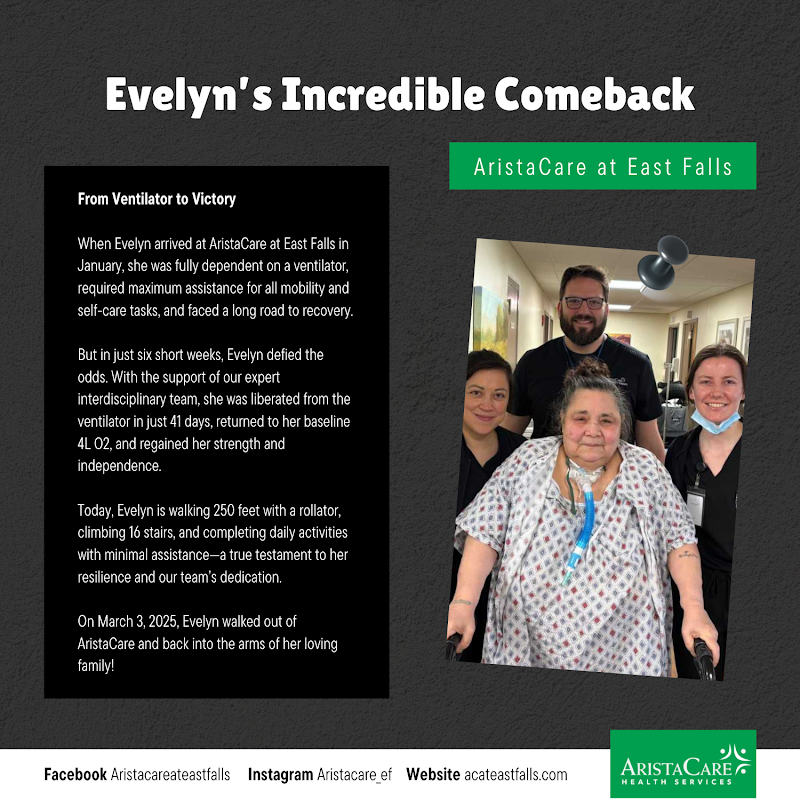
How Does Aristacare At East Falls Compare to Other Pennsylvania Nursing Homes?

Compared to the 100 nursing homes in Pennsylvania, ARISTACARE AT EAST FALLS's overall rating (1 stars) is below the state average of 3.0, staff turnover (63%) is significantly higher than the state average of 46%, and health inspection rating (1 stars) is much below the national benchmark.

What Should Families Ask When Visiting Aristacare At East Falls?

Based on this facility's data, families visiting should ask: "What changes have been made since the serious inspection findings, and how are you preventing similar issues?" "How do you ensure continuity of care given staff turnover, and what is your staff retention strategy?" "Can you walk me through typical staffing levels on day, evening, and night shifts?" "Can I visit during a mealtime to observe dining assistance and food quality?" These questions are particularly relevant given the facility's Immediate Jeopardy citations, the facility's high staff turnover rate, and the below-average staffing rating.

Is Aristacare At East Falls Safe?

Based on CMS inspection data, ARISTACARE AT EAST FALLS has documented safety concerns. Inspectors have issued 2 Immediate Jeopardy citations (the most serious violation level indicating risk of serious injury or death). The facility has a 1-star overall rating and ranks #100 of 100 nursing homes in Pennsylvania. Families considering this facility should ask detailed questions about what corrective actions have been taken since these incidents.

Do Nurses at Aristacare At East Falls Stick Around?

Staff turnover at ARISTACARE AT EAST FALLS is high. At 63%, the facility is 17 percentage points above the Pennsylvania average of 46%. Registered Nurse turnover is particularly concerning at 88%. RNs handle complex medical decisions and coordinate care — frequent RN changes can directly impact care quality. High turnover means new staff may not know residents' individual needs, medications, or preferences. It can also be disorienting for residents, especially those with dementia who rely on familiar faces. Families should ask: What is causing the turnover? What retention programs are in place? How do you ensure care continuity during staff transitions?

Was Aristacare At East Falls Ever Fined?

ARISTACARE AT EAST FALLS has been fined $75,219 across 4 penalty actions. This is above the Pennsylvania average of $33,831. Fines in this range indicate compliance issues significant enough for CMS to impose meaningful financial consequences. Common causes include delayed correction of deficiencies, repeat violations, or care failures affecting resident safety. Families should ask facility leadership what changes have been made since these penalties.

Is Aristacare At East Falls on Any Federal Watch List?

ARISTACARE AT EAST FALLS is not on any federal watch list. The most significant is the Special Focus Facility (SFF) program, which identifies the bottom 1% of nursing homes nationally based on persistent, serious quality problems. Not being on this list means the facility has avoided the pattern of deficiencies that triggers enhanced federal oversight. This is a positive indicator, though families should still review the facility's inspection history directly.