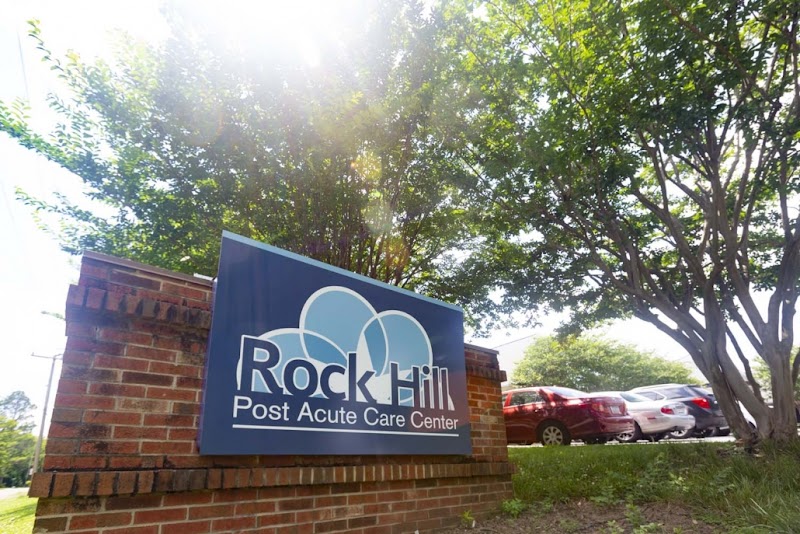
Rock Hill Post Acute Care Center
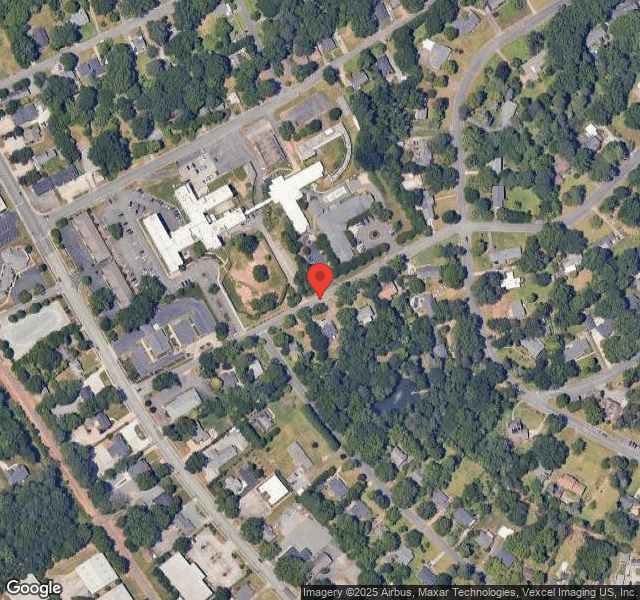
159 Sedgewood Dr, Rock Hill, SC 29732 (803) 329-6565
For profit - Limited Liability company 99 Beds THE ENSIGN GROUP Data: November 2025
Trust Grade
90/100
#23 of 186 in SC
Last Inspection: September 2025

Inspected within the last 6 months. Data reflects current conditions.

Overview

Rock Hill Post Acute Care Center has an excellent Trust Grade of A, which indicates a high level of quality care and is highly recommended. Ranking #23 out of 186 facilities in South Carolina places it in the top half, and it is the best option among 8 homes in York County. The facility's trend is stable, with 2 reported issues in both 2024 and 2025, suggesting consistency in their performance. Staffing is rated average with a turnover rate of 47%, which is similar to the state average, and there are no fines on record, which is a positive sign. However, there are some concerns, including incidents where residents' property was not adequately protected from theft, as well as failures in medication administration that could lead to infection risks. Overall, while the facility has strengths in its ratings and lack of fines, families should be aware of these specific issues that may impact resident safety and care.
Trust Score
A
90/100
In South Carolina
#23/186
Top 12%
Safety Record
Low Risk
No red flags
Inspections
Holding Steady
2 → 2 violations
Staff Stability
⚠ Watch
47% turnover. Above average. Higher turnover means staff may not know residents' routines.
Penalties
✓ Good
No fines on record. Clean compliance history, better than most South Carolina facilities.
Skilled Nurses
⚠ Watch
Each resident gets only 28 minutes of Registered Nurse (RN) attention daily — below average for South Carolina. Fewer RN minutes means fewer trained eyes watching for problems.
Violations
○ Average
7 deficiencies on record. Average for a facility this size. Mostly minor or procedural issues.
★★★★★
5.0
Overall Rating
★★★☆☆
3.0
Staff Levels
★★★★★
5.0
Care Quality
★★★★☆
4.0
Inspection Score
Stable
2024: 2 issues
2025: 2 issues

The Good

  • 5-Star Quality Measures · Strong clinical quality outcomes
  • Full Sprinkler Coverage · Fire safety systems throughout facility
  • No fines on record

Facility shows strength in quality measures, fire safety.

The Bad

Staff Turnover: 47%

Near South Carolina avg (46%)

Higher turnover may affect care consistency

Chain: THE ENSIGN GROUP

Part of a multi-facility chain

Ask about local staffing decisions and management

The Ugly 7 deficiencies on record

Sept 2025 2 deficiencies
CONCERN (D)

Potential for Harm - no one hurt, but risky conditions existed

Deficiency F0602 (Tag F0602)

Could have caused harm · This affected 1 resident

**NOTE- TERMS IN BRACKETS HAVE BEEN EDITED TO PROTECT CONFIDENTIALITY** Based on interview, record review, and facility document and policy review, the facility failed to protect a resident's property...

Read full inspector narrative →
**NOTE- TERMS IN BRACKETS HAVE BEEN EDITED TO PROTECT CONFIDENTIALITY** Based on interview, record review, and facility document and policy review, the facility failed to protect a resident's property from misappropriation for one of three residents (Resident (R) 96) reviewed for resident rights out of a total sample of 23. This failure had the possibility of negatively impacting all residents residing at the facility due to residents' property not being safeguarded against theft. Findings include: Review of the facility's Inservice Attendance Record, dated 04/04/25, indicated, Course Title: Resident Reported Theft/Loss . Subject: Theft/Loss by Residents: Theft of patient property is a form of abuse and should be reported to facility administration immediately. If the theft/loss is greater than $50.00 a police report must be filed. Employees could be subject to termination and/or legal consequences if found guilty of theft of resident property regardless of declared value .Review of the facility's policy titled, Abuse Prevention and Prohibition, dated 09/2023, indicated, . It is the policy of this facility that each resident has the right to be free from abuse, neglect, and misappropriation of resident property, and exploitation . Investigation: All identified events are reported to the Administrator/Designee immediately and will [be] thoroughly investigated . The facility will analyze occurrences and determine what changes are needed, if any, to the policies and procedures to prevent further occurrences . Review of R96's admission Record, located under the Profile tab of the electronic medical record (EMR), revealed R96 was originally admitted to the facility on [DATE] and readmitted on [DATE] with the diagnoses of type II diabetes, traumatic subdural hemorrhage, cognitive communication deficit, heart failure, fatty liver, dementia, major depressive disorder, Alzheimer's disease, and osteoporosis. R96 was discharged from the facility on 09/05/25. During R96's stay at the facility she resided on Hall 100. Review of R96's undated Inventory of Personal Effects indicated an inventory was taken of R96's personal effects that included: five blouses, five brassieres, two dresses, one pair of eyeglasses, three pajamas, five shirts, two shoes, and five socks. A staff member did not sign the inventory. There was no jewelry listed on this inventory sheet. Review of R96's quarterly Minimum Data Set (MDS), with an Assessment Reference Date (ARD) date of 09/03/25 and located under the RAI (Resident Assessment Instrument) tab, indicated R96 required set up assistance for eating and oral hygiene; partial/moderate assistancefor upper body dressing and personal hygiene; and substantial/moderate assistance for bed mobility, toileting hygiene, lower body dressing, and bathing. The MDS indicated R96 had a Brief Interview for Mental Status (BIMS) score of 14 out of 15, which indicated R96 was cognitively intact. Review of R96's Progress Note, dated 06/30/25 and located in EMR under the Progress Notes tab and written by Licensed Practical Nurse (LPN) 4, indicated, . Rt [resident] stated that on Friday night a young black lady told her that her fingers were swollen and that she needed to remove her rings and she would put them up. Called husband to verify that she returned to the facility with her rings on as well as verified with [Licensed Practical Nurse (LPN)3]. [LPN3] and I did do a thorough search of the room and did not find the rings. Also verified if rt recognized us as we were her nurses that night. Statement was made and filled out by CNA [Certified Nursing Assistant] who the rings were reported missing to as well as myself and [LPN3].Review of R96's Progress Note, dated 07/01/25 and located in EMR under the Progress Notes tab, indicated, SS [Social Services] called and made a police report about residents missing rings. Talked with officer . Case Id# is 2507010020 .Review of the facility's investigation regarding R96's missing rings indicated a written statement by LPN3, dated 07/01/25, which indicated, I . did the admission assessment on [R96] when she returned from the hospital on [DATE]. During her skin assessment, she was noted with two rings on her left ring finger, both gold in color . The rings were included in her inventory upon admission. I was also the nurse working the floor from 7:00 PM until 11:00 PM. Unfortunately, I did not pay attention to whether or not the rings were still on during that time. On Monday, June 30th at 1745 [5:45 PM], I was informed by the floor nurse . that [R96] stated her wedding ring was missing. I immediately informed my supervisor . searched [R96]'s room with [LPN4]. Still unable to locate rings . Review of the facility's investigation regarding R96's missing rings indicated an undated written statement by LPN4 which indicated, I . worked with R96 the night of June 27th from 11-7a but I did not notice if the resident was or was not wearing any rings .Review of the facility's investigation form titled, Five-Day Follow-Up Report, dated 07/07/25, indicated, . Immediate corrective action/assessment following Reportable Incident: Resident room searched, husband notified on details of police investigation. Showed resident pictures in an attempt to identify who asked her to remove her rings due to her fingers swelling, but she was unable to positively identify anyone . Interventions by Facility to prevent future Injury/Alleged Abuse: Facility has posted signage around the building and in resident rooms encouraging residents to send valuables home. Facility also acquired a safe and created a process for nursing to log and secure any valuables that resident is unbale to send home but wants stored at the facility. Summary Report of Facility Investigation: The facility does feel that this was a case of theft, but unable to prove who or exactly when the theft occurred .During an interview on 09/11/25 at 9:25 AM, the Administrator stated they now discourage Residents from bringing jewelry into the facility. The Administrator stated they posted signs around the facility about not keeping jewelry on site. The Administrator stated they hadpurchased a safe to enable them to store resident's jewelry securely. The Administrator said it was difficult to prove a case of theft.During an interview on 09/11/25 at 9:36 AM, Resident Representative (RP) 96 stated R96 had to go to the hospital for eight or nine days, and when R96 returned to the facility [R96] said some lady told her she needed to take the rings off due to her hands swelling. RP96 stated the following day a friend of R96 came to visit R96, and R96 asked her to locate the rings but she was unable to find them. RP96 stated the facility did make a police report and did show R96 pictures of staff that was working during that night. RP96 stated the facility staff had not offered any form of compensation for the missing rings. RP96 explained he had purchased replacement rings for R96. During an interview on 09/11/25 at 12:30 PM, the Director of Nursing (DON) confirmed he was involved with the investigation of R96's missing rings. The DON explained initially R96's room was searched, and after the rings were not located in R96's room or at her home, a report was made to the police department, staff was interviewed, and additional residents were interviewed. The DON stated as a result of the missing property, they put into place that the admission coordinator will discourage new residents from bringing jewelry with them into the facility. The DON also stated that during the admission process, when the Resident Inventory is being completed, there was now going to be a focus on jewelry items, and the documentation will be more detailed. The DON stated he watched hours of camera footage of people going in and out of R96's room but did not see anything out of the ordinary. During an interview on 09/11/25 at 1:45 PM, Occupational Therapy Assistant (OTA) confirmed he was familiar with R96 but did not remember if R96 had any rings on during her stay at the facility. During an interview on 09/11/25 at 1:55 PM, Speech Therapist (ST) 1 stated she was familiar with R96 but did not recall if R96 was wearing any rings.During an interview on 09/11/25 at 2:00 PM, Case Manager (CM) stated she did not remember seeing rings on R96's hand. CM stated R96 was admitted to the hospital and wondered if the rings were misplaced at the hospital.During an interview on 09/11/25 at 2:05 PM, CNA1 stated she was close to R96 and confirmed that R96 was wearing rings during her stay at the facility.During an interview on 09/11/25 at 2:15 PM, R96 stated on the night of the incident, someone told her to remove her rings due to her hands swelling. R96 stated she could not remember who the person was. R96 confirmed the facility staff did not offer any type of compensation for the missing rings.
CONCERN (D)

Potential for Harm - no one hurt, but risky conditions existed

Infection Control (Tag F0880)

Could have caused harm · This affected 1 resident

Based on observations, interview, and facility policy review, the facility failed to administer medications in a manner to prevent cross-contamination for five out of six residents (Resident (R)14, R6...

Read full inspector narrative →
Based on observations, interview, and facility policy review, the facility failed to administer medications in a manner to prevent cross-contamination for five out of six residents (Resident (R)14, R65, R87, R97, and R98) observed during medication administration. This had the potential to cause the spread of infection in the facility.Findings: Review of facility's undated policy titled, Infection Control Prevention and Control Program - Hand Hygiene revealed, . This facility considers hand hygiene the primary means to prevent the spread of infections . 3. Wash hands with soap (antimicrobial or non-antimicrobial) and water for the following situations:a. When hands are visibly soiled; and . 4. Use an alcohol-based hand rub containing at least 62% alcohol; or, alternatively, soap (antimicrobial or non-antimicrobial) and water for the following situations:a. Before and after coming on duty;b. Before and after direct contact with residents;c. Before preparing or handling medications .l. After contact with objects (e.g., medical equipment) in the immediate vicinity of the resident;m. After removing gloves .5. Hand hygiene is the final step after removing and disposing of personal protective equipment6. The use of gloves does not replace hand washing/hand hygiene. Integration of glove use along with routine hand hygiene is recognized as the best practice for preventing healthcare-associated infections . Review of undated policy titled, Medication Administration, revealed, . Hand hygieneLicensed nurse will foam in and out between residents unless resident is under enteric contact precautions or hands are visibly soiled then licensed nurse will wash hands with soap and water . 1. On 09/11/25 at 8:30 AM, Registered Nurse (RN) 1 was holding a cup of R97's medications. One pill accidentally dropped on the floor, and RN1 immediately picked it up with a bare hand, discarded the pill in the trash receptable of the medication cart, and failed to perform hand hygiene after. RN1 walked into R97's room holding the medication cup and gave the medications to R97. RN1 walked away to retrieve a replacement for the pill that was dropped. 2. On 09/11/25 at 9:06 AM, RN1 was dispensing a pill into a medication cup. RN1 dropped the pill on the medication cart. RN1 picked up the pill with a bare hand and placed it back in the medication cup. RN went ahead to give the pill to R98. During an interview on 09/11/25 at 9:09 AM, RN1 stated he had sanitized the medication cart at the beginning of medication pass and did not need to discard the medication. 3. On 09/11/25 at 9:10 AM, RN performed hand hygiene and donned a pair of gloves to administer eye drops to R65. On 09/11/25 at 9:12 AM, RN1 exited R65's room, wearing the same gloves. RN1 discarded the gloves in the medication cart's trash receptacle. RN1 did not perform hand hygiene. RN1 touched his computer mouse, keyboard, reached into his pocket for cart keys, opened the medication cart, and continued to dispense medications for the next resident (R87). 4. On 09/11/25 at 9:13 AM, without performing hand hygiene, RN1 entered R87's room with a cup of medications. R87 requested that his big pills be broken into two. On 09/11/25 at 9:18 AM, RN1 donned a pair of gloves while in R87's room without first performing hand hygiene, returned to the medication cart, broke some pills in the medication cup in two, and returned to R87's room to give the medications to R87. At 9:22 AM, wearing the same gloves, RN1 exited R87's room, doffed his gloves, and did not perform hand hygiene. 5. On 09/11/25 at 9:23 AM, RN1 touched the medication cart, the computer keyboard, mouse, and some paperwork on the cart. RN1 reached into his pocket for cart keys, opened the cart, and retrieved medications from the medication cart. RN1 accidentally dropped three pills on the medication cart. RN1 retrieved the pills with a bare hand and returned the pills into a medication cup. At 9:26 AM, RN1 entered R14's room and gave R14 the medications that had been picked off the medication cart. RN did not perform hand hygiene before entering R14's room. On 09/11/25 at 9:26 AM, RN1 performed hand hygiene upon exiting R14's room.During an interview on 09/11/25 at 9:28 AM, RN1 stated he had been performing hand hygiene. When told that he had entered several resident's rooms without performing hand hygiene, had donned and doffed gloves without performing hand hygiene, had not performed hand hygiene in between residents' rooms, and had picked up dropped pills with bare, unwashed hands, RN1 acknowledged these observations. During an interview on 09/11/2025 at 3:31 PM, the Infection Preventionist (IP) stated it was her expectation forRN1 to perform hand hygiene before donning and after doffing gloves. The IP stated RN1 should not have picked up dropped medications with bare hands and should have discarded dropped medications and not put them back in the medication cup for administration.
Aug 2024 2 deficiencies
CONCERN (D)

Potential for Harm - no one hurt, but risky conditions existed

Respiratory Care (Tag F0695)

Could have caused harm · This affected 1 resident

**NOTE- TERMS IN BRACKETS HAVE BEEN EDITED TO PROTECT CONFIDENTIALITY** Based on review of observations, interviews, record review and facility policy, the facility failed to administer oxygen consist...

Read full inspector narrative →
**NOTE- TERMS IN BRACKETS HAVE BEEN EDITED TO PROTECT CONFIDENTIALITY** Based on review of observations, interviews, record review and facility policy, the facility failed to administer oxygen consistent with professional standards of practice for 1 of 1 residents reviewed for respiratory care, Resident (R)21. Findings include: Review of the facility's policy titled, Infection Control Policy/Procedure, Subject: Oxygen, Use of with revision date 05/2021 revealed, Policy: It is the policy of this facility to promote resident safety in administrating oxygen. Procedures: The following guidelines will be observed in oxygen administration. 1. The O2 cannula or mask will be changed at least every 7 days, as well as the disposable humidifier. Tubing, masks, humidifiers and other disposables used for oxygen administration will be changed weekly or as needed. Review of R21's Electronic Medical Record (EMR) revealed R21 was admitted to the facility on [DATE] with diagnoses including but not limited to: chronic diastolic (congestive) heart failure, atrial fibrillation, and dependence on supplemental oxygen. Review of R21's admission Minimum Data Set (MDS) with an Assessment Reference Date (ARD) date of 08/12/24 revealed a Brief Interview for Mental Status (BIMS) score of 15 out of 15, indicating R21 has cognition intact. Review of R21's Care Plan documented, Focus: Date Initiated 08/13/24 . has potential for significant wt changes and altered nutritional status r/t dx of cutaneous abscess of abdominal wall, sepsis, ascites, chronic CHF, PCM, muscle weakness, O2 dependent, bacteremia, hx of TIA, Vit D deficiency, MDD, A-fib, HTN, CKD 3, wound, and variable intake. Goal Target Date: 10/31/24 Will maintain adequate nutritional status as evidenced by maintaining weight with no s/sx of malnutrition through review date. Interventions Date Initiated: 08/13/24 Administer medications as ordered. Monitor/Document for side effects and effectiveness. Review of R21's Physician Order documented, CHANGE O2 TUBING, H2O BOTTLE EVERY WEEK ON WEDNESDAY every night shift every Wed. During an observation of R21's room on 08/13/24 at 1:06 PM oxygen was observed via nasal canula at 2L/min. with tubing not labeled. During an interview on 08/13/24 at 1:13 PM, Licensed Practical Nurse (LPN)1 was asked to view the electronic medication administration record (eMAR) to confirm the oxygen rate of 2L/min and to confirm the order for changing tubing. Order for tubing change revealed it was to be weekly on Wed. nightshift. On 08/07/24 the eMAR was observed as signed by a nurse as completed. During an observation and interview on 08/13/24 at 1:15 PM, LPN1 confirmed in the room that the oxygen tubing was not dated. LPN1 agreed that it looked like it was signed as being completed per the order but evidence at the bedside did not support as tubing was observed without a date. LPN1 stated she would change the tubing and label. During an interview on 08/15/24 at 3:36 PM the Director of Nursing (DON) stated the expectation for ensuring that orders for changing oxygen tubing would be to follow the order. Evidence of following the order would include documentation in Point Click Care (PCC), and for some items it would be to date the tubing.
CONCERN (D)

Potential for Harm - no one hurt, but risky conditions existed

Deficiency F0761 (Tag F0761)

Could have caused harm · This affected 1 resident

**NOTE- TERMS IN BRACKETS HAVE BEEN EDITED TO PROTECT CONFIDENTIALITY** Based on observations, facility policy, and interviews, the facility failed to remove expired biologicals in 1 of 2 medication s...

Read full inspector narrative →
**NOTE- TERMS IN BRACKETS HAVE BEEN EDITED TO PROTECT CONFIDENTIALITY** Based on observations, facility policy, and interviews, the facility failed to remove expired biologicals in 1 of 2 medication storage rooms. Findings include: Review of the facility policy titled, Storing and Controlling Medications dated 01/2022 revealed, Policy: It is the policy of this facility to: 1. Store medications safely, securely, and properly following manufacturer's recommendations or those of the supplier, and in accordance with federal and state laws and regulations .Procedure: 9. Medications that are discontinued, expired .are immediately removed from the locked medication storage area and disposed of in accordance with the facility policies and procedures. During an observation on [DATE] at 8:40 AM on Unit one (1) medication storage room revealed the condition of the following biological: 1. One (1) Red top BD Vacutainer with lot number 3025477 and expiration date of [DATE]. During an observation and interview on [DATE] at 8:40 AM the Director of Nursing (DON) verified the medication supply was expired.
Aug 2022 3 deficiencies
CONCERN (D)

Potential for Harm - no one hurt, but risky conditions existed

Comprehensive Care Plan (Tag F0656)

Could have caused harm · This affected 1 resident

Based on review of the facility policy, observation, interview, and record review, the facility failed to ensure that 1 of 5 residents (Resident (R) 70) reviewed for potential accidents related to bed...

Read full inspector narrative →
Based on review of the facility policy, observation, interview, and record review, the facility failed to ensure that 1 of 5 residents (Resident (R) 70) reviewed for potential accidents related to bed rail use was care planned for bed mobility and positioning with bed rails. The failure to address the use of bed rails in the comprehensive care plan could increase the risk for falls, entrapments, and injuries related to the facility's use of bed rails for vulnerable residents. Findings include: Review of the facility policy titled Subject: Developing Baseline and Comprehensive Care plans, revised 02/2018, showed: Policy: It is the policy of this facility to develop and implement both a baseline care plan and a comprehensive care plan for each resident prepared by the interdisciplinary team Procedure: a. The facility will develop and implement a baseline care plan within 48 hours of admission including but not limited to: i. Initial goals based on admission orders ii. Physician orders iii. Dietary orders iv. Therapy services v. Social Services vi If applicable, PASARR recommendations b. The facility will develop the comprehensive care plan within 7 days after completion of the comprehensive assessment. Review of the Resident Assessment Instrument [RAI] Manual, October 2017 edition, page G-2 showed: Planning for Care Individualized care plans should address strengths and weakness, possible reversible causes such as deconditioning, . These may contribute to needless loss of self-sufficiency. -For some residents, cognitive deficits can limit ability or willingness to initiate or participate in self-care or restrict understanding of the tasks required to complete ADLs . Individualized care plans should be based on an accurate assessment of the resident's self-performance and the amount and type of support being provided to the resident. -Many residents might require lower levels of assistance if they are provided with appropriate devices and aids, . This type of supervision requires skill, time, and patience. Page G-3 Activities of Daily Living Definitions A. Bed mobility: how resident moves to and from lying position, turns side or side, and positions body while in bed or alternate sleep furniture. Page 4-9 and 4-10 The care plan is driven not only by identified resident issues and/or conditions but also by a resident's unique characteristics, strengths, and needs. A care plan that is based on a thorough assessment, effective clinical decision making, and is compatible with current standards of clinical practice can provide a strong basis for optimal approaches to quality of care and quality of life needs of individual residents. A well developed and executed assessment and care plan: -Looks at each resident as a whole human being with unique characteristics and strengths; -Views the resident in distinct functional areas for the purpose of gaining knowledge about the resident's functional status (MDS); . Observation of R70 on 08/07/22 at 4:53 PM showed him dressed and sleeping on top of his bedding with bilateral upper quarter bed rails. During an observation and interview on 08/08/22 at 8:51 AM, R70 was dressed and seated at the bedside, bilateral upper rails in place. At 8:57 AM, R70 was asked if he used his side rails and responded that he did use them when in bed. Review of R70's admission Record from the electronic medical record (EMR) Profile tab showed an original admission date of 02/10/20, and readmission dates of 06/10/20 and 06/23/21, with medical diagnoses that included cerebral aneurysm, hemiplegia and hemiparesis, and peripheral vascular disease. Review of R70's EMR Orders tab showed an order for 1/4 Siderails to assist with bed mobility and positioning active as 06/23/21. Review of R70's EMR Assessments tab showed LN [Licensed Nurse] - Restraint / Enabling Device / Safety Device Evaluation. showed the assessment for bed/side rails was completed on 06/24/22 with a recommendation for bilateral quarter side rails for bed mobility and positioning. Previous evaluations were completed on 03/24/22, 12/24/21, 09/24/21, 06/24/21, 06/12/20, and 02/11/20. A review of R70's quarterly Minimum Data Set (MDS) with an Assessment Reference Date (ARD) of 03/11/22, showed a Brief Interview for Mental Status (BIMS) score of 15, indicative of cognitively intact; with a Bed mobility assessment of extensive physical assistance of one person. R70's annual MDS with an ARD of 06/01/22, showed a BIMS score of 14, indicative of being cognitively intact; with a Bed mobility assessment of limited assistance of one person. R70's 5-day readmission MDS with an ARD of 08/01/22, showed a BIMS score of 12, indicative of mild cognitive impairment; with a Bed mobility assessment of independent with set up help only. Review of R70's care plan from the EMR Care Plan tab showed: Focus: [Res Name] has ADL [Activities of Daily Living] Self Care Performance Deficit r/t [related to] Limited Mobility r/t CVA [cerebral vascular accident] with right hemiplegia. He has a hx [history] of cerebral aneurysm. Date Initiated: 06/24/2021 Revision on: 05/26/2022 Goal: Will have ADL needs met with staff assist AEB [as evidenced by] neat clean appearance through the review date. Date Initiated: 06/24/2021 Revision on: 06/13/2022 Target Date: 09/01/2022 Interventions: -Converse with resident while providing care. -Explain all procedures/tasks before starting. -Offer masks QD [daily] and as needed -Pt to wear R arm sling when OOB, for RUE support and positioning, as tolerated by Patient -Right arm sling as indicated and tolerated -Therapy evaluation and treatment as per MD orders. -Encourage to participate to the fullest extent possible with each interaction. -Assist with transfers, dressing, grooming, toileting, and bathing QD and as needed. Further review did not show any care plan regarding bed mobility. During an interview on 08/08/22 at 3:15 PM regarding the care planning of bed mobility and side rails, MDS Coordinator (MDSC) 1 stated, Side rails should be care planned on the ADLs. MDSC1 reviewed R70's care plan in the EMR, and stated, It's not on his ADL care plan. I don't see where it [clarified, side rails] is on his care plan. In an interview on 08/09/22 at 2:53 PM, the Director of Nursing (DON) stated an expectation that bed rails would be care planned.
CONCERN (D)

Potential for Harm - no one hurt, but risky conditions existed

Deficiency F0700 (Tag F0700)

Could have caused harm · This affected 1 resident

Based on review of the facility policy, observation, interview, and record review, the facility failed to ensure that 1 of 5 residents (Resident (R) 123) and/or Resident Representative (RR) reviewed f...

Read full inspector narrative →
Based on review of the facility policy, observation, interview, and record review, the facility failed to ensure that 1 of 5 residents (Resident (R) 123) and/or Resident Representative (RR) reviewed for bed rail used were informed of the risks and benefits, and consent, for the use of bed rails. This failure had the potential for residents with bed rails to be uninformed of the risk of severe injury and/or death associated with bed rail use. Findings include: Review of the facility policy titled Subject: Bedrail Assessment, revised 08/2017, showed residents required assessment for bed rail use, but did not address the advisement of risks and benefits or obtaining an informed consent for bed rail use. Review of R123's admission Record from the electronic medical record (EMR) Profile tab showed an admission date of 08/05/22 with medical diagnoses that included chronic pain syndrome, ataxia (poor muscle control that causes clumsy voluntary movements), and orthopedic after care. R123 was observed in bed on 08/07/22 at 4:07 PM with bilateral upper (quarter) bed rails and on 08/08/22 at 8:45 AM, R123 was observed in bed with bilateral upper bed rails. Review of the IDT [Interdisciplinary Team] - BIMS [Brief Interview for Mental Status], dated 08/05/22, from the EMR Assessments tab, showed R123 had a score of zero of a possible 15, indicative of severe cognitive impairment. During an interview on 08/07/22 at 5:14 PM, regarding if the facility had informed of the risks and benefits of bilateral upper bed rails, R123's RR stated, Nobody said anything. When queried if R123's RR had signed a consent, the RR responded that he had signed a lot, so he was unsure. In an interview on 08/08/22 at 11:50 AM, the Administrator stated the bed rail risks and benefits are gone over by the person completing the restraints assessment located in the EMR Assessments tab. Review of R123's EMR Assessment tab LN [Licensed Nurse] - Restraint / Enabling Device / Safety Device Evaluation ., completed by Licensed Practical Nurse (LPN)1 and dated 08/07/22 showed the risks and benefits, and in the box titled Consent received from was typed R123's name. During a follow-up interview on 08/08/22 at 1:35 PM with R123's RR, at R123's room door (R123 was in bed with the head of the bed elevated and bilateral upper bed rails) regarding the licensed nurse having gone over risks and benefits and obtained consent from R123, the RR responded Well they might have but she wouldn't have understood them and had no idea what she was consenting to. In an interview on 08/08/22 at 3:20 PM, regarding the risk and benefits and consent with R123 who was severely cognitively impaired, LPN1 stated, I didn't personally go over it with them [R123 or R123's RR] but if the resident wasn't cognitive and not able to consent, I would give the responsible party the information, but I thought it was gone over in the admission process. I was just assessing. LPN1 accompanied the surveyor to the Director of Admissions (DAdmit) office at 3:24 PM and was present when the query was made if bed rail risks and benefits were reviewed during the admission process; DAdmit responded I don't go over side rails, no not at all. During an interview on 08/09/22 at 2:53 PM, the Director of Nursing stated an expectation that bed rail risks and benefits would be reviewed with the patient and family.
CONCERN (D)

Potential for Harm - no one hurt, but risky conditions existed

Deficiency F0761 (Tag F0761)

Could have caused harm · This affected 1 resident

Based on review of the facility policy, observation, interview, and record review, the facility failed to ensure, for 1 of 4 residents (Resident (R) 10) observed during medication administration obser...

Read full inspector narrative →
Based on review of the facility policy, observation, interview, and record review, the facility failed to ensure, for 1 of 4 residents (Resident (R) 10) observed during medication administration observations, the medication was accurately labeled during 1 of 1 nasal spray medication observations. This failure to identify a mislabeled medication increases the potential of medication errors. Findings include: Review of the facility policy titled Labeling and Packaging Guidelines, 09/2020 version, showed: A. Medication Labeling: All prescription medications and all non-prescription medications not in the original manufacturer's package shall be dispensed in an approved container. Each container shall have at least the following information contained on the label: 1. The brand and generic name of the medication if the medication is a brand name drug. 2. Directions for use. During a medication administration observation on 08/09/22 at 9:10 AM, Registered Nurse (RN)1 retrieved a prescription bottle for R10 from the medication cart that contained a fluticasone 50 microgram (mcg) allergy spray labeled for two sprays in each nare daily; opened 05/14/22. Review of R10's electronic medical record (EMR) Orders tab showed a prescription for Allergy Relief 50 MCG/ACT [activation] Suspension 1 spray in both nostrils one time a day for allergies shake gently ordered 05/12/22. After reviewing the order versus the label on 08/09/22 at 9:10 AM, RN1 stated she would contact the pharmacy about the discrepancy. During a telephone interview on 08/09/22 at 2:39 PM, Registered Pharmacist (RPh), from the facility pharmacy, reviewed the pharmacy documentation and the order and stated, The label does say two and order is one. We corrected it today. The RPh confirmed the label issued in May on the allergy spray was incorrect. During an interview on 08/09/22 at 2:59 PM, the Director of Nursing (DON) stated, Medication labels should match the order.
Understanding Severity Codes (click to expand)
Life-Threatening (Immediate Jeopardy)
J - Isolated K - Pattern L - Widespread
Actual Harm
G - Isolated H - Pattern I - Widespread
Potential for Harm
D - Isolated E - Pattern F - Widespread
No Harm (Minor)
A - Isolated B - Pattern C - Widespread

Questions to Ask on Your Visit

  • "Can I speak with families of current residents?"
  • "What's your RN coverage like on weekends and overnight?"

Our Honest Assessment

Strengths
  • • Grade A (90/100). Above average facility, better than most options in South Carolina.
  • • No major safety red flags. No abuse findings, life-threatening violations, or SFF status.
  • • No fines on record. Clean compliance history, better than most South Carolina facilities.
Concerns
  • • No significant concerns identified. This facility shows no red flags across CMS ratings, staff turnover, or federal penalties.
Bottom line: Generally positive indicators. Standard due diligence and a personal visit recommended.

About This Facility

What is Rock Hill Post Acute Care Center's CMS Rating?

CMS assigns Rock Hill Post Acute Care Center an overall rating of 5 out of 5 stars, which is considered much above average nationally. Within South Carolina, this rating places the facility higher than 99% of the state's 100 nursing homes. This rating reflects solid performance across the metrics CMS uses to evaluate nursing home quality.
How is Rock Hill Post Acute Care Center Staffed?
CMS rates Rock Hill Post Acute Care Center's staffing level at 3 out of 5 stars, which is average compared to other nursing homes. Staff turnover is 47%, compared to the South Carolina average of 46%.

What Have Inspectors Found at Rock Hill Post Acute Care Center?

State health inspectors documented 7 deficiencies at Rock Hill Post Acute Care Center during 2022 to 2025. These included: 7 with potential for harm.

Who Owns and Operates Rock Hill Post Acute Care Center?

Rock Hill Post Acute Care Center is owned by a for-profit company. For-profit facilities operate as businesses with obligations to shareholders or private owners. The facility is operated by THE ENSIGN GROUP, a chain that manages multiple nursing homes. With 99 certified beds and approximately 86 residents (about 87% occupancy), it is a smaller facility located in Rock Hill, South Carolina.

How Does Rock Hill Post Acute Care Center Compare to Other South Carolina Nursing Homes?

Compared to the 100 nursing homes in South Carolina, Rock Hill Post Acute Care Center's overall rating (5 stars) is above the state average of 2.9, staff turnover (47%) is near the state average of 46%, and health inspection rating (4 stars) is above the national benchmark.

What Should Families Ask When Visiting Rock Hill Post Acute Care Center?

Based on this facility's data, families visiting should ask: "Can I visit during a mealtime to observe dining assistance and food quality?" "How do you handle medical emergencies, and what is your hospital transfer rate?" "Can I speak with family members of current residents about their experience?"

Is Rock Hill Post Acute Care Center Safe?

Based on CMS inspection data, Rock Hill Post Acute Care Center has a clean safety record: no substantiated abuse findings (meaning no confirmed cases of resident harm), no Immediate Jeopardy citations (the most serious violation level indicating risk of serious injury or death), and is not on the Special Focus Facility watch list (a federal program monitoring the lowest-performing 1% of nursing homes). The facility has a 5-star overall rating and ranks #1 of 100 nursing homes in South Carolina. While no facility is perfect, families should still ask about staff-to-resident ratios and recent inspection results during their visit.

Do Nurses at Rock Hill Post Acute Care Center Stick Around?

Rock Hill Post Acute Care Center has a staff turnover rate of 47%, which is about average for South Carolina nursing homes (state average: 46%). Moderate turnover is common in nursing homes, but families should still ask about staff tenure and how the facility maintains care continuity when employees leave.

Was Rock Hill Post Acute Care Center Ever Fined?

Rock Hill Post Acute Care Center has no federal fines on record. CMS issues fines when nursing homes fail to meet care standards or don't correct problems found during inspections. The absence of fines suggests the facility has either maintained compliance or corrected any issues before penalties were assessed. This is a positive indicator, though families should still review recent inspection reports for the full picture.

Is Rock Hill Post Acute Care Center on Any Federal Watch List?

Rock Hill Post Acute Care Center is not on any federal watch list. The most significant is the Special Focus Facility (SFF) program, which identifies the bottom 1% of nursing homes nationally based on persistent, serious quality problems. Not being on this list means the facility has avoided the pattern of deficiencies that triggers enhanced federal oversight. This is a positive indicator, though families should still review the facility's inspection history directly.