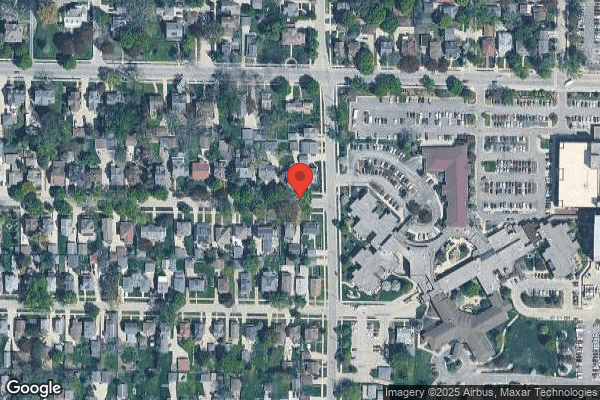
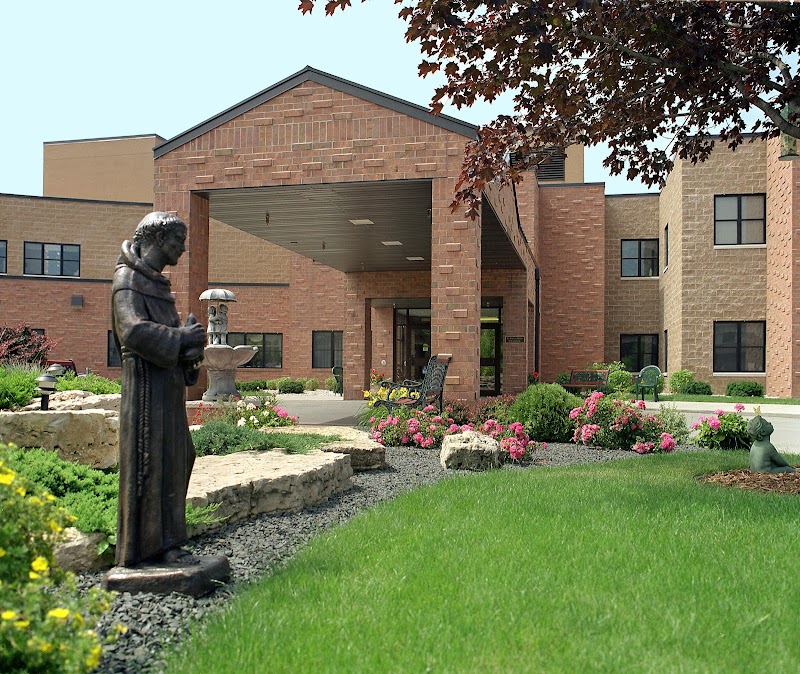
ST FRANCIS HOME

33 EVERETT ST, FOND DU LAC, WI 54935 (920) 923-7980
Non profit - Corporation 107 Beds SSM HEALTH Data: November 2025
Trust Grade
70/100
#124 of 321 in WI
Last Inspection: December 2024

Within standard 12-15 month inspection cycle. Federal law requires annual inspections.

Overview

St. Francis Home in Fond du Lac, Wisconsin has a Trust Grade of B, indicating it is a good choice but not among the very best. It ranks #124 out of 321 facilities in Wisconsin, placing it in the top half, and #2 out of 7 in Fond du Lac County, meaning only one local option is better. The facility is showing improvement, with issues decreasing from 13 in 2024 to just 1 in 2025. Staffing is rated 4 out of 5 stars, which is a strength, although the turnover rate is 51%, slightly above the state average of 47%. Notably, the facility has no fines on record, which is a positive sign. However, there are some concerns that families should consider. Recent inspections revealed that staff failed to wear personal protective equipment (PPE) during resident care and did not sanitize equipment properly, which could increase the risk of infection. Additionally, call lights were found out of reach for several residents, which could hinder their ability to request assistance when needed. While the facility has strengths, these issues highlight areas for improvement in resident safety and care.

Trust Score
B
70/100
In Wisconsin
#124/321
Top 38%
Safety Record
Low Risk
No red flags
Inspections
Getting Better
13 → 1 violations
Staff Stability
⚠ Watch
51% turnover. Above average. Higher turnover means staff may not know residents' routines.
Penalties
✓ Good
No fines on record. Clean compliance history, better than most Wisconsin facilities.
Skilled Nurses
✓ Good
Each resident gets 53 minutes of Registered Nurse (RN) attention daily — more than average for Wisconsin. RNs are trained to catch health problems early.
Violations
⚠ Watch
27 deficiencies on record. Higher than average. Multiple issues found across inspections.
★★★★☆
4.0
Overall Rating
★★★★☆
4.0
Staff Levels
★★★★★
5.0
Care Quality
★★★☆☆
3.0
Inspection Score
Stable
2024: 13 issues
2025: 1 issues

The Good

  • 4-Star Staffing Rating · Above-average nurse staffing levels
  • 5-Star Quality Measures · Strong clinical quality outcomes
  • Full Sprinkler Coverage · Fire safety systems throughout facility
  • No fines on record

Facility shows strength in staffing levels, quality measures, fire safety.

The Bad

Staff Turnover: 51%

Near Wisconsin avg (46%)

Higher turnover may affect care consistency

Chain: SSM HEALTH

Part of a multi-facility chain

Ask about local staffing decisions and management

The Ugly 27 deficiencies on record

Apr 2025 1 deficiency
CONCERN (D) 📢 Someone Reported This

A family member, employee, or ombudsman was alarmed enough to file a formal complaint

Potential for Harm - no one hurt, but risky conditions existed

Report Alleged Abuse (Tag F0609)

Could have caused harm · This affected 1 resident

Based on staff interview and record review, the facility did not report an allegation of misappropriation of contingency medication to the State Agency (SA). This had the potential to affect residents...

Read full inspector narrative →
Based on staff interview and record review, the facility did not report an allegation of misappropriation of contingency medication to the State Agency (SA). This had the potential to affect residents in the facility who may have needed contingency medications that were potentially diverted. On 1/11/25, the facility discovered missing doses of narcotic medication which raised the concern of potential drug diversion. The facility did not report the allegation of misappropriation to the SA. Findings include: The facility's Reporting Suspected Crimes Under the Federal Elder Justice Act, dated May 2020, indicates: It is the policy of this facility to a comply with the Elder Justice Act about reporting a reasonable suspicion of a crime under Section 1150B of the Social Security Act, as established by the Patient Protection and Affordable Care Act .Facilities are not required to report to either the State Survey Agency or local law enforcement under this act; only individuals are required to report. However, facilities may be required to report certain incidents under other federal, state, or local laws and regulations such as reporting to the SA abuse, neglect or misappropriation . On 4/21/25 at 10:09 AM, Surveyor interviewed Registered Nurse (RN)-D who was an agency nurse and worked at the facility part-time. RN-D indicated the nurse who worked on (a named hall) is the only nurse with a key to the facility's narcotic contingency medication. RN-D indicated if a narcotic medication is needed from the contingency box, two nurses call the pharmacy for permission. RN-D indicated this process changed after a big diversion which occurred around December 2024 in which almost the entire box of narcotics was missing. RN-D indicated contingency medications were moved to first floor during the process change. On 4/21/25 at 10:14 AM, Surveyor interviewed RN-E who indicated the new process started in December (2024) or January (2025) and includes checking the tag numbers and ensuring medication is in each compartment of the contingency box. RN-E indicated two nurses, one one each shift at shift change, complete the task. Surveyor observed RN-E open a cabinet in a locked medication room with a key from RN-E's pocket. RN-E indicated two nurses ensure the tag numbers on the box match the tag numbers written on the form and sign the form to verify it was checked and correct at shift change. Surveyor noted the contingency box was secured with two tags, one on each side. The box had an opaque see-through cover through which unit dose medications could be observed in individual compartments of the box. RN-E indicated the two nurses conduct a visual inspection of each compartment to ensure there are medications in each compartment but don't count the individual doses each shift. RN-E indicated if a medication is needed and the box is opened, the two nurses count the inventory of the box. On 4/21/25, Surveyor reviewed the facility's investigation which included a document titled Estimated Time form Discovery of Missing Controlled Substance II and Scheduled 2-5 Medications. The document indicated on 1/11/25 at 6:02 AM, staff called Director of Nursing (DON)-B and reported several medications were missing from the contingency box. The document indicated the contingency box was missing one 12 microgram (mcg) fentanyl (a narcotic medication used to treat severe pain) patch, five 15 mg morphine (a narcotic medication used to treat moderate to severe pain) IR (immediate release) tablets, five 15 mg morphine SR (sustained release) tablets, nine 5 mg oxycodone (a narcotic medication used to treat moderate to severe pain) tablets, ten 10 mg Oxycontin (a narcotic medication used to treat moderate to severe pain) ER (extended release) tablets, ten 5/325 mg hydrocodone/APAP (an opioid analgesic medication used to treat pain) tablets, and ten 10/325 mg hydrocodone/APAP tablets. The document indicated the facility contacted local law enforcement on 1/11/25 at approximately 8:30 AM. The document did not indicate the facility reported the potential allegation of misappropriation to the SA. On 4/21/25 at 2:37 PM, Surveyor interviewed Nursing Home Administrator (NHA)-A who verified the SA was not notified of the potential allegation of misappropriation that was discovered on 1/11/25.
Dec 2024 10 deficiencies
CONCERN (D)

Potential for Harm - no one hurt, but risky conditions existed

Notification of Changes (Tag F0580)

Could have caused harm · This affected 1 resident

**NOTE- TERMS IN BRACKETS HAVE BEEN EDITED TO PROTECT CONFIDENTIALITY** Based on staff interview and record review, the facility did not ensure a physician was notified when 1 resident (R) (R186) of 1...

Read full inspector narrative →
**NOTE- TERMS IN BRACKETS HAVE BEEN EDITED TO PROTECT CONFIDENTIALITY** Based on staff interview and record review, the facility did not ensure a physician was notified when 1 resident (R) (R186) of 1 sampled resident had a blood sugar outside the parameters of a physician's order. R186 had an order to notify the physician if R186's blood sugar was higher than 400 mg/dL (milligrams per deciliter) or less than 60 mg/dL. On 12/15/24, R186's blood sugar was 409 mg/dL. R186's physician was not notified. Findings include: The facility's Notification of Change policy, revised 11/2022, indicates: The community will consult the resident's Physician, Nurse Practitioner, or Physician Assistant and notify the resident representative or an interested family member when there is: .acute illness or a significant change in the resident's physical, mental, or psychosocial status (i.e., deterioration in health, mental, or psychosocial status in either life-threatening conditions or clinical complications) .A need to alter treatment significantly means a need to stop a form of treatment because of adverse consequences .or commence a new form of treatment to deal with a problem. Notification: Depending on the nursing assessment, appropriate notification may be immediate to 48 hours. From 12/16/24 to 12/18/24, Surveyor reviewed R186's medical record. R186 was admitted to the facility on [DATE] with diagnoses including diabetes and cellulitis of left limb. R186's Minimum Data Set (MDS) assessment, dated 12/16/24, had a Brief Interview for Mental Status (BIMS) score of 15 out of 15 which indicated R186 was not cognitively impaired. R186 did not have an activated healthcare decision maker. R186 had a physician's order that indicated to notify the physician if R186's blood sugar reading was higher than 400 mg/dL or less than 60 mg/dL. On 12/17/24, Surveyor reviewed R186's blood sugar results and noted on 12/15/24, R186 had a blood sugar level of 409. R186's medical record did not indicate R186's physician was notified of the result. On 12/17/24 at 1:05 PM, Surveyor interviewed Registered Nurse (RN)-I who verified R186's blood sugar level on was 409 on 12/15/24. RN-I indicated if R186's blood sugar level was greater than 400, R186's physician should be notified. RN-I confirmed R186's medical record did not contain documentation of physician notification. On 12/17/24 at 3:55 PM, Surveyor interviewed Director of Nursing (DON)-B who indicated the physician should have been notified when R186's blood sugar level was over 400 per R186's order.
CONCERN (D)

Potential for Harm - no one hurt, but risky conditions existed

Deficiency F0625 (Tag F0625)

Could have caused harm · This affected 1 resident

**NOTE- TERMS IN BRACKETS HAVE BEEN EDITED TO PROTECT CONFIDENTIALITY** Based on staff and resident interview and record review, the facility did not ensure 2 residents (R) (R11 and R33) of 6 resident...

Read full inspector narrative →
**NOTE- TERMS IN BRACKETS HAVE BEEN EDITED TO PROTECT CONFIDENTIALITY** Based on staff and resident interview and record review, the facility did not ensure 2 residents (R) (R11 and R33) of 6 residents reviewed for hospitalization received written notification of the facility's bedhold policy when they were transferred to the hospital. R11 was transferred to the hospital on 2/22/24. The facility did not obtain written bedhold confirmation from R11 or R11's Power of Attorney (POA). In addition, R11 was transferred to the hospital on 5/1/24. Neither R11 or R11's POA were provided with a written bedhold notification for R11's 5/1/24 hospital transfer. R33 was transferred to the hospital on 8/7/24. The facility did not obtain written bedhold confirmation from R33 or R33's emergency contact. Findings include: The facility's undated Bedhold Policy and Notification/Acknowledgement policy indicates prior to a resident being transferred to a hospital .a notice is given concerning the facility's bedhold policy. 1. From 12/16/24 to 12/18/24, Surveyor reviewed R11's medical record. R11 was admitted to the facility on [DATE] and had diagnoses including congestive heart failure, type 2 diabetes, and major depression. R11 had an activated POA. R11's medical record indicated R11 had a change in condition on 2/22/24 and was transferred to the hospital. R11 returned to the facility on 2/29/24. R11 had another change in condition on 5/1/24 and was transferred to the hospital. R11 returned to the facility on 5/6/24. On 12/17/24, Surveyor reviewed the Bedhold Notification/Acknowledgment for R11's 2/22/24 hospital transfer which did not include a signature of acknowledgement from R11 or R11's POA. In addition, the facility did not provide R11 or R11's POA with a written bedhold notice for R11's 5/1/24 hospital transfer. 2. From 12/16/24 to 12/138/24, Surveyor reviewed R33's medical record. R33 was admitted to the facility on [DATE] and had diagnoses including cardiomyopathy, cardiomegaly, type 2 diabetes. R33 did not have an activated POA. R33's medical record indicated R33 had a change in condition on 8/7/24 and was transferred to the hospital. R33 returned to the facility on 8/9/24. On 12/17/24, Surveyor reviewed the Bedhold Notification/Acknowledgment for R33's 2/22/24 hospital transfer which did not include a signature of acknowledgement from R33 or R33's emergency contact. On 12/18/24 at 1:44 PM, Surveyor interviewed Nursing Home Administrator (NHA)-A who indicated it is the nurse's responsibility to ask the resident or their representative if they want a bedhold and the Social Worker's responsibility to follow-up and obtain responses and signatures. NHA-A confirmed signatures should have been obtained for R11 and R33's hospitalizations. NHA-A stated the facility did not complete a bedhold for R11's 5/1/24 hospital transfer because R11 did not want a bedhold and the facility discharged R11 from the record.
CONCERN (D)

Potential for Harm - no one hurt, but risky conditions existed

Assessment Accuracy (Tag F0641)

Could have caused harm · This affected 1 resident

**NOTE- TERMS IN BRACKETS HAVE BEEN EDITED TO PROTECT CONFIDENTIALITY** Based on staff interview and record review, the facility did not ensure Minimum Data Set (MDS) assessments were coded correctly ...

Read full inspector narrative →
**NOTE- TERMS IN BRACKETS HAVE BEEN EDITED TO PROTECT CONFIDENTIALITY** Based on staff interview and record review, the facility did not ensure Minimum Data Set (MDS) assessments were coded correctly for 2 residents (R) (R11 and R19) of 21 sampled residents. R11 was prescribed lorazepam (an anti-anxiety medication) and oxycodone (an opioid medication). R11's MDS assessments, dated 5/21/24, 6/24/24 and 9/20/24, did not indicate R11 received anti-anxiety or opioid medication. R19 had a diagnosis of mental illness (MI). R19's MDS assessment, dated 8/6/24, indicated R19 did not have a serious mental illness. Findings include: 1. From 12/16/24 to 12/18/24, Surveyor reviewed R11's medical record. R11 was admitted to the facility on [DATE] and had diagnoses including major depression disorder, altered mental status, and psychophysiologic insomnia. R11's MDS assessment, dated 9/20/24, had a Brief Interview for Mental Status (BIMS) score of 6 out of 15 which indicated R11 had severely impaired cognition. R11 had an activated Power of Attorney (POA) to assist with healthcare decisions. R11 had physician's orders for lorazepam (with a start date of 5/15/24) and oxycodone (with a start date of 5/15/24). R11's MDS assessments, dated 5/21/24, 6/24/24, and 9/20/24 did not indicate R11 received anti-anxiety or opioid medication. 2. From 12/16/24 to 12/18/24, Surveyor reviewed R19's medical record. R19 admitted to the facility on [DATE] from another skilled nursing facility (SNF) and had diagnoses including schizoaffective disorder and anxiety disorder. R19's MDS assessment, dated 11/1/24, had a BIMS score of 15 out of 15 which indicated R19 was not cognitively impaired. R19's Preadmission Screening and Resident Review (PASRR) Level I, dated 9/12/17, indicated R19 was at another SNF at the time of completion and had an MI with corresponding medication. R19's PASRR Level II, dated 10/12/17, confirmed R19's MI diagnosis. R19 transferred to the facility on 8/11/24. R19's MDS assessment, dated 8/6/24, indicated R19 was not evaluated by PASRR Level II and determined to have a serious MI (section A1500). On 12/18/24 at 1:21 PM, Surveyor interviewed Director of Nursing (DON)-B who stated the facility had been in transition with an MDS coordinator and had an outside company completing MDS assessments in the interim, therefore, DON-B was unable to confirm the MDS coding errors. On 12/18/24 at 2:32 PM, Surveyor interviewed Social Worker (SW)-G who stated SW-G was responsible for completion of section A1500 of the MDS. SW-G indicated R19's MDS should have been coded to indicate R19 had a serious MI.
CONCERN (D)

Potential for Harm - no one hurt, but risky conditions existed

Deficiency F0692 (Tag F0692)

Could have caused harm · This affected 1 resident

**NOTE- TERMS IN BRACKETS HAVE BEEN EDITED TO PROTECT CONFIDENTIALITY** Based on staff interview and record review, the facility did not ensure the appropriate care and treatment were provided for 1 r...

Read full inspector narrative →
**NOTE- TERMS IN BRACKETS HAVE BEEN EDITED TO PROTECT CONFIDENTIALITY** Based on staff interview and record review, the facility did not ensure the appropriate care and treatment were provided for 1 resident (R) (R54) of 1 resident reviewed for weight monitoring. The facility did not ensure R54's physician was notified when R54 had a significant weight gain. In addition, the facility did not consistently monitor R54's weight per the physician's order. Findings include: The facility's Nutrition Policy, dated 2/2023, indicates the facility maintains acceptable parameters of nutritional status such as body weight or desirable body weight range .unless the resident's clinical condition demonstrates that this is not possible, or the resident's preferences indicates otherwise. From 12/16/24 to 12/18/24, Surveyor reviewed R54's medical record. R54 was admitted to the facility on [DATE] and had diagnoses including atrial fibrillation, personal history of other venous thrombosis and embolism, and chronic kidney disease, stage 3 unspecified. R54's Minimum Data Set (MDS) assessment, dated 10/17/24, had a Brief interview for Mental Status (BIMS) score of 14 out of 15 which indicated R54 was not cognitively impaired. R54's medical record contained the following information: ~ R54 had a physician's order for weights to be completed daily for 3 days and then weekly and to update the physician if R54's weight increased or decreased by 3 lbs in 1 day or 5 lbs in 1 week. ~ R54 was first weighed on 10/13/24 and was 151.2 lbs. ~ R54 weighed 152 lbs on 10/23/24. ~ On 11/5/24, R54 had a weight gain of 8.4 lbs in 23 days. R54's medical record did not indicate the physician was notified. ~ On 11/26/24, R54 had an additional weight gain of 7.2 lbs. R54's medical record did not indicate the physician was notified. ~ On 12/9/24, R54 had an additional weight gain of 9.7 lbs. R54's medical record did not indicate physician was notified. ~ On 12/11/24, R54 weighed 176.5 lbs (which was a 16.73% weight gain). The Dietitian documented R54 was up 20 lbs since admission. R54's medical record did not indicate the physician was notified. ~ On 12/11/24, R54's physician order was changed to daily weights due to edema and changes in medication and to update the physician if R54's weight increased or decreased by 3 lbs in 1 day or 5 lbs in 1 week. ~ R54's medical record did not contain weights after 12/11/24. On 12/18/24 at 1:01 PM, Surveyor interviewed Infection Preventionist (IP)-E who confirmed R54 was not weighed for the first 3 days following admission but should have been weighed per the physician's order. IP-E stated IP-E changed R54's order on 12/11/24 to daily weights because R54's weights had been off and R54 was started on a diuretic. IP-E confirmed R54's weights were not consistently obtained and should have been completed per the physician's order. IP-E confirmed R54's physician was not updated per the order or of R54's significant weight gain. IP-E indicated R54 was placed on isolation precautions on 12/11/24 due to illness. IP-E stated staff do not complete weights on residents who are on isolation precautions. IP-E confirmed staff should have updated R54's physician on the facility's inability to obtain R54's weight.
CONCERN (D)

Potential for Harm - no one hurt, but risky conditions existed

Pharmacy Services (Tag F0755)

Could have caused harm · This affected 1 resident

**NOTE- TERMS IN BRACKETS HAVE BEEN EDITED TO PROTECT CONFIDENTIALITY** Based on observation, staff and resident interview, and record review, the facility did not provide pharmaceutical services to e...

Read full inspector narrative →
**NOTE- TERMS IN BRACKETS HAVE BEEN EDITED TO PROTECT CONFIDENTIALITY** Based on observation, staff and resident interview, and record review, the facility did not provide pharmaceutical services to ensure the safe administration of drugs and biologicals for 2 residents (R) (R27 and R78) of 21 sampled residents. On 12/16/24, Surveyor observed two inhalers on R27's bedside table. R27 indicated R27 self-administered the inhalers as needed. A self-administration of medication assessment, dated 9/24/24, determined R27 was unable to self-administer medication. On 12/17/24, R78's 500 milligram (mg) ranolazine (used to treat chest pain) tablet was administered late. Findings include: The facility's Medication Administration policy, revised 11/2024, indicates: This community supervises or administers all medications a resident receives as ordered by their physician. The community provides appropriate methods and procedures for obtaining, dispensing, and administering drugs approved by the resident's physician and consulting pharmacist .Staff members responsible for administering medications review the physician's order prior to administering medications .Medication Administration Record (MAR) is reviewed to obtain correct medication, time, dosage, and route of administration as ordered by the physician for each individual resident .Resident Medication Agreement: .3) When a resident's drugs are obtained from another pharmacy, it is the resident/responsible party's responsibility to see that all drugs brought in are in compliance with policy and state regulations. 4) To meet policy and state regulations, all medications must have a doctor's order and a proper label .If drugs are purchased from another pharmacy, it becomes the responsibility of the person obtaining the drugs to see that they are properly labeled. 5) Labels should include the name of the pharmacy, pharmacy's address and telephone number, name of the resident, name of the prescribing physician or dentist, date and prescription number, directions for use of the drug, dosage unit of the medication, quantity of the drug, expiration date, and other auxiliary statements as required by the drug and as determined by the pharmacist .7) When a resident moves in, the community requires a doctor's order in writing. Only those drugs listed on the order will be administered to the resident .9) No drugs are allowed in resident rooms unless specifically ordered by the physician. If a resident does self-administer medications, they must have a locked box or cabinet in their room. The resident will have a key to the box or cabinet and one key is kept in the medication room. 1. On 12/16/24, Surveyor reviewed R27's medical record. R27 was admitted to the facility on [DATE] and had diagnoses including spinal stenosis, wheezing, and congestive heart failure. R27's Minimum Data Set (MDS) assessment, dated 10/8/24, had a Brief Interview for Mental Status (BIMS) score of 12 out of 15 which indicated R27 had moderate cognitive impairment. R27 did not have an activated healthcare decision maker. On 12/16/24 at 11:27 AM, Surveyor observed two inhalers on R27's bedside table. The first inhaler was Spiriva 2.5 micrograms (mcg) with no open date. The second inhaler was albuterol sulfate 200 metered inhalation with no open date. R27 indicated both inhalers were brought from home. R27's medical record contained a physician's order for Albuterol Sulfate HFA Inhalation Aerosol Solution 108 (90 base) mcg/act (micrograms/actuation), 2 puffs inhale orally every 4 hours as needed for wheezing. R27 did not have a physician's order for Spiriva. R27's medical record contained a self-administration of medication assessment, dated 9/24/24, that indicated R27 was unable to self-administer medication. On 12/17/24 at 1:29 PM, Surveyor interviewed Registered Nurse (RN)-I who confirmed both inhalers were on R27's bedside table but should not be in R27's room. RN-I verified R27 had a physician's order for albuterol sulfate but did not have an order for Spiriva. RN-I also verified R27 did not have an order to self-administer medication or an assessment that indicated R27 could safely and accurately do so. Surveyor also interviewed Assistant Director of Nursing (ADON)-J who indicated R27 was unable to use a locked drawer and was, therefore, not able to self-administer medication. On 12/17/24 at 2:23 PM, Surveyor interviewed Director of Nursing (DON)-B who verified R27's self-administration of medication assessment indicated R27 was unable to self-administer medication. DON-B indicated R27 should not have inhalers in R27's room. 2. On 12/17/24, Surveyor reviewed R78's medical record. R78 was admitted to the facility on [DATE] and had diagnoses including pulmonary embolism (obstruction in blood vessel), pressure ulcer stage 3 to left heel, and after care following surgical amputation to right leg. R78's MDS assessment, dated 10/4/24, had a BIMS score of 9 out of 15 which indicated R78 had moderately impaired cognition. R78 did not have an activated healthcare decision maker. On 12/17/24 at 9:07 AM, Surveyor observed Licensed Practical Nurse (LPN)-O prepare and administer R78's AM medication, including a 500 mg tablet of ranolazine. Surveyor reviewed R78's physician orders and noted R78 had an order for ranolazine 500 mg to be given by mouth every 12 hours at 8:00 AM and 8:00 PM. On 12/17/24 at 10:47 AM, Surveyor interviewed LPN-O who verified R78's ranolazine was scheduled for 8:00 AM and there was an hour window to administer. On 12/17/24 at 11:08 AM, Surveyor interviewed DON-B who indicated if a medication is ordered to be administered at 8:00 AM, there is a one hour window for administration. DON-B indicated if an 8:00 AM medication is administered at 9:07 AM, the medication is considered late.
CONCERN (D)

Potential for Harm - no one hurt, but risky conditions existed

Deficiency F0757 (Tag F0757)

Could have caused harm · This affected 1 resident

**NOTE- TERMS IN BRACKETS HAVE BEEN EDITED TO PROTECT CONFIDENTIALITY** 3. From 12/17/24 to 12/18/24, Surveyor reviewed R11's medical record. R11 was admitted to the facility on [DATE] and had diagnos...

Read full inspector narrative →
**NOTE- TERMS IN BRACKETS HAVE BEEN EDITED TO PROTECT CONFIDENTIALITY** 3. From 12/17/24 to 12/18/24, Surveyor reviewed R11's medical record. R11 was admitted to the facility on [DATE] and had diagnoses including CHF, chronic kidney disease, stage 3, and type 2 diabetes. R11's MDS assessment, dated 9/20/24, had a BIMS score of 6 out of 15 which indicated R11 had severely impaired cognition. R11 had an activated Power of Attorney for Healthcare (POAHC) to assist with healthcare decisions. R11's medical record contained physician orders for one 5 mg oxycodone tablet every 2 hours as needed for pain and one 10 mg torsemide tablet once daily for CHF. R11 had a pain care plan. Surveyor noted R11's pain care plan and medical record did not contain monitoring interventions for opioid or diuretic use. On 12/18/24, Surveyor reviewed R11's plan of care and noted R11's pain care plan was updated on 12/17/24 to indicate R11 received opioid medication and to monitor/notify for side effects of opioid use such as: sedation, dizziness, nausea, vomiting, constipation, and respiratory depression. R11's plan of care still did not contain monitoring interventions for diuretic use. On 12/18/24 at 10:18 AM, Surveyor interviewed DON-B who confirmed R11 did not have side effect monitoring in place for opioid medication (prior to 12/17/24) or diuretic medication but should have. Based on staff interview and record review, the facility did not ensure monitoring for high risk medications was in place for 3 residents (R) (R30, R69, and R11) reviewed for unnecessary medications. R30 was prescribed hydrocodone-acetaminophen (an opioid medication) for pain. R30 was not monitored for adverse reactions or side effects of the high-risk medication. R69 was prescribed oxycodone (an opioid medication) for pain. R69 was not monitored for adverse reactions or side effects of the high-risk medication. R11 was prescribed oxycodone and torsemide (a diuretic medication) for congestive heart failure (CHF). R11 was not monitored for adverse reactions or side effects of the high-risk medications. Findings include Per the Federal Food and Drug Administration (FDA), opioid medications have a black box warning. A black box warning is the FDA's strongest safety warning given to medications. These medications have the potential for severe side effects. The facility's Pain Management policy, dated 4/1/08, indicates: There is a system in place to identify, monitor and evaluate residents' pain .12. Potential side effects related to pain medications will be identified in the person-centered care plan. 1. On 12/17/24, Surveyor reviewed R30's medical record. R30 was admitted to the facility on [DATE] and had diagnoses including right femur fracture, gout, muscle spasms, rheumatoid arthritis, and generalized discomfort. R30's Minimum Data Set (MDS) assessment, dated 10/8/24, had a Brief Interview for Mental Status (BIMS) score of 15 out of 15 which indicated R30 was not cognitively impaired. R30's medical record indicated R30 was prescribed one 5-325 milligram (mg) tablet of hydrocodone-acetaminophen two times daily and as needed (PRN) every 6 hours for pain. Surveyor noted R30's pain care plan (initiated on 8/9/23) and medical record did not contain monitoring interventions for opioid use. On 12/18/24, Surveyor reviewed R30's plan of care and noted R30's pain care plan was updated on 12/17/24 to indicate R30 received opioid medication. The care plan indicated staff should monitor/notify for side effects of opioid use such as: sedation, dizziness, nausea, vomiting, constipation, and respiratory depression. 2. On 12/17/24, Surveyor reviewed R69's medical record. R69 was admitted to the facility on [DATE] and had diagnoses including spondylosis without myelopathy or radiculopathy, cervical region and osteoarthritis of the hip. R69's MDS assessment, dated 11/15/24, had a BIMS score of 1 out of 15 which indicated R69 had severely impaired cognition. R69 received Hospice services. R69's medical record indicated R69 was prescribed 5 mg of oxycodone every 2 hours as needed for pain 4-10/10 or terminal and 2 tablets by mouth 3 times daily. R69 had a pain care plan. Surveyor neither R69's pain care plan or medical record contained monitoring interventions for opioid use. On 12/18/24, Surveyor reviewed R69's plan of care and noted the facility had revised R69's pain care plan on 12/17/24 to indicate R69 received opioid medication and to monitor/notify for side effects of opioid use such as: sedation, dizziness, nausea, vomiting, constipation, and respiratory depression. On 12/18/24 at 12:47 PM, Surveyor interviewed Director of Nursing (DON)-B who confirmed R30 and R69 did not have opioid side effect monitoring in their care plans prior to 12/17/24 but should have.
CONCERN (D)

Potential for Harm - no one hurt, but risky conditions existed

Unnecessary Medications (Tag F0759)

Could have caused harm · This affected 1 resident

**NOTE- TERMS IN BRACKETS HAVE BEEN EDITED TO PROTECT CONFIDENTIALITY** Based on observation, staff interview, and record review, the facility did not ensure it was free of a medication error rate of ...

Read full inspector narrative →
**NOTE- TERMS IN BRACKETS HAVE BEEN EDITED TO PROTECT CONFIDENTIALITY** Based on observation, staff interview, and record review, the facility did not ensure it was free of a medication error rate of 5% or greater. During medication administration observations, 3 errors occurred during 32 opportunities which resulted in a 9.37% medication error rate that affected 1 resident (R) (R21) of 3 residents observed during medication administration. On 12/17/24, R21 was administered two medications in the wrong form and one incorrect medication. Findings include: The facility's Medication-Crushing policy, revised 4/1/08, indicates: Only appropriate medications will be crushed with physician orders .1) Only medications approved to be crushed by the manufacturer are crushed. 2) All crushed medications are documented with a physician's order. According to Carbidopa and Levodopa Extended-Release Tablets-Drugs.com: .How is this medicine best taken? .Swallow whole. Do not chew or crush. According to Potassium Chloride: Uses, Dosage & Side Effects-Drugs.com: .How Should I take Potassium Chloride? .Do not crush, chew, or suck on a tablet or capsule. The facility's Medication Administration policy, revised 11/2024, indicates: The community provides appropriate methods and procedures for obtaining, dispensing, and administering drugs approved by the resident's physician and consulting pharmacist .Staff members responsible for administering medications review the physician's order prior to administering medications .Procedure: .5) Medication Administration Record (MAR) is reviewed to obtain correct medication, time, dosage, and route of administration as ordered by the physician for each individual resident . 1. On 12/17/24, Surveyor reviewed R21's medical record. R21 was admitted to the facility on [DATE] and had diagnoses including hemiplegia (paralysis) and hemiparesis (weakness) following nontraumatic intracranial hemorrhage (brain bleed) affecting the left non-dominant side and Parkinson's disease. R21's Minimum Data Set (MDS) assessment, dated 10/29/24, had a Brief Interview for Mental Status (BIMS) score of 7 out of 15 which indicated R21 had severely impaired cognition. R21 had an activated Power of Attorney for Healthcare (POAHC). On 12/17/24 at 8:44 AM, Surveyor observed Licensed Practical Nurse (LPN)-O prepare and administer R21's AM medication. Surveyor observed LPN-O crush R21's medications, including carbidopa/levodopa (used to treat Parkinson's disease) 25-100 milligrams (mg) extended release and potassium chloride (supplement) 20 milliequivalents (mEq) extended release. Surveyor also observed LPN-O administer an 8.6 mg tablet of senna (used to treat constipation). Surveyor reviewed R21's physician orders and noted R21 did not have an order for senna 8.6 mg. R21 had an order for senna plus oral tablet 8.6-50 mg (which contained docusate, another laxative). On 12/17/24 at 9:05 AM, Surveyor interviewed LPN-O who indicated extended release medications should not be crushed. LPN-O indicated LPN-O crushed R21's extended release medications due to R21's swallowing issues. LPN-O indicated LPN-O should call a resident's physician prior to crushing extended release medications. On 12/17/24 at 9:18 AM, Surveyor interviewed Assistant Director of Nursing (ADON)-J who indicated extended release medications should not be crushed. On 12/17/24 at 10:47 AM, Surveyor interviewed LPN-O who verified LPN-O administered senna 8.6 mg to R21 instead of senna plus 8.6-50 mg.
CONCERN (E)

Potential for Harm - no one hurt, but risky conditions existed

Deficiency F0558 (Tag F0558)

Could have caused harm · This affected multiple residents

**NOTE- TERMS IN BRACKETS HAVE BEEN EDITED TO PROTECT CONFIDENTIALITY** Based on observation, staff and resident interview, and record review, the facility did not ensure call lights were in reach for...

Read full inspector narrative →
**NOTE- TERMS IN BRACKETS HAVE BEEN EDITED TO PROTECT CONFIDENTIALITY** Based on observation, staff and resident interview, and record review, the facility did not ensure call lights were in reach for 5 residents (R) (R44, R10, R60, R38, and R285) of 21 sampled residents. R44, R10, R60, R38, and R285 were dependent on staff for mobility and cares. During observations on 12/16/24 and 12/17/24, R44, R10, R60, R38, and R285's call lights were not within reach. Findings include: On 12/17/24, Surveyor requested the facility's call light policy. The policy was not provided to Surveyor. 1. From 12/16/24 to 12/18/24, Surveyor reviewed R44's medical record. R44 was admitted to the facility on [DATE] and had diagnoses including Alzheimer's disease, palliative care, right and left hand contractures, and visual disturbance. R44's most recent Minimum Data Set (MDS) assessment, dated 11/22/24, indicated R44 was rarely/never understood. The MDS also indicated R44 had highly impaired vision. R44's care plan indicated R44 had right and left hand contractures with splints to both hands and was completely dependent on staff for cares. On 12/16/24 at 10:22 AM, Surveyor observed R44 in bed. Surveyor noted R44's call light was wrapped around R44's nightstand handle and R44 could not reach the call light from R44's position in bed. On 12/16/24 at 10:28 AM, Surveyor asked Certified Nursing Assistant (CNA)-K if R44's call light should be within reach. CNA-K indicated yes and attached the call light to R44's blanket. On 12/16/24 at 2:03 PM, Surveyor observed R44's call light hanging over the drawer of R44's nightstand. Surveyor asked CNA-K if R44's call light should be within reach. CNA-K confirmed R44's call light should be within reach and attached the call light to R44's blanket. 2. From 12/16/24 to 12/18/24, Surveyor reviewed R10's medical record. R10 was admitted to the facility on [DATE] and had diagnoses including Alzheimer's disease, palliative care, and spinal stenosis. R10's most recent MDS assessment, dated 11/7/24, indicated R10 was rarely/never understood. On 12/16/24 at 2:10 PM, Surveyor observed R10 in bed. Surveyor noted R10's call light was hanging on the drawer of R10's nightstand and not within R10's reach. When Surveyor asked CNA-K if R10's call light should be within reach, CNA-K indicated yes and gave the call light to R10. 3. From 12/16/24 to 12/18/24, Surveyor reviewed R60's medical record. R60 was admitted to the facility on [DATE] and had diagnoses including fracture to olecranon process (portion of the elbow), Meniere's disease (condition that occurs when fluid builds up in the inner ear), hallucinations, irritable bowel syndrome (IBS), and radiculopathy of the cervical region of the spine (neuropathy that causes radiating pain when nerve/nerves are not working properly). R60's most recent MDS assessment, dated 9/27/24, had a BIMS score of 9 out of 15 which indicated R60 had moderate cognitive impairment. R60's care plan, with a revision date of 10/2/24, indicated R60 required the assistance of one staff to transfer and ambulate and should have a call light within reach. On 2/17/24 at 9:15 AM, Surveyor observed R60 in bed and noted R60's call light was across the room in a chair. Surveyor asked CNA-L if R60's call light should be within reach. CNA-L indicated yes and moved the call light within R60's reach. 4. From 12/16/24 to 12/18/24, Surveyor reviewed R38's medical record. R38 was admitted to the facility on [DATE] and had diagnoses including Alzheimer's disease, palliative care, IBS, and stage 3 pressure injury to the sacral region. R38's most recent MDS assessment, dated 11/26/24, indicated R38 was rarely/never understood. On 12/17/24 at 9:20 AM, Surveyor observed R38 sitting in a Broda chair. Surveyor noted R38's call light was hanging on R38's nightstand drawer approximately 3 feet away. When Surveyor asked CNA-L if R38's call light should be within reach, CNA-L indicated yes. CNA-L moved R38 closer to the nightstand and put the call light in R38's lap. 5. From 12/16/24 to 12/18/24, Surveyor reviewed R285's medical record. R285 was admitted to the facility on [DATE]. R285's BIMS score had not been determined yet because R285 was a new admission and an MDS assessment had not been completed yet. R285's care plan indicated (under Safety/Falls) that R285's call light should be positioned for easy access. On 12/17/24 at 9:23 AM, Surveyor observed R285 sitting in a recliner. Surveyor noted R285's call light was on the bed and not within reach. When Surveyor asked if R285 was able to reach the call light, R285 indicated no. R285 indicated R285 was not able to get up independently and get the call light. On 12/17/24 at 9:29 AM, Surveyor interviewed CNA-N who indicated R285 should have a call light within reach and provided the call light to R285. On 12/17/24 at 10:25 AM, Surveyor interviewed Nursing Home Administrator (NHA)-A and Director of Nursing (DON)-B who confirmed residents should have call lights on their person or within reach.
CONCERN (E)

Potential for Harm - no one hurt, but risky conditions existed

Transfer Notice (Tag F0623)

Could have caused harm · This affected multiple residents

**NOTE- TERMS IN BRACKETS HAVE BEEN EDITED TO PROTECT CONFIDENTIALITY** Based on staff interview and record review, the facility did not ensure a written transfer notice was provided for 1 resident (R...

Read full inspector narrative →
**NOTE- TERMS IN BRACKETS HAVE BEEN EDITED TO PROTECT CONFIDENTIALITY** Based on staff interview and record review, the facility did not ensure a written transfer notice was provided for 1 resident (R) (R11) of 6 residents reviewed for hospitalization. In addition, the facility did not ensure the Ombudsman was notified of hospital transfers for 6 (R11, R33, R21, R30, R59, and R82) of 6 residents. R11 was transferred to the hospital on 2/22/24 and 5/1/24. Neither R11 or R11's Power of Attorney (POA) were provided with a written transfer notice for R11's 5/1/24 hospital transfer. In addition, the facility did not notify the Ombudsman of R11's hospital transfers. R33 was transferred to the hospital on 8/7/24. The facility did not notify the Ombudsman of R33's hospital transfer. R21 was transferred to the hospital on [DATE]. The facility did not notify the Ombudsman of R21's hospital transfer. R30 was transferred to the hospital on 6/30/24. The facility did not notify the Ombudsman of R30's hospital transfer. R59 was transferred to the hospital on [DATE] and 11/13/24. The facility did not notify the Ombudsman of R59's hospital transfers. R82 was transferred to the hospital on 9/22/24 and 10/21/24. The facility did not notify the Ombudsman of R82's hospital transfers. Findings include: The facility's Admission, Transfer and Discharge policy, dated 10/2022, indicates: It is the policy to follow all state and federal regulations regarding admission, transfer, and discharge to and from the skilled nursing facility, and the transfer or discharge includes appropriate information that is communicated to the receiving health care provider or institution .7. Residents are notified in writing of their right to appeal this action. Written notification includes the name, email, and telephone number of the state long-term care Ombudsman, as well as information on how to obtain an appeal form. 1. From 12/16/24 to 12/18/24, Surveyor reviewed R11's medical record. R11 was admitted to the facility on [DATE] and had diagnoses including congestive heart failure and type 2 diabetes. R11 had an activated POA. R11's medical record indicated R11 had a change in condition on 2/22/24 and was transferred to the hospital. R11 returned to the facility on 2/29/24. R11 had another change in condition on 5/1/24 and was transferred to the hospital. R11 returned to the facility on 5/6/24. R11's medical record did not indicate R11 or R11's POA were provided with a written transfer notice for R11's 5/1/24 hospital transfer. On 12/17/24, Surveyor reviewed the facility's Ombudsman Notification for transfers/discharges and noted R11's 2/22/24 and 5/1/24 hospital transfers were not listed on the report provided to the Ombudsman. 2. From 12/16/24 to 12/18/24, Surveyor reviewed R33's medical record. R33 was admitted to the facility on [DATE] and had diagnoses including cardiomyopathy, cardiomegaly, and type 2 diabetes. R33's medical record indicated R33 had a change in condition on 8/7/24 and was transferred to the hospital. R33 returned to the facility on 8/9/24. On 12/17/24, Surveyor reviewed the facility's Ombudsman Notification for transfers/discharges and noted R33's 8/7/24 hospital transfer was not listed on the report provided to the Ombudsman. 3. From 12/16/24 to 12/18/24, Surveyor reviewed R21's medical record. R21 was admitted to the facility on [DATE] and had diagnoses including hemiplegia (paralysis) and hemiparesis (weakness) following nontraumatic intracranial hemorrhage affecting the left non-dominant side and Parkinson's disease. R21's Minimum Data Set (MDS) assessment, dated 10/29/24, had a Brief Interview for Mental Status (BIMS) score of 7 out of 15 which indicated R21 had severely impaired cognition. R21 had an activated Power of Attorney for Healthcare (POAHC). R21's medical record indicated R21 was transferred to the hospital on [DATE]. On 12/17/24, Surveyor reviewed the facility's Ombudsman Notification for transfers/discharges and noted R21's 12/11/24 hospital transfer was not listed on the report provided to the Ombudsman. 4. From 12/16/24 to 12/18/24, Surveyor reviewed R30's medical record. R30 was admitted to the facility on [DATE] and had diagnoses including arthritis and malnutrition. R30's MDS assessment, dated 10/8/24, had a BIMS score of 15 out of 15 which indicated R30 was not cognitively impaired. R30's medical record indicated R30 was transferred to the hospital on 6/30/24. On 12/17/24, Surveyor reviewed the facility's Ombudsman Notification for transfers/discharges and noted R30's 6/30/24 hospital transfer was not listed on the report provided to the Ombudsman. 5. From 12/16/24 to 12/18/24, Surveyor reviewed R59's medical record. R59 was admitted to the facility on [DATE] and had diagnoses including acute embolism (obstruction in blood vessel) and thrombosis (formation of blood clot) of right femoral (thigh) vein, Parkinson's disease, and obesity. R59's MDS assessment, dated 11/8/24, had a BIMS score of 12 out of 15 which indicated R59 had moderately impaired cognition. R59 did not have an activated healthcare decision maker. R59's medical record indicated R59 was transferred to the hospital on [DATE] and 11/13/24. On 12/17/24, Surveyor reviewed the facility's Ombudsman Notification for transfers/discharges and noted the Ombudsman was not notified of R59's 11/2/24 and 11/13/24 hospital transfers. 6. From 12/16/24 to 12/28/24, Surveyor reviewed R82's medical record. R82 was admitted to the facility on [DATE] and had diagnoses including L1 compression fracture and acute cystitis. R82's medical record indicated R82 was hospitalized on [DATE]. R82 returned to the facility on 9/27/24 with diagnoses including aspiration pneumonia, acute hypoxic respiratory failure, and acute on chronic congestive heart failure (CHF). R82 was hospitalized again on 10/21/24 due to weakness and did not return to the facility. On 12/17/24, Surveyor reviewed the facility's Ombudsman Notification for transfers/discharges and noted the Ombudsman was not notified of R82's hospital transfers. On 12/17/24 at 2:13 PM, Surveyor interviewed Health Information Manager (HIM)-C who indicated HIM-C sent a monthly report to the Ombudsman. HIM-C indicated HIM-C used to include hospitalizations on the report, however, the Ombudsman only wanted to be notified of residents that had been discharged and not residents who had gone back and forth to the hospital. On 12/18/24 at 11:05 AM, Surveyor interviewed Ombudsman (OM)-D who indicated when OM-D speaks with facilities, OM-B encourages facilities to speak with the State Agency and consult the regulations regarding what information should be sent to the Ombudsman regarding transfers and discharges. OM-D did not recall telling the facility not to send hospital transfer information.
CONCERN (F)

Potential for Harm - no one hurt, but risky conditions existed

Infection Control (Tag F0880)

Could have caused harm · This affected most or all residents

**NOTE- TERMS IN BRACKETS HAVE BEEN EDITED TO PROTECT CONFIDENTIALITY** 3. On 12/17/24 at 9:30 AM, Surveyor observed CNA-L and MT-M enter R44's room to reposition R44. CNA-L and MT-M did not wear PPE ...

Read full inspector narrative →
**NOTE- TERMS IN BRACKETS HAVE BEEN EDITED TO PROTECT CONFIDENTIALITY** 3. On 12/17/24 at 9:30 AM, Surveyor observed CNA-L and MT-M enter R44's room to reposition R44. CNA-L and MT-M did not wear PPE during repositioning. Surveyor noted there was not a PPE cart inside or outside R44's room. When Surveyor asked if R44 was on EBP due to the EBP sign posted on R44's door, MT-M indicated gowns and gloves only had to be worn during wound care. When Surveyor inquired about PPE, MT-M stated PPE could be at the CNA desk or in storage. CNA-L then assisted R44 with dining and MT-M resumed medication pass. No PPE was brought to R44's room at that time. 4. On 12/16/24 at 10:28 AM, Surveyor observed CNA-K exit R38's room with a lift. CNA-K rolled the lift to a storage area and walked away. Surveyor interviewed CNA-K and asked if the lift should be sanitized after use. CNA-K indicated lifts only needed to be sanitized when the facility was on precautions which had been lifted. Surveyor noted R38 was on EBP due to a sign posted on R38's door Surveyor noted there was not a PPE cart inside or outside R38's room. CNA-K confirmed PPE should be available and went to a storage closet at the end of the hall. CNA-K returned with gowns and put them on a dresser next to the entrance to R38's room. On 12/17/24 at 10:25 AM, NHA-A and DON-B confirmed staff should wear PPE during high-contact cares for residents on EBP. DON-B indicated PPE carts should be outside the rooms of residents on precautions. DON-B also confirmed lifts should be wiped with cleaner and air dried for 1 minute before use on the next resident. 2. On 12/16/24, Surveyor reviewed R30's medical record. R30 was admitted to the facility on [DATE] and had diagnoses including right femur fracture, gout, and rheumatoid arthritis. R30's Minimum Data Set (MDS) assessment, dated 10/8/24, had a Brief Interview for Mental Status (BIMS) score of 15 out of 15 which indicated R30 was not cognitively impaired. On 12/16/24 at 11:00 AM, Surveyor observed an EBP sign on R30's door. Surveyor did not observe a PPE cart outside or inside R30's room. Surveyor observed CNA-P enter R30's room to reposition R30 prior to morning cares. On 12/16/24 at 11:38 AM, Surveyor interviewed CNA-P who indicated CNA-P was not sure why R30 was on EBP. CNA-P indicated R30 did not have wounds or an infection, therefore, CNA-P did not don PPE. CNA-P also indicated RN-I was unsure why there was an EBP sign on R30's door. On 12/16/24 at 1:15 PM, Surveyor noted the EBP sign was removed from R30's door. Surveyor interviewed R30 who indicated staff told R30 that since R30 was positive for methicillin-resistant Staphylococcus aureus (MRSA) a few years ago and was now colonized, the EBP sign was removed. R30 confirmed staff did not wear the appropriate PPE during cares. On 12/17/24 at 1:37 PM, Surveyor interviewed RN-I who indicated RN-I removed the EBP sign from R30's room because R30's wounds were healed. RN-I indicated R30 informed RN-I that R30's MRSA was colonized. RN-I indicated an EBP sign should have been in place per the facility's policy. On 12/17/25 at 1:45 PM, Surveyor interviewed Assistant Director of Nursing (ADON)-J who indicated an EBP sign should be posted on or near R30's door and staff should wear the appropriate PPE during cares. On 12/17/24 at 2:00 PM, Surveyor observed an EBP sign on R30's door. Surveyor did not observe a PPE cart outside or near R30's room. Based on observation, staff and resident interview, and record review, the facility did not maintain an infection prevention and control program designed to prevent the transmission of communicable disease and infection for 8 residents (R) (R57, R28, R54, R186, R73, R30, R44, and R38) of 8 sampled residents. This practice had the potential to affect all 74 residents residing in the facility. The facility's line list for a current gastrointestinal outbreak (GI) of Norovirus was inaccurate for R57, R28, R54, R186, and R73. R30 was on enhanced barrier precautions (EBP) and had an EBP sign posted on R30's door. On 12/16/24, Certified Nursing Assistant (CNA)-P repositioned R30 without wearing the appropriate personal protective equipment (PPE). R44 was on EBP related to wounds and had an EBP sign posted on R44's door. On 12/17/24, CNA-L and Medication Technician (MT)-M repositioned R44 without wearing the appropriate PPE. R38 was on EBP and had an EBP sign posted on R38's door. On 12/16/24, CNA-K exited R38's room with a lift used to transfer R38. CNA-K did not sanitize the lift after use. In addition, PPE was not available in or near R38's room. Findings include: The Centers for Disease Control and Prevention (CDC) defines Norovirus as a very contagious virus that causes vomiting and diarrhea. The CDC document titled Guidelines for the Prevention and Control of Norovirus Gastroenteritis Outbreaks in Healthcare Settings, dated 2/2017, indicates: During outbreaks, place patients with Norovirus gastroenteritis on contact precautions for a minimum of 48 hours after the resolution of symptoms to prevent further exposure of susceptible patients .Wait at least 2 days (48 hours) after symptoms resolve .Begin active case-finding when a cluster of acute gastroenteritis cases is detected in the healthcare facility. Use a specified case definition, and implement line lists to track both exposed and symptomatic patients and staff . The facility's Infection Prevention and Control Program Policy, revised 2/2024, indicates: The Infection Preventionist (IP) .conducts surveillance for community-associated infections .to identify opportunities to prevent and/or reduce the rate of infection in our residents .surveillance includes use of a data collection tool .Collected by concurrent and/or retrospective chart review, review of microbiological reports, reports from resident care providers and review of other documents . The facility's Infection Prevention binder includes the Wisconsin Department of Health Services' Recommendations for Prevention and Control of Acute Gastroenteritis Outbreaks in Wisconsin Long-Term Care Facilities, dated 12/2017, which recommends: .Develop and implement routine surveillance for gastrointestinal infection in residents and staff to more rapidly identify illnesses and outbreaks .A line list is a log of ill staff and residents with similar signs and symptoms. It should be used as a tool to track illnesses within a facility when an outbreak is suspected and while an outbreak is occurring in real time . The facility's Enhanced Barrier Precautions (EBP) policy, revised 4/1/24, indicates: .For EBP, signage should clearly indicate the high-contact resident care activities that require the use of a gown and gloves (dressing, showering, transferring, providing hygiene, changing linens, changing briefs, device care, or wound care) .3. Make PPE, including gowns and gloves, available immediately outside of the resident's room, including a mask for cares that might generate splash or spray. Per facility signage posted on residents' doors, contact precautions indicates the use of patient-dedicated, single-use disposable or shared equipment that should be cleaned and disinfected between patients. 1. When Surveyor entered the facility on the morning of 12/16/24, Surveyor noted signage at the entrance and throughout the building that indicated the facility had an outbreak of Norovirus. At the entrance, Nursing Home Administrator (NHA)-A confirmed the facility was in an active Norovirus outbreak. On 12/17/24 at 1:45 PM, the facility provided Surveyor with infection prevention line lists, including a line list for the Norovirus outbreak. Surveyor reviewed the Norovirus line list and noted the first resident had a symptom onset date of 12/6/24. There were 25 residents on the line list some of which still had active infections. Surveyor also reviewed resident charting, including CNA bowel charting, and noted the following: ~ R57 was added to the line list due to GI symptom onset (diarrhea) on 12/12/24. The line list indicated R57's last symptom of diarrhea was on 12/13/24. R57's well date was listed as 12/16/24. R57's CNA bowel charting indicated R57 last had diarrhea on 12/15/24 at 7:26 PM which indicated R57's well date was incorrect and R57 should have still been on precautions. ~ R28 was added to the line list due to GI symptom onset (diarrhea) on 12/7/24. The line list indicated R28's last symptom of diarrhea was on 12/15/24. R28's CNA bowel charting indicated R28 last had diarrhea on 12/16/24 at 4:37 PM. ~ R54 was added to the line list due to GI symptom onset (diarrhea) on 12/11/24. The line list indicated R54's last symptom of diarrhea was on 12/15/24. R54's CNA bowel charting indicated R54 last had diarrhea on 12/16/24 at 1:55 PM. ~ R186 was admitted to the facility on [DATE]. R186 had a contact precautions sign on R186's door and a PPE cart outside R186's room. A progress note, dated 12/17/24 at 2:02 AM, indicated R186 had loose stools on 12/16/24 and was placed on contact isolation precautions. Surveyor noted R186 was not on the line list for GI symptoms. ~ R73 was added to the line list due to GI symptom onset (diarrhea and abdominal cramping) on 12/6/24. The line list indicated R73's last symptom of diarrhea was on 12/8/24. R73's well date was listed as 12/11/24. R73's CNA bowel charting indicated R73 last had diarrhea on 12/16/24. On 12/17/24 at 3:51 PM, Surveyor interviewed Director of Nursing (DON)-B who indicated DON-B maintained the line list since Infection Preventionist (IP)-E had been out ill. DON-B indicated DON-B reviewed the 24-hour report daily which included progress notes, medication changes, and physician communication. DON-B indicated staff and shift huddles occurred daily and staff contacted DON-B if a resident had symptoms. When Surveyor reviewed the above discrepancies between the line list and CNA bowel charting, DON-B indicated the 24-hour report did not pull bowel documentation. DON-B confirmed R186 started symptoms yesterday and should be on the line list. DON-B also confirmed R57 should still be on precautions if R57's last documented bout of diarrhea was on 12/15/24. DON-B and NHA-A acknowledged that by not accurately tracking residents' last episodes of diarrhea on the line list, staff could be removing symptomatic residents from precautions too early which could cause continued spread of the illness. DON-B also confirmed the line lists should be accurate. On 12/18/24 at 8:51 AM, Surveyor observed a contact isolation precaution sign (which indicated anyone entering the room needed to wear a gown and gloves) on R73's door and a PPE cart outside R73's room. Surveyor interviewed MT-F who indicated R73 was on contact precautions. On 12/18/24 at 1:04 PM, Surveyor interviewed IP-E who indicated on 12/17/24, Social Worker (SW)-G called the staff who documented R73 had diarrhea on 12/16/24 and was told R73's bowel movement was a loose stool, not diarrhea. IP-E indicated the loose stool was not watery which indicated it was not Norovirus. IP-E indicated there should not have been a contact precautions sign on R73's door. IP-E stated staff were updated about precaution changes on the 24-hour board at the nurses' station, via daily communication, and during staff huddles. IP-E indicated either DON-B or IP-E calls the nurse on the floor to update them on precaution changes and the nurse either posts or removes precaution signs and PPE carts from outside residents' rooms. On 12/18/24 at 1:41 PM, Surveyor interviewed Registered Nurse (RN)-H who stated R73 was not on contact precautions at that time. When Surveyor asked how RN-H knew if a resident was on contact precautions, RN-H stated it was in the resident's care plan. RN-H and Surveyor looked at R73's care plan which did not indicate R73 was on contact precautions. RN-H and Surveyor looked at the 24-hour board in the facility's electronic medical record which did not indicate R73 was on contact precautions. RN-H did not know why R73's door had a contact precautions sign or why a PPE cart was located outside R73's room. At that time, MT-F stated R73 was supposed to be on contact precautions because R73 had a loose stool on 12/16/24.
Jul 2024 2 deficiencies
CONCERN (D) 📢 Someone Reported This

A family member, employee, or ombudsman was alarmed enough to file a formal complaint

Potential for Harm - no one hurt, but risky conditions existed

Report Alleged Abuse (Tag F0609)

Could have caused harm · This affected 1 resident

**NOTE- TERMS IN BRACKETS HAVE BEEN EDITED TO PROTECT CONFIDENTIALITY** Based on staff and resident interview and record review, the facility did not ensure an injury of unknown source involving poten...

Read full inspector narrative →
**NOTE- TERMS IN BRACKETS HAVE BEEN EDITED TO PROTECT CONFIDENTIALITY** Based on staff and resident interview and record review, the facility did not ensure an injury of unknown source involving potential abuse/neglect was reported to the State Agency (SA) in a timely manner for 1 Resident (R) (R1) of 4 sampled residents. On 6/30/24, R1 had a fall with major injury. The facility did not submit a 5-day investigation to the SA in a timely manner. In addition, the report submitted to the SA had incorrect information. Findings include: The facility's Abuse, Neglect, and Exploitation policy, with a revision date of January 2023, states it is the policy of the facility to take appropriate steps to prevent the occurrence of abuse and neglect .b. The Administrator, Director of Nursing (DON), or designee will notify the appropriate regulatory, investigative, or law enforcement agencies immediately, in accordance with state regulations .b. The results of all investigations are reported to the Administrator and to the appropriate state agency, as required by state law and/or within 5 working days of the alleged violation. 1. On 7/29/24, Surveyor reviewed R1's medical record. R1 was admitted to the facility on [DATE] with diagnoses including rheumatoid arthritis (a chronic progressive disease causing inflammation in the joints and resulting in painful deformity and immobility) and osteoarthritis (a painful joint disease that results from breakdown of joint cartilage and underlying bone). R1's Minimum Data Set (MDS) assessment, dated 7/11/24, stated R1's Brief Interview for Mental Status (BIMS) score was 14 out of 15 which indicated R1 had little to no cognitive impairment. R1's medical record indicated R1 was responsible for R1's healthcare decision. According to R1's medical record and a fall investigation, on 6/30/24 at approximately 8:35 AM, R1's right knee buckled behind R1's left leg when R1 pivot transferred from the toilet to a wheelchair. A Certified Nursing Assistant (CNA) assisted R1 to the floor. R1 complained of pain and was transferred to the emergency room (ER) and diagnosed with a mildly displaced fracture of the lateral aspect of the right distal femoral diaphysis (outside portion of the upper leg long bone at the lower end). The facility's 5-day investigation indicated R1's fall occurred on 6/30/24 at 12:00 PM. In addition, the 5-day investigation was due to the SA on 7/8/24. The facility did not submit the 5-day investigation until 7/9/24 at 1:00 PM. On 7/29/24 at 10:52 AM, Surveyor interviewed R1 who stated R1's fall occurred during morning cares in the bathroom when R1 got up on the morning of 6/30/24 with the assistance of a CNA. R1 reiterated the events of the fall which were consistent with the facility's investigation. On 7/29/24 at 2:09 PM, Surveyor interviewed Nursing Home Administrator (NHA)-A who verified the time of R1's fall was listed incorrectly on the facility's 5-day investigation. NHA-A also verified the facility submitted the 5-day investigation late.
CONCERN (D) 📢 Someone Reported This

A family member, employee, or ombudsman was alarmed enough to file a formal complaint

Potential for Harm - no one hurt, but risky conditions existed

Accident Prevention (Tag F0689)

Could have caused harm · This affected 1 resident

**NOTE- TERMS IN BRACKETS HAVE BEEN EDITED TO PROTECT CONFIDENTIALITY** 2. On 7/29/24, Surveyor reviewed R3's medical record. R3 was admitted to the facility on [DATE] with diagnoses including chronic...

Read full inspector narrative →
**NOTE- TERMS IN BRACKETS HAVE BEEN EDITED TO PROTECT CONFIDENTIALITY** 2. On 7/29/24, Surveyor reviewed R3's medical record. R3 was admitted to the facility on [DATE] with diagnoses including chronic kidney disease (CKD), congestive heart failure (CHF), diabetes, and urinary tract infection (UTI). R3's MDS assessment, dated 6/24/24, stated R3's BIMS score was 2 out of 15 which indicated R3 had severe cognitive impairment. R3's Power of Attorney for Healthcare (POAHC) was activated on 11/28/22. R3's medical record, care plan, and altercation investigation indicated the following: ~ On 4/5/24, R3 was sitting next to R2 when R3 slapped R2's arm and told R2 to shut up. Staff separated the residents. Following the resident-to-resident altercation, the facility did not revise R3's care plan or implement interventions to prevent future inappropriate interactions with other residents. On 7/29/24 at 2:22 PM, Surveyor interviewed DON-B who verified the facility did not revise R3's care plan after the resident-to-resident altercation on 4/5/24. DON-B stated DON-B expects staff to revise residents' care plans post-altercation to keep residents safe. Based on staff interview and record review, the facility did not ensure an environment free of accident hazards for 2 Residents (R) (R1 and R3) of 4 sampled residents. On 4/8/24 and 6/21/24, R1 experienced falls. The facility did not revise R1's care plan to help prevent future falls. On 4/5/24, R3 slapped R2 on the arm and told R2 to shut up. The facility did not revise R3's care plan to include measures to prevent R3 from further inappropriate interactions toward residents. Findings include: 1. On 7/29/24, Surveyor reviewed R1's medical record. R1 was admitted to the facility on [DATE] with diagnoses including rheumatoid arthritis (a chronic progressive disease causing inflammation in the joints and resulting in painful deformity and immobility) and osteoarthritis. R1's Minimum Data Set (MDS) assessment, dated 7/11/24, stated R1's Brief Interview for Mental Status (BIMS) score was 14 out of 15 which indicated R1 had little to no cognitive impairment. R1's medical record indicated R1 was responsible for R1's healthcare decision. R1's medical record, care plan, and fall investigations indicated the following: ~ On 4/8/24: R1 experienced a fall while staff transferred R1 with a sit-to-stand mechanical lift and R1's feet slipped off the lift platform. An assessment indicated R1 had no injuries from the fall. R1's care plan was not revised to prevent future falls. ~ On 6/21/24: R1 slid off a recliner and onto the floor after staff transferred R1 into the recliner and R1's feet got tangled up in the wheelchair pedals. An assessment indicated R1 had no injuries from the fall. R1's care plan did not contain a revision to prevent future falls. On 7/29/24 at 3:26 PM, Surveyor interviewed Director of Nursing (DON)-B who verified the facility did not revise R1's care plan following R1's falls on 4/8/24 and 6/21/24. DON-B stated DON-B expects staff to care plan revisions post-fall to help prevent future falls and injury.
Jan 2024 1 deficiency
CONCERN (E) 📢 Someone Reported This

A family member, employee, or ombudsman was alarmed enough to file a formal complaint

Potential for Harm - no one hurt, but risky conditions existed

Accident Prevention (Tag F0689)

Could have caused harm · This affected multiple residents

**NOTE- TERMS IN BRACKETS HAVE BEEN EDITED TO PROTECT CONFIDENTIALITY** Based on observation, staff interview, and record review, the facility did not ensure interventions were implemented to reduce a...

Read full inspector narrative →
**NOTE- TERMS IN BRACKETS HAVE BEEN EDITED TO PROTECT CONFIDENTIALITY** Based on observation, staff interview, and record review, the facility did not ensure interventions were implemented to reduce accidents and hazards and ensure a safe environment for 4 Residents (R) (R1, R8, R2, and R3) of 6 residents reviewed for fall prevention and supervision. R1's care plan contained an intervention that instructed staff not to leave R1 alone in the bathroom. The intervention was not consistently implemented. R8's care plan contained an intervention to transfer R8 with a sit-to-stand lift and the assistance of 2 staff. The intervention was not consistently implemented. A facility-reported incident (FRI), dated 12/19/23, indicated an intervention was added to R2's care plan for a stop sign banner across R2's doorway at night. The intervention was not consistently implemented or added to R2's care plan prior to 1/11/24. A FRI, dated 12/19/23, indicated an intervention was added to R3's care plan for a motion sensor alarm in R3's room. The intervention was not consistently implemented or added to R3's care plan prior to 1/11/24. Findings include: The facility's Mechanical Lifts (Total Body and Sit-to-Stand) policy, with a revision date of November 2023, indicated: All mechanical lifts will be operated per the manufacturer's instructions. Staff must be trained in lift use and safety precautions. A minimum of two staff members will be used for all total body lifts. Sit-to-Stand: Assistance with sit-to-stand lift is determined by therapy and assistance level is documented in the care plan and Certified Nursing Assistant (CNA) [NAME]. 1. R1 was admitted to the facility on [DATE] with diagnosis including macular degeneration and cataracts of the eyes, hearing loss, morbid obesity, ulcer of the right lower leg, pain in right knee, edema, osteoarthritis (knee, ankle, foot), muscle weakness, and cellulitis of the lower extremities. R1's Minimum Data Set (MDS) assessment, dated 11/7/23, contained a Brief Interview for Mental Status (BIMS) score of 15 out of 15 which indicated R1 had intact cognition. On 1/11/24, Surveyor reviewed R1's care plan which indicated R1 required a sit-to-stand lift for transfers with the assistance of 1-2 staff. R1's care plan for toilet use indicated: Assist of 1-2 staff, do not leave resident alone in the bathroom. R1's medical record contained a progress note, dated 11/20/23 at 2:52 PM, that indicated: R1 returned from the Emergency Department. R1 had a fall at the facility which R1 stated occurred when R1 was in the bathroom with the mechanical lift hooked up in front of R1 and staff left the bathroom. R1 indicated R1 removed R1's self from the lift sling, reached for the call light, and fell off the toilet and onto the floor. On 1/11/24 at 4:15 PM, Surveyor interviewed R1 who indicated staff continue to leave R1 alone in the bathroom with the lift, especially on the PM shift. R1 indicated when the lift battery dies, staff leave or shut the bathroom door, say they will be back, and then go help someone else. R1 stated the most recent occurrence was last evening (1/10/24). On 1/11/24 at 4:30 PM, Surveyor interviewed PM shift CNA-C who confirmed CNA-C provided care for R1. CNA-C indicated R1 is assisted to the bathroom via mechanical lift and 2 staff. CNA-C indicated it is okay to leave R1 alone in the bathroom and stated that is what everyone does on this shift. CNA-C indicated CNA-C has left R1 alone in the bathroom with the door closed and the lift attached, but locked. CNA-C stated CNA-C stands outside the door or in the room door threshold area which CNA-C believed that was allowed per R1's care plan. On 1/11/24 at 4:55 PM, Surveyor interviewed Director of Nursing (DON)-B who confirmed R1's care plan instructed staff not to leave R1 alone in the bathroom. DON-B indicated staff need to have R1 within eyesight and should not shut the door when R1 is in the bathroom alone. 2. R8 was admitted to the facility on [DATE] with diagnosis including malnutrition, muscle weakness, generalized weakness, bilateral macular degeneration of eyes, and hearing loss. R1's MDS assessment, dated 11/27/23, contained a BIMS score of 9 out of 15 which indicated R8 was moderately cognitively impaired. On 1/11/24, Surveyor reviewed R8's care plan which indicated R8 required a sit-to-stand lift with the assistance of 2 staff for transfers. On 1/11/24 at 2:11 PM, Surveyor observed CNA-D enter R8's room with a sit-to-stand lift. CNA-D transferred R8 without the assistance of a second staff. On 1/11/24 at 3:11 PM, Surveyor interviewed CNA-D who indicated R8 only required 1 staff for transfers. Surveyor reviewed R8's care plan with CNA-D who indicated CNA-D was not aware that R8 required 2 staff for transfers. On 1/11/24 at 4:55 PM, Surveyor interviewed DON-B who confirmed R8's care plan indicated R8 required the assistance of 2 staff for transfers. DON-B indicated staff likely are not checking care plans. 3. R2 was admitted to the facility on [DATE] with diagnosis including Lewy body dementia, anxiety, and history of stroke with right-sided hemiplegia (paralysis). R2's MDS assessment, dated 11/9/23, contained a BIMS score of 12 out of 15 which indicated R2 had mildly impaired cognition. On 1/11/24, Surveyor reviewed a FRI that occurred between R2 and R3. On 12/19/23, R3 was observed in R2's room touching R2 without R2's consent. CNA-E intervened, separated R2 and R3, and an investigation was completed. The investigation indicated an intervention was added to R2's care plan to place a stop sign banner across R2's doorway at night. Surveyor noted the intervention was not on R2's care plan. On 1/11/24 at 5:06 PM, Surveyor interviewed CNA-E regarding increased supervision/monitoring for R2. CNA-E verified CNA-E worked with R2 on 12/19/23 and 12/20/23. CNA-E indicated there were no interventions added for R2. On 1/11/24 at 2:10 PM, Surveyor interviewed CNA-F who worked with R2 on 12/20/23. CNA-F verified there was not a stop banner across R2's doorway and stated CNA-F chose to stay within eyesight of R2's doorway for most of the shift. On 1/11/24 at 10:34 PM, Surveyor interviewed Licensed Practical Nurse (LPN)-G via telephone who verified there was not a stop sign banner in place across R2's doorway at the time of the interview. On 1/11/24 at 3:13 PM, Surveyor interviewed Nursing Home Administrator (NHA)-A who verified the intervention was not added to R2's care plan as of 1/11/24. 4. R3 was admitted to the facility on [DATE] with diagnosis including Alzheimer's disease, congestive heart failure, chronic kidney disease, and chronic obstructive pulmonary disorder (COPD). R3's MDS assessment, dated 12/27/23, contained a BIMS score of 5 out of 15 which indicated R3 had severely impaired cognition. On 1/11/24, Surveyor reviewed a FRI that occurred between R2 and R3. On 12/19/23, R3 was observed in R2's room touching R2 without R2's consent. Staff separated R2 and R3 and an investigation was completed. The investigation indicated an intervention was added to R3's care plan to use a motion sensor alarm in R3's room due to R3's tendency to wander on the unit. Surveyor noted the intervention was not on R3's care plan. On 1/11/24 at 11:14 AM, Surveyor observed a motion sensor alarm present in R3's room, but the device was not turned on. Surveyor observed staff enter and exit R3's room at 1:23 PM and 3:05 PM and the motion sensor did not alarm. On 1/11/24 at 5:06 PM, Surveyor interviewed CNA-E regarding increased supervision/monitoring for R3. CNA-E verified CNA-E worked with R3 on 12/19/23 and 12/20/23 and indicated there were no interventions added for R3. On 1/11/24 at 2:10 PM, Surveyor interviewed CNA-F who worked with R3 on 12/20/23. CNA-F verified a motion sensor was not in place in R3's room and CNA-F chose to stay within eyesight of R3's doorway for most of the shift. On 1/11/24 at 3:13 PM, Surveyor interviewed NHA-A who verified the intervention was not added to R3's care plan as of 1/11/24.
Nov 2023 2 deficiencies
CONCERN (D) 📢 Someone Reported This

A family member, employee, or ombudsman was alarmed enough to file a formal complaint

Potential for Harm - no one hurt, but risky conditions existed

Report Alleged Abuse (Tag F0609)

Could have caused harm · This affected 1 resident

Based on resident and staff interview, and record review, the facility did not ensure timely reporting of an injury of unknown origin for 1 Resident (R) (R2) of 4 residents reviewed. R2 was diagnosed ...

Read full inspector narrative →
Based on resident and staff interview, and record review, the facility did not ensure timely reporting of an injury of unknown origin for 1 Resident (R) (R2) of 4 residents reviewed. R2 was diagnosed with a hip fracture of unknown origin. The injury was not reported to the State Agency (SA) within two hours of discovery. Findings include: The facility's Freedom from Abuse, Neglect, and Exploitation policy, dated May 2020, indicated: It is also the policy of this community to take appropriate steps to ensure that all alleged violations of federal or state laws which involve mistreatment, neglect, abuse, injuries of unknown source, and misappropriation of resident property (alleged violations) are reported immediately to the administrator of the community. If the events that caused the allegation involve abuse or serious bodily injury, it must be reported to the State Agency immediately, but no later two hours after forming the suspicion per state and federal regulation. On 11/9/23, Surveyor reviewed R2's medical record. R2 was admitted to the facility with diagnoses including a right hip fracture, and unilateral primary osteoarthritis. R2's Minimum Data Set (MDS) assessment, dated 11/3/23, contained a Brief Interview for Mental Status (BIMS) score of 12 out of 15 which indicated R2 had moderately impaired cognition. The MDS also indicated R2 required staff assistance with activities of daily living (ADLs). A progress note, dated 10/28/23 at 10:00 PM, indicated R2 had respiratory difficulties and was sent to the emergency room (ER) for evaluation. A progress note, dated 10/29/23 at 12:50 AM, stated facility staff spoke with hospital staff who reported R2 complained of hip pain. An X-ray of the right hip indicated R2 had a mildly displaced and angulated right femoral neck fracture. On an initial report form submitted to the SA, the facility indicated the injury of unknown origin was discovered on 10/30/23. A hospital note dated 10/29/23, indicated R2 was admitted with pneumonia and a urinary tract infection (UTI), and complained of right lower extremity discomfort. An X-ray was obtained and showed an acute displaced hip fracture. R2 reported to hospital staff that R2 did not fall, but sustained an injury, bruise, and skin tear without pain during a past transfer. R2 opted not to have corrective surgery. On 11/9/23 at 11:53 AM, Surveyor interviewed Director of Nursing (DON)-B who indicated staff should have alerted the on-call nurse manager of the fracture report from the hospital during the AM shift on 10/29/23. DON-B indicated DON-B was not notified of R2's hip fracture on 10/29/23 and verified an initial report was submitted to the SA on 10/30/23. On 11/9/23 at 12:30 PM, Surveyor interviewed Nursing Home Administrator (NHA)-A and DON-B who verified a serious injury of unknown origin is reportable to the SA within two hours of discovery. NHA-A stated NHA-A was not notified of R2's hip fracture on 10/29/23
CONCERN (D) 📢 Someone Reported This

A family member, employee, or ombudsman was alarmed enough to file a formal complaint

Potential for Harm - no one hurt, but risky conditions existed

Investigate Abuse (Tag F0610)

Could have caused harm · This affected 1 resident

Based on resident and staff interview, and record review, the facility did not ensure an injury of unknown origin was thoroughly investigated for 1 Resident (R) (R2) of 4 residents reviewed. R2 incurr...

Read full inspector narrative →
Based on resident and staff interview, and record review, the facility did not ensure an injury of unknown origin was thoroughly investigated for 1 Resident (R) (R2) of 4 residents reviewed. R2 incurred a hip fracture of unknown origin. The injury was not thoroughly investigated. Findings include: The facility's Freedom from Abuse, Neglect, and Exploitation policy, dated May 2020, indicated: The community investigates each such alleged violation thoroughly and reports the results of all investigations to the administrator, as well as to State Agencies and Adult Protective Services, as required by state and federal law. On 11/9/23, Surveyor reviewed R2's medical record. R2 was admitted to the facility with diagnoses including a right hip fracture, and unilateral primary osteoarthritis. R2's Minimum Data Set (MDS) assessment, dated 11/3/23, contained a Brief Interview for Mental Status (BIMS) score of 12 out of 15 which indicated R2 had moderately impaired cognition. The MDS also indicated R2 required assistance with activities of daily living (ADLs). A progress, note dated 10/28/23 at 10:00 PM, indicated R2 had respiratory difficulties and was sent to the emergency room (ER) for evaluation. R2 had a history of respiratory failure. A progress note, dated 10/29/23 at 12:50 AM, indicated facility staff spoke with hospital staff who reported an X-ray of R2's right hip showed a mildly displaced and angulated right femoral neck fracture. A hospital note, dated 10/29/23, stated R2 was admitted with pneumonia and a urinary tract infection (UTI) and complained of right lower extremity discomfort. An X-ray was obtained and showed an acute displaced hip fracture. R2 reported to hospital staff that R2 did not fall, however, R2 sustained an injury, bruise, and skin tear without pain during a transfer. R2 opted not to have corrective surgery. The facility's investigation indicated on 10/23/23, R2 self-transferred and hit R2's leg/hip on the wheelchair. R2 sustained a skin tear, but indicated no pain. R2 had a care plan for fall risk/safety and transfers. The investigation contained printouts of documents from R2's medical record. The investigation did not contain a summary of the investigation, staff or resident interviews, a statement from R2, a revised care plan, or a root cause analysis to determine the origin of R2's hip fracture. On 11/9/23 at 11:35 AM, Surveyor interview Registered Nurse (RN)-C who indicated RN-C was not interviewed regarding R2's hip fracture. On 11/9/23 at 11:45 AM, Surveyor interviewed R2 who indicated R2 was not interviewed by staff regarding how the hip fracture occurred. R2 indicated R2 was not abused and did not know how the fracture occurred, but stated R2 bumped R2's leg on the wheelchair when R2 self-transferred from the wheelchair prior to R2's hospitalization. On 11/9/23 at 11:50 AM, Surveyor interviewed Certified Nursing Assistant (CNA)-D who indicated CNA-D was not interviewed regarding R2's hip fracture. On 11/9/23 at 11:53 PM, Surveyor interviewed Director of Nursing (DON)-B who verified staff and residents, including R2, were not interviewed regarding R2's hip fracture. DON-B indicated since R2 was in the hospital when diagnosed with a hip fracture, DON-B did not think it was necessary to complete resident or staff interviews. DON-B verified R2's plan of care was not updated, and a root cause analysis was not completed to determine the cause of R2's hip fracture. On 11/9/23 at 12:30 PM, Surveyor interviewed DON-B and Nursing Home Administrator (NHA)-A who verified a thorough investigation should be completed for an injury of unknown origin. NHA-A verified a thorough investigation was not completed.
Sept 2023 5 deficiencies
CONCERN (D)

Potential for Harm - no one hurt, but risky conditions existed

Deficiency F0552 (Tag F0552)

Could have caused harm · This affected 1 resident

**NOTE- TERMS IN BRACKETS HAVE BEEN EDITED TO PROTECT CONFIDENTIALITY** Based on staff interview and record review, the facility did not ensure 2 Residents (R) (R17 and R61) of 5 residents reviewed fo...

Read full inspector narrative →
**NOTE- TERMS IN BRACKETS HAVE BEEN EDITED TO PROTECT CONFIDENTIALITY** Based on staff interview and record review, the facility did not ensure 2 Residents (R) (R17 and R61) of 5 residents reviewed for unnecessary medications and their legal representatives were informed in advance of the risk and benefits of prescribed psychotropic medications. R17 was prescribed Seroquel (an antipsychotic medication), sertraline (a selective serotonin reuptake inhibitor used to treat depression and panic disorder), trazodone (an antidepressant and sedative medication), and lorazepam (a sedative medication). The facility did not obtain written informed consents for the medications. R61 was prescribed sertraline. The facility obtained verbal consent from R61's decision maker upon R61's admission to the facility on 6/6/23, but did not obtain written consent as of 9/11/23. Findings include: The facility's Psychotropic Medications Use policy, dated 11/2012, indicated: Informed Consent 1. Before administering a psychotropic medication to a resident with a degenerative brain disorder, the facility will obtain written informed consent. 1. From 9/11/23 through 9/13/23, Surveyor reviewed R17's medical record. R17 was admitted to the facility on [DATE] and had diagnoses including vascular dementia, mental disorder due to known physiological condition, mild cognitive impairment, insomnia, anxiety disorder and alcohol abuse. R17's Power of Attorney for Health Care (POAHC) was activated on 10/25/19. R17's current physician orders included the following medications with a black box warning (the strictest warning put in the labeling of prescription drugs or drug products by the Food and Drug Administration (FDA) when there is reasonable evidence of an association of a serious hazard with the drug): Seroquel tablet 25 milligrams (mg) give ½ tablet by mouth two times a day for agitation until 9/20/23. Sertraline tablet 100 mg give 1 tablet by mouth one time a day for depression. Trazodone tablet 50 mg give 1 tablet by mouth every 24 hours as needed for insomnia give at HS (bedtime) as needed. Lorazepam tablet 0.5 mg give 1 tablet by mouth two times a day for anxiety. Lorazepam tablet 0.5 mg give 1 tablet by mouth every 2 hours as needed for insomnia/agitation until 2/17/24. R17's medical record did not include informed consents for the medications, including the risks and benefits of the medications, potential side effects or adverse reactions, and alternatives to treatment. On 9/13/23 at 9:39 AM, Surveyor interviewed Director of Nursing (DON)-B who verified the facility did not have informed consents for R17's medications. DON-B stated DON-B expects informed consents to be completed prior to the first dose of the medication. 2. From 9/11/23 through 9/13/23, Surveyor reviewed R61's medical record. R61 was admitted to the facility on [DATE] and had a diagnosis of major depressive disorder. R61 had an activated POAHC. R61's current physician orders included the following medication with a black box warning: Sertraline 25 milligrams, 1 tablet by mouth one time a day for depression. R61's medical record included an informed consent for sertraline, dated 6/6/23, with a printed phrase in the signature section of the form that indicated verbal consent was obtained from Power of Attorney (POA)-I per Certified Social Worker (CSW)-H. The information on the consent included the risks and benefits of the medication, potential side effects or adverse reactions, and alternatives to treatment. On 9/13/23 at 9:00 AM, Surveyor interviewed CSW-H who stated POA-I was not in the facility at the time R61 was prescribed sertraline, so CSW-H obtained verbal consent for the medication from POA-I via telephone. CSW-H stated CSW-H should have had POA-I sign the consent form the next time POA-I was in the facility, but it was missed.
CONCERN (D)

Potential for Harm - no one hurt, but risky conditions existed

Respiratory Care (Tag F0695)

Could have caused harm · This affected 1 resident

**NOTE- TERMS IN BRACKETS HAVE BEEN EDITED TO PROTECT CONFIDENTIALITY** Based on observation, staff and resident interview, and record review, the facility did not provide oxygen therapy consistent wi...

Read full inspector narrative →
**NOTE- TERMS IN BRACKETS HAVE BEEN EDITED TO PROTECT CONFIDENTIALITY** Based on observation, staff and resident interview, and record review, the facility did not provide oxygen therapy consistent with professional standards of practice for 1 Resident (R) (R29) of 2 residents reviewed for oxygen therapy. R29's oxygen was not administered based on a licensed nurse assessment. In addition, R29's oxygen saturation was not assessed prior to R29 receiving oxygen. Findings include: The facility's Oxygen Administration policy, dated 5/30/08, indicated: Initial and ongoing clinical assessment of oxygen patients should be performed by licensed and/or credentialed respiratory therapists (RTT or CRT) or other professional persons functioning within the scope of practice as required by the state under which the professional is licensed .There is a potential in some spontaneously breathing hypoxemic patients with hypercapnia and chronic obstructive pulmonary disease that oxygen administration may lead to an increase in PaCO2 (the partial pressure of carbon dioxide in arterial blood). Undesirable results or events may result from noncompliance with physicians' orders . Record review indicated R29 was admitted to the facility on [DATE] with diagnoses including respiratory failure, hypoxia, and chronic obstructive pulmonary disease (COPD). R29's most recent Minimum Data Set (MDS) assessment contained a Brief Interview for Mental Status (BIMS) score of 15 out of 15 which indicated R29 had intact cognition. R29 required staff assistance with activities of daily living (ADLs). On 9/11/23 at 10:03 AM, Surveyor interviewed R29 who was sitting in a wheelchair in R29's room. Surveyor observed oxygen tubing wrapped around the right handle of the wheelchair. At 10:05 AM, a licensed nurse entered the room, administered ear drops in R29's right ear, and then exited the room. R29's oxygen saturation was not assessed. R29's medical record contained an order, dated 7/20/23, for oxygen 1-4 liters per minute via nasal cannula to keep SPO2 (oxygen saturation) above 91% as needed/intermittent. A hospital discharge document, dated 7/20/23, stated, Please use oxygen via NC (nasal cannula) at all time(s) to keep saturation above 91%. OK to wean off during the day if saturation is stable equal or above 91%. On 9/11/23 at 10:41 AM, Surveyor observed R29 lying in bed. R29 was not using oxygen, but oxygen tubing was observed on R29's wheelchair. R29's oxygen saturation level had not been assessed. On 9/12/23 at 11:15 AM, Surveyor observed R29 lying in bed with oxygen running at 2 liters per minute via nasal cannula. R29's oxygen saturation level had not been assessed. On 9/12/23 at 1:47 PM, Surveyor interviewed Licensed Practical Nurse (LPN)-C who indicated R29 was provided oxygen if R29 felt R29 needed oxygen. LPN-C indicated LPN-C did not think R29 had an order to check R29's oxygen saturation daily. LPN-C stated LPN-C would not know what level of oxygen administration R29 needed without checking R29's oxygen saturation. LPN-C indicated Certified Nursing Assistants (CNAs) placed oxygen on R29 and didn't report it to the nurse. LPN-C also indicated CNAs do not know how many liters per minute to administer. On 9/12/23 at 1:59 PM, Surveyor interviewed Registered Nurse (RN)-D who indicated oxygen administration is based on a resident's oxygen saturation level. On 9/12/23 at 1:57 PM, Surveyor interviewed CNA-E and CNA-F who indicated they applied R29's oxygen when CNA-E and CNA-F got R29 up in the morning. CNA-E and CNA-F did not know the level at which R29's oxygen should be set. On 9/12/23 at 2:29 PM, Surveyor interviewed Director of Nursing (DON)-B who indicated an order to administer 1-4 liters of oxygen to keep an oxygen saturation at a certain level requires the resident's oxygen saturation level be assessed to determine the amount of oxygen to administer. Further record review indicated R29's oxygen saturation level was last assessed on 9/7/23 and was documented as assessed a total of 23 times between 7/20/23 and 9/12/23.
CONCERN (D)

Potential for Harm - no one hurt, but risky conditions existed

Medication Errors (Tag F0758)

Could have caused harm · This affected 1 resident

**NOTE- TERMS IN BRACKETS HAVE BEEN EDITED TO PROTECT CONFIDENTIALITY** Based on staff interview and record review, the facility did not ensure 1 Resident (R) (R17) of 5 residents reviewed for unneces...

Read full inspector narrative →
**NOTE- TERMS IN BRACKETS HAVE BEEN EDITED TO PROTECT CONFIDENTIALITY** Based on staff interview and record review, the facility did not ensure 1 Resident (R) (R17) of 5 residents reviewed for unnecessary medications was monitored for adverse reactions to an antipsychotic medication. R17 was prescribed Seroquel (an antipsychotic medications). The facility did not complete a tardive dyskinesia (TD) (movement disorder characterized by uncontrollable, abnormal, and repetitive movements of the face, torso, and/or other body parts caused by prolonged use of treatments that block dopamine receptors in the brain, such as antipsychotic use) screening assessment to monitor for adverse reactions to the medication. Findings including: The facility's Psychotropic Medication Use policy, with effective date of 11/2012, indicates: 2. Residents undergoing antipsychotic drug therapy receive adequate monitoring for significant side effects of such therapy with emphasis on: tardive dyskinesia, postural (orthostatic) hypotension, hypertension, cognitive/behavior impairment, akathisia, Parkinsonism, and anorexia. From 9/11/23 through 9/13/23, Surveyor reviewed R17's medical record. R17 was admitted to the facility on [DATE] and had diagnoses including vascular dementia, mental disorder due to known physiological condition, mild cognitive impairment, insomnia, anxiety disorder and alcohol abuse. R17's Power of Attorney for Health Care (POAHC) was activated on 10/25/19. R17's medical record did not contain a baseline TD assessment. On 9/13/23 at 9:39 AM, Surveyor interviewed Director of Nursing (DON)-B who verified the facility did not complete a baseline TD assessment for R17. DON-B stated DON-B expects TD assessments to be completed upon admission.
CONCERN (D)

Potential for Harm - no one hurt, but risky conditions existed

Deficiency F0883 (Tag F0883)

Could have caused harm · This affected 1 resident

**NOTE- TERMS IN BRACKETS HAVE BEEN EDITED TO PROTECT CONFIDENTIALITY** Based on staff interview and record review, the facility did not ensure vaccinations were reviewed, offered, and administered fo...

Read full inspector narrative →
**NOTE- TERMS IN BRACKETS HAVE BEEN EDITED TO PROTECT CONFIDENTIALITY** Based on staff interview and record review, the facility did not ensure vaccinations were reviewed, offered, and administered for 3 Residents (R) (R17, R22 and R61) of 5 residents reviewed for vaccines. The facility did not review R17's vaccination history or offer R17 the PCV20: 20-valent pneumococcal conjugate vaccine (Prevnar 20®). The facility did not review R22's vaccination history or offer R22 the PCV20: 20-valent pneumococcal conjugate vaccine (Prevnar 20®). The facility did not review R61's vaccination history or offer R61 the PCV20: 20-valent pneumococcal conjugate vaccine (Prevnar 20®). Findings include: Abbreviations (www.cdc.gov): PCV13: 13-valent pneumococcal conjugate vaccine (Prevnar13®) PCV15: 15-valent pneumococcal conjugate vaccine (Vaxneuvance®) PCV20: 20-valent pneumococcal conjugate vaccine (Prevnar 20®) PPSV23: 23-valent pneumococcal polysaccharide vaccine (Pneumovax23®) The most recent Centers for Disease Control and Prevention (CDC) recommendations for pneumococcal vaccinations indicate: For adults 65 years or older who have only received PPSV23, the CDC recommends: Give 1 dose of PCV15 or PCV20. The PCV15 or PCV20 dose should be administered at least 1 year after the most recent PPSV23 vaccination. Regardless of if PCV15 or PCV20 is given, an additional dose of PPSV23 is not recommended since they already received it. For those who have received PCV13 and 1 dose of PPSV23, the CDC recommends you give 1 dose of PCV20 at least 5 years after the last pneumococcal vaccine. The facility's Immunization: Pneumococcal policy, last revised 11/2022, included the following: All residents are encouraged to obtain both the pneumococcal PCV13 and PPSV23 vaccines unless contraindicated. There is a system to assure that all eligible residents are offered both of these pneumococcal vaccines at the time of admission. 1. R17 was admitted to the facility on [DATE] with diagnoses including hypertension, protein calorie malnutrition and anxiety. R17 received the PPSV23 vaccine on 3/22/11 and the PCV13 vaccine on 6/7/17. R17's medical record did not indicate R17 was offered or administered the PCV20 vaccine. 2. R22 was admitted to the facility on [DATE] with diagnoses including hypertension, diabetes, and dementia. R22 received the PPSV23 vaccine on 12/15/09 and the PCV13 vaccine on 10/6/2015. R22's medical record did not indicate R22 was offered or administered the PCV20 vaccine. 3. R61 was admitted to the facility on [DATE] with diagnosis including hypertension and diabetes. R61 received the PPSV23 vaccine on 19/21/10 and the PCV13 vaccine on 7/18/16. R61's medical record did not indicate R61 was offered or administered the PCV20 vaccine. On 9/12/23 at 3:03 PM, Surveyor interviewed Director of Nursing (DON)-B, who was also the facility's Infection Preventionist. DON-B stated DON-B brought up the topic of vaccines at a quality improvement meeting; however, the facility has not yet come up with a plan or program to ensure vaccines are reviewed, offered, and administered. DON-B indicated the facility's policy is not up to date and verified R17, R22, and R61's vaccination histories were not reviewed. DON-B further indicated an audit was not completed to determine which residents are recommended to receive the PCV20 vaccine.
CONCERN (F)

Potential for Harm - no one hurt, but risky conditions existed

Infection Control (Tag F0880)

Could have caused harm · This affected most or all residents

**NOTE- TERMS IN BRACKETS HAVE BEEN EDITED TO PROTECT CONFIDENTIALITY** Based on staff interview and record review, the facility did not ensure Transmission-Based Precautions (TBP) were implemented fo...

Read full inspector narrative →
**NOTE- TERMS IN BRACKETS HAVE BEEN EDITED TO PROTECT CONFIDENTIALITY** Based on staff interview and record review, the facility did not ensure Transmission-Based Precautions (TBP) were implemented for 3 Residents (R) (R33, R70 and R71) of 3 residents. In addition, the facility did not have a system to identify, monitor and prevent the spread of infections and communicable diseases. The facility did not initiate TBP when R33 was symptomatic and tested positive for Clostridioides Difficile (C.diff) (a contagious infection caused by the bacteria Clostridioides difficile which can be spread person-to-person or on surfaces; symptoms include watery diarrhea, fever, nausea, and abdominal pain). The facility did not initiate TBP when R70 was symptomatic and required treatment for pneumonia (an inflammatory condition of the lungs caused by bacteria or a virus that primarily affects the small air sacs known as alveoli; symptoms include a productive or dry cough, chest pain, fever, and difficulty breathing). The facility did not initiate TPB when R71 was symptomatic and tested positive for a streptococcal infection (a type of bacteria that is spread from person-to-person through respiratory droplets such as from coughing or sneezing and from touching skin or other surfaces contaminated with bacteria; symptoms include fever, pain when swallowing, a sore throat, red and swollen tonsils, and swollen lymph nodes). The facility did not provide adequate surveillance of symptomatic residents. Finding include: The facility's Standard Precautions and Transmission Based Precautions policy, with an effective date of 3/2013, contained the following information: The objective is to provide guidance for establishing the basic requirements for isolation practices within St. [NAME] Home .2. Once it has been recognized that a resident requires isolation precautions, the Licensed Nurse notifies the Registered Nurse Clinical Supervisor who forwards communication to the Director of Health Service. 3. The nurse then identifies the appropriate type of isolation based on the resident's disease or condition and posts the appropriate information at the entrance to the resident's room. A notation should also be made on the care plan about the need for isolation. The need for isolation precautions should be explained to the resident and his/her family. Where appropriate, this explanation should include information about how the infection can be transmitted. Surveyor reviewed the facility's surveillance line list which contained residents who were treated with antibiotics for various illnesses. A separate line list was provided with residents who tested positive for COVID-19. Surveyor requested a line list or means of tracking other identified infections (including other respiratory and gastrointestinal illnesses) to help prevent the spread to other residents in the facility. The facility did not provide documentation of surveillance for infections other than COVID-19 and those treated with an antibiotic. 1. R33 was admitted to the facility on [DATE] with diagnoses including acute kidney failure, and immunodeficiency. On 9/11/23 at 12:45 PM, Surveyor interviewed R33 who stated R33 had a low immune system due to prescribed medication and was more susceptible to infection. R33 stated R33 had a few infections while residing in the facility. Surveyor reviewed the facility's infection surveillance, including line lists. Surveyor noted R33 had an onset of loose stools on 3/15/23 and tested positive for C. diff. On 3/16/23, R33 was prescribed Flagyl (an antibiotic) 500 milligrams (mg) every 8 hours for 10 days. On 3/17/23, contact precautions were initiated. R33's care plan was not updated at the time of the infection to reflect R33's infection or the necessary precautions to prevent the spread of C. diff. to others. R33's care plan also did not indicate R33 had a history of C. diff. 2. R70 was admitted to the facility on [DATE] with diagnoses including pleural effusion, and pneumonia. R70 was discharged from the facility on 2/20/23. Surveyor reviewed the facility's line list and noted R70 had an onset of symptoms on 1/11/23, including new or increased cough, new or increased sputum production, and new or increased change in lung examination. A chest X-ray and blood work indicated R70 required treatment for pneumonia. R33 was treated with doxycycline (an antibiotic) 100 mg twice daily for 7 days. R70 did not have an order for TBP. R70's care plan did not reflect R70's infection or the necessary precautions to prevent the spread to others. 3. R71 was admitted to the facility on [DATE] with diagnoses including streptococcal infections on 2/18/23 and 2/23/23. R71 was discharged from the facility on 3/9/23. Surveyor reviewed the facility's line list which indicated on 2/23/23, R71 had a rapid strep test that was positive for streptococcal infection. R71 had an order for Cefdinir (an antibiotic) 300 mg twice daily for 5 days with an end date of 2/28/23. R71 did not have an order for TBP. R71's care plan did not reflect R71's streptococcal infection or the necessary precautions to prevent the spread to others. On 9/12/23 at 12:14 PM, Surveyor interviewed Registered Nurse (RN)-G who stated the facility's procedure is to initiate TBP upon first symptoms and place orders in the resident's chart. When Surveyor asked how staff know when to discontinue the precautions, RN-G stated after the symptoms resolve. RN-G was unsure who monitors the resolution of symptoms and stated RN-G can do an audit of a resident's last symptoms by reviewing documentation in their medical record. On 9/12/23 at 9:00 AM, Surveyor requested a line list of residents with non-treated illnesses. Director of Nursing (DON)-B, who was also the facility's Infection Preventionist, stated the facility only tracks resident infections when treatment is needed. DON-B indicated the facility does not document, track or trend for other illnesses. On 9/13/23 at 8:30 AM, Surveyor again interviewed DON-B regarding TBP and surveillance tracking. DON-B indicated the facility had a lapse in the process with changes in management and the infection prevention program lead. DON-B verified the facility did not have documentation for residents if they were on TBP along with a delay in the initiation of TBP. DON-B verified the importance of proper documentation and surveillance of all transmissible illnesses, not just illnesses that are treated with an antibiotic.
Jul 2023 3 deficiencies
CONCERN (D) 📢 Someone Reported This

A family member, employee, or ombudsman was alarmed enough to file a formal complaint

Potential for Harm - no one hurt, but risky conditions existed

Notification of Changes (Tag F0580)

Could have caused harm · This affected 1 resident

**NOTE- TERMS IN BRACKETS HAVE BEEN EDITED TO PROTECT CONFIDENTIALITY** Based on staff interview and record review, the facility did not ensure a physician or power of attorney (POA) was notified of a...

Read full inspector narrative →
**NOTE- TERMS IN BRACKETS HAVE BEEN EDITED TO PROTECT CONFIDENTIALITY** Based on staff interview and record review, the facility did not ensure a physician or power of attorney (POA) was notified of a change in condition for 2 Residents (R) (R3 and R1) of 3 residents. R3 sustained bruising to the pelvic area. R3's POA was not notified of the bruising. R1 experienced a significant weight loss beginning on 5/11/23. R1's POA and physician were not notified until 5/24/23 when R1's POA inquired about R1's weight loss. Findings include: The facility's Notification of Change policy, last revised on 11/2022, included the following information: The community will consult the resident's physician, nurse practitioner, or physician assistant and notify the resident representative or an interested family member when there is: An accident which results in injury and has the potential for requiring physician intervention. Acute illness or a significant change in the resident's physical, mental, or psychosocial status . 1. On 7/10/23, Surveyor reviewed R3's medical record. R3 was admitted to the facility on [DATE], had an activated POA and started hospice services on 11/1/22. R3's most recent Minimum Data Set (MDS) indicated R3 was rarely/never understood. An incident report, dated 3/27/23, indicated a 6.9 centimeter (cm) by 4.5 cm purple bruise on the pelvic area was discovered by staff. A facility-reported incident (FRI) was initiated. The investigation did not indicate R3's POA was notified from 3/27/23 through 4/2/23 of the ongoing investigation or the bruising found on R3's pelvic area. On 7/10/23 at 12:33 PM, Surveyor interviewed Registered Nurse (RN)-C who stated even though a resident is on hospice services, it is the facility's responsibility to update the physician and POA/resident representative when a resident has a change in condition. If the resident is on hospice services, the facility will also update the hospice team. RN-C indicated the notification should be documented in the communication section of the resident's medical record. 2. R1 was admitted to the facility on [DATE] with diagnoses to include dementia, congestive heart failure, hypertension, anxiety, and insomnia. R1's MDS assessment, dated 6/1/23, indicated R1 had severely impaired cognition and required extensive assistance of two staff for most activities of daily living (ADLs). R1 received hospice services and passed away on 6/7/23. On 7/10/23, Surveyor reviewed R1's medical record, including weights, progress notes, and physician and POA notification. R1's medical record included the following weights: 11/11/22 - 153 pounds (lbs) 3/9/23 - 139 lbs 4/6/23 - 139 lbs 5/11/23 - 131 lbs (down 5.76%) (-14.38% in six months) 5/23/23 - 122 lbs (down 6.87% in one month) 6/1/23 - 130 lbs R1's medical record did not indicate R1's physician was notified of R1's significant weight loss until 5/23/23. At that time, nutritional supplements were re-started and R1's weight began to increase. On 7/10/23 at 1:37 PM, Surveyor interviewed R1's POA who indicated communication from the facility worsened over the past few months. R1's POA stated they were notified on 5/24/23 about a reddened area on R1's buttocks. At that time, R1's POA asked about R1's weight and was devastated to hear R1 was down to 122 pounds. R1's POA indicated they wished they knew about the weight loss so a hospice referral could have been made sooner. On 7/10/23 at 2:30 PM, Surveyor interviewed Interim Director of Nursing (DON)-B who stated DON-B expected staff to notify the physician, family, and other essential care team members such as hospice about any changes in condition. DON-B indicated staff should refer to the facility's policy for the process and document notification in the resident's medical record.
CONCERN (D) 📢 Someone Reported This

A family member, employee, or ombudsman was alarmed enough to file a formal complaint

Potential for Harm - no one hurt, but risky conditions existed

Report Alleged Abuse (Tag F0609)

Could have caused harm · This affected 1 resident

**NOTE- TERMS IN BRACKETS HAVE BEEN EDITED TO PROTECT CONFIDENTIALITY** Based on staff interview and record review, the facility failed to implement policies and procedures for ensuring the reporting ...

Read full inspector narrative →
**NOTE- TERMS IN BRACKETS HAVE BEEN EDITED TO PROTECT CONFIDENTIALITY** Based on staff interview and record review, the facility failed to implement policies and procedures for ensuring the reporting of a reasonable suspicion of a crime in accordance with section 1150B of the Act for 1 Resident (R) (R2) of 4 residents. On 5/8/23, the facility discovered a missing dose of narcotic medication for R2 which raised concern of potential drug diversion or misappropriation of resident property. The facility did not report the suspected crime of drug diversion to law enforcement. Findings include: The facility's Abuse - Reporting/Response policy, dated March 2012, contained the following information: Each resident has the right to be free from abuse, corporal punishment, and involuntary seclusion. Residents must not be subjected to abuse by anyone, including, but not limited to, facility staff, other residents, consultants or volunteers, staff of other agencies serving the resident, family members or legal guardians, friends, or other individuals. It is the policy of this facility to report all allegations of abuse including elder adults-at-risk incidents to the State of Wisconsin Division of Quality Assurance and other agencies as required and to take all necessary actions depending on the results of the investigations .2. In addition to federal and state reporting requirements, local law enforcement authorities are to be notified of any situation where there is a potential criminal offense. On 7/10/23, Surveyor reviewed R2's medical record. R2 was admitted to the facility on [DATE] with diagnoses to include pneumonia, asthma, and anxiety disorder. R2's Minimum Data Set (MDS) assessment, dated 5/4/23, contained a Brief Interview for Mental Status (BIMS) score of 15 out of 15 which indicated R2 had no cognitive impairment. R2 was responsible for R2's healthcare decisions and was discharged home on 5/16/23. R2 had a physician order for Pregabalin (a narcotic medication used to treat nerve pain) 150 mg (milligrams) two times daily. R2's Medication Administration Record (MAR) indicated R2 received all scheduled doses of Pregabalin. On 7/10/23, Surveyor reviewed the facility's investigation, dated 5/16/23, for Office of Caregiver Quality (OCQ) incident 1164921 which contained the following information: Missing one dose of Pregabalin from package. Discovered on 5/8/23 when count was off. R2 had no ill effect, was not in distress, and R2's pain was controlled. R2 is not responsible for repayment and is discharging home with home health after a rehabilitation stay under Medicare. No questions or concerns regarding incident. R2 is R2's own person, is involved in R2's care, and has no scheduled pain meds. No misconduct alleged. Will follow up with education and auditing of medication counting. The investigation did not indicate law enforcement was notified by the facility. On 7/10/23 at 9:08 AM, Surveyor interviewed Registered Nurse (RN)-C who worked at the facility for 7.5 years and stated the process for counting narcotics to monitor for potential diversion did not change since RN-C began employment. RN-C indicated a month or so ago, the facility placed a posting in front of the narcotic count binder and instructed nurses to read the posting. RN-C provided Surveyor with a copy of the posting. On 7/10/23, Surveyor reviewed the undated posting titled Controlled Substance Count which contained the following information: -Never accept keys without count being completed and signed off -Is required by 2 nurses (offgoing and oncoming) -Every card is to be removed from the drawer and the number of pills or liquid measured and compared to count sheet -The offgoing nurse reads each page and reads aloud the number of medications left according to the log. The oncoming nurse, looks at the log and then counts medications in card, or bottles and acknowledges out loud the number of medications and that the count is correct -All medications are to be removed from boxes and the bottles inspected for count and color of medication -Both nurses are to sign off that count is correct -Any count that does not match requires DON (Director of Nursing) .be called immediately. If count is off, do not accept keys until DON gives approval to leave -Disciplinary action up to termination and informing the Board of Nursing will be taken if counts are not accurate as drug diversion is against the law On 7/10/23 at 12:21 PM, Surveyor interviewed Nursing Home Administrator (NHA)-A who verified law enforcement was not notified of the potential drug diversion. When asked if drug diversion was a crime, NHA-A stated, Yes, it could be. NHA-A verified facility staff were mandatory reporters of crime. NHA-A expressed understanding that law enforcement should have been notified. NHA-A verified NHA-A would notify law enforcement of the above 5/8/23 situation on 7/10/23.
CONCERN (D) 📢 Someone Reported This

A family member, employee, or ombudsman was alarmed enough to file a formal complaint

Potential for Harm - no one hurt, but risky conditions existed

Investigate Abuse (Tag F0610)

Could have caused harm · This affected 1 resident

**NOTE- TERMS IN BRACKETS HAVE BEEN EDITED TO PROTECT CONFIDENTIALITY** Based on staff interview and record review, the facility did not ensure an allegation of misappropriation was thoroughly investi...

Read full inspector narrative →
**NOTE- TERMS IN BRACKETS HAVE BEEN EDITED TO PROTECT CONFIDENTIALITY** Based on staff interview and record review, the facility did not ensure an allegation of misappropriation was thoroughly investigated for 1 Resident (R) (R2) of 4 residents. On 5/8/23, the facility discovered a missing dose of narcotic medication for R2 which raised a concern of potential drug diversion or misappropriation of resident property. The facility did not thoroughly investigate the allegation of misappropriation. Findings include: The facility's Abuse-Reporting/Response policy, dated March 2012, contained the following information: Each resident has the right to be free from abuse, corporal punishment, and involuntary seclusion. Residents must not be subjected to abuse by anyone, including, but not limited to, facility staff, other residents, consultants or volunteers, staff of other agencies serving the resident, family members or legal guardians, friends, or other individuals. It is the policy of this facility to report all allegations of abuse including elder adults-at-risk incidents to the State of Wisconsin Division of Quality Assurance and other agencies as required and to take all necessary actions depending on the results of the investigations .4. A thorough investigation of any reported incident must be initiated immediately which corroborates or disproves the incident and documents the findings for each incident. On 7/10/23, Surveyor reviewed R2's medical record. R2 was admitted to the facility on [DATE] with diagnoses to include pneumonia, asthma and anxiety disorder. R2's Minimum Data Set (MDS) assessment, dated 5/4/23, contained a Brief Interview for Mental Status (BIMS) score of 15 out of 15 which indicated R2 was not cognitively impaired. R2 was responsible for R2's healthcare decisions and was discharged home on 5/16/23. R2 had a physician order for Pregabalin (a narcotic medication used to treat nerve pain) 150 mg (milligrams) two times daily. R2's Medication Administration Record (MAR) indicated R2 received all scheduled doses of Pregabalin. On 7/10/23, Surveyor reviewed the facility's investigation, dated 5/16/23, for Office of Caregiver Quality (OCQ) incident 1164921 which contained the following information: Missing one dose of Pregabalin from package. Discovered on 5/8/23 when count was off. R2 had no ill effect, was not in distress, and R2's pain was controlled. R2 is not responsible for repayment and is discharging home with home health after a rehabilitation stay under Medicare. No questions or concerns regarding incident. R2 is R2's own person, is involved in R2's care, and has no scheduled pain meds. No misconduct alleged. Will follow up with education and auditing of medication counting. Surveyor noted the investigation did not include interviews with R2, other residents or staff. The investigation also did not include staff education and proof of an initial medication audit. On 7/10/23 at 9:08 AM, Surveyor interviewed Registered Nurse (RN)-C who worked at the facility for 7.5 years and stated the process for counting narcotics to monitor for potential diversion did not change since RN-C started employment. RN-C indicated a month or so ago, staff were told to read a posting in front of the narcotic count binder. RN-C provided Surveyor with a copy of the posting. On 7/10/23, Surveyor reviewed the undated posting titled Controlled Substance Count and noted the following: -Never accept keys without count being completed and signed off -Is required by 2 nurses (offgoing and oncoming) -Every card is to be removed from the drawer and the number of pills or liquid measured and compared to count sheet -The offgoing nurse reads each page and reads aloud the number of medications left according to the log. The oncoming nurse looks at the log and then counts the medications in card, or bottles and acknowledges out loud the number of medications and that the count is correct -All medications are to be removed from boxes and the bottles inspected for count and color of medication -Both nurses are to sign off that count is correct -Any count that does not match, requires DON (Director of Nursing) .be called immediately. If count is off, do not accept keys until DON gives approval to leave -Disciplinary action up to termination and informing the Board of Nursing will be taken if counts are not accurate as drug diversion is against the law On 7/10/23 at 12:21 PM, Surveyor interviewed Nursing Home Administrator (NHA)-A who stated the facility could not locate additional documentation related to the potential misappropriation. NHA-A recalled the investigation, remembered making copies and stated, We talked to the resident (R2) and (R2) had no issues or concerns. NHA-A indicated the facility ordered medication to replace the missing dose of Pregabalin and R2 did not miss any doses. When asked if other residents or staff were interviewed during the investigation, NHA-A stated DON-B completed the nursing interviews, but staff could not locate any notes taken during the interviews. NHA-A verified other residents, aside from R2, were not interviewed. When asked if the facility had proof of staff education, NHA-A stated, I don't know. We can't find the file. NHA-A confirmed the facility did not have documentation of a thorough investigation.
Oct 2022 3 deficiencies
CONCERN (D)

Potential for Harm - no one hurt, but risky conditions existed

ADL Care (Tag F0677)

Could have caused harm · This affected 1 resident

**NOTE- TERMS IN BRACKETS HAVE BEEN EDITED TO PROTECT CONFIDENTIALITY** Based on staff interviews and record review, the facility did not ensure provision of bathing assistance was completed for 2 res...

Read full inspector narrative →
**NOTE- TERMS IN BRACKETS HAVE BEEN EDITED TO PROTECT CONFIDENTIALITY** Based on staff interviews and record review, the facility did not ensure provision of bathing assistance was completed for 2 residents (R) (R21 and R35) of 2 residents reviewed for bathing. Facility did not ensure R21 and R35 were bathed at least weekly. Findings include: 1. On 10/3/22 through 10/5/22, Surveyor reviewed R21's medical record, R21's most recent Minimum Data Set (MDS), dated [DATE], indicated R21's Brief Interview for Mental Status (BIMS) score was 5 out of 15 indicating severely impaired cognition. R21's MDS, dated [DATE], indicated R21 was totally dependent on staff for bathing. The medical record documented R21 was scheduled to be bathed on Tuesdays. Surveyor reviewed bathing documentation since 6/7/22 through investigation date. Bathing was documented as completed on: 6/7/22, 7/19/22, 7/26/22, 8/3/22, 8/9/22, 8/16/22, 8/30/22, 9/6/22, 9/20/22, 9/27/22 and 10/4/22. (7 of 18 opportunities missed.) 2. On 10/3/22 through 10/5/22, Surveyor reviewed R35's medical record, R35's most recent MDS, dated [DATE], revealed R35's mental status to be severely impaired based on staff assessment. The same MDS indicated R35 was totally dependent on staff for bathing and was scheduled for baths on Mondays. Surveyor reviewed bathing documentation since 6/6/22 through investigation date. Bathing was documented as completed on: 6/6/22, 6/13/22, 6/20/22, 6/27/22, 7/11/22, 8/1/22, 8/8/22, 8/15/22, 8/22/22, 9/19/22, 9/26/22 and 10/3/22. (6 of 18 opportunities missed.) On 10/5/22 at 10:19 AM, Surveyor interviewed Anonymous Staff Member (SM)-D regarding sufficient staff needed to complete resident cares, specifically bathing. SM-D refused to answer Surveyors question regarding enough staff to meet resident needs. Surveyor discussed missed documentation of bathing in resident records and SM-D nodded head yes and stated we all need more help. On 10/5/22 at 10:26 AM, Surveyor interviewed Certified Nursing Assistant (CNA)-C regarding staffing to meet resident needs, specifically bathing. CNA-C reported not enough staff to complete resident cares. CNA-C continued to discuss cares like showers and getting washed up prior to bed were being missed. On 10/5/22 at 11:58 AM, Surveyor interviewed Nursing Home Administrator (NHA)-A regarding expectation for resident receiving shower or baths. NHA-A verified should be receiving at least weekly. Surveyor discussed concerns regarding missed baths and showers. NHA-A verified the omissions in the bathing and shower documentation. NHA-A indicated their belief the showers and baths are being completed but not documented.
CONCERN (D)

Potential for Harm - no one hurt, but risky conditions existed

Accident Prevention (Tag F0689)

Could have caused harm · This affected 1 resident

**NOTE- TERMS IN BRACKETS HAVE BEEN EDITED TO PROTECT CONFIDENTIALITY** Based on interview, and record review, the facility did not ensure assessments were completed post fall for 1 of 5 residents (R)...

Read full inspector narrative →
**NOTE- TERMS IN BRACKETS HAVE BEEN EDITED TO PROTECT CONFIDENTIALITY** Based on interview, and record review, the facility did not ensure assessments were completed post fall for 1 of 5 residents (R)(R28) reviewed for falls. R28 had multiple unwitnessed falls and neurochecks were either not completed or only partially completed post fall. Findings include: Facility policy titled Accidents/Falls - HDGR with a revision date of May 2020, indicated: Procedure #6: If a fall or other incident/accident should occur, nursing/emergency care is to be provided to the resident per the facility's policy/standard of practice. Neurological observations (Neuros) will be conducted following any observation of a resident hitting their head during a fall/incident/accident or if it is unknown/not observed whether a resident actually hit their head or not during a fall/incident/accident. On 10/5/22 at 10:08 AM, Surveyor interviewed Unit Manager (UM-F) who indicated the facility does neurochecks at the following intervals if a fall is unwitnessed: at the time of the fall, then every 15 minutes X (times) 4, then every 30 X 2, then every hour X 2, then every 4 hours X 2, every shift for 6 shifts. UM-F also indicated that if a resident is cognitively intact and tells staff the resident did not hit their head, then Neurochecks would not be completed. All neuro checks would be documented in the Electronic Health Record (EHR). On 10/5/22, Surveyor reviewed the EHR of R28 who was admitted to the facility on [DATE] with primary diagnoses of Parkinson's Disease (a brain disorder that causes unintended or uncontrollable movements, such as shaking, stiffness, and difficulty with balance and coordination. Symptoms usually begin gradually and worsen over time. As the disease progresses, people may have difficulty walking and talking.). R28 also had secondary diagnoses of: aphasia following cerebral infarction; frontal lobe and executive function deficit; major depressive disorder; anxiety disorder with depression. R28 had other diagnoses that included: unspecified macular degeneration; psychophysical visual disturbances; psychotic disorder with hallucinations due to known physiological condition. R28 had a Brief Interview of Mental Status Score (BIMS) (a brief verbal exam that assesses one's level of cognition) of 15/15 which indicated that R28 was cognitively intact. R28's guidelines for daily care indicated under Mental Status: redirect/reorient resident when needed. Divert resident's attention as needed. Speak slowly and clearly to the resident, Give resident ample time to respond . Between 10/3/22 and 10/5/22, Surveyor reviewed R28's falls and neurochecks between 7/1/22 to 10/5/22. R28 had 9 unwitnessed falls during this time period. Surveyor noted 8 of the 9 unwitnessed falls did not have or had incomplete neurochecks completed/documented per facility policy. ~On 7/6/22 at 9:45 AM R28 had a fall. The fall report indicated there were no witnesses. Neurochecks were not completed. ~On 8/10/22 at 9:00 AM, R28 had a fall. The fall report indicated there were no witnesses and R1 had an injury which was a laceration to the back of head and was complaining of head pain. The fall report indicated possible cause: resident had confusion and lacks safety awareness. Neurochecks were completed appropriately until 9:45 AM when R28 was sent to the emergency room (ER) for evaluation. R28 came back from the ER at 12:00 with staples to head. Surveyor noted the 2nd of 6 shift neuro checks was missed. R28 had a neurocheck on 8/11/22 at 4:32 AM and then not until 8/11/22 at 7:00 PM. ~On 8/10/22 at 8:20 PM, R28 had a fall. The falls report indicated that the fall was unwitnessed. Neurochecks were not re-initiated for this fall. Staff continued to do neurochecks q shift based on the fall from 8/10/22 at 9:00 AM. ~On 8/16/22 at 7:40 PM, R28 had a fall. The fall report indicated there were no witnesses. Neurochecks were initiated. The facility missed the 2nd - hour neurocheck. R28 had the first - 4 hour check on 8/17/22 at 3:23 AM and then not until 8/17/22 at 9:25 PM. ~On 8/31/22 at 9:09 PM, R28 had a fall. The fall report indicated there were no witnesses. The fall report also indicated R28 indicated to staff R28 did not hit head. Neurochecks were not initiated. ~On 9/9/22 at 9:46 AM, R28 had a fall. The fall report indicated there were no witnesses. The fall report also indicated R28 indicated to staff R28 did not hit head. Neurochecks were not initiated. ~On 9/10/22 at 8:00 PM, R28 had a fall. The fall report indicated there were no witnesses. There was no documentation of neurochecks being completed in R28's EHR. On 9/11/22 at 8:27 PM, R28 had a a fall. The fall report indicated there were no witnesses. There was no ~documentation of neurochecks being completed in R28's EHR. On 10/5/22 at 11:50 AM, Surveyor interviewed Nurse Consultant (NC-E) who indicated if a resident was oriented and staff do not see an injury, neurochecks would not be initiated. If a person was confused staff would initiate neurochecks. NC-E then reviewed the facility policy and confirmed that policy indicated that neurochecks should be completed if there is an unwitnessed fall and NC-E verified the facility had not been following policy.
CONCERN (D)

Potential for Harm - no one hurt, but risky conditions existed

Deficiency F0692 (Tag F0692)

Could have caused harm · This affected 1 resident

**NOTE- TERMS IN BRACKETS HAVE BEEN EDITED TO PROTECT CONFIDENTIALITY** Based on interview and record review, the facility did not ensure 1 of 1 Residents (R) (R36) reviewed for weight loss received t...

Read full inspector narrative →
**NOTE- TERMS IN BRACKETS HAVE BEEN EDITED TO PROTECT CONFIDENTIALITY** Based on interview and record review, the facility did not ensure 1 of 1 Residents (R) (R36) reviewed for weight loss received the necessary treatment and services to prevent weight loss. R36 did not receive weights as ordered and R36 was identified as having a significant weight loss. Findings include: Facility policy titled, Implementing physician orders with effective date of 2/22/22 indicated: Plan: 1. Physician / provider orders will be implemented as written. Between 10/3/22 and 10/5/22, Surveyor reviewed the EHR (Electronic Health Record) of R36 who was admitted to the facility on [DATE] with diagnoses to include: hydrocephalus; compression of brain; pain in left foot, anxiety disorder, other depressive episodes, and unspecified fracture lower end of right femur. During this time Surveyor also reviewed R36's physician orders related to weights and noted the following: ~2/6/22 to 8/1/22 R36 was to have daily weights. ~8/1/22 to present R36 was to have weekly weights. Between 10/3/22 and 10/5/22, Surveyor reviewed R36's EHR which also identified the resident as having, a 6 month weight loss of 14.6%, which is considered significant. Weights were: ~4/4/22 R36 weighed 181.6 pounds ~9/29/22 R36 weighed 155.0 pounds Also, noted were 1 month weights: ~8/19/22, R36 weighed 164 Pounds ~9/29/22, R36 weighed 155 pounds This was a 5.4% loss in 1 month which is significant. Surveyor could not find any other weights completed between 8/19/22 and 9/29/22. On 10/3/22, Surveyor noted the following nutrition note in progress notes dated 10/3/22: (R36) was weighed on 9/29 - weight of 155 lbs, with most recent weight prior on 8/19 of 164 lbs. Resident's weight is down from ~180 lbs 6 months ago with majority of weight loss occurring during resident's hospitalization for a hip fracture. Appetite has been decreased since, currently eating an average of 22-58% of meals, which is consistent with intake at full assessment on 8/26, where resident was averaging 21 - 62% of meals. On 9/7, resident was started on 4 oz ensure TID (three times a day). Informed nursing to please ensure weekly weights are being obtained so watch for further weight loss - in which case supplements would be increased. Will continue to monitor resident and assess for further nutrition concerns or needs. Surveyor also reviewed the Medication and Treatment administration record from July 1 to present and noted that in July, ordered daily weights noted to be missed were: 7/3, 7/8, 7/10, 7/16, 7/17, 7/27, and 7/29. On 10/5/22 at 11:50 AM, Surveyor interviewed Nurse Consultant (NC-E) who indicated that NC-E would expect the facility to be following physician orders related to weights. On 10/5/22 at 11:50 AM, Surveyor interviewed Nursing Home Administrator (NHA-A) who indicated that the facility was aware that the weights were missed and NHA-A would expect that they would have been completed.
Understanding Severity Codes (click to expand)
Life-Threatening (Immediate Jeopardy)
J - Isolated K - Pattern L - Widespread
Actual Harm
G - Isolated H - Pattern I - Widespread
Potential for Harm
D - Isolated E - Pattern F - Widespread
No Harm (Minor)
A - Isolated B - Pattern C - Widespread

Questions to Ask on Your Visit

  • "Can I speak with families of current residents?"
  • "What's your RN coverage like on weekends and overnight?"

Our Honest Assessment

Strengths
  • • No major safety red flags. No abuse findings, life-threatening violations, or SFF status.
  • • No fines on record. Clean compliance history, better than most Wisconsin facilities.
Concerns
  • • 27 deficiencies on record. Higher than average. Multiple issues found across inspections.
Bottom line: Mixed indicators with Trust Score of 70/100. Visit in person and ask pointed questions.

About This Facility

What is St Francis Home's CMS Rating?

CMS assigns ST FRANCIS HOME an overall rating of 4 out of 5 stars, which is considered above average nationally. Within Wisconsin, this rating places the facility higher than 99% of the state's 100 nursing homes. This rating reflects solid performance across the metrics CMS uses to evaluate nursing home quality.

How is St Francis Home Staffed?

CMS rates ST FRANCIS HOME's staffing level at 4 out of 5 stars, which is above average compared to other nursing homes. Staff turnover is 51%, compared to the Wisconsin average of 46%.

What Have Inspectors Found at St Francis Home?

State health inspectors documented 27 deficiencies at ST FRANCIS HOME during 2022 to 2025. These included: 27 with potential for harm.

Who Owns and Operates St Francis Home?

ST FRANCIS HOME is owned by a non-profit organization. Non-profit facilities reinvest revenue into operations rather than distributing to shareholders. The facility is operated by SSM HEALTH, a chain that manages multiple nursing homes. With 107 certified beds and approximately 80 residents (about 75% occupancy), it is a mid-sized facility located in FOND DU LAC, Wisconsin.

How Does St Francis Home Compare to Other Wisconsin Nursing Homes?

Compared to the 100 nursing homes in Wisconsin, ST FRANCIS HOME's overall rating (4 stars) is above the state average of 3.0, staff turnover (51%) is near the state average of 46%, and health inspection rating (3 stars) is at the national benchmark.

What Should Families Ask When Visiting St Francis Home?

Based on this facility's data, families visiting should ask: "Can I visit during a mealtime to observe dining assistance and food quality?" "How do you handle medical emergencies, and what is your hospital transfer rate?" "Can I speak with family members of current residents about their experience?"

Is St Francis Home Safe?

Based on CMS inspection data, ST FRANCIS HOME has a clean safety record: no substantiated abuse findings (meaning no confirmed cases of resident harm), no Immediate Jeopardy citations (the most serious violation level indicating risk of serious injury or death), and is not on the Special Focus Facility watch list (a federal program monitoring the lowest-performing 1% of nursing homes). The facility has a 4-star overall rating and ranks #1 of 100 nursing homes in Wisconsin. While no facility is perfect, families should still ask about staff-to-resident ratios and recent inspection results during their visit.

Do Nurses at St Francis Home Stick Around?

ST FRANCIS HOME has a staff turnover rate of 51%, which is 5 percentage points above the Wisconsin average of 46%. Moderate turnover is common in nursing homes, but families should still ask about staff tenure and how the facility maintains care continuity when employees leave.

Was St Francis Home Ever Fined?

ST FRANCIS HOME has no federal fines on record. CMS issues fines when nursing homes fail to meet care standards or don't correct problems found during inspections. The absence of fines suggests the facility has either maintained compliance or corrected any issues before penalties were assessed. This is a positive indicator, though families should still review recent inspection reports for the full picture.

Is St Francis Home on Any Federal Watch List?

ST FRANCIS HOME is not on any federal watch list. The most significant is the Special Focus Facility (SFF) program, which identifies the bottom 1% of nursing homes nationally based on persistent, serious quality problems. Not being on this list means the facility has avoided the pattern of deficiencies that triggers enhanced federal oversight. This is a positive indicator, though families should still review the facility's inspection history directly.