


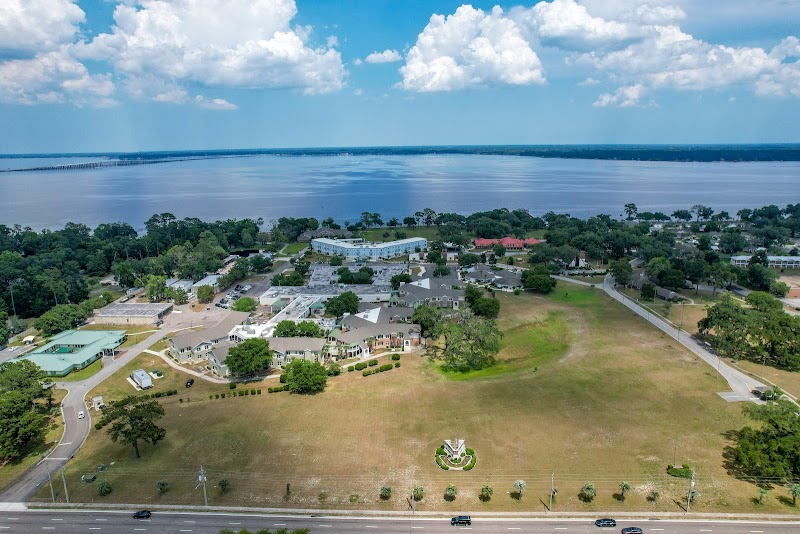
MOOSEHAVEN

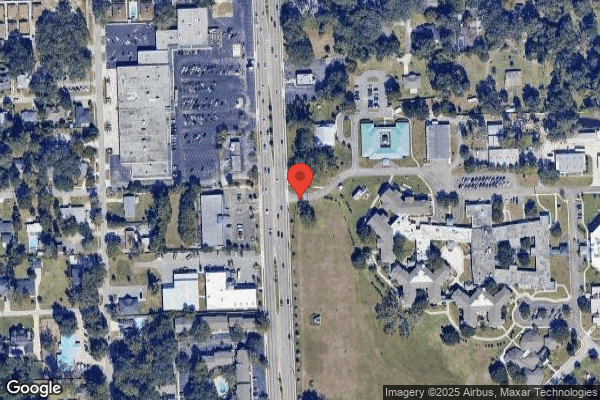
1701 PARK AVENUE, ORANGE PARK, FL 32073 (904) 278-1200
Non profit - Corporation 72 Beds Independent Data: November 2025
Trust Grade
80/100
#236 of 690 in FL
Last Inspection: August 2024

Within standard 12-15 month inspection cycle. Federal law requires annual inspections.

Overview

Moosehaven in Orange Park, Florida, has a Trust Grade of B+, which indicates it is above average and recommended for families considering care options. It ranks #236 out of 690 facilities in Florida, placing it in the top half, and #8 out of 12 in Clay County, meaning only a few local facilities are rated higher. The facility is improving, with issues decreasing from one in 2022 to none in 2024. Staffing is a concern here, rated at 1 out of 5 stars, though the turnover rate is excellent at 0%, meaning staff tend to stay long-term. The home has no fines on record, which is a positive sign, and it maintains average RN coverage, ensuring some level of professional oversight. However, there have been specific incidents noted, such as failing to provide proper respiratory care for a resident and not updating care plans following Do Not Resuscitate orders for multiple residents, which raises some concerns about compliance with care standards. Overall, Moosehaven has strengths in its financial standing and trend toward improvement, but families should be aware of the staffing challenges and specific care issues.

Trust Score
B+
80/100
In Florida
#236/690
Top 34%
Safety Record
Low Risk
No red flags
Inspections
Getting Better
1 → 0 violations
Staff Stability
○ Average
Turnover data not reported for this facility.
Penalties
✓ Good
No fines on record. Clean compliance history, better than most Florida facilities.
Skilled Nurses
○ Average
Each resident gets 37 minutes of Registered Nurse (RN) attention daily — about average for Florida. RNs are the most trained staff who monitor for health changes.
Violations
✓ Good
Only 5 deficiencies on record. Cleaner than most facilities. Minor issues only.
★★★★☆
4.0
Overall Rating
★☆☆☆☆
1.0
Staff Levels
★★★★☆
4.0
Care Quality
★★★★★
5.0
Inspection Score
Stable
2022: 1 issues
2024: 0 issues

The Good

  • 4-Star Quality Measures · Strong clinical quality outcomes
  • Full Sprinkler Coverage · Fire safety systems throughout facility
  • No fines on record

Facility shows strength in quality measures, fire safety.

The Bad

No Significant Concerns Identified

This facility shows no red flags. Among Florida's 100 nursing homes, only 0% achieve this.

The Ugly 5 deficiencies on record

Sept 2022 1 deficiency
CONCERN (D)

Potential for Harm - no one hurt, but risky conditions existed

Respiratory Care (Tag F0695)

Could have caused harm · This affected 1 resident

Based on observation, interview, and record review, the facility failed to ensure that a resident who required respiratory care, was provided such care, consistent with professional standards of pract...

Read full inspector narrative →
Based on observation, interview, and record review, the facility failed to ensure that a resident who required respiratory care, was provided such care, consistent with professional standards of practice and the comprehensive person-centered care plan, for one (Resident #75) of 10 residents receiving respiratory treatment, from a total of 13 residents in the sample. The findings include: On 8/29/2022 at 10:16 a.m., Resident #75 was observed asleep in bed. Her nasal cannula was lying across her chest and an oxygen concentrator was observed at bedside. The concentrator was set to administer oxygen at a rate of 4 liters per minute (LPM). During a follow-up attempt to interview the resident at 1:11 p.m. the same day, she was again observed sleeping. The oxygen concentrator flow rate remained set at 4 LPM. On 8/30/2022 at 10:53 a.m., the resident was observed sitting up in bed with her nasal cannula in place. Her oxygen concentrator was still set to administer oxygen at 4 LPM. (Photographic evidence obtained) During another visit to the resident's room on 8/31/2022 at 11:07 a.m., her nasal cannula was in place. The oxygen concentrator remained set to administer oxygen at 4 LPM. On 8/31/2022 at 1:54 p.m., Resident #75 was observed resting in bed with her nasal cannula in place and her oxygen concentrator set to administer oxygen at 4 LPM. During an interview with Registered Nurse (RN) A on 8/31/2022 at 11:18 a.m., she confirmed the resident's oxygen was ordered at a flow rate of 2 LPM. She stated the certified nursing assistants (CNAs) were responsible for taking the residents' vital signs, and the nurses were responsible for adjusting the oxygen flow rates as needed. During the interview, RN A was asked to observe the oxygen for Resident #75. She went to the resident's room and confirmed that the resident's nasal cannula was in place. She further stated the concentrator was set to administer oxygen at 4 LPM. When she was asked about the flow rate, she stated it was titrated up to keep the resident's oxygen saturation (sats) above 92%. She was asked if there was an order for the titration to which she replied, At this point it's to keep her comfortable. RN A was unable to provide supporting physician's orders as requested. During an interview with CNA B on 8/31/2022 at 2:05 p.m., she stated she had been employed at this facility for nine years and Resident #75 was a total assist. She further stated the CNAs were responsible for ensuring that the residents' oxygen concentrators were set at the ordered flow rate. She stated the CNAs could consult the nurses or the residents' care plans for the oxygen orders. She further stated the CNAs were responsible for filling the portable oxygen tanks. During an interview with CNA C on 8/31/2022 at 2:15 p.m., she stated she had been employed at this facility for seven years and the CNAs were responsible for ensuring water was in the oxygen concentrator for Resident #75. They were also responsible for changing the oxygen tubing weekly. She stated the tubing for all residents receiving oxygen was changed every Sunday. When asked what Resident #75's oxygen flow rate should be set at, she did not answer. Instead, she stated, We can titrate it if her sats are less than 90%. We can adjust it between 2 and 4 (LPM) to get it back to the 90% or higher. When asked, she was unable to provide the orders for the oxygen flow rate or the orders for the titration. She stated the CNAs took vital signs daily and documented them on the vital sign sheet for all the residents. Once complete, the form went to the nurse. She stated the nurse then entered the information into the resident's electronic medical record once all the vitals were complete. During an interview with Registered Nurse/Unit Manager D on 8/31/2022 at 2:22 p.m., she stated she was familiar with Resident #75. The resident was currently receiving Hospice services as her health was declining rapidly. She stated she spoke with RN A today regarding Resident #75. When she asked RN A about the oxygen for Resident #75, RN A advised her that the resident's sats were at 88% on 8/30/2022, so she increased the oxygen flow rate. RN D stated she reviewed the resident's records and observed that nursing charted they had increased the oxygen flow rate from 2 LPM to 3 LPM, and stated there was no order for that. She confirmed the current order for the oxygen level was 2 LPM, again stating there was no order to increase or decrease the oxygen flow rate for this resident. RN D stated she contacted the physician on the day of this interview for new orders. A review of Resident #75's medical record revealed a written physician's order for Oxygen @ 2L/NC PRN (oxygen at 2 LPM via nasal cannula as needed) to keep O2 sat (blood oxygen saturation) above 92% every shift. The order was signed and dated 8/24/2022. There were no additional orders in Resident #75's record related to her oxygen flow rate or titration. .
Feb 2021 4 deficiencies
CONCERN (D)

Potential for Harm - no one hurt, but risky conditions existed

Deficiency F0657 (Tag F0657)

Could have caused harm · This affected 1 resident

Based on medical record reviews and staff interviews, the facility failed to revise resident care plans following the completion of a signed Do Not Resuscitate (DNR) order for three (Residents #80, #2...

Read full inspector narrative →
Based on medical record reviews and staff interviews, the facility failed to revise resident care plans following the completion of a signed Do Not Resuscitate (DNR) order for three (Residents #80, #22 and #1) residents sampled for a review of their care plans, from a total sample of 25 residents. The findings include: 1. A review of the medical record for Resident #80, revealed a DNR order dated 10/1/2018. A review of Resident #80's hard chart revealed an admission care plan that stated the resident was a Full Code (the resident desired resuscitation in the event of respiratory/cardiac arrest). The hard copy admission care plan was dated 9/28/2018. A review of Resident #80's current comprehensive care plan, revealed the care plan was not revised to include the current DNR order. 2. A medical record review for Residents #22 and #1 revealed that both residents had signed, active Do Not Resuscitate orders. The signed declarations were located in the hard charts, and the DNRs were also acknowledged in their files located in the electronic medical records. During a review of the two residents' current comprehensive care plans, the advanced directives were not addressed. During an interview with the Nursing Supervisor on 02/23/21 at 10:14 a.m., she confirmed the care plan had not been revised to include the active DNR order for Residents #80, #22 or #1. She stated, DNR orders are care planned by the social worker and they should be listed on the care plan, because that is how we communicate with the interdisciplinary team. During an interview with the Director of Social Services on 2/23/21 at 10:20 a.m., she confirmed that the care plans had not been revised to include the active DNR orders for Residents #80, #22 or #1. She stated, I will revise the care plan to include the DNR orders. .
CONCERN (D)

Potential for Harm - no one hurt, but risky conditions existed

Medication Errors (Tag F0758)

Could have caused harm · This affected 1 resident

**NOTE- TERMS IN BRACKETS HAVE BEEN EDITED TO PROTECT CONFIDENTIALITY** Based on interviews and record reviews, the facility failed to 1) Ensure as needed (PRN) psychotropic medications ordered for gr...

Read full inspector narrative →
**NOTE- TERMS IN BRACKETS HAVE BEEN EDITED TO PROTECT CONFIDENTIALITY** Based on interviews and record reviews, the facility failed to 1) Ensure as needed (PRN) psychotropic medications ordered for greater than fourteen days included justification for extended use for one (Resident #9) of five residents reviewed, and 2) Ensure the provision of adverse consequence monitoring for two (Residents #14 and #11) of five residents reviewed for psychotropic medications, from a total of 25 residents in the sample. The findings include: 1. A review of the medical record for Resident #9 revealed he was admitted on [DATE]. He had a diagnosis of anxiety and was prescribed 0.5 mg (milligram) of Ativan every 6 hours PRN on 06/09/2020, with an end date of 08/03/2020. On 09/03/2020, a new order was written for 0.5 mg of Ativan every 6 hours PRN for 90 days. On 01/02/2021, a new order for 1.0 mg of Ativan every 6 hours PRN was written. The Order Summary Report revealed an end date of 04/02/2021, but no language was added to the order to justify the length of use. (Photographic evidence obtained) A History and Physical dated 06/12/2020, electronically signed by the physician who prescribed the Ativan, revealed no rationale statement for the extended use of the medication. The next physician's assessment, dated 09/03/2020, was also lacking the rationale statement. Resident #9's nurse, Employee C, was interviewed on 02/25/2021 at 11:58 a.m. He confirmed that Resident #9 had been prescribed antianxiety medication since his admission. There was no additional documentation with the rationale for the 90-day supply presented. The Director of Nursing (DON) was asked to present the thinned chart (materials removed from the resident's immediate record and maintained in a medical records file) for review. No documentation with the rationale for extended use was discovered. At 1:55 p.m. on 02/25/2021, the DON confirmed knowledge of the requirement for the PRN order justification. The facility's policy titled Antipsychotic Medication Use, dated December 2016, stated: (14) The need to continue PRN orders for psychotropic medication beyond 14 days requires that the practitioner document the rationale for the extended order. The duration of the PRN order will be indicated in the order. (Photographic evidence obtained) 2. A review of Resident #14's medical record revealed she was ordered Zoloft 125 mg and Wellbutrin XL (extended release) 150 mg for depression. She was also ordered Buspirone 75 mg for anxiety on 10/16/2020. On 2/23/2021 at 11:11 a.m., her nurse explained that behavior monitoring was completed each shift and documented in the hard chart (physical paper medical record) at the nurses' station. Resident #14's current care plan addressed her depression (initiated on 07/06/2020), which included a goal that she would experience fewer signs and symptoms of depression. An intervention included monitoring and documenting side effects of her medication. (Photographic evidence obtained) Resident #14's hard chart contained a behavior monitoring form for Bupropion (Wellbutrin). The behavior listed was tremors and the form showed no instances of tremors for the current month. Sertraline (Zoloft) 100 mg and 25 mg each, had a different sheet which listed a behavior of depression. No instances were documented. Buspirone 10 mg had a form which listed the behavior of anxiety. This form listed no behaviors for the current month. These forms all had a section titled side effects with three lines to indicate which side effects staff were to look for. Nothing was specified on any of the forms. The back of the forms listed potential side effects and included 26 potential side effects depending on the drug class. (Photographic evidence obtained) There was no documentation in the electronic record of adverse consequence monitoring for Resident #14. 3. A review of Resident #11's medical record revealed she was admitted on [DATE]. She was diagnosed with anxiety for which she was ordered Lorazepam (Ativan)1 mg once a day, as well as Lorazepam 1 mg every other day. She also had a PRN order written on 02/18/2021, to be taken every 8 hours as needed. The electronic Medication Administration Record (MAR) showed Resident #11 took the scheduled medications as ordered, and used the PRN anxiety medication twice in February 2021 (02/03/2021 and 2/04/2021). The hard chart included behavior monitoring sheets for Lorazepam 1 mg, with the behavior anxiety written in. A second form for Lorazepam 1 mg was also in this section, also for the behavior anxiety. There was a behavior monitoring sheet for Duloxetine (Cymbalta), with the behavior depression written in. None of the behavior sheets had any side effects written in the box to specify which behaviors one was monitoring for. (Photographic evidence obtained) A review of the nursing documentation for the previous three months, located in the electronic record, did not indicate nurses were documenting their efforts to monitor for adverse consequences. Resident #11's depression care plan (initiated 06/17/2020) addressed her anxiety and the first intervention listed was to Administer medications as ordered. Monitor/document for side effects and effectiveness. (Photographic evidence obtained) During an interview on 02/24/2021at 9:15 a.m. with Employee A, Resident #11's nurse, he was asked how he monitored for side effects of Resident #11's medications. Employee A explained that Resident #11 received antianxiety and antidepressant medication. When asked what side effects he was monitoring for with the antidepressant, he stated he didn't know. When asked about PRN medication monitoring, he explained that the nurses documented in the nursing notes when they administered the medications. He further stated the nurses could also use the behavior monitoring sheets. He opened Resident #11's and explained that if she were to have any side effects they'd be able to document those there. A review of the policy titled Behavioral Assessment, Intervention, and Monitoring, dated March 2019, mandated the following in the Management section: (10) When medications are prescribed for behavioral symptoms, documentation will include: (h.) Monitoring for efficacy and adverse consequences. (Photographic evidence obtained) On 02/25/2021 at 10:05 AM, the DON was asked how nurses were monitoring for adverse consequences of medications, and the explain the details of the facility's policy that required documentation. She explained that the nurses were documenting by exception, which was not her expectation. She acknowledged corrective action was needed. .
CONCERN (D)

Potential for Harm - no one hurt, but risky conditions existed

Dental Services (Tag F0791)

Could have caused harm · This affected 1 resident

Based on interviews and record reviews, the facility failed to ensure dental appointments were coordinated and scheduled according to physicians' orders for one (Resident #14) of two sampled residents...

Read full inspector narrative →
Based on interviews and record reviews, the facility failed to ensure dental appointments were coordinated and scheduled according to physicians' orders for one (Resident #14) of two sampled residents. The findings include: During an interview with Resident #14 on 02/22/2021 at 11:07 a.m., she was asked about her dental needs. She explained she was having issues, and was waiting for the facility to follow up on an order written by her dentist for more dental work to be completed. A review of the electronic medical record did not reveal any visits to a dentist, or orders for dental work to be completed. The Director of Nursing (DON) was interviewed on 2/23/2021 at 1:44 p.m. She was asked to provide any information related to dental appointments for Resident #14. The DON called the facility's clinic and was told Resident #14 went to the dentist on 11/11/2020; information would be located in the hard chart (physical paper record) located at the nurses' station. A review of the hard chart conducted directly after the interview showed no notes about Resident #14's dental visit on 11/11/2020. At 2:57 p.m. on 2/23/2021, the DON confirmed she also found no documentation, and agreed to check the thinned materials (materials removed from the resident's immediate record and maintained in a medical records file). She later presented paperwork from Resident #14's dental visits in 2019 and 2020. A review of these records showed that in 2019, she visited the dentist on 3/26/2019 and he ordered work done to smooth out a fractured molar and a filling in a different tooth. This carbon paper had a notation in different handwritten/ink which read,3/27/2019 Committee approval and was signed by an RN (Registered Nurse). A second carbon paper note, dated 4/2/2019, showed the work ordered on 3/26/2019 had been completed. (Photographic evidence obtained) The next dental visit record was dated 11/11/2020, and was on the same yellow carbon paper. This form noted Resident #14 had a lot of decay. At least four teeth should be extracted. And multiple cavities. The bottom of this form indicated the resident was to return on 11/17/2020 at 12:00 p.m. This, as well as the next cleaning date of 11/10/2021, was initialed in different ink. (Photographic evidence obtained) There were no other dental visit records presented from the thinned chart. A second review of the hard chart and electronic medical record found no evidence indicating the resident went back to the dentist on 11/17/2020. This was confirmed by the DON on 2/24/2021 at 4:15 p.m., who stated the clinic may have more records, and she would investigate further. At 11:15 a.m. on 2/25/2021, the DON confirmed there was no follow-up visit on 11/17/2020. She explained the documentation was lacking as to why she didn't go back to the dentisit, but during this time they were reviewing every appointment to see if it was necessary to send people out because of the cases in the community. The DON stated the resident now had an appointment scheduled for 3/2/2021 for a follow-up to the 11/11/2020 orders. She was asked when the appointment for 3/2/20201 was scheduled for Resident #14, and she confirmed it was not until today, 2/25/2021. .
CONCERN (F)

Potential for Harm - no one hurt, but risky conditions existed

Grievances (Tag F0585)

Could have caused harm · This affected most or all residents

Based on staff interviews and a review of the facility's policies and procedures, the facility failed to ensure its grievance policy contained all mandated requirements. All 25 residents had the poten...

Read full inspector narrative →
Based on staff interviews and a review of the facility's policies and procedures, the facility failed to ensure its grievance policy contained all mandated requirements. All 25 residents had the potential to be affected by the omissions in the facility-wide policy. The findings include: A review of the facility's grievance policy (undated) revealed the following purpose: It is the policy of this facility to assist residents, their representatives (sponsors), other interested family members, or advocates in filing grievances or complaints when such requests are made. The form listed procedural steps one should take to file a grievance. Step (2) stated, Grievances and/or complaints must be submitted in writing and signed by the resident, or the person filing the grievance or complaint on behalf of the resident. Step four (4) indicated that it was upon receipt of a written grievance and/or complaint that the investigation would commence. The form did not detail guidance to the reader that grievances could be submitted orally, or anonymously. (Photographic evidence obtained) An interview was conducted with the Social Services Director (SSD) on 2/23/2021 at 12:00 p.m. She explained that most grievances came to her or one of the nurses. The policy was reviewed with her and she confirmed this was the same policy that was given to residents when they moved in. She acknowledged the missing information in the policy and confirmed it was undated, so the last time it was updated was unclear. She was given time to investigate whether any updated versions of the policy were being used, but none were presented by the end of the survey. In a follow-up interview with the Administrator on 2/25/2021 at 12:44 p.m., he also acknowledged the importance of updating the policy to include all required elements. .
Understanding Severity Codes (click to expand)
Life-Threatening (Immediate Jeopardy)
J - Isolated K - Pattern L - Widespread
Actual Harm
G - Isolated H - Pattern I - Widespread
Potential for Harm
D - Isolated E - Pattern F - Widespread
No Harm (Minor)
A - Isolated B - Pattern C - Widespread

Questions to Ask on Your Visit

  • "Can I speak with families of current residents?"
  • "What's your RN coverage like on weekends and overnight?"

Our Honest Assessment

Strengths
  • • Grade B+ (80/100). Above average facility, better than most options in Florida.
  • • No major safety red flags. No abuse findings, life-threatening violations, or SFF status.
  • • No fines on record. Clean compliance history, better than most Florida facilities.
  • • Only 5 deficiencies on record. Cleaner than most facilities. Minor issues only.
Concerns
  • • No significant concerns identified. This facility shows no red flags across CMS ratings, staff turnover, or federal penalties.
Bottom line: Generally positive indicators. Standard due diligence and a personal visit recommended.

About This Facility

What is Moosehaven's CMS Rating?

CMS assigns MOOSEHAVEN an overall rating of 4 out of 5 stars, which is considered above average nationally. Within Florida, this rating places the facility higher than 99% of the state's 100 nursing homes. This rating reflects solid performance across the metrics CMS uses to evaluate nursing home quality.

How is Moosehaven Staffed?

CMS rates MOOSEHAVEN's staffing level at 1 out of 5 stars, which is much below average compared to other nursing homes.

What Have Inspectors Found at Moosehaven?

State health inspectors documented 5 deficiencies at MOOSEHAVEN during 2021 to 2022. These included: 5 with potential for harm.

Who Owns and Operates Moosehaven?

MOOSEHAVEN is owned by a non-profit organization. Non-profit facilities reinvest revenue into operations rather than distributing to shareholders. The facility operates independently rather than as part of a larger chain. With 72 certified beds and approximately 26 residents (about 36% occupancy), it is a smaller facility located in ORANGE PARK, Florida.

How Does Moosehaven Compare to Other Florida Nursing Homes?

Compared to the 100 nursing homes in Florida, MOOSEHAVEN's overall rating (4 stars) is above the state average of 3.2 and health inspection rating (5 stars) is much above the national benchmark.

What Should Families Ask When Visiting Moosehaven?

Based on this facility's data, families visiting should ask: "Can you walk me through typical staffing levels on day, evening, and night shifts?" "Can I visit during a mealtime to observe dining assistance and food quality?" "How do you handle medical emergencies, and what is your hospital transfer rate?" "Can I speak with family members of current residents about their experience?" These questions are particularly relevant given the below-average staffing rating.

Is Moosehaven Safe?

Based on CMS inspection data, MOOSEHAVEN has a clean safety record: no substantiated abuse findings (meaning no confirmed cases of resident harm), no Immediate Jeopardy citations (the most serious violation level indicating risk of serious injury or death), and is not on the Special Focus Facility watch list (a federal program monitoring the lowest-performing 1% of nursing homes). The facility has a 4-star overall rating and ranks #1 of 100 nursing homes in Florida. While no facility is perfect, families should still ask about staff-to-resident ratios and recent inspection results during their visit.

Do Nurses at Moosehaven Stick Around?

MOOSEHAVEN has not reported staff turnover data to CMS. Staff turnover matters because consistent caregivers learn residents' individual needs, medications, and preferences. When staff frequently change, this institutional knowledge is lost. Families should ask the facility directly about their staff retention rates and average employee tenure.

Was Moosehaven Ever Fined?

MOOSEHAVEN has no federal fines on record. CMS issues fines when nursing homes fail to meet care standards or don't correct problems found during inspections. The absence of fines suggests the facility has either maintained compliance or corrected any issues before penalties were assessed. This is a positive indicator, though families should still review recent inspection reports for the full picture.

Is Moosehaven on Any Federal Watch List?

MOOSEHAVEN is not on any federal watch list. The most significant is the Special Focus Facility (SFF) program, which identifies the bottom 1% of nursing homes nationally based on persistent, serious quality problems. Not being on this list means the facility has avoided the pattern of deficiencies that triggers enhanced federal oversight. This is a positive indicator, though families should still review the facility's inspection history directly.