EMBASSY OF HEARTHSIDE
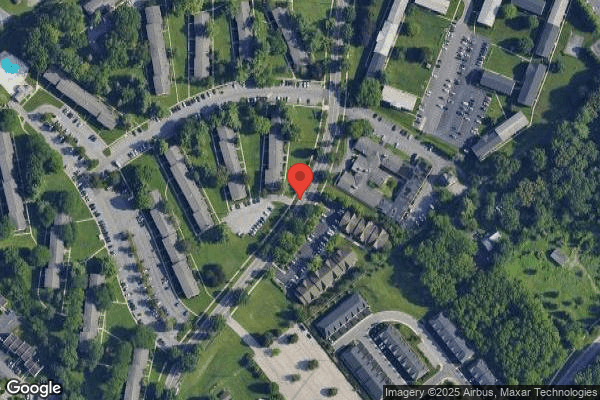
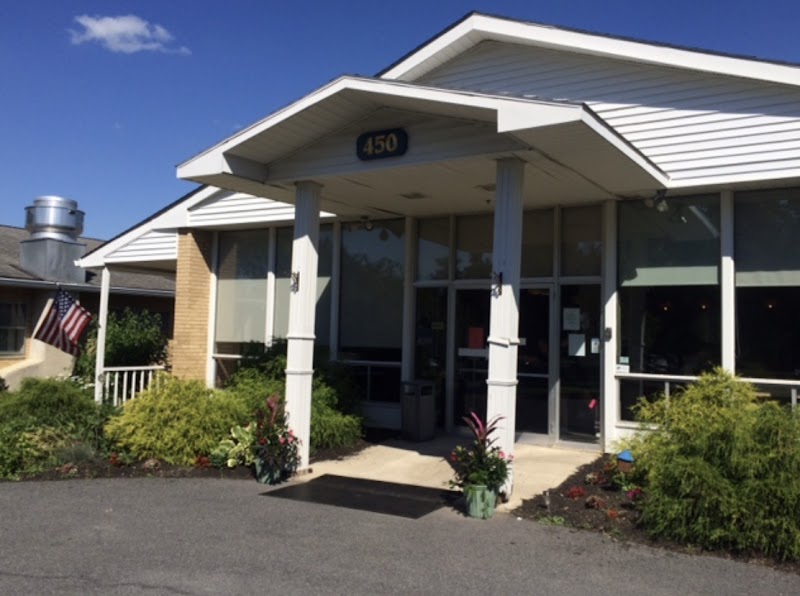
450 WAUPELANI DRIVE, STATE COLLEGE, PA 16801 (814) 237-0630
For profit - Corporation 157 Beds EMBASSY HEALTHCARE Data: November 2025
Trust Grade
23/100
#413 of 653 in PA
Last Inspection: March 2025

Within standard 12-15 month inspection cycle. Federal law requires annual inspections.

Overview

Embassy of Hearthside in State College, Pennsylvania has a Trust Grade of F, indicating significant concerns about the quality of care provided. It ranks #413 out of 653 nursing homes in Pennsylvania, placing it in the bottom half of facilities statewide, and #5 out of 6 in Centre County, meaning only one local option is better. While the facility's trend is improving-reducing issues from 25 down to 21 over the past year-there are still serious concerns, including incidents where residents suffered neglect leading to injuries, and significant weight loss due to poor nutritional management. Staffing is rated at 2 out of 5 stars, with a turnover rate of 46%, which is average for the state, but the facility has less RN coverage than 93% of Pennsylvania facilities, raising questions about the level of medical oversight. Additionally, the nursing home has incurred fines totaling $23,995, which is concerning and suggests ongoing compliance problems.

Trust Score
F
23/100
In Pennsylvania
#413/653
Bottom 37%
Safety Record
High Risk
Review needed
Inspections
Getting Better
25 → 21 violations
Staff Stability
⚠ Watch
46% turnover. Above average. Higher turnover means staff may not know residents' routines.
Penalties
⚠ Watch
$23,995 in fines. Higher than 78% of Pennsylvania facilities, suggesting repeated compliance issues.
Skilled Nurses
⚠ Watch
Each resident gets only 22 minutes of Registered Nurse (RN) attention daily — below average for Pennsylvania. Fewer RN minutes means fewer trained eyes watching for problems.
Violations
⚠ Watch
73 deficiencies on record. Higher than average. Multiple issues found across inspections.
★★☆☆☆
2.0
Overall Rating
★★☆☆☆
2.0
Staff Levels
★★★★★
5.0
Care Quality
★☆☆☆☆
1.0
Inspection Score
Stable
2024: 25 issues
2025: 21 issues

The Good

  • 5-Star Quality Measures · Strong clinical quality outcomes
  • Full Sprinkler Coverage · Fire safety systems throughout facility
  • No fines on record

Facility shows strength in quality measures, fire safety.

The Bad

2-Star Overall Rating

Below Pennsylvania average (3.0)

Below average - review inspection findings carefully

Staff Turnover: 46%

Near Pennsylvania avg (46%)

Higher turnover may affect care consistency

Federal Fines: $23,995

Below median ($33,413)

Minor penalties assessed

Chain: EMBASSY HEALTHCARE

Part of a multi-facility chain

Ask about local staffing decisions and management

The Ugly 73 deficiencies on record

2 actual harm
Aug 2025 2 deficiencies
CONCERN (E) 📢 Someone Reported This

A family member, employee, or ombudsman was alarmed enough to file a formal complaint

Potential for Harm - no one hurt, but risky conditions existed

Quality of Care (Tag F0684)

Could have caused harm · This affected multiple residents

**NOTE- TERMS IN BRACKETS HAVE BEEN EDITED TO PROTECT CONFIDENTIALITY** Based on a review of select facility policies and procedures, clinical record review, observation, and staff interview, it was d...

Read full inspector narrative →
**NOTE- TERMS IN BRACKETS HAVE BEEN EDITED TO PROTECT CONFIDENTIALITY** Based on a review of select facility policies and procedures, clinical record review, observation, and staff interview, it was determined that the facility failed to provide the highest practicable care regarding elopements for one of five residents reviewed (Resident 4) and medication errors for one of five residents reviewed (Resident CR1). Findings include: The current facility policy entitled Elopements and Wandering Residents, revealed the facility ensures that residents who exhibit wandering behavior and/or are at risk of elopement receive adequate supervision to prevent accidents and receive care in accordance with their person-centered plan of care addressing the unique factors contributing to wandering or elopement risk. The facility will establish and utilize a systematic approach to monitoring and managing residents at risk for elopement or unsafe wandering, including identification and assessment of risk, evaluation and analysis of hazards and risks, implementing interventions to reduce hazards and risks, and monitoring for effectiveness and modifying interventions when necessary. Residents will be assessed for risk of elopement and unsafe wandering upon admission and throughout their stay by the interdisciplinary care plan team. The interdisciplinary team will evaluate the unique factors contributing to risk in order to develop a person-centered care plan. Interventions to increase staff awareness of the resident's risk, modify the resident's behavior, or to minimize risks associated with hazards will be added to the resident's plan of care and communicated to the appropriate staff. Adequate supervision will be provided to help prevent accidents or elopements. Clinical record review revealed the facility admitted Resident 4 on August 4, 2025. Nursing documentation dated August 4, 2025, at 11:48 PM revealed Resident 4 arrived at the facility via hospital transport and a nurse. Documentation revealed Resident 4 fled on foot and the police were notified by hospital staff. The police returned Resident 4 to the facility unharmed. Resident 4 was escorted into the facility with the assistance of the police, and one to one supervision was started with Resident 4 due to being an elopement risk. Resident 4's son was notified of his arrival and fleeing incident. Resident 4's son was notified his father was currently under one-to-one supervision. Review of Resident 4's elopement evaluation dated August 4, 2025, at 11:00 PM revealed Resident 4 had a history of elopement while at home. Nursing staff assessed Resident 4, scoring him as a 7 (high risk), noting Resident 4 eloped from the facility shortly after arrival and was found and taken to the hospital for evaluation. Resident 4 returned to the facility by the police and is currently under one-to-one supervision. An admission interdisciplinary note dated August 5, 2025, at 9:47 AM revealed Resident 4 initially arrived at 2:00 PM. Resident 4 was escorted to his room and within minutes he pushed the window open and fled the building. Documentation revealed the window was secured to open six inches, but Resident 4 was able to remove the bracket and screen. Staff immediately called the physician, alerting him of Resident 4's elopement. Several staff members exited the building and began the search. The facility contacted 911. Resident 4 was located approximately 15 minutes later and returned to the facility safely. Resident 4 was again escorted to his room. Physician and Psych certified nurse practitioner (CRNP) were onsite and agreed that Resident 4 be sent to the hospital. At approximately 8:00 PM the hospital emergency room called the facility and stated they were sending Resident 4 back to the facility. Documentation revealed the facility attempted to refuse Resident 4's admission but the transport van arrived with a driver, nurse from the local hospital, and Resident 4. Resident 4 got out of the van and again took off running. The facility called 911 again and the police located Resident 4 and returned him to the facility. There were no injuries noted. One on one care is continuing at this time. A picture of the resident was obtained and placed in the elopement book located at the front desk. A follow up elopement evaluation was completed August 5, 2025, and nursing staff assessed Resident 4, as a nine (high risk). Nursing documentation dated August 5, 2025, at 2:26 PM revealed Resident 4 was still pacing the halls trying to open windows. Documentation noted one to one remains in place. Nursing documentation dated August 13, 2025, at 9:39 AM revealed Resident 4 continued to exhibit exit seeking behaviors by going to the door and pushing numbers on the keypad. Staff was to maintain visual supervision when Resident 4 is having an acute episode. Nursing documentation dated August 14, 2025, at 3:25 PM revealed Resident 4 was walking throughout the halls, actively exit seeking, and clicking buttons at exit doors. Nursing documentation dated August 16, 2025, at 10:58 AM revealed Resident 4 was walking throughout the nursing unit, often going up to the keypads by the exit doors and typing in numbers. Nursing documentation dated August 22, 2025, at 9:56 AM revealed Resident 4 continued to seek exit doors and attempted to type in codes. Resident 4 was found pushing and pounding on the stairwell door on the unit. Further review of Resident 4's clinical record revealed no documentation of staff' one-to-one supervision with Resident 4. Review of Resident 4's plan of care-initiated August 4, 2025, revealed Resident 4 was at risk for wandering and elopement, but did not include any interventions regarding increasing Resident 4's supervision. Interview with the Nursing Home Administrator and Director of Nursing on August 25, 2025, at 11:30 AM confirmed they were unable to provide any documentation that the staff were completing one to one, or close supervision with Resident 4. The Director of Nursing stated she thinks Resident 4 was on one-to-one supervision from August 4 to 8, 2025, but was unable to provide any further documentation. During a meeting with the Nursing Home Administrator and Director of Nursing on August 25, 2025, at 9:30 AM the Nursing Home Administrator received a call from Resident 4's son indicating that Resident 4 left the facility and showed up at his former job location on the [NAME] State campus, approximately three quarters of a mile from the facility. The facility staff were unaware that Resident 4 left the building. Observation of Resident 4's room with the Director of Nursing on August 25, 2025, at 1:25 PM revealed that Resident 4 removed the screws from the window in his room, and there was no screen present. It was observed that Resident 4 would have had to walk down a hill to the facility courtyard, and from the courtyard it appeared that Resident 4 walked through two unsecured doors into an area the Director of Nursing called the breezeway, and then had access to the parking lot where he exited the facility. Nursing documentation dated August 25, 2025, at 3:22 PM noted the Nursing Home Administrator received a call from Resident 4's son stating Resident 4's son received a call from his former job location on the [NAME] State University campus. They notified Resident 4's son that his dad was there. The local police went to the location and returned Resident 4 to the facility. After a room search it was revealed that Resident 4 departed the facility through his room window. A butter knife was found in his bedside nightstand that is believed to have been used to unscrew the bolts that had the window secured. The facility failed to provide the highest practical care to Resident 4, preventing his elopement. The current facility policy entitled Medication Errors, revealed medication errors once identified will be evaluated to determine if they are considered significant or not. If a medication error occurs, the nurse assesses and examines the resident's condition and notifies the physician as soon as possible. The nurse will monitor and document the resident's condition, including response to medical treatment or nursing interventions. Once the resident is stable, the nurse reports the incident to the appropriate supervisor and completes the incident report. Closed clinical record review revealed the facility admitted Resident CR1 on June 3, 2025. Further review revealed Resident CR1 remained in the facility until July 21, 2025, when he was sent to the hospital and was admitted with diagnoses including anemia (lack of healthy red blood cells), bronchitis, and hyperglycemia (high blood sugar). Review of Resident CR1's Medication Administration Record (MAR, a form utilized by the facility to document the administration of medications) dated July 2025, revealed the following three orders for Prednisone (medication used to decrease inflammation and suppress the immune system): Prednisone 20 milligrams (mg), two tablets one time only for cough and congestion on July 21, 2025, at 1:15 AMPrednisone 20 mg, two tablets four times a day for cough and congestion for four days on July 21, 2025, at 8:00 AMPrednisone 20 mg, two tablets one time a day for cough and congestion for four days on July 22, 2025, at 8:00 AM Interview with the Director of Nursing on August 25, 2025, at 1:20 PM confirmed the registered nurse wrote the Prednisone order on July 21, 2025, at 8:00 AM wrong, indicating it was supposed to be Prednisone 20 mg, two tablets one time a day instead of four times a day. The licensed practical nurse administered Resident CR1's 8:00 AM and 1:00 PM Prednisone doses. The nurse did not report the medication error, or complete an incident report, The facility failed to provide the highest practical care to Resident CR1 28 Pa. Code 211.10(d) Resident care policies28 Pa. Code 211.12(d)(1)(3)(5) Nursing services
CONCERN (F) 📢 Someone Reported This

A family member, employee, or ombudsman was alarmed enough to file a formal complaint

Potential for Harm - no one hurt, but risky conditions existed

Food Safety (Tag F0812)

Could have caused harm · This affected most or all residents

Based on observation and staff interview, it was determined the facility failed to store food in accordance with professional standards for food service in the facility's main kitchen. Findings includ...

Read full inspector narrative →
Based on observation and staff interview, it was determined the facility failed to store food in accordance with professional standards for food service in the facility's main kitchen. Findings include: An observation in the facility's main kitchen on August 25, 2025, at 11:30 AM with Employee 1 (dietary manager) revealed the following: In the dry storage area, there was a bag of elbow macaroni, and a bag of opened egg noodles, with no open or use by dates. On the bread racks, there were six packs of English muffins, three loaves of bread, two packs of sandwich rolls, and one pack of hotdog rolls with no received or use by dates. In the walk-in Freezer, there was a box of mixed vegetables with no open or use by dates. The vegetables were not covered or sealed. In the walk-in refrigerator, there were boxes of mushrooms, lemons, and oranges with no open or use by dates. The items were not covered or sealed. In the reach-in cooler, there was an opened container of grape jelly and strawberry juice with no open or use by dates. In the production area, there was an opened box of thick and easy, bag of flour, container of peanut butter, container of quick oats, box of cream of rice, box of potato pearls, and a container identified by Employee 1 as Cream of Wheat. All of these items were opened with no open date or use by dates. The above findings in the main kitchen were reviewed with the Nursing Home Administrator and Director of Nursing on August 25, 2025, at 3:04 PM. 483.60(i)(2) Store, prepare, food safe and sanitaryPreviously cited 3/14/25 28 Pa. Code 201.14 (a) Responsibility of Licensee
Jun 2025 1 deficiency
CONCERN (D) 📢 Someone Reported This

A family member, employee, or ombudsman was alarmed enough to file a formal complaint

Potential for Harm - no one hurt, but risky conditions existed

Abuse Prevention Policies (Tag F0607)

Could have caused harm · This affected 1 resident

**NOTE- TERMS IN BRACKETS HAVE BEEN EDITED TO PROTECT CONFIDENTIALITY** Based on review of select facility policies and procedures, clinical record review, and staff interview, it was determined that ...

Read full inspector narrative →
**NOTE- TERMS IN BRACKETS HAVE BEEN EDITED TO PROTECT CONFIDENTIALITY** Based on review of select facility policies and procedures, clinical record review, and staff interview, it was determined that the facility failed to thoroughly investigate and report to the appropriate agencies an allegation of resident-to-resident physical abuse for one of five records reviewed (Resident 1). Findings include: The current facility policy entitled Abuse, Neglect, and Exploitation, revealed an immediate investigation is warranted when suspicion of abuse, neglect or exploitation, or reports of abuse, neglect or exploitation occur. Investigation of alleged abuse includes identifying and interviewing all involved persons, including the alleged victim, alleged perpetrator, witnesses, or others who might have knowledge of the allegations. The facility will have written procedures that include reporting of all alleged violations to the Administrator, state agency, adult protective services, and to all other required agencies (law enforcement when applicable) within specified timeframes. Report immediately, but not later than two hours after the allegation is made if the events that cause the allegation involve abuse, or result in serious bodily injury, or not later than 24 hours if the events that cause the allegation do not involve abuse, and do not result in serious bodily injury. The current facility policy entitled Compliance with Reporting Allegations of Abuse, Neglect, or Exploitation, revealed it is the policy of the facility to report all allegations of abuse, neglect, exploitation, or mistreatment are reported immediately to the Administrator of the facility and to other appropriate agencies in accordance with current state and federal regulations within prescribed timeframes. When suspicion or reports of abuse, neglect, or exploitation occur, the licensed nurse will respond to the needs of the resident and protect him or her from further incident, notify the Administrator or designee, notify the attending physician, resident's family, and Medical Director. The nurse will monitor and document the resident's condition, including response to treatment or nursing interventions, and document actions taken in the medical record. The licensed nurse will complete an incident report. The Administrator or designee will notify the appropriate agencies immediately, or as soon as possible but no later than 24 hours after discovery, obtain statements from direct care staff, and within five days of the incident, report sufficient information to describe the results of the investigation, and indicate any corrective actions taken. Interview with Resident 1 on June 11, 2025, at 10:34 AM revealed that on May 17, 2025, at approximately 9:00 PM, Resident 2 entered his room and was rummaging through his closet. Resident 1 stated when he yelled at Resident 2 to stop, Resident 2 approached Resident 1's bed hitting his arm, and grabbing Resident 1's cell phone out of his hand. Resident 1 stated Resident 2 threw his cell phone, hitting Resident 1 in the face, just below his eye. Resident 1 stated he told the licensed practical nurse who entered the room and the registered nurse in charge what happened. Resident 1 stated he told the nurses he wanted the police called. Resident 1 indicated the staff told him that they wanted him to wait until Monday to call the police, until the Administrator could do her own investigation. Resident 1 stated that no one has done an investigation into his concern. or interviewed him. Resident 1 stated that he has text message correspondence with the Nursing Home Administrator pertaining to the incident. Observation of Resident 1's text correspondence with the Nursing Home Administrator revealed a text message dated June 5, 2025, noting the alleged assault happened two and a half weeks ago and no one has been in to talk to him about the incident. Interview with the Nursing Home Administrator over the phone and Employee 2 (assistant director of nursing) on June 11, 2025, at 11:30 AM, confirmed that the facility did not investigate or report to the appropriate authorities Resident 1's allegation of resident-to-resident physical abuse. The Nursing Home Administrator revealed that they did not thoroughly investigate and report Resident 1's allegation because there were no witnesses to the incident. During an interview with Employee 1 (licensed practical nurse) on June 11, 2025, at 12:02 PM, she confirmed [NAME] made the same allegation of resident-to-resident physical abuse to her on May 17, 2025. Employee 1 stated she notified the registered nurse of the allegation. Employee 1 confirmed when she entered the room Resident 1's phone was across the room. Interview with Employee 2 and Employee 3 (social service) on June 11, 2025, at 1:30 PM confirmed that the facility did not complete an investigation, obtain witness statements, notify law enforcement, or notify the Department of Health related to Resident 1's allegation of abuse. 28 Pa. Code 201.14(a) Responsibility of licensee 28 Pa Code 201.18(b)(1)(3)(e)(1) Management 28 Pa Code 201.19(8) Personnel policies and procedures
Mar 2025 18 deficiencies 2 Harm
SERIOUS (G)

Actual Harm - a resident was hurt due to facility failures

Free from Abuse/Neglect (Tag F0600)

A resident was harmed · This affected 1 resident

Based on observation, clinical record review, review of facility documents, and resident and staff interview, it was determined that the facility failed to protect the rights of a resident to be free ...

Read full inspector narrative →
Based on observation, clinical record review, review of facility documents, and resident and staff interview, it was determined that the facility failed to protect the rights of a resident to be free from neglect by not providing the services necessary to avoid physical harm related to a fracture of her right leg on one of two residents reviewed for abuse/neglect (Resident 9). This deficiency is cited as past noncompliance Findings include: Observation and interview with Resident 9 on March 12, 2025, at 10:48 AM revealed the resident was in bed. She stated she was sore on both of her knees and had an injury in her thigh area from an incident with her wheelchair. Clinical record review for Resident 9 revealed a medical provider note dated January 21, 2025, at 9:49 PM that the resident was seen for an acute visit for right knee pain and the knee area was mildly swollen. An x-ray was ordered for the resident due to hitting her knee. There were no further details of any accident/injury. Review of x-ray results for Resident 9 dated January 23, 2025, revealed the resident was positive for a fracture of the right femur (thighbone). Review of a staff interview with Resident 9 dated January 23, 2025, revealed Resident 9 indicated Employee 18, licensed practical nurse, was pushing her in her wheelchair and her leg went under the wheelchair. She stated Employee 18 told her it would be okay. Resident 9 was transferred to the hospital on January 23, 2025, and was admitted for surgical intervention for the fracture. The facility investigation into Resident 9's injury revealed the resident was self-propelling to the dining room area on January 19, 2025, when Employee 18, licensed practical nurse, approached the resident from behind and began pushing her to the dining room and the resident's leg got caught under the wheelchair. Per Employee 18's statement of the incident dated January 23, 2025, Employee 18 indicated he was pushing the resident to lunch on January 19, 2025, when the resident's right foot fell to the ground (there were no leg rests to have caused her leg to fall to the ground) and went slightly back under the wheelchair, noting the resident yelped in pain. Employee 18 noted on the statement that he immediately stopped and carefully moved the resident to a comfortable position and indicated no injury, bruising, or swelling was noted. Employee 18 indicated on the statement the resident complained of pain of 4 on a scale of one to 10, and pain medication was administered. It was noted on the statement the resident ate lunch and did not mention any discomfort until shortly after the evening meal noting he made a follow up assessment and observed mild swelling, but no redness, bruising, or other signs of injury. There was no evidence Employee 18 reported the incident when it occurred on January 19, 2025, to any other staff. Per staff statements, the resident refused to get out of bed on January 20, 2025, due to pain, and did the same on January 21, 2025, when the medical provider was contacted. Resident 9 returned to the facility on January 27, 2025. Employee 18 pushed Resident 9 in the wheelchair on January 19, 2025, to the dining room without leg rests on the chair causing Resident 9's right foot to get caught under the wheelchair resulting in a fracture. Employee 18 did not report the incident or the resident's change in condition due to the incident until the investigation revealed Employee 18's involvement in the injury on January 23, 2025. Employee 18 was terminated from the facility on January 27, 2025. All staff education was completed January 24-29, 2025, on abuse/neglect, proper notification of a resident change in condition, and utilizing leg rests when a resident requires being pushed in a wheelchair. The above information was reviewed with the Nursing Home Administrator and Director of Nursing on March 14, 2025, at 10:30 AM. 28 Pa. Code 201.18(e)(1) Management 28 Pa. Code 201.29(a) Resident rights
SERIOUS (G)

Actual Harm - a resident was hurt due to facility failures

Deficiency F0692 (Tag F0692)

A resident was harmed · This affected 1 resident

**NOTE- TERMS IN BRACKETS HAVE BEEN EDITED TO PROTECT CONFIDENTIALITY** Based on clinical record review, review of select facility policies and procedures, and resident and staff interview, it was det...

Read full inspector narrative →
**NOTE- TERMS IN BRACKETS HAVE BEEN EDITED TO PROTECT CONFIDENTIALITY** Based on clinical record review, review of select facility policies and procedures, and resident and staff interview, it was determined the facility failed to ensure acceptable parameters of nutrition status were maintained for four of 15 residents reviewed for nutrition concerns (Residents 49, 81, 105, and 108) and provide timely assessments and interventions from a qualified nutrition professional to promote acceptable parameters of nutrition status resulting in severe weight loss resulting in harm for one of 15 residents reviewed for nutrition concerns (Resident 81). Findings include: Review of facility policy entitled Nutrition Management, last reviewed on January 1, 2025, revealed the facility is to provide care and services to each resident to ensure the resident maintains acceptable parameters of nutritional status in the context of his or her overall condition. Compliance guidelines of the policy indicate a systemic approach is used to optimize each resident's nutritional status including monitoring the effective ness of interventions and revising them as necessary. The policy states a nutritional assessment will be completed by a dietitian within 72 hours of admission , annually, and upon significant change in condition. Monitoring will occur to determine if current interventions are being implemented and effective, and the physician will be notified of any significant weight changes, intake changes, or changes in nutritional status. In an interview with Resident 81 on March 11, 2025, at 1:11 PM the resident stated he has lost weight since his admission to the facility and that he was down to about 180 pounds from 210 pounds. Clinical record review for Resident 81 revealed the resident was admitted to the facility on [DATE]. The resident's weight upon admission was 210 pounds. Review of a nutrition assessment completed by a registered dietitian dated December 29, 2024, greater than 72 hours after the resident's admission, indicated the resident was receiving a mechanical soft diet due to difficulty chewing. It was noted the resident had increased needs due to alcohol abuse and that the resident was asking for shakes as he had been trying to eat better at home with the support of his family. Resident 81 reported he was drinking two to three shakes a day to get better. The dietitian noted the resident's appetite and intakes were good and the resident is above an ideal body weight, although it was noted the resident had indicators of mild protein calorie malnutrition. The dietitian indicated one shake would be added to the resident's lunch meal and noted the resident was identified at nutritional risk. A review of Resident 81's physician orders revealed the resident was ordered a four-ounce shake on December 29, 2024. A review of Resident 81's plan of care revealed a nutrition care plan was added on December 29, 2024, that indicated the resident was at risk for alteration in nutrition and/or hydration status and interventions included monitoring weight on admission, per facility policy, every month and as needed, to notify the physician of any significant weight change, and to monitor acceptance, effectiveness, and ongoing needs. There were no new interventions added since December 29, 2024. Resident 81's weight on January 6, 2025, 13 days after his admission, was 200.6 pounds indicating a 9.4-pound (4.4 percent) weight loss in just under two weeks. There was no evidence the dietitian addressed the weight loss. Resident 81 was weighed again on January 13, 2025, at 198.8 pounds reflecting another 1.8-pound loss and a total of 11.2 pounds since admission, now a significant weight loss at 5.3 percent. There was no evidence the resident was reassessed by the dietitian. The resident then was documented as weighing 189.2 on January 20, 2025, a further decline of 9.6 pounds in a week, and now a 20.8 pound loss since admission, which was a 9.9 percent severe weight loss in less than a month. There was no evidence the resident was reassessed by the dietitian. Resident 81 was weighed again on January 28, 2025, remaining at 189 pounds On February 3, 2025, Resident 81 weighed 180 pounds, reflecting a 30-pound weight loss since admission, which was a 14 percent severe weight loss. There was no evidence that Resident 81 was weighed after February 3, 2025, no evidence of the resident refusing to be weighed, and no further assessments by the dietitian despite the severe weight loss and minimal food intakes. Review of Resident 81's meal intake records for December 2024, January, February, and March 2025, revealed the resident ate well for two meals on the day of admission December 24, 2024, and one meal on December 25, 2024. All other meals for the remainder of the month were only documented as intakes of zero to 50 percent, with an occasional meal that was greater. Review of Resident 81's medication administration record (where staff document acceptance of nutrition supplements) revealed the resident was receptive and accepting the nutritional shake that was ordered on December 24, 2024, one time a day. There was no evidence the resident was offered or had the shakes increased as he had indicated he was drinking two to three a day at home prior to admission. As of March 13, 2025, there was no evidence Resident 81 was seen or further assessed by the dietitian since the resident presented with significant and severe weight loss from week to week from December 24, 2024, to February 3, 2025. There was no evidence Resident 81's physician was aware of the resident's significant weight changes as noted above. The above information was reviewed with the Nursing Home Administrator and Director of Nursing on March 14, 2025, at 9:30 AM and a current weight was requested if Resident 81 would allow. Resident 81's current weight was 178.4 pounds, an additional 1.6-pound loss since the last weight on February 3, 2025, for a total loss of 31.6 pounds (15 percent severe weight loss) since admission on [DATE]. At 10:35 AM on March 14, 2025, the Nursing Home Administrator confirmed there was no evidence the dietitian had reviewed or assessed Resident 81 since the initial nutrition assessment was completed on December 29, 2024, or that the resident's medical provider was made aware of the resident's significant weight changes. Clinical record review for Resident 49 revealed the resident experienced a weight loss from September 2, 2024, to October 1, 2024, from 121 pounds to 118.6 pounds. The resident was weighed again on November 1, 2024, at a weight of 107.8 pounds, a significant loss of 10.8 pounds (9.1 percent) in one month, and a severe 13.2-pound (10.9 percent) loss over the prior two months. There was no evidence Resident 49's severe weight loss on November 1, 2024, was addressed by a nutrition professional until February 14, 2025, three months later. There was no evidence Resident 49 had been seen by a nutrition professional since August 2024. There was no evidence Resident 49's provider or responsible party was made aware of Resident 49's significant change in nutrition status in November 2024. Clinical record review for Resident 105 revealed the resident experienced a severe weight loss from October 1, 2024, of 173 pounds to November 1, 2024, weighing 146 pounds, a loss of 26.7 pounds (15.4 percent). A re-weight was completed on November 28, 2024, of 144.2 pounds, a 2.2-pound additional loss. There was no evidence Resident 105 was assessed by the dietitian after the severe weight loss was identified on November 1, 2024, until November 26, 2024. Review of a dietary progress note date November 26, 2024, at 2:11 PM for Resident 105 revealed the dietitian assessed the resident as eating well and weight loss at the rate indicated would not be likely and noted in addition to a nutrition supplement being added to the resident's meals, the resident would be placed on weekly weight monitoring. Further review of Resident 105's weights after the resident was seen by the dietitian on November 26, 2024, revealed the resident was weighed on December 1, 2024, at 130.8 pounds, a further loss of 13.8 pounds from November 18, 2024, and no weekly weights were documented as completed between December 1, and the next weight on December 20, 2024, which did indicate a slight increase. There was no evidence Resident 105 was followed by the dietitian after the November 26, 2024, visit until December 27, 2024. Clinical record review for Resident 108 revealed the resident was documented at a weight of 140 pounds on October 2, 2024. The resident's next weight on November 1, 2024, was 126.8 pounds, a severe weight loss of 13.2 pounds (9.4 percent). A re-weight was not completed until November 18, 2024, at 127.2 pounds. There was no evidence Resident 108's severe weight loss indicated on November 1, 2024, was addressed by a registered dietitian or medical provider until November 26, 2024. Review of a dietary progress note dated November 26, 2024, at 3:36 PM for Resident 108, indicated the resident had been experiencing trending weight loss since June of 2024, and had not been on any nutritional support. The dietitian noted the resident presented with signs of moderate protein calorie malnutrition and was unable to identify factors of weight loss other than the resident's dementia. It was noted the resident would be started on nutrition supplementation of a fortified pudding three meals a day, a nutrition supplement at evening medication pass, and add the resident to the weekly weight list. There was no evidenced Resident 108 received any weekly weights for monitoring as recommended on November 26, 2024, the next weight was documented on December 1, 2024, and then December 23, 2024. Resident 108 did stabilize in weight although there was no further dietary assessment for Resident 108 until January 9, 2025. There was no evidence Resident 108's physician or responsible party was notified of Resident 108's significant change in weight that occurred on November 1, 2024. The above information regarding Residents 49, 105, and 108, was reviewed with the Nursing Home Administrator and Director of Nursing on March 13, 2025, at 10:30 AM. Cross Refer F801 28 Pa. Code 211.10(c) Resident care policies 28 Pa. Code 211.12(d)(1)(3)(5) Nursing services
CONCERN (D)

Potential for Harm - no one hurt, but risky conditions existed

Deficiency F0554 (Tag F0554)

Could have caused harm · This affected 1 resident

Based on clinical record review, observation, and resident and staff interview, it was determined that the facility failed to ensure that the facility determined a resident's ability to self-administe...

Read full inspector narrative →
Based on clinical record review, observation, and resident and staff interview, it was determined that the facility failed to ensure that the facility determined a resident's ability to self-administer medications for one of one resident reviewed (Resident 72). Findings include: Observation of Resident 72 on March 11, 2025, at 12:25 PM revealed the resident was in bed. An adjacent bedside table had Fluticasone nasal spray (a steroid medication used to treat various signs and symptoms that could be caused by allergies). A concurrent interview revealed the resident utilized the medication to treat allergies. A current physician's order dated February 22, 2025, for Resident 72 revealed an order for Fluticasone Propionate Nasal Suspension 50 micrograms per actuation (mcg/act)c, use two sprays in both nostrils one time daily related to allergic rhinitis (an allergic reaction to allergens in the air that may cause nasal congestion, sneezing, and watery eyes). Further clinical record review for Resident 72 revealed no physician's order that the resident may self-administer the medication, or that the facility determined the resident was able to safely self-administer the medication. The above information was reviewed in a meeting with the Nursing Home Administrator and Director of Nursing on March 13, 2025, at 2:40 PM. 28 Pa. Code 201.18(b)(1) Management 28 Pa. Code 211.9 (a)(1)(b) Pharmacy services 28 Pa. Code 211.12(d)(1) Nursing services
CONCERN (D)

Potential for Harm - no one hurt, but risky conditions existed

Deficiency F0578 (Tag F0578)

Could have caused harm · This affected 1 resident

**NOTE- TERMS IN BRACKETS HAVE BEEN EDITED TO PROTECT CONFIDENTIALITY** Based on clinical record review and staff interview, it was determined that the facility failed to establish clear advance direc...

Read full inspector narrative →
**NOTE- TERMS IN BRACKETS HAVE BEEN EDITED TO PROTECT CONFIDENTIALITY** Based on clinical record review and staff interview, it was determined that the facility failed to establish clear advance directives for one of four residents reviewed (Resident 323). Findings include: A review of the census for Resident 323 revealed that the resident was admitted to the facility on [DATE]. Current physician orders for Resident 323 revealed no orders related to the code status (instructions for health care personnel if the resident's heart stopped beating or the resident stopped breathing; does the resident want cardiopulmonary resuscitation) for the resident. Review of the current care plan for Resident 323 revealed no care plan related to code status. Review of the POLST (Pennsylvania Orders for Life-Sustaining Treatment, a form directing medical staff to complete life-sustaining treatment or allow a natural death) documentation for Resident 323 on March 12, 2025, at 2:18 PM revealed a form located in the POLST binder on the Nittany Nursing Unit for Resident 323 that was signed by the resident's responsible party, but not the medical provider that indicated the resident was a DNR/Do Not Attempt Resuscitation (Allow Natural Death). This information was confirmed by Employee 8, licensed practical nurse, at the time of the findings. The above information for Resident 323 was reviewed with the Nursing Home Administrator and Director of Nursing on March 13, 2025, at 2:40 PM. The facility provided a second POLST form for Resident 323 on March 14, 2025, signed by the medical provider, however, not the resident or resident's responsible party. The facility reported there must have been two POLST forms filled out for the resident. 28 Pa. Code 211.12(d)(1)(3)(5) Nursing services
CONCERN (D)

Potential for Harm - no one hurt, but risky conditions existed

Deficiency F0676 (Tag F0676)

Could have caused harm · This affected 1 resident

**NOTE- TERMS IN BRACKETS HAVE BEEN EDITED TO PROTECT CONFIDENTIALITY** Based on clinical record review and staff interview, it was determined that the facility failed to provide care and services to ...

Read full inspector narrative →
**NOTE- TERMS IN BRACKETS HAVE BEEN EDITED TO PROTECT CONFIDENTIALITY** Based on clinical record review and staff interview, it was determined that the facility failed to provide care and services to maintain or improve the ability to perform activities of daily living for one of three residents reviewed for eating concerns (Resident 105). Findings include: Clinical record review for Resident 105 revealed an MDS (Minimum Data Set, assessment completed at specific intervals to determine care needs) assessment dated [DATE], that staff assessed Resident 105 as requiring the supervision with set up help only for eating. Resident 105's next MDS assessment dated [DATE], revealed staff assessed Resident 105 as now requiring extensive assistance of one staff for eating. There was no documented evidence in Resident 105's clinical record to indicate that the facility identified or assessed Resident 105's decline in her ability to perform this activity of daily living. Speech Therapy did not assess Resident 105 until January 19, 2025. Further review of Resident 105's clinical record revealed from October 1, 2024, to January 13, 2025, he lost 27.10 pounds, a 15.65 percent severe weight loss in three months. The surveyor reviewed the above findings for Residents 105 with the Director of Nursing and the Nursing Home Administrator on March 13, 2025, at 1:45 PM. The facility was unable to provide any further documentation that the facility assessed Resident 105's decline in eating ability or implemented any measures to mitigate the decline. Cross refer F692. 28 Pa. Code 211.12(d)(1)(3)(5) Nursing services
CONCERN (D)

Potential for Harm - no one hurt, but risky conditions existed

Quality of Care (Tag F0684)

Could have caused harm · This affected 1 resident

Based on clinical record review and resident and staff interview, it was determined that the facility failed to implement physician orders for two of 24 residents reviewed (Residents 104 and 115). Fin...

Read full inspector narrative →
Based on clinical record review and resident and staff interview, it was determined that the facility failed to implement physician orders for two of 24 residents reviewed (Residents 104 and 115). Findings include: In an interview with Resident 115 on March 12, 2025, at 9:44 AM the resident indicated she was recently admitted to the facility about a month prior and had a feeding tube in place when she arrived but was no longer receiving feedings through the tube because she was eating. Resident 115 then indicated the tube had not been flushed since the feedings through the tube had stopped. Resident 115 stated she asked a nurse about the tube not being flushed and was told everything had been discontinued. Resident 15 stated she was concerned because the tube had an odor. No odor was observed near Resident 115, although the resident lifted her shirt to expose a feeding tube coming from her abdomen area and the tubing had particles and a red substance observed inside the exposed area of the tubing. Clinical record review for Resident 115 revealed the resident did have a G-tube (gastrostomy tube, a flexible tube inserted through an incision into the abdomen and into the stomach which is used to provide supplemental nutrition and hydration) and had been receiving feedings of a nutritional supplement through the tube which were discontinued on February 26, 2025. Further review revealed Resident 115 had several water flush orders for her G-tube. A physician's order dated February 3, 2025, indicated the resident was to have a flush of 100 ml (milliliters) of water via the G-tube every four hours. This was an active order at the time of review, although no evidence of the order appeared on the resident's medication or treatment administration records. Resident 115 also had an order for a water flush of 100 ml's every four hours for a total of 2400 ml's every 24 hours to be infused via a feeding pump ordered on February 14, 2025, and discontinued on March 5, 2025. A new order dated March 6, 2025, was identified for Resident 115 to receive a 150 ml water flush of the tube three times a day. This was documented as administered one time on March 6, 2025, at 7:00 AM, but then was discontinued. Another new physician's order dated March 6, 2025, indicated to flush the G-tube with 150 ml of water three times a day. This was documented as completed twice on March 6, 2025, and on the day and evening shift of March 7, 2025, but was then discontinued on March 7, 2025. There was no evidence Resident 115 received any water flushes via the G-tube to maintain patency since March 7, 2025, even though an active order remained for flushes that were ordered on February 3, 2025. The above findings for Resident 115 were reviewed with the Nursing Home Administrator and Director of Nursing on March 12, 2025, at 2:30 PM. In a follow up interview with the Nursing Home Administrator and Director of Nursing on March 13, 2025, at 2:30 PM it was determined that Resident's 115's G-tube water flush order was entered incorrectly and did not appear on the resident's administration record. A new water flush order was placed for the resident on March 12, 2025. It was confirmed Resident 115 had not received any water flushes via the G-tube from March 7, 2025, as indicated until the new order was placed on March 12, 2025. Clinical record review for Resident 104 revealed an order dated March 1, 2025, at 2:00 PM that noted the resident was to have an arm sling on for four hours daily on bilateral arms for edema (swelling) every evening shift for four hours only. Review of Resident 104's current care plan revealed intervention dated March 4, 2025, that noted an arm sling for four hours daily on evening shift to bilateral arms due to edema. An interview with Resident 104 on March 14, 2025, at 10:08 AM revealed the resident was sitting in a chair with both arms hanging down towards the floor. The resident reported that he does not wear a sling or have one in the room that he is aware of. Nursing documentation for Resident 104 dated February 27, 2025, at 4:07 AM revealed that Both hands appear swollen with fluid and non-pitting edema (swelling that is not affected by pressure). Further review of the documentation revealed that both hands were propped on the resident's thighs and slightly elevated and staff will pass along in morning report to have the resident evaluated by the medical provider. Medical provider documentation for Resident 104 dated February 28, 2025, at 6:16 AM revealed that it was decided to use arm slings to help prop up the resident's arms. Documentation noted that it was decided on four hours on for each arm as a start, which gave the resident a free arm to do daily tasks. Further review of the medical provider's documentation noted that for the edema (swelling caused by fluid), we will try an arm sling to keep the resident's hands up because now they are resting on the resident's legs or pointing straight down. An interview with Employee 10, licensed practical nurse, on March 14, 2025, at 10:10 AM revealed after speaking with Resident 104 and checking the resident's room that there was not a sling present for the resident to wear. Employee 10 further stated that she believed that another shift utilized pillows to prop up the resident's arms because they hang down and swell due to his clinical history. A review of Resident 104's Treatment Administration Record (TAR where staff document the administration of treatments) for March 2025, revealed that staff documented the sling as being applied as ordered for the following dates on the evening shift: March 1, 3, 4, 6, 7, 8, 11, 2025. There was no documentation for March 2, 2025. A review of the March 2025, TAR notes entered by staff for Resident 104 revealed the following: March 5, 2025, at 10:34 PM awaiting on sling March 9, 2025, awaiting sling March 10, 2025, awaiting sling An interview on March 14, 2025, at 11:30 AM with the Nursing Home Administrator revealed that there was a probable miscommunication between nursing staff and the physician and the sling for Resident 104 was not being applied as ordered by the physician or available for use. 483.25 Quality of Care Previously cited deficiency 4/26/24 28 Pa. Code 211.12(d)(1)(3)(5) Nursing services
CONCERN (D)

Potential for Harm - no one hurt, but risky conditions existed

Deficiency F0687 (Tag F0687)

Could have caused harm · This affected 1 resident

Based on observation, clinical record review, and resident and staff interview, it was determined that the facility failed to offer a resident to receive proper treatment and care to maintain good foo...

Read full inspector narrative →
Based on observation, clinical record review, and resident and staff interview, it was determined that the facility failed to offer a resident to receive proper treatment and care to maintain good foot health in accordance with professional standards of practice for one of 24 residents reviewed (Resident 81). Findings include: An observation of Resident 81's left foot during a pressure ulcer dressing change to the same foot, on March 14, 2025, at 10:26 AM revealed the resident's toenails on the left foot were yellow and extremely thick, one-half inch in depth raised up on top of the center surface of the toenails. A closer look revealed the toenails had extended from each toe and curled upward and had attached to the top flat surface portion of the nail with a fungal looking appearance. The skin on the toes was scaled and peeling. Upon concurrent interview with the resident regarding his toenails, the resident stated he has asked three times to see a podiatrist since he has been there and hasn't seen one yet. In an interview with the Director of Nursing on March 14, 2025, at 10:35 AM it was reported the resident was not scheduled for routine podiatry services through the facility's provider as the resident was considered short term and only long term residents are added for routine services such as podiatry. Since the resident had just changed to long term, the resident would now be able to be added for the routine services. A nursing note date March 13, 2025, at 3:29 PM indicated that facility staff spoke with the resident's family member regarding the resident wanting to see a podiatrist, but the family member would like to schedule the appointment so they could assure transportation was set up. There was no evidence any podiatry services were offered, or the resident/responsible party were assisted/offered coordination with outside services if the services could not be provided in the facility prior to March 13, 2025. 28 Pa. Code 211.12(d)(3)(5) Nursing services
CONCERN (D)

Potential for Harm - no one hurt, but risky conditions existed

Deficiency F0688 (Tag F0688)

Could have caused harm · This affected 1 resident

**NOTE- TERMS IN BRACKETS HAVE BEEN EDITED TO PROTECT CONFIDENTIALITY** Based on clinical record review and staff interview, it was determined that the facility failed to provide services to maintain ...

Read full inspector narrative →
**NOTE- TERMS IN BRACKETS HAVE BEEN EDITED TO PROTECT CONFIDENTIALITY** Based on clinical record review and staff interview, it was determined that the facility failed to provide services to maintain a resident's range of motion for two of three residents reviewed for ROM concerns (Residents 101 and 25). Findings include: Clinical record review revealed the facility admitted Resident 101 on November 9, 2023. Review of Resident 101's most recent quarterly MDS (Minimum Data Set, an assessment completed at specific intervals to determine care needs) dated February 7, 2025, noted staff assessed Resident 101 as having impairment to his range of motion (ROM, movement of the body to maintain a resident's ability) of his bilateral lower extremities. Nursing documentation dated January 24, 2025, at 3:07 PM revealed Resident 101's daughter was made aware of his fall and that therapy was being discontinued. Review of Resident 101's physical therapy Discharge summary dated [DATE], noted he exhausted his benefits. Therapy documentation revealed Resident 101 was provided education for proper execution with exercises, benefits of range of motion and stretching, proper sequence and safety with bed mobility, and sit to stand transfers. Review of Resident 101's MDS assessment dated [DATE], revealed staff assessed Resident 101's cognition as severely impaired. Attempts to interview Resident 101 on March 12 and 13, 2025, were unsuccessful. Further review of Resident 101's therapy Discharge summary dated [DATE], revealed he responded positively to passive techniques to stimulate functional performance and enhance safety to prevent further decline. Therapy noted Resident 101 made improvements with the ROM of his knee and ankle. Therapy further documented Resident 101 did not meet all his goals, but he was safe in long term care facility with assistance from staff. Therapy noted Resident 101's prognosis to maintain his current level of function was good, with consistent staff follow through. There was no documentation that Resident 101 received care from staff to maintain his current level of function upon discharge from therapy. Interview with Employee 9 (physical therapist) on March 13, 2025, at 10:57 AM revealed that she was told the facility does not have enough staff; therefore, Employee 9 did not recommend a restorative nursing program upon Resident 101's discharge from therapy. The facility failed to ensure Resident 101 received appropriate treatment and services to maintain or prevent further decrease in his range of motion. Interview with the Director of Nursing and the Nursing Home Administrator on March 13, 2025, at 1:45 PM confirmed these findings. Clinical record review for Resident 25 revealed that the facility admitted her on March 8, 2019. Review of her most recent quarterly MDS dated [DATE], revealed that she had an impairment of her bilateral lower extremities. Review of Resident 25's most recent physical therapy Discharge summary dated [DATE], revealed that Resident 25 was provided with home exercise programs to complete. Her prognosis was documented as excellent with the home exercise program and consistent staff support. There was no restorative program established and the discharge summary indicated it was not indicated at this time. Interview with Employee 9 (physical therapist) on March 13, 2025, at 10:57 AM revealed that she was told the facility does not have enough staff; therefore, Employee 9 did not recommend a restorative nursing program upon Resident 25's discharge from therapy. Interview with Resident 25 on March 13, 2025, at 1:06 PM revealed that she was given exercises to do but she does not remember to do them. She also indicated that her left knee is worse since she has not been receiving therapy and it does not straighten the same. Interview with the Director of Nursing and the Nursing Home Administrator on March 13, 2025, at 1:45 PM confirmed the above noted findings that Resident 25 does not have a program to prevent a decline in her ROM to her lower extremities. 483.25(c) Mobility Previously cited 4/26/24 28 Pa. Code 211.12(d)(1)(5) Nursing services
CONCERN (D)

Potential for Harm - no one hurt, but risky conditions existed

Deficiency F0698 (Tag F0698)

Could have caused harm · This affected 1 resident

**NOTE- TERMS IN BRACKETS HAVE BEEN EDITED TO PROTECT CONFIDENTIALITY** Based on clinical record review, observation, and staff and resident interview, it was determined that the facility failed to en...

Read full inspector narrative →
**NOTE- TERMS IN BRACKETS HAVE BEEN EDITED TO PROTECT CONFIDENTIALITY** Based on clinical record review, observation, and staff and resident interview, it was determined that the facility failed to ensure the availability of necessary emergency supplies for one of one resident reviewed receiving hemodialysis (Resident 15). Findings include: In an interview and observation of Resident 15 on March 11, 2025, at 1:39 PM revealed she was lying in bed eating lunch. The resident indicated she attended dialysis outside the facility three days a week. Resident 15 pointed to her dialysis access site on her left chest area and indicated she used to have it on the right side, but they had to change it. Concurrent observation of Resident 15's room did not reveal any emergency supplies in the resident 's room for the central line to include sterile gauze, hemostat (a tool used to control bleeding), needleless connector, or tape. With the resident's permission to look in her bed side drawers, closet, and wheelchair bag, there was also no evidence of any emergency supplies in those areas belonging to Resident 15. Clinical record review for Resident 15 revealed the resident was receiving hemodialysis (a machine that performs a basic function of the kidney by cleansing the blood of impurities) three days a week outside the facility and the resident had a left chest tunnel catheter (a central line placed under the skin allowing long term access to a vein) for dialysis. A review of Resident 15's plan of care revealed a care plan focus last revised on January 11, 2025, that indicated the resident had a potential for bleeding or hemorrhage related to the use of anticoagulant (blood thinning) medication. An intervention last revised on January 15, 2025, indicated in the event of bleeding from the catheter site to hold pressure and apply a pressure dressing, if bleeding is uncontrollable to call 911 and notify the physician. An additional focus last revised on March 10, 2025, indicated the resident was at risk for potential complications related to requiring dialysis and the resident had a new left chest catheter. In the same interview noted above with Resident 15, the resident indicated she had an emergency kit when she was at home but had not had one at the facility since her admission on [DATE]. A follow up observation of Resident 15's room on March 12, 2025, at 10:28 AM revealed an emergency kit was now hanging on the wall above the resident's bed. Resident 15 was out of the facility at dialysis. The above information was reviewed with the Nursing Home Administrator and Director of Nursing on March 12, 2025, at 2:30 PM. 28 Pa. Code 211.12 (d)(1)(3)(5) Nursing services
CONCERN (D)

Potential for Harm - no one hurt, but risky conditions existed

Deficiency F0744 (Tag F0744)

Could have caused harm · This affected 1 resident

Based on clinical record review and staff interview, it was determined that the facility failed to develop and implement an individualized person-centered care plan to address dementia and cognitive l...

Read full inspector narrative →
Based on clinical record review and staff interview, it was determined that the facility failed to develop and implement an individualized person-centered care plan to address dementia and cognitive loss displayed by one of two residents reviewed (Resident 25). Findings include: Clinical record review for Resident 25 revealed the facility admitted her on March 8, 2019, with diagnosis including Dementia (loss of memory, language, problem-solving, and other thinking abilities that interfere with daily life). A review of Resident 25's significant change Minimum Data Set Assessment (MDS, a form completed at specific intervals to determine care needs) dated May 28, 2024, indicated that the facility assessed Resident 25 as having a diagnosis of dementia. The facility determined that a care plan for dementia and cognitive loss would be developed. A review of Resident 25's care plan entitled Cognitive Status: has an impaired cognitive function r/t (related to) dx (diagnosis) vascular Dementia revealed that there was no indication that the facility had implemented an individualized person-centered care plan to address the resident's dementia and cognitive loss needs. The findings were reviewed with the Nursing Home Administrator and Director of Nursing on March 14, 2025, at 12:30 PM. The facility failed to develop and implement an individualized person-centered care plan to address dementia and cognitive loss for Resident 25. 483.40(b)(3) Dementia Treatment and Services Previously cited 04/26/24 28 Pa Code 211.12 (d)(1)(3)(5) Nursing services
CONCERN (D)

Potential for Harm - no one hurt, but risky conditions existed

Deficiency F0745 (Tag F0745)

Could have caused harm · This affected 1 resident

**NOTE- TERMS IN BRACKETS HAVE BEEN EDITED TO PROTECT CONFIDENTIALITY** Based on clinical record review and resident and staff interview, it was determined that the facility failed to ensure that medi...

Read full inspector narrative →
**NOTE- TERMS IN BRACKETS HAVE BEEN EDITED TO PROTECT CONFIDENTIALITY** Based on clinical record review and resident and staff interview, it was determined that the facility failed to ensure that medically related social services were provided to one of one resident reviewed (Resident 100). Findings include: Clinical record review revealed a nursing progress note date [DATE], at 4:19 PM that indicated Resident 100's family was in and notified her that her husband had passed away. The progress note indicated that Resident 100 cried for a while with family present and was doing well while they were visiting. Further clinical record review for Resident 100 revealed a progress note dated [DATE], at 1:58 PM that indicated she was mildly depressed today due to the passing of her spouse and family was in to visit. A social service progress note dated [DATE], at 11:16 AM revealed that the social service worker met with Resident 100 regarding her depression after her husband passed away. The note indicated that Resident 100 stated that she is doing okay and is still feeling sad. She also indicated that she was trying to keep her mind busy with leisure activities. The note indicated that she presented well and was at her baseline. No new concerns were presented. A dietary progress note dated [DATE], at 10:41 PM revealed that the dietician visited with Resident 100 and her son at lunch, and the son reported that Resident 100 does not have an appetite since her spouse passed away. Resident 100 reported that she has had no appetite stating that she is eating less and less. The dietician indicated that she would notify the physician of Resident 100's significant decreased appetite in the past three months. A social service progress note dated [DATE], at 12:09 PM revealed that social services met with Resident 100 because she had stated she wanted to die. The note indicated that Resident 100 appeared to not feel well when the social worker entered her room, and that the resident did have some liquid in her basin. The note indicated that Resident 100 stated she did not want to die but that she is just not feeling well and hoping once she is no longer sick, she will feel better overall. A nursing progress note dated February 1, 2025, at 11:20 AM revealed that Resident 100's son and daughter-in-law were at her bedside. The nurse spoke to them at length regarding Resident 100's decline in condition. They indicated that they felt like she was giving up due to wanting to be with her husband in heaven. An interview with Resident 100 on [DATE], at 9:47 AM revealed that she has not had an appetite since her husband died and she knows she is losing weight. She was unable to state when he died but stated that she believed it was just recently. She indicated her family visits sometimes and that she is ok but sad. Resident 100 was notified of the death of her spouse on [DATE]. There was no follow-up documentation indicating medically related social service interventions were provided to Resident 100 related to the loss of her spouse and her depression until social service documented on [DATE], at 11:16 AM, 11 days later, indicating that she met with Resident 100 regarding her depression related to her spouse passing away. Interview with the Nursing Home Administrator on [DATE], at 9:32 AM revealed that there was no evidence that the facility provided Resident 100 with medically related social services to include interventions to provide support during the grieving process and the offer of psych services related to her depressive symptoms. The facility failed to meet the needs of a Resident 100 who was grieving the loss of her spouse. 28 Pa. Code 201.29 (a) Resident rights 28 Pa. Code 211.12 (d)(5) Nursing services
CONCERN (D)

Potential for Harm - no one hurt, but risky conditions existed

Deficiency F0947 (Tag F0947)

Could have caused harm · This affected 1 resident

Based on review of employee education records and staff interview, it was determined that the facility failed to ensure that nurse aides received 12 hours of in-service training annually for two of tw...

Read full inspector narrative →
Based on review of employee education records and staff interview, it was determined that the facility failed to ensure that nurse aides received 12 hours of in-service training annually for two of two nurse aides reviewed (Employees 16 and 17). Findings include: During a meeting with the Nursing Home Administrator and Director of Nursing on March 13, 2025, at 1:45 PM the surveyor asked for training records to indicate that nurse aides had received at least 12 hours of in-service training in the last year for Employees 16 and 17 (nurse aides). Interview with the Director of Nursing on March 14, 2025, at 10:41 AM confirmed there was no documented evidence that Employee 16 received the required 12 hours of annual in-service training in the last year. Review of Employee 17's Employee Annual Education Tracking Sheet, revealed that the Director of Nursing documented Employee 17 completed 27.5 hours of training on February 11, 2025. Interview with the Director of Nursing on March 14, 2025, at 10:40 AM revealed the facility gave Employee 17 a packet of information to review and the Director of Nursing and Employee 17 signed that she received the packet and would review. There was no further documentation to ensure that Employee 17 had at least 12 hours of in-service training in the last year. 28 Pa. Code 201.19 (7) Personnel policies and procedures
CONCERN (E) 📢 Someone Reported This

A family member, employee, or ombudsman was alarmed enough to file a formal complaint

Potential for Harm - no one hurt, but risky conditions existed

Safe Environment (Tag F0584)

Could have caused harm · This affected multiple residents

**NOTE- TERMS IN BRACKETS HAVE BEEN EDITED TO PROTECT CONFIDENTIALITY** Based on observation and staff interview, it was determined that the facility failed to provide adequate housekeeping and mainte...

Read full inspector narrative →
**NOTE- TERMS IN BRACKETS HAVE BEEN EDITED TO PROTECT CONFIDENTIALITY** Based on observation and staff interview, it was determined that the facility failed to provide adequate housekeeping and maintenance services to ensure a clean, safe, and orderly environment on three of four nursing units ([NAME], Nittany, University and Residents 8, 15, 43, 54, 64, 81, 82, 91, 100). Findings include: Observation of Resident 64's room on March 11, 2025, at 12:59 PM revealed an electrical outlet box lying on the floor connected to wires, which extended into a long piece of conduit that was hanging off the wall behind the resident's bed. An unpainted area with empty screw holes was observed on the wall above where the outlet box was laying. Some dry wall debris and wire clippings were observed along the wall. An oxygen concentrator was plugged into the outlet box on the floor. A follow up observation of Resident 64's room on March 12, 2025, at 10:07 AM also revealed significant brown/black buildup along the baseboard heater under the window of the room where the floor meets the wall. An observation of Resident 8's room on March 12, 2025, at 10:19 AM revealed significant marring of the wall behind the resident's bed. An observation of Resident 81's bathroom (shared between Resident 81 and 64's rooms) on March 11, 2025, at 1:20 PM revealed staining throughout the floor, the caulking around the toilet base was orange and dirty, dust was observed hanging from the water connection from the wall to the toilet, and the interior of the toilet bowl was covered in black streaks. A screw was observed hanging out of the top corner of the right-side cabinet door under the vanity sink in the bathroom (appearing to be in place to prevent the door from opening). The left side cabinet door under the vanity opened. The interior of the cabinet under the vanity was dirty, and contained a piece of toilet paper, a plastic bag, and two large brass-colored bolts lying in the cabinet. A wall tile was missing by the soap dispenser in the bathroom. A garbage can in the bathroom was overflowing with the lid lying on the floor beside the can. The lid was soiled with a dried brown substance. An observation of Resident 15's room on March 12, 2025, at 10:29 AM revealed the privacy curtain along the wall and between the resident's bed and the roommate's bed were both significantly stained and contained brown smears on the curtains. An observation on March 13, 2025, at 1:05 PM of the [NAME] unit hallway extending from the shower room door to the double exterior doors at the end of the hall beside a staff office revealed the lower portion of the hallway wall was significantly marred. An observation of the [NAME] nursing unit nourishment room on March 13, 2025, at 1:09 PM revealed a significant buildup of dirt at the door transition strip from the nursing unit to the nourishment room. The flooring of the nourishment room was dirty with dirt and debris throughout the flooring and where the floor meets the cabinets. The white metal cabinets in the room where food and resident supplies were stored contained visible rust on the doors, door frames, drawers, and shelves. The cabinets and drawers also had chipped paint, missing handles, and were in dilapidated condition. A lower cabinet door would not open without holding a drawer up, and the drawer could not open without moving the cabinet door. A large sink in the area contained stained caulking around the sink and a buildup of a thick yellow, cracked substance along the back edge of the sink where it meets the wall. Large pieces of the countertop covering were observed broken off. The countertop was stained and contained dried spills. A back room located within the nourishment room was observed with a large round light hanging upside down from the ceiling with the electric components and wires handing down. A garbage can in the room was observed to have dried liquid spills on the exterior and the interior of the can. The lid was soiled with dried food and dried liquids. The above findings for Resident 8, 15, 64, 81, and the [NAME] nursing unit hallway and nourishment room were reviewed with the Nursing Home Administrator and Director of Nursing on March 13, 2025, at 3:09 PM. Observation of the Nittany Nursing Unit nutritional closet on March 13, 2025, at 1:56 PM revealed an extensive build-up of dust on an air vent located in the ceiling. Observation of the Nittany Nursing Unit activity/dining room on March 13, 2025, at 1:59 PM revealed a vent in the ceiling above the ice machine. The ceiling area surrounding the vent appeared to be previously repaired and was damaged and flaking pain in multiple areas. The corner of the ceiling vent appeared to be coming off the ceiling. There was a golf-ball sized hole in the ceiling adjacent to the vent. Further observation revealed the top of the ice machine was covered with a cloth pad that was stained with brown stains. Under the pad appeared to be a significant accumulation of dust and debris from the damaged area of the ceiling. A lidded garbage can next to the ice machine did not have a garbage bag in it and contained multiple paper products, two empty soda cans, and used medical gloves. The above information for the Nittany Nursing Unit was reviewed in a meeting with the Nursing Home Administrator and Director of Nursing on March 13, 2025, at 2:40 PM. Observation of Resident 100's room on March 12, 2025, at 10:34 AM revealed there was dirt behind the door to the room and the bathroom door had peeling paint. The bathroom door frame was all marred. The bathroom mirror was dirty, the floor behind the toilet was dirty, the cove base all was dirty, there was a wall tile next to the soap dispenser with a piece broken off it, and the toilet was dirty. Observation of Resident 43's room on March 12, 2025, at 12:33 PM revealed dirt in the corner behind the door to his room, the curtain between the beds had two areas of something red smeared on it, and the window in the room appeared dirty and was hard to see out of. Observation of Resident 54's room on March 12, 2025, at 12:43 PM revealed dirt in the corner behind the door. The bathroom floor had loose dirt all over it, and there was a tissue with something brown on it on the floor in front of the garbage can. The Nursing Home Administrator and Director of Nursing were made aware of the concerns related to Residents 54, 43, and 100's environment on March 13, 2025, at 2:25 PM. Observation of Resident 82's room on March 11, 2025, at 2:34 PM revealed the privacy curtain was noted with dark brown soiled spots and pink opaque smears. The wall and the floor under the window and the floor behind the door were coated with black buildup and dirt. Observation of Resident 91's room on March 12, 2025, at 10:42 AM revealed the privacy curtain had multiple discolored areas. The filter on the AC unit under the window was coated in dust. The tray table veneer coating was removed around the corners, exposing particle board underneath. The Nursing Home Administrator and Director of Nursing were made aware of the concerns related to Residents 82 and 91's environment on March 13, 2025, at 2:44 PM. 28 Pa. Code 201.18(b)(3) Management
CONCERN (E)

Potential for Harm - no one hurt, but risky conditions existed

Deficiency F0726 (Tag F0726)

Could have caused harm · This affected multiple residents

Based on review of facility documentation and staff interview, it was determined that the facility failed to ensure that nursing staff possessed the appropriate competencies and skill sets related to ...

Read full inspector narrative →
Based on review of facility documentation and staff interview, it was determined that the facility failed to ensure that nursing staff possessed the appropriate competencies and skill sets related to the care and assessment of residents with enteral tube feeding, catheter care, medication administration, and dressing changes for four of four employees reviewed for competencies (Employees 11, 12, 13, and 14). Findings include: A review of the facility documentation revealed that the facility had a total of 118 residents receiving medications, eight residents with indwelling catheters (insertion of a tube into the bladder to remove urine), seven residents with pressure ulcers, and three residents with enteral tube feedings (device that allows liquid food to enter your stomach or intestine through a tube). A request for nursing staff competencies for enteral tube feeding, catheter care, medication administration, and dressing changes revealed the facility was unable to provide any competencies for Employees 11 and 12 (registered nurse), and Employees 13 and 14 (licensed practical nurse). The findings were reviewed with the Nursing Home Administrator and Director of Nursing on March 14, 2025, at 10:33 AM. Further interview with the Director of Nursing at this time confirmed the facility could provide no documentation that ensured Employees 11, 12, 13, and 14 had specific competencies and skill sets to care for the residents needs listed above. 28 Pa Code 201.20(a) Staff development
CONCERN (E)

Potential for Harm - no one hurt, but risky conditions existed

Drug Regimen Review (Tag F0756)

Could have caused harm · This affected multiple residents

Based on clinical record review and staff interview, it was determined that the facility failed to maintain pharmacy recommendations or evidence pharmacy recommendations were addressed by the physicia...

Read full inspector narrative →
Based on clinical record review and staff interview, it was determined that the facility failed to maintain pharmacy recommendations or evidence pharmacy recommendations were addressed by the physician for five of five residents reviewed (Residents 8, 16, 101, 108). Findings include: Clinical record review for Resident 8 revealed pharmacy notes dated July 22, August 22, September 11, December 15, 2024, and January 16, 2025, which indicated a pharmacy review was completed for the resident and pharmacy recommendations were made to the physician. There was no evidence of the pharmacist report of recommendations or a physician's response to the pharmacy recommendations for the dates indicated. Clinical record review for Resident 101 revealed pharmacy notes dated August 20, 2024, and January 17, 2025, which indicated a pharmacy review was completed and pharmacy recommendations were made. There was no evidence of the pharmacist report of recommendations or a physician's response to the pharmacy recommendations for the dates indicated. Clinical record review for Resident 108 revealed pharmacy notes dated September 11, December 29, 2024, and January 18, and February 12, 2025, which indicated a pharmacy review was completed and pharmacy recommendations were made for the resident. There was no evidence of the pharmacist report of recommendations or a physician's response to the pharmacy recommendations for the dates indicated. Clinical record review for Resident 16 revealed pharmacy notes dated September 12, December 20, 2024, and January 16, and February 13, 2025, which indicated a pharmacy review was completed for the resident and recommendations were made to the physician. There was no evidence of the pharmacist report of recommendations or a physician's response to the pharmacy recommendations for the dates indicated. Interview with the Nursing Home Administrator and Director of Nursing on March 14, 2025, at 12:45 PM confirmed they could not locate the pharmacy recommendations noted for the resident and dates above or a physicians response to the recommendations. 483.45(c)(4) Pharmacy review Previously cited 4/26/24 28 Pa. Code 211.9 (d)(k) Pharmacy services 28 Pa. Code 211.12(d)(3)(5) Nursing services
CONCERN (E)

Potential for Harm - no one hurt, but risky conditions existed

Infection Control (Tag F0880)

Could have caused harm · This affected multiple residents

**NOTE- TERMS IN BRACKETS HAVE BEEN EDITED TO PROTECT CONFIDENTIALITY** Based on observation and staff interview, it was determined that the facility failed to implement appropriate enhanced barrier p...

Read full inspector narrative →
**NOTE- TERMS IN BRACKETS HAVE BEEN EDITED TO PROTECT CONFIDENTIALITY** Based on observation and staff interview, it was determined that the facility failed to implement appropriate enhanced barrier precautions for three of 24 residents reviewed (Residents 40, 72, and 325) and ensure an environment free from the potential spread of infection with the storage of resident equipment and supplies for one of four nursing units ([NAME]; Residents 8, 54, 64, and 81), and the facility laundry area. Findings include: An observation of Resident 81's bathroom, which is shared with an adjoining room with Resident 64 on March 11, 2025, at 1:20 PM revealed a raised toilet seat sitting beside the toilet directly on the floor. An observation of Resident 8's bathroom on March 12, 2025, at 10:19 AM revealed a raised toilet seat sitting directly on the floor beside the toilet in the bathroom. An observation of the [NAME] unit nourishment room, located behind the nursing station on March 13, 2025, at 1:09 PM revealed a rusted white metal cabinet in the room labeled personal hygiene. The cabinet contained three packages of protective gowns. A drawer above the cabinet labeled thermometers was observed with chipped paint, blackened, and rusty. In the drawer were several items including gait belts (supported belt used in resident ambulation), a pancake syrup packet, three empty boxes labeled electric shaver manual, an electric razor, loose disposable razors, a brush wrapped in plastic, slipper socks, and two urinary leg bags. A cabinet under a sink located in the same area with rusted and dilapidated doors revealed a carboard case of vinyl exam gloves, a roll of toilet paper, and two basins stored under the sink. An observation of Resident 54's room on March 12, 2025, at 12:43 PM revealed a raised toilet seat and two bath basins directly on the floor under the sink in his bathroom. The infection control concerns related to Resident 54's were reviewed with the Nursing Home Administrator and Director of Nursing on March 13, 2025, at 2:20 PM. The findings noted above for Resident 8, 64, and 81, and the [NAME] nourishment room were reviewed with the Nursing Home Administrator on March 13, 2025, at 3:09 PM. Review of the memo entitled Enhanced Barrier Precautions (EBP, gown and glove use) in Nursing Homes to Prevent the Spread of Multi-drug Resistant Organisms released by the Center for Medicaid and Medicare Services (CMS) on March 20, 2024, with an implementation date of April 1, 2024, revealed that nursing care facilities are to use EBP for residents with chronic wounds or indwelling medical devices during high-contact resident care activities regardless of their multidrug-resistant organism status. High-contact activity would include dressing, transferring, changing linens, providing hygiene, changing briefs, wound care, device care, etc. Observation of Resident 72 on March 11, 2025, at 12:25 PM revealed the resident had wounds to the lower extremities that the resident stated are being treated by the facility. Further observation of Resident 72's room revealed no evidence that the resident was on EBP (no sign indicating EBP precautions, no personal protective equipment (PPE) in the room or at the doorway to don, or any sign placed that instructed to see the nurse prior to care). Clinical record review for Resident 72 revealed a diagnoses list that included ulcers of the bilateral lower extremities, local infection of the skin and subcutaneous tissue, and a history of methicillin resistant staphylococcus aureus infection (MRSA, bacteria that is resistant to certain antibiotics). Review of Resident 72's care plan revealed that the resident has an area of skin impairment due to venous ulcers of the right and left lower legs. An intervention dated March 1, 2025, included enhanced barrier precautions. Clinical record review for Resident 40 revealed the resident had a nephrostomy tube (a medical tube that drains urine from the kidney). Further review of Resident 40's clinical record revealed the resident had physician orders dated January 22, 2025, for nephrostomy care. Resident 40's care plan related to potential complications due to a right nephrostomy tube revealed an intervention that included EBP that was dated as initiated March 12, 2025. There was no evidence in Resident 40's clinical record that they were on enhanced barrier precautions or any type of isolation. Observation of Resident 40 on March 11, 2025, at 9:46 AM revealed no evidence that the resident was on EBP (no sign indicating EBP precautions, no PPE in the room or at the doorway to don, or any sign placed that instructed to see the nurse prior to care). Observation of Resident 325 on March 11, 2025, at 1:18 PM revealed they had a foley catheter (medical tubing that drains urine from the bladder) that was hanging from the resident's left side of the bed. There was no evidence that Resident 325 was on EBP (no sign indicating EBP precautions, no PPE in the room or at the doorway to don, or any sign placed that instructed to see the nurse prior to care). Further observation of Residents 40, 72, and 325's rooms on March 12, 2025, at 11:05 AM now revealed signs on each of the doors that indicated Contact Precautions (a type of isolation measure that is intended to prevent transmission of infectious agents, which are spread by direct or indirect contact with the resident or the resident's environment). A concurrent interview with Employee 8, licensed practical nurse, on March 12, 2025, at 11:07 AM about the Contact Isolation sign on Resident 325's door revealed the sign was placed because the resident had a foley catheter and the employee proceeded to enter the room and confirm the presence of a foley catheter. Employee 8 further revealed that staff refer to either the orders or care plan to confirm the resident is on EBP or isolation. The above information for Residents 40, 72, and 325 were reviewed in a meeting with the Nursing Home Administrator and Director of Nursing on March 12, 2025, at 2:15 PM. Further review of Resident 325's clinical record revealed that their foley catheter was removed on March 13, 2025, at 1:00 AM. Further observation of Resident 40 and 72's rooms on March 13, 2025, at 1:56 PM revealed signs on the door were again changed by the facility to now indicate, Enhanced Barrier Precautions. Observation of the facility's main laundry area on March 14, 2025, at 2:02 PM with Employee 15, Director of Maintenance, revealed the following: Four rows of facility linens that included blankets and various other linen were stacked four feet high directly on the ground behind the egress door to the folding room. The linens were uncovered and unprotected from the ambient environment. A glass window in the folding room was broken. The air conditioning unit in the window had a significant accumulation of dust build-up on it. The dirty linen sorting room had two damaged panels on the ceiling. The cooling/heating unit on the wall adjacent to the washing machines had a significant build-up of dust and debris accumulating on it and the surrounding area. There was a significant accumulation of dust and debris behind the washing units. There was a blue colored liquid chemical leaking onto the ground behind the washing machines from an unknown source. A blanket was located on the floor in the area and was absorbing some of the blue colored liquid. There was a build-up of what Employee 15 referred to as calcium on top of each washing machine. The dryers had an accumulation of dust and lint located behind them. There was an extensive build-up of lint on the floor and on the vent in the dryer service room. The above information for the facility's laundry area was reviewed in a meeting with the Nursing Home Administrator on March 14, 2025, at 2:07 PM. 483.80(a)(1)(2)(4)(e)(f) Infection Prevention & Control Previously cited deficiency 4/26/24 28 Pa. Code 211.10(d) Resident care policies 28 Pa. Code 211.12(d)(1) Nursing services
CONCERN (F)

Potential for Harm - no one hurt, but risky conditions existed

Deficiency F0801 (Tag F0801)

Could have caused harm · This affected most or all residents

Based on staff interview, it was determined that the facility failed to employ a full-time qualified director of food and nutrition services in the absence of a full-time qualified dietitian. Findings...

Read full inspector narrative →
Based on staff interview, it was determined that the facility failed to employ a full-time qualified director of food and nutrition services in the absence of a full-time qualified dietitian. Findings include: During an interview on March 12, 2025, at 1:45 PM the Administrator stated the facility was utilizing a registered dietitian on a part time basis who was primarily working remotely with some onsite visits, and the facility did employee a full-time dietary manager (Employee 1). The Administrator was not sure of Employee 1's qualifications. In a follow up interview on March 13, 2025, at 10:00 AM, the Administrator confirmed Employee 1 was not a certified dietary manager, certified food service manager, did not have a national certification for food service management and safety, and did not hold a degree in food service management. The Administrator also indicated the registered dietitian onsite visits to the facility occurred over the night shift hours when no food service operations were taking place, and residents were likely sleeping. The facility did not employe a full-time qualified dietitian or qualified director of food and nutrition services. Cross Refer F692, F812 28 Pa. Code 201.18(b)(1)(3) Management
CONCERN (F)

Potential for Harm - no one hurt, but risky conditions existed

Food Safety (Tag F0812)

Could have caused harm · This affected most or all residents

**NOTE- TERMS IN BRACKETS HAVE BEEN EDITED TO PROTECT CONFIDENTIALITY** Based on observation and staff interview, it was determined that the facility failed to store food and maintain food service equ...

Read full inspector narrative →
**NOTE- TERMS IN BRACKETS HAVE BEEN EDITED TO PROTECT CONFIDENTIALITY** Based on observation and staff interview, it was determined that the facility failed to store food and maintain food service equipment in accordance with professional standards for food service safety in the facility's main kitchen, and one of four nursing units ([NAME]). Findings include: An observation in the facility's main kitchen on March 11, 2025, at 10:26 AM with Employee 1, dietary manager revealed the following: A large hole in the left lower wall inside the entrance doors to the kitchen. Dried food splatter and staining were observed on the ceiling tiles and light covers in the dish room area. The top of the dishwasher was covered in debris and dust. The tile flooring in the dish room contained multiple cracks and broken tiles. Water and food particles were observed pooling in the areas where the tiles were broken off. Two stacks of dish washing racks were observed on carts in the center of the dish machine room. The gray colored plastic wash racks were worn, with multiple broken plastic pieces at the base of the rack. A large ball of what appeared to be hair was attached to one of the broken sections. A three-tiered cart parked in the clean end of the dish machine, which Employee 1 indicated staff use to sit clean items on as they come out of the machine was dirty, dusty, and covered in lime scale buildup. A large meal tray storage rack was observed sitting along the wall in the dish room. The flooring under and behind the rack contained a buildup of dirt and debris, a pitcher and lid were also observed under the rack. A portable air conditioner sitting in the dish room was dirty and the filter on the back was coated in thick brown dust/debris. Lids observed over empty steam table wells contained brown buildup. The lower shelf of the steam table where pans and supplies were stored were observed with dried spills and food debris. A steamer was located on a metal table/stand across from the steam table area. Water coming from the steamer was observed to be dripping down from the steamer onto multiple adaptive feeding dishes (lip plates and divided dishes) located on a lower shelf of the table. Employee 1 indicated the dishes were clean in use for serving meals from the tray line. A red knob on the stove/oven was blackened and sticky. A plate warming unit contained brown buildup surrounding the plate hole openings and black support brackets around the openings. The tilt kettle had a buildup of dark brown matter on the interior lids, and exterior front of the kettle. Dried food splatter/runs were observed down the side of the kettle towards the stove. Employee 2, cook, was observed transferring hot pans on the production area wearing a large white oven mitt on each hand. Both oven mitts were significantly blackened and stained. A utensil rack was observed hanging from the ceiling above the cooks table with multiple serving utensils hanging from the rack such as ladles, spoons, spatulas, and many other utensils exposing food contact surfaces to airborne particles, and potential for food splatter from the work area. Six white spatulas observed hanging from the rack were significantly stained orange/brown. Three cake pans were observed on the lower shelf of the production table. The pans were covered in brown/black burnt on buildup. A large round garbage can by the preparation table was observed filled with trash and did not have a lid. Two knife racks mounted on the wall in the food preparation area with knives in them, contained dust/debris on the top of the racks where the knives are inserted. A shelf extending from the wall where spices, peanut butter, chocolate chips, and marshmallow were stored was dirty with dust and food debris. A large portable air conditioning unit located in the corner of the kitchen beside a two-door cooler was observed not in operation, but the front vent and filter of the unit was covered with thick orange/brown debris. Inside a two-door cooler in the production area was a clear plastic bin with diced carrots in a liquid. The container was dated March 4. On the same shelf was another clear plastic container with several hot dogs, some partially cut, floating in a chunky liquid. The container was dated March 5. It was unclear if the items expired on the date indicated or when they were placed there. Employee 2, was asked what the hot dogs were floating in, and Employee 2 indicated grease and probably water, whatever they were cooked in. Employee 2 indicated she was not sure how long the products were good for after the date, as she had not worked at the facility very long but thought three to four days. The carrots had been there seven days from the date indicated, and the hot dogs six days from the date on the container. A lower shelf of an additional production table where the food processor was located was observed with a piece of equipment on the shelf covered in plastic bags. The bags were covered in white food particles and dried food. Under the bag was a food slicer. The slicer was dirty with a white substance in several spots on the slicer that could be wiped away. A stack of resident meal service trays was observed by the tray line serving area, the trays were cracked, worn, and contained broken edges exposing the metal edges from under the plastic coating. A plastic bin filled with plastic adaptive feeding cups was observed sitting in the same area. The cups were significantly stained brown, and some had spots of black debris. Multiple dish machine wash racks were stacked on dollies along the wall across from the tray line serving station. The racks were significantly worn, some with broken pieces, and many contained black buildup, appearing soiled. The racks were filled with clear plastic beverage cups. The cups were significantly stained brown and contained white limescale buildup. The clear plastic cups were completely opaque (could not be seen through). Two beverage pitchers in a nearby upright cooler were observed with iced tea in them. The pitchers and lids were significantly stained brown. The outside delivery entrance to the kitchen located off a small hallway area outside the dry storage room was observed piled with leaves, with a significant number of cobwebs and bugs hanging from the lights over the area. An ice machine located in the dry storage room was observed with the cover over the top of the machine hanging off with screws hanging out. The flooring near the drain located behind the machine was wet with a wet towel observed on the floor around the drain. Water splatter was also observed on the wall by the drain. Two unplugged floor standing fans were observed in the dry storage area. The metal fan blade covers for both fans were covered in dust. Lower shelves of the walk-in cooler were observed with dried food hanging from the rack on the right side of the cooler. A piece of cove base molding was observed missing by the floor of the kitchen exposing a hole in the dry wall. A foot pedal trash receptacle located by the three-compartment sink was observed with dried liquid runs and dried food on the exterior of the can. Observation of a nourishment room located on the [NAME] nursing unit on March 13, 2025, at 1:19 PM revealed the following: Multiple beverage cups on the counter in the resident nourishment room included an open bottle of Gatorade, an open bottle of soda, a plastic cup with ice/liquid from an outside restaurant, and metal water mugs with straws. Five plastic bowls of various types of dry cereal were stored in a corner cabinet. The metal cabinet was blackened and rusty. The bowls did not have any labels to indicate the contents, or date to indicate when they were placed there, or when the needed used by. Three condiment storage trays were observed on the countertop containing ketchup, mustard, syrup, sugar, sweetener, salt, pepper, and various other packets of condiments. The bins of the container contained debris such as loose salt, pepper, sugar, etc. and the bins were dated with a use by date of March 4, 2025. The interior of the microwave contained rusted spots on the base of the interior door, along the back edge of the interior base, and on the left interior side where a vent area was also observed broken. Dried food splatter was observed on the interior top of the microwave. The countertop contained dried spills and staining and broken pieces off the surface of the countertop. A refrigerator located in a back area of the nourishment room was observed packed with food items, with cups tipped over, and multiple items piled on top of one another. The shelves were soiled. The drawers were soiled and the area under the bottom right drawer of the refrigerator was completely covered in a dried brown substance. Bags of fast food were observed in a drawer with a resident name and no date. Several facility plastic bowls were inside the refrigerator with no label to identify the contents and no date. The freezer of the unit contained a frozen liquid in a plastic cup from an outside source with an open lid and straw sticking out of it with no label or date. A large cup of an ice cream product was observed also sitting on the shelf with a spoon sticking out of it, uncovered, with no label or date. The ice cream appeared to have thawed partially and refroze. The above items in the [NAME] unit nourishment room were concurrently reviewed with the Nursing Home Administrator. The above findings in the main kitchen were reviewed with the Nursing Home Administrator and Director of Nursing on March 13, 2025, at 2:45 PM. 483.60(i)(2) Store, prepare, food safe and sanitary Previously cited 4/26/24 28 Pa. Code 201.14 (a) Responsibility of Licensee
Nov 2024 1 deficiency
CONCERN (D) 📢 Someone Reported This

A family member, employee, or ombudsman was alarmed enough to file a formal complaint

Potential for Harm - no one hurt, but risky conditions existed

Medical Records (Tag F0842)

Could have caused harm · This affected 1 resident

Based on clinical record review, and staff interview, it was determined that the facility failed to ensure complete and accurate clinical documentation for one of one resident reviewed (Resident 1). F...

Read full inspector narrative →
Based on clinical record review, and staff interview, it was determined that the facility failed to ensure complete and accurate clinical documentation for one of one resident reviewed (Resident 1). Findings include: Clinical record review revealed the facility admitted Resident 1 on June 12, 2024. Nursing documentation dated on November 12, 2024, at 12:27 PM revealed the licensed practical nurse noted after Resident 1 began eating his meal tray, he began to have a mild coughing episode and indicated he was not feeling well. The licensed practical nurse documented the registered nurse was aware. Nursing documentation dated November 12, 2024, at 1:13 PM indicated that the licensed practical nurse documented Resident 1's oxygen saturation was at 75% on room air and the registered nurse was aware. Nursing documentation dated November 12, 2024, at 4:35 PM indicated the licensed practical nurse noted while Resident 1 was eating dinner he began coughing and spitting up large amounts of mucus with particles of food. The licensed practical nurse noted the registered nurse was aware. Nursing documentation dated November 12, 2024, at 5:00 PM revealed that the licensed practical nurse noted Resident 1 was unresponsive, sternal rub was done with no success, and color was very gray. The registered nurse was called to the unit immediately. Resident 1 remained unresponsive, with large amounts of mucus and food running out of his mouth. Nursing documentation noted Resident 1 ceased to breath at 6:06 PM. Review of the current facility policy entitled Change in Condition Notification Protocol, revealed as soon as the nurse has been made aware of a change in condition by an employee, and once the nurse has been able to assess the resident, the nurse will initiate a Change in Condition Tool (SBAR). The nurse will gather pertinent information as directed by the SBAR prior to making a phone call to the physician. The facility will inform the resident, consult the resident's physician, and notify the resident's representative. They will complete notification to the resident's physician and/or nurse practitioner, or physician's assistant to discuss the resident status and the care for the resident. Further review of Resident 1's clinical record revealed the nurse did not complete the Change in Condition Tool. There was no documentation in Resident 1's closed clinical record that the nurse notified Resident 1's physician; however, the CRNP (certified registered nurse practitioner) sent an email to the facility dated November 22, 2044, that indicated the registered nurse notified her at the time of the first coughing episode and kept her apprised of the situation. The CRNP indicated that nursing was monitoring the oxygen saturation rates, downgraded Resident 1's diet, sent a request to speech therapy for an evaluation, and ordered a chest x-ray for the morning. Further review of Resident 1's clinical record revealed Employee 1 (registered nurse) did not document in Resident 1's clinical record until November 13, 2024. Resident 1's clinical record contained documentation created on November 13, 2024, at 7:17 AM noting on November 12, 2024, at 1:30 PM she received a call from the unit charge nurse that during lunch Resident 1 had a coughing episode and was complaining of not feeling well. Employee 1 noted she instructed the licensed practical nurse to apply oxygen until Resident 1 is assessed. Employee 1 documented on November 13, 2024, at 7:27 AM noting on November 12, 2024, at 1:40 PM Resident 1 was in no acute distress, he was alert per his baseline. A small amount of mucus was noted on his sweatshirt. Employee 1 documented on November 13, 2024, at 7:58 AM that she received a call on November 12, 2024, at 5:30 PM that Resident 1 was not responding. Employee 1 noted she arrived on the unit to observe Resident 1 sitting in the hall near the nurses' station with oxygen on, his head tilted forward with his chin on his chest. She noted a call was placed to 911 to transfer Resident 1 to the emergency department due to his sudden altered mental status change. Resident 1 was noted to be nonresponsive to sternal rub. Employee 1 noted Resident 1's skin color was pale, with a faint radial pulse. Review of Employee 1's personnel file revealed a Coaching/Counseling Form dated May 29, 2024, noting Employee 1 failed to complete registered nurse duties of documentation and communication as expected. The solution indicated that Employee 1 signed and agreed to complete documentation at the time of the occurrence, including registered nurse assessments completed prior to leaving her shift. Interview with the Nursing Home Administrator, Director of Nursing, and Employee 2 (regional nurse) on November 22, 2024, at 3:02 PM confirmed these findings and revealed that it is expected that Employee 1 complete her documentation so that the information is available to oncoming staff prior to her leaving her shift. The facility failed to ensure Resident 1's complete and accurate documentation. 28 Pa. Code 211.12(d)(1)(5) Nursing services
Nov 2024 1 deficiency
CONCERN (E) 📢 Someone Reported This

A family member, employee, or ombudsman was alarmed enough to file a formal complaint

Potential for Harm - no one hurt, but risky conditions existed

Deficiency F0772 (Tag F0772)

Could have caused harm · This affected multiple residents

Based on review of clinical records and staff interview, it was determined that the facility failed to obtain laboratory work as ordered by the physician for five of seven residents reviewed (Resident...

Read full inspector narrative →
Based on review of clinical records and staff interview, it was determined that the facility failed to obtain laboratory work as ordered by the physician for five of seven residents reviewed (Residents 1, 3, 4, 6, and 7). Findings include: Review of the facility's contracted laboratory order sheet revealed that a Dermatology panel included skin testing for Sarcoptes scabiei (the mite that causes scabies). Clinical record review for Resident 1 revealed that on October 27, 2024, at 9:53 PM staff indicated that they had a continuing itchy rash with raised areas. On October 29, 2024, there was a physician's order for staff to obtain a Dermatology panel. Review of Resident 1's Dermatology panel results dated October 30, 2024, revealed that the facility's contracted laboratory did not test for Sarcoptes scabiei or report the results of the Sarcoptes scabiei test to the facility. Clinical record review for Resident 3, 4, 6, and 7 revealed that on October 29, 2024, there was a physician's order for staff to obtain a Dermatology panel. Review of Resident 3, 4, 6, and 7's Dermatology panel results date October 30, 2024, revealed that the facility's contracted laboratory did not test for Sarcoptes scabiei or report the results of the Sarcoptes scabiei test to the facility. There was no documentation indicating that the facility obtained a full Dermatology panel (which included testing for Sarcoptes scabiei) for Residents 1, 3, 4, 6, and 7 per their physician's order. The facility also failed to identify that Residents 1, 3, 4, 6, and 7's Dermatology panel results did not include testing for Sarcoptes scabiei until review by the surveyor on November 13, 2024, (14 days later). The surveyor reviewed the above findings with the Nursing Home Administrator on November 13, 2024, at 1:55 PM. 28 Pa. Code 211.12(d)(1)(5) Nursing services
Sept 2024 1 deficiency
CONCERN (E) 📢 Someone Reported This

A family member, employee, or ombudsman was alarmed enough to file a formal complaint

Potential for Harm - no one hurt, but risky conditions existed

Medical Records (Tag F0842)

Could have caused harm · This affected multiple residents

Based on clinical record review and staff interview, it was determined that the facility failed to ensure complete and accurate clinical documentation for five of five residents reviewed (Residents 1,...

Read full inspector narrative →
Based on clinical record review and staff interview, it was determined that the facility failed to ensure complete and accurate clinical documentation for five of five residents reviewed (Residents 1, 2, 3, 4, and 5). Findings include: Clinical record review for Residents 1, 2, 3, 4, and 5 revealed that staff failed to consistently document (leaving several blank areas or areas that indicated not applicable) on their ADL Task Documentation form (Activities of Daily Living, a document staff use to indicate the Resident's self-performance and staff support needed while completing a task and/or receiving care) that indicated staff provided ADL care, such as bed mobility, transfers, skin care, eating assistance, continence status and care, and resident behaviors, on the following dates: Resident 1 August 1, 3, 6, 8, 11, 13, 15, 17, 18, 20, 25, 26, 27, 28, and 31, 2024 September 2, 4, 5, 6, 12, 13 and 17, 2024 Resident 2 August 6 and 9, 2024 September 2, 4, 5, 6, 9, 12 and 17, 2024 Resident 3 August 17, 20, 21, 22, 24, 25, 26, 29, and 31, 2024 September 2, 4, 5, 6, 12, 13 and 17, 2024 Resident 4 August 1, 5, 7, 8, 11, 14, 17, 21, 22, 24, 25, 26, 28, and 31, 2024 September 2, 4, 6, 9, and 11, 2024 Resident 5 August 4, 6, 16, 18, 21, 23, and 25, 2024 September 8, 9, 13 and 16, 2024 This surveyor reviewed the above information during an interview on September 17, 2024, at 1:45 PM with the Nursing Home Administrator and Director of Nursing (DON). The DON revealed that the residents received care and confirmed that staff failed to document the provision of ADL care. The DON indicated that their corporate office recently removed all the portable electronic devices when the facility switched to a new ADL documentation system and had not provided the facility any additional electronic devices to assist the nurse aide staff with their documentation. 28 Pa. Code 211.5 (f) Medical records 28 Pa. Code 211.12(d)(1)(5) Nursing services
Apr 2024 20 deficiencies
CONCERN (D) 📢 Someone Reported This

A family member, employee, or ombudsman was alarmed enough to file a formal complaint

Potential for Harm - no one hurt, but risky conditions existed

Deficiency F0657 (Tag F0657)

Could have caused harm · This affected 1 resident

Based on clinical record review and resident and staff interview, it was determined that the facility failed to ensure resident and/or responsible party participation in comprehensive care plans for t...

Read full inspector narrative →
Based on clinical record review and resident and staff interview, it was determined that the facility failed to ensure resident and/or responsible party participation in comprehensive care plans for two of two residents reviewed for care planning concerns (Residents 8 and 69). Findings include: Interview with Resident 8 on April 23, 2024, at 3:32 PM revealed that she denied any invitation to participate in her care plan meetings. Resident 8 stated, I haven't had no meetings like that at all. Clinical record review for Resident 8 revealed an undated printed invitation, addressed to Resident 8, that indicated there would be a meeting to discuss a care plan. The letter instructed that she should RSVP to the social service office as soon as possible or the facility would continue with the care conference, .as scheduled above; however, there was no date or time included on this page of the invitation. There was no email, phone number, or facility staff member name provided on the invitation to inform Resident 8 who or how to contact someone regarding the letter. A Care Plan Meeting Note dated December 26, 2023, at 3:53 PM documented, Family/resident invited, family/resident did not attend. The note stipulated, Care Plan Meeting notes uploaded under misc.; however, there were no notes uploaded under miscellaneous information in Resident 8's electronic medical record. Information provided by the facility on April 26, 2024, at 9:02 AM (following the surveyor's questioning) revealed handwritten documentation (reportedly held in another staff's office and not uploaded into Resident 8's electronic medical record) that revealed neither Resident 8 or her responsible party attended a care plan conference on December 26, 2023. There was no explanation included in Resident 8's medical record if their participation was determined not practicable for the development of her care plan. Nursing documentation dated March 22, 2024, at 1:13 PM revealed that a care plan meeting was scheduled for March 27, 2024, at 1:45 PM with the resident. No progress note documentation in Resident 8's electronic medical record indicated that there was a care plan meeting held on March 27, 2024. Information provided by the facility on April 26, 2024, at 9:02 AM (following the surveyor's questioning) revealed handwritten documentation (reportedly held in another staff's office and not uploaded into Resident 8's electronic medical record) that revealed a care plan conference on March 27, 2024, included no information regarding Resident 8's problems or needs or evaluation of goals for the nursing, social services, therapy, and resident/family sections of the document. There was no documentation in Resident 8's record to indicate that the facility took steps to identify and eliminate barriers that limit Resident 8's ability to participate in her care planning. Interview with Resident 69 on April 24, 2024, at 11:58 AM indicated that he was not familiar with care plan meetings. Care plan conference documentation dated November 2, 2023, indicated that neither Resident 69 nor his responsible party attended. Clinical record review for Resident 69 revealed an undated printed invitation, addressed to Resident 69 and his daughter, that indicated there would be a meeting to discuss a care plan. The letter instructed that he should RSVP to the social service office as soon as possible or the facility would continue with the care conference, .as scheduled above; however, there was no date or time included on this page of the invitation. There was no email, phone number, or staff member name provided on the invitation to inform Resident 69 who or how to contact someone regarding the letter. A second page entitled, CARE PLAN MEETING, instructed to, Please click below to read your Care Plan Invitation for December 19th, 2023. Times are not included in Care Plan Invitation. To receive your meeting time, please contact Social Services. There was no phone number or email address included in the notice to facilitate contacting the social services department. Care plan conference documentation dated December 19, 2023, indicated that neither Resident 69 nor his responsible party attended. There was no documentation in Resident 69's record to indicate that his or his responsible party's participation was determined not practicable for the development of his care plan. There was no indication that the facility took steps to identify and eliminate barriers that limit Resident 69's ability to participate in his care planning. The surveyor reviewed the above concerns regarding resident/responsible party participation for the development of residents' care plans during interviews with Employee 1 (regional director of clinical services) and the Director of Nursing on April 24, 2024, at 2:00 PM, April 25, 2024, at 2:00 PM, and April 26, 2024, at 8:50 AM. 28 Pa. Code 211.12(d)(1)(3)(5) Nursing services
CONCERN (D) 📢 Someone Reported This

A family member, employee, or ombudsman was alarmed enough to file a formal complaint

Potential for Harm - no one hurt, but risky conditions existed

Quality of Care (Tag F0684)

Could have caused harm · This affected 1 resident

**NOTE- TERMS IN BRACKETS HAVE BEEN EDITED TO PROTECT CONFIDENTIALITY** Based on select policy review, clinical record review, and resident and staff interview, it was determined that the facility fai...

Read full inspector narrative →
**NOTE- TERMS IN BRACKETS HAVE BEEN EDITED TO PROTECT CONFIDENTIALITY** Based on select policy review, clinical record review, and resident and staff interview, it was determined that the facility failed to provide the highest practicable care regarding a fluid restriction for one of one resident reviewed (Resident 62), and physician ordered treatments for one of one resident reviewed (Resident 2). Findings include: The facility policy entitled, Fluid restriction or Encouragement last reviewed without changes on March 29, 2024, revealed that residents are encouraged and assisted as needed to consume the amount of fluids appropriate for their diagnoses and medical status. Fluid restrictions will have a dietician or physician's order specifying the total amount of fluid per day. The total amount may be broken down into recommendations for the fluids at meals, between meals, and with medication passes. Fluids consumed should be recorded as accurately as possible. Appropriate documentation should be completed regarding the resident's compliance or refusal regarding fluid recommendations. Clinical record review for Resident 62 revealed that she was re-admitted to the facility on [DATE], after a hospital admission for congestive heart failure (CHF, a condition in which the heart cannot pump blood well enough to meet the body's needs causing the body to retain fluid). Resident 62's clinical record revealed that she was ordered a fluid restriction on February 14, 2024. The orders indicated that she was to only have 1500 milliliters (ml) of fluid every 24 hours. She was to only have 270 ml with her medications on dayshift, 270 ml with her medications on evening shift, and 120 ml with her medications on night shift. There were no other orders that designated how the remaining 1500 ml of fluid were to be provided to her. Further clinical record review revealed that on February 29, 2024, Resident 62's fluid restriction orders were changed and designated amounts with medication administration were as follows: 370 ml with medications on dayshift, 370 ml with medications on evening shift, and 220 ml with medications on night shift. There were no other orders that designated how the remaining 1500 ml of fluid were to be provided to her. On March 19, 2024, Resident 62's fluid restriction orders were changed to 1800 ml every 24 hour period as follows for medications and meals: medications: dayshift 360 ml; evening shift 240 ml and night shift 120 ml meals: 480 ml Breakfast; 360 ml Lunch; 240 ml Dinner Review of Resident 62's clinical record revealed that the only fluid intakes documented were located on her Medication Administration Record (MAR, a form used to document medications administered) for the months of February 14-29, and March 1-19, 2024, and only included the fluids given to her with her medications. Review of Resident 62's clinical record revealed no fluid intake documentation for the dates of March 19 to April 24, 2024. Interview with the Director of Nursing on April 25, 2024, at 2:40 PM revealed that the Dietician did not correctly code Resident 62's new fluid restriction order on March 19, 2024, so it did not show up on her MAR for the nurses to document her fluid intake. She also confirmed that there was no documentation recording what Resident 62's fluid intake was with meals or in between meals, and there was no evidence that the fluid restriction was being reviewed to ensure compliance. Further clinical record review for Resident 62 revealed a dietary progress note dated April 2, 2024, at 1:01 PM that indicated Resident 62 continues to adhere to 1800 ml/day fluid restriction. A dietary progress note dated April 11, 2024, at 2:03 PM revealed that Resident 62 has variable adherence to her current daily fluid restriction order. A dietary progress note dated April 18, 2024, at 4:10 PM revealed that Resident 62's adherence to her daily fluid restriction remains variable. Interview with Employee13 (RD, registered dietician), on April 25, 2024, at 3:55 PM revealed that she was basing her progress notes of April 2, 2024, April 11, 2024, and April 18, 2024, off observations of the resident and her room and the fact that Resident 62 continues to order out of the facility for food and drinks keeping her out of compliance with her fluid restriction. Employee 13 confirmed that there was no clinical documentation related to Resident 62's total fluid restriction that she based the above progress notes on. The Director of Nursing was made aware of the concerns with Resident 62's fluid restriction in a meeting on April 26, 2024, at 9:22 AM. The facility failed to provide the highest practicable care related to Resident 62's physician ordered fluid restriction. Clinical record review for Resident 2 revealed the resident has a diabetic foot ulcer to the right second toe. Observation of Resident 2's right second toe with Employee 1, Regional Director of Clinical Services, on April 26, 2024, at 10:00 AM revealed a scabbed area to the top of the right second toe that appeared to be 0.5 cm x 0.5 cm, no drainage, and some surrounding erythema (redness). Nursing documentation for Resident 2 dated January 29, 2024, at 8:22 PM revealed that staff first noted an open area to the top of the resident's right second toe. The toe was described as bent with a wound base that has slough (non-viable yellow, tan, gray, green or brown tissue; usually moist, can be soft, stringy, and mucinous in texture) and tenderness when touched. Nursing documentation for Resident 2 dated February 17, 2024, at 2:44 AM revealed the resident's right second toe diabetic foot ulcer was scabbed over. A physician's order for Resident 2 dated February 17, 2024, instructed staff to cleanse the right second toe with normal saline solution, apply skin prep to the wound base, and leave open to air every shift. Review of the Treatment Administration Record for Resident 2 for February 2024 revealed the treatment was not documented as being completed on the following shifts: evening shift on February 23, 2024; day shift and night shift on February 24, 2024. There was no documented evidence in the clinical record as to why the treatment was not completed per the medical provider's order or any documentation that the resident refused the treatment. Clinical record review for Resident 2 revealed skin and wound documentation from the wound care provider dated February 27, 2024, at 8:39 AM that indicated the right second toe diabetic foot ulcer was documented as Worsening. An order for Resident 2 dated February 28, 2024, instructed staff to cleanse the right second toe with normal saline solution, apply medical grade honey to the wound base, and secure with bordered gauze every day shift. Review of the Treatment Administration Record for Resident 2 for March 2024 revealed the treatment was not documented as being completed on the following dates: March 9 and March 12, 2024. There was no documented evidence in the clinical record as to why the treatment was not completed per the medical provider's order or any documentation that the resident refused the treatment. Clinical record review for Resident 2 revealed skin and wound documentation from the wound care provider dated April 23, 2024, at 2:49 AM that indicated the resident had a diabetic foot ulcer that was improving with delayed wound closure to the right second toe. The documentation further noted, The patient needs offloading to the area of foot ulcer, glycemic control, and routine wound dressing management. Continue routine foot care. The above information regarding Resident 2's wound was reviewed with the Director of Nursing (DON) on April 26, 2024, at 12:30 PM. The DON could provide no further information regarding the missed treatments other than the DON believed the staff were not waking the resident for the ordered night shift treatment. 483.25 Quality of Care Previously cited deficiency 5/5/2023 28 Pa. Code 211.10(a)(c)(d) Resident care policies 28 Pa. Code 211.12(d)(1)(3)(5) Nursing services
CONCERN (D) 📢 Someone Reported This

A family member, employee, or ombudsman was alarmed enough to file a formal complaint

Potential for Harm - no one hurt, but risky conditions existed

Deficiency F0685 (Tag F0685)

Could have caused harm · This affected 1 resident

**NOTE- TERMS IN BRACKETS HAVE BEEN EDITED TO PROTECT CONFIDENTIALITY** Based on clinical record review and resident and staff interview, it was determined that the facility failed to obtain necessary...

Read full inspector narrative →
**NOTE- TERMS IN BRACKETS HAVE BEEN EDITED TO PROTECT CONFIDENTIALITY** Based on clinical record review and resident and staff interview, it was determined that the facility failed to obtain necessary audiology services for one of one resident reviewed for hearing concerns (Resident 8). Findings include: Interview with Resident 8 on April 23, 2024, at 3:12 PM revealed she was extremely hard of hearing and that she required the use of a dry erase board to communicate every question to her during the interview. Resident 8 stated that, .they've been promising me that a hearing doctor would come in and clean my ears and give me hearing aids, but no one has come, haven't seen anyone. Clinical record review for Resident 8 revealed an admission MDS (Minimum Data Set, an assessment tool completed at specific intervals to determine resident care needs) assessment dated [DATE], that assessed Resident 8 as having highly impaired hearing (with the use of a hearing aid if used); but that no hearing aid was used. The care assessment area (CAA, section of the assessment that documents the facility's decision to proceed to a care plan) of the assessment noted that hearing was one of the triggered conditions; and that the facility would develop a plan of care. Review of a plan of care initiated December 28, 2023, to address Resident 8's care preferences revealed that Resident 8 had interventions that included she used a dry-erase board to assist with communication; and confirmed that staff identified that Resident 8 had highly impaired hearing on January 8, 2024. A plan of care initiated December 14, 2023, and was last revised January 11, 2024, identified that Resident 8 had the potential for impaired communication related to hearing loss. Interventions listed in the plan of care instructed staff to assist with hearing aid placement and maintenance, if available, use non-verbal communication as needed, and that Resident 8 utilized a dry erase board for communication. A consent for services from the facility's contracted provider for vision, podiatry, dental, and audiology included Resident 8's signature dated February 13, 2024, indicating her consent for those services. Documentation by the facility's contracted provider for audiology services dated February 23, 2024, indicated that Resident 8 was evaluated for a hearing aid check, that Resident 8 was an experienced hearing aid user with one hearing aid on the left side, that hearing aids were purchased through this provider and were fit on November 20, 2023. The left hearing aid, . is missing. Submitted a loss and damage claim under warranty. The plan was to fit replacement left hearing aid once received and follow-up with hearing aid fitting in one month. Although the document repeated hearing aids (plural), and assessed Resident 8 as having bilateral sensorineural (type of hearing loss in which the root cause lies in the inner ear) hearing loss, the document referred only to the left hearing aid and did not assess or plan treatment for a right hearing aid. Interview with the Director of Nursing on April 25, 2024, at 12:26 PM confirmed that any information provided by the facility still did not indicate that Resident 8 received professional audiology services after the February 23, 2024, progress note. Interview with the Director of Nursing and Employee 1 (regional director of clinical services) on April 25, 2024, at 2:04 PM revealed that facility staff believed Resident 8 was to have one hearing aid (does not have), was to have it repaired/replaced in one month (has been two months), that there has been no follow-up visit, and that nothing in Resident 8's medical record indicated that staff incorporated her one hearing aid into her plan of care. 28 Pa. Code 211.12(d)(1)(3)(5) Nursing services
CONCERN (D) 📢 Someone Reported This

A family member, employee, or ombudsman was alarmed enough to file a formal complaint

Potential for Harm - no one hurt, but risky conditions existed

Pressure Ulcer Prevention (Tag F0686)

Could have caused harm · This affected 1 resident

**NOTE- TERMS IN BRACKETS HAVE BEEN EDITED TO PROTECT CONFIDENTIALITY** Based on clinical record review and family and staff interview, it was determined that the facility failed to implement treatmen...

Read full inspector narrative →
**NOTE- TERMS IN BRACKETS HAVE BEEN EDITED TO PROTECT CONFIDENTIALITY** Based on clinical record review and family and staff interview, it was determined that the facility failed to implement treatment and services to promote the healing of a pressure ulcer for one of four residents reviewed for pressure ulcer concerns (Resident 40). Findings include: Clinical record review revealed the facility admitted Resident 40 on [DATE]. Review of Resident 40's admission assessment noted nursing staff assessed Resident 40 with an unstageable pressure sore on his coccyx measuring 1.5 centimeters (cm) by 0.5 cm with an unknown depth. Review of Resident 40's care plan initiated on [DATE], revealed the facility implemented a wound treatment, and instructed nursing to observe the wound dressing daily to ensure that the dressing remains intact and there are no signs and symptoms of infection or increased drainage. Review of Resident 40's Treatment Administration Record (TAR, a form the facility utilizes to document treatments) dated [DATE] revealed the facility did not initiate a treatment to Resident 40's wound until [DATE]. Interview with the Director of Nursing on [DATE], at 12:13 PM confirmed these findings and stated that the nurse aides were applying a barrier cream with incontinent episodes. Review of a Skin and Wound note dated [DATE], noted the unstageable pressure ulcer on Resident 40's coccyx was worsening and now measured 2.4 cm by 1.6 cm by 0.2 cm. The treatment recommendations were to clean Resident 40's wound with normal saline, apply medical-grade honey to the base of the wound, secure it with bordered foam, and change it every day and as needed. Review of a Skin and Wound note dated [DATE], noted the unstageable pressure ulcer on Resident 40's coccyx was worsening and now measured 4 cm by 2.5 cm by 1.5 cm. Surgical debridement was completed, and the treatment was changed to cleanse the wound with Dakin's solution, apply Dakin's moistened fluffed gauze to the base of the wound, secure with bordered foam, and change twice a day and as needed. Review of Resident 40's TAR revealed that nursing staff did not apply the Dakin's treatment as ordered from [DATE] to 22, 2023, due to not arriving from the pharmacy. Documentation from the nurse practitioner dated [DATE], revealed that she spoke to Resident 40's family, and they voiced concerns that Resident 40's sacral wound had progressively worsened since admission. Resident 40's representative stated that she can see bone. The documentation further revealed that Resident 40's representative requested an air mattress before Resident 40 arrived at the facility, but no one ever completed this request even though Resident 40 was admitted with a pressure ulcer. Nursing documentation dated [DATE], revealed that Resident 40 was sent to the hospital and admitted with severe sepsis and osteomyelitis (bone infection) of the coccyx. Documentation noted Resident 40 returned to the facility on [DATE]. Resident 40's representative requested to speak to the surveyor on [DATE], at 12:38 PM. Resident 40's representative confirmed that she asked the facility to place an air mattress on his bed on admission due to his pressure ulcer. She stated that no one would listen to her. Resident 40's daughter stated that the air mattress never worked right. She stated that on [DATE], when a family member sat on Resident 40's bed, the mattress deflated. Resident 40's representative stated that he expired on [DATE]. Interview with Employee 22 (maintenance) confirmed the air mattress was not placed on Resident 40's bed on admission liked requested. He stated that it was placed on Resident 40's bed on [DATE]. Employee 22 stated that he replaced the faulty air mattress when made aware by the family. Nursing documentation dated [DATE], at 5:48 PM revealed that Dakin's solution was not available. Nursing documentation dated [DATE], revealed there was no Dakin's solution and Resident 40's responsible party was at the facility and stated she wanted the dressing ordered from the hospital to be applied. Review of the [DATE] TAR revealed there were no documented dressings to Resident 40's wound on [DATE] and 31, 2023. Review of the Skin and Wound note dated [DATE], noted Resident 40's coccyx was a Stage 4 (extends below the subcutaneous fat into deep tissues, including muscle, tendons, and ligaments} measuring 4.5 cm by 5.5 cm by 2 cm. Resident 40's last Skin and Wound note dated [DATE], revealed Resident 40's coccyx pressure ulcer measured 4 cm by 6 cm by 1.5 cm. The facility failed to implement treatment and services to promote the healing of Resident 40's pressure ulcer. 483.25(b)(1)(i)(ii) Treatment/svcs to Prevent/heal Pressure Ulcer Previously cited deficiency [DATE] 28 Pa. Code 201.18(b)(1)(3) Management 28 Pa. Code 211.5(f)(ii)(iv)(ix) Medical records 28 Pa. Code 211.10(a)(d) Resident care policies 28 Pa. Code 211.12(d)(1)(5) Nursing services
CONCERN (D) 📢 Someone Reported This

A family member, employee, or ombudsman was alarmed enough to file a formal complaint

Potential for Harm - no one hurt, but risky conditions existed

Accident Prevention (Tag F0689)

Could have caused harm · This affected 1 resident

Based on clinical record review, observation, and family and staff interview, it was determined that the facility failed to implement interventions to deter resident falls and prevent potential injury...

Read full inspector narrative →
Based on clinical record review, observation, and family and staff interview, it was determined that the facility failed to implement interventions to deter resident falls and prevent potential injury for two of 12 residents reviewed for fall concerns (Residents 20 and 48). Findings include: Clinical record review for Resident 20 revealed a plan of care developed by the facility to address her risk for falls. Interventions listed in the plan of care included bilateral fall mats at all times when she is in bed since October 17, 2023. Observation of Resident 20 on April 23, 2024, at 3:00 PM revealed she was in bed. There was a fall mat on the left side of her bed. There was no fall mat on the right side of her bed. Observation of Resident 20 on April 26, 2024, at 10:51 AM revealed she was in bed with a fall mat on only the left side of her bed. Interview with Employee 2 (licensed practical nurse) on April 26, 2024, at 10:56 AM at Resident 20's bedside, confirmed that there was only one fall mat in her room. The right side of her bed was not equipped with a fall mat. The surveyor reviewed the above concern regarding Resident 20's fall mat during an interview with Employee 1 (regional director of clinical services) on April 26, 2024, at 11:00 AM. Interview with Resident 48's wife on April 23, 2024, at 1:35 PM revealed that Resident 48 fell approximately six weeks ago when he tried to get up by himself and hit his head on the door frame. Resident 48 had to go to the hospital and receive treatment to a laceration on his head. Nursing documentation dated December 16, 2023, at 8:11 PM revealed that the nurse aide brought the licensed practical nurse to Resident 48's room to find him sitting on the floor in his room. Resident 48 stated that he was trying to get to the toilet. Review of the facility's Incident/Accident Investigation dated December 16, 2023, revealed that the plan to prevent future fall recurrence included to obtain laboratory testing including a urinalysis (testing of the urine for any infection). Resident 48's clinical record did not contain evidence that the facility obtained laboratory or urine testing as planned for Resident 48 in response to this fall. Interview with the Director of Nursing on April 26, 2024, at 8:50 AM confirmed that the facility could not provide evidence of laboratory or urine testing in response to Resident 48's fall on December 16, 2023. Nursing documentation dated December 17, 2023, at 6:45 PM revealed that Resident 48 was sitting on the floor in the television lounge after an attempt to transfer without assistance. Review of the facility's Incident/Accident Investigation dated December 17, 2023, revealed that Resident 48 is redirected and reminded numerous times to not attempt to stand without staff assistance. The document did not indicate that the facility implemented any new intervention to prevent fall recurrence for Resident 48 at that time. Interdisciplinary documentation dated December 28, 2023, at 10:02 AM revealed that the team reviewed Resident 48's fall that occurred on December 17, 2023 (11 days earlier). The documentation indicated that the new intervention implemented to prevent fall recurrence was to place a sign on the table in the lounge to ring for assistance. The documentation repeated Resident 48's known behavior of non-compliance with his transfer and ambulation status; however, the team did not identify that Resident 48 may not benefit from a sign to ring for assistance. Review of a plan of care developed by the facility to address Resident 48's risk for falls related to his history of falls, cognitive impairment, potential medication side effects, left-sided paralysis (loss of extremity function), non-compliance with transfer and ambulation status, and impulsivity, revealed interventions that included to place a sign on the table in the television lounge to remind Resident 48 to, Call for staff assistance, do not attempt to stand on your own. The plan of care stipulated that Resident 48 was non-compliant in following all the interventions in place; however, there was no intervention to alert staff timely when he is non-compliant with his plan of care (e.g., alarms, increased supervision, or alterations in his seating and bed surfaces to deter his attempts to transfer or ambulate unassisted). Observation of Resident 48 in the television lounge on April 26, 2024, at 11:00 AM with Employee 1, confirmed that there was no sign on the table to, Call for staff assistance, do not attempt to stand on your own. Nursing documentation dated December 23, 2023, at 9:40 AM revealed that the facility transferred Resident 48 to the hospital emergency room. Nursing documentation dated December 23, 2023, at 10:17 AM revealed that staff called the registered nurse to the nursing unit. Resident 48 was on the floor, on his back, in front of his room. Resident 48 reported to staff that he needed to use the bathroom; however, would not wait for staff to assist him. Staff heard a bang and found him on the floor with his head bleeding. Staff called the certified registered nurse practitioner who provided an order to send Resident 48 to the emergency room for his wound evaluation. Interdisciplinary documentation dated December 27, 2023, at 9:51 AM revealed that the team reviewed Resident 48's fall on December 23, 2023. The documentation confirmed that Resident 48 was sent to the emergency room for evaluation and received staples to his head laceration. The team decided that Resident 48 was focused on toileting and that the new intervention to prevent fall recurrence would be to complete a post void residual (use a medical device over the skin to assess the amount of urine left in the bladder after urination) and refer him for psychiatric services. Review of the facility's Incident/Accident investigation dated December 23, 2023, assessed Resident 48's wound as a laceration to the back of his head that measured 2 cm (centimeters) by 0.25 cm. Interview with the Director of Nursing on April 26, 2024, at 8:50 AM revealed that the facility had no evidence staff obtained a post void residual assessment or a psychiatric evaluation in response to Resident 48's fall. Clinical record review of consultant provider documentation revealed that Resident 48 did not have a psychology evaluation until February 1, 2024. Nursing documentation dated February 7, 2024, at 12:25 AM revealed that staff at the nurse's station heard a loud bang and observed Resident 48, supine (on his back) in the doorway of his room. His wheelchair was unlocked and positioned to the right of him. The nurse aide reported that Resident 48 unlocked his wheelchair, stood up with his urinal, lost his balance, and fell. Interdisciplinary team documentation dated February 7, 2024, at 9:46 AM revealed that the intervention implemented to prevent fall recurrence was to instruct maintenance staff to install anti-rollback brakes (equipment on a wheelchair that prevents the wheels from rolling backward unintentionally) on Resident 48's wheelchair. Review of Resident 48's plan of care developed by the facility to address his fall risk indicated that the facility discontinued the anti-rollback system to Resident 48's wheelchair on September 14, 2023. The plan of care revealed no evidence that the facility included anti-rollback equipment in the list of interventions after his fall on February 7, 2024. Nursing documentation dated March 8, 2024, at 8:47 PM revealed that staff observed Resident 48 in front of his toilet, on the floor. Resident 48 stated, I was trying to sit on the w/c (wheelchair) and the w/c kicked out. Staff, .reminded (Resident 48) to use the call bell that is located near the toilet for assistance. Staff did not recognize Resident 48's risk for falls when left alone in the bathroom despite his known behavior of non-compliance with his transfer status. Interdisciplinary team documentation dated March 11, 2024, at 9:53 AM revealed that the team reviewed Resident 48's fall on March 8, 2024, at 7:30 PM. The team reiterated that Resident 48 was getting off the toilet to sit on his wheelchair when the chair, kicked out, and he sat on the floor. The documentation indicated that a new intervention was for therapy to assess Resident 48 for an appropriate chair with an anti-rollback device. The interdisciplinary team failed to identify that the anti-rollback device was an intervention planned after Resident 48's fall on February 7, 2024, at 12:25 AM. Interview with the Director of Nursing on April 26, 2024, at 8:50 AM confirmed that the facility could not provide any nursing, maintenance, or therapy staff documentation that the facility implemented an anti-rollback device to Resident 48's wheelchair after his fall on February 7, 2024. The interview also confirmed that, although the facility identified Resident 48 was impulsive and non-compliant with requesting staff assistance with transfers, Resident 48 was left alone in the bathroom on March 8, 2024, when he fell transferring from the toilet to his wheelchair. 483.25(d)(1)(2) Free of Accident Hazards/supervision/devices Previously cited deficiency 5/5/23 28 Pa. Code 211.12(d)(1)(3)(5) Nursing services
CONCERN (D) 📢 Someone Reported This

A family member, employee, or ombudsman was alarmed enough to file a formal complaint

Potential for Harm - no one hurt, but risky conditions existed

Respiratory Care (Tag F0695)

Could have caused harm · This affected 1 resident

Based on clinical record review, observation, and staff interview, it was determined that the facility failed to administer supplemental oxygen as prescribed by the physician for two of five residents...

Read full inspector narrative →
Based on clinical record review, observation, and staff interview, it was determined that the facility failed to administer supplemental oxygen as prescribed by the physician for two of five residents reviewed for oxygen concerns (Residents 8 and 62). Findings include: Clinical record review for Resident 8 revealed an active physician's order dated December 14, 2023, that instructed staff to administer supplemental oxygen via a nasal cannula (NC, flexible tubing with small prongs at one end inserted into the nostrils for the application of supplemental oxygen) at 3 liters per minute (l/m) continuously. Observation of Resident 8 on April 23, 2024, at 3:52 PM revealed the application of supplemental oxygen via a NC and a room concentrator (medical device used to concentrate the oxygen available in room air to administer oxygen-enriched supply back to the resident). The administration setting on the room concentrator was 2.5 l/m. Observation of Resident 8 on April 26, 2024, at 11:13 AM again revealed the application of supplemental oxygen via a NC and room concentrator at a rate of 2.5 l/m. Interview with Employee 1 (regional director of clinical services) on April 26, 2024, at 11:15 AM confirmed that staff applied Resident 8's supplemental oxygen at 2.5 l/m when her active physician's order instructed staff to apply the supplemental oxygen at a rate of 3 l/m. Clinical record review for Resident 62 revealed an active physician's order dated February 12, 2024, that instructed staff to administer supplemental oxygen via a NC at 2 l/m continuously. Observation of Resident 62 on April 24, 2024, at 12:11 PM revealed the application of supplemental oxygen via a NC and a room concentrator. The administration setting on the room concentrator was 3.5 l/m. Observation of Resident 62 on April 25, 2024, at 12:40 PM revealed the application of supplemental oxygen via NC and a room concentrator. The administration setting on the room concentrator was 3.5 l/m. Concurrent observation and interview with Employee 14, Licensed Practical Nurse, confirmed that the concentrator was set at 3.5 l/m and should have only been at 2 l/m per Resident 62's current physician order. The Director of Nursing was made aware of concerns with Resident 62's oxygen on April 25, 2024, at 2:40 PM. The facility failed to administer supplemental oxygen as prescribed by the physician for Residents 8 and 62. 483.25(i) Respiratory/tracheostomy Care and Suctioning Previously cited deficiency 5/5/23 28 Pa. Code 211.12(d)(1)(5) Nursing services
CONCERN (D) 📢 Someone Reported This

A family member, employee, or ombudsman was alarmed enough to file a formal complaint

Potential for Harm - no one hurt, but risky conditions existed

Deficiency F0700 (Tag F0700)

Could have caused harm · This affected 1 resident

Based on review of select facility policies and procedures, clinical record review, observation, and staff interview, it was determined that the facility failed to assess the entrapment risk of assist...

Read full inspector narrative →
Based on review of select facility policies and procedures, clinical record review, observation, and staff interview, it was determined that the facility failed to assess the entrapment risk of assist bar use for two of six residents reviewed for accident concerns (Residents 8 and 20) Findings include: The facility policy entitled, Proper Use of Bed Rails, last reviewed without changes on March 29, 2024, revealed that it is the policy of the facility to utilize a person-centered approach when determining the use of bed rails. Entrapment, is an event in which a resident is caught, trapped, or entangled in the space in or about the bed rail. Resident assessment must also assess the resident's risk from using bed rails. Examples of the potential risks with the use of bed rails include accident hazards (e.g., falls, entrapment, and other injuries sustained from attempts to climb over, around, between, or through the rails, or over the footboard). The resident assessment should assess the resident's risk of entrapment between the mattress and bed rail or in the bed rail itself. The medical record should include evidence of the assessment of the resident, the bed, the mattress, and rail for entrapment risk (which would include ensuring bed dimensions are appropriate for resident size/weight). Installation and Maintenance of Bed Rails includes inspecting and regularly checking the mattress and bed rails for areas of possible entrapment; and ensuring the bed frame, bed rail, and mattress do not leave a gap wide enough to entrap a resident's head or body, regardless of mattress width, length, and/or depth. Ongoing Monitoring and Supervision includes ongoing evaluation of risks as follows: a nurse assigned to the resident will complete reassessments in accordance with the facility's assessment schedule, but not less than quarterly, upon a significant change in status, or a change in the type of bed/mattress/rail. The maintenance director, or designee, is responsible for adhering to a routine maintenance and inspection schedule for all bed frames, mattresses, and bed rails. The Bed Entrapment Grid portion of the policy describe the entrapment zones as follows: Zone 1, within the rail Zone 2, between the top of a compressed mattress to the bottom of the rail, between rail and supports Zone 3, horizontal space between rail and mattress Zone 4, between top of compressed mattress and bottom of rail at the end of the rail Zone 5, between split rails Zone 6, between rail and edge of head/foot board Zone 7, between head or foot board and mattress Clinical record review for Resident 8 revealed an active physician's order dated December 18, 2023, for the use of bilateral enabler bars to aide with turning and repositioning. A Maintenance Bed Rail Evaluation dated April 16, 2024, indicated that maintenance staff only evaluated Zone 1 and Zone 3 for entrapment risks. Observation of Resident 8 on April 23, 2024, at 3:52 PM revealed she was in bed; bilateral assist bars were mounted to the head of the bed. Resident 8's bed was equipped with a footboard. Resident 8's bed and equipment would make Zone 1, Zone 2, Zone3, Zone 4, Zone 6, and Zone 7 potential areas of entrapment risk. The surveyor reviewed the above concerns regarding Resident 8's entrapment risk assessment with Employee 1 (regional director of clinical services) on April 25, 2024, at 12:00 PM. Clinical record review for Resident 20 revealed an active physician's order dated March 31, 2023, for the use of bilateral enabler bars to aide with turning and repositioning; and an active physician's order dated November 13, 2019, for the use of bilateral assist rails for bed mobility. Observation of Resident 20 on April 23, 2024, at 3:01 PM revealed she was in bed; bilateral assist rails were mounted to the head of the bed. Resident 20's bed was equipped with a headboard and a footboard. Resident 20's bed and equipment would make Zone 1, Zone 2, Zone3, Zone 4, Zone 6, and Zone 7 potential areas of entrapment risk. A Maintenance Bed Rail Evaluation dated April 16, 2024, indicated that maintenance staff only evaluated Zone 1 and Zone 3 for Resident 20's entrapment risks. An interview with Employee 1 and the Director of Nursing on April 25, 2024, at 2:00 PM confirmed the above findings. 28 Pa. Code 211.10(d) Resident care policies 28 Pa. Code 211.12(d)(1)(3)(5) Nursing services
CONCERN (D) 📢 Someone Reported This

A family member, employee, or ombudsman was alarmed enough to file a formal complaint

Potential for Harm - no one hurt, but risky conditions existed

Deficiency F0740 (Tag F0740)

Could have caused harm · This affected 1 resident

Based on clinical record review, observation, and family, resident, and staff interview, it was determined that the facility failed to arrange for behavioral health care and services to maintain the h...

Read full inspector narrative →
Based on clinical record review, observation, and family, resident, and staff interview, it was determined that the facility failed to arrange for behavioral health care and services to maintain the highest practicable well-being for one of four residents reviewed for behavioral concerns (Resident 78; University nursing unit, Resident 69). Findings include: Review of the Facility Assessment (document developed by the facility to determine what resources are necessary to care for its residents competently) revealed that the facility identified the number of specialty unit beds specifically for those with dementia and the diseases/conditions and physical/cognitive disabilities cared for included psychiatric/mood disorders. Resident acuity affecting licensed nurses included behavioral health, dementia, mood disorders (like bipolar disorder) and schizophrenia. Specific Care or Practices for the Mental Health and Behavior category included a current contract with a new service. Clinical record review for Resident 78 revealed a diagnoses list that included Wernicke's encephalopathy (Wernicke-Korsakoff syndrome is a type of memory disorder due to a lack of thiamin (vitamin B1); most often happens in people with alcohol use disorder and malnutrition) and alcohol abuse. Interview with Resident 78's daughter on April 23, 2024, at 4:20 PM revealed that her opinion of her father was that he was very difficult due to his history of alcohol abuse; .he's just like a toddler. She stated that there were conversations with facility staff about sending Resident 78 to an inpatient facility; however, she could not afford to pay for his bed-hold privately while he went there for treatment. She stated that she had to wait until his Medicaid application was approved for his long-term care stay; however, at this point, Resident 78 is required to, spend down, any assets before Medicaid will assume the costs for his care. Resident 78's daughter stated that no one had mentioned to her if the bed-hold cost could be used towards his spending down before his Medicaid approval. Resident 78's daughter stated that she did not believe that any psychological service professionals treated her father after an initial assessment upon his admission to the facility (November 9, 2023). Clinical record review of a Psychiatric Evaluation and Consultation by the facility's contracted provider dated November 30, 2023, as an initial evaluation, revealed that Resident 78 would benefit from continued behavioral health; and that the plan was to follow-up in one month or sooner if indicated. Clinical record review for Resident 78 revealed social service documentation dated February 20, 2024, at 4:00 PM that the writer spoke with Resident 78's daughter about the behaviors that he exhibits (sitting sideways on a chair, crawling on the floor, and attempting to stand at handrails, and combativeness with care). The writer educated Resident 78's daughter about Resident 78 benefitting from going to an inpatient psychiatric location for assessment and treatment to assist with his behaviors. The documentation confirmed that Resident 78's daughter verbalized understanding, would like for Resident 78 to be sent to an inpatient facility, but stated that she wanted his Medicaid to be approved for the bed hold prior to sending him for inpatient psych services. Documentation by the certified registered nurse practitioner (CRNP) dated February 29, 2024, at 12:11 PM indicated that Resident 78 was seen that date for a psychotropic visit and reviewed the psychotropic medications used in his plan of care: Depakote (mood stabilizer) 250 mg (milligrams) every eight hours Haldol (antipsychotic used to treat mood disorders) 1 mg twice daily Ativan (antianxiety medication) 0.5 mg every six hours The assessment listed Resident 78's diagnoses/problems that included: Alcohol dependence with alcohol induced psychotic disorder with hallucinations (characterized by hallucinations (false perceptions of reality that can affect any of the five senses), paranoia (intense, irrational, persistent instinct or thought process of fearful feelings and thoughts), and fear Unspecified mood disorder (a diagnosis for people who have symptoms of a mood disorder like depression, but do not meet the criteria for any specific type) Restlessness and agitation Nursing documentation dated March 8, 2024, at 11:52 AM revealed that staff observed Resident 78 attempting to enter other residents' rooms and became combative when staff attempted to redirect him. A nurse aide witnessed Resident 78 in a female resident's room where he picked up the bed remote and was swinging it; almost hitting the female resident and the resident's family member that was present. Staff were able to get Resident 78 out of the room, but he attempted to hit them multiple times. Nursing documentation dated March 8, 2024, at 1:07 PM revealed that Resident 78 was having increased behaviors. Resident 78 overturned the refrigerator in the registered nursing office and was walking into all rooms and arguing with the residents who resided in those rooms. Documentation by the CRNP dated April 5, 2024, at 10:20 AM revealed that new orders on that date included the use of Aricept (drug used to treat brain disorders like dementia by reducing the destruction of necessary chemicals in the brain) 5 mg every day at hour of sleep. The documentation indicated that Resident 78 was physically aggressive with staff and all care. He has had multiple medication changes and will not improve with medications. Nursing documentation dated April 7, 2024, at 2:04 PM revealed that Resident 78 was alert, pleasant, and cooperative until 1:00 PM when he began threatening to throw things and hit people. Resident 78 stated, I'll throw this chair at you, and he attempted to pick up a broda chair (larger, customizable, semi-tilt reclining wheelchair) but was unable to lift it. Nursing documentation dated April 11, 2024, at 12:31 PM revealed that Resident 78 was exit-seeking at the main entrance and had put himself on the floor in the lobby. Nursing documentation dated April 12, 2024, at 5:37 AM revealed that Resident 78 had been awake the entire shift, eating constantly throughout the night, wandering up and down the halls, getting up and down from the floor. He wandered into another female's room causing her to yell at him. He was not easily redirected due to agitation. Nursing documentation dated April 18, 2024, at 8:25 PM revealed that Resident 78 urinated on the floor at the nurses' station. Nursing documentation dated April 18, 2024, at 5:22 PM revealed that Resident 78 was violent toward staff and threatening to other residents. Resident 78 had a bowel movement and threw it in the direction of another resident. Resident 78 tried to trip a nurse aide for no apparent reason. Review of the plan of care developed by the facility to address Resident 78's mood and potential to express depressive behaviors revealed interventions that included a psychological consult as needed. Interview with Employee 1 and the Director of Nursing on April 25, 2024, at 2:25 PM revealed that the facility recently signed a new contract with a behavioral management company, that the psychologist comes to the facility, but it was unknown if Resident 78 received services from the psychologist. The facility was unable to provide any evidence that a behavioral health or psychiatric professional treated Resident 78 after his initial assessment in November 2023. Interview with Resident 69 on April 24, 2024, at 11:48 AM revealed that he reported a male resident had gotten in his bed and was slow to respond when he told him to leave. During the interview with Resident 69 on April 24, 2024, at 12:14 PM Resident 78 attempted to wander in Resident 69's room. Resident 69 yelled at Resident 78 to leave, which caused staff to respond and redirect Resident 78 from the room. Resident 69 confirmed that Resident 78 is the male resident he referred to; and stated that there are times when Resident 78 is wandering while naked. Observation of Resident 78 on April 26, 2024, at 11:28 AM revealed he was in the hallway of the nursing unit, sitting on the floor, with a cup of juice. Interview with Employee 11 (nurse aide) on the date and time of the observation revealed that Resident 78 was no worse than usual at the time; .plenty of days he repeatedly puts himself on the floor. The facility failed to provide Resident 78 the necessary behavioral health care and services to attain or maintain the highest practicable physical, mental, and psychosocial well-being in accordance with his plan of care. 28 Pa. Code 211.2(d)(3)(7) Medical director 28 Pa. Code 211.12(d)(1)(3)(5) Nursing services
CONCERN (D) 📢 Someone Reported This

A family member, employee, or ombudsman was alarmed enough to file a formal complaint

Potential for Harm - no one hurt, but risky conditions existed

Deficiency F0744 (Tag F0744)

Could have caused harm · This affected 1 resident

Based on clinical record review and staff interview, it was determined that the facility failed to develop and implement individualized person-centered care plans to address dementia and cognitive los...

Read full inspector narrative →
Based on clinical record review and staff interview, it was determined that the facility failed to develop and implement individualized person-centered care plans to address dementia and cognitive loss displayed by one of two residents reviewed (Residents 56). Findings include: Clinical record review for Resident 56 revealed that the facility admitted him on June 20, 2023, with diagnoses including dementia (loss of memory, language, problem-solving, and other thinking abilities that interfere with daily life) with other behavioral disturbances. A review of Resident 56's admission Minimum Data Set Assessment (MDS, a form completed at specific intervals to determine care needs) dated June 28, 2023, indicated that the facility assessed Resident 56 as having a diagnosis of dementia. The facility determined that a care plan for dementia and cognitive loss would be developed. A review of Resident 56's care plan revealed that there was no indication that the facility had developed and implemented a person-centered care plan to address the resident's dementia and cognitive loss. The findings were reviewed with the Director of Nursing on April 25, 2024, at 11:33 AM. She confirmed the facility had no further documentation that the facility developed and implemented an individualized person-centered care plan to address Residents 56's dementia and cognitive loss. 483.40(b)(3) Dementia Treatment and Services Previously cited 5/5/23 28 Pa Code 211.12 (d)(1)(3)(5) Nursing services
CONCERN (D) 📢 Someone Reported This

A family member, employee, or ombudsman was alarmed enough to file a formal complaint

Potential for Harm - no one hurt, but risky conditions existed

Drug Regimen Review (Tag F0756)

Could have caused harm · This affected 1 resident

Based on clinical record review and staff interview it was determined that the facility failed to ensure that the consultant pharmacist reported irregularities to the attending physician and that the ...

Read full inspector narrative →
Based on clinical record review and staff interview it was determined that the facility failed to ensure that the consultant pharmacist reported irregularities to the attending physician and that the physician appropriately responded to reported irregularities for two of five residents reviewed for potentially unnecessary medications (Residents 20 and 52). Findings include: Clinical record review for Resident 20 revealed a consultant pharmacist recommendation to the physician on July 28, 2023, to evaluate Resident 20's use of the Oxcarbazepine medication (anti-seizure medication used to treat Resident 20's dementia with psychotic disturbance, condition where individuals with cognitive decline experience symptoms such as hallucinations and delusional thinking) from 150 mg twice daily. The certified registered nurse practitioner (CRNP) responded to the recommendation on August 25, 2023, that the recommendation was declined because the reduction would likely exacerbate Resident 20's underlying psychiatric disorder. Resident 20's active physician order for the Oxcarbazepine medication indicated that it had been at the same dose since March 9, 2019. There was no evidence that Resident 20 failed a previous attempt at a dose reduction of that medication. Review of Resident 20's physician orders for the use of the antipsychotic, Risperdal, revealed that she had a dose reduction from 0.5 mg twice daily to 0.5 mg daily on March 21, 2022, then another dose reduction to 0.25 mg daily on April 18, 2023, without any documented adverse effects. Resident 20's clinical record did not provide evidence that her target behavior symptoms would likely exacerbate after a reduction in a psychotropic medication. Pharmacy documentation on August 25, 2023, December 18, 2023, January 15, 2024, February 16, 2024, and April 22, 2024, indicated that the consultant pharmacist had a new recommendation; however, the documentation did not indicate if the pharmacist forwarded a report to the physician, the Director of Nursing, or both. Interview with the Director of Nursing on April 26, 2024, at 8:50 AM, and April 26, 2024, at 12:30 PM, confirmed that the facility could not provide a separate, written report that was sent from the consultant pharmacist to the attending physician/facility's medical director and/or the Director of Nursing on August 25, 2023, December 18, 2023, January 15, 2024, February 16, 2024, and April 22, 2024. Clinical record review for Resident 52 revealed a pharmacy medication regimen review assessments dated December 14, 2023, and March 19, 2024, that indicated a review by the pharmacist was completed and a new recommendation was made. The assessment note did not indicate if the recommendations were forwarded to the Director of Nursing, the Physician, or both. Further clinical record review for Resident 52 revealed that there was no evidence in the clinical record indicating what the recommendations were and if they had been addressed by the appropriate medical professional. Interview with the Director of Nursing on April 26, 2024, at 12:44 PM confirmed that pharmacy recommendations for the dates of December 14, 2023, and March 19, 2024, for Resident 52, were not available in his clinical record, and that she could not locate the recommendations provided by the pharmacist. The facility failed to ensure that the consultant pharmacist reported irregularities to the attending physician and that the physician appropriately responded to reported irregularities for potentially unnecessary medications for Residents 20 and 52. 28 Pa. Code 211.2(d)(3) Medical director 28 Pa. Code 211.9(k) Pharmacy services 28 Pa. Code 211.12(d)(1)(3)(5) Nursing services
CONCERN (D) 📢 Someone Reported This

A family member, employee, or ombudsman was alarmed enough to file a formal complaint

Potential for Harm - no one hurt, but risky conditions existed

Medication Errors (Tag F0758)

Could have caused harm · This affected 1 resident

Based on clinical record review and staff interview, it was determined that the facility failed to ensure a resident's medication regime was free from potentially unnecessary medications for two of si...

Read full inspector narrative →
Based on clinical record review and staff interview, it was determined that the facility failed to ensure a resident's medication regime was free from potentially unnecessary medications for two of six residents reviewed for medication regime review (Residents 56 and 20). Findings include: Clinical record review revealed the facility admitted Resident 56 on June 20, 2023. Resident 56's clinical record revealed a physician's order dated June 26, 2023, noting the facility added Trazodone (an antidepressant-sedative medication) 100 milligrams (mg), one tablet on June 26, 2023, for insomnia. There was no diagnosis of insomnia at this time. Review of the consultant pharmacist recommendation dated September 25, 2023, revealed hypnotic/sedative medications should be reviewed for gradual dose reductions (GDR) to determine if symptoms can be controlled at a lower dose, or without the medication. The consultant pharmacist recommended a gradual dose reduction. Resident 56's physician indicated he is stable on his current regimen and his mood instability is too great. Review of the consultant pharmacist recommendations dated December 13, 2023, and March 19, 2024, revealed the same recommendation for Resident 56's Trazodone listed above. Resident 56's physician responded, no GDR, benefit outweighs the risk. Review of Resident 56's behavior tracking documentation revealed there was no evidence the facility was monitoring Resident 56's insomnia to ensure his Trazadone was medically necessary. There was no evidence that the facility attempted a gradual dose reduction of Resident 56's Trazodone. Interview with the Director of Nursing on April 26, 2024, at 10:47 AM confirmed Resident 56 was not admitted to the facility on Trazodone, and that the facility had no evidence of a failed GDR that was evidenced by a return or worsening of target behaviors. The facility was unable to provide documentation of the clinically significant symptoms that required the continued use of Resident 56's Trazodone. Clinical record review for Resident 20 revealed a consultant pharmacist recommendation to the physician on July 28, 2023, to evaluate Resident 20's use of the Oxcarbazepine medication (anti-seizure medication used to treat Resident 20's dementia with psychotic disturbance, condition where individuals with cognitive decline experience symptoms such as hallucinations and delusional thinking) from 150 mg twice daily. The certified registered nurse practitioner (CRNP) responded to the recommendation on August 25, 2023, that the recommendation was declined because the reduction would likely exacerbate Resident 20's underlying psychiatric disorder. Resident 20's active physician order for the Oxcarbazepine medication indicated that it had been at the same dose since March 9, 2019. There was no evidence that Resident 20 failed a previous attempt at a dose reduction of that medication. Review of Resident 20's physician orders for the use of the antipsychotic, Risperdal, revealed that she had a dose reduction from 0.5 mg twice daily to 0.5 mg daily on March 21, 2022, then another dose reduction to 0.25 mg daily on April 18, 2023, without any documented adverse effects. Resident 20's clinical record did not provide evidence that her target behavior symptoms would likely exacerbate after a reduction in a psychotropic medication. Documentation by the CRNP dated February 5, 2024, at 12:59 PM noted that her assessment of Resident 20 during the routine visit was that she reported a good appetite, was sleeping well, and that there were no concerns reported by nursing staff. Nursing documentation dated February 6, 2024, at 10:09 PM revealed that antibiotic therapy continued for Resident 20 due to a labia boil (a painful, pus-filled bump that develops when a hair follicle becomes infected outside of the vagina). Nursing documentation dated February 8, 2024, at 12:33 PM revealed that the facility moved a new roommate into Resident 20's room, which resulted in her yelling at the roommate, screaming that she did not want anyone in her room. There was no indication that Resident 20's comments were delusional or independent of the stimulus of the change from a private room to a semi-private room. Nursing documentation dated February 8, 2024, at 6:52 PM revealed that Resident 20 was in her room, yelling at her new roommate to get out of the room. Resident 20 would not halt the behavior and administration staff instructed nursing staff to move the roommate out of Resident 20's room. A physician's order dated February 10, 2024, increased Resident 20's Risperdal from 0.25 mg daily to 0.5 mg daily. There was no evidence that Resident 20 continued to exhibit inappropriate behaviors after the roommate was moved out of her room and before the physician doubled her Risperdal dose. A plan of care developed by the facility to address Resident 20's impaired cognitive function related to her vascular dementia (general term for problems with reasoning, planning, memory, and other thought processes caused by brain damage from impair blood flow to the brain) initiated March 11, 2019, listed interventions that included, Keep (Resident 20's) routine consistent and try to provide consistent care givers as much as possible in order to decrease confusion. Discuss with MD and family the ongoing need for use of medication. Review behaviors/interventions and alternate therapies attempted and their effectiveness as per facility policy. Monitor/record occurrence of target behavior symptoms and document per facility protocol. Interview with the Director of Nursing and Employee 20 (activities director) on April 26, 2024, at 12:38 PM reviewed available target behavior tracking for Resident 20. The interview indicated that the documentation completed by nurse aide staff deleted in the electronic system after 30 days. The resulting information available indicated a few times each target behavior had occurred in one week; however, did not indicate if the behaviors extended over many days or occurred all in one shift (or brief time). The interview confirmed that the facility's justification for increasing Resident 20's antipsychotic medication, Risperdal, was the episode of target behaviors for the hours Resident 20 had a roommate; during a time when she received antibiotic treatment for a medical condition. Behavior Summary Reports available from December 10, 2023, to January 6, 2024, revealed Resident 20 had one episode of yelling. Behavior Summary Reports available from January 7, 2024, to February 3, 2024, revealed Resident 20 had zero target behaviors. The facility failed to allow the modification of other causes (an acute medical condition and a change in routine of a new roommate) for Resident 20's symptoms to work before determining that the symptoms were persistent or clinically significant enough to warrant the increase in medication therapy. 28 Pa. Code 211.12(d)(1)(3)(5) Nursing services
CONCERN (D) 📢 Someone Reported This

A family member, employee, or ombudsman was alarmed enough to file a formal complaint

Potential for Harm - no one hurt, but risky conditions existed

Unnecessary Medications (Tag F0759)

Could have caused harm · This affected 1 resident

Based on observation, clinical record review, review of select facility policies and procedures, and staff interview, it was determined that the facility failed to ensure a medication error rate below...

Read full inspector narrative →
Based on observation, clinical record review, review of select facility policies and procedures, and staff interview, it was determined that the facility failed to ensure a medication error rate below five percent (Residents 56 and 61). Findings include: The facility's medication error rate was 7.89 percent based on 38 medication opportunities with three medication errors. The policy entitled Medication Administration, last reviewed on March 29, 2024, indicates that medications will be administered by legally authorized and trained persons in accordance with applicable State, Local, and Federal laws and consistent with accepted standards of practice. The nurse is responsible to read the label comparing it to the medication administration record before preparing the medication. Observation of a medication administration pass on April 23, 2024, at 9:35 AM revealed Employee 15 (licensed practical nurse, LPN), prepared and administered Resident 56's medications. Employee 15 administered Resident 56's medications with water. Review of Resident 56's pharmacy medication label revealed that his Metoprolol (blood pressure medication) 25 milligrams, one tablet was instructed to be given with food due to side effects labeled dizzy and drowsy. Resident 56's Metoprolol was not given with food. Resident 56 was unable to be interviewed due to his current cognitive status. Observation of a medication administration pass on April 23, 2024, at 9:50 AM revealed Employee 15 prepared and administered Resident 61's medications. Employee 15 administered Resident 61's medications with water. Review of Resident 61's pharmacy label revealed that his Aspirin (anti-inflammatory medication) and Multivitamin with minerals tablets were instructed to be given with food. Resident 61's aspirin and multivitamin with minerals was not given with food. Resident 61 was unable to be interviewed due to his current cognitive status. There was no evidence of breakfast trays on the Heirloom nursing unit at the time the surveyor entered on April 23, 2024, at 9:23 AM. Review of the facility's mealtimes revealed that the Heirloom nursing unit breakfast trays are delivered at 6:45 AM. The surveyor reviewed the above findings during an interview with the Nursing Home Administrator on April 25, 2024, at 2:07 PM. 28 Pa. Code 211.12(c)(d)(1)(3)(5) Nursing services
CONCERN (D) 📢 Someone Reported This

A family member, employee, or ombudsman was alarmed enough to file a formal complaint

Potential for Harm - no one hurt, but risky conditions existed

Deficiency F0761 (Tag F0761)

Could have caused harm · This affected 1 resident

**NOTE- TERMS IN BRACKETS HAVE BEEN EDITED TO PROTECT CONFIDENTIALITY** Based on observation and resident and staff interview, it was determined that the facility failed to properly secure medications...

Read full inspector narrative →
**NOTE- TERMS IN BRACKETS HAVE BEEN EDITED TO PROTECT CONFIDENTIALITY** Based on observation and resident and staff interview, it was determined that the facility failed to properly secure medications on one of three nursing units ([NAME] unit, Resident 23). Findings include: Observation of Resident 23's room on the [NAME] Hall on April 24, 2024, at 11:55 AM revealed her in her bed with her overbed table beside the bed on her left-hand side. Noted on the overbed table was a small medicine cup with four pills in it. Resident 23 reached over to her bedside stand to get the remote to turn down her television and she knocked over the medication cup spilling the four pills to the floor. She indicated to the surveyor that they were her morning pills that she did not finish taking because she forgot. The surveyor immediately alerted Resident 23's medication nurse about the event. Concurrent interview with Employee 16, Licensed Practical Nurse, revealed that he thought Resident 23 took the medications and was unaware they were still in a cup on her bedside table. The medications that were in the cup were identified as calcium acetate (a medication used to treat high phosphorus in the blood) 667 mg (milligrams), Simethicone tab (used to treat gas and bloating) 80 mg, Fish oil (a supplement used to help lower cholesterol 1000 mg, and hydralazine hcl (a medication used to treat blood pressure) 25 mg. The Director of Nursing and Employee 1, director of clinical services, were made aware of the concerns related to medication security on the [NAME] unit related to Resident 23's unsecure medications on April 25, 2024, at 2:33 PM. The facility failed to secure Resident 23's medications as noted above. 28 Pa. Code 211.9 (k) Pharmacy services 28 Pa. Code 211.12 (c)(d)(1)(3)(5) Nursing services
CONCERN (D) 📢 Someone Reported This

A family member, employee, or ombudsman was alarmed enough to file a formal complaint

Potential for Harm - no one hurt, but risky conditions existed

Dental Services (Tag F0791)

Could have caused harm · This affected 1 resident

**NOTE- TERMS IN BRACKETS HAVE BEEN EDITED TO PROTECT CONFIDENTIALITY** Based on clinical record review, observation, and staff and resident interview, it was determined that the facility failed to pr...

Read full inspector narrative →
**NOTE- TERMS IN BRACKETS HAVE BEEN EDITED TO PROTECT CONFIDENTIALITY** Based on clinical record review, observation, and staff and resident interview, it was determined that the facility failed to provide dental care services for two of five residents reviewed for dental concerns (Residents 8 and 20). Findings include: Interview with Resident 8 on April 23, 2024, at 3:12 PM revealed that she had not received dental services since being admitted to the facility on [DATE]. Resident 8 stated, My teeth are breaking and falling out. Observation of Resident 8 on the date and time of the interview revealed that she had missing, likely broken, and discolored natural teeth. Clinical record review for Resident 8 revealed an admission MDS (Minimum Data Set, an assessment tool completed at specific intervals to determine resident care needs) assessment dated [DATE], that assessed Resident 8 as having obvious or likely cavity or broken natural teeth with mouth or facial pain, discomfort, or difficulty with chewing. The dental care area triggered for staff to develop a plan of care to address the concern. A plan of care initiated by the facility on December 30, 2023, identified that Resident 8 was at risk for dental or chewing problems related to missing or broken teeth. The plan of care did not include an intervention regarding arranging for appointments or Resident 8's preference for professional dental services. A consent for services from the facility's contracted provider for vision, podiatry, dental, and audiology services included Resident 8's signature dated February 13, 2024, indicating her consent for those services. The surveyor requested any evidence of any professional dental services for Resident 8 since her admission to the facility during an interview with Employee 1 (regional director of clinical services) and the Director of Nursing on April 24, 2024, at 2:00 PM. The facility provided a letter by the contracted dental provider addressed to, Dear Resident/Family/Friend, to inform the recipient that there was an upcoming dental visit on March 1, 2024. There was no evidence in Resident 8's medical record that she received professional dental services on March 1, 2024. Interview with the Director of Nursing on April 25, 2024, at 12:26 PM revealed that the facility could not provide any evidence that Resident 8 received professional dental services since her admission to the facility. Clinical record review for Resident 20 revealed a plan of care initiated by the facility on September 15, 2020, (last revised by the facility on January 28, 2024) that identified Resident 20 had oral/dental health problems with multiple missing and broken teeth. Nursing documentation dated April 6, 2024, at 12:28 AM indicated that Resident 20 recently had services provided/performed by a licensed public health dental hygiene practitioner and were preventative in nature. The services did not constitute comprehensive dental diagnosis and/or care. Documentation by the facility's contracted dental provider on March 29, 2024, indicated services by a dental hygienist for prophylactic cleaning. The documentation stipulated that a dentist was not present during the visit. Documentation by the certified registered nurse practitioner dated April 9, 2024, at 2:27 PM revealed that Resident 20 complained of a headache and toothache. The documentation indicated that Resident 20 was on the schedule for the in-house dentist on April 12, 2024. Nursing documentation dated April 10, 2024, at 12:26 PM revealed that Resident 20 was having some mouth pain with a bad tooth. The documentation indicated that she would see the dentist that Friday (April 12, 2024). Resident 20's clinical record did not contain evidence that she received dental services on April 12, 2024. Documentation by the facility's contracted dental services provider dated March 22, 2023, revealed that Resident 20 received an, annual exam. Documentation by the facility's contracted dental services provider dated March 22, 2024, revealed that Resident 20 received a, periodic exam. Interview with the Director of Nursing on April 26, 2024, at 8:50 AM confirmed the facility had no further evidence of professional dental services for Resident 20. The facility failed to assist Resident 20 to receive professional dental services every six months as an incurred medical expense under the State plan. 483.55(b)(1)-(5) Routine/emergency Dental Services in NFs Previously cited deficiency 5/5/23 28 Pa. Code 211.12(d)(1)(3)(5) Nursing services 28 Pa. Code 211.15 Dental services
CONCERN (D) 📢 Someone Reported This

A family member, employee, or ombudsman was alarmed enough to file a formal complaint

Potential for Harm - no one hurt, but risky conditions existed

Deficiency F0848 (Tag F0848)

Could have caused harm · This affected 1 resident

Based on review of the facility's arbitration agreement and staff interview, it was determined that the facility's arbitration agreement failed to ensure a neutral and fair arbitration process by ensu...

Read full inspector narrative →
Based on review of the facility's arbitration agreement and staff interview, it was determined that the facility's arbitration agreement failed to ensure a neutral and fair arbitration process by ensuring both the resident or his or her representative, have the opportunity for the selection of a venue convenient to both parties, and the selection of a neutral arbitrator, for one of one resident reviewed with a signed arbitration agreement (Resident 8). Findings include: Review of an Arbitration Agreement (an agreement that the resident and the facility will resolve legal disputes through binding arbitration, waiving their right to a trial) signed by Resident 8 on December 13, 2023, revealed that the arbitration agreement failed to allow for a choice of venue convenient to both parties. Further review of the facility's arbitration agreement revealed that the facility failed to provide for the selection of a neutral arbitrator (an impartial, or unbiased third-party decision maker, contracted with, and agreed to by both parties to resolve their dispute) as one is designated in the facility arbitration agreement. Interview with Employee 1, Director of Clinical Services, on April 26, 2024, at 9:03 AM confirmed that the Arbitration Agreement did not allow for a choice of venue convenient to both parties and that the agreement designated an entity that would conduct the Arbitration. 28 Pa. Code 201.14(a) Responsibility of licensee 28 Pa. Code 201.18(b)(2) Management. 28 Pa. Code 201.29(a)(j) Resident rights
CONCERN (E) 📢 Someone Reported This

A family member, employee, or ombudsman was alarmed enough to file a formal complaint

Potential for Harm - no one hurt, but risky conditions existed

Abuse Prevention Policies (Tag F0607)

Could have caused harm · This affected multiple residents

Based on a review of select facility policies and procedures, employee personnel record review, and staff interview, it was determined that the facility failed to obtain attestation of Pennsylvania re...

Read full inspector narrative →
Based on a review of select facility policies and procedures, employee personnel record review, and staff interview, it was determined that the facility failed to obtain attestation of Pennsylvania residency or criminal background checks as required for four of five personnel records reviewed (Employees 3, 4, 5, and 6); and failed to ensure the completion of abuse training for one of five newly hired employees reviewed (Employee 5). Findings include: In accordance with Act 13 Elder Abuse Mandatory Reporting and Act 169 Criminal Background Checks, nursing facilities are required to obtain a criminal background check on all newly hired employees. Facilities are required to obtain the Pennsylvania State Police (PSP) background check within 30 days of hire on all prospective employees. If the applicant has not been a Pennsylvania resident for the two years before application, they will need to have a PSP criminal history background check completed and an FBI Background Check. The applicant will obtain an FBI fingerprint card either from their prospective employer or by contacting Pennsylvania Department of Aging (PDA). The applicant will go to the police to be fingerprinted. The completed card (fingerprints and requested information) will be forwarded to PDA along with payment. The fingerprints will be forwarded to the FBI for processing by the PDA. The normal processing time is between 60 and 90 days. The facility policy entitled, Abuse, Neglect, Exploitation, and Misappropriation of Resident Property, last reviewed without changes on March 29, 2024, revealed that screening procedures include that the facility will undertake background checks of all employees and to retain on file applicable records of current employees regarding such checks. The facility will conduct a criminal background check in accordance with Pennsylvania law and facility policy and verify that the applicant is not excluded from any Federally funded health care programs. Training procedures include that the facility will educate its staff upon hire and annually thereafter regarding the facility's policy concerning abuse, neglect, exploitation of residents, and misappropriation of resident property; and how to handle resident-to-resident abuse and injuries of unknown origin. The policy did not include how the facility will have an employee attest to two consecutive years of Pennsylvania residency before application for employment. The policy did not include how the facility would check information from previous and/or current employers (obtain reference checks). Review of Employee 3's (nurse aide) personnel file revealed that the facility hired him on December 11, 2023. A Pennsylvania Resident Verification for Waiver of FBI Report (form included in the facility's personnel records that require an employee to list all addresses for the past 10 years) revealed that Employee 3 did not provide a signature to attest to the addresses he lived at for the previous 10 years. Employee 3's file did not include an FBI Background Check. Employee 3's personnel file included a Pennsylvania State Police criminal record check with a date of request of April 24, 2024 (the day after the surveyor requested his personnel record, more than four months after his hire date). Review of Employee 4's (dietary aide) personnel file revealed that the facility hired her on January 8, 2024. Employee 4 did not sign a Pennsylvania Resident Verification for Waiver of FBI Report until January 23, 2024 (15 days after her hire date). The Pennsylvania State Police criminal record check, dated as requested January 12, 2024, was still pending. The facility did not have a completed criminal record check within 30 days of Employee 4's hire date. Review of Employee 4's timecard revealed that she worked paid hours starting January 11, 2024. Review of Employee 5's (registered nurse) personnel file revealed that the facility hired her on February 22, 2024. Employee 5's personnel record did not contain a Pennsylvania Resident Verification for Waiver of FBI Report form to attest to Pennsylvania residency for two years before hire. Employee 5's file did not include an FBI Background Check. Employee 5's personnel file included a Pennsylvania State Police criminal record check with a date of request of April 24, 2024 (the day after the surveyor requested her personnel record, more than two months after her hire date). Employee 5 did not sign to attest to receipt of education regarding the facility's abuse policies until March 4, 2024. Review of Employee 5's timecard revealed that she worked paid hours on March 2 and 3, 2024 (before her orientation to the facility's abuse prevention program). Review of Employee 6's (activities aide) personnel file revealed that the facility hired her on March 1, 2024. Employee 6 did not sign a Pennsylvania Resident Verification for Waiver of FBI Report form to attest to Pennsylvania residency for two years until April 25, 2024 (after the surveyor reviewed her personnel record). Employee 6's personnel file included a Pennsylvania State Police criminal record check with a date of request of March 13, 2024 (12 days after her hire date). A review of Employee 6's timecard revealed that she worked paid hours on March 2, 3, 4, 6, 7, 8, 11, 12, and 13, 2024. Employee 6's personnel file did not indicate that the facility attempted to obtain any personal or professional references. The surveyor reviewed the above concerns regarding Employees 3, 4, 5, and 6 during an interview with Employee 10 (human resources director) on April 25, 2024, at 8:30 AM. Interview with Employee 10 on April 25, 2024, at 4:06 PM confirmed that she had no additional information regarding the above concerns. 483.12(b)(1)-(3) Develop/implement Abuse/neglect Policies Previously cited deficiency 5/5/23 28 Pa. Code 201.14(a) Responsibility of licensee 28 Pa Code 201.18(b)(1)(3)(e)(1) Management 28 Pa Code 201.19(6)(7)(8) Personnel policies and procedures
CONCERN (E) 📢 Someone Reported This

A family member, employee, or ombudsman was alarmed enough to file a formal complaint

Potential for Harm - no one hurt, but risky conditions existed

Deficiency F0688 (Tag F0688)

Could have caused harm · This affected multiple residents

**NOTE- TERMS IN BRACKETS HAVE BEEN EDITED TO PROTECT CONFIDENTIALITY** Based on clinical record review and staff interview, it was determined that the facility failed to provide the appropriate recom...

Read full inspector narrative →
**NOTE- TERMS IN BRACKETS HAVE BEEN EDITED TO PROTECT CONFIDENTIALITY** Based on clinical record review and staff interview, it was determined that the facility failed to provide the appropriate recommended services for a resident's range of motion for four of nine residents reviewed (Residents 6, 11, 14, and 51). Findings included: Clinical record review for Resident 11 revealed a quarterly MDS (Minimum Data Set, an assessment tool completed at specific intervals to determine resident care needs) dated March 6, 2024, that indicated the resident had a BIMS (Brief Interview for Mental Status) score of 3 that indicated a severe cognitive impairment level. The current care plan for Resident 1 revealed the resident requires assistance with activities of daily living (ADL) care related to dementia, weakness, and impaired balance. The care plan indicated the resident was dependent on staff for transfers and required extensive assistance of two from staff for bed mobility. A review of the most current physical therapy discharge summary for Resident 11 dated March 6, 2024, at 11:42 AM revealed recommendations from therapy for a restorative nursing program that included passive range of motion (PROM) supine exercises to the bilateral lower extremities daily as tolerated. A review of the most current occupational therapy discharge summary for Resident 11 dated March 14, 2024, at 4:26 PM revealed recommendations from therapy included a restorative nursing program that noted the following: To facilitate patient maintaining current level of performance and in order to prevent decline, development of and instruction in the following RNPs (restorative nursing program) has been completed with the IDT (interdisciplinary team): ROM (range of motion, movement of the body to maintain a resident's ability). A review of facility documentation for Resident 11 titled, Therapy Discharge Recommendation Sheet, marked as informational and dated March 14, 2024, indicated the following recommendations: Supine passive range of motion exercises to bilateral lower extremities; two to three sets with 10 to 15 repetitions daily. Supine passive range of motion exercises with some active movement to the bilateral upper extremities; two to three sets with 10 repetitions daily. A review of the current tasks for Resident 11 included the following program that was dated June 13, 2023: Active ROM: Upper and lower extremities with ADLs with 15 repetitions and a participation goal of 15 minutes as tolerated to be completed daily. Further review revealed that staff were documenting this program as being completed as ordered. An interview with Employee 17, Director of Rehabilitation, on April 26, 2024, at 10:36 AM regarding Resident 11 revealed that the programs on the Therapy Discharge Recommendation Sheet were different than the program on the tasks list in the clinical record. An interview with Employee 1, Regional Director of Clinical Services, on April 26, 2024, at 11:00 AM revealed that it appears the program under the tasks list in the clinical record was never updated to reflect the recommendations from therapy dated March 14, 2024. Clinical record review for Resident 14 revealed his most recent MDS dated [DATE], noting lower extremity impairment on both sides. Further review of Resident 14's clinical record revealed a physical therapy Discharge summary dated [DATE], recommending passive range of motion to bilateral knees to maintain joint range of motion, and gentle passive range of motion to bilateral lower extremities every day as able. Further review of Resident 14's clinical record revealed no documentation that nursing staff completed Resident 14's passive range of motion recommended by physical therapy. Clinical record review for Resident 51 revealed his most recent MDS dated [DATE], nursing staff assessed Resident 51 as having lower extremity impairment on both sides. Further review of Resident 51's clinical record revealed a physical therapy Discharge summary dated [DATE], recommending gentle passive/active range of motion to her bilateral lower extremities every day, twice for 10 reps to maintain her lower extremity strength and joint range of motion as tolerated. Further review of Resident 51's clinical record revealed no documentation that nursing staff completed Resident 51's passive/active range of motion as recommended by therapy. Interview with Employee 21 (physical therapist aide) on April 26, 2024, at 10:26 AM confirmed these findings for Resident's 14 and 51. Employee 21 revealed that the facility has not had a restorative nursing program since she was hired over a year ago. The above information for Residents 14 and 51 were reviewed in an interview with the Director of Nursing on April 26, 2024, at 11:51 AM. Clinical record review for Resident 6 revealed an MDS dated [DATE], that indicated he had an impairment to both upper extremities. Review of Resident 6's current care plan revealed he was at risk for a decline in his range of motion related to left side hemiplegia (paralysis). The goal indicated that he would not show a decline in range of motion with passive range of motion. The interventions indicated to encourage resident to participate in passive range of motion, move joints slowly and smoothly, and for restorative to assess resident quarterly and as needed. Review of Resident 6's task documentation (computerized documentation of the care completed for a resident) revealed that he was to have PROM to his upper and lower extremities for 15 minutes providing 15 repetitions to each extremity. This was to be completed every shift. Further review of Resident 6's task documentation for the PROM revealed that from February 1-8, 2024, not applicable was documented for his PROM program 10 times. He was then admitted to the hospital from [DATE]-16, 2024. The PROM program resumed on February 17, 2024. Task documentation revealed that not applicable was documented 9 times from February 17-29, 2024. Review of task documentation for March 1-31, 2024, revealed that staff documented not applicable without explanation, 38 times when the program was scheduled for Resident 6's PROM program. Review of task documentation for Resident 6's PROM program from April 1-24, 2024, revealed that staff documented not applicable 33 times when the program was scheduled without explanation. Interview of the Director of Nursing on April 26, 2024, at 9:15 AM revealed that the staff told her that they document not applicable when the resident does not get their full 15 minutes of PROM. Review of PROM task documentation for February, March, and April 2024, for Resident 6 revealed that staff were documenting the number of minutes even when it was less than 15 minutes and this was confirmed with the Director of Nursing on April 26, 2024, at 9:30 AM. The facility failed to provide the appropriate recommended services to maintain or prevent decline in range of motion for Residents 6, 11, 14, and 51. 483.25(c) Mobility Previously cited 5/5/2023 28 Pa. Code 211.12(d)(1)(3)(5) Nursing services
CONCERN (E) 📢 Someone Reported This

A family member, employee, or ombudsman was alarmed enough to file a formal complaint

Potential for Harm - no one hurt, but risky conditions existed

Deficiency F0699 (Tag F0699)

Could have caused harm · This affected multiple residents

**NOTE- TERMS IN BRACKETS HAVE BEEN EDITED TO PROTECT CONFIDENTIALITY** Based on clinical record review and staff interview, it was determined that the facility failed to identify triggers related to ...

Read full inspector narrative →
**NOTE- TERMS IN BRACKETS HAVE BEEN EDITED TO PROTECT CONFIDENTIALITY** Based on clinical record review and staff interview, it was determined that the facility failed to identify triggers related to a resident's diagnosis of Post-Traumatic Stress Disorder, to provide culturally, competent, trauma-informed care, and to eliminate or mitigate re-traumatization for two of four residents reviewed for mood/behavior (Residents 14 and 28). Findings include: Clinical record review for Resident 14 revealed a diagnosis of Post Traumatic Stress Disorder (PTSD, a mental and behavioral disorder that develops related to a terrifying event) since admission on [DATE]. Resident 14 was unable to be interviewed related to his diagnosis of PTSD due to his current cognitive status. A review of Resident 14's admission minimum data set (MDS, an assessment completed by the facility at intervals to determine care needs) assessment dated [DATE], indicated a diagnosis of PTSD for Resident 14. A review of Resident 14's most recent quarterly MDS assessment dated [DATE], indicated PTSD continued to be an active diagnosis for Resident 14. Further review of Resident 14's care plan identified he had a diagnosis of PTSD. There were no identified triggers (everyday situations that cause a person to re-experience the traumatic event as if it was reoccurring). Clinical record review for Resident 28 revealed a diagnosis of PTSD since admission on [DATE]. Resident 28 was unable to be interviewed related to his diagnosis of PTSD due to his current cognitive status. A review of Resident 28's admission MDS assessment dated [DATE], indicated a diagnosis of PTSD for Resident 28. A review of Resident 28's most recent quarterly MDS assessment, dated February 13, 2024, indicated PTSD continued to be an active diagnosis for Resident 28. An interview with the Director of Nursing on April 25, 2024, at 9:50 AM confirmed these findings. The facility failed to identify and care plan triggers that may retraumatize Residents 14 and 28 related to their diagnosis of PTSD. 28 Pa Code 211.12 (d)(3)(5) Nursing services
CONCERN (E) 📢 Someone Reported This

A family member, employee, or ombudsman was alarmed enough to file a formal complaint

Potential for Harm - no one hurt, but risky conditions existed

Food Safety (Tag F0812)

Could have caused harm · This affected multiple residents

Based on review of select facility policies, observation, and staff interview, it was determined that the facility failed to store food items in a safe and sanitary manner, maintain equipment in a san...

Read full inspector narrative →
Based on review of select facility policies, observation, and staff interview, it was determined that the facility failed to store food items in a safe and sanitary manner, maintain equipment in a sanitary condition, and prepare food items in accordance with professional standards in the main kitchen. Findings include: Initial tour of the facility's main kitchen with Employee 19, Dietary Manager, on April 23, 2024, between 9:18 AM and 10:30 AM revealed the following: A white dry erase board was falling off the wall. There was a six pack of hoagie rolls located in a walk-in cooler with no date or label on them. There was a roll of thawed beef with a prepared date of 4/17 and an expired use by date of 4/20 on it. There was a significant amount of dust and debris on a window air conditioning unit in the dry goods storage area. There was a build-up of a black substance on the corners of the air vents and a significant build-up of the same substance on the interior vents. There was a significant number of cobwebs located on the ceiling border with the wall located in the dry goods storage area. An air conditioning unit located in a corner of the main kitchen had a significant build-up of dust on it including the air filter on the front of the unit. Two circular air outlets located at the front top of the unit were expelling air into the ambient environment of the kitchen. One of the outlets had several layers of duct tape around it with noted dust stuck to the tape. The other outlet had a build-up of a black, sticky substance on the interior of the outlet. A previously repaired section of the ceiling located above the area from the main kitchen to the walk-in cooler had a plastic-like sheet over what appeared to be a hole. A corner was starting to curl and expose the previously repaired hole. The plastic-like sheet had several screws in it that were only partially screwed into the repair. A large, opened bag of sprinkles was found in a stainless-steel cabinet near the middle of the kitchen that had no expiration and had a date of 2/9 with no year. A metal wire storage rack holding various pans, large bowls, and empty food storage buckets had a build-up of dust on it and the bottom shelf protective covering (to protect from mop splash) had a white dust-like substance coating the top of the entire covering. A rack of food trays that Employee 19 identified as clean located in the dishwashing area had several trays on the bottom shelf. There was no protective covering to protect these clean food trays on the bottom shelf from mop splash during floor cleaning or splashes from the wet floor. The ground directly behind the facility's main dumpsters had a discarded stainless steel butter knife, a hairnet, and a used glove. The above information was reviewed in a meeting with Employee 1, Regional Director of Clinical Services, and the Director of Nursing on April 24, 2024, at 2:36 PM. A review of the facility policy titled, Record of Food Temperatures, last reviewed per the document on January 1, 2024, revealed that it is the policy of the facility to record food temperatures daily to ensure food is at the proper serving temperature(s) before trays are assembled. Some items in the policy included: Food temperature will be checked on all items prepared in the dietary department; measure and record the temperatures for each food product and milk at all meals and record the temperature on the temperature log. A review of the food temperature logs for March 2024 and April 2024 with Employee 19 on April 25, 2024, at 11:40 AM revealed the following dates with no recorded temperatures: March 2, 2024 (lunch) March 25, 2024 (breakfast and lunch) March 29, 2024 (breakfast and lunch) April 14, 2024 (dinner) Employee 19 confirmed the above missing temperatures at the time of the findings and could provide no further evidence that the food temperatures were taken on the above dates. The above information regarding the missing food temperatures was reviewed with the Director of Nursing on April 25, 2024, at 2:07 PM. 28 Pa. Code 201.14(a) Responsibility of licensee
CONCERN (E) 📢 Someone Reported This

A family member, employee, or ombudsman was alarmed enough to file a formal complaint

Potential for Harm - no one hurt, but risky conditions existed

Infection Control (Tag F0880)

Could have caused harm · This affected multiple residents

Based on observation, clinical record review, and resident and staff interview, it was determined that the facility failed to implement appropriate enhanced barrier transmission-based precautions for ...

Read full inspector narrative →
Based on observation, clinical record review, and resident and staff interview, it was determined that the facility failed to implement appropriate enhanced barrier transmission-based precautions for five of 18 residents reviewed (Residents 6, 33, 40, 68, and 69). Findings include: Review of the memo entitled Enhanced Barrier Precautions (EBP, gown and glove use) in Nursing Homes to Prevent the Spread of Multi-drug Resistant Organisms released by the Center for Medicaid and Medicare Services (CMS) on March 20, 2024, with an implementation date of April 1, 2024, revealed that nursing care facilities are to use EBP for residents with chronic wounds or indwelling medical devices (i.e., indwelling urinary catheters) during high-contact resident care activities regardless of their multidrug-resistant organism status. High-contact activity would include things like dressing, transferring, changing linens, providing hygiene, changing briefs, wound care, or device care. Clinical record review for Resident 33 revealed current physician orders that included the following: change the 16 French indwelling catheter every 30 days as needed due to obstructive and reflex uropathy (a problem with urinary flow due to various structural and functional problems); change the indwelling catheter drainage bag once each month and as needed; and indwelling catheter care every shift and as needed. The care plan for Resident 33 revealed a current care plan related to the use of a foley catheter (a catheter inserted into the bladder to drain urine). Further clinical record review for Resident 33 revealed no evidence that the resident was on EBP. An interview with Employee 12, licensed practical nurse, on April 23, 2024, at 11:57 AM revealed that Resident 33 was not on any EBP or transmission-based precautions. Employee 12 further noted the resident had a urinalysis (a urine test) that was just sent out due to infection concerns; however, the results were still pending. Observation of Resident 33 on April 23, 2024, at 11:59 AM and April 24, 2024, at 10:30 AM revealed the resident had an indwelling foley catheter with a urine collection bag partially filled with urine. There were no EBP in place or any indications to staff or visitors that the resident was on EBP. An interview with Employee 1, Regional Director of Clinical Services, on April 24, 2024, at 2:15 PM confirmed that Resident 33 was not on EBP; however, should be on EBP due to the indwelling foley catheter. Employee 1 further advised that the facility is still in the process of implementing EBP for residents that require EBP such as Resident 33. Observation of Resident 6 on April 23, 2024, at 1:20 PM and April 24, 2024, at 9:42 AM revealed the resident had an indwelling foley catheter with a urine collection bag partially filled with urine. There were no EBP in place or any indications to staff or visitors that the resident was on EBP. Observation of Resident 6 on April 26, 2024, at 10:30 AM during a dressing change to a Stage 4 pressure ulcer (a sore on the body caused by prolonged pressure to the area, that has bone, tendon or muscle exposed) to his sacrum (the bone located at the base of the spine ) revealed that there were no EBP in place or any indications to staff or visitors that the resident required EBP. Observation of Resident 68 on April 23, 2024, at 12:12 PM and April 24, 2024, at 10:15 AM revealed that he received nutrition through a PEG tube (Percutaneous endoscopic gastrostomy, a tube inserted through the wall of the abdomen directly into the stomach used to provide nourishment, hydration, and medications). There were no EBP in place or any indications to staff or visitors that the resident was on EBP An interview with Employee 1, Regional Director of Clinical Services, on April 24, 2024, at 2:39 PM confirmed that Residents 6 and 68 were not on EBP. Employee 1 further advised that the facility is still in the process of implementing EBP for residents that require EBP Observation of Resident 69's room on April 23, 2024, at 4:11 PM revealed no indication that he required EBP. Interview with Employee 8 (licensed practical nurse who identified herself as the nurse assigned to Resident 69's care on this date and time) confirmed the finding. Employee 8 stated that Employee 9 (nurse aide) was assigned as the nurse aide providing care to Resident 69 on this date. Interview with Employee 9 on April 23, 2024, at 4:11 PM revealed that he wears gloves when providing care to Resident 69; however, there were no additional infection control precautions used. Interview with Resident 69 on April 24, 2024, at 12:21 PM revealed that he believed that he was currently taking an antibiotic for a urinary tract infection. Observation of Resident 69 on the date and time of the interview revealed that he had an indwelling urinary catheter collection bag on the left side of his bed with tubing visible entering the leg of his pants. Resident 69 confirmed that he has been using an indwelling urinary catheter due to insufficient emptying of his bladder. Observation of Resident 69's room at the time of the observation and interview revealed no evidence of EBP. Clinical record review for Resident 69 revealed a physician's order dated April 18, 2024, that indicated that Resident 69 had an indwelling urinary catheter due to obstructive urinary disease (blockages prevent the complete emptying of urine from the bladder naturally). Nursing documentation dated April 8, 2024, at 1:33 PM revealed that the nurse educated Resident 69 regarding the risks associated with placing his indwelling urinary catheter collection bag on the floor. Resident 69 verbalized understanding, but replied, I'll probably keep doing it. Clinical record review of a laboratory report dated April 12, 2024, revealed that Resident 69 had a urinary tract infection with two bacterial organisms (Proteus mirabilis and Enterococcus faecalis). The completed urine culture printed on April 15, 2024, noted that Resident 69's result had, Complicated UTI (urinary tract infection) Interpretations. A physician's order starting April 15, 2024, instructed staff to administer the antibiotic, Cefuroxime Axetil, 500 milligrams (mg), two times a day related to a personal history of urinary tract infections. Resident 69 finished the antibiotic on April 21, 2024. A physician's order starting April 16, 2024, instructed staff to administer the antibiotic, Macrobid, 100 mg, two times a day for a urinary tract infection for seven days. Resident 69 finished the antibiotic on April 22, 2024. Interview with Employee 1 and the Director of Nursing on April 25, 2024, at 2:00 PM confirmed that the facility did not implement enhanced barrier precautions for Resident 69 who had an indwelling urinary catheter, recent history of a urinary tract infection, and exhibited non-compliance with good infection control behaviors pertaining to his catheter use. Clinical record review for Resident 40 revealed a physician's order dated April 4, 2024, for staff to cleanse Resident 40's Stage 4 pressure ulcer twice a day and as needed for soilage and dislodgement. Observation of Resident 40's room on April 23, 2024, at 10:19 AM, and April 24, 2024, at 11:03 AM revealed there were no EBP in place or any indications to staff or visitors that the resident was on EBP. An interview with Employee 18 (licensed practical nurse) revealed that Resident 40 is not on any precautions. Interview with the Director of Nursing and Employee 1 on April 24, 2024, at 2:05 PM confirmed that Resident 40 was not on EBP but should be due to his Stage 4 pressure ulcer. Employee 1 further advised that the facility is still in the process of implementing EBP for residents who require EBP, such as Resident 40. 28 Pa. Code 201.18(b)(1) Management 28 Pa. Code 211.10(d) Resident care policies
Feb 2024 2 deficiencies
CONCERN (D) 📢 Someone Reported This

A family member, employee, or ombudsman was alarmed enough to file a formal complaint

Potential for Harm - no one hurt, but risky conditions existed

Deficiency F0625 (Tag F0625)

Could have caused harm · This affected 1 resident

**NOTE- TERMS IN BRACKETS HAVE BEEN EDITED TO PROTECT CONFIDENTIALITY** Based on select facility policy and procedures, clinical record review and staff interview, it was determined that the facility ...

Read full inspector narrative →
**NOTE- TERMS IN BRACKETS HAVE BEEN EDITED TO PROTECT CONFIDENTIALITY** Based on select facility policy and procedures, clinical record review and staff interview, it was determined that the facility failed to ensure that the resident and resident representative received written notice of the facility's bed hold policy at the time of transfer for two of four residents reviewed for hospitalizations (Residents 3 and CR1 ). Findings include: The current facility policy entitled, Transfer/Bed Hold/Return Policy, revealed that the facility provides the resident and responsible representative with notice of its bed hold policy upon admission and at the time of transfer or therapeutic leave from the facility to ensure continuity of care. Clinical record review for Resident 3 revealed that he was transferred to the hospital on January 18, 2024, for behavioral issues. A progress note dated January 18, 2024, at 3:08 PM revealed that the facility bed-hold agreement was printed and sent with the resident to the hospital per policy. Review of Resident 3's quarterly Minimum Data Set (MDS, an assessment completed by the facility, at intervals, to determine the resident's care needs) assessment dated [DATE], revealed that he had a BIMS (Brief interview of mental status) score of 2, indicating he was mentally severely impaired. The Director of Nursing confirmed that Resident 3 would not understand the bed-hold notice and that his responsible party should have been notified and provided a copy of the bed-hold policy within 24 hours, on February 15, 2024, at 2:30 PM. The facility failed to provide written notice of their bed hold policy to Resident 3's responsible party within 24 hours of his transfer to the hospital. Closed clinical record review for Resident CR1 revealed that the facility completed an MDS (Minimum Data Set, an assessment tool completed at specific intervals to determine resident care needs) on October 2, 2023, and indicated that the resident was comatose (of or in a state of deep unconsciousness for a prolonged or indefinite period, especially as a result of severe injury or illness.) Resident CR1 was transferred to the hospital on October 28, 2023, and January 16, 2024, after they had a change in condition. There was no documentation available that the facility provided written notice regarding a bed hold to the resident's responsible party upon transfer out to the hospital. The surveyor reviewed the above information for during an interview with the Nursing Home Administrator and Director of Nursing on February 15, 2024, at 2:36 PM. 28 Pa. Code 201.14(a) Responsibility of licensee
CONCERN (D) 📢 Someone Reported This

A family member, employee, or ombudsman was alarmed enough to file a formal complaint

Potential for Harm - no one hurt, but risky conditions existed

Safe Transfer (Tag F0626)

Could have caused harm · This affected 1 resident

**NOTE- TERMS IN BRACKETS HAVE BEEN EDITED TO PROTECT CONFIDENTIALITY** Based on facility policy, review of clinical records, and staff interview, it was determined that the facility failed to ensure ...

Read full inspector narrative →
**NOTE- TERMS IN BRACKETS HAVE BEEN EDITED TO PROTECT CONFIDENTIALITY** Based on facility policy, review of clinical records, and staff interview, it was determined that the facility failed to ensure that a resident who was transferred from the facility with the expectation of returning was permitted to return, had met the specific requirements for a facility-initiated discharge, and/or provided evidence that the facility was not able to meet the resident's needs for one of four residents reviewed (Resident CR1). Findings included: The current facility policy entitled Transfer/Bed-Hold/Return Policy, revealed that the resident may resume residence in the facility following therapeutic leave or hospitalization if the resident required services provided by the facility and the resident was eligible for Medicaid nursing facility services or agrees to pay privately for these services. Closed clinical record review revealed that Resident CR1 was admitted on [DATE], with diagnoses of a tracheostomy (surgically placed throat breathing tube), enteral tube feed (surgically placed stomach feeding tube), pressure ulcers, and nontraumatic subarachnoid hemorrhage (brain bleed). The facility transferred Resident CR1 on January 25, 2024, to the hospital at the request of his family member for a concern of respiratory distress. Further review revealed that the hospital attempted to transfer Resident CR1 back to the facility on January 25, 2024. Hospital documentation dated January 26, 2024, revealed that the hospital readmitted him due to the lack of caregiver. Resident CR1 was brought back to the (emergency department) via (emergency transport) after (the facility) refused to take the patient back due to lack of bed availability . refused to accept him and demanded that he be take back to the (emergency department) for placement at another facility. Nursing documentation dated January 26, 2024, at 11:49 AM revealed the facility called (Resident CR1's) mother and made her aware we are not able to accept (Resident CR1) back at the (facility). This is due to Medicaid pending status, no bed hold in place, and the facility feels this is [not] the appropriate facility for (Resident CR1's) or family's needs. Interview with the Nursing Home Administrator on February 15, 2024, at 2:30 PM confirmed that Resident CR1 was Medicaid Pending status, which the facility considered as a private pay resident, until Medicaid status was confirmed on February 5, 2024. Review of the facility's roster (form CMS-802, to identify specific resident diagnoses and/or concerns) revealed that the facility had other residents admitted with the same and/or similar diagnoses as Resident CR1. The resident's clinical record contained no physician documentation of the specific reasons why the resident's symptoms could not be treated at the facility and documented evidence of the facility's attempts to meet this resident's needs and maintain the resident's safety and the safety of others. There was no documentation of the level of services provided at the receiving facility, which could not be provided at the long-term care facility. There was no indication that the facility had evaluated the resident's current treatment plan and the resident's response to that plan while they were hospitalized to determine if the resident may be permitted to return to the long-term care facility. Interview with the Director of Nursing (DON) on February 15, 2024, at 2:30 PM acknowledged that the facility failed to explain the specific reasons for Resident CR1's discharge but speculated that it was due to Resident CR1's family members actions, threats, and verbal and physical aggression while at the facility and emails and/or voicemails sent to the DON, the facility's medical director, and nurse practitioner. The DON voiced concern that Resident CR1's family would continue to threaten, abuse, and display aggression towards facility and contracted staff if readmitted to the facility. There was no physician documentation in Resident CR1's clinical record regarding the circumstances surrounding the resident's discharge or why the facility was unable to meet the resident's needs at the time they were ready to be readmitted to the facility from the hospital. Cross Refer F625 28 Pa. Code 201.14(a) Responsibility of licensee. 28 Pa. Code 201.18(b)(1)(3) Management. 28 Pa. Code 201.29 (a)(c) Resident rights
Nov 2023 1 deficiency
CONCERN (E) 📢 Someone Reported This

A family member, employee, or ombudsman was alarmed enough to file a formal complaint

Potential for Harm - no one hurt, but risky conditions existed

Investigate Abuse (Tag F0610)

Could have caused harm · This affected multiple residents

Based on clinical record review and staff interview, it was determined that the facility failed to thoroughly investigate and report allegations of potential staff to resident abuse for four of nine r...

Read full inspector narrative →
Based on clinical record review and staff interview, it was determined that the facility failed to thoroughly investigate and report allegations of potential staff to resident abuse for four of nine residents reviewed for abuse (Residents 3, 4, 12, and 13). Findings include: Interview with Employee 4, Director of Memory Care unit and Activities, on November 21, 2023, at 11:11 AM revealed that she did not witness any abuse related to Resident 3, but that her staff told her about it, and she directed them to write statements and give them to the Director of Nursing (DON). She also indicated that she knows the statements were reviewed but the event was not investigated because it was determined it was not verbal abuse and that the alleged perpetrator is always loud. She did not know who made that determination. Interview with the DON on November 21, 2023, at 12:25 PM revealed that she did receive staff statements alleging verbal abuse by Employee 8, nurse aide, but that after review determined that it was not abuse or a reportable event. Review of the staff statements provided to the surveyor by the DON, revealed concerns of verbal abuse by Employee 8, nurse aide on October 27, 2023. The statement was written by Employee 9, nurse aide. He indicated that at 2:31 PM he witnessed Employee 8 scream loudly and angrily at Resident 12, stating she was going to call the police if the resident did not stop touching her and sit down. He also indicated that at 3:30 PM he heard Employee 8 screaming at Resident 13 very loudly. He stated he could not make out what she was saying because she was yelling so loudly. Review of a statement from Employee 10, Activity Director, dated October 27, 2023, at 3:30 PM revealed that she was in the dining room and heard yelling. She went to see what was happening and observed Employee 8 yelling at Resident 13. She said Employee 8 was yelling you are working everyone up over here and you need to leave. She also indicated that she then heard yelling again, she went to see what was happening, and she noted Employee 8 yelling at Resident 3, who was in her wheelchair at the nurse's station. Employee 8 was yelling, you know better, you need to stay in your chair, you know not to stand up. Interview with the DON on November 21, 2023, at 12:45 PM revealed that she called Employee 8 and educated her regarding her tone toward Resident 3. The DON confirmed she did not address Residents 12 or 13 with Employee 8. She also confirmed that she did not report the above allegations of abuse to the appropriate entities. The facility failed to complete a thorough abuse investigation or report the allegations of abuse for Residents 3, 12 and 13. Clinical record review for Resident 4 revealed that Employee 1, registered nurse, documented on November 7, 2023, at 4:30 PM and 5 PM that Resident 4 was found on the floor next to her bed with her head and shoulders under the bed. The resident indicated that she was on the floor because she wants to be on the floor. After several attempts, Resident 4 allowed staff to put her back to bed, with the bed placed in a low position and a mattress placed beside the bed for resident safety. On November 7, 2023, at 9:30 PM Employee 2, licensed practical nurse, documented that she heard Resident 4 calling out before dinner. She entered the resident's room to complete neurological checks and vital signs, and she found Resident 4 face down with her head and shoulders under the bed and only wearing a brief. Employee 2 notified Employee 1 of Resident 4's second fall. Employee 1 came to Resident 4's room. Resident 4 indicated that yes she wanted to stay on the floor when asked if she wanted to be assisted off the floor or to lay on the floor. Employee 1 instructed staff to leave patient lay on the floor. Employee 2 notified nurse aides of the occurrence and Employee 2 and three nurse aides assisted Resident 4 off the floor with a mechanical lift and back into bed. Bruising (hematoma) was noted surrounding the resident's right eye. Review of Resident 4's facility investigation dated November 13, 2023, revealed that the facility identified that the resident was not safe when Employee 1 instructed staff to leave Resident 4 on the floor and substantiated a concern with resident abuse. Review of three nurse aides and Employee 1 and 2's witness statements confirmed the nursing documentation above. Employee 2's witness statement revealed that Employee 1 made verbally inappropriate and abusive statements towards Resident 4. When she asked Resident 4 if she wanted staff to help her off the floor or leave her on the cold floor naked, Resident 4 made unclear verbalization per Employee 2, to which Employee 1 stated she said yes and instructed staff to leave Resident 4 on the cold floor until she thinks about her actions and decides to want to get up from the floor. Employee 2 notified the three nurse aides of the occurrence and Employee 1's statements to Resident 4. Review of nursing documentation and staffing schedules for November 8, 2023, revealed that Employee 1 worked from 6:0 AM until 6:00 PM that date and documented at 5:28 PM that she had access to, assessed and spoke to Resident 4 on November 8, 2023. Interview with the NHA on November 21, 2023, at 11:15 AM and 11:50 AM confirmed that staff did not notify facility administration timely, instead they completed written statements and placed them in his facility mailbox and not in the Director of Nursing's mailbox. He did not check his mailbox until late in the day on November 8, 2023, and found the staff statements. There was no documentation that Employee 2 or any of the three nurse aides notified facility administration of Employee 1's actions and/or statements immediately after the occurrence to prevent Employee 1 access to Resident 4 during the investigation and ensure the safety of the other residents. 28 Pa. Code 201.18(e)(1) Management 28 Pa. Code 201.29(a) Resident rights 28 Pa. Code 211.12(d)(1)(3)(5) Nursing services
Sept 2023 1 deficiency
CONCERN (D) 📢 Someone Reported This

A family member, employee, or ombudsman was alarmed enough to file a formal complaint

Potential for Harm - no one hurt, but risky conditions existed

Safe Environment (Tag F0584)

Could have caused harm · This affected 1 resident

Based on observation and staff interviews, it was determined that the facility failed to provide a clean, comfortable environment on one of four nursing units (Heirloom unit; Residents 1 and 6). Findi...

Read full inspector narrative →
Based on observation and staff interviews, it was determined that the facility failed to provide a clean, comfortable environment on one of four nursing units (Heirloom unit; Residents 1 and 6). Findings included: Observation of Resident 1's bathroom on September 19, 2023, at 11:20 AM revealed that there was paint chipping on the inside door frame. The cover on the light over the sink was falling off. The mirror in the medicine cabinet was not fitted right and appears to be off track. There appeared to be rust on the shelves inside the medicine cabinet and on the frame outside of the cabinet. The inside of the toilet bowl was dirty with a black ring. There was loose dirt behind the toilet and around the toilet base. There was paint peeling on the left wall (when looking at the toilet) beside the toilet. Observation of Resident 6's room at 11:30 AM on September 19, 2023, revealed his overbed table had a white colored spillage on the wheelbase. Behind the head of Resident 6's bed there was a broken floor tile that appeared to be wet. Further observation revealed that there was water under the floor tiles and the floor tiles appeared discolored and wet. The water appeared to be coming under the cove base. The room wall was adjacent to the unit's shower room wall. Also, in the room there was loose dirt behind a garbage can that is along the wall between the bathroom door and the closet. The bathroom in Resident 6's room revealed the inside of the toilet was discolored. There was loose dirt in the corners in the bathroom and along the cove base under the sink in the bathroom. The bathroom door was marred inside. Behind the door to the room there was loose dirt in the corner. Observation of the shower room on the Heirloom unit at 11:30 AM revealed there was loose dirt around the toilet. The base of the toilet was dirty. The toilet seat had scratch marks on it. The grab bar located to the right of the toilet (when facing the toilet) had peeling paint. There was black discoloration between tiles on the lower middle part of the back wall of the shower. The metal ring that goes around the shower head was loose and hanging. The shower privacy curtain rings were rusted. The light above the sink in the shower room had rusted ends. The first ceiling light as you enter the shower room had a cracked light cover. The above noted environmental concerns were brought to the attention of the Nursing Home Administrator and Director of Nursing at 11:45 AM on September 19, 2023. The facility failed to provide a clean, comfortable environment on the Heirloom unit and the rooms of Residents 1 and 6. 28 Pa. Code 201.18 (b)(1)(3) Management 28 Pa. Code 207.2 (a) Administrator's responsibility
Aug 2023 1 deficiency
CONCERN (D) 📢 Someone Reported This

A family member, employee, or ombudsman was alarmed enough to file a formal complaint

Potential for Harm - no one hurt, but risky conditions existed

Deficiency F0729 (Tag F0729)

Could have caused harm · This affected 1 resident

Based on review of personnel files, Pennsylvania State nurse aide registry information, and staff interview, it was determined that the facility failed to ensure current registry verification for one ...

Read full inspector narrative →
Based on review of personnel files, Pennsylvania State nurse aide registry information, and staff interview, it was determined that the facility failed to ensure current registry verification for one out of 20 registries reviewed (Employee 1). Findings include: Review of Employee 1's personnel file revealed that the facility hired her on June 5, 2023, and she began working in the facility on July 10, 2023. Further review revealed that Employee 1 completed the Personal Care Home and Assisted Living Direct Care Staff Training and Competency Test on November 15, 2023. Employee 1 did not complete a Pennsylvania State Nurse Aide Training Program, nor has she passed the Pennsylvania State Nurse Aide Written Examination or Skills Evaluation. A review of facility staffing records revealed that Employee 1 worked and provided resident care and services at the facility without appropriate Nurse Aide training and certification a total of 25 days since July 10, 2023. Interview with the Nursing Home Administrator and Director of Nursing on August 15, 2023, at 3:50 PM confirmed the above findings. 28 Pa. Code 201.18(e)(1)(3) Management 28 Pa. Code 201.19 (3) Personnel policies and procedures 28 Pa. Code 211.12(c) Nursing services
May 2023 24 deficiencies
CONCERN (D) 📢 Someone Reported This

A family member, employee, or ombudsman was alarmed enough to file a formal complaint

Potential for Harm - no one hurt, but risky conditions existed

Deficiency F0558 (Tag F0558)

Could have caused harm · This affected 1 resident

Based on clinical record review, observation, and staff interview, it was determined that the facility failed to accommodate resident needs regarding the accessibility of their call bells for three of...

Read full inspector narrative →
Based on clinical record review, observation, and staff interview, it was determined that the facility failed to accommodate resident needs regarding the accessibility of their call bells for three of 20 residents reviewed (Residents 19, 39, and 295) Findings include: Clinical record review for Resident 19 revealed a diagnoses list that included a history of falling. Resident 19's current care plan noted the resident was at a high risk for falls related to her medical history that included impaired cognition, impaired mobility, decreased balance, and medication side effects. Interventions listed in the care plan instructed staff to be sure the call light was within reach and encourage to use it for assistance as needed. Observation of Resident 19 on May 2, 2023, at 11:50 AM revealed the resident was seated in a chair near the foot of the bed and had received a food tray from staff. The call bell was located on the floor at the foot of the bed and not readily accessible by the resident. Staff did not ensure the call bell was within reach for Resident 19 and continued to pass food trays. Observation of Resident 19 on May 5, 2023, at 8:42 AM revealed the resident was in bed. The call bell was observed to the resident's right side, hanging down between the enabler bar and the bed just inches from the floor and out of reach of the resident. Interview with Employee 4, licensed practical nurse, on May 5, 2023, at 9:04 AM confirmed the findings and placed the call bell within Resident 19's reach. Clinical record review for Resident 39 revealed a diagnoses list that included a history of falling and abnormalities of gait and mobility. Resident 39's current care plan noted the resident was at risk for falls due to the resident's medical history. Interventions listed in the care plan included ensuring the call bell was within reach, encourage the resident to use it for assistance as needed, and place the call bell across the bed when the resident is up and in a wheelchair. Observation of Resident 39 on May 4, 2023, at 11:30 AM revealed she could be heard by the surveyor in the hallway calling for help from her room. Facility staff were not observed in the hallway at that time. The resident was observed sitting upright in her wheelchair near the foot of the bed and reported, I'm cold. The call bell was observed five feet away, directly behind the resident, and draped across a partially open dresser drawer out of her reach. Interview regarding Resident 39 with Employee 9, registered nurse, on May 4, 2023, at 11:34 AM confirmed the findings, they assisted the resident, and placed the call bell within reach. The above findings for Residents 19 and 39 were reviewed with the Nursing Home Administrator and Director of Nursing on May 5, 2023, at 9:30 AM. Clinical record review for Resident 295 revealed a diagnoses list that included osteoarthritis (a disease impacting the joints), muscle weakness, and abnormalities of gait and mobility. Resident 295's current care plan noted the resident had a potential risk for falls related to the medical history. An intervention included using a soft touch call bell to the door side of bed when in bed. Observation of Resident 295 on May 3, 2023, at 10:16 AM revealed the resident was in bed. A regular push-button style call bell was observed next to the resident and not a soft touch call bell. Interview regarding the findings for Resident 295 on May 3, 2023, at 2:00 PM with the Director of Nursing revealed the soft touch call bell noted in the care plan referred to a flat call bell. Further interview regarding Resident 295 on May 4, 2023, at 10:42 AM with the Director of Nursing revealed the resident switched rooms recently, on Monday, and staff never thought to change the call bell over. 28 Pa. Code 211.12(d)(5) Nursing services
CONCERN (D) 📢 Someone Reported This

A family member, employee, or ombudsman was alarmed enough to file a formal complaint

Potential for Harm - no one hurt, but risky conditions existed

Deficiency F0583 (Tag F0583)

Could have caused harm · This affected 1 resident

Based on observations and staff interview, it was determined that the facility failed to ensure confidentiality of personal health information and a resident's right to privacy for two of 20 residents...

Read full inspector narrative →
Based on observations and staff interview, it was determined that the facility failed to ensure confidentiality of personal health information and a resident's right to privacy for two of 20 residents reviewed on one of four nursing units (University Nursing Unit, Residents 2 and 77). Findings include: Observation of the medication pass on May 4, 2023, between 12:30 PM to 12:55 PM revealed Employee 10, licensed practical nurse, threw away two pre-packaged medication bags into the trash receptacle located on the medication cart for the University Nursing Unit. A concurrent interview with Employee 10 revealed that, It was ok to throw them away as long as the names are detached. Observation of the trash receptacle revealed an empty medication bag for Resident 2 that noted the resident's name and the prescribed dose of Gabapentin (a medication used for seizure control and nerve pain) 600 mg (milligrams). Observation of the trash receptacle revealed an empty medication bag for Resident 77 that noted the resident's name and the prescribed dose of Acetaminophen (a medication used to treat mild to moderate pain and fever) 500 mg x 2. The names for Resident 2 and Resident 77 were still attached to the packages and Employee 10 further stated, I guess they didn't tear the whole way off. The above findings for Residents 2 and 77 were reviewed with the Nursing Home Administrator and Director of Nursing on May 5, 2023, at 9:18 AM. The Director of Nursing reported the expectation for staff would be to blacken out the names with black markers that are supposed to be kept on each medication cart prior to discarding the empty packages in the trash receptacle. 28 Pa. Code 201.29(j) Resident rights 28 Pa. Code 211.12(d)(1) Nursing services
CONCERN (D) 📢 Someone Reported This

A family member, employee, or ombudsman was alarmed enough to file a formal complaint

Potential for Harm - no one hurt, but risky conditions existed

Safe Environment (Tag F0584)

Could have caused harm · This affected 1 resident

Based on observation and staff interview, it was determined that the facility failed to provide a clean, comfortable, homelike environment, and maintain the facility free of disrepair on one of four n...

Read full inspector narrative →
Based on observation and staff interview, it was determined that the facility failed to provide a clean, comfortable, homelike environment, and maintain the facility free of disrepair on one of four nursing units (University Nursing Unit, Resident 43). Findings include: Observation of the facility's University Nursing Unit on May 2, 2023, at 11:04 AM revealed the ceiling of the University Dining Lounge had brown colored splash stains covering a significant portion of the ceiling. Observation of the facility's University Nursing Unit on May 3, 2023, between 9:24 AM and 10:44 AM revealed the following: A dark colored cloth chair in the University Dining Lounge was stained with debris covering the seat. An air conditioner located under the middle window in the University Dining Lounge was leaking water that was pooling under the unit. This observation was shown to the Director of Nursing and Employee 12, regional consultant, on May 3, 2023, at 11:00 AM. Observation of the facility's University Nursing Unit on May 4, 2023, between 9:10 AM and 9:45 AM revealed the following: The shower room closer to the main nurse station contained a shower gurney that had a torn and marred top pad with the foam visible. Under the pad was an accumulation of debris and a brown stain. A plastic shelf-like area underneath the part where the resident would position had an accumulation of hair, unidentified debris, and a large, pink-colored stain. An interview with Employee 10, licensed practical nurse, on May 4, 2023, at 9:10 AM revealed the shower gurney is supposed to be cleaned after each use. The smaller shower room had towels discarded on the floor and draped across a chair that Employee 10 removed upon entry with the surveyor. There was a bottle of shampoo and body wash positioned directly on the shower floor. A black colored plastic comb with a significant accumulation of white hair was on the faucet area of the shower. There was a significant accumulation of hair in the shower drain. The water faucet control for the shower was encased in a box and had an exposed wooden area underneath with dried and flaking caulking noted around the bottom edges. A green shower curtain had multiple brown and red colored stains especially located near the bottom of the curtain. A locked cabinet had an accumulation of dust, a black colored substance, and several pieces of small tiles on top of it. A section of cove base was loose and coming off the wall. A corner of the wall leading into the toilet area had two cracked tiles that were crumbling and accumulating on the floor. A section of cove base outside of Resident 43's room in the main hallway was peeling away from the wall. The nourishment center located on the University Nursing Unit had a large corner of the tile missing with the underlying wooden wall visible above the sink. A quarter-sized hole in the wall was noted. There was a significant accumulation of dust on the ceiling vent. There were multiple drip stains on the front and side of the cabinet under the sink and brown stains on the walls. There was a Keurig coffee maker located on the counter directly above an active electrical strip with three plugs and an active electrical outlet with two plugs. There was no process in place to protect the electrical outlets from an overflowed cup or spill. Multiple splash stains were noted on the electrical strip. There was an accumulation of debris under the handle of the Keurig. A metal cabinet with metal painted shelves had an accumulation of brown-colored stains that looked like rust accumulating on the shelves with no protective covering for the resident food items being stored. An interview on May 4, 2023, at 9:40 AM with Employee 23, nurse aide, revealed the Keurig coffee belonged to a resident and the resident still used it with assistance from staff. The above findings were reviewed with the Nursing Home Administrator and Director of Nursing on May 4, 2023, at 2:00 PM. 483.10(i)(1)-(7) Safe/clean/comfortable/homelike Environment Previously cited 5/25/22 28 Pa. Code 201.18 (b) (1) (3) Management 28 Pa. Code 207.2 (a) Administrator's responsibility
CONCERN (D) 📢 Someone Reported This

A family member, employee, or ombudsman was alarmed enough to file a formal complaint

Potential for Harm - no one hurt, but risky conditions existed

Deficiency F0658 (Tag F0658)

Could have caused harm · This affected 1 resident

Based on clinical record review, review of select facility policies and procedures, and staff interview, it was determined that the facility failed to provide nursing services consistent with professi...

Read full inspector narrative →
Based on clinical record review, review of select facility policies and procedures, and staff interview, it was determined that the facility failed to provide nursing services consistent with professional standards according to Title 49, Professional and Vocational Standards, Department of State, Chapter 21, State Board of Nursing for medication administration for one of 20 residents reviewed (Resident 63). Findings include: Title 49, Professional and Vocational Standards, Department of State, Chapter 21, State Board of Nursing, Paragraph 21.11 states, (a) the registered nurse assesses human responses and plans, implements, and evaluates nursing care for individuals or families for whom the nurse is responsible. Carries out nursing care actions, which promote, maintain, and restore the well-being of individuals. The registered nurse is fully responsible for all actions as a licensed nurse and is accountable to clients for the quality of care delivered. Paragraph 21.18 states, a registered nurse shall document and maintain accurate records. A registered nurse may not leave a nursing assignment prior to the proper reporting and notification to the appropriate department head or personnel of such an action. The facility policy entitled Medication Administration, last reviewed without changes on February 16, 2023, revealed medications will be administered by legally authorized and trained persons in accordance with applicable state, local, and federal laws and consistent with accepted standards of practice. Clinical record review for Resident 63 revealed nursing documentation (completed by Employee 13, registered nurse) dated May 1, 2023, at 5:37 AM noting Resident 63 was extra tired this morning. Resident 63 would not wake up for his shower. Nursing documentation dated May 1, 2023, at 5:54 indicated Resident 63 refused his shower three times, noting Resident 63 was extra tired this morning. A late entry entered on May 4, 2023, at 4:26 AM for May 1, 2023, at 6:00 AM revealed when Employee 13 left she was unable to awaken Resident 63. Documentation revealed the next shift and Optum (health care service provider) was notified. Nursing documentation dated May 1, 2023, at 6:30 PM revealed that Employee 25 (registered nurse) spoke to Optum certified nurse practitioner (CRNP) with new orders for normal saline solution, one liter intravenously at 100 ml/hour due to his lethargy and low oral intake. Nursing documentation dated May 2, 2023, at 4:48 PM noted a new order for a foley catheter and a second bag of intravenous fluids was started. Interview with the Director of Nursing and Nursing Home Administrator on May 4, 2023, at 9:52 AM revealed that the facility is currently investigating Resident 63's change in condition and possible medication error. Review of a facility incident report dated April 30, 2023, revealed that on the morning of May 1, 2023, Resident 63 was unable to be aroused. The licensed practical nurse and registered nurse were made aware of Resident 63's change in condition. The incident report listed Resident 63's consciousness as stuporous, responsive only to vigorous stimulation. The report noted Resident 63 was given the wrong medications of Lyrica (nerve pain medication) 200 milligrams (mg) and Baclofen (muscle relaxant) 40 mg. Interview with the Director of Nursing on May 5, 2023, at 10:22 AM revealed that the facility did not complete a medication error report. The Director of Nursing stated that Employee 13 never reported the potential medication error until the facility contacted her later in the day on May 1, 2023, via phone due to Resident 63's severe change in condition. Review of Employee 13's statement dated May 4, 2023, revealed that on May 1, 2023, at 5:00 AM she was the house registered nurse supervisor and University Hall unit nurse. The statement noted nurse aides attempted to awaken Resident 63 and stated he was lethargic. Employee 13 stated that she assessed Resident 63 at this time and there were no abnormal findings, or a change in condition, that Resident 63 just appeared tired. Employee 13 noted no further reporting on Resident 63 occurred. Employee 13's statement indicated that she received a phone call from the assistant director of nursing regarding Resident 63's unusual lethargy. Employee 13's statement indicated, I believe that I may have administered the incorrect medications to Resident 63. Employee 13 explained to the assistant director of nursing that the shift was extremely busy and hectic, and she was relieved from the unit on multiple instances as the house supervisor and the mistake could have occurred. Interview with Employee 25 (registered nurse) on May 5, 2023, at 11:48 AM revealed that she was the nurse that relieved Employee 13 on May 1, 2023. She stated that she was notified that Resident 63 was lethargic, but she was not made aware of a potential medication error. Employee 25 stated that she received a call from Employee 13 in the afternoon of May 1, 2023, that Resident 63 possibly received the wrong medications on the previous evening shift. Employee 25 stated that she made the assistant director of nursing aware. Review of assistant director of nursing statement dated May 4, 2023, confirmed that she spoke to Employee 13 on May 1, 2023. The statement affirmed Employee 13's shift was hectic and interrupted multiple times as a registered nurse supervisor, and the mistake could have occurred. Employee 13 did not notify the appropriate staff prior to leaving her shift of the potential medication errors and failed to maintain accurate records. 28 Pa Code 211.12(d)(1)(3)(5) Nursing services
CONCERN (D) 📢 Someone Reported This

A family member, employee, or ombudsman was alarmed enough to file a formal complaint

Potential for Harm - no one hurt, but risky conditions existed

Deficiency F0679 (Tag F0679)

Could have caused harm · This affected 1 resident

Based on clinical record review, facility documentation, and resident and staff interview, it was determined that the facility failed to provide an ongoing program of activities designed to meet the i...

Read full inspector narrative →
Based on clinical record review, facility documentation, and resident and staff interview, it was determined that the facility failed to provide an ongoing program of activities designed to meet the individual needs and interests for one of five residents reviewed (Resident 34). Findings include: Review of Resident 34's current care plan revealed that the resident enjoys participating in independent leisure activities and out of room activities for meeting her social needs. Some interventions included: the resident will participate in two to three out of room activities of interests weekly through the next review, assist and escort the resident to activities of choice that reflect prior interests and desired activity level, encourage the resident to participate in group activities, and encourage socialization, which noted the resident's preferred activities included Catholic Communion. Further review of Resident 34's current care plan revealed that the resident has an impaired cognitive process for daily decision making and is at risk for further decline in cognitive status. An intervention listed instructed staff to take her to activities to provide emotional and sensory stimulation. Review of Resident 34's activity logs since April 18, 2023, revealed the resident has attended Church four times since this date. A review of the facility's activity calendar for May 2023, included Catholic Communion on May 3, 2023, at 10:30 AM. Observation and interview of Resident 34 on May 3, 2023, at 10:48 AM revealed she was sitting in a wheelchair at the foot of her bed. The resident stated she was supposed to Get communion and a man came and asked her to go 15 to 20 minutes ago, but never returned to take her to the activity as he stated he would per the resident. The resident reported the activity started at 10:30. Observation of the main dining room of the facility on May 3, 2023, at 10:50 AM revealed the activity underway with multiple residents in attendance. The findings for Resident 34 were reviewed with the Director of Nursing (DON) and Employee 12, regional consultant, on May 3, 2023, at 10:52 AM. The DON stated, Sometimes she refuses and forgets she refuses. The employee that reported to the resident's room earlier was believed to be an activity aide per the DON. Observation on May 3, 2023, at 10:55 AM revealed the resident was back in her bed and reported to Employee 12 that she did not want to go now since it was already 10:55 AM and noted the event was almost over, It doesn't last that long. The facility failed to escort the resident to an activity to meet the individual needs and interests of Resident 34. 28 Pa Code 201.29(j) Resident rights 28 Pa. Code 211.10(d) Resident care policies 28 Pa. Code 211.12(d)(3) Nursing services
CONCERN (D) 📢 Someone Reported This

A family member, employee, or ombudsman was alarmed enough to file a formal complaint

Potential for Harm - no one hurt, but risky conditions existed

Quality of Care (Tag F0684)

Could have caused harm · This affected 1 resident

Based on clinical record review and staff interview, it was determined that the facility failed to provide the highest practicable care regarding medication administration for one of one resident revi...

Read full inspector narrative →
Based on clinical record review and staff interview, it was determined that the facility failed to provide the highest practicable care regarding medication administration for one of one resident reviewed (Resident 77). Findings include: Clinical record review for Resident 77 revealed a diagnoses list that included joint replacement surgery. Review of Resident 77's current care plan revealed the resident was experiencing pain and discomfort related to the medical history. Interventions listed in the care plan instructed staff to administer pain medications as ordered and observe for side effects and effectiveness. Current physician orders for Resident 77 revealed the following: Acetaminophen (Tylenol, a medication used to treat mild to moderate pain and fever) order dated April 27, 2023, give 1000 milligrams (mg) by mouth three times a day for pain Acetaminophen order dated April March 1, 2023, 325 mg give two tablets (650 mg) every six hours as needed for mild pain level one to three on a scale of one to 10 and do not exceed 3 grams in 24 hours Percocet (oxycodone with acetaminophen, a combination medication used to treat moderate to severe pain) order dated April 27, 2023, 5-325 mg give two tablets (10-650 mg) every six hours as needed for pain with no noted pain scale. The facility electronic charting indicated a black box warning (a strict warning that is issued by the Food and Drug Administration, FDA, that alerts staff to potentially serious side effects or restrictions to a medication) for acetaminophen. The warning noted that, Acetaminophen has been associated with cases of acute liver failure, at times resulting in liver transplant and death. Most of the cases of liver injury are associated with the use of acetaminophen at doses that exceed 4 grams per day in adults, and often involve more than one acetaminophen-containing product. A review of the Medication Administration Record (MAR) for Resident 77 for April and May 2023 revealed the following total doses of Acetaminophen: April 28, 2023, 5600 mg April 29, 2023, 4300 mg May 1, 2023, 4300 mg May 2, 2023, 4950 mg May 3, 2023, 4950 mg May 4, 2023, 4300 mg An interview with the Director of Nursing (DON) on May 5, 2023, at 12:45 PM revealed the DON had talked to the physician after noting the surveyor's findings and the resident was receiving too much Tylenol and the orders were changed. 28 Pa. Code 211.12(d)(1)(3)(5) Nursing services 28 Pa. Code 211.10(c)(d) Resident care policies
CONCERN (D) 📢 Someone Reported This

A family member, employee, or ombudsman was alarmed enough to file a formal complaint

Potential for Harm - no one hurt, but risky conditions existed

Pressure Ulcer Prevention (Tag F0686)

Could have caused harm · This affected 1 resident

**NOTE- TERMS IN BRACKETS HAVE BEEN EDITED TO PROTECT CONFIDENTIALITY** Based on observation, clinical record review, and staff interview, it was determined that the facility failed to provide the hig...

Read full inspector narrative →
**NOTE- TERMS IN BRACKETS HAVE BEEN EDITED TO PROTECT CONFIDENTIALITY** Based on observation, clinical record review, and staff interview, it was determined that the facility failed to provide the highest practicable care to promote optimal pressure ulcer healing for one of three residents reviewed for pressure ulcer concerns (Resident 29). Findings include: Review of Resident 29's clinical record revealed a care plan initiated September 23, 2019, related to pressure ulcers. An intervention dated March 3, 2023, indicated staff were to not have a brief (incontinence product) on the resident or leave it open when the resident is in bed. Review of Resident 29's clinical record revealed a wound consultation dated May 2, 2023, that indicated the resident had the following pressure ulcers that were determined to be unstageable due to slough: Full thickness ulceration of the right gluteal fold/ischium wound base yellow slough (dead tissue), 1.0 cm (centimeters) length x 3.0 cm width x 0.1 cm depth Full thickness ulceration of the left gluteal fold/ischium, 3.0 cm x 7.0 cm x 0.1 cm., wound base yellow slough Full thickness ulceration of the right gluteus (buttocks), 2.0 cm x 1.0 c, x 0.1 cm., wound base yellow slough Full thickness ulceration of the left gluteus, 0.5 cm x 0.5 cm x 0.1 cm., wound base yellow slough The wound care provider ordered the treatment to be continued with cleansing the areas with normal saline solution (solution like body fluid composition), apply a nickel thickness of Santyl (a debriding agent) to the wound bases daily and as needed, and cover with a bordered dressing. Continue to reposition the resident, off-load pressure on wounds with side-to-side repositioning, monitor nutritional intake, and no brief while in bed. Review of Resident's 29 [NAME] (instruction record for staff) dated March 5, 2023, revealed staff were to leave the resident's brief open in bed. Observation of a dressing change on May 4, 2023, at 1:45 PM for Resident 29 by Employee 14, licensed practical nurse, revealed the resident was wearing an incontinent brief that had to be removed prior to the dressing change. The facility failed to promote wound healing by not following wound recommendations of Resident 29 not wearing an incontinent brief in bed. During an interview with the Director of Nursing on May 5, 2023, at 9:45 AM the surveyor reviewed the findings for Resident 29. 28 Pa. Code 211.10(d) Resident care policies 28 Pa. Code 211.12(d)(1)(3)(5) Nursing services
CONCERN (D) 📢 Someone Reported This

A family member, employee, or ombudsman was alarmed enough to file a formal complaint

Potential for Harm - no one hurt, but risky conditions existed

Deficiency F0687 (Tag F0687)

Could have caused harm · This affected 1 resident

Based on observation, clinical record review, and staff and resident interview, it was determined that the facility failed to provide foot care and treatment to avoid medical complications for one of ...

Read full inspector narrative →
Based on observation, clinical record review, and staff and resident interview, it was determined that the facility failed to provide foot care and treatment to avoid medical complications for one of two residents reviewed (Resident 31). Findings include: Clinical record review for Resident 31 revealed admission nursing documentation dated March 16, 2023, at 3:40 PM indicating that the facility admitted her and noted that Resident 31's great toes loop over her second toes on both feet, and she has elongated toenails. Observation on May 3, 2023, at 11:04 AM revealed Resident 31 was lying in bed. Both of her feet were exposed from under the sheet at the bottom of the bed and she had no socks or slippers on. Resident 31's toenails were all elongated, thick, and yellow, most above the top of her toes. The big toenail on Resident 31's left foot was so long it went past the top of her toe one-half inch. Interview with Resident 31 at this time revealed that she also thinks her toenails need trimmed and that no one has mentioned it or has tried to get them trimmed. There was no documented evidence in Resident 31's clinical record to indicate that the facility attempted to provide podiatry services to Resident 31 after the need was identified on March 16, 2023. Interview with the Director of Nursing on May 4, 2023, at 10:30 AM confirmed the above findings for Resident 31 and indicated that the facility will contact a podiatrist. 28 Pa. Code 211.12(d)(3)(5) Nursing services
CONCERN (D) 📢 Someone Reported This

A family member, employee, or ombudsman was alarmed enough to file a formal complaint

Potential for Harm - no one hurt, but risky conditions existed

Accident Prevention (Tag F0689)

Could have caused harm · This affected 1 resident

**NOTE- TERMS IN BRACKETS HAVE BEEN EDITED TO PROTECT CONFIDENTIALITY** Based on review of select facility policies and procedures, clinical record review, and staff interview, it was determined that ...

Read full inspector narrative →
**NOTE- TERMS IN BRACKETS HAVE BEEN EDITED TO PROTECT CONFIDENTIALITY** Based on review of select facility policies and procedures, clinical record review, and staff interview, it was determined that the facility failed to implement interventions to prevent choking and self-inflicted injury for two of five residents reviewed for accident hazards (Residents 89 and 79) and implement interventions to prevent resident accidents for one of eight residents reviewed for falls (Resident 13). Findings include: The policy entitled Precautions for Risk of Self-Harm, last reviewed without changes on February 16, 2023, revealed when a resident expresses the thought he/she may harm themselves, or no longer wishes to live, an assessment will be completed, and appropriate interventions implemented to attempt to reduce the resident from harming themselves. The physician, administrator, responsible party, and Director of Nursing/Assistant Director of Nursing will determine the appropriate immediate and long-term interventions to be implemented. The facility will provide increased supervision. If the resident is felt to be in danger of harming themselves one to one supervision will be implemented with the resident until a physician gives an order to discontinue, or until the resident is transferred to a hospital, or other agency. Resident supervision will be maintained by the assigned staff person with oversight by the nurse. Nursing documentation (licensed practical nurse) dated December 18, 2022, at 10:23 PM revealed Resident 79 was found by the nurse aide sitting on the toilet bleeding. The registered nurse supervisor was notified. A registered nurse from another nursing unit was present and aware. Resident 79 was found to have a linear vertical self-inflicted wound on his right wrist, measuring approximately five centimeters in length. The wound was superficial but was bleeding. A pressure dressing was applied to Resident 79's wound. Documentation revealed all items were removed from the resident's belongings and room that could be utilized for any further self-injurious behaviors. A late entry created on December 29, 2022, at 3:10 PM, for December 18, 2022, revealed the registered nurse responded to the licensed practical nurse and the nurse aide requesting assistance with a resident at approximately 9:45 PM. Upon presenting to resident room, Resident 79 was found sitting on the toilet in his bathroom experiencing emotional distress. A registered nurse assessment revealed vertical superficial abrasions to his right wrist/forearm area. Upon questioning, Resident 79 did reveal an attempt to self-harm. Resident 79 is aphasic (disorder that results from damage to portions of the brain that are responsible for language) and has great difficulty expressing his emotions and verbal interactions. Documentation dated December 19, 2022, at 7:17 AM revealed the registered nurse received information during shift report this morning that Resident 79 has had increased behaviors and mood changes on the previous shift and throughout the night. Documentation dated December 19, 2022, at 7:20 AM revealed Resident 79's physician and the assistant director of nursing were made aware of Resident 79's increased behaviors and mood changes. Documentation dated December 19, 2022, at 7:40 AM revealed Resident 79 was in his room lying on his bed, attempting to verbalize his concerns. Resident 79 appeared anxious, restless, and easily frustrated with his communication barrier. Resident 79 was assisted out in the hallway in his wheelchair awaiting his breakfast. A call was placed to 911 for transfer to a medical center per physician orders. Social service documentation dated December 19, 2022, at 8:45 AM revealed she was notified that morning that Resident 79 had self-inflicted wounds to his right wrist. Crisis was called and recommended to send Resident 79 to the emergency room. Nursing documentation dated December 19, 2022, at 11:55 AM revealed the assistant director of nursing called at this time to speak to Resident 79's responsible party regarding Resident 79's recent events. Review of the facility investigation dated December 18, 2022, at 9:50 PM noted the witness statement of the nurse aide finding Resident 79 noted he was in the bathroom on the toilet with blood on his arms. The witness stated Resident 79 pointed to the garbage can, and when she lifted the lid, she found the blue razor used. Review of the facility investigation revealed the Resident Observational Rounding Form (a form the facility utilizes for intentional rounding with identified residents) was blank. The facility reported the event to the Department of Health through the event reporting system on December 19, 2022, at 3:45 PM noting Resident 79 had been exhibiting increased behavioral mood changes with outbursts in the last 24 hours and noted he was sent to the emergency room for evaluation and treatment. The report did not disclose Resident 79's self-inflicted injuries with the razor. There was no documentation of an assessment at the time Resident 79 harmed himself. The physician, director of nursing/assistant director of nursing, and responsible party were not notified in a timely manner to determine the appropriate immediate interventions to be implemented. The facility failed to provide increased supervision to Resident 79. Interview with the Nursing Home Administrator and Director of Nursing on May 5, 2023, at 10:03 AM confirmed these findings and indicated the facility had no further information. Clinical record review for Resident 89 revealed the facility admitted her on March 16. 2023, with diagnoses including dysphagia (difficulty swallowing). Review of a ST (Speech Therapy) Discharge summary dated [DATE], revealed that ST recommended a mechanical soft textured diet (food that is easily chewed) and nectar thick liquids with compensatory strategies for Resident 89. The compensatory strategies included cues and assistance to decrease bite sized pieces and alternate between solids and liquids to ensure the oropharyngeal (the mouth and throat) cavity is cleared. ST recommended single bites of food and removal of food if mastication (chewing) deficits presented. Single sips with nectar thick liquids were recommended. Close supervision was recommended for oral intake. Review of Resident 89's admission MDS (Minimum Data Set, an assessment completed at specific intervals to determine care needs) dated March 22, 2023, noted nursing staff assessed the resident as having a BIMS (BIMS, Brief Interview for Mental Status, assessment that scores a resident's response to memory questions, a score of eight to 12 indicates moderate cognitive impairment) of 10. Review of a Therapy Discharge Recommendation Sheet with a discharge date from ST of April 13, 2023, revealed that seven staff members signed the recommendation form that indicated Resident 89 required supervision with all meals and included the safe strategies for food and fluid intake. Observation on May 3, 2023, from 9:23 AM through 9:53 AM revealed Resident 89 sitting in bed with her breakfast tray in front of her and eating without staff supervision. Staff removed her breakfast tray at 9:53 AM, during the process of collecting meal trays to return to the kitchen. During an interview with the Director of Nursing on May 4, 2023, at 10:25 AM it was confirmed that Resident 89 required supervision and cueing for meals. On May 5, 2023, at 9:00 AM the surveyor was provided a care plan for Resident 89 that was dated April 10, 2023. Review of the care plan revealed that Resident 89 refused assistance with meals. During a meeting on May 5, 2023, at 10:30 AM with the Director of Nursing, it was confirmed that despite Resident's 89 refusal for assistance, the staff were to provide supervision for meals. The policy entitled Fall Prevention Program, last reviewed on February 16, 2023, indicated that each resident will be assessed for fall risks and will receive care and services in accordance with their individualized level of risk to minimize the likelihood of falls. Review of Resident 13's clinical record revealed that the facility admitted him on February 6, 2023. The facility initiated a fall plan of care on February 7, 2023, that included orienting the resident to the call bell system and ensuring adequate footwear. There was no documented evidence to indicate that the facility implemented individualized interventions to prevent falls to Resident 13 plan of care. On February 10, 2023, the facility completed a fall risk assessment for Resident 13 that indicated he was at high risk for falls. There was no documented evidence to indicate that the facility implemented additional measures to prevent falls once Resident 13 was assessed as being high risk. Nursing documentation dated February 19, 2023, at 8:42 PM revealed that nursing staff found Resident 13 lying face down on the floor. A large amount of blood was noted when nursing staff turned Resident 13 face up. The facility sent Resident 13 to the emergency room and found that he sustained a fracture to his nasal and maxilla (upper jaw) bones. Interview with the Director of Nursing on May 4, 2023, at 10:30 AM confirmed the above findings for Resident 13 and indicated no other individualized interventions were added to Resident 13's care plan after being assessed as high risk for falls. 28 Pa. Code 211.11(d) Resident care plan 28 Pa. Code 211.12(d)(1)(3)(5) Nursing services
CONCERN (D) 📢 Someone Reported This

A family member, employee, or ombudsman was alarmed enough to file a formal complaint

Potential for Harm - no one hurt, but risky conditions existed

Incontinence Care (Tag F0690)

Could have caused harm · This affected 1 resident

**NOTE- TERMS IN BRACKETS HAVE BEEN EDITED TO PROTECT CONFIDENTIALITY** Based on clinical record review, review of select facility policies and procedures, and responsible party and staff interview, i...

Read full inspector narrative →
**NOTE- TERMS IN BRACKETS HAVE BEEN EDITED TO PROTECT CONFIDENTIALITY** Based on clinical record review, review of select facility policies and procedures, and responsible party and staff interview, it was determined that the facility failed to assess and implement individualized interventions to promote bowel and bladder continence for two of three residents reviewed for incontinence concerns (Residents 89 and 13). Findings include: The policy entitled Incontinence Management, last reviewed February 16, 2023, indicted that the facility will assess residents for their continence status, potential contributing factors if incontinent, and provide interventions to attempt to maintain or attain their highest level of continence. Clinical record review for Resident 89 revealed the resident was admitted to the facility on [DATE], with a diagnosis of Hemiplegia (paralysis of one side of body) and Hemiparesis (muscle weakness on one side of the body, which can affect arms, legs, and facial muscles) following Cerebral Infarction (stroke) affecting the left non-dominant side. Clinical record review for Resident 89 revealed a care plan initiated on March 17, 2023, that indicated the resident was incontinent of bowel and bladder related to impaired mobility and CVA (cerebral vascular accident, a stoke). The care plan included an intervention to provide incontinence care every two hours and as needed. There were no interventions related to offering the bedpan or toileting. Clinical record review for Resident 89 revealed there was no assessment of bowel or bladder throughout her stay to determine if continence could be restored to the extent possible. During a meeting with the Director of Nursing on May 5, 2023, at 12:44 PM it was confirmed that there were no bowel and bladder assessments completed for Resident 89 and the resident was never assessed for a toileting program. Interview with Resident 13's responsible party on May 2, 2023, at 11:00 AM revealed that before Resident 13 was admitted to the facility, he was able to wheel himself into a bathroom and use the toilet on his own. Resident 13's responsible party indicated that since he is no longer getting out of bed, he is forced to wear a diaper. An admission assessment dated [DATE], indicated that the facility determined Resident 13 was incontinent of both bowel and bladder. There was no documented evidence to indicate that the facility further assessed Resident 13 to determine what interventions would be needed to promote his highest level of continence or evidence of other treatment and services to restore continence to the best extent possible. Interview with the Director of Nursing on May 4, 2023, at 9:54 AM confirmed the above findings for Resident 13. 28 Pa. Code 211.11(d) Resident care plan 28 Pa. Code 211.12(d)(1)(5) Nursing services
CONCERN (D) 📢 Someone Reported This

A family member, employee, or ombudsman was alarmed enough to file a formal complaint

Potential for Harm - no one hurt, but risky conditions existed

Respiratory Care (Tag F0695)

Could have caused harm · This affected 1 resident

Based on clinical record review, observation, and staff interview, it was determined that the facility failed to administer supplemental oxygen consistent with professional standards of practice for o...

Read full inspector narrative →
Based on clinical record review, observation, and staff interview, it was determined that the facility failed to administer supplemental oxygen consistent with professional standards of practice for one of four residents reviewed (Resident 43) and failed to store supplemental oxygen equipment per professional standards of practice for one of four residents reviewed (Resident 34). Findings include: A review of the current physician orders for Resident 34 dated March 15, 2023, instructed staff to apply oxygen to at four liters per minute via nasal cannula (medical tubing with two nasal prongs used to deliver supplemental oxygen into the nose) continuously. Review of Resident 34's current care plan revealed that the resident has the potential for shortness of breath and impaired breathing related to the medical history. Observation of Resident 34's wheelchair located in the hallway outside of the resident's room revealed the nasal cannula tubing was stored tightly wrapped around the push handle multiple times with no protection from the ambient environment. Interview regarding Resident 34's oxygen tubing with Employee 10, licensed practical nurse, on May 4, 2023, at 12:36 PM revealed the nasal cannula tubing should be stored in a bag and proceeded to place the tubing in a protective bag. A review of the current physician orders for Resident 43 dated March 30, 2023, instructed staff to apply oxygen to Resident 43 at two liters per minute via nasal cannula continuously. Review of Resident 43's current care plan revealed that the resident has the potential for complications related to the medical diagnosis and an intervention listed is to administer oxygen as ordered by the physician. Further review of the care plans revealed the resident has a potential for dyspnea (difficulty breathing) related to congestive heart failure and an intervention listed is to administer oxygen as ordered. Observation of Resident 43 on May 3, 2023, at 9:28 AM revealed the resident was in bed and supplemental oxygen was being administered via a nasal cannula at a rate of 3.5 liters per minute (LPM). Observation of Resident 43 on May 4, 2023, at 11:42 AM revealed the resident was in bed and supplemental oxygen was being administered via a nasal cannula at a rate of 3.5 LPM. An interview with Employee 10 confirmed Resident 43's oxygen setting of 3.5 LPM at the bedside on May 4, 2023, at 11:45 AM. Employee 10 proceeded to check the electronic health record and determined the resident's oxygen is supposed to be at 2 LPM. The above findings were reviewed with the Nursing Home Administrator and Director of Nursing on May 4, 2023, at 2:15 PM. 28 Pa. Code 211.10 (c) Resident care policies 28 Pa. Code 211.12(d)(1)(5) Nursing services
CONCERN (D) 📢 Someone Reported This

A family member, employee, or ombudsman was alarmed enough to file a formal complaint

Potential for Harm - no one hurt, but risky conditions existed

Deficiency F0744 (Tag F0744)

Could have caused harm · This affected 1 resident

Based on clinical record review and staff interview, it was determined that the facility failed to develop and implement an individualized person-centered care plan to address dementia and cognitive l...

Read full inspector narrative →
Based on clinical record review and staff interview, it was determined that the facility failed to develop and implement an individualized person-centered care plan to address dementia and cognitive loss displayed by one of one resident reviewed (Resident 68). Findings include: Clinical record review for Resident 68 revealed that the facility admitted her on February 24, 2023, with diagnosis including Alzheimer's Dementia. Review of a Minimum Data Set Assessment (MDS, a form completed at specific intervals to determine care needs) dated March 1, 2023, indicated that the facility assessed Resident 68 as having the diagnosis of dementia. The facility determined that a care plan for dementia and cognitive loss would be developed. Review of Resident 68's care plan revealed that there was no indication that the facility had developed and implemented a person-centered care plan to address the resident's dementia and cognitive loss. Interview with the Director of Nursing and Nursing Home Administrator on May 5, 2023, at 10:03 AM confirmed the above findings for Resident 68. 28 Pa Code 211.12 (d)(1)(3)(5) Nursing services 28 Pa Code 211.11(d) Resident care plan
CONCERN (D) 📢 Someone Reported This

A family member, employee, or ombudsman was alarmed enough to file a formal complaint

Potential for Harm - no one hurt, but risky conditions existed

Deficiency F0745 (Tag F0745)

Could have caused harm · This affected 1 resident

Based on clinical record review and staff and responsible party interview, it was determined that the facility failed to provide medically related social services to one of 20 sampled residents (Resid...

Read full inspector narrative →
Based on clinical record review and staff and responsible party interview, it was determined that the facility failed to provide medically related social services to one of 20 sampled residents (Resident 13). Findings include: The policy entitled Social Services, last reviewed on February 16, 2023, indicates that the facility, regardless of size, will provide medically related social services to each resident to attain or maintain the resident's highest practicable physical, mental, and psychosocial wellbeing. This would include transition of care services and assisting with transfer arrangements to other facilities. Interview with Resident 13's responsible party on May 2, 2023, at 11:02 AM revealed that she spoke to the facility upon his admission that her goal was to move him closer to home so that she could visit more frequently. Resident 13's responsible party feels that since she cannot visit every day due to location, he is declining. Review of Resident 13's clinical record revealed that the facility admitted him on February 6, 2023. An initial care conference document dated February 10, 2023, indicated that social services documented that Resident 13's responsible party would like him to be transferred closer to home. A social service note dated March 8, 2023, at 12:35 PM indicated that the facility contacted five other nursing homes per his wife's request. A social service note dated March 9, 2023, at 10:23 AM indicated that a call was received from one of the nursing homes indicating that they could not take Resident 13. There was no further documented evidence to indicate that social services or anyone from the facility followed up with the other four nursing homes about transfer and placement for Resident 13. Interview with the Administrator and Director of Nursing on May 4, 2023, 10:00 AM confirmed the above findings for Resident 13 and indicated that the facility has been without a full time social worker since April 6, 2023. 28 Pa. Code 211.16 (a) Social services 28 Pa. Code 211.5 (h) Clinical records
CONCERN (D) 📢 Someone Reported This

A family member, employee, or ombudsman was alarmed enough to file a formal complaint

Potential for Harm - no one hurt, but risky conditions existed

Dental Services (Tag F0791)

Could have caused harm · This affected 1 resident

Based on clinical record review, review of select policies and procedures, and resident and staff interview, it was determined that the facility failed to provide dental services for one of four resid...

Read full inspector narrative →
Based on clinical record review, review of select policies and procedures, and resident and staff interview, it was determined that the facility failed to provide dental services for one of four residents reviewed (Resident 67). Findings include: Review of the policy entitled Dental Services, last reviewed February 16, 2023, revealed that routine and emergency dental services are available to meet the resident's oral health services in accordance with the resident's assessment and plan of care. Interview with Resident 67 on May 3, 2023, at 10:54 AM revealed that he indicated he needs someone to brush his teeth. Resident 67 indicated that no one brushes his teeth and that he cannot do it himself. Observation of Resident 67's teeth at this time revealed he had thick white and yellow debris covering most of his teeth on both his upper and lower palate. Review of the Resident 67's dental consult dated May 12, 2022, indicated that Resident 67 presented with heavy plaque and food debris build up, severe gum inflammation and/or bleeding gums, and was at moderate risk for dental caries (cavities). The dentist recommended that Resident 67 have follow up prophylactic cleaning every six months, which would indicate that Resident 67 would need a cleaning again around November 2022. There was no documented evidence in Resident 67's clinical record to indicate that he was seen by dental for a cleaning in November 2022 or after. Interview with Employee 12, regional consultant, on May 4, at 1:50 PM confirmed the above findings for Resident 67. 483.45 Dental Services Previously cited 5/25/22 28 Pa. Code 211.15(a) Dental services
CONCERN (D) 📢 Someone Reported This

A family member, employee, or ombudsman was alarmed enough to file a formal complaint

Potential for Harm - no one hurt, but risky conditions existed

Menu Adequacy (Tag F0803)

Could have caused harm · This affected 1 resident

**NOTE- TERMS IN BRACKETS HAVE BEEN EDITED TO PROTECT CONFIDENTIALITY** Based on clinical record review, facility documentation, and staff and responsible party interview, it was determined that the f...

Read full inspector narrative →
**NOTE- TERMS IN BRACKETS HAVE BEEN EDITED TO PROTECT CONFIDENTIALITY** Based on clinical record review, facility documentation, and staff and responsible party interview, it was determined that the facility failed to provide meals in accordance with resident preferences for one of three residents reviewed for food concerns (Resident 89). Findings include: During an interview on May 2, 2023, at 11:18 AM with Resident 89's responsible party, it was revealed that she met with the facility about the resident's meal likes and dislikes. The responsible party indicated that the resident required nectar thick liquids due to a swallowing problem and asked that thickened water be provided with her meals, and it was not provided. Clinical record review for Resident 89 revealed the facility admitted her on March 16, 2023, with diagnoses including dysphagia (difficulty swallowing). Review of a ST (Speech Therapy) Discharge summary dated [DATE], revealed that ST recommended a mechanical soft textured diet (food that is easily chewed) and nectar thick liquids for Resident 89. Observation on May 3, 2023, at 12:40 PM revealed Resident 89's lunch tray did not have thickened water. The corresponding meal ticket did not include thickened water. Review of Resident 89's food preferences form (not dated) revealed that the resident preferred to have water with lunch and dinner. Resident 89's responsible party provided the resident's food preferences. During an interview on May 4, 2023, at 10:29 AM with the Director of Nursing it was confirmed that the meal ticket did not match Resident 89's preferences and that the food preferences were not in the clinical record. During an interview with Employee 11, dietary manager, on May 4, 2023, at 12:13 PM it was confirmed that the above food preference form for Resident 89 was completed on March 28, 2023. 28 Pa. Code 211.6(c) Dietary services
CONCERN (D) 📢 Someone Reported This

A family member, employee, or ombudsman was alarmed enough to file a formal complaint

Potential for Harm - no one hurt, but risky conditions existed

Medical Records (Tag F0842)

Could have caused harm · This affected 1 resident

**NOTE- TERMS IN BRACKETS HAVE BEEN EDITED TO PROTECT CONFIDENTIALITY** Based on clinical record review and staff interview, it was determined that the facility failed to maintain accurately documente...

Read full inspector narrative →
**NOTE- TERMS IN BRACKETS HAVE BEEN EDITED TO PROTECT CONFIDENTIALITY** Based on clinical record review and staff interview, it was determined that the facility failed to maintain accurately documented medical records for one of 20 residents reviewed (Resident 50). Findings include: Clinical record review for Resident 50 revealed a POLST (Pennsylvania Orders for Life-Sustaining Treatment) dated [DATE], and signed by the certified registered nurse practitioner (CRNP) and the resident's responsible party. The POLST indicated the resident was a Do Not Resuscitate (no cardiopulmonary resuscitation CPR when the resident has no pulse and is not breathing). The medical interventions, when the resident has a pulse and/or is breathing according to the POLST form, noted comfort measures only. The current physician orders for Resident 50 revealed an order dated [DATE], that indicated the resident was a Full code (attempt resuscitation and CPR when the person has no pulse and is not breathing). A current care plan for Resident 50 revealed the resident is a full code and CPR will be attempted during cardiac arrest. Some interventions noted included: code status changes will be posted in the resident's chart and physician's orders, nursing staff will provide chest compressions when the resident is in cardiac arrest, and call for an ambulance to transport to the hospital. Clinical documentation for Resident 50 dated [DATE], at 12:13 PM revealed a physician's progress note that indicated the resident's code status is full code. The findings for Resident 50 were reviewed in a meeting with the Nursing Home Administrator and Director of Nursing on [DATE], at 2:00 PM. The Director of Nursing further reported that a new POLST may not have been scanned into the electronic health record. A further interview regarding Resident 50 with the Director of Nursing on [DATE], at 2:00 PM revealed the physician's order was never changed to reflect the updated POLST and the resident is a DNR. 28 Pa. Code 211.5(h) Clinical records
CONCERN (D) 📢 Someone Reported This

A family member, employee, or ombudsman was alarmed enough to file a formal complaint

Potential for Harm - no one hurt, but risky conditions existed

Deficiency F0947 (Tag F0947)

Could have caused harm · This affected 1 resident

Based on review of employee education records and staff interview, it was determined that the facility failed to ensure that nurse aides received 12 hours of in-service training annually for four of f...

Read full inspector narrative →
Based on review of employee education records and staff interview, it was determined that the facility failed to ensure that nurse aides received 12 hours of in-service training annually for four of four nurse aides reviewed (Employees 5, 6, 7, and 8). Findings include: Review of the active nurse aide hire list revealed that Employee 5, nurse aide, was hired on August 1, 2019. There was no documented evidence that Employee 5 completed any trainings in the past year. Employee 6, nurse aide, was hired by the facility on May 24, 2018. There was no documented evidence that Employee 6 completed any trainings in the past year. Employee 7, nurse aide, was hired by the facility on March 28, 2017. There was no documented evidence that Employee 7 completed any trainings in the past year. Employee 8, nurse aide, was hired by the facility on May 11, 2016. There was no documented evidence that Employee 8 completed any trainings in the past year. Interview with Employee 1, staff development, on May 5, 2023, at 12:02 PM confirmed the above findings for Employees 5, 6, 7, and 8. 28 Pa. Code 201.18 (b)(3) Management 28 Pa. Code 201.19 Personnel policies 28 Pa. Code 201.20 (a)(c)(d) Staff development 28 Pa. Code 211.12(c) Nursing services
CONCERN (E) 📢 Someone Reported This

A family member, employee, or ombudsman was alarmed enough to file a formal complaint

Potential for Harm - no one hurt, but risky conditions existed

Abuse Prevention Policies (Tag F0607)

Could have caused harm · This affected multiple residents

Based on review of select facility policies, employee personnel records, clinical record review, and staff interview, it was determined that the facility failed to implement an abuse prohibition polic...

Read full inspector narrative →
Based on review of select facility policies, employee personnel records, clinical record review, and staff interview, it was determined that the facility failed to implement an abuse prohibition policy pertaining to screening for five of five newly hired employees reviewed (Employees 17, 18, 19, 20, and 21), and report potential resident to resident abuse for one of one resident reviewed (Resident 78). Findings include: The policy entitled Abuse, Neglect, Exploitation & Misappropriation of Resident Property, last reviewed without changes on February 16, 2023, revealed the Administrator, or his/her designee will notify the Pennsylvania Department of Health of all alleged violations involving abuse, neglect, exploitation, mistreatment of a resident, misappropriation of resident property, or injuries of unknown source as soon as possible, but no later than 24 hours from the time the allegation was made. Clinical record review revealed nursing documentation dated January 12, 2023, at 4:37 PM noting Resident 78 was observed strangling a resident in the hallway with a sock. Resident 78 was observed yelling, I am going to kill him. Nursing documentation dated January 19, 2023, at 8:47 PM revealed Resident 78 hit another resident in the face from behind. Documentation revealed the action was witnessed by staff and unprovoked. Documentation dated January 19, 2023, at 10:45 PM revealed Resident 78 was ambulating in the hallway after her evening care. Resident 78 started yelling at a male resident sitting in the television room. Resident 78 was observed hitting the male resident on the right side of his cheek causing a two-centimeter scratch on his cheek. Nursing documentation dated January 20, 2023, at 10:50 AM noted the facility attempted to call Resident 78's daughter in regard to Resident 78 punching another resident last evening. Interview with the Nursing Home Administrator and Director of Nursing on May 5, 2023, at 10:03 AM confirmed that the facility failed to report Resident 78's potential resident to resident abuse to the Pennsylvania Department of Health and failed to complete a PB22 (a facility report form for the investigation of alleged abuse, neglect, and misappropriation of resident property) if indicated. In accordance with Act 13 Elder Abuse Mandatory Reporting and Act 169 Criminal Background Checks, nursing facilities are required to obtain a criminal background check on all newly hired employees. Facilities are required to obtain the Pennsylvania State Police background check on all prospective employees. If the prospective employee does not have continuous residency in Pennsylvania for two years prior to employment, then the facility is required to obtain a Federal Bureau of Investigation (FBI) national criminal history record check. The policy titled, Abuse, Neglect, Exploitation and Misappropriation of Resident Property last reviewed without changes on February 16, 2023, revealed that it is the policy of the facility to undertake background check on all employees and to retain on file applicable records of current employees regarding such checks. The policy further noted the facility will conduct a background check in accordance with Pennsylvania law. The policy further noted that, If the facility enters into a contract for the use of temporary (agency) employees, then it will generally require the organization providing such employees to conduct background checks noted in this policy. Review of Employee 17's, nurse aide, personnel file revealed that the facility hired Employee 17 on March 20, 2023. There was no documented evidence in Employee 17's personnel file that Employee 17 attested to living in the Commonwealth of Pennsylvania for a continuous two years prior to employment. There was no evidence that the facility obtained an FBI criminal history check for Employee 17. Review of Employee 18's, licensed practical nurse, personnel file revealed that the facility hired Employee 18 on March 1, 2023. There was no documented evidence in Employee 18's personnel file that Employee 18 attested to living in the Commonwealth of Pennsylvania for a continuous two years prior to employment. There was no evidence that the facility obtained an FBI criminal history check for Employee 18. The Pennsylvania State Police criminal background check provided by the facility indicated the response for Employee 18's criminal record check in Pennsylvania was noted as, Request under review for control. Review of Employee 19's, scheduling department, personnel file revealed that the facility hired Employee 19 on March 14, 2023. There was no documented evidence in Employee 19's personnel file that Employee 19 attested to living in the Commonwealth of Pennsylvania for a continuous two years prior to employment. There was no evidence that the facility obtained an FBI criminal history check for Employee 19. Review of Employee 20's, registered nurse, personnel file revealed that the facility hired Employee 20 on February 27, 2023. There was no documented evidence in Employee 20's personnel file that Employee 20 attested to living in the Commonwealth of Pennsylvania for a continuous two years prior to employment. There was no evidence that the facility obtained an FBI criminal history check for Employee 20. The Pennsylvania State Police criminal background check provided by the facility indicated the response for Employee 20's criminal record check in Pennsylvania was notes as, Request still pending for control. Review of Employee 21's, therapy department, personnel file revealed that the facility hired Employee 21 on March 29, 2023. There was no documented evidence in Employee 21's personnel file that Employee 21 attested to living in the Commonwealth of Pennsylvania for a continuous two years prior to employment. There was no evidence that the facility obtained an FBI criminal history check for Employee 21. There was also no evidence that the facility completed a thorough background check for Employee 21 that included the education history and previous employment history. Interview with Employee 22, Director of Human Resources, on May 5, 2023, at 12:45 PM confirmed that the facility did not obtain a residency attestation or FBI check on Employees 17, 18, 19, 20, or 21. The facility could not provide evidence of the education or employment history for Employee 21. The above findings for Employees 17, 18, 19, 20, and 21 were reviewed with the Nursing Home Administrator and Director of Nursing on May 5, 2023, at 1:50 PM. 483.12(b)(1)-(3) Develop/implement Abuse/neglect Policies Previously cited 5/22/2022 28 Pa. Code 201.18(b)(3) Management 28 Pa. Code 201.19 Personnel policies and procedures
CONCERN (E) 📢 Someone Reported This

A family member, employee, or ombudsman was alarmed enough to file a formal complaint

Potential for Harm - no one hurt, but risky conditions existed

ADL Care (Tag F0677)

Could have caused harm · This affected multiple residents

**NOTE- TERMS IN BRACKETS HAVE BEEN EDITED TO PROTECT CONFIDENTIALITY** Based on clinical record review, observation, and resident and staff interview, it was determined that the facility failed to pr...

Read full inspector narrative →
**NOTE- TERMS IN BRACKETS HAVE BEEN EDITED TO PROTECT CONFIDENTIALITY** Based on clinical record review, observation, and resident and staff interview, it was determined that the facility failed to provide activities of daily living care for three of five residents reviewed that are dependent on staff assistance (Residents 5, 12, and 67). Findings include: Review of Resident 67's clinical record revealed a Minimum Data Set Assessment (MDS, a form completed at specific intervals to determine care needs) dated March 1, 2023, indicating that the facility assessed him as needing the extensive assistance of two caregivers for brushing teeth. Interview with Resident 67 on May 3, 2023, at 10:54 AM revealed that he wishes someone would brush his teeth, because he cannot do it, and no one will do it for him. Observation of Resident 67's teeth at this time revealed both the upper and lower teeth to have thick yellow and white debris covering all his teeth. Review of Resident 67's activity of daily living task completions revealed that nursing staff had already completed Resident 67's oral care on May 3, 2023, prior to the interview with Resident 67. Interview with Employee 2, nurse aide, on May 3, 2023, at 10:59 AM confirmed that she completed oral care on Resident 67 this morning by using a mouth swab. Employee 2 confirmed that she did not brush Resident 67's teeth or offer to brush his teeth. Observation on May 3, 2023, at 11:07 AM revealed Employee 2 entering the clean utility room to obtain a toothbrush for Resident 67 and entering Resident 67's room. A few minutes later, Employee 2 exited his room and indicated she brushed Resident 67's teeth. Interview with the Administrator and Director of Nursing on May 3, 2023, at 2:30 PM acknowledged the above findings for Resident 67. Review of Resident 5's clinical record revealed a 14-day MDS dated [DATE], indicating that the facility assessed her as needing the physical help of one caregiver for showering. Interview with Resident 5 on May 2, 2023, at 12:42 PM revealed that the resident prefers to have showers twice weekly and was scheduled for showers on Wednesdays and Sundays. Resident 5 indicated that when there are not enough staff, she doesn't get a shower and she went without a shower for about 12 days. Review of Resident 5's shower documentation for March 2023 revealed that the resident was provided a shower on March 12 and then again March 29. There was a total of 16 days between showers. Review of Resident 12's clinical record revealed a quarterly MDS dated [DATE], indicating the facility assessed the resident as needing extensive assistance for personal hygiene and bathing. Interview and observation with Resident 12 on May 3, 2023, at 10:20 AM revealed the resident had long facial hair and his hair was long. The resident indicated that he doesn't want any facial hair and he could make a ponytail with his hair. During an interview with the Director of Nursing on May 4, 2023, at 10:30 AM the above findings were confirmed for Residents 5 and 12 and indicated Resident 12 was not offered a haircut. 28 Pa. Code 211.12 (d)(1)(2)(3)(5) Nursing services
CONCERN (E) 📢 Someone Reported This

A family member, employee, or ombudsman was alarmed enough to file a formal complaint

Potential for Harm - no one hurt, but risky conditions existed

Deficiency F0688 (Tag F0688)

Could have caused harm · This affected multiple residents

**NOTE- TERMS IN BRACKETS HAVE BEEN EDITED TO PROTECT CONFIDENTIALITY** Based on clinical record review and staff interview, it was determined that the facility failed to implement a range of motion p...

Read full inspector narrative →
**NOTE- TERMS IN BRACKETS HAVE BEEN EDITED TO PROTECT CONFIDENTIALITY** Based on clinical record review and staff interview, it was determined that the facility failed to implement a range of motion program recommended by therapy for five of five residents reviewed (Residents 13, 67, 4, 89, and 84). Findings include: Interview with Resident 13's responsible party on May 2, 2023, at 11:00 AM revealed that Resident 13 is now having problems moving or stretching his legs because he lays in bed all day. A therapy discharge recommendation sheet dated February 22, 2023, indicated that therapy recommended an exercise program for nursing staff to provided active range of motion to Resident 13's lower extremities. An occupational therapy Discharge summary dated [DATE], indicated that they were recommending a range of motion program for Resident 13's upper extremities. There was no documented evidence in Resident 13's clinical record to indicate that the recommended therapy programs were initiated by the facility. Review of Resident 67's clinical record revealed a Minimum Data Set Assessment (MDS, an assessment completed at specific intervals to determine care needs) dated December 2, 2022, indicated that the facility assessed Resident 67 as having no limitations to his range of motion in his lower extremities. An MDS dated [DATE], now indicated that the facility assessed Resident 67 as having limited range of motion to both sides of his lower extremities. A therapy discharge recommendation sheet dated March 10, 2023, indicated that therapy recommended an exercise program for nursing staff to provide active range of motion to Resident 67's lower extremities. There was no documented evidence in Resident 67's clinical record to indicate that the recommended therapy program was initiated by the facility. Interview with Employee 3, rehabilitation manager, on May 4, 2023, at 12:35 PM confirmed the above findings for Residents 13 and 67. Review of Resident 4's clinical record revealed an OT (Occupational Therapy) Discharge summary dated [DATE]. The summary revealed that the resident had range of motion to prevent contractures (a permanent tightening of the muscles, tendons, skin, and tissues that cause the joints to shorten and become very stiff). Resident 4 exhibited a 10-degree improvement in elbow flexion and shoulder planes after service since December 7, 2022. The OT recommended an exercise program and contracture management schedule as discharge recommendations. The resident's current level of function was good with consistent staff follow-through. Review of Resident 89's clinical record revealed an OT Discharge summary dated [DATE]. The summary recommended an exercise program for strengthening and range of motion. The resident and primary caregivers were instructed in this. The resident had an excellent prognosis to maintain the current level of functioning with consistent staff support. During an interview with the Director of Nursing on May 4, 2023, at 10:25 AM it was confirmed that there was no documented evidence that the above recommended range of motion programs and strengthening programs for Residents 4 and 89 were initiated by the facility. Review of Resident 84's clinical record revealed a Quarterly MDS dated [DATE], that indicated that the facility assessed Resident 84 as having impairment on one side of both upper and lower extremities. A review of the most recent physical therapy documentation for Resident 84 dated April 10, 2023, at 2:03 PM revealed the resident had an upcoming discharge date of April 17, 2023. The documentation noted that, Provided patient and patient's mother with handout of seated bilateral lower extremity active range of motion exercise program to complete daily to maintain lower extremity strength and joint range of motion after upcoming physical therapy discharge. A seated Home Exercise Program was also reviewed with the patient and mother. Occupational therapy discharge notes for Resident 84 dated April 17, 2023, at 11:24 AM revealed the resident had discharge recommendations that included a home exercise program and a range of motion program. There was no documented evidence in Resident 84's clinical record to indicate that the recommended range of motion programs were initiated by the facility. An interview with Employee 26, occupational therapist, and Employee 27, physical therapist, regarding Resident 84's range of motion recommendations on May 5, 2023, at 11:46 AM revealed that the resident's family member was provided the recommended exercises and the nurse aides are encouraged to complete the program with the resident if they have time to do the program. However, Employees 26 and 27 could not provide evidence that the range of motion programs were being completed. 483.25(c) Mobility Previously cited 5/25/22 28 Pa. Code 211.12 (d)(1)(2)(3)(5) Nursing services
CONCERN (E) 📢 Someone Reported This

A family member, employee, or ombudsman was alarmed enough to file a formal complaint

Potential for Harm - no one hurt, but risky conditions existed

Deficiency F0692 (Tag F0692)

Could have caused harm · This affected multiple residents

Based on review of select facility policies and procedures, clinical record review, and staff interview, it was determined that the facility failed to implement interventions to prevent significant we...

Read full inspector narrative →
Based on review of select facility policies and procedures, clinical record review, and staff interview, it was determined that the facility failed to implement interventions to prevent significant weight loss for three of six residents reviewed (Residents 78, 82, and 86). Findings include: The policy entitled Nutrition/Unplanned Weight Loss last reviewed on February 16, 2023, indicates that the nursing staff will monitor and document the weight and dietary intake of residents in a format which permits comparisons over time. The staff and physician will identify pertinent interventions based on identified causes and overall resident condition. For residents with recent or rapid weight gain or loss, the staff will review for possible fluid or electrolyte imbalance as a cause. The physician, with the help of the multidisciplinary team, will identify conditions and medications that may be causing weight loss. The physician will help identify medical conditions (i.e., cancer, cardiac or renal disease, depression, dental problems, etc.) and medications that may be causing weight gain or loss or increasing risk for either gaining or losing weight. The physician will review carefully and rule out medical causes of oral or swallowing problems before authorizing other consults or interventions to modify diet consistency. Review of Resident 86's clinical record revealed that nursing staff weighed her on January 16, 2023, at 189.2 pounds. Nursing staff weighed her on April 4, 2023, and she was 170.6 pounds, which was a 9.83 percent significant weight loss in three months. Dietary documentation dated April 6, 2023, at 10:57 PM indicated that the facility's dietician noted the change in weight and indicated that Resident 86 would be added to the weekly weight schedule. There was no documented evidence in Resident 86's clinical record to indicate that nursing staff obtained any further weights after April 4, 2023. Documentation by the Director of Nursing on May 3, 2023, indicated that Resident 86's weight was obtained at 150.4 pounds, after the concern was brought up by the surveyor. Resident 86 lost an additional 20 pounds since April 4, 2023. Interview with the Director of Nursing on May 4, 2023, at 1:50 PM confirmed the above findings for Resident 86. Clinical record review for Resident 82 revealed the facility admitted him on November 11, 2022. Review of Resident 82's weight documentation in Matrix Care (electronic medical record) indicated the following weights: January 2, 2023, 153.4 pounds February 2, 2023, 125.8 pounds (27.6-pound, 17.99 percent severe weight loss in a month) February 3, 2023, 127.4 pounds (re-weight) February 20, 2023, 125.2 pounds Review of dietary documentation revealed a weight warning note dated February 15, 2023, noting Resident 82 triggered for a severe weight loss with a re-weight obtained on February 3, 2023. The registered dietician noted Resident 82's BMI (Body Mass Index, is a measure of body fat based on height and weight) is 17.3 (underweight, adults normal BMI is between 18 and 25). The registered dietician noted Resident 82 can feed himself. Upon observation Resident 82 reported to the registered dietician that he ate a good lunch, however, upon lifting the plate lid, he did not touch his food, only drank 6 ounces of fruit punch, and ate his dessert. Once the plate lid was removed, foods cut up, and milk opened, Resident 82 did begin eating, using his fingers for self-feeding and drank all his milk. The registered dietician noted Resident 82 was observed with moderate hollowing in orbitals, mild scooping in his temples, and moderate clavicle mass loss. She noted Resident 82 was alert, oriented to self, with decreased recognition of his hunger, thirst, and needs. There was no documentation that Resident 82's physician was made aware of his severe weight loss. A physician's progress note dated February 7, 2023, at 2:07 PM did not address Resident 82's severe weight loss or implement any interventions to prevent further weight loss. Interview with the Director of Nursing on May 5, 2023, at 10:39 AM confirmed these findings for Resident 82. She affirmed nursing did not implement any immediate interventions to address Resident 82's severe weight loss and indicated that the facility did not assess and implement interventions prior to February 15, 2023. Clinical record review for Resident 78 revealed the facility admitted her on November 26, 2022. Review of Resident 78's weight documentation in Matrix Care indicating the following weights: December 6, 2022, 151 pounds January 3, 2022, 147 pounds February 3, 2022, 143.2 pounds March 7, 2022, 137.6 pounds (13.4-pound, 8.87 percent significant weight loss in three months) April 4, 2022, 131.8 pounds April 24, 2022, 130.1 Review of the Medical Nutrition Therapy Progress/Quarterly note dated March 6, 2023, revealed Resident 78's weight was down 8.2 percent since admission to the facility. The registered dietician recommended adding an eight-ounce whole milk at all meals, to monitor intakes, appetite, and weights. There was no documentation that the facility implemented the registered dietician's March 6, 2023, recommendation for an eight-ounce milk at all meals for Resident 78. Review of a dietary progress note dated April 6, 2023, revealed Resident 78 had a significant weight loss over three months. Staff consulted and reported Resident 78 has had changes in mood/behavior with altered sleep pattern and increased agitation. Staff reported she may have missed more meals because of the altered sleep/wake cycle and mood/behaviors. The registered dietician noted she recommended adding an eight-ounce whole milk at all meals, and a pudding or ice cream to lunch and dinner. The registered dietician also recommended adding weekly weights to monitor effectiveness. Review of Resident 78's orders revealed the facility did not add the registered dieticians eight-ounce whole milk to all meals until April 6, 2023 (second time the registered dietician recommended), after Resident 78 lost an additional 5.8 pounds. The facility also did not implement the registered dietician's recommendation on April 6, 2023, of weekly weights. Interview with the Nursing Home Administrator and Director of Nursing on May 5, 2023, at 10:39 AM confirmed these findings for Resident 78 and were unable to provide any further documentation. The facility failed to implement interventions to promote acceptable parameters of nutrition for Residents 78, 82, and 86. 28 Pa. Code 211.6(d) Dietary services 28 Pa. Code 211.10(c) Resident care policies 28 Pa. Code 211.12(d)(1)(3)(5) Nursing services
CONCERN (E) 📢 Someone Reported This

A family member, employee, or ombudsman was alarmed enough to file a formal complaint

Potential for Harm - no one hurt, but risky conditions existed

Deficiency F0726 (Tag F0726)

Could have caused harm · This affected multiple residents

Based on review of the facility's assessment tool, employee skill competency documentation, clinical record review, and staff interview, it was determined that the facility failed to ensure nurses dem...

Read full inspector narrative →
Based on review of the facility's assessment tool, employee skill competency documentation, clinical record review, and staff interview, it was determined that the facility failed to ensure nurses demonstrated competency in skills necessary for resident care for four of four staff reviewed for tracheostomy and subcutaneous fluid competencies (Employees 13, 14, 15, 16; Residents 89), and one of one staff reviewed for medication administration competencies (Employee 13; Residents 29 and 63). Findings include: Review of the facility's current facility-wide assessment tool (document that determines what resources are necessary to care for the facility's residents competently) indicated that the facility will assess annually the educational needs including competencies that are needed for staff. During this evaluation, the facility will produce a list of education and competencies that are needed annually. Interview with Employee 1, staff development, on May 5, 2023, at 11:14 AM revealed that she has developed a list of competencies needed for staff that include tracheostomy care and intravenous therapy but confirmed that none of the licensed staff in the facility has completed them. Observation on May 4, 2023, at 11:29 AM of Resident 89 revealed that the resident had a tracheostomy (an opening at the front of the neck so that a tube can be inserted into the windpipe/trachea to help a person breathe). Review of physician orders dated March 17, 2023, for Resident 89 revealed that staff is to provide tracheostomy care every shift and as needed using a tracheostomy care kit and change the disposable inner cannula (the tracheostomy has an outer and inner cannula, the inner cannula is replaced while the outer cannula stays in place to maintain airway) daily. During a meeting with the Director of Nursing on May 4, 2023, at 2:30 PM the surveyor asked for employee competencies of who changed the inner cannula for Resident 89 this month on the care of residents with a tracheostomy. The surveyor provided the initials of three licensed practical nurses (Employees 14, 15, and 16) that signed for tracheostomy care on the May 2023 Treatment Administration Record. During an interview on May 5, 2023, at 12:02 PM with Employee 1, Staff Development, it was confirmed that there were no employee competencies completed on tracheostomy care. Review of a nurse practitioner progress note for Resident 29 dated April 6, 2023, at 2:46 PM revealed the resident was to receive NSS (normal saline solution, a solution like body fluid) at 60 milliliters per hour by subcutaneous (under the skin into the fatty tissue) needle for an elevated blood sugar. Review of a registered nurse progress note for Resident 29 dated April 6, 2023, at 7:00 PM that the nurse started the above clysis (another term for subcutaneous fluids) in the resident's abdomen without difficulty. A dressing was applied for safety of clysis needle using sterile technique. The resident tolerated it well and had no complaints of pain. Review of a nurse practitioner progress note for Resident 29 dated April 7, 2023, at 9:19 AM revealed that the resident was ordered hypodermoclysis (same term for clysis/subcutaneous fluids) yesterday. The resident's abdomen and bedding were wet. The dressing was removed from the abdomen and the subcutaneous needle was not inserted into the abdomen. Upon further investigation it was noted the caps were not taken off the subcutaneous needle and the resident did not receive any of the NSS that was to be infused overnight. During an interview with the Director of Nursing on May 5, 2023, at 10:00 AM the surveyor asked for employee competencies on subcutaneous fluid administration for Employee 13, registered nurse, and for the investigation into the failed infusion. On May 5, 2023, at 12:40 PM the Director of Nursing reported that there was no investigation into the failed infusion as she was unaware of it and there were no competencies done prior to the staff performing the specialized procedures. Clinical record review for Resident 63 revealed nursing documentation dated May 1, 2023, at 5:37 AM that Employee 13 indicated Resident 63 was extra tired this morning, noting he would not wake up for his shower. Facility investigation dated April 30, 2023, revealed on the morning of May 1, 2023, Resident 63 was unable to be aroused. Employee 13 noted Resident 63 was given the wrong medications. Interview with Employee 1 on May 5, 2023, at 11:15 AM confirmed there were no employee competencies on medication administration. Employee 1 was unable to provide any medication administration competencies for Employee 13. The facility failed to ensure nurses demonstrated competency in skills necessary for resident care. 28 Pa Code 201.20(a) Staff development
CONCERN (E) 📢 Someone Reported This

A family member, employee, or ombudsman was alarmed enough to file a formal complaint

Potential for Harm - no one hurt, but risky conditions existed

Deficiency F0730 (Tag F0730)

Could have caused harm · This affected multiple residents

Based on review of active nurse aides and staff interview, it was determined that the facility failed to complete a performance evaluation of every nurse aide at least once every 12 months for four of...

Read full inspector narrative →
Based on review of active nurse aides and staff interview, it was determined that the facility failed to complete a performance evaluation of every nurse aide at least once every 12 months for four of four nurse aides reviewed (Employees 5, 6, 7, and 8). Findings Include: Review of the facility's list of active nurse aide staff revealed Employee 5 with a hire date in 2019; Employee 6 with a hire date in 2018; Employee 7 with a hire date in 2017; and Employee 8 with a hire date in 2016. Requests to review Employees 5, 6, 7, and 8's performance evaluations revealed no documented evidence that the facility is completing the evaluations at least once every 12 months. Interview with Employee 1, staff development, on May 5, 2023, at 12:02 PM confirmed the above findings and indicated that no performance evaluations could be provided on any current nurse aide working in the facility. 28 Pa. Code 201.19 Personnel policies and procedures
CONCERN (E) 📢 Someone Reported This

A family member, employee, or ombudsman was alarmed enough to file a formal complaint

Potential for Harm - no one hurt, but risky conditions existed

Social Worker (Tag F0850)

Could have caused harm · This affected multiple residents

**NOTE- TERMS IN BRACKETS HAVE BEEN EDITED TO PROTECT CONFIDENTIALITY** Based on clinical record review and staff interview, it was determined that the facility failed to provide a qualified full-time...

Read full inspector narrative →
**NOTE- TERMS IN BRACKETS HAVE BEEN EDITED TO PROTECT CONFIDENTIALITY** Based on clinical record review and staff interview, it was determined that the facility failed to provide a qualified full-time social worker for a facility with more than 120 beds (Resident 13). Findings include: Review of Resident 13's clinical record revealed that upon his admission on [DATE], it was noted that the goal was to transfer Resident 13 to a nursing facility closer to his wife's home. Nursing documentation dated March 8, 2023, at 12:35 PM indicated that a call was placed to several nursing homes for transfer. There was no documented evidence to indicate that any follow up was completed regarding all the referrals to other nursing facilities. Interview with the Administrator and Director of Nursing on May 4, 2023, at 2:06 PM confirmed that the facility did not have a social worker for the 157-bed facility since April 6, 2023. 211.16(a) Social services
Understanding Severity Codes (click to expand)
Life-Threatening (Immediate Jeopardy)
J - Isolated K - Pattern L - Widespread
Actual Harm
G - Isolated H - Pattern I - Widespread
Potential for Harm
D - Isolated E - Pattern F - Widespread
No Harm (Minor)
A - Isolated B - Pattern C - Widespread

Questions to Ask on Your Visit

  • "What safeguards are in place to prevent abuse and neglect?"
  • "Can I speak with families of current residents?"
  • "What's your RN coverage like on weekends and overnight?"

Our Honest Assessment

Strengths
  • • Licensed and certified facility. Meets minimum state requirements.
Concerns
  • • Multiple safety concerns identified: Federal abuse finding, 2 harm violation(s). Review inspection reports carefully.
  • • 73 deficiencies on record, including 2 serious (caused harm) violations. Ask about corrective actions taken.
  • • $23,995 in fines. Higher than 94% of Pennsylvania facilities, suggesting repeated compliance issues.
  • • Grade F (23/100). Below average facility with significant concerns.
Bottom line: This facility has a substantiated abuse finding. Extreme caution advised. Explore alternatives.

About This Facility

What is Embassy Of Hearthside's CMS Rating?

CMS assigns EMBASSY OF HEARTHSIDE an overall rating of 2 out of 5 stars, which is considered below average nationally. Within Pennsylvania, this rating places the facility higher than 0% of the state's 100 nursing homes. A rating at this level reflects concerns identified through health inspections, staffing assessments, or quality measures that families should carefully consider.
How is Embassy Of Hearthside Staffed?

CMS rates EMBASSY OF HEARTHSIDE's staffing level at 2 out of 5 stars, which is below average compared to other nursing homes. Staff turnover is 46%, compared to the Pennsylvania average of 46%. This relatively stable workforce can support continuity of care.

What Have Inspectors Found at Embassy Of Hearthside?

State health inspectors documented 73 deficiencies at EMBASSY OF HEARTHSIDE during 2023 to 2025. These included: 2 that caused actual resident harm and 71 with potential for harm. Deficiencies causing actual harm indicate documented cases where residents experienced negative health consequences.
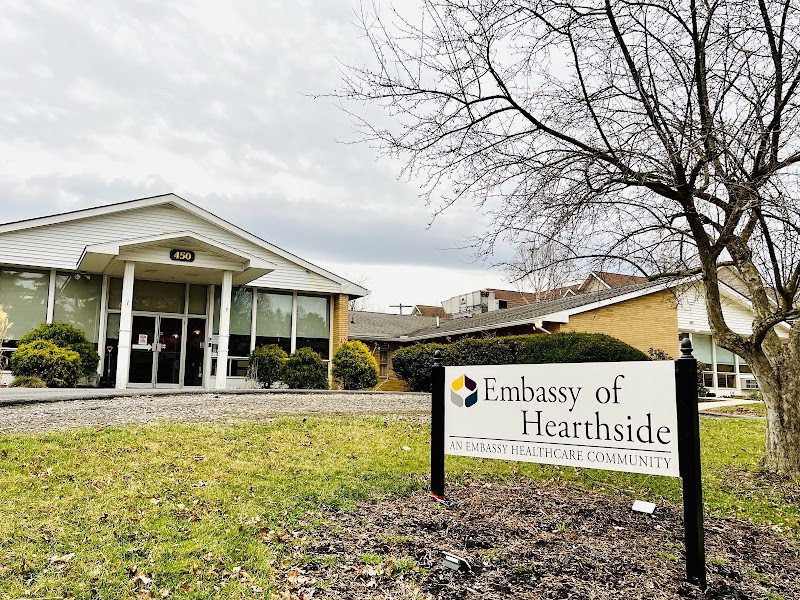
Who Owns and Operates Embassy Of Hearthside?

EMBASSY OF HEARTHSIDE is owned by a for-profit company. For-profit facilities operate as businesses with obligations to shareholders or private owners. The facility is operated by EMBASSY HEALTHCARE, a chain that manages multiple nursing homes. With 157 certified beds and approximately 119 residents (about 76% occupancy), it is a mid-sized facility located in STATE COLLEGE, Pennsylvania.
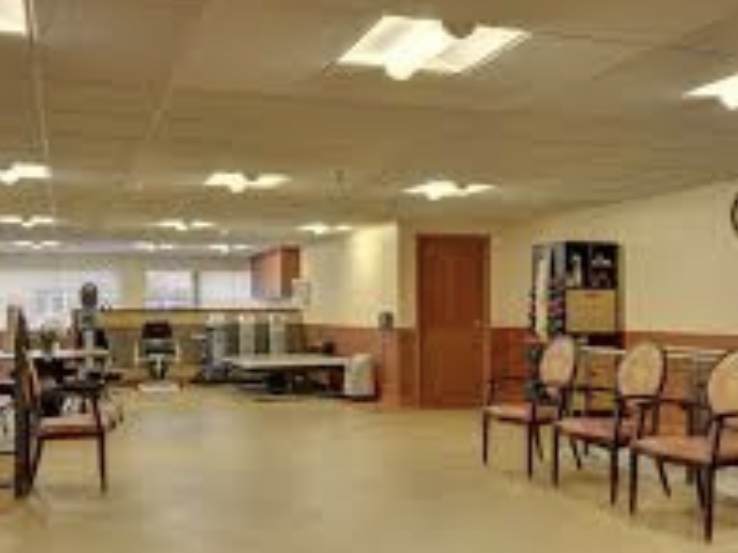
How Does Embassy Of Hearthside Compare to Other Pennsylvania Nursing Homes?

Compared to the 100 nursing homes in Pennsylvania, EMBASSY OF HEARTHSIDE's overall rating (2 stars) is below the state average of 3.0, staff turnover (46%) is near the state average of 46%, and health inspection rating (1 stars) is much below the national benchmark.

What Should Families Ask When Visiting Embassy Of Hearthside?

Based on this facility's data, families visiting should ask: "What safeguards and monitoring systems are in place to protect residents from abuse or neglect?" "Can you walk me through typical staffing levels on day, evening, and night shifts?" "Can I visit during a mealtime to observe dining assistance and food quality?" "How do you handle medical emergencies, and what is your hospital transfer rate?" These questions are particularly relevant given the substantiated abuse finding on record and the below-average staffing rating.

Is Embassy Of Hearthside Safe?

Based on CMS inspection data, EMBASSY OF HEARTHSIDE has documented safety concerns. The facility has 1 substantiated abuse finding (meaning confirmed case of resident harm by staff or other residents). The facility has a 2-star overall rating and ranks #100 of 100 nursing homes in Pennsylvania. Families considering this facility should ask detailed questions about what corrective actions have been taken since these incidents.

Do Nurses at Embassy Of Hearthside Stick Around?

EMBASSY OF HEARTHSIDE has a staff turnover rate of 46%, which is about average for Pennsylvania nursing homes (state average: 46%). Moderate turnover is common in nursing homes, but families should still ask about staff tenure and how the facility maintains care continuity when employees leave.

Was Embassy Of Hearthside Ever Fined?

EMBASSY OF HEARTHSIDE has been fined $23,995 across 4 penalty actions. This is below the Pennsylvania average of $33,319. While any fine indicates a compliance issue, fines under $50,000 are relatively common and typically reflect isolated problems that were subsequently corrected. Families should ask what specific issues led to these fines and confirm they've been resolved.

Is Embassy Of Hearthside on Any Federal Watch List?

EMBASSY OF HEARTHSIDE is not on any federal watch list. The most significant is the Special Focus Facility (SFF) program, which identifies the bottom 1% of nursing homes nationally based on persistent, serious quality problems. Not being on this list means the facility has avoided the pattern of deficiencies that triggers enhanced federal oversight. This is a positive indicator, though families should still review the facility's inspection history directly.